

NHK’s 66th Taiga drama, Gyakuzoku no Bakushin (“The Traitor Retainer,” starring Tori Matsuzaka, written by Naoko Adachi), begins airing on January 10, 2027. Its protagonist is Tadamasa Oguri Kozukenosuke, a late-Edo shogunate official who proposed the construction of the Yokosuka Ironworks — an architect of Japan’s modernization — and who ended his life in what is now Gonda, Kurabuchi-machi, Takasaki City, Gunma. With roughly five months to go before broadcast, this article takes stock of how much lodging capacity currently exists around the sites tied to his life, measured on a room-count basis: number of properties, number of rooms, and price band.
Metric Definitions Used in This Article
- ADR (average daily rate): An estimated settled rate (tax-exclusive equivalent) calculated by applying property-type correction coefficients to the lowest published plan level each property lists on OTAs and similar channels (two guests per room, per-room rate, tax-included). Cross-checked against property-level disclosures from listed hotel REITs (91 properties, most recent three months), the median error is approximately 7%. These are estimates and differ from each property’s actual settled rates or accounting figures. Area-level ADR is the median of the properties covered (the level of a typical property in that area).
- Published price (all-plan average): The average published selling price across all plans, from room-only to meal-inclusive (two guests per room, per-room rate, tax-included). Because its scope differs from estimated settled ADR, the two are never discussed interchangeably.
- Lodging capacity (room count): The room count aggregated from properties whose room counts are registered in the property master as of the survey date and that were observed listed for at least 10 days for check-in dates between May and October 2026 (“observed on sale”). Whole-property rentals such as vacation homes, cottages, and campgrounds are shown separately.
- Data source: MetroEngines Research
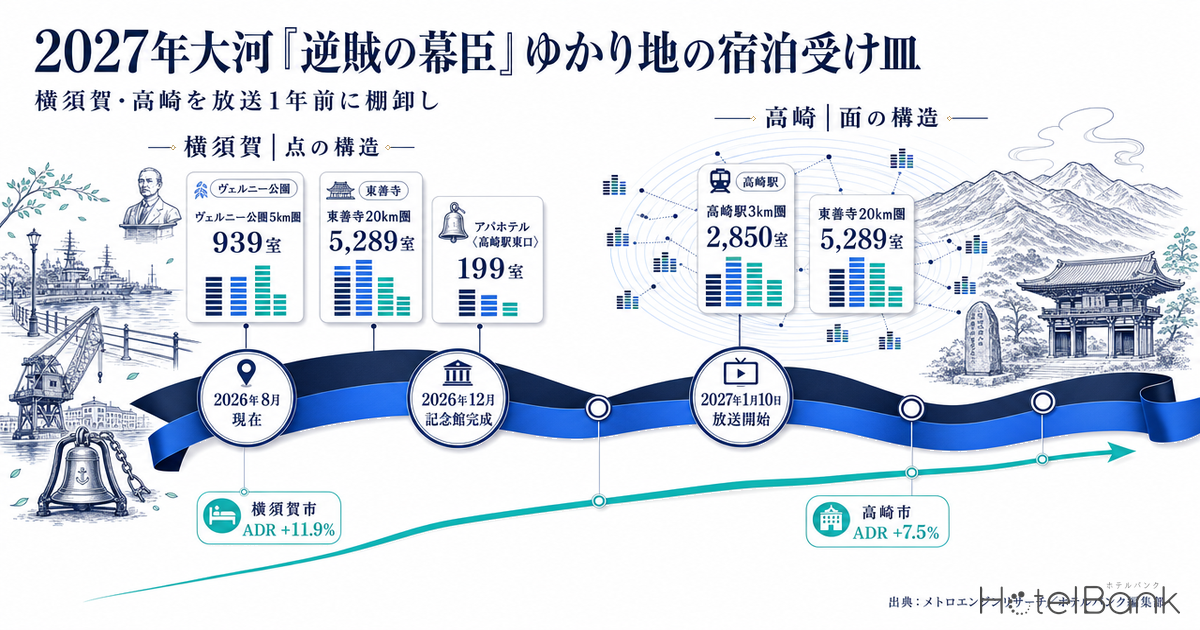
- — Within a 1 km radius of Verny Park there are 3 properties and 437 rooms, and 12 properties with 939 rooms within 5 km. The historic site doubles as the lodging base — a “point” structure.
- — Within 5 km of Tozenji Temple there is 1 property with 10 rooms. Lodging is absorbed roughly 23 km away within 3 km of Takasaki Station (30 properties, 2,850 rooms) and by onsen clusters within 20 km — an “area-wide” structure.
- — Price mix is asymmetric: within 5 km of Verny Park, 55% sits in the ¥30,000–49,999 band (516 rooms), while within 3 km of Takasaki Station 69% sits below ¥20,000 (1,965 rooms).
- — Cumulative estimated settled ADR for January–July 2026 rose +11.9% in Yokosuka City (Kanagawa Prefecture +4.3%) and +7.5% in Takasaki City (Gunma Prefecture +2.0%) — both cities outpacing their prefectural averages.
- — Broadcast begins January 10, 2027. The Oguri Kozukenosuke Memorial Museum is scheduled for completion in December 2026, and 199 rooms of new supply (about 7% of current stock) are taking shape in front of Takasaki Station.
Airing from January 10, 2027 — Two Poles: Yokosuka and Takasaki
NHK has announced Gyakuzoku no Bakushin as its 66th Taiga drama, to be produced for 2027. Tori Matsuzaka stars; the screenplay is by Naoko Adachi, whose credits include Okaeri Mone and What Did You Eat Yesterday?. The series depicts the end of the Edo period from the shogunate’s point of view, with the first episode announced for January 10, 2027 (Sunday, 8:00 p.m.). The protagonist, Tadamasa Oguri Kozukenosuke, traveled to the United States as part of Japan’s first mission there, went on to hold a succession of senior shogunate posts, and proposed the construction of the Yokosuka Ironworks.
His footprint splits cleanly into two geographies. One is Yokosuka City, Kanagawa Prefecture, the site of his modernization projects; the other is Gonda, Kurabuchi-machi, Takasaki City, Gunma Prefecture, where he lived in seclusion and met his end. The two are about 150 km apart in a straight line, so they function less as a single touring circuit than as two independent destinations. We begin by organizing the sites that can be confirmed through municipal and temple sources.
| Area | Site | Location / access | Notes |
|---|---|---|---|
| Yokosuka | Verny Park | Shioiri-cho, Yokosuka City / adjacent to Keikyu Shioiri Station | Busts of Oguri and Verny. The city runs guided tours |
| Yokosuka | Verny Memorial Museum | Inside Verny Park | Presents the ironworks’ role and Oguri’s career |
| Yokosuka | Yokosuka Museum of Modern Heritage — Thibaudier House | Inside Verny Park | A reconstruction of the ironworks deputy director’s residence |
| Yokosuka | Former Yokosuka Ironworks (now U.S. Fleet Activities Yokosuka) | Visible across the water from Verny Park | The grounds are closed to the public |
| Takasaki | Tozenji Temple | 169 Gonda, Kurabuchi-machi, Takasaki City / along National Route 406 | Oguri’s grave. The temple where he spent his final 64 days |
| Takasaki | Site of the Kannonyama Oguri residence | Gonda, Kurabuchi-machi, Takasaki City | Where he planned to build his residence. Foundation stones remain |
| Takasaki | Karasu River bank (site of his death) | Mizunuma, Kurabuchi-machi, Takasaki City | Prefecturally designated historic site |
| Takasaki | Oguri Kozukenosuke Memorial Museum (under development) | Adjacent to Tozenji Temple | Completion scheduled for December 2026; total floor area 213 m² |
Source: Yokosuka City tourism information “Yokosuka, Land of Tadamasa Oguri,” Takasaki City official website, Tozenji Temple official website, and Tokyo Shimbun; compiled by the HotelBank Editorial Team
How Many Rooms Within How Many Kilometers — Yokosuka Is a “Point,” Takasaki an “Area”
To measure the depth of lodging capacity, we aggregated properties observed on sale and their room counts in concentric circles centered on each historic site. The result is distinctly asymmetric. We applied the same method to lodging capacity around a newly inscribed World Heritage site in Asuka-Fujiwara World Heritage: Only 35 Hotels, 851 Rooms in Nara.
| Center point | Radius | Properties | Rooms | Whole-property rentals |
|---|---|---|---|---|
| Verny Park | 1 km | 3 | 437 rooms | 0 |
| 3 km | 9 | 887 rooms | 0 | |
| 5 km | 12 | 939 rooms | 0 | |
| 10 km | 44 | 1,690 rooms | 38 / 55 rooms | |
| Tozenji Temple | 5 km | 1 | 10 rooms | 0 |
| 10 km | 2 | 35 rooms | 1 / 5 rooms | |
| 20 km | 128 | 5,289 rooms | 22 / 136 rooms | |
| Takasaki Station (reference) | 3 km | 30 | 2,850 rooms | 0 |
Source: MetroEngines Research; compiled by the HotelBank Editorial Team (straight-line distances. Properties observed listed for at least 10 days for check-in dates between May and October 2026)
Source: MetroEngines Research; compiled by the HotelBank Editorial Team (same aggregation as Table 2. Verny Park 10 km N=44 properties / Tozenji 20 km N=128 properties / Takasaki Station 3 km N=30 properties)
On the Yokosuka side, 3 properties with 437 rooms sit within a 1 km walk of Verny Park alone. Widen to 3 km and it becomes 9 properties with 887 rooms; at 5 km, 12 properties with 939 rooms. This is a “point” structure in which the historic site itself doubles as the lodging base, letting visitors stay without an intervening journey. The core is business and city hotels in the sub-200-room class: Hotel New Yokosuka (196 rooms, opened 1987) and Mercure Hotel Yokosuka (160 rooms, opened 1993) — long-running properties — joined by Hotel New Port Yokosuka (155 rooms, opened 2021).
Takasaki looks different. Within 5 km of Tozenji Temple, just 1 property with 10 rooms is observed on sale; widening to 10 km brings only 2 properties and 35 rooms. Gonda in Kurabuchi-machi lies in the mountains on the western flank of Mount Haruna, and the area was never designed to host lodging immediately beside the site. The point here is not to read this as weak capacity but to recognize that lodging is absorbed across a wider area. Tozenji Temple is about 23 km from Takasaki Station in a straight line, and within 3 km of that station sit 30 properties with 2,850 rooms — more than adequate as a day-trip base.
Widen to a 20 km radius and the count reaches 128 properties with 5,289 rooms, but this figure needs careful reading. A straight-line 20 km circle crosses the Usui Pass and Mount Haruna to reach Karuizawa and Ikaho, which does not match actual driving times. Broken down by municipality, it looks like this.
| Municipality (within 20 km straight-line of Tozenji) | Properties | Rooms | Main lodging areas |
|---|---|---|---|
| Shibukawa City, Gunma | 47 | 2,178 rooms | Ikaho Onsen and others |
| Karuizawa Town, Kitasaku District, Nagano | 34 | 1,837 rooms | Karuizawa (across the Usui Pass) |
| Annaka City, Gunma | 15 | 454 rooms | Isobe Onsen and others |
| Naganohara Town, Agatsuma District, Gunma | 13 | 430 rooms | Kita-Karuizawa and others |
| Takasaki City, Gunma (Kurabuchi and Haruna areas) | 6 | 95 rooms | Lake Haruna, Kurabuchi Onsen and others |
| Others (Tomioka City, Yoshioka Town, Nakanojo Town, etc.) | 13 | 295 rooms | — |
Source: MetroEngines Research; compiled by the HotelBank Editorial Team (N=128 properties)
In other words, capacity for visitors to Kurabuchi is spread across several clusters: the business-hotel concentration in front of Takasaki Station, the onsen groups of Ikaho and Haruna, Isobe Onsen in Annaka, and Karuizawa beyond the pass. Should the broadcast lift visitor numbers, there is considerable room to design which cluster those visitors are steered toward.
Price Mix — Mid-Range in Yokosuka, Weighted Low in Front of Takasaki Station
Next we split the same aggregation into published-price bands (all-plan average, two guests per room, tax-included) and stack the room counts. Capacity takes on a different character depending not only on how many rooms exist, but on which price band those rooms sit in.
Source: MetroEngines Research; compiled by the HotelBank Editorial Team (Verny Park 5 km N=12 properties / Takasaki Station 3 km N=30 properties / Tozenji 20 km N=128 properties)
Within 5 km of Verny Park, 516 rooms cluster in the ¥30,000–49,999 band — 55% of all 939 rooms. Stay demand here is tied to naval-port cruises and modern-heritage touring, giving the area depth in the mid-tier of room rates. The ¥50,000-and-above band amounts to just 1 property with 24 rooms, leaving room to develop the upper price tiers.
Within 3 km of Takasaki Station, by contrast, 1,242 rooms sit below ¥15,000 and 723 rooms in the ¥15,000–19,999 band — 1,965 rooms in total, or 69%, below ¥20,000. That is the result of optimizing for business and transit demand at a junction where the Hokuriku and Joetsu Shinkansen lines meet. Depth in this band means high volumetric absorption capacity for the day-trip-plus-one-night visits likely during the broadcast period.
What is striking about the Tozenji 20 km ring is that its largest block — 2,598 rooms — sits in the ¥50,000-and-above band. That reflects the resort and ryokan stock of Ikaho and Karuizawa: even within the same “around the site” perimeter, two very different price ranges coexist, one station-front business, the other onsen resort. It is an environment in which itineraries combining site pilgrimage with an onsen stay are easy to design. How price tiers divide between onsen destinations and urban areas within Gunma Prefecture is set out in Gunma Hotel Market 2026: Four ADR Tiers and a ¥5,700 Upper-Mid Gap.
Actual Rates Are Already Outpacing Prefectural Averages
From here we look at prevailing rates using estimated settled ADR. Note that both Yokosuka City and Takasaki City are areas where published prices and estimated settled ADR sit far apart. In July 2026, for example, Yokosuka City’s published price (all-plan average) was about ¥40,200 (N=36 properties), while estimated settled ADR was about ¥11,500 (N=17 properties). Because the two differ in both population and scope, every “prevailing rate” in this article is stated as estimated settled ADR.
Source: MetroEngines Research; compiled by the HotelBank Editorial Team (Yokosuka City N=16–17 properties, Takasaki City N=27–32 properties. Completed months only)
On a January–July 2026 cumulative basis, Yokosuka City’s estimated settled ADR rose +11.9% year on year. Kanagawa Prefecture as a whole rose +4.3% over the same period, so rates in the city are climbing 7.6 points faster than the prefectural average. Takasaki City rose +7.5%, 5.5 points ahead of Gunma Prefecture’s +2.0%. This trend predates the Taiga drama announcement, so the increase cannot be attributed to broadcast effects — but it does confirm that both cities are markets where rates move.
| Area | Estimated settled ADR July 2026 | Properties in population | Published price July 2026 | Listed properties | Jan–Jul cumulative YoY |
|---|---|---|---|---|---|
| Yokosuka City | ¥11,500 | 17 | ¥40,200 | 36 | +11.9% |
| Kanagawa Prefecture | ¥12,800 | 576 | ¥31,900 | 1,118 | +4.3% |
| Takasaki City | ¥7,400 | 31 | ¥16,300 | 46 | +7.5% |
| Maebashi City | ¥7,100 | 31 | ¥18,600 | 47 | +0.2% |
| Annaka City | ¥8,100 | 13 | ¥24,400 | 16 | +10.2% |
| Gunma Prefecture | ¥10,900 | 438 | ¥28,900 | 788 | +2.0% |
Source: MetroEngines Research; compiled by the HotelBank Editorial Team
That said, Yokosuka City’s estimated settled ADR is an estimate based on 17 properties and cannot be treated as representative of room rates across the city as a whole. Against 36 listed properties, the estimated settled ADR population is 17 — a coverage rate of roughly 47%, because it is limited to verified property types. Takasaki City is somewhat deeper at 31 of 46 properties (about 67%). This difference in population should be kept in mind as a premise when comparing the two cities side by side. (For the nationwide distribution of how far ADR spreads at the municipal level, see Japan Intra-Prefecture ADR Gaps Reach 5.2x: 368 Municipalities Ranked.)
Site Maps — How the Historic Sites and Lodging Stock Line Up
The maps below show how the historic sites and lodging properties sit relative to one another. Circle size corresponds to room count.
Yokosuka | Around Verny Park (1 km, 3 km, 5 km radii)
Source: MetroEngines Research; compiled by the HotelBank Editorial Team
Takasaki | Around Tozenji Temple and Takasaki Station (5 km, 10 km, 20 km radii)
Source: MetroEngines Research; compiled by the HotelBank Editorial Team
The Year Before Broadcast — Preparation Time Left on the Supply Side
About five months remain until the January 10, 2027 premiere as of writing, and local preparations are already under way. In Takasaki City, construction of the Oguri Kozukenosuke Memorial Museum is proceeding on land adjacent to Tozenji Temple; according to Tokyo Shimbun, completion is scheduled for December 2026, with the city subsidizing ¥110 million of the roughly ¥140 million project cost. The two-story building will have a total floor area of 213 m² and is planned to display materials Oguri brought back from the United States, among other items — a reception hub coming online just before the broadcast begins. On the Yokosuka side, the Yokosuka City Guide Association runs guided tours of Verny Park and a Taiga drama tie-in logo has been produced, putting on-the-ground content in place early.
What about lodging supply? Checking planning data based on the Ministry of Land, Infrastructure, Transport and Tourism’s Building Dynamics Statistics Survey, no building-confirmation applications for new hotels appear in either Yokosuka City or Takasaki City as of the survey date (5 across Kanagawa Prefecture and 1 across Gunma Prefecture in total). Note, however, that this is a lower bound based on confirmation applications, and the count is expected to rise as further applications are filed.
In front of Takasaki Station, meanwhile, 199 rooms of new supply are taking shape. APA Hotel Takasaki-Ekihigashiguchi held its groundbreaking ceremony in July 2024 and was originally scheduled to open on November 27, 2025, but the company’s official website has announced a postponement, and a new opening date awaits official confirmation. Adding 199 rooms at a station-front site a six-minute walk from Takasaki Station would thicken the current 2,850-room stock within 3 km of the station by roughly 7%. If it lands before the broadcast, it would raise volumetric absorption capacity.
Judging from past Taiga dramas and their associated locales, timing when demand begins to move is difficult. In Nara City — a locale for the 2026 Taiga drama Toyotomi Kyodai! — estimated settled ADR rose +15.9% year on year in January 2026, the premiere month (¥10,700 → ¥12,400, N=58 properties), but subsequent months included some that fell below the prior year. The Kansai region also had a separate demand driver in the 2025 Osaka-Kansai Expo, so the Taiga effect cannot be isolated on its own. Rather than over-generalizing from these figures, the more practical stance is to keep observing prevailing conditions in one’s own area on an ongoing basis.
For hoteliers: plan-naming cues that fit this theme
Appeal elements most common among published plan names in Gunma Prefecture referencing the Taiga drama (N=13) ——
Open-air onsen 38%Dining-focused 23%Japanese-style room 23%Commemorative event 8%Early-bird discount 8%Seasonal event 8%
Examples of actual names (anonymized):
- [Early booking, 30 days ahead] ¥550 off × 24-hour natural hot spring bathing | A hot spring with 100 years of history
- Year-end and New Year only | Fine dining and hot springs at a historic inn
- [No meals] Temple experience & open-air bath! Stay at a shukubo with roughly 370 years of history — room-only plan
* A tendency derived from aggregated published plan names; it does not demonstrate that naming causes sales.
Conclusion — Different Preparation Priorities for a “Point” and an “Area”
What this stocktake roughly five months before broadcast shows is that preparation priorities differ entirely even between locales tied to the same drama. Yokosuka already has “point” capacity — 437 rooms within walking distance of the historic site and 939 rooms within 5 km — with 55% concentrated in the mid price band (¥30,000–49,999). The question there is less about adding volume than about designing stay value around the modern-heritage theme and filling the headroom in the upper price tiers.
Takasaki has limited lodging capacity immediately around its historic site but holds “area-wide” capacity: 2,850 rooms in front of Takasaki Station 23 km away and 5,289 rooms in the onsen clusters within 20 km. The focus is on designing the routes that connect the Kurabuchi sites with each lodging cluster, and on linking the memorial museum scheduled for completion in December 2026 with lodging products. Having stay destinations as different in character as Ikaho, Haruna, Isobe, and Karuizawa within a 20 km radius is also a strength, allowing a wide range of room rates.
The period remaining before broadcast is valuable time for the supply side to spend on product design and channel development. Rates in both cities are already climbing faster than their prefectural averages. The question is how to layer the story of these locales on top of that trend. Decisions made from the second half of 2026 into the first half of 2027 will shape the results achieved during the broadcast period.
Related Reading
- Asuka-Fujiwara World Heritage: Only 35 Hotels, 851 Rooms in Nara
- Gunma Hotel Market 2026: Four ADR Tiers and a ¥5,700 Upper-Mid Gap
- Japan Intra-Prefecture ADR Gaps Reach 5.2x: 368 Municipalities Ranked
- Aomori Nebuta 2026: 97.4% Sold 45 Days Out, Post-Festival +14pt
⚠ Note on the data: The estimated settled ADR and published prices in this article cover completed months through July 2026. The capacity aggregation is limited to properties whose listings could be confirmed on OTAs as of the survey date, and excludes ryokan, minshuku, and simple lodging houses not listed on OTAs. Planning data for newly opening hotels is a lower bound based on building-confirmation applications; property and room counts are expected to rise as further applications are filed.
References and Sources
■ Taiga drama and historic sites
- Takasaki City official website, “Tadamasa Oguri Kozukenosuke, protagonist of the Taiga drama Gyakuzoku no Bakushin” (in Japanese)
- Yokosuka City tourism information, “Yokosuka, Land of Tadamasa Oguri” (in Japanese)
- Yokosuka City, “Guided tours of Verny Park, a site associated with Tadamasa Oguri, protagonist of the 2027 Taiga drama” (in Japanese)
- Tozenji Temple official website (169 Gonda, Kurabuchi-machi, Takasaki City, Gunma) (in Japanese)
- Tokyo Shimbun, “Passing on Oguri Kozukenosuke’s achievements: memorial museum and site improvements advance in Takasaki ahead of the 2027 Taiga drama Gyakuzoku no Bakushin” (in Japanese)
- Jomo Shimbun, “2027 NHK Taiga drama: Gunma-linked Tadamasa Oguri Kozukenosuke as protagonist, Tori Matsuzaka starring in Gyakuzoku no Bakushin” (in Japanese)
■ Lodging supply
- APA Hotel official, “APA Hotel Takasaki-Ekihigashiguchi opening schedule” (including the postponement notice) (in Japanese)
- APA Group, “Groundbreaking ceremony held for APA Hotel Takasaki-Ekihigashiguchi” (July 25, 2024) (in Japanese)
- Ministry of Land, Infrastructure, Transport and Tourism, Building Dynamics Statistics Survey (planned-hotel data)
■ Data sources
Property and room counts come from property-master registrations and observed OTA public inventory (properties observed listed for at least 10 days for check-in dates between May and October 2026). Estimated settled ADR and published prices are monthly area aggregations (completed months from January 2025 through July 2026). Attributes such as opening year and room count come from registrations in the same master. Historic sites, the memorial museum, and new-opening plans are based on official announcements from the relevant municipalities, temple, and operators, and on news reporting.
■ Calculation assumptions
All distances are straight-line distances from representative coordinates for each site or station. Area-level ADR is the median of the properties covered (the level of a typical property in that area). Year-on-year change compares the average of completed months from January to July for 2025 and 2026. Price-band composition is classified by published price (all-plan average, two guests per room, tax-included). The increase in stock depth from new supply (about 7%) is calculated as 199 rooms ÷ 2,850 rooms.
■ Limitations and caveats
The estimated settled ADR population is limited to verified property types: 17 of 36 listed properties in Yokosuka City (about 47%) and 31 of 46 in Takasaki City (about 67%), so the difference in these premises should be noted when comparing the two cities’ levels directly. Straight-line concentric circles cross terrain such as the Usui Pass and Mount Haruna, so they do not match actual travel times. Planned hotels are a lower bound based on building-confirmation applications. This article does not test any causal relationship between the drama’s broadcast and movements in room rates.
■ Market data
- MetroEngines Research — estimated settled ADR, published prices, and area-level lodging supply aggregation (Yokosuka City N=17 / Takasaki City N=31 / Kanagawa Prefecture N=576 / Gunma Prefecture N=438 properties, as of July 2026)