

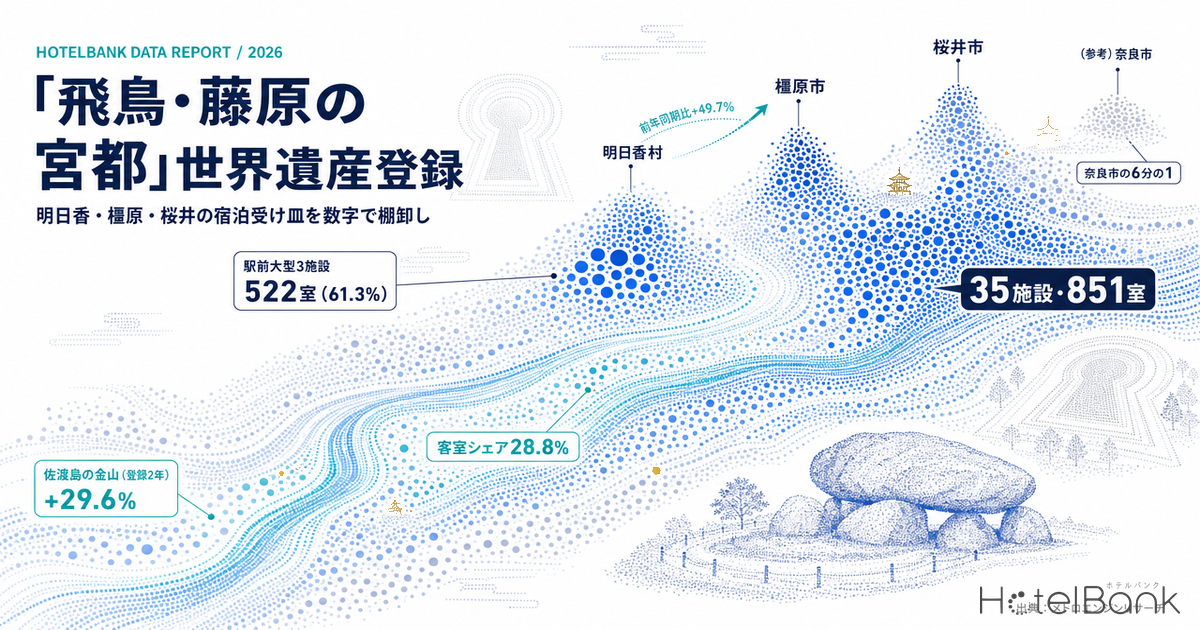
On 26 July 2026, the UNESCO World Heritage Committee meeting in Busan, South Korea, decided to inscribe Nara Prefecture’s “Asuka-Fujiwara: Archaeological Sites of Japan’s Ancient Capitals and Related Properties” on the World Cultural Heritage list. It is Japan’s 27th inscription, comprising 19 component properties spread across three municipalities — Kashihara City, Sakurai City and Asuka Village. Inscription is a powerful tailwind for tourism demand, but whether that demand can be captured as overnight stays is a separate question. This article uses MetroEngines Research data to take stock of just how thin accommodation supply is in the inscribed area on a room-count basis, and cross-references it against actual market data from the “Sado Island Gold Mines,” inscribed earlier, to quantify the headroom that remains in this region.
Metric Definitions Used in This Article
- ADR (average daily rate): An estimated settled rate (tax-exclusive equivalent) calculated by applying property-type correction coefficients to the lowest published plan level each property lists on OTAs and similar channels (double occupancy, per-room rate, tax-inclusive). Cross-checked against property-level actuals disclosed by listed hotel REITs (91 properties, most recent three months), the median error is approximately 7%. These are estimates and differ from each property’s actual transacted prices and accounting figures. Area-level ADR is the median across the target properties (the level of a typical property in the area).
- Published price: The average price of all plans listed on OTAs and similar channels (double occupancy, per-room rate, tax-inclusive, ranging from room-only to meals-included). Because it is measured on a different basis from estimated settled ADR, the two are not compared directly.
- Property count / room count: Aggregates covering properties whose operation can be confirmed on OTAs, drawn from the approximately 168,000 domestic properties tracked by MetroEngines Research. This is not a complete census; ryokan, minshuku and simple lodging businesses not listed on OTAs are excluded.
- Data source: MetroEngines Research
- — Accommodation inventory with confirmed OTA operation across the three inscribed municipalities (Kashihara City, Sakurai City, Asuka Village) totals 35 properties and 851 rooms. That is roughly 16% of Nara City’s 5,288 rooms at the same point in time — less than one sixth.
- — Of those 851 rooms, 522 rooms (61.3%) are concentrated in just three large station-front properties in Kashihara and Sakurai. On the Asuka Village side, where the component properties cluster, there are 10 properties with 38 rooms, and 9 of those properties have 9 rooms or fewer.
- — The middle band is missing — only 9 properties fall in the 10–99 room range (of which just 4 are in the 10–29 room band). In Asuka Village there is also a price-band gap between ¥34,000 and ¥57,000.
- — In the precedent case of the “Sado Island Gold Mines,” operating properties grew from 54 to 70 (+29.6%) in the two years after inscription. Estimated settled ADR stalled at -5.1% in the first year after inscription, then caught up at +15.3% in the second year.
- — No planned projects can be confirmed within the three inscribed municipalities at this point, either as new openings or on a building-confirmation-application basis. All eight properties whose 2026 opening could be confirmed in Nara Prefecture are outside the inscribed area.
The Facts of the Inscription — 19 Properties, 3 Municipalities, and Takatori Town Is Not Included
What was inscribed is “Asuka-Fujiwara.” It consists of 19 component properties — palace sites, Buddhist temple sites and burial mounds from the Asuka period (late 6th to early 8th century) — evaluated as an archaeological complex that demonstrates the process by which Japan’s first full-fledged centralised state took shape. According to the list of component properties published by the Asuka Village tourism site, the 19 are: the Fujiwara Palace Site, the Moto-Yakushiji Temple Site, the Daikandaiji Temple Site, the Yamadadera Temple Site, the Asuka Mizuochi Site, the Asukadera Temple Site, the Shobuike Tumulus, the Asuka Kyoseki Garden Ponds, the Sakafuneishi Site, the Tomb of Emperor Tenmu and Empress Jito, the Kawaradera Temple Site, the Kengoshizuka Tumulus, the Asuka Palace Site, the Nakaoyama Tumulus, the Tachibanadera Temple Site, the Takamatsuzuka Tumulus, the Ishibutai Tumulus, the Hinokuma-dera Temple Site and the Kitora Tumulus.
Most of the properties are located in Asuka Village; Kashihara City holds the Fujiwara Palace Site, the Moto-Yakushiji Temple Site and the Shobuike Tumulus, while Sakurai City holds the Yamadadera Temple Site. One point that is easily confused is worth clarifying here. Takatori Town is not among the component properties in this inscription. Takatori Town appears instead within the Japan Heritage framework “When Japan Was Born — Women Who Soared Over Asuka,” which is a separate scheme from World Heritage component properties. Likewise, Hikone Castle is a separate case targeting inscription in 2028 and is unrelated to this decision.
Another point worth noting is the population scale of this region. Asuka Village has a population of roughly 5,000. It is a small municipality whose continued existence as an independent local government was debated during the municipal-merger wave of the early 2000s, and World Heritage inscription has long been positioned as part of the village’s survival strategy. In other words, this inscription is an event that has occurred in a region with extremely large demand headroom but a thin business base to absorb it. Let us first confirm that “thinness” in numbers.
Accommodation Supply in the Three Inscribed Municipalities — 35 Properties, 851 Rooms, One Sixth of Nara City
Within the scope tracked by MetroEngines Research (properties listed on major OTAs), the number of properties whose operation could be confirmed on OTAs as of June 2026 was 10 in Asuka Village, 11 in Kashihara City and 14 in Sakurai City. Even combined, the three municipalities amount to only 35 properties and 851 rooms. Nara City at the same point in time had 137 properties and 5,288 rooms, meaning the inscribed area’s room inventory is roughly 16% of Nara City’s — less than one sixth in ratio terms.
Looking further at the size composition makes the substance of that 851-room figure clearer still. Of the 851 rooms, 522 rooms (61.3%) are accounted for by just three properties with 100 or more rooms. All three sit in station-front locations in Kashihara City and Sakurai City; none are on the Asuka Village side where the component properties are concentrated. Asuka Village’s 10 properties total 38 rooms, and 9 of those 10 have 9 rooms or fewer.
| Area | Properties (N) | Rooms | Average per property | Median published price |
|---|---|---|---|---|
| Asuka Village | 10 | 38 rooms | 3.8 rooms | ¥29,000 |
| Kashihara City | 11 | 476 rooms | 43.3 rooms | ¥15,900 |
| Sakurai City | 14 | 337 rooms | 24.1 rooms | ¥20,300 |
| Three inscribed municipalities, total | 35 | 851 rooms | 24.3 rooms | — |
| (Reference) Nara City | 137 | 5,288 rooms | 38.6 rooms | — |
Takatori Town, incidentally, had only one property with confirmed OTA operation at the same point in time. Because that is too few to be meaningful as an area aggregate, it is excluded from the tallies in this article. As noted above, Takatori Town is not a municipality where a component property is located, although it does sit within the touring range of the Asuka area.
Where Prices Stand — Asuka Village’s Published Price Has Risen About 1.5x in a Year
Next, price. One caveat matters here: Asuka Village has no properties in the categories for which estimated settled ADR can be calculated (business, city, resort, ryokan and capsule). Asuka Village’s supply centres on guesthouses, minshuku and whole-house rentals, which fall outside the verified categories for estimated settled ADR. Asuka Village must therefore be viewed on a published-price basis, while Kashihara City, Sakurai City and Nara City are viewed on an estimated settled ADR basis — each separately.
Overlaying Asuka Village’s published price by year makes the jump in level since the start of 2026 immediately visible. The first-half 2026 (January–June) average was approximately ¥29,600, versus approximately ¥19,800 in the same period a year earlier — up 49.7% year on year.
This figure should not, however, be read directly as “Asuka Village’s lodgings raised their prices.” With only N=8–10 target properties, the structure is such that a single property entering or leaving swings the overall level substantially. Looking at the distribution of individual published prices, Asuka Village’s 10 properties are polarised between four minshuku-type properties below ¥20,000 and four whole-house-rental or few-room, high-rate properties in the ¥58,000–¥63,000 range, with only two properties in between. The increase from the prior year looks much more like a mix shift driven by new high-rate small properties entering the market. It is more reasonable to understand this as a change in the composition of supply itself rather than as a price increase.
By contrast, Kashihara City and Sakurai City, where estimated settled ADR can be calculated, show subdued prices. First-half 2026 averages were approximately ¥7,500 in Kashihara City (+4.9% year on year, N=5 properties) and approximately ¥8,400 in Sakurai City (-3.7%, N=7 properties). Over the same period, Nara Prefecture as a whole was approximately ¥12,800 (+3.2%) and Nara City approximately ¥12,100 (-2.3%). Rates for the station-front business-hotel format that dominates the inscribed area sit 40–50% below the prefectural average and below Nara City. Put the other way round, the headroom on price is precisely in this band.
| Area | H1 2025 | H1 2026 | YoY | N (properties) |
|---|---|---|---|---|
| Kashihara City | ¥7,100 | ¥7,500 | +4.9% | 5 |
| Sakurai City | ¥8,700 | ¥8,400 | -3.7% | 7 |
| Nara City | ¥12,300 | ¥12,100 | -2.3% | 58–62 |
| Nara Prefecture, total | ¥12,400 | ¥12,800 | +3.2% | 131–139 |
Benchmark — The “Sado Island Gold Mines” Added 30% More Properties in Two Years
So what does World Heritage inscription actually bring to an accommodation market? As a recent referenceable case, we look at market data for the “Sado Island Gold Mines” (Sado City, Niigata Prefecture), inscribed in July 2024. It is one of the few cases where data can be obtained continuously before and after inscription without being confounded by the pandemic.
The conclusion first: what moved first was supply, not price. The number of properties with confirmed OTA operation in Sado City stood at 54 as of June 2024, immediately before inscription. That grew to 62 in June 2025 and 70 in June 2026 — up 29.6% in the two years after inscription.
Estimated settled ADR, by contrast, paused in the year following inscription. On a first-half-average basis, 2025 came in at approximately ¥8,500 against approximately ¥8,900 in 2024 (-5.1% year on year). Rates rose clearly only in 2026, the second year after inscription, reaching approximately ¥9,800 (+15.3% year on year) — roughly 10% above the 2024 level. The sequence that emerges is that immediately after inscription the increase in property count dilutes rates, and rates catch up as demand becomes established.
| Sado City | 2023 | 2024 | 2025 | 2026 |
|---|---|---|---|---|
| Properties with confirmed operation (as of June) | 53 | 54 | 62 | 70 |
| Estimated settled ADR (January–June average) | ¥7,300 | ¥8,900 | ¥8,500 | ¥9,800 |
| World Heritage inscription | — | Inscribed in July | Year 1 after inscription | Year 2 after inscription |
We also attempted to examine the “Mozu-Furuichi Kofun Group” (Sakai City, Habikino City and Fujiidera City in Osaka), inscribed in 2019, but the pandemic began roughly six months after inscription, and among the municipalities where component properties are located, Habikino City and Fujiidera City have only one OTA-operating property each — leaving no basis on which to isolate an inscription effect. In keeping with a policy of not forcing conclusions about municipalities where the data is thin, Mozu-Furuichi has been excluded from the comparison in this article. We note this openly.
Access Structure — The Separation of “Stations You Pass Through” and “Stations You Stay At”
The thinness of accommodation in the Asuka area is not solely a matter of supply-side circumstances. The transport structure itself is built around day trips. According to FY2023 figures in the Ministry of Land, Infrastructure, Transport and Tourism’s National Land Numerical Information (station-level passenger data), average daily boardings and alightings at the stations serving as gateways to the area are 32,591 at Yamato-Yagi Station, 16,713 at Kashiharajingu-mae Station and 13,879 at Sakurai Station. Asuka Station, the closest to the component properties, does not rank within the top 100 in Kintetsu’s station rankings.
Both Osaka-Namba to Kashiharajingu-mae and Kyoto to Yamato-Yagi are reachable in roughly an hour. Conversely, because the area is within a range where visitors can leave in the morning and return by evening, there is little necessity to add an overnight stay. Reference materials on tourism policy published by Nara Prefecture likewise point to a large gap between visits and overnight stays: the prefecture ranks 30th nationally in foreign overnight guests (approximately 400,000 in 2024) while ranking 7th nationally in visitor numbers. The Asuka area is a place that embodies this prefecture-wide structure in even more concentrated form.
The map below overlays the approximate locations of seven representative component properties with the distribution of the 35 properties whose operation can be confirmed on OTAs. Circle size indicates room scale and colour indicates published price band.
What the map shows is that accommodation is not located in the area where the component properties cluster (central to southern Asuka Village) but is instead scattered around the station fronts of Kashihara City and the urban area and Hase district of Sakurai City. What surrounds the properties themselves are small lodgings with single-digit room counts.
White Space by Size Band — Nine Properties in the 10–99 Room Range, and the Middle Price Band Is Missing Too
Plotting the 35 properties in the three inscribed municipalities on two axes — room scale and published price — makes the skew in supply structure clearer still.
Of the 35 properties, 23 have 9 rooms or fewer and 3 have 100 rooms or more. In the middle, the 10–99 room band contains only 9 properties, of which just 4 are in the 10–29 room range. From a traveller’s perspective, there is almost nothing within the inscribed area that can absorb demand such as “we want to book two or three rooms together as a group or family” or “we want to fit a small party of around 20 people into a single property.”
| Room-size band | Properties | Rooms | Share of rooms | Principal locations |
|---|---|---|---|---|
| 1–9 rooms | 23 | 84 rooms | 9.9% | Across all three municipalities (9 in Asuka Village) |
| 10–29 rooms | 4 | 59 rooms | 6.9% | Kashihara City 1, Sakurai City 2, Asuka Village 1 |
| 30–99 rooms | 5 | 186 rooms | 21.9% | Kashihara City 2, Sakurai City 3 |
| 100 rooms or more | 3 | 522 rooms | 61.3% | Kashihara City 2, Sakurai City 1 (all station-front) |
There is a gap on price bands as well. In Asuka Village no property falls in the ¥34,000–¥57,000 band; supply splits between four minshuku-type properties below ¥20,000 and four whole-house-rental properties at ¥58,000 and above. Moreover, only one property in Asuka Village has 10 or more rooms, with 12. The band that travellers visiting in a World Heritage context look for — “a mid-sized lodging at ¥30,000–¥50,000 offering a stay experience rooted in the locality” — is simply vacant on the Asuka Village side where the component properties cluster. How that band has come to work in Kumano Kodo and Koyasan, which likewise host World Heritage sites, is broken down by price, experience and property scale in our analysis of the Kumano Kodo and Koyasan cultural tourism accommodation business model.
Supply Pipeline — No New Openings Currently Confirmable Within the Inscribed Area
Will this gap be filled in the near future? On a confirmed-OTA-listing basis, MetroEngines Research counts eight properties whose opening could be confirmed in Nara Prefecture in 2026. All are between 1 and 42 rooms in scale, and no opening within the three inscribed municipalities can be confirmed. The same holds for the 12 properties in 2025 and 11 in 2024, which centred on other areas of the prefecture such as Nara City, Ikoma and Yoshino.
Nor can any hotel-use project in Nara Prefecture currently be confirmed in planning data on a building-confirmation-application basis derived from the Ministry of Land, Infrastructure, Transport and Tourism’s Building Construction Statistics Survey. An important caveat applies here. OTA listings appear only a few months before opening, so recent months will grow with future listings, and confirmation applications are typically filed one to two years before opening. These figures are therefore a lower bound on the currently confirmable pipeline, not an upper bound. Counts are expected to rise as further applications are filed.
Even so, the fact remains that no visible supply-side movement has yet been observed in response to the demand event of inscription. Given that property counts in Sado grew 30% in two years, it is highly likely that new entry by small lodgings will be the first thing to take off in the Asuka area over the next one to two years. How the June 2026 regulatory change that made ryokan and hotel operation possible from a single room affects small-format operators is examined against data on 554 new openings in our analysis of the revised Hotel Business Act and the lifting of the single-room operating restriction.
Conclusion — The Thinness of the Base Is Itself the Scale of the Headroom
To summarise the numbers so far. Accommodation inventory across the three inscribed municipalities is 35 properties and 851 rooms, of which 61.3% is concentrated in three large station-front properties. The Asuka Village side, where the component properties cluster, has 10 properties and 38 rooms, 90% of them small lodgings with single-digit room counts. The 10–99 room middle band contains only 9 properties, and in Asuka Village the ¥34,000–¥57,000 price band is missing as well. Transport is optimised for day trips, and a gap between visits and overnight stays has long been noted for the prefecture as a whole.
All of these can be read as indicators of where the headroom lies. First, the mid-size band within the inscribed area. Lodgings of 10 to 30 rooms capable of translating the region’s historical context into an experience are, as the Sado case shows, the band most likely to move within one to two years of inscription. Second, the existing large station-front properties. Estimated settled ADR in Kashihara City and Sakurai City sits 40–50% below the prefectural average, so strengthening their value proposition as touring bases leaves substantial rate headroom. The fact that 522 rooms of infrastructure already exist is a strength for this region.
Third, touring demand as it affects existing lodgings in Nara City and Osaka. Since accommodation inventory in the Asuka area will not expand rapidly in the short term, many of the additional visitors will come on day trips from Nara City or Osaka. For Nara City’s 5,288 rooms, and for inventory across the Kansai region, this means a new reason to stay — “a multi-day tour that includes Asuka-Fujiwara” — is being added. For properties able to build a proposition that stretches one night into two, it is a clear opportunity.
World Heritage inscription is not a mechanism that automatically delivers something to a region. What the Sado data showed is a sequence in which supply moves before rates, and rates catch up once demand is established. In the case of Asuka-Fujiwara, the supply that would be the starting point of that sequence is currently extremely thin. Precisely for that reason, the moves made over the next one to two years will determine the shape of this region’s accommodation market a decade from now.
⚠ Note on interpreting the data: The property and room counts in this article are aggregates of properties listed on OTAs with confirmed operation within the scope tracked by MetroEngines Research, and do not constitute a complete census. Ryokan, minshuku and simple lodging businesses not listed on OTAs are excluded. In areas where the number of target properties is in single digits, such as Asuka Village and Takatori Town, a single property entering or leaving swings the aggregate substantially. Please note that these figures do not indicate the level of any individual property.
Related Reading
References and Sources
■ Facts of the World Heritage inscription
- Nara’s “Asuka-Fujiwara” confirmed as World Heritage, Japan’s 27th (The Nikkei)
- What is the World Heritage site “Asuka-Fujiwara” (Asuka Village tourism site “Asuka Jikan”) — list of the 19 component properties
- Documents submitted to the Agency for Cultural Affairs toward World Heritage inscription of “Asuka-Fujiwara” (Asuka Village official website)
- Access to Asuka-Fujiwara (Sakurai City) — used to confirm that the Yamadadera Temple Site is a component property located in Sakurai City
- Asuka-Fujiwara: Archaeological Sites of Japan’s Ancient Capitals and Related Properties (used to confirm the municipalities where component properties are located)
■ Government statistics and public data
- Nara Prefecture, “On Nara Prefecture’s Tourism Challenges,” Reference Material 1 (18 July 2025) — national ranking for foreign overnight guests and the gap with visitor numbers
- Japan Tourism Agency, “Overnight Travel Statistics Survey” press release
- Nara Prefecture Tourism Data Portal “Mirunara”
- Ministry of Land, Infrastructure, Transport and Tourism, National Land Numerical Information, “Station-level Passenger Data” (FY2023) — average daily boardings and alightings at Yamato-Yagi, Kashiharajingu-mae and Sakurai stations
- Ministry of Land, Infrastructure, Transport and Tourism, “Building Construction Statistics Survey” — accommodation project planning data on a building-confirmation-application basis
■ Data sources
Property counts, room counts, published prices and estimated settled ADR are aggregates of properties with confirmed operation on major OTAs among the approximately 168,000 domestic properties tracked by MetroEngines Research (coverage period January 2023 – June 2026; area cross-section as of June 2026). World Heritage component properties and their host municipalities are based on information published by the Asuka Village tourism site, the Asuka Village official site and the Sakurai City official site; station-level passenger figures are FY2023 values from the Ministry of Land, Infrastructure, Transport and Tourism’s National Land Numerical Information (station-level passenger data); national rankings for overnight guests and visitor numbers are from Nara Prefecture’s “On Nara Prefecture’s Tourism Challenges” reference material and the Japan Tourism Agency’s “Overnight Travel Statistics Survey”; planned projects are based on the Ministry of Land, Infrastructure, Transport and Tourism’s “Building Construction Statistics Survey.”
■ Calculation assumptions
Area-level published prices and estimated settled ADR are both calculated monthly as cross-property medians, and the “first-half average” is the simple average of the monthly values for January–June of the relevant year (H1 2026 = January–June 2026; same period a year earlier = January–June 2025). Estimated settled ADR is an estimate derived by applying property-type correction coefficients, and covers only the verified categories of business, city, resort, ryokan and capsule. Published price and estimated settled ADR are measured on different bases and are not compared directly. Year-on-year changes are calculated only between series sharing the same definition. The comparison with Sado City aligns the same months and periods before and after the year of inscription (July 2024) as its starting point, without controlling for demand factors.
■ Limitations and caveats
(1) This is not a complete census; ryokan, minshuku and simple lodging businesses not listed on OTAs are excluded from the aggregates. (2) In areas where target properties number in single digits, such as Asuka Village (N=8–10) and Takatori Town (N=1), a single property entering or leaving swings the aggregate substantially. We regard Asuka Village’s +49.7% year-on-year published price as driven primarily by a change in supply composition rather than by price increases. (3) New openings are on a confirmed-OTA-listing basis and plans are on a building-confirmation-application basis; both are lower bounds on what is currently confirmable, not upper bounds. (4) The Sado Island Gold Mines is only one recent referenceable case, and there are limits to generalising inscription effects from it. The Mozu-Furuichi Kofun Group was excluded from the comparison because of confounding with the pandemic and the small number of target properties. (5) This article is not intended to support investment decisions or earnings forecasts for any specific property.
■ Market data
- MetroEngines Research — area-level estimated settled ADR and published prices (January 2023 – June 2026), property and room counts based on confirmed OTA operation, and new opening data