


In 2026, MetroEngines Research tracked 24 lodging properties with 641 rooms that newly opened or began listing in Ibaraki Prefecture (as of November 20, 2026). Of these, 6 properties with 461 rooms could be confirmed as new builds in public sources: the 217-room Toyoko Inn Tsukuba Station (東横INNつくば駅), which opened on September 11, and 244 rooms across five “HOTEL R9 The Yard” container hotels lined up along trunk roads in the south, west and north of the prefecture. In other words, Ibaraki’s 2026 supply came down almost entirely to two very different development models: one 14-story building in front of the terminal station of the Tsukuba Express (TX) line, and five single-story properties of around 50 rooms each near expressway interchanges, national highways and industrial parks. This article inventories the 24 properties one by one, then layers in the room stock within 1km of Tsukuba Station, the estimated settled ADR of each host city, and the working and residential population nearby, to set out yardsticks for site decisions from next year onward.
• ADR (average daily rate) = an estimated settled rate (tax-excluded equivalent), calculated by applying a segment-specific adjustment factor to the lowest-plan level each property publishes on OTAs (per room, 2 guests per room, tax included). Checked against property-level results disclosed by listed hotel REITs (91 properties, most recent 3 months), the median error is about 7%. These are estimates and differ from each property’s actual settled prices and accounting figures.
• Area-level ADR (prefecture / municipality) is the median of the estimated settled rates of the properties covered (the level of a typical property in the area).
• Where listed prices are mentioned, they are per-room rates for 2 guests per room (tax included).
• OCC (occupancy) = the share of rooms sold out of total rooms in the area (an estimate based on OTA sales inventory).
• Source: MetroEngines Research (continuously tracking OTA published prices for approx. 168,000 properties in Japan, of which approx. 27,000 are confirmed operating)
The room stock in this article covers lodging properties with 10 or more rooms within a 1,000m radius of Tsukuba Station (excluding leisure hotels); “operating” refers to properties whose selling prices were confirmed on major booking sites in the last 3 months (September–November 2026) (as of November 21, 2026; compiled by MetroEngines Research).
Counts of new openings and rooms are based on listings confirmed on major booking sites; the analysis covers the approx. 27,000 properties confirmed as operating among those MetroEngines Research tracks. Occupancy in this article is “occupancy (OTA listed inventory basis, estimated)”: an estimate based on how the inventory sold on OTAs is absorbed, which differs from a property’s actual overall occupancy.
- — 24 properties / 641 rooms: properties confirmed as opened or newly listed in Ibaraki in 2026 (as of November 20). Of these, 6 properties / 461 rooms (71.9%) were confirmed as new builds in public sources
- — Two development models: Toyoko Inn Tsukuba Station in front of Tsukuba Station (217 rooms, opened September 11) and five HOTEL R9 The Yard properties along interchanges, national highways and industrial parks (244 rooms)
- — +24.3%: rooms within 1km of Tsukuba Station rose from 894 in 2017–2025 to 1,111, the first new opening within 1km of the station in 17 years
- — ¥7,720: Tsukuba’s estimated settled ADR for October 2026 (N=32) was down 0.8% year on year, holding its level after the 217-room opening
- — Allowable total investment per room: a simple estimate at a 6% GOP yield gives about ¥14.09M for the station-front model and about ¥11.04M for the interchange model; the station-front figure sits level with the construction cost benchmark (about ¥14.58M per room)
24 Properties, 641 Rooms in 2026: Only 6 Properties, 461 Rooms Are Confirmed New Builds, 70% from Two Models
First, the overall volume for the prefecture. New openings and new listings in Ibaraki moved from 31 properties / 189 rooms in 2023 to 25 properties / 561 rooms in 2024, 19 properties / 884 rooms in 2025, and 24 properties / 641 rooms in 2026 as of November 20. The number of properties stays in a 20–30 range, while room counts swing more than threefold depending on whether a large project opens that year: supply in the prefecture is structured so that a handful of limited-service hotels decide most of the room count. In 2025, two 200-room-class buildings in front of Moriya Station and in Shimotsuma City lifted the total; in 2026 that role was played by the 217 rooms in front of Tsukuba Station.
That said, not all 24 are newly built. The 24 are properties whose listing on major booking sites began on a date in 2026, and they include long-running properties that only started listing, or were renamed. This article therefore checked public sources such as operators’ press releases and sorted the 24 into five groups. Those confirmed as new builds in public sources are Toyoko Inn Tsukuba Station plus the five HOTEL R9 The Yard properties: 6 properties with 461 rooms, or 71.9% of the 641 rooms.
Of the remaining 18, Kokumin Shukusha Unomisaki (58 rooms), a public lodge in Hitachi City, is a long-standing favorite: according to Ibaraki Prefecture, its FY2025 occupancy ranked first among 39 public kokumin shukusha lodges nationwide (77.6%), keeping the top spot for the 37th straight year, so its November 2026 date marks the start of a listing. Hitachi Ocean View Hotel & Resort (27 rooms), also in Hitachi City, reopened under a new brand in January 2026 according to the property. These 2 properties / 85 rooms are treated as renamed existing buildings or new listings and are not counted as net additions. The 2 leisure hotels (42 rooms) fall in a category excluded from this article’s room stock count and are likewise shown separately. Small properties under 20 rooms number 12 with 53 rooms, mostly 1–6-room whole-house rentals such as vacation rentals, cottages and glamping.
Putting this together, the figure to read as supply is at most 18 properties / 514 rooms, i.e. the “6 new builds / 461 rooms” plus the 12 small properties / 53 rooms, and the part that bears directly on the competitive landscape for limited-service hotels in the prefecture is 461 rooms. In Okayama and Nagasaki, where we took stock of 2026 openings by prefecture the same way, there was also a gap between the listing-based total and net additions. What sets Ibaraki apart is that almost all of its net additions were limited-service hotels targeting business demand.
| Opened / listed | Property | Municipality | Rooms | Type | Group in this article |
|---|---|---|---|---|---|
| Jan 1 | Hitachi Ocean View Hotel & Resort | Hitachi | 27 | Resort hotel | Existing property renamed / newly listed |
| Feb 1 | SORA Blue House | Hokota | 1 | Vacation rental | Small (under 20 rooms) |
| Feb 4 | Private Rental Inn Touemon | Omitama | 1 | Vacation rental | Small (under 20 rooms) |
| Feb 21 | HOTEL R9 The Yard Ryugasaki | Ryugasaki | 39 | Cottage | New build (confirmed in public sources) |
| Mar 22 | HOTEL R9 The Yard Ushiku | Ushiku | 44 | Business hotel | New build (confirmed in public sources) |
| Apr 1 | Mobilita Court Namegata | Namegata | 6 | Vacation rental | Small (under 20 rooms) |
| Apr 1 | Omitama Onsen Omitan House | Omitama | 2 | Vacation rental | Small (under 20 rooms) |
| May 19 | Sauna Lodge Camp Mori no Oto | Hokota | 1 | Lodge | Small (under 20 rooms) |
| May 20 | Family Lodge Nanamagari | Daigo | 1 | Vacation rental | Small (under 20 rooms) |
| May 31 | Smart Work Hotel Hitachi Takahagi | Takahagi | 14 | Business hotel | Small (under 20 rooms) |
| Jun 10 | HITACHI HEAVEN | Hitachi | 1 | Glamping | Small (under 20 rooms) |
| Jun 15 | HOTEL R9 The Yard Joso | Joso | 65 | Business hotel | New build (confirmed in public sources) |
| Jul 1 | POOL VILLA Mito Building B | Mito | 1 | Vacation rental | Small (under 20 rooms) |
| Jul 1 | POOLVILLA Mito Building A | Mito | 1 | Vacation rental | Small (under 20 rooms) |
| Jul 13 | Hotel Excio | Kasama | 22 | Adults only | Leisure hotel |
| Jul 29 | CUBE6 | Oarai | 6 | Cottage | Small (under 20 rooms) |
| Sep 11 | Toyoko Inn Tsukuba Station | Tsukuba | 217 | Business hotel | New build (confirmed in public sources) |
| Oct 25 | HOTEL R9 The Yard Hitachiomiya | Hitachiomiya | 42 | Cottage | New build (confirmed in public sources) |
| Nov 10 | Solana Smart INN Kamisu | Kamisu | 18 | Other | Small (under 20 rooms) |
| Nov 10 | HOTEL R9 The Yard Chikusei | Chikusei | 54 | Business hotel | New build (confirmed in public sources) |
| Nov 17 | Hotel Yushima Gyoen Mito | Mito | — | Business hotel | Room count unconfirmed |
| Nov 18 | Bel La Foret Resort | Mito | 20 | Adults only | Leisure hotel |
| Nov 19 | Kokumin Shukusha Unomisaki | Hitachi | 58 | Corporate / group lodging | Existing property renamed / newly listed |
| Nov 19 | ELM On The Beach | Kitaibaraki | — | Business hotel | Room count unconfirmed |
Distribution: The 461 New-Build Rooms Split 300 South, 119 West, 42 North, All in Business Locations
Next, the map shows where the 6 new builds went up. The south of the prefecture accounts for 300 rooms across three cities, Tsukuba (217 rooms), Ushiku (44) and Ryugasaki (39); the west for 119 rooms in Joso (65) and Chikusei (54); and the north for 42 rooms in Hitachiomiya. The chosen sites were not well-known tourist spots such as Oarai, Kitaibaraki or the Okukuji hot springs, but the station front of a science city and corridors along trunk roads such as the Ken-O Expressway, National Route 50 and National Route 118. Meanwhile, new listings of small properties such as whole-house rentals and glamping dot the coast at Hitachi, Oarai and Hokota and the area around Lake Kasumigaura.
That the center of gravity by room count lies in the south and west is consistent with the nature of demand. This area, where the Tsukuba Express (TX) and the Ken-O Expressway cross, has a concentration of research institutions, factories and logistics hubs, generating weekday business demand from business trips, construction work and training throughout the year. Because seasonal swings are smaller than for leisure demand, it suits models that are easy to standardize, such as limited-service hotels with breakfast or single-story properties where guests can drive up and walk straight to their room. Ibaraki in 2026 can be read as the year when, within such business locations, “one high-rise at the station” and “five single-story roadside properties” arrived side by side.
Within 1km of Tsukuba Station: After 9 Years at 894 Rooms, a 217-Room New Build Lifts Stock to 1,111 (+24.3%)
Turning to the station front of Tsukuba, where supply was most concentrated, we look at room stock within a 1,000m radius of the station. There are 8 operating properties with 1,111 rooms in the zone: 6 business hotels with 832 rooms and 2 city hotels with 279 rooms. Tracing the annual trend, the zone held steady at 7 properties / 894 rooms for the nine years from 2017 to 2025, and only crossed 1,000 rooms in 2026 when the 217 rooms of Toyoko Inn Tsukuba Station were added. The increase is +24.3%, and all 217 additional rooms come from this one building.
| 1970s | 1 property / 115 rooms |
| 1980s | 2 properties / 180 rooms |
| 1990s | 2 properties / 290 rooms |
| 2000s | 2 properties / 309 rooms |
| 2020s | 1 property / 217 rooms |
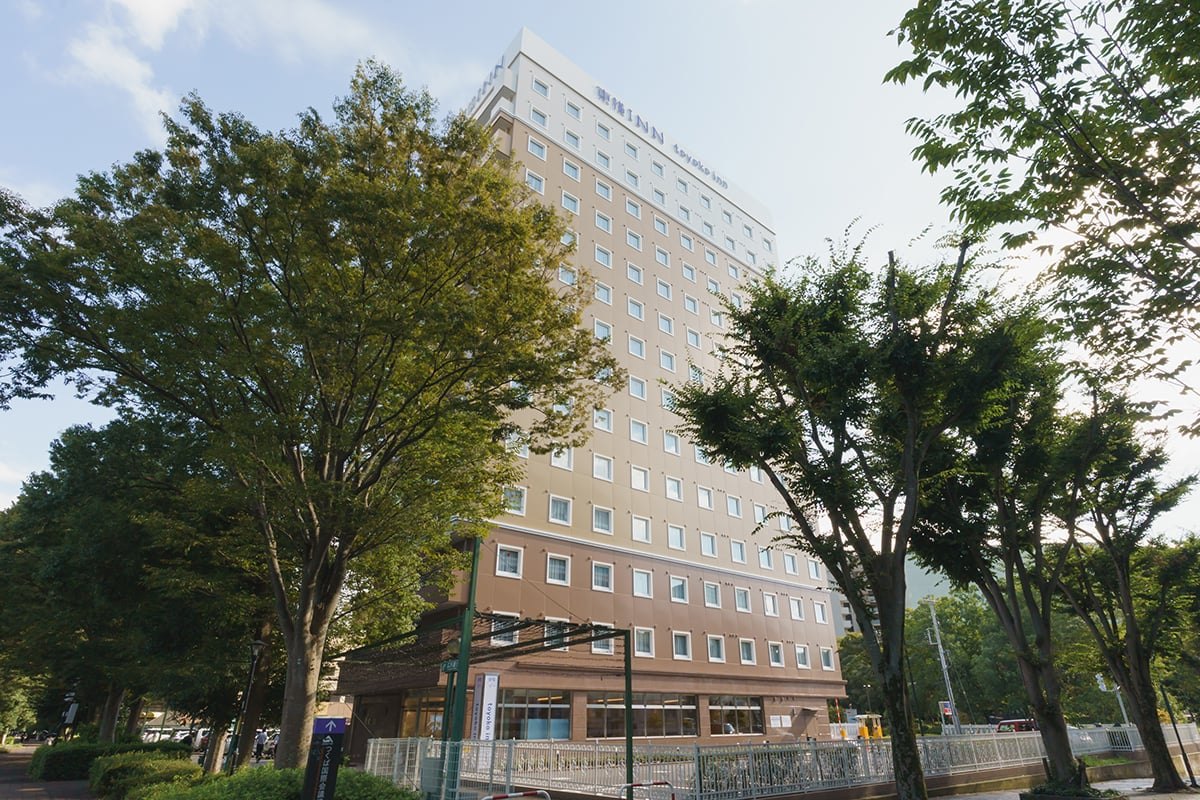
By decade of opening, the 8 properties in the zone break down into 1 property / 115 rooms from the 1970s, 2 / 180 from the 1980s, 2 / 290 from the 1990s and 2 / 309 from the 2000s; the 2020s has only this one property with 217 rooms. The previous opening was Daiwa Roynet Hotel Tsukuba (240 rooms) in 2009, making this the first new opening within 1km of the station in 17 years. By size, Toyoko Inn Tsukuba Station is the second largest in the zone, and the two properties with 201+ rooms now hold 457 rooms, or 41.1% of the zone.
| # | Property | Type | Rooms | Opened | Distance from Tsukuba Station |
|---|---|---|---|---|---|
| 1 | Daiwa Roynet Hotel Tsukuba | Business hotel | 240 | 2009 | approx. 120m |
| 2 | Toyoko Inn Tsukuba Station | Business hotel | 217 | 2026 | approx. 495m |
| 3 | Hotel JAL City Tsukuba | Business hotel | 186 | 1999 | approx. 747m |
| 4 | Hotel Nikko Tsukuba | City hotel | 164 | 1983 | approx. 205m |
| 5 | Hotel Grand Shinonome | City hotel | 115 | 1976 | approx. 608m |
| 6 | Hotel Matsushima | Business hotel | 104 | 1990 | approx. 504m |
| 7 | Hotel Tsukuba Hills Gakuen-Nishi-Odori | Business hotel | 69 | 2008 | approx. 802m |
| 8 | Hotel Yamakyu | Business hotel | 16 | 1983 | approx. 535m |
According to Toyoko Inn’s announcement, Toyoko Inn Tsukuba Station is a 4-minute walk from Tsukuba Station, with 14 floors and 217 rooms, and is the chain’s 7th property in Ibaraki, the first since Toride Station East Exit in June 2021. Tsukuba International Congress Center, whose largest hall holds over 1,200 people, is a 7-minute walk away, so the location squarely targets demand unique to Tsukuba: academic conferences, international meetings and business trips to research institutions. The format the company has refined nationwide (station-front, breakfast included, uniform rooms) is an easy choice for researchers and conference attendees visiting for the first time, and it overlaps little with the banquet and restaurant functions that the existing properties in the zone have provided.
Site Assessment: Commercial Zone with 400% FAR, Land Prices Up 12–14% a Year, 13,900 Workers Within 1km
So what kind of land is the Tsukuba station front? According to MLIT’s Real Estate Information Library, both Tsukuba Station and the site of Toyoko Inn Tsukuba Station lie in a commercial zone (floor area ratio 400%, building coverage ratio 80%), surrounded by medium-to-high-rise exclusive residential zones and Category 2 residential zones with a 200% floor area ratio. The area where a high-rise limited-service hotel can be built is a limited radius around the station, and this scarcity of sites likely explains why the stock did not move for nine years.
| Point | Category | Distance from station | Price (¥/sq m) | YoY | Prior-year price (¥/sq m) |
|---|---|---|---|---|---|
| Azuma 1-14-2 and others, Tsukuba (Tsukuba 5-2) | Commercial, Prefectural Land Price Survey (July 1, 2026) | 300m | 400,000 | +14.3% | 350,000 |
| Takezono 1-8-2, Tsukuba (Tsukuba-29) | Residential within a commercial zone, Official Land Price Publication (January 1, 2026) | 600m | 302,000 | +11.9% | 270,000 |
| Higashiarai 24-3 and others, Tsukuba (Tsukuba 5-4) | Commercial, Official Land Price Publication (January 1, 2026) | 700m | 247,000 | +12.3% | 220,000 |
Land price movements also reflect the scarcity of sites. A commercial site 300m from the station (Azuma 1-chome) stood at ¥400,000 per sq m as of July 2026, up 14.3% year on year; a point in Takezono 1-chome, the same district as Toyoko Inn Tsukuba Station, was ¥302,000 (+11.9%); and even Higashiarai, 700m from the station, was ¥247,000 (+12.3%), all double-digit gains for the second year running. For anyone acquiring land to build from scratch, rising land costs are pushing up total investment, so the environment favors operators that have already secured land or that can use ground leases or equivalent-exchange schemes.
| Establishments within 1km | 580 establishments |
| Workers within 1km | 13,861 |
| Of which office workers | 3,211 (23.2%) |
| Residents within 1.5km (2020) | 29,633 |
| Same, 2040 estimate | 35,610 (+20.2%) |
| Working-age population share (2025 estimate) | 74.3% |
The demand base is also deep. According to the Economic Census (2021), 580 establishments with 13,861 workers are concentrated within 1km of Tsukuba Station, of which 3,211 (23.2%) are office workers. Station passengers fell from 36,100 a day in 2019 to 21,000 in 2020, but recovered to 35,590 in 2024, 98.6% of the 2019 level. In addition, the residential population within 1.5km is projected to grow 20.2% from 29,633 in 2020 to 35,610 in 2040, and the working-age share is high at 74.3%. Note that population here means census-based residents, not visitors or people passing through. A station front where both workers and residents keep increasing had seen no hotel added for nine years. That combination is what laid the ground for absorbing new supply on the scale of 217 rooms.
HOTEL R9 The Yard, 5 Properties, 244 Rooms: Single-Story Units of About 50 Rooms Near Interchanges, Highways and Industrial Parks
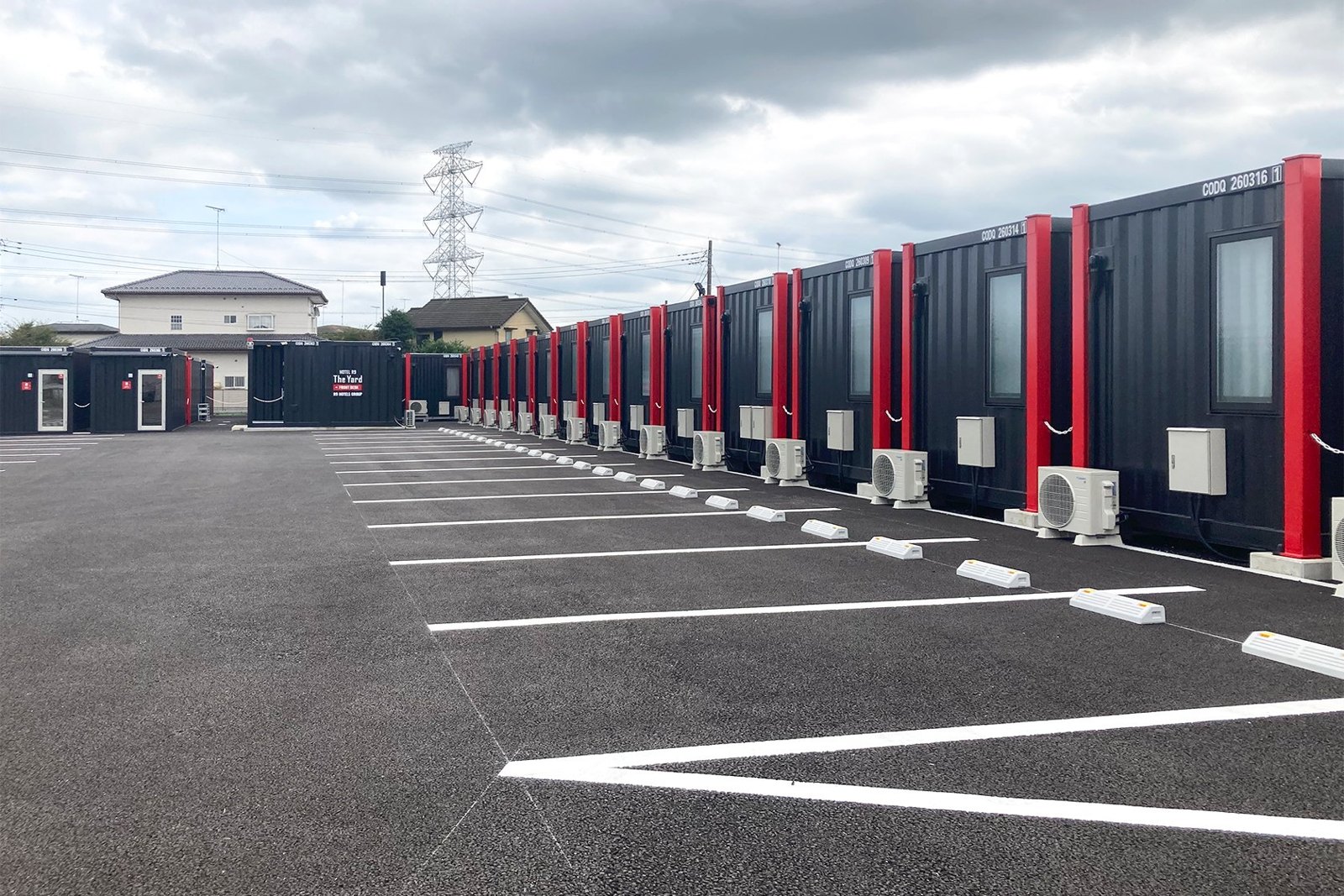
HOTEL R9 The Yard, the other pillar, chose the opposite of a station-front location. According to its operator Develop, five properties with 244 rooms opened in Ibaraki in 2026: Ryugasaki (February 21, 39 rooms), Ushiku (March 22, 44 rooms), Joso (June 15, 65 rooms), Hitachiomiya (October 25, 42 rooms) and Chikusei (November 10, 54 rooms), with Chikusei being the series’ 20th property in the prefecture. The average is 48.8 rooms per property; each room is a self-contained 13 sq m container, and doubles account for 219 of the 244 rooms (89.8%).
| Property | Opening date | Rooms | City | Location (operator announcement) | Order in prefecture |
|---|---|---|---|---|---|
| Ryugasaki | Feb 21 | 39 (35 double, 4 twin) | Ryugasaki | About 15 min by car from Ushiku-Ami IC on the Ken-O Expressway, on Prefectural Road 243 | 16th |
| Ushiku | Mar 22 | 44 (38 double, 6 twin) | Ushiku | About 10 min walk from JR Ushiku Station; about 10 min by car from Tsukuba-Ushiku IC on the Ken-O Expressway | 17th |
| Joso | Jun 15 | 65 (59 double, 6 twin) | Joso | About 5 min by car from Joso IC on the Ken-O Expressway, on National Route 294 | 18th |
| Hitachiomiya | Oct 25 | 42 (38 double, 4 twin) | Hitachiomiya | About 15 min by car from Naka IC on the Joban Expressway, on National Route 118; two industrial parks within 15 min by car | 19th |
| Chikusei | Nov 10 | 54 (49 double, 5 twin) | Chikusei | On National Route 50; about 5 min by car to Tamado Industrial Park | 20th |
What the five location descriptions have in common is the drive time from an expressway interchange, frontage on a national or prefectural road, and proximity to surrounding factories, industrial parks and logistics hubs. For Hitachiomiya, the announcement names the Mito Hokubu Chukaku and Miyanosato industrial parks; for Chikusei, the Tamado, Shimodate and Tsukuba Akeno industrial parks, making it clear that the target guests are business travelers who move by car. Free-standing rooms that share no walls with their neighbors and sit a short walk from the parking lot suit guests who want quiet rest during on-site work or long business trips.
Within the listings we could confirm, the series’ openings in the prefecture have deepened year after year: 2 properties / 72 rooms in 2023, 2 / 91 in 2024, 4 / 193 in 2025 and 5 / 244 in 2026. Keeping each property at 40–65 rooms and placing one per city where demand exists makes it easier to succeed even in small catchments, in contrast to the station-front model that supplies 217 rooms in a single building. The series also functions as a “rescue hotel” whose rooms can be relocated to disaster areas, and it signed a disaster agreement with Chikusei City in April 2025. For municipalities it serves as both everyday lodging infrastructure and emergency preparedness, a design that is also an advantage in securing land and building local relationships. Container hotel room rates are covered in our guide to container hotel prices.
Estimated Settled ADR by Host City: Tsukuba Flat at ¥7,720, Joso Up 23.5%
How about rate levels in the cities hosting the 6 new builds? The estimated settled ADR for October 2026 was ¥7,720 in Tsukuba (N=32), ¥10,658 in Hitachiomiya (N=6), ¥6,207 in Joso (N=7), ¥6,048 in Chikusei (N=6), ¥5,656 in Ushiku (N=6) and ¥5,652 in Ryugasaki (N=7). Mito, the prefectural capital, was ¥8,806 (N=34) and Ibaraki as a whole ¥7,168 (N=311). Apart from Tsukuba and Mito, the five cities have only 6–7 properties each, so a single property’s move can swing the median; read them as reference values for the general level.
| Area | Oct 2026 ADR | Properties | Oct 2025 ADR | Properties | YoY |
|---|---|---|---|---|---|
| Tsukuba | ¥7,720 | N=32 | ¥7,782 | N=32 | −0.8% |
| Ushiku | ¥5,656 | N=6 | ¥5,623 | N=5 | +0.6% |
| Ryugasaki | ¥5,652 | N=7 | ¥5,791 | N=7 | −2.4% |
| Joso | ¥6,207 | N=7 | ¥5,026 | N=6 | +23.5% |
| Chikusei | ¥6,048 | N=6 | ¥6,175 | N=6 | −2.1% |
| Hitachiomiya | ¥10,658 | N=6 | ¥10,630 | N=6 | +0.3% |
| Mito | ¥8,806 | N=34 | ¥8,238 | N=32 | +6.9% |
| Ibaraki (all types) | ¥7,168 | N=311 | ¥6,825 | N=309 | +5.0% |
| Ibaraki (business hotels) | ¥7,040 | N=187 | ¥6,707 | N=182 | +5.0% |
Year on year, Tsukuba moved from ¥7,782 to ¥7,720, down 0.8%, essentially flat: even the month after 217 rooms of new supply were added, the city-wide rate level held. Ibaraki as a whole rose 5.0%, and business hotels alone also rose 5.0%, so rates in the prefecture are on a gentle upward trend. Among the R9 host cities, Joso, where 65 rooms opened in June, jumped 23.5% from ¥5,026 to ¥6,207; Ushiku (+0.6%) and Hitachiomiya (+0.3%) were flat; and Chikusei (−2.1%) and Ryugasaki (−2.4%) moved only slightly. There is no case of rates collapsing in a city that received new supply, suggesting that business-location demand is absorbing the supply.
Overlaying the monthly estimated settled ADR of business hotels in the prefecture, rates edged up within a narrow ¥6,200–7,100 band from 2024 to 2026. October 2026 was ¥7,040 (N=187), up for the second straight year from ¥6,707 in October 2025 and ¥6,374 in October 2024. On occupancy, Ibaraki business hotels posted a high October 2026 occupancy (OTA listed inventory basis, estimated) of 87.3% (83–88 properties / 6,745–7,019 rooms, based on major booking site listings), and all types combined were at 86.4% (191–203 properties / 9,621–9,963 rooms). Rates are low compared with Japan’s major cities, while occupancy is high and stable. That is likely why limited-service hotels keep opening in Ibaraki’s business locations. The relationship between new-room ratios and inventory absorption across the 47 prefectures is set out in our analysis of business hotel new-room ratios.
Revenue Density by Model: Annual Revenue per Room of ¥2.11M at the Station vs ¥1.66M at the Interchange
Next is a simple estimate that compares the two development models on the same yardstick. It does not estimate any specific property’s performance; it works backward to how much revenue one room would generate, and how much investment it could justify, if a property of the same size were run at the host city’s typical rate. ADR uses the host city’s estimated settled ADR for October 2026: ¥7,720 for Tsukuba for the station-front model, and ¥6,048, the median of the five cities where R9 opened, for the interchange model. Occupancy is 75%, the GOP margin 40% and the required GOP yield 6%, all assumptions of this article.
| Item | A. Station-front new build, 217 rooms | B. Interchange / highway, approx. 50 rooms |
|---|---|---|
| Assumed size | 217 | 49 rooms (5-property average) |
| ADR assumption (Oct 2026, host city estimated settled ADR) | ¥7,720 (Tsukuba, N=32) | ¥6,048 (median of 5 cities, N=6–7 each) |
| Occupancy assumption (this article’s assumption) | 75% | 75% |
| RevPAR | ¥5,790 | ¥4,536 |
| Annual room revenue per room | ¥2.11M | ¥1.66M |
| Annual room revenue, whole property | ¥459M | ¥81M |
| GOP (assuming 40% GOP margin) | ¥183M | ¥32M |
| Allowable total investment per room (6% GOP yield) | ¥14.09M | ¥11.04M |
In the base case, the station-front 217-room model generates annual room revenue of about ¥2.11M per room, or about ¥459M for the whole property. The interchange/highway model of about 50 rooms generates about ¥1.66M per room, or about ¥81M for the whole property, so the station-front model’s revenue density per room is about 28% higher. Working back from a 6% GOP yield, the allowable total investment per room (land, building and pre-opening costs combined) is about ¥14.09M for the station-front model and about ¥11.04M for the interchange model. The station-front model costs more because it builds high-rise on expensive commercial land, while the interchange model keeps investment down by choosing single-story, small-scale sites with low land prices, so the gap in revenue density maps directly onto the difference in the two models’ investment structures.
| Case | A. Annual revenue per room | A. Allowable total investment per room | B. Annual revenue per room | B. Allowable total investment per room |
|---|---|---|---|---|
| Base case (75% occupancy) | ¥2.11M | ¥14.09M | ¥1.66M | ¥11.04M |
| ADR −10% | ¥1.90M | ¥12.68M | ¥1.49M | ¥9.93M |
| Occupancy −5pt (70%) | ¥1.97M | ¥13.15M | ¥1.55M | ¥10.30M |
| ADR −10%, occupancy −5pt | ¥1.78M | ¥11.83M | ¥1.39M | ¥9.27M |
| Occupancy +5pt (80%) | ¥2.25M | ¥15.03M | ¥1.77M | ¥11.77M |
| Applying Ibaraki business hotels’ estimated occupancy of 87.3% (Oct 2026, 83–88 properties) | ¥2.46M | ¥16.40M | ¥1.93M | ¥12.85M |
On sensitivity, if ADR falls 10% or occupancy falls 5pt, allowable total investment per room shrinks to about ¥12.68M–13.15M for the station-front model and about ¥9.93M–10.30M for the interchange model. Conversely, applying Ibaraki business hotels’ estimated occupancy of 87.3% (as above, October 2026) as is widens it to about ¥16.40M for the station-front model and about ¥12.85M for the interchange model. For reference, the 2025 planned construction cost of hotels and ryokan (steel frame) calculated from MLIT’s Building Construction Starts statistics was about ¥2.405M per tsubo (3.3 sq m); assuming 20 sq m of gross floor area per room, construction alone comes to about ¥14.58M. For a new station-front build, construction cost and the allowable amount sit at the same level, so the more a project combines brand strength able to command rates above the city median, occupancy in the high 80s and a way to hold down land costs, the more room there is for profitability.
Two-Way ADR × Occupancy Sensitivity: The Station-Front Model Matches the Construction Cost Benchmark at Base ADR and 80% Occupancy
| ADR (station-front / interchange) vs. occupancy assumption | 65% | 70% | 75% | 80% | 85% |
|---|---|---|---|---|---|
| ADR −10% (¥6,948 / ¥5,443) | 10.99 / 8.61 | 11.83 / 9.27 | 12.68 / 9.93 | 13.53 / 10.60 | 14.37 / 11.26 |
| ADR −5% (¥7,334 / ¥5,746) | 11.60 / 9.09 | 12.49 / 9.79 | 13.38 / 10.49 | 14.28 / 11.18 | 15.17 / 11.88 |
| ADR base (¥7,720 / ¥6,048) | 12.21 / 9.57 | 13.15 / 10.30 | 14.09 / 11.04 | 15.03 / 11.77 | 15.97 / 12.51 |
| ADR +5% (¥8,106 / ¥6,350) | 12.82 / 10.04 | 13.81 / 10.82 | 14.79 / 11.59 | 15.78 / 12.36 | 16.77 / 13.13 |
| ADR +10% (¥8,492 / ¥6,653) | 13.43 / 10.52 | 14.46 / 11.33 | 15.50 / 12.14 | 16.53 / 12.95 | 17.56 / 13.76 |
Table 8 shows allowable total investment per room when ADR is moved within +/-10% of the host city’s estimated settled ADR and the occupancy assumption within 65–85% at the same time. At base ADR, the station-front model exceeds the construction cost benchmark (steel frame, about ¥14.58M at 20 sq m per room) only if occupancy is assumed at 80% or more (about ¥15.03M); with ADR +5% it reaches about ¥14.79M even at 75%, and with ADR −5% it still exceeds the benchmark at about ¥15.17M if 85% is assumed. In the harshest cell, ADR −10% with a 65% occupancy assumption, the figures fall to about ¥10.99M for the station-front model and about ¥8.61M for the interchange model. Whether the station-front model pays off depends on keeping both rate and occupancy at or above base; the single-story, small-scale interchange model has a different construction cost structure and cannot be compared on the same yardstick, but its range of allowable amounts is narrower than the station-front model’s.
This is a simple estimate; actual investment decisions require a detailed feasibility study. Rising construction costs raise the hurdle for new entrants, but for properties that have already opened they are also an upside, since follow-on supply becomes less likely. Until the next new build appears within 1km of Tsukuba Station, the 8 existing properties will share conference and academic meeting demand and weekday business-trip demand within a 1,111-room envelope.
Implications for Development Teams and Lenders: Three Checkpoints
Summing up, the yardsticks for site decisions that can be read from Ibaraki’s 2026 supply come down to the following three points. None is definitive; use them as starting points when comparing candidate sites.
1. Ratio of room stock to workers within 1km of the station
Within 1km of Tsukuba Station there are 1,111 rooms against 13,861 workers, about 8.0 rooms per 100 workers, up from about 6.4 before the new build. Measuring the same indicator at other TX and Joban Line stations makes it possible to compare supply headroom side by side.
2. Size small catchments at 40–65 rooms
Even where the host city’s ADR is ¥5,700–6,200, a single-story property of about 50 rooms justifies an allowable total investment of about ¥11M per room. A 5–15 minute drive to an industrial park or interchange is the location condition common to the announcements.
3. Read new builds, not totals
Of the 24 properties / 641 rooms, only 6 properties / 461 rooms bear directly on the competitive landscape for limited-service hotels. In loan screening and market research, it is effective to separate renamings and new listings from new builds and look at net additions.
To add to point 1, rooms per 100 workers within 1km of Tsukuba Station rose from about 6.4 to about 8.0 with the 217-room opening. Whether this level is heavy or light relative to demand will be answered by the city’s rate and occupancy trends over the coming months. That the city’s ADR held at last year’s level in October, the month after opening, is at least evidence that absorption is progressing in the short term. On point 2, comparing with our analysis of site requirements, which works backward from Route Inn’s opening criteria, shows that even on the same roadside, a 200-room-class property and a 50-room-class property need very different catchment depth. From a landowner’s standpoint, the size of the site, the frontage road and the distance to an interchange should determine which size of model to approach.
As for supply from next year onward, the only lodging project in Ibaraki we identified from MLIT’s Building Dynamics Statistics at the time of the survey was one 197-room building in Shimotsuma City completed in September 2025, which corresponds to Hotel Route-Inn Shimotsuma, already open since September 2025. No unopened projects identifiable from building confirmation applications remain at present. *Based on building confirmation applications at the time of the survey. The count and room numbers are expected to grow as applications are added, so treat this as the lower bound of the confirmed pipeline at present. Small projects like R9, with a short lead time from building confirmation to opening, often surface only in announcements 1–2 months before opening, so reading 2027 supply requires continued tracking of each company’s releases. As an example of using public land in the prefecture, the 45-unit business model converting a prefectural botanical garden in Naka City is also a useful reference.
Caveats and Risk Factors: Small-Sample Rates, Land Costs and Follow-On Supply
| Category | Details | What to check |
|---|---|---|
| Market | Host city ADR is the median of 6–7 properties and swings easily with one property’s price change | Read multi-month trends together with the prefecture as a whole (N=311) |
| Demand | Demand at the Tsukuba station front may be skewed toward months with academic conferences and international meetings | Check the convention center’s event calendar and the weekday/weekend rate gap |
| Land | Commercial land at the station front has seen double-digit price rises two years running | Compare total investment including ground leases, equivalent exchange and conversion of existing buildings |
| Construction | Planned construction cost for steel frame is about ¥2.405M per tsubo (2025) | Manage investment per room by reducing gross floor area or using faster construction methods |
| Supply | Plans for small projects tend not to surface until just before opening | Track operators’ releases and building confirmation applications regularly |
On the disaster side, when evaluating an individual candidate site, be sure to check the municipality’s hazard map for flood projections and liquefaction potential. Also note that occupancy in this article is estimated from the absorption of inventory listed on major booking sites; because unlisted rooms are counted on the sold side, it tends to run higher than actual room occupancy. For investment decisions, it is effective to confirm levels against the published figures of the Japan Tourism Agency’s Overnight Travel Statistics Survey.
Frequently Asked Questions
Q. How many hotels newly opened in Ibaraki in 2026?
A. MetroEngines Research confirmed 24 properties with 641 rooms opened or newly listed on major booking sites as of November 20, 2026. Of these, 6 properties with 461 rooms were confirmed as new builds in public sources: Toyoko Inn Tsukuba Station (217 rooms) and five HOTEL R9 The Yard properties (244 rooms).
Q. When did Toyoko Inn Tsukuba Station open, and how many rooms does it have?
A. According to Toyoko Inn’s announcement, it opened on Friday, September 11, 2026. It is a 4-minute walk from Tsukuba Station, with 14 floors and 217 rooms, and is the chain’s 7th property in Ibaraki.
Q. How many hotel rooms are there around Tsukuba Station?
A. There are 8 operating properties with 1,111 rooms within a 1,000m radius of Tsukuba Station. The zone held at 7 properties / 894 rooms from 2017 to 2025 and grew by 217 rooms (+24.3%) in 2026.
Q. Where in Ibaraki did HOTEL R9 The Yard open in 2026?
A. According to the operator, five properties with 244 rooms: Ryugasaki (39 rooms), Ushiku (44), Joso (65), Hitachiomiya (42) and Chikusei (54). All are described as close to interchanges, national highways or industrial parks.
Q. What are hotel rates like in Tsukuba?
A. Tsukuba’s estimated settled ADR in October 2026 was ¥7,720 (32 properties), almost the same as ¥7,782 a year earlier. Ibaraki as a whole was ¥7,168 (311 properties).
Summary
Ibaraki’s new openings and new listings in 2026 totaled 24 properties / 641 rooms, of which 6 properties / 461 rooms were confirmed as new builds in public sources. They consist of the 217-room Toyoko Inn Tsukuba Station in front of the TX terminal and 244 rooms across five HOTEL R9 The Yard properties along trunk roads in the south, west and north, both limited-service formats targeting business demand from research, manufacturing and logistics. Rooms within 1km of Tsukuba Station rose 24.3% from the 894 that had held for nine years to 1,111, yet Tsukuba’s estimated settled ADR the month after opening held at last year’s level of ¥7,720, and estimated occupancy of business hotels in the prefecture remains high at 87.3%.
For those considering new properties, three yardsticks can serve as a common language when comparing candidate sites: the ratio of workers to rooms within 1km of a station, the allowable total investment per room worked back from the host city’s rates, and supply measured on a new-build basis rather than totals. In Ibaraki’s business locations, where high occupancy and gently rising rates continue, there is room for two formats, a large single building at the station and 50-room properties in small catchments, to stand side by side, each playing to its strengths.
Related Articles
Further Reading
- Ibaraki Hotel Rates: Oarai’s ¥18,911 Is 2.4x Capital Mito
- Ibaraki Hotel Market Map 2026: Four ADR Tiers, ¥10-14k Whitespace
- Container Hotel Investment: 141 Sites, ¥6,300 ADR, 7.8% NOI Yield
- Japan Container Hotel Prices: ¥11,200 Weekdays, ¥14,200 Saturdays
- Hyogo Hotel Openings 2026: 1,284 Rooms, but 497 Are Rebrands
References and Sources
■ Data sources
New openings / new listings are based on listings confirmed on major booking sites (Ibaraki, as of November 20, 2026, N=24 properties), matched property by property against operator announcements and Ibaraki Prefecture publications and sorted into five groups. Room stock covers operating properties with 10 or more rooms (excluding leisure hotels) within a 1,000m radius of Tsukuba Station (as of November 21, 2026, N=8 properties). Estimated settled ADR is the median of covered properties in each city and the prefecture (October 2025 and October 2026). Land prices and zoning are from MLIT’s Real Estate Information Library, workers from the Economic Census for Business Activity (2021), and residents from National Land Numerical Information’s future population estimates by 250m mesh.
■ Estimate assumptions
The simple estimate by development model sets ADR at the host city’s estimated settled ADR for October 2026 (¥7,720 for Tsukuba for the station-front model; ¥6,048, the median of the five cities where R9 opened, for the interchange model), occupancy at 75% (65–85% for sensitivity), GOP margin at 40% and GOP yield at 6%. Annual room revenue per room = ADR × occupancy assumption × 365 days; allowable total investment per room = annual room revenue per room × GOP margin ÷ GOP yield. The construction cost benchmark converts the planned construction cost of steel-frame hotels and ryokan in the Building Construction Starts statistics (2025) at 20 sq m per room.
■ Limitations and caveats
Listing start dates may not match opening dates, and the 24 properties include renamed or newly listed existing properties. ADR for the five cities is the median of 6–7 properties and swings easily with one property’s price change. Occupancy is an estimate based on the absorption of OTA listed inventory and runs higher than actual overall occupancy. The estimate does not project any specific property’s performance; land, pre-opening, tax and FF&E replacement costs vary by case. Plans based on building confirmation applications exclude small projects that do not surface until just before opening.
■ Market data
| MetroEngines Research & Consulting — New opening / new listing data (confirmed OTA listings, Ibaraki 2026, N=24 properties), room stock within 1km of Tsukuba Station (N=8 properties), estimated settled ADR (Ibaraki, N=311 properties), occupancy (OTA listed inventory basis, estimated) |
■ Government statistics and public data
■ News and press releases