

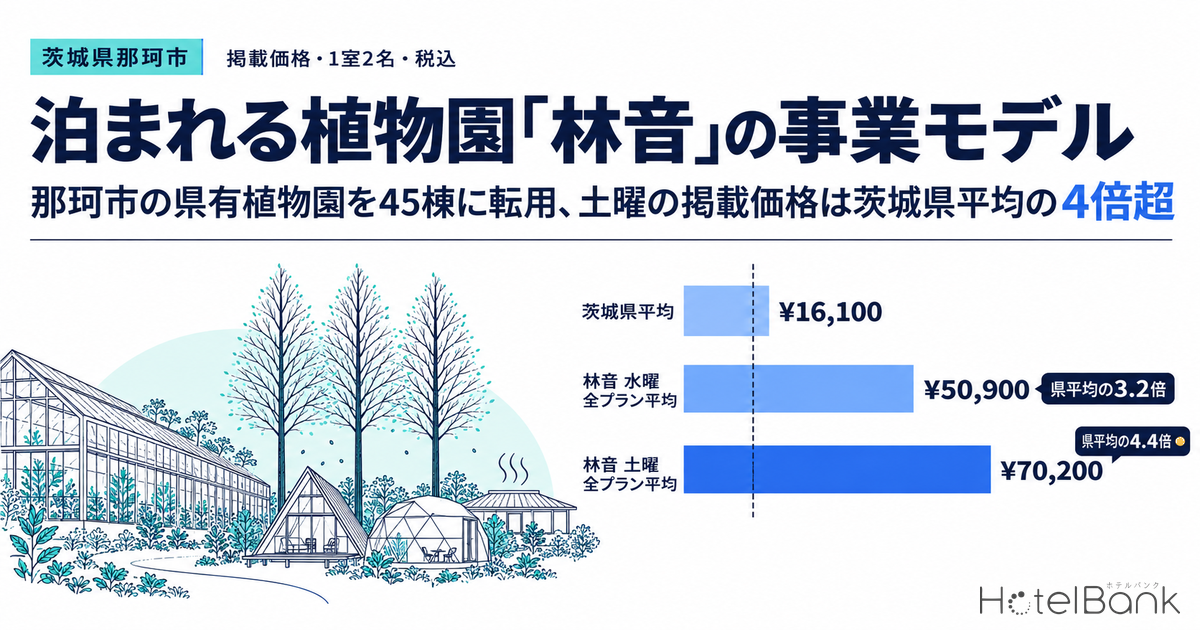
A “stay-in botanical garden” refers to THE BOTANICAL RESORT Rinne (林音), a destination complex that reopened on Saturday, November 29, 2025, after the private sector redeveloped the Ibaraki Prefectural Botanical Garden and Ibaraki Prefectural Citizens’ Forest, prefecture-owned facilities in Naka City, Ibaraki. The grounds now hold 45 lodging units — 18 cottages and 27 glamping units — the previously paid admission has been made free, and a bathhouse, “Ofuro Cafe Rinne no Yu,” sits alongside food, beverage and activity facilities. It is operated by Botalasian Resort Co., Ltd. (株式会社ボタラシアンリゾート), a special purpose company (SPC) established in May 2024. This is not a guide for guests; from an investor’s and operator’s perspective, we break down the business model of converting a prefectural botanical garden into lodging along four lines: the deal structure, listed prices, the surrounding room stock, and the conditions for replicating it in other prefectures.
Readers considering Rinne for a family trip or a personal stay may prefer HotelPicks’ feature on villa-style glamping in the Kanto region (Japanese) or KazokuStay (Japanese), which covers family-friendly stays. What follows is limited to analysis for industry readers.
Metric Definitions Used in This Article
- Listed price (per room, 2 guests, tax included): The selling price each property publishes on major booking sites. All of Rinne’s prices in this article are listed prices; “all-plan average” is the average across all plans from room-only to meal-inclusive, and “lowest” is the cheapest plan listed for that date. Aggregated from listings as of October 11, 2026.
- ADR (Average Daily Rate): An estimated settled rate (tax-excluded equivalent), calculated by applying a segment-specific adjustment factor to the lowest plan level each property publishes on OTAs (per-room rate for 2 guests, tax included). Checked against property-level results disclosed by listed hotel REITs (91 properties, most recent 3 months), the median error is about 7%. These are estimates and differ from each property’s actual settled prices and accounting figures. Area-level ADR is the median of the target properties (the level of a typical property in the area). In this article we label it “estimated settled ADR” and do not mix it with listed prices.
- OCC (Occupancy Rate): The share of sold rooms in the total room count of an area (an estimate based on OTA sales inventory). The occupancy rates used in this article’s calculations are published figures from the Japan Tourism Agency’s Overnight Travel Statistics Survey, not our own estimates.
- Data source: MetroEngines Research (tracks about 168,000 properties and analyzes about 27,000 whose operation can be confirmed on major booking sites)
- — 45 units, total project cost about ¥3.0 billion: An SPC funded by eight companies handled design, construction and operation of the Ibaraki Prefectural Botanical Garden and Citizens’ Forest in one package and reopened it as “Rinne” on November 29, 2025.
- — Listed prices are 3.2–4.4x the Ibaraki average: For November–December, the all-plan average runs around ¥50,900 on Wednesdays and ¥70,200 on Saturdays (per room, 2 guests, tax included, as of October 11, 2026). The prefectural average is ¥16,100.
- — 121 properties and 6,411 rooms within 20 km: 92% are hotel-type, centered on limited-service hotels near stations. Rinne is the only property in Naka City with confirmed price listings.
- — Facility cost borne by the prefecture; operation under a 20-year designated-manager contract: The prefecture pays Rinne’s facility cost as a service fee, and under the tender terms the designated-manager fee steps down to zero in year six. The structure differs from a privately built, privately operated project.
- — Required ADR in a hypothetical fully private case: ¥55,000: With on-site spending of ¥1,000 from 260,000 visitors it falls to ¥24,500, and to ¥10,400 with 380,000 visitors. The lodging units alone need ¥14,700 (20-year simple payback).
Inside the stay-in botanical garden — 45 units, free admission and a bathhouse
Let us first set out the facts. The Ibaraki Prefectural Botanical Garden opened in 1981 and, together with the adjacent Citizens’ Forest, is a public facility established by the prefecture. According to the operator’s announcement, the purpose of the project was to bring private-sector ingenuity and management capability to the two facilities, more than 40 years after opening, to increase visitors and shift to sustainable operation. With the reopening, the former admission fee was abolished: entry for walking the grounds is free, while lodging, bathing, dining and activities are each priced separately.
| Item | Details |
|---|---|
| Name | THE BOTANICAL RESORT Rinne (林音, read “Rinne”) |
| Location | 4369-1 To, Naka City, Ibaraki (inside the Ibaraki Prefectural Botanical Garden) |
| Opening date | Saturday, November 29, 2025. Closed for renovation from July of the previous year |
| Lodging units | 18 cottages + 27 glamping units = 45 units (11 unit types confirmed in listings) |
| Bathing | Ofuro Cafe Rinne no Yu (13th location of the “Ofuro Cafe” bathhouse brand, first in Ibaraki). Adults ¥950 on weekdays / ¥1,100 on weekends and holidays |
| Dining & activities | RINNE CAFE (102 indoor seats, 56 terrace seats), Rinne Shokudo, BBQ facility (THE FOREST BBQ), 150 m zipline, AR experience, night illumination of the tropical greenhouse |
| Admission | Previously paid → now free (each facility charged separately) |
| Operator | Botalasian Resort Co., Ltd. (SPC, established May 2024) |
Source: Operator release (September 24, 2025); reporting by Ryoko Shimbun, Mito Keizai Shimbun and Ibaraki Broadcasting System
Before the redevelopment, annual visitors to the garden had been falling. Ibaraki Broadcasting System reported about 56,000 users in FY2022, a quarter of the peak, and the operator’s announcement put FY2023 at about 50,000, while Ryoko Shimbun reported annual operating costs of more than ¥100 million. For the prefecture, it was “a facility whose visitors keep declining while maintenance costs keep coming”; for the private side, it was “a site where prefectural land and an existing botanical garden — a ready-made visitor draw — could be used without upfront land investment.” The conversion model starts from that alignment of interests.
Deal structure — an eight-company SPC, chosen through a public proposal, handles design, construction and operation in one package
So what kind of contract was put in place with the prefecture? The primary document we could confirm is a timely disclosure published on May 22, 2024, by Ikka Holdings (TSE Standard: 7127), which holds 50% of the SPC. According to that document, an eight-company consortium applied to the public proposal for the prefecture’s “Ibaraki Prefectural Botanical Garden, etc. Development and Management/Operation Project” and was selected as the preferred negotiating party on May 17, 2024. The disclosure sets out the steps: the prefecture and the consortium sign a basic agreement, the consortium jointly establishes an SPC, and the SPC and the prefecture then sign a basic contract. According to the Nikkan Kensetsu Kogyo Shimbun, a contract was signed with the SPC on June 20, 2024, as the party responsible for detailed design and construction, with a total project cost of about ¥3.0 billion.
| Date | Event | Document checked |
|---|---|---|
| Jan 2024 | Prefecture adopts the “Ibaraki Prefectural Botanical Garden, etc. Facility Development Basic Plan” | Prefectural assembly materials on prefecture-owned facilities |
| Apr 2024 | Public notice of the proposal competition for the “Botanical Garden, etc. Development and Management/Operation Project” | Prefecture Forestry Policy Division page (notice posting) |
| May 17, 2024 | Eight-company consortium selected as preferred negotiating party | Ikka HD timely disclosure (May 22, 2024) |
| May 2024 | SPC Botalasian Resort Co., Ltd. established (capital ¥3 million, head office in Ichikawa, Chiba) | Same as above |
| Jun 20, 2024 | Prefecture contracts with the SPC for detailed design and construction. Total project cost about ¥3.0 billion | Nikkan Kensetsu Kogyo Shimbun |
| From Jul 2024 | Garden closed for demolition and renovation. Opening initially planned for April 2025 was postponed to November due to rising material and equipment costs | Nikkan Kensetsu Kogyo Shimbun, Mito Keizai Shimbun |
| Apr 2025 | Botalasian Resort becomes designated manager (April 1). Nickname “Rinne” announced on the 23rd | Ibaraki Prefecture release (April 23, 2025) |
| Nov 29, 2025 | Grand opening | Operator release |
Source: Compiled from Ikka Holdings, “Notice of the Commencement of New Business by a Subsidiary” (May 22, 2024), Nikkan Kensetsu Kogyo Shimbun, Ibaraki Broadcasting System and Ibaraki Prefecture publications
The SPC’s equity is split as follows: 50% held by two Ikka group companies whose core businesses are food service and leisure (Ikka Leisure Service 35%, Ikka Dining Project 15%); 10% by The Farm, which operates agricultural-experience facilities; 10% each by three construction firms (Shuken, Asakawa Kensetsu, Akiyama Komuten); and 5% each by two design firms (Shiba Architectural Design Office, Oyama Urban Architectural Design). The parties responsible for design, construction and operation are themselves the shareholders, so the party receiving the construction orders and the party taking on operating risk are one and the same — a defining feature of this deal. Ikka Holdings’ disclosure describes the impact on group earnings as “under review,” while positioning the business as contributing to earnings over the long term.
| Shareholder | Head office | Stake | Role |
|---|---|---|---|
| Ikka Leisure Service Co., Ltd. | Ichikawa, Chiba | 35% | Leisure operation |
| Ikka Dining Project Co., Ltd. | Ichikawa, Chiba | 15% | F&B operation |
| The Farm Co., Ltd. | Katori, Chiba | 10% | Agricultural experience & lodging operation |
| Shuken Co., Ltd. | Chiba City, Chiba | 10% | Construction |
| Asakawa Kensetsu Co., Ltd. | Naka, Ibaraki | 10% | Construction |
| Akiyama Komuten Co., Ltd. | Hitachi, Ibaraki | 10% | Construction |
| Shiba Architectural Design Office Co., Ltd. | Mito, Ibaraki | 5% | Detailed design |
| Oyama Urban Architectural Design Co., Ltd. | Chikusei, Ibaraki | 5% | Construction supervision |
Source: Compiled from Ikka Holdings timely disclosure (May 22, 2024), Ibaraki Prefecture release (April 23, 2025) and Nikkan Kensetsu Kogyo Shimbun. Roles are based on the division of work in the prefecture’s release and each company’s published business description
The contract framework can be confirmed from the prefecture’s tender documents and releases. The project period runs from the date of the assembly resolution on the construction contract to March 31, 2025, for detailed design, construction supervision and construction, and for 20 years from April 1, 2025, to March 31, 2045, for maintenance and operation; Botalasian Resort became the designated manager of the botanical garden and related facilities on April 1, 2025 (the designation of the previous manager, the Ibaraki Agriculture and Forestry Promotion Corporation, a public interest incorporated association, had been extended by one year to March 31, 2025). Costs consist of “service fees” the prefecture pays the SPC. In the tender, the proposal ceiling for detailed design, construction supervision and construction (Service Fee A) was about ¥2,988.9 million, matching the roughly ¥3.0 billion total project cost in press reports. For maintenance and operation (Service Fee B, i.e., the designated-manager fee), the first-year ceiling was set at the most recent actual designated-manager fee (about ¥111.06 million), to be stepped down over five years to zero in year six, with the actual amount to be set through re-review by the designated-manager selection committee. In other words, Rinne is designed so that the prefecture bears the facility cost and operations become self-sustaining on user-fee income from year six — a structure different from a privately built, privately operated project that recovers facility cost through lodging, bathing and F&B revenue. Whether the SPC pays any fee to the prefecture could not be confirmed from public documents. Readers considering replication should note that this contract term and cost split are exactly the variables that determine profitability.
Figure 1: Listed prices — weekday all-plan average is 3x the Ibaraki average, Saturdays exceed 4x
Next, we check the price band at which the property sells, using listed prices. Looking at Rinne’s listed prices (per room, 2 guests, tax included) as aggregated by MetroEngines Research as of October 11, 2026, for 12 Wednesdays and 12 Saturdays from November to February, the all-plan average for November–December ran around ¥50,900 on Wednesdays and around ¥70,200 on Saturdays. Since Ibaraki Prefecture’s overall listed price (all-plan average, October 2026) is ¥16,100, that is 3.2x the prefectural average even on weekdays and 4.4x on Saturdays. Even on the lowest plan, the floor was ¥16,800 on Wednesdays and ¥30,700 on Saturdays, above the prefecture’s average listed price (all-plan average) on every date.
Figure 1 lines up the lowest listed price by unit type. Of the four glamping types, the most affordable, “Metasequoia Terrace” and “Family Suite,” set the entry price band at ¥16,800–¥19,200 on Wednesdays and ¥30,700–¥33,000 on Saturdays, while the cottages range from ¥32,400–¥55,200 on Wednesdays to ¥44,900–¥67,700 on Saturdays. The Saturday-to-Wednesday ratio is 1.4–1.8x for glamping and 1.2–1.6x for cottages, so pricing is designed to swing sharply between weekdays and weekends. For January–February, there are fewer listed plans (72–83) than in November–December (272–405) and only some unit types are listed, so winter prices are best treated as still being loaded.
Source: Prepared by MetroEngines Research & Consulting (THE BOTANICAL RESORT Rinne; listings for 9 Wednesdays and 8 Saturdays in November–December 2026, as of October 11, 2026, per room, 2 guests, tax included). The dashed line is Ibaraki Prefecture’s listed price (all-plan average, October 2026, N=434 properties)
| Wednesday | All-plan avg. | Lowest | Plans | Saturday | All-plan avg. | Lowest | Plans |
|---|---|---|---|---|---|---|---|
| Wed, Nov 4 | ¥51,249 | ¥16,842 | 405 | Sat, Nov 7 | ¥69,069 | ¥30,702 | 283 |
| Wed, Nov 11 | ¥51,249 | ¥16,842 | 405 | Sat, Nov 14 | ¥67,892 | ¥30,702 | 339 |
| Wed, Nov 18 | ¥51,249 | ¥16,842 | 405 | Sat, Nov 21 | ¥76,299 | ¥38,210 | 320 |
| Wed, Nov 25 | ¥51,249 | ¥16,842 | 405 | Sat, Nov 28 | ¥67,964 | ¥30,702 | 365 |
| Wed, Dec 2 | ¥50,575 | ¥16,842 | 304 | Sat, Dec 5 | ¥67,154 | ¥30,702 | 272 |
| Wed, Dec 9 | ¥50,575 | ¥16,842 | 304 | Sat, Dec 12 | ¥67,210 | ¥30,702 | 274 |
| Wed, Dec 16 | ¥50,262 | ¥16,842 | 294 | Sat, Dec 19 | ¥75,817 | ¥38,210 | 280 |
| Wed, Jan 13 | ¥60,622 | ¥42,572 | 83 | Sat, Jan 16 | ¥72,025 | ¥51,350 | 79 |
| Wed, Jan 20 | ¥60,622 | ¥42,572 | 83 | Sat, Jan 23 | ¥72,025 | ¥51,350 | 79 |
| Wed, Feb 3 | ¥61,533 | ¥42,572 | 76 | Sat, Feb 6 | ¥73,242 | ¥51,350 | 72 |
| Wed, Feb 10 | ¥67,852 | ¥46,962 | 72 | Sat, Feb 13 | ¥78,633 | ¥55,740 | 72 |
| Wed, Feb 17 | ¥61,533 | ¥42,572 | 76 | Sat, Feb 20 | ¥78,633 | ¥55,740 | 72 |
Source: Prepared by MetroEngines Research & Consulting (listed prices, per room, 2 guests, tax included, as of October 11, 2026). January–February plan counts are low and levels are still being loaded
Note also that listed prices and estimated settled ADR are different things. Ibaraki Prefecture’s estimated settled ADR was ¥6,900 in September 2026 (historical basis), up 2.2% year on year, and its listed price was ¥15,700, up 1.0% — prefecture-wide rates are essentially flat. The estimated settled ADR for October 2026 is ¥9,600 (an estimate based on listing levels at the time of the survey), and by category business hotels are at ¥6,800, ryokan ¥7,200 and resort hotels ¥7,500 (all September 2026): existing properties in the prefecture are concentrated below ¥10,000. Rinne’s estimated settled ADR was ¥19,000 in September 2026 and ¥25,900 in August, but this estimate starts from the lowest plan (the glamping entry tier) and applies an adjustment factor, so it tends to understate the actual cottage-led rate. In this article we therefore discuss Rinne’s level in terms of listed prices and do not bring estimated settled ADR into the comparison with the prefectural average.
Figure 2: Room stock in the Mito–Naka area — 92% of 6,400 rooms within 20 km are hotel-type; the botanical-garden site takes a gap in the market
How, then, does lodging in this price band relate to surrounding supply? Within a 20 km radius centered on Rinne, MetroEngines Research confirmed price listings for 121 properties and 6,411 rooms in October–December 2026. By municipality, Mito City accounts for nearly 60% with 52 properties and 3,753 rooms, followed by Hitachinaka City with 31 properties and 1,484 rooms. Within Naka City, only Rinne’s 45 units had confirmed price listings; no other lodging in the city was confirmed as listed during this period. Of the 6,411 rooms in the radius, 5,897 (92%) are hotel-type (business, city and resort), most of them limited-service hotels around Mito and Katsuta stations. Listed prices (all-plan average, October 2026) are ¥15,500 in Mito and ¥17,200 in Hitachinaka, roughly in line with the prefectural average.
Source: Prepared by MetroEngines Research & Consulting. Circle size reflects room count. The dashed circle shows a 20 km radius centered on Rinne (showing Rinne and properties with 40+ rooms and confirmed price listings)
Source: Prepared by MetroEngines Research & Consulting (20 km radius from Rinne; 121 properties and 6,411 rooms with confirmed price listings in October–December 2026, based on listings on major booking sites)
| Municipality | Properties | Rooms | Of which hotel-type |
|---|---|---|---|
| Mito City | 52 | 3,753 | 3,552 |
| Hitachinaka City | 31 | 1,484 | 1,342 |
| Hitachi City | 9 | 348 | 311 |
| Kasama City | 12 | 307 | 219 |
| Hitachiomiya City | 6 | 143 | 118 |
| Hitachiota City | 5 | 104 | 91 |
| Tokai Village | 1 | 63 | 63 |
| Naka City | 1 | 45 | 45 |
| Shirosato Town | 2 | 36 | 31 |
| Motegi Town, Tochigi (portion within the radius, outside Ibaraki) | 1 | 125 | 125 |
| Ibaraki Town | 1 | 3 | 0 |
| Total | 121 | 6,411 | 5,897 |
Source: Prepared by MetroEngines Research & Consulting (based on confirmed OTA listings; for municipalities partly within the 20 km radius, only the portion inside is counted)
The lineup of new openings points the same way. Within what MetroEngines Research tracks, 21 properties with 676 rooms opened in Ibaraki Prefecture in the 12 months from October 2025 to September 2026 (based on confirmed OTA listings). Business hotels — Toyoko Inn Tsukuba Station (217 rooms), Comfort Hotel Mito (128), HOTEL R9 The Yard Joso (65), Kasama (45) and Ushiku (44), and Smart Work Hotel Hitachi Takahagi (14) — account for six properties and 513 rooms, or 76% of rooms. The remainder comprises two resort hotels (Rinne with 45 units and Hitachi Ocean View Hotel & Resort with 27 rooms) plus the cottage-style HOTEL R9 The Yard Ryugasaki (39 rooms) and vacation rentals, cottages and glamping sites of 1–16 rooms, for a total of 13 properties. In short, supply in the prefecture is polarized between “limited-service hotels by stations” and “small whole-unit rentals,” and Rinne, with a 45-unit destination product for families and groups, sits in the gap between them.
| Opened | Property | Rooms | Category |
|---|---|---|---|
| Oct 2025 | Mongolian Theme Park Japan | 15 | Glamping |
| Oct 2025 | SMA·MO inn Omitama | 16 | Cottage |
| Oct 2025 | HOTEL R9 The Yard Kasama | 45 | Business hotel |
| Nov 2025 | Comfort Hotel Mito | 128 | Business hotel |
| Nov 2025 | THE BOTANICAL RESORT Rinne | 45 | Resort hotel |
| Jan 2026 | Hitachi Ocean View Hotel & Resort | 27 | Resort hotel |
| Feb 2026 | HOTEL R9 The Yard Ryugasaki | 39 | Cottage-style |
| Mar 2026 | HOTEL R9 The Yard Ushiku | 44 | Business hotel |
| May 2026 | Smart Work Hotel Hitachi Takahagi | 14 | Business hotel |
| Jun 2026 | HOTEL R9 The Yard Joso | 65 | Business hotel |
| Jul 2026 | POOLVILLA Mito Bldg. A / Bldg. B, CUBE6 | 1 / 1 / 6 | Vacation rental / cottage |
| Sep 2026 | Toyoko Inn Tsukuba Station | 217 | Business hotel |
Source: MetroEngines Research & Consulting (based on confirmed OTA listings; major properties excerpted from 21 openings between October 2025 and September 2026). Listings appear several months before opening, so the most recent months may rise as further listings appear
Let us add demand-side data. According to the 2025 annual figures (final) of the Japan Tourism Agency’s Overnight Travel Statistics Survey, Ibaraki’s room occupancy rate was 54.1% overall (30th nationwide); by property type, business hotels were at 70.4% and city hotels at 66.6%, while resort hotels were at only 51.9% and ryokan at 33.2%. Total guest-nights were 7.27 million, essentially flat year on year (+15.4% vs. 2019), of which foreign guest-nights were 312,000 (+12.4% YoY), only about 4% of the total. While limited-service hotels by stations run at around 70% occupancy, leisure properties have room to grow, and what a destination product like Rinne is going after is not business demand but weekend leisure demand from within the prefecture and the Tokyo metropolitan area. The design of a 1.4–1.8x price gap between weekdays and Saturdays can be read as premised on this skew in demand.
Figure 3: Conditions for replication — recovering ¥3.0 billion from lodging alone needs a ¥55,000 ADR; visitor spending brings it down to the ¥10,000 range
To sum up so far, the Rinne model rests on three layers: “a free-admission botanical garden as a visitor draw,” “45 lodging units,” and “bathing and F&B.” To consider whether the same model could be taken to prefectural parks and botanical gardens elsewhere, we estimated the required ADR in a simple-payback framework. In line with the assumptions of our earlier analysis of 203 Park-PFI parks, annual NOI to recover the total investment in 20 years is set as annual revenue × (GOP margin 35% − park-use fee rate 3%), ignoring interest, taxes, residual value and inflation. Occupancy is set at 51.9%, the Japan Tourism Agency figure for Ibaraki resort hotels (2025), with the same 45 lodging units as Rinne. In this framework, the annual revenue needed to justify a ¥3.0 billion project cost is about ¥470 million. As noted above, in Rinne’s actual scheme the prefecture bears the facility cost as a service fee; the estimates below show the hurdle if the private side were to bear the full cost of a development of the same scale.
Covering this revenue from lodging alone would require an ADR of ¥55,000 (¥47,600 even at 60% occupancy). Rinne’s Saturday listed prices reach this level, but as a year-round settled rate including weekdays it is a high hurdle. On the other hand, once “non-lodging revenue” — spending by visitors attracted by free admission — is added, the required ADR drops quickly. If 260,000 visitors a year (about 70% of the operator’s target) each spend ¥1,000 (roughly one bathhouse visit), the required ADR is ¥24,500; at the operator’s target of 380,000 it falls to ¥10,400. At ¥1,500 per visitor, it is ¥9,200 with 260,000 visitors and, with 380,000, reaches a level that does not depend on room rates at all. The two lines in Figure 3 show this trade-off between “spending per visitor” and “required ADR.”
Source: MetroEngines Research & Consulting estimates. Assumptions: total investment ¥3.0 billion (Nikkan Kensetsu Kogyo Shimbun), 20-year simple payback, GOP margin 35%, park-use fee rate 3%, 45 lodging units, occupancy 51.9% (Japan Tourism Agency, Overnight Travel Statistics Survey, full-year 2025, Ibaraki resort hotels). A simplified estimate applying the same GOP margin to non-lodging revenue
| Scenario | Investment | Visitors × spend per visitor | Required ADR (51.9% occupancy) | Interpretation |
|---|---|---|---|---|
| A. 45 lodging units only (our estimate of lodging investment) | ¥800 million | – | ¥14,700 | Lodging units alone work within the prefecture’s average listed-price band |
| B. Rinne model, no visitor revenue | ¥3.0 billion | – | ¥55,000 | Lodging carries bathing, F&B and grounds development alone. Equivalent to the Saturday listed-price band |
| C. Rinne model, 260,000 visitors | ¥3.0 billion | 260,000 × ¥1,000 | ¥24,500 | Visitor revenue supports just under half of the investment |
| D. Rinne model, operator’s visitor target | ¥3.0 billion | 380,000 × ¥1,000 | ¥10,400 | Required ADR falls to about the prefecture’s average estimated settled ADR |
| E. Rinne model, high visitor spending | ¥3.0 billion | 380,000 × ¥1,500 | ¥0 | A structure that does not depend on room rates |
Source: MetroEngines Research & Consulting estimates. Lodging investment for A assumes cottages at 40 ㎡ per unit × ¥591,000/㎡ construction cost for accommodation use (MLIT, Building Construction Starts Statistics, 2024, national, planned construction cost ÷ floor area), glamping at ¥10 million per unit (our assumption), plus 15% for common areas. The actual development cost of Rinne’s lodging units has not been disclosed
We also show the required ADR when the occupancy assumption changes. The table below keeps the same framework (assuming the private side bears the full cost of a development of the same scale; ¥3.0 billion project cost, 20-year simple payback, GOP margin 35%, park-use fee rate 3%, 45 lodging units) and sets out the required ADR on two axes: year-round occupancy and on-site visitor spending. With no visitor revenue, even if year-round occupancy rises to 70%, the required ADR is still ¥40,800, meaning a year-round settled rate in the ¥40,000s is still needed. By contrast, if 260,000 visitors a year each spend ¥1,000, the required ADR is ¥31,800 even with occupancy at only 40%. Whether there is visitor revenue moves the required ADR more than adding 10 points of occupancy.
| Year-round occupancy | No visitor revenue | 260,000 × ¥1,000 | 380,000 × ¥1,000 | 260,000 × ¥1,500 |
|---|---|---|---|---|
| 40% | ¥71,300 | ¥31,800 | ¥13,500 | ¥12,000 |
| 51.9% (Japan Tourism Agency, Ibaraki resort hotels, 2025; this article’s base case) | ¥55,000 | ¥24,500 | ¥10,400 | ¥9,200 |
| 60% | ¥47,600 | ¥21,200 | ¥9,000 | ¥8,000 |
| 70% | ¥40,800 | ¥18,200 | ¥7,700 | ¥6,800 |
Source: MetroEngines Research & Consulting estimates. Same assumptions as Figure 3 (required ADR rounded to the nearest ¥100). Visitor numbers are assumptions for the estimate, not actual results
From these estimates, the conditions for replication come down to three. First, the development cost of the lodging units is around ¥800 million for 45 units, and on their own they need an ADR of ¥14,700 — within the prefecture’s average listed-price band — so “placing lodging units” is not in itself a high hurdle. Second, what swells the total project cost to the ¥3.0 billion scale is the bathhouse, F&B and pathway development, and trying to recover that through room rates sends the required ADR into the ¥50,000s. Third, therefore, whether this model works depends on attracting 260,000–380,000 visitors a year through free admission and getting each of them to spend ¥1,000 or more on bathing or dining. A co-located bathhouse is best seen not only as a revenue source but also as a device that lengthens visitors’ dwell time and lifts spending per head. The gap between 260,000 visitors and the operator’s target of 380,000 (120,000 people) corresponds to a difference of ¥14,000 in required ADR.
Site selection is also part of the equation. Rinne is within 30 minutes by car of central Mito and within two hours of the Tokyo metropolitan area via the Joban Expressway, and even with 6,400 rooms of existing stock within 20 km, a 45-unit destination product was a gap in the market. Publicly owned facilities like an existing botanical garden or citizens’ forest — “where visiting habits already exist and parking and paths are already in place” — keep initial investment lower than building a visitor draw from scratch. Compared with converting municipal lodges or closed schools, the strength of this model is that it has a non-lodging revenue source, visitor revenue, from day one. For the economics of another route to turning public facilities into lodging, see our analysis of how to buy a municipal inn in Japan.
Implications for operators and investors — visitor spending and filling weekdays are the keys to revenue
From the operator’s perspective, the opportunity to grow revenue lies in building weekday occupancy while making the most of the current design, which has a 1.4–1.8x price gap between weekdays and Saturdays. Resort-hotel occupancy in the prefecture is 51.9%, and there is a limit to how far weekends alone can lift annual occupancy. Weekday use from the Tokyo area (multi-night stays, workations, weekday trips by seniors) and tie-ups with the roadside station (michi-no-eki) that Naka City plans to develop near the Naka IC could widen weekday demand. Managing day visitors to the Ofuro Cafe bathhouse brand separately from guests’ on-site spending would also make it easier to track actual spending per visitor.
From the investor’s perspective, this deal can be read as a case where the structure of “an SPC whose shareholders are also the parties responsible for design, construction and operation” worked as a mechanism to absorb project-cost fluctuation within the group. Although opening was delayed seven months by rising material costs, the total project cost was kept at about ¥3.0 billion. Beyond the need to stay within the proposal ceiling set by the prefecture (about ¥2.99 billion), a setup in which the designer and builder could coordinate specification changes within the same SPC (cutting about ¥100 million on cottage equipment and about ¥100 million on the bathhouse’s substation and boiler equipment, etc.) appears to have contributed. When building the same model in other prefectures, whether there is a structure able to absorb construction-cost overruns translates directly into competitiveness at the tender stage. In addition, having a listed company among the shareholders means the project’s progress can be followed externally through timely disclosures and earnings reports — a level of transparency rare in private conversions of public facilities.
⚠ Note on listed prices for future dates:Rinne’s prices in this article are selling prices published on major booking sites as of October 11, 2026, and will change as new plans are added and prices adjusted closer to check-in. In particular, January–February 2027 has few listed plans, so current levels are not definitive. Ibaraki Prefecture’s estimated settled ADR from October 2026 onward is also an estimate based on listing levels at the time of the survey.
Summary
The stay-in botanical garden “Rinne” is a project that revived a prefecture-owned botanical garden — one with falling visitors and rising maintenance costs — by having an eight-company SPC take on design, construction and operation in one package. Listed prices for its 45 lodging units are 3.2x the Ibaraki average on weekdays and 4.4x on Saturdays, bringing a price band and product absent from existing supply in the prefecture (92% of the 6,400 rooms within 20 km are hotel-type, mostly limited-service hotels by stations). In Rinne’s actual scheme, however, the prefecture bears the facility cost as a service fee, operation runs under a 20-year designated-manager contract to March 2045, and under the tender terms the designated-manager fee steps down to zero in year six. Assuming the private side were to bear the full cost of a development of the same scale, recovering the ¥3.0 billion project cost from lodging alone would require an ADR in the ¥50,000s; only with on-site spending from visitors attracted by free admission (260,000–380,000 people × ¥1,000 or more) does it settle into the ¥10,000 range. The conditions for replicating it at prefectural parks elsewhere lie less in the number of lodging units than in choosing public facilities with established visiting habits, capturing spending per visitor through bathing and F&B, and nailing down the contract term and cost split at the tender stage.
FAQ
Q. Where is the “stay-in botanical garden”?
It is THE BOTANICAL RESORT Rinne, inside the Ibaraki Prefectural Botanical Garden at 4369-1 To, Naka City, Ibaraki. It opened on November 29, 2025, with 45 lodging units: 18 cottages and 27 glamping units. Admission itself is free; lodging, bathing and dining are priced separately.
Q. Which company operates it?
Botalasian Resort Co., Ltd., a special purpose company. Two Ikka Holdings subsidiaries hold 50%, and The Farm, three construction firms and two design firms hold the remaining 50%; it was established in May 2024. Its head office at establishment was in Ichikawa, Chiba, and it moved to Rinne’s location (To, Naka City) in April 2025.
Q. How much does it cost to stay at Rinne?
Based on listed prices as of October 11, 2026 (per room, 2 guests, tax included), Wednesdays in November–December start from ¥16,800 and Saturdays from ¥30,700. The all-plan average was about ¥50,000–¥51,000 on Wednesdays and about ¥67,000–¥76,000 on Saturdays. Prices vary widely by unit type and date.
Q. Would the same model work at other prefectural parks?
The lodging units alone work with a required ADR in the mid-¥10,000s, but if the private side bears and recovers a development cost of around ¥3.0 billion including bathing and F&B, the conditions are attracting 260,000–380,000 visitors a year through free admission and capturing on-site spending of ¥1,000 or more per person. At Rinne the prefecture bears the facility cost, and the contract term and cost split with the prefecture determine profitability.
Related Articles
References and Sources
■ Deal structure and facility overview
- Ikka Holdings, “Notice of the Commencement of New Business by a Subsidiary” (May 22, 2024, timely disclosure; Japanese)
- Ikka Holdings, “A new tourism hub in Ibaraki: Japan’s first ‘stay-in botanical garden,’ THE BOTANICAL RESORT Rinne, to open Saturday, November 29, 2025” (September 24, 2025; Japanese)
- Nikkan Kensetsu Kogyo Shimbun, “Changes due to soaring material and equipment costs / Prefectural botanical garden renewal” (Japanese)
- Ibaraki Broadcasting System, “Details including nickname announced for Ibaraki Prefectural Botanical Garden, renovated in November” (April 23, 2025; Japanese)
- Ryoko Shimbun, “Japan’s first ‘stay-in botanical garden’ opens in Ibaraki: THE BOTANICAL RESORT Rinne” (Japanese)
- Mito Keizai Shimbun, “Ibaraki Prefectural Botanical Garden in Naka renewed as a complex resort” (Japanese)
- “Ofuro Cafe Rinne no Yu” opening release (September 25, 2025; Japanese)
- Ibaraki Prefecture Forestry Policy Division, “On the renewal of the Ibaraki Prefectural Botanical Garden, etc.” (a temporary page was displayed due to a system failure at the time of writing; Japanese)
- Ibaraki Prefecture, “Public notice of the proposal competition for the Ibaraki Prefectural Botanical Garden, etc. Development and Management/Operation Project” (April 2024; application guidelines, calculation and payment of service fees; Japanese)
- Ibaraki Prefecture, “Courtesy visit to the Governor by the new designated manager of the prefectural botanical garden, etc. and announcement of the post-renewal facility nickname (results)” (April 23, 2025; Japanese)
■ Data sources
Listed prices (per room, 2 guests, tax included) and estimated settled ADR for Rinne and for Ibaraki Prefecture, Mito City and Hitachinaka City, room stock within the 20 km radius, and new openings in the prefecture are aggregated by MetroEngines Research & Consulting (based on listings on major booking sites; Rinne’s prices as of October 11, 2026). Room occupancy and guest-nights are from the Japan Tourism Agency’s Overnight Travel Statistics Survey, 2025 annual figures (final); construction cost per ㎡ is from MLIT’s Building Construction Starts Statistics, 2024; the deal structure is from Ibaraki Prefecture’s tender documents and releases, Ikka Holdings’ timely disclosure, the operator’s releases and press reports.
■ Estimate assumptions
Required ADR is calculated in a framework that recovers total investment over 20 years by simple payback (annual NOI = annual revenue × (GOP margin 35% − park-use fee rate 3%)). Lodging is 45 units, year-round occupancy is the Japan Tourism Agency figure for Ibaraki resort hotels (2025), and the same GOP margin is applied to non-lodging revenue. Interest, taxes, residual value and inflation are not considered. The ¥800 million lodging investment assumes cottages at 40 ㎡ per unit × ¥591,000/㎡, glamping at ¥10 million per unit (our assumption), plus 15% for common areas.
■ Limitations and caveats
Listed prices are selling prices for future dates, not settled prices. January–February 2027 has few listed plans, and levels may change. In Rinne’s actual scheme the prefecture bears the facility cost as a service fee; the required ADR is the level assuming the private side bears the full cost of a development of the same scale. The designated-manager fee (stepping down to zero in year six under the tender terms) and any payment to the prefecture are not reflected in the estimates. The 380,000 visitors is the operator’s target and 260,000 is an assumption set at about 70% of it; neither is an actual result. The actual development cost of Rinne’s lodging units has not been disclosed, and the lodging investment is based on our assumptions.
■ Market data
- MetroEngines Research & Consulting — Rinne’s listed prices; listed prices and estimated settled ADR for Ibaraki Prefecture, Mito City and Hitachinaka City; room stock within the 20 km radius; new openings (based on confirmed OTA listings)
■ Government statistics
- Japan Tourism Agency, “Overnight Travel Statistics Survey (2025, annual figures, final)” (July 6, 2026; Japanese)
- e-Stat, “Building Construction Starts Statistics” (statistics ID: 0003114490, 2024, accommodation use, national; Japanese)