


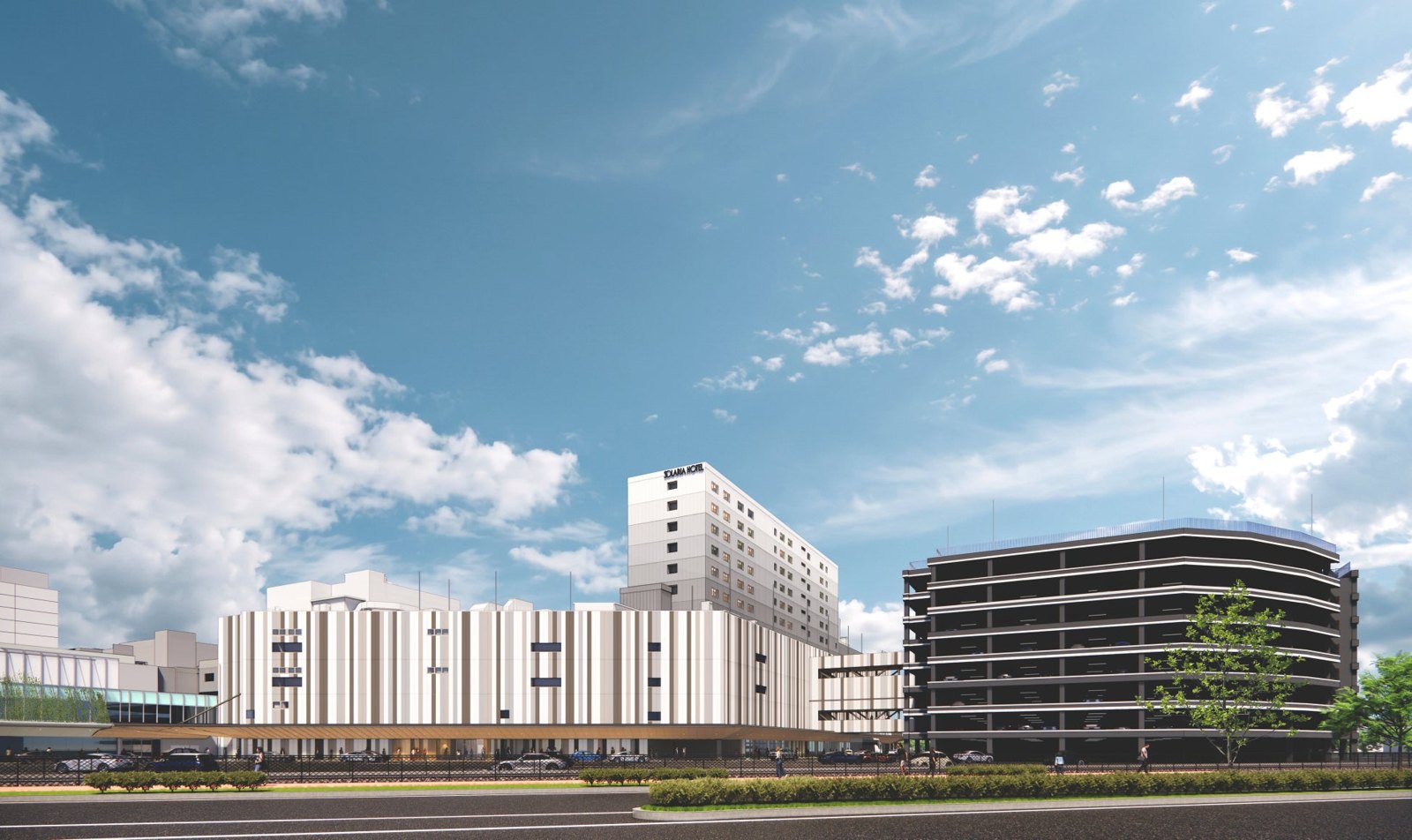
Solaria Nishitetsu Hotel Fukuoka Airport (tentative name; ソラリア西鉄ホテル福岡エアポート), the Nishitetsu Group’s first hotel directly connected to an airport terminal, is scheduled to open around summer 2027 on floors 5–11 of TABISIA, a mixed-use complex under construction next to the domestic passenger terminal of Fukuoka Airport. Its 165 planned rooms equal about 30% of the 548 rooms at the 8 properties currently confirmed on sale within a 2km radius of the site. Using the room stock in that radius and the estimated settled ADR of Hakata Ward, this article examines what demand a terminal-connected location can capture and at what ADR a 165-room development pencils out.
• ADR (average daily rate) = estimated settled rate (tax-exclusive equivalent), calculated by applying segment-specific adjustment factors to the lowest-plan rate each property publishes on OTAs (per room for two guests, tax included). Checked against property-level results disclosed by listed hotel REITs (91 properties, latest 3 months), the median error is about 7%. These are estimates and differ from each property’s actual settled rates and accounting figures.
• Area-level ADR (prefecture / municipality) is the median of the estimated settled rates of the properties in scope (the level of a typical property in the area).
• Where listed prices are mentioned, they are per-room rates for two guests (tax included).
• OCC (occupancy) = rooms sold as a share of total rooms in the area (an estimate based on OTA sales inventory).
• Source: MetroEngines Research (continuously tracks OTA published rates for about 168,000 properties in Japan, of which about 27,000 are confirmed operating)
Room stock in this article covers lodging properties with 10 or more rooms (excluding leisure/love hotels) within a 2,000m radius of Solaria Nishitetsu Hotel Fukuoka Airport. “Operating” means a property whose selling price was confirmed on major booking sites in the latest 3 months (September–November 2026) (as of November 22, 2026; compiled by MetroEngines Research).
- — 165 rooms (planned), opening around summer 2027. The Nishitetsu Group’s first terminal-connected airport hotel, on floors 5–11 of the TABISIA complex next to Fukuoka Airport’s domestic terminal (a leased-space opening).
- — Operating rooms within 2km of the site: 548 rooms at 8 properties (as of November 2026). 165 rooms add +30.1%, but only about 1.4% against the 11,581 rooms within 3km, a radius that reaches the Hakata Station area.
- — Estimated settled ADR is ¥14,471 for Hakata Ward business hotels and ¥11,919 for the 3 main properties within 2km of the airport (12-month average, November 2025–October 2026; both up 11%+ YoY). The airport area sits at 82% of the ward average.
- — On a construction-cost basis, the ADR needed for a 7% GOP yield at 80% annual OCC (modeling assumption) is ¥14,200–¥14,900, almost identical to the Hakata Ward average. Allocating the complex’s total project cost by floor area raises it to ¥20,200.
- — Case B GOP yield is 6.8% at ¥14,500 ADR and 80% annual OCC, and 4.9% at ¥11,900 ADR and 70% OCC. How much of a “connection premium” over the local level can be priced in determines rent-paying capacity.
Summary — 165 Rooms Into a 548-Room 2km Market; Required ADR Close to Hakata Ward Levels
The bottom line first: room stock within walking distance of the airport is thin, and the arrival of 165 rooms will significantly reshape the local mix. Widen the radius to 3km, however, and it connects to the cluster east of Hakata Station, lifting operating rooms to 11,581. It is therefore natural to see this hotel’s competition as not only the properties around the airport but also the Hakata Station area, linked by subway. The construction-cost-based required ADR falls close to the Hakata Ward average, and the upside to earnings lies in how much of the value of a direct terminal connection can be built into rates.
Project Overview — An 11-Story Complex Integrated With Retail and a Bus Terminal
Let us first lay out the project’s framework. TABISIA, whose name was announced in October 2026, is a mixed-use complex with 11 floors above ground, about 43,300㎡ of total floor area and a total project cost of about ¥45 billion. Completion is scheduled for around spring 2027 and the grand opening for around summer the same year. Floors 1–4 hold about 180 retail stores, floor 1 a bus terminal and floor 2 the boarding area for the domestic–international connecting bus, with the hotel occupying the upper floors.
| Item | Details (as stated in published materials) |
|---|---|
| Name | Solaria Nishitetsu Hotel Fukuoka Airport (tentative name) |
| Address | 778-1 Shimousui, Hakata-ku, Fukuoka City, Fukuoka |
| Opening | Around summer 2027 (planned) |
| Total rooms | 165 rooms (planned) · 7 types including double, twin and triple |
| Leased floor area | About 6,300㎡ |
| Floor layout | Floor 5: front desk, lobby, large public bath (with sauna), fitness, meeting space / Floors 6–11: guest rooms |
| Operator | Nishitetsu Hotels Co., Ltd. |
From a development standpoint, the notable point is that the operator opens on leased space rather than owning the building. With the airport company developing the complex and the hotel company leasing the upper floors, the structure splits the initial investment and operating risk between the two. For an overview of Nishitetsu Hotels’ brands, see our profile of Nishitetsu Hotels and its four brands.
Supply Within 2km of the Airport — Rooms Jumped in 2020; at 3km the Radius Reaches Hakata Station
Counting lodging properties within a 2km radius of the site, there were 8 operating properties with 548 rooms whose selling prices were confirmed in the latest 3 months. Adding 165 rooms brings the total to 713, a 30.1% increase in the radius. The annual trend for listed properties with a confirmed opening year shows a jump from 223 rooms in 2019 to 576 in 2020: two properties of more than 100 rooms each (353 rooms in total) that opened that year form the base of today’s supply.
This chart is based on confirmed OTA listings. Only about 19% of properties are listed on OTAs before opening and more than half are listed after opening, so the 2027 value does not include openings other than the planned 165 rooms and is likely to rise as more listings appear. Please refer to it together with the building-plan pipeline based on building confirmation applications (MLIT “Building Starts Statistics”).
Note that the 608 rooms for 2026 in the annual trend is the total of listed properties, 60 rooms more than the 548 rooms currently confirmed on sale. As the denominator for supply impact we used the 548 operating rooms that actually compete in the market. Using the listing-basis 608 rooms as the denominator, the increase would be 27.1%.
By distance band, the structure becomes even clearer. Operating rooms total 274 within 1km and 548 within 2km, but jump to 11,581 within 3km. Hakata Station lies about 2.6km in a straight line from the site, so the 3km circle just captures the cluster around the station. A thin base at the airport’s doorstep with a thick lodging cluster around Hakata Station just beyond it: this two-layer structure is the starting point for reading this area.
Demand Mix of a Domestic-Terminal-Connected Hotel — A Location That Turns Time Constraints Into Value
The strength of a terminal-connected airport hotel is that it removes guests’ time constraints. According to Ministry of Land, Infrastructure, Transport and Tourism (MLIT) materials, Fukuoka Airport’s operating hours are 7:00 to 22:00. For passengers on the first morning flight or arriving on the last flight, a room reachable indoors from the terminal is highly valuable.
| Demand segment | Fit with the location | Points to check in development |
|---|---|---|
| Night before an early flight | Stay the night before a 7 a.m. departure | Early breakfast service, check-out flow |
| Night after the last flight | Stay right after arriving close to 22:00 | Late-night front desk staffing, public bath hours |
| Domestic–international transfers | Connected to the floor-2 connecting bus area | Luggage storage, day-use products |
| Airport workers and business travelers | Stays by flight crews and related businesses | Corporate contracts, multi-night rate design |
| Small MICE and business meetings | Floor-5 meeting space plus air access | Meeting-and-stay packages |
| Inbound visitors and groups | Triple and other multi-guest rooms | Price differences by room type |
It is also worth checking the scale of demand needed. Fukuoka Airport handled about 28.4 million passengers in 2025 (about 19.26 million domestic and 9.13 million international, preliminary), or about 78,000 a day on average. If the 165 rooms run at 80% annual OCC with 1.5 guests per room, the hotel would have about 198 guests a day, roughly 0.25% of airport users. Capturing only a tiny fraction of passengers fills the rooms, so the room count is a reasonable size relative to the demand base. For another hotel opening next to an airport in 2027, our analysis of the 143-room Kagoshima Airport Hotel rebuild digs into how to read room stock and rates around an airport.
Second Runway and Movement Capacity — Expansion to 188,000 Underpins Demand
A demand-side tailwind not to be overlooked is the second runway (2,500m), which entered service on March 20, 2025. According to the Kyushu Regional Development Bureau, annual aircraft movements rose from 176,000 before to 188,000 after it opened, with 211,000 in view for the future. However, the 211,000 figure is positioned as a level at which an increase will be considered in light of future demand and with local consent, and should not be treated as a fixed ceiling. Fukuoka City materials put the slot limit at a maximum of 40 movements per hour.
From a hotel development perspective, more aircraft movements mean more touchpoints with passengers, not only in the early morning and evening. On the other hand, operating hours remain 7:00 to 22:00, so demand for stays before and after flights will not rise mechanically in proportion. Regularly tracking which time slots added flights are assigned to will help with pricing after opening.
Rate Comparison With the Hakata Station Area — The Airport Area Runs at Just Over 80% of Hakata Ward
Next, let us check where rates sit. The estimated settled ADR for Hakata Ward as a whole was ¥17,000 in October 2026 (N=152), up 20.6% from ¥14,100 a year earlier. Chuo Ward was ¥18,500 (N=85), +12.3% YoY. To compare like with like, the next chart narrows Hakata Ward to business hotels (N=134) and compares them with the median of the 3 main business hotels within 2km of the site that have a full year of data (449 rooms in total).
| Area | Latest 12-month average | Prior-year period | YoY |
|---|---|---|---|
| Hakata Ward business hotels (N=132–134) | ¥14,471 | ¥13,017 | +11.2% |
| 3 main properties within 2km of the airport (449 rooms) | ¥11,919 | ¥10,730 | +11.1% |
The 3 properties within 2km of the airport run at 82% of the Hakata Ward business hotel level, and their growth of +11.1% is almost the same pace as the ward. In other words, the airport area has tracked Hakata’s demand expansion while sitting one step below it in price. The new hotel will offer added value in its public bath and sauna, upper-floor rooms overlooking the runways and a direct terminal connection, so it has room to aim at or above the Hakata Ward average rather than the existing local level. That difference is the “connection premium” that will determine the project’s profitability.
Development Scenarios for 165 Rooms — Required ADR of ¥14,200–¥20,200
So at what ADR does a 165-room hotel work as a business? Using the leased floor area of about 6,300㎡ (about 1,909 tsubo) as a proxy for total floor area, we set the investment in three cases. Case A uses ¥2.405 million per tsubo, the 2025 steel-frame hotel/ryokan figure from MLIT’s “Building Starts Statistics”; Case B adds Turner & Townsend’s +5.3% construction cost outlook for 2026; and Case C allocates the complex’s total project cost of about ¥45 billion by floor-area share (14.5%).
| Investment case | Investment | Per room | 6% yield | 7% yield | 8% yield |
|---|---|---|---|---|---|
| A. Construction cost (2025 actual level) | ¥4.59bn | ¥27.83m | ¥12,200 | ¥14,200 | ¥16,200 |
| B. Construction cost (with inflation) | ¥4.83bn | ¥29.30m | ¥12,800 | ¥14,900 | ¥17,100 |
| C. Complex project cost allocated by area | ¥6.55bn | ¥39.68m | ¥17,300 | ¥20,200 | ¥23,100 |
The 40% GOP margin (GOP, gross operating profit = total revenue minus operating costs, as a share of total revenue) is an assumption based on the 39.7% actual for the 73 MHM-operated properties disclosed by Invincible Investment Corporation for the period ended June 2024. In the construction-cost-based Cases A and B, the ADR needed for a 7% yield is ¥14,200–¥14,900, almost identical to the ¥14,500 average for Hakata Ward business hotels. In Case C, which allocates project costs including common areas and retail and transport functions, it rises to ¥20,200. Recovering the whole complex’s cost from the hotel alone is unrealistic, which suggests that structuring returns together with retail rents and the bus terminal function is the rational approach.
Sensitivity and Rent-Paying Capacity — The Range of Returns Under a Lease
Using the Case B investment as the base, we check the GOP yield when ADR and occupancy fluctuate. At the base of ¥14,500 ADR and 80% annual OCC the yield is 6.8%, and it holds at 5.7% even if ADR falls 10% and occupancy falls 5pt at the same time.
| Scenario | Rooms revenue | GOP | GOP yield |
|---|---|---|---|
| Base (ADR ¥14,500 · annual OCC 80%) | ¥699m | ¥329m | 6.8% |
| ADR −10% | ¥629m | ¥296m | 6.1% |
| Annual OCC −5pt | ¥655m | ¥308m | 6.4% |
| Both | ¥589m | ¥277m | 5.7% |
| Required ADR sensitivity (Case B) | Annual OCC 75% | Annual OCC 80% | Annual OCC 85% |
|---|---|---|---|
| GOP yield 6% | ¥13,600 | ¥12,800 | ¥12,000 |
| GOP yield 7% | ¥15,900 | ¥14,900 | ¥14,000 |
| GOP yield 8% | ¥18,200 | ¥17,100 | ¥16,100 |
The two tables above move either ADR or occupancy alone, or look at sensitivity from the required-ADR side. Moving ADR and annual OCC together in five steps each and lining up the GOP yield on the Case B investment of ¥4.83 billion gives the following. Bold cells are yields of 7% or more.
| ADR \ Annual OCC | 70% | 75% | 80% | 85% | 90% |
|---|---|---|---|---|---|
| ADR ¥11,900 (level of the 3 local properties) | 4.9% | 5.2% | 5.6% | 5.9% | 6.3% |
| ADR ¥13,000 | 5.3% | 5.7% | 6.1% | 6.5% | 6.9% |
| ADR ¥14,500 (Hakata Ward business level) | 5.9% | 6.4% | 6.8% | 7.2% | 7.6% |
| ADR ¥16,000 | 6.6% | 7.0% | 7.5% | 8.0% | 8.4% |
| ADR ¥17,500 | 7.2% | 7.7% | 8.2% | 8.7% | 9.2% |
At the level of the 3 local properties (¥11,900), the yield stays at 6.3% even at 90% annual OCC. A 7% yield is reached at 85%+ annual OCC at the Hakata Ward business hotel level (¥14,500), and from 75% at ¥16,000. Bringing rates closer to the Hakata Ward level does more for the yield than adding occupancy.
Because this is a leased-space project, the practical question for the operator is “how much rent can it afford?” Rent has not been disclosed, so we set rent at 30–50% of GOP and converted it into a monthly amount per ㎡ of leased floor area.
| ADR (80% annual OCC) | GOP | Rent 30% | Rent 40% | Rent 50% |
|---|---|---|---|---|
| ADR ¥11,900 | ¥270m | ¥1,100 | ¥1,400 | ¥1,800 |
| ADR ¥14,500 | ¥329m | ¥1,300 | ¥1,700 | ¥2,200 |
| ADR ¥16,800 | ¥381m | ¥1,500 | ¥2,000 | ¥2,500 |
If ADR rises from the local level of ¥11,900 to Hakata Ward’s October level of ¥16,800, affordable rent widens by about 1.4x at the same rent ratio. How much of the connection premium can be reflected in rates determines the earnings opportunity for both landlord and tenant.
Site Conditions — Zoning, Flood Risk and Aircraft Noise
For development at a transport hub, checking hazards and environmental conditions is essential. We summarize the results of querying three points around the site (the hotel location, Fukuoka Airport subway station and the representative point of the lot number) in MLIT’s Real Estate Information Library.
| Item | Result | Development implications |
|---|---|---|
| Zoning | The Fukuoka Airport subway station point is in a commercial zone | Check site-specific conditions within the airport grounds in Fukuoka City’s urban planning information |
| Flooding (maximum assumed scale) | Areas of 0–under 0.5m or 0.5–under 3.0m for both the Mikasa and Umi rivers | Check placement of electrical equipment on lower floors and flood barrier plans |
| Storm surge | Area of 1m to under 3m | Rooms are on floor 6 and above; plan BCP together with the floor-1 transport functions |
| Liquefaction tendency | Somewhat prone to liquefaction (back marsh) | Check foundation and ground improvement specifications |
| Aircraft noise | Class 1–3 zones designated around the airport according to Lden | Check applicable zones on the Fukuoka Airport Office’s notice maps and reflect them in sound insulation specs |
Placing the hotel on floor 5 and above makes it easier to protect guest-room functions against assumed flooding. While runway views add to a room’s appeal, sound insulation directly affects guest satisfaction, so window specifications should be treated as a core part of the product.
Investment Takeaways — Three Perspectives Common to Transport-Hub Hotels
From this analysis, the points that businesses involved in airport and transport-hub development should keep in mind can be organized into three. The first is how the market is defined. Looking only at the 2km radius, this is a large +30% addition of supply, but against the 11,581 rooms within 3km it is only about 1.4%. Supply assessments change greatly depending on the denominator, so supply and demand should be viewed including the area linked by subway.
The second is the basis for rates. There is a gap of about ¥2,600 between the ¥11,900 of the 3 local properties and Hakata Ward’s ¥14,500, and how far the new hotel can exceed that gap is the dividing line for profitability. Translating elements such as the public bath and sauna, views and the direct connection into price differences by room type is effective.
The third is revenue allocation in mixed-use development. A design that recovers the cost of common areas and transport functions, which are hard to recoup from a hotel alone, together with retail rents can be applied to other airport and station-connected developments. For regional banks and investors, evaluating the landlord’s earnings structure separately from the operator’s rent-paying capacity will help sharpen credit assessment. For new projects around Hakata Station, see also our analysis of the Hakata Ekimae 3-chome hotel (tentative name).
Frequently Asked Questions
Q. When will Solaria Nishitetsu Hotel Fukuoka Airport open?
A. Published materials say it is scheduled to open around summer 2027. The hotel name is tentative, and the 165-room count is also a planned figure.
Q. Where will the hotel be?
A. On floors 5–11 of TABISIA, a mixed-use complex next to Fukuoka Airport’s domestic passenger terminal. The front desk and large public bath will be on floor 5, and guest rooms on floors 6–11.
Q. How much will it affect hotel supply in the area?
A. It adds +30.1% to the 548 operating rooms within 2km of the site, and about 1.4% to the 11,581 rooms within 3km, which includes the Hakata Station area.
Q. What ADR would make the project viable?
A. This article’s construction-cost-based estimate is ¥14,200–¥14,900 for a 7% GOP yield at 80% annual OCC. It is a simplified estimate based on assumptions and differs from the actual business plan.
Related Articles
- What Is Nishitetsu Hotels? Profile, Philosophy & 4 Brands
- Hakata Ekimae 3-chome Hotel (tentative name): JR Kyushu’s 150 Rooms, FY2028
- The 45m Airport Height Limit and Hotel Development
- Hiyori Hotel Flex Hakata: 157-Room Reflag and the Rate Gap
References & Sources
■ Data sources
Room stock aggregates, property by property, lodging properties with 10 or more rooms (excluding leisure/love hotels) within 1km, 2km and 3km radii of the site; properties whose selling prices were confirmed on major booking sites in the latest 3 months (September–November 2026) are counted as “operating” (as of November 22, 2026. Within 2km: 12 listed properties with 796 rooms, of which 8 operating properties with 548 rooms). ADR is MetroEngines Research’s estimated settled ADR (tax-exclusive equivalent); Hakata Ward and Chuo Ward are area medians, and the airport 2km radius is the monthly median of the 3 main business hotels with a full year of data (449 rooms in total). The project overview is based on published materials from Nishitetsu Hotels and Fukuoka International Airport and on press reports; aircraft movements and passenger numbers are from MLIT and Fukuoka City publications.
■ Modeling assumptions
The leased floor area of about 6,300㎡ (about 1,909 tsubo) was used as a proxy for total floor area. Investment: Case A = ¥2.405 million per tsubo for steel-frame hotels/ryokan in the 2025 Building Starts Statistics; Case B = Case A plus the +5.3% construction cost outlook; Case C = the complex’s total project cost of about ¥45 billion allocated at a 14.5% floor-area share. The base assumes a 40% GOP margin (referencing the 39.7% actual for Invincible Investment Corporation’s 73 MHM-operated properties for the period ended June 2024), an 85% rooms revenue share and 80% annual OCC, with required ADR = investment × GOP yield ÷ GOP margin × rooms revenue share ÷ (165 rooms × 365 days × annual OCC). Rent is provisionally set at 30–50% of GOP.
■ Limitations
The 80% annual OCC, GOP margin and rooms revenue share are general assumptions, not the hotel’s planned figures. Investment excludes land, FF&E and pre-opening costs, and Case C includes the costs of common areas and retail and transport functions, so it is an upper-end reference. Actual lease terms and the business plan have not been published, and these estimates do not represent the project’s financials. Room stock is based on confirmed OTA listings, so properties not yet listed are excluded and other new openings from 2027 onward are not reflected. Estimated settled ADR is estimated from OTA published rates and differs from each property’s actual settled rates.
■ Market data
- MetroEngines Research & Consulting — estimated settled ADR; room stock by radius (within 2km: 12 listed properties / 8 operating properties with 548 rooms, as of November 2026)
■ Government statistics and public data (in Japanese)
- MLIT Kyushu Regional Development Bureau, “Fukuoka Airport’s Second Runway Has Entered Service” (March 2025)
- MLIT, “Fukuoka Airport’s Second Runway to Enter Service on March 20, 2025”
- MLIT Civil Aviation Bureau, “Technical Review Committee on Fukuoka Airport Capacity Enhancement: Secretariat Briefing Materials”
- Fukuoka City website (Fukuoka Airport capacity enhancement)
- Fukuoka City website (Fukuoka Airport surveys and passenger numbers; 2025 figures preliminary)
- Fukuoka City website (Fukuoka Airport and community coexistence)
- MLIT Real Estate Information Library — zoning, flooding, storm surge, liquefaction
- National Land Numerical Information (Flood Inundation Areas) Product Specification, Version 4.2
- MLIT “Building Starts Statistics” 2025 (hotels/ryokan, steel frame)
■ REIT and industry reports
- Invincible Investment Corporation, Financial Results Presentation for the Period Ended June 2024 (in Japanese)
- Turner & Townsend, “Trends shaping Japan’s construction market in 2026”
■ News and press releases
- Fukuoka International Airport Co., Ltd. press release (PR TIMES, in Japanese)
- Fukuoka Airport’s new complex named “TABISIA” (TRAICY, October 27, 2026, in Japanese)
- Airport-connected “Solaria Nishitetsu Hotel Fukuoka Airport (tentative name)” to open around summer 2027 (Fukuoka Leap Up, March 2025, in Japanese)
- Nishitetsu to open airport-connected Solaria hotel (Fukuoka Now, March 7, 2025)
Recommended Reading
- Solaria Nishitetsu Hotel Osaka Honmachi Opens December 18, 2026: 202 Rooms Into 17,900 Within 1km; Chuo Ward ADR at Pre-Expo Levels
- Kagoshima Airport Hotel Rebuild Brings 143 Rooms by July 2027 — 18 Operating Rooms Within 3km, Kirishima ADR ¥13,600
- 838x Hotel Supply Gap Across 20 Privatized Airports — Fukuoka 31,010 Rooms vs. Obihiro 37, Read Per 10,000 Passengers Within 10km
- Fukuoka Adds 72 Hotels and 1,778 Rooms in 2026 — Business ADR +9.9% in September; What RM Should Watch as Supply Grows
- Fukuoka Hakata/Tenjin Room Supply 2026–2028 — Absorbing Post-Tenjin Big Bang Demand and the Inbound Gateway
- Bouncee by RIHGA Fukuoka Hakata, 117 Rooms: First-Month ADR ¥25,000 Is 1.8x Hakata Ward — Read Through Price Bands of 24,000 Rooms Within 1km