

Fukuoka — Kyushu’s gateway city — reaches a major milestone in 2026 as its two flagship redevelopment programs, Tenjin Big Bang and Hakata Connected, enter their closing phases. Office supply has led the way, but how many hotel rooms are actually stacking up in the lodging market, and where is the demand coming from? This article draws on new-opening data tracked by MetroEngines Research, OTA published rates, and property-level remaining-inventory trends to quantify the supply headroom across Hakata, Tenjin and the Fukuoka Airport area — and the city’s capacity as an inbound gateway.
Metric Definitions Used in This Article
* ADR (average daily rate) = estimated settled rate (tax-exclusive equivalent), derived by applying category-specific adjustment coefficients to the lowest published plan level each property lists on OTAs (double occupancy, per-room rate, tax-inclusive). Cross-checked against property-level results disclosed by listed hotel REITs (91 properties, most recent 3 months), the median error is approximately 7%. These are estimates and differ from each property’s actual transacted rates or accounting figures. Area-level ADR is the median of the properties covered (the level of a typical property in that area). Where published rates are referenced, they are per-room rates at double occupancy (tax-inclusive, averaged across all plans). New openings and room counts cover the scope tracked by MetroEngines Research & Consulting (based on confirmed OTA listings) and are not an exhaustive census. Data source: MetroEngines Research.
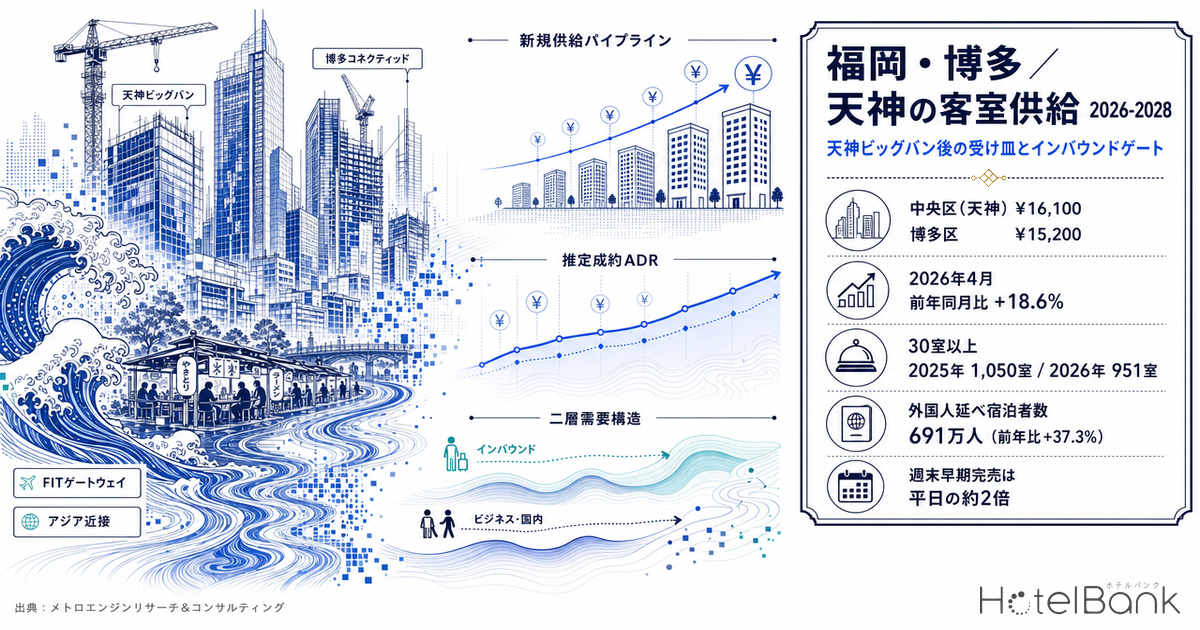
- — Effective downtown supply runs at roughly 1,000 rooms a year — narrowing to properties of 30+ rooms, 23 properties and about 2,190 rooms have been added over the past three years
- — Estimated settled ADR carries a Tenjin premium — Chuo Ward ¥16,100 > Hakata Ward ¥15,200 (May 2026); across the three central wards, Tenjin edges out Hakata
- — ADR is on a clear uptrend, +18.6% year on year — Fukuoka Prefecture posted ¥12,500 in April 2026 (¥10,500 a year earlier), with pronounced seasonality peaking in the autumn demand season
- — Demand is two-tiered: business on weekdays, leisure/inbound on weekends — roughly twice as many properties sell out early on weekends as on weekdays
- — An FIT gateway close to Asia — foreign guest nights reached 6.91 million in 2024 (+37.3% YoY), sixth nationwide, leaving constructive room to absorb more supply
2026: Two Flagship Redevelopments Reach a Turning Point in Central Fukuoka
Tenjin Big Bang is the redevelopment incentive program the City of Fukuoka launched in 2015 to accelerate rebuilding across the Tenjin district. According to materials published by the city, building confirmation applications had reached 93 buildings and completions 74 buildings as of the end of March 2025 — far surpassing the original target of 30 buildings. The program is expected to reach a milestone at the end of 2026, with mixed-use buildings that include lodging functions now entering their final stages: Tenjin Business Center Phase 2 (completion June 2026, opening scheduled for August 2026) and the Tenjin 1-7 Project, which will house the U.S. brand Ace Hotel and is slated for completion at the end of December 2026.
Around Hakata Station, meanwhile, Hakata Connected is the umbrella term for redevelopment that has been underway since 2019, with the Nishi-Nippon City Building scheduled for completion in April 2026. Renewal activity continues elsewhere as well: the Fukuoka Center Building in front of Hakata Station will close in September 2026, with a rebuild under consideration. One notable exception is the “Hakata Station Sky City Project,” which would have used the airspace above the station tracks and incorporated a luxury hotel — its cancellation was announced in September 2025 amid soaring construction and labor costs. With redevelopment led by office and retail uses, the reality is that lodging supply is accumulating partly as one component of redevelopment buildings, and partly through small and mid-sized hotels in the surrounding area.
The New Supply Pipeline — Effective Supply of About 1,000 Rooms a Year
New openings in Fukuoka Prefecture tracked by MetroEngines Research (based on confirmed OTA listings) totaled 42 properties and roughly 390 rooms in 2024, 58 properties and roughly 1,350 rooms in 2025, and 31 properties and roughly 1,111 rooms in 2026. Because much of the property count consists of single-unit vacation rentals and machiya townhouses, the sensible way to capture effective supply as hotels and ryokan is to narrow the field to properties with 30 or more rooms. On that basis the figures are 3 properties and 189 rooms in 2024, 12 properties and 1,050 rooms in 2025, and 8 properties and 951 rooms in 2026 — a three-year total of 23 properties and roughly 2,190 rooms. Read together, effective downtown supply has been running at broadly 1,000 rooms a year.
One important caveat applies here. New-opening data is recorded at the point an OTA listing can be confirmed, and because listings typically appear only a few months before opening, property and room counts for the most recent months onward will rise as further listings are reflected. Figures from the second half of 2026 onward should therefore be treated as a floor. For the impact that a nationwide clustering of openings has on rates and occupancy, we break the numbers down by area in May-Aug 2026 Supply Shock: 25 Hotels, 5,091 Rooms Across Japan.
Source: MetroEngines Research & Consulting (based on confirmed OTA listings, N=131 properties, Fukuoka Prefecture 2024-2027)
The table below lists the main downtown hotels that opened in 2025-2026. In Tenjin, The Gate Hotel Fukuoka by HULIC (ザ・ゲートホテル福岡 by HULIC, 171 rooms) and ONE FUKUOKA HOTEL (41 rooms) opened in 2025, followed by THE KNOT FUKUOKA Tenjin (206 rooms) in April 2026. On the Hakata side, KOKO HOTEL Premier Hakata (120 rooms), BASE LAYER HOTEL Fukuoka (126 rooms) and Bouncy by RIHGA Fukuoka Hakata (バウンシー・バイ・リーガ 福岡博多, 117 rooms) arrived in quick succession, while Fukuoka Prince Hotel Momochihama (福岡プリンスホテル ももち浜, 229 rooms) opened in the Seaside Momochi district. A defining feature is that city and business hotels of more than 100 rooms form the core of new supply.
| Opening | Property | Rooms | Category | Area |
|---|---|---|---|---|
| 2025-04 | The Gate Hotel Fukuoka by HULIC (ザ・ゲートホテル福岡 by HULIC) | 171 | City | Tenjin |
| 2025-04 | ONE FUKUOKA HOTEL | 41 | City | Tenjin |
| 2025-10 | Quintessa Hotel Fukuoka Watanabe-dori (クインテッサホテル福岡渡辺通) | 66 | Business | Watanabe-dori |
| 2026-02 | KOKO HOTEL Premier Hakata (KOKO HOTEL Premier 博多) | 120 | Business | Hakata |
| 2026-03 | Fukuoka Prince Hotel Momochihama (福岡プリンスホテル ももち浜) | 229 | City | Momochi |
| 2026-04 | THE KNOT FUKUOKA Tenjin | 206 | City | Tenjin |
| 2026-04 | BASE LAYER HOTEL Fukuoka (BASE LAYER HOTEL 福岡) | 126 | Business | Hakata area |
| 2026-09 | Bouncy by RIHGA Fukuoka Hakata (バウンシー・バイ・リーガ 福岡博多) | 117 | City | Hakata |
Source: MetroEngines Research & Consulting (based on confirmed OTA listings)
Source: MetroEngines Research & Consulting (map) / circle size = number of rooms
The ADR Hierarchy — Tenjin Holds a Slim Premium Over Hakata
Breaking down estimated settled ADR for May 2026 by ward, Chuo Ward — which contains Tenjin — is highest at ¥16,100 (N=83), followed by Hakata Ward, home to Hakata Station, at ¥15,200 (N=147). Higashi Ward, which includes Fukuoka Airport and the Hakozaki area, sits a notch lower at ¥13,000 (N=12). Nishi Ward and Sawara Ward, which take in the resorts toward Itoshima, are high at around ¥24,000, but with only four properties covered it is worth noting that a small number of resort properties are pulling the figure up. Across the three central wards where business and city hotels cluster, the pattern confirms that Tenjin maintains a slim premium over Hakata.
Source: Compiled by MetroEngines Research & Consulting (May 2026, estimated settled ADR)
By category (Fukuoka Prefecture, May 2026, estimated settled ADR), business hotels stand at ¥11,500 (N=341), city hotels at ¥18,800 (N=40) and resort hotels at ¥17,400 (N=14). City-category properties above 100 rooms — the core of new supply — occupy a rate band roughly 1.6 times that of business hotels, suggesting they are absorbing the upgrade demand generated by downtown redevelopment. Fukuoka’s business-hotel rates also sit within the broader band seen across Japan’s major business-travel cities, where central Fukuoka’s downtown premium is a function of the same office-led redevelopment described above.
ADR Seasonality — A Steady Uptrend on a Year-on-Year Basis
Tracking estimated settled ADR for Fukuoka Prefecture as a whole on a monthly basis, April 2026 came in at ¥12,500 (¥10,500 a year earlier, +18.6% YoY) and May at ¥12,400 (¥11,200 a year earlier, +10.3%) — clearly above the prior year. The seasonality of higher rates during the autumn demand season is also pronounced, with November 2025 reaching ¥13,300. Layering the years by calendar month, 2026 traces a broadly higher trajectory, indicating that downtown rates are on a steady uptrend.
Source: Compiled by MetroEngines Research & Consulting (Fukuoka Prefecture, estimated settled ADR; July 2026 onward is estimated from listed rate levels as of the survey date)
A Two-Tier Demand Structure — Business Fills Weekdays, Leisure and Inbound Thicken Weekends
Demand in central Fukuoka consists of two tiers: a business segment that underpins weekdays, and a leisure and inbound segment that adds depth on weekends. We verified this structure from property-level remaining-inventory trends (on a room basis). Taking a weekday (Thursday, August 6) and a weekend day (Saturday, August 8) in early August 2026, and aggregating properties in Fukuoka Prefecture whose OTA-published allocation represents at least 30% of total rooms, the weekday sample covered 143 properties and the weekend 120 properties (in-progress booking status as of the survey date; both roughly 15-18 days out from check-in).
For early sell-outs (properties where remaining inventory first hit zero at a lead time of LT30 or longer), the weekday count was 7 business-oriented and 5 leisure-oriented properties, versus 12 business and 10 leisure on the weekend — roughly double in both tiers. What stands out is that the median sell-out lead time for business-oriented properties is already LT43 even on weekdays, indicating structurally deep weekday demand. Weekend leisure and inbound demand stacks on top of that, and the result is downtown occupancy supported by both tiers.
Source: Compiled by MetroEngines Research & Consulting (early sell-out = number of properties whose remaining inventory first reached zero at LT30 or longer)
Among the properties with notable early weekend sell-outs, Hotel New Gaea Dome-mae (ホテルニューガイアドーム前, 71 rooms, business) had zero rooms remaining as early as LT90, with 40 days observed sold out — a sign of strong demand filling up early in step with events. Hotel Ichiraku Minami-Tenjin (ホテル一楽 南天神, 147 rooms, business) in southern Tenjin was also observed sold out at LT90 on both the weekday and the weekend, pointing to the strength of a location favored by business and leisure travelers alike. That mid-sized downtown hotels achieve high fill rates regardless of day of week is evidence that the market has headroom to absorb additional supply.
Headroom as an FIT Gateway Close to Asia
Fukuoka is roughly two hours from major East Asian cities such as Seoul, Shanghai and Taipei, and it has used that proximity to build its presence as a gateway for independent travelers (FIT). According to the Japan Tourism Agency’s Overnight Travel Statistics Survey, foreign guest nights in Fukuoka Prefecture reached 6.91 million in 2024 (+37.3% year on year, +62.3% versus 2019), ranking sixth nationwide. A location connected directly to major Asian cities by both air and sea is a structural tailwind that thickens the weekend leisure and inbound tiers — and the concentration of hotel supply within a short radius of Fukuoka Airport is part of what makes that connectivity commercially usable.
On the supply side, effective downtown supply is stacking up at around 1,000 rooms a year, while two-tier demand — business on weekdays, leisure and inbound on weekends — underpins occupancy. As Tenjin Big Bang and Hakata Connected continue to renew central-city functions, the expansion of capacity centered on city and business hotels above 100 rooms is consistent with Fukuoka’s growth headroom as an FIT gateway close to Asia. From 2026 onward, as new buildings integrating office, retail and lodging are completed, the downtown lodging market looks likely to gain further depth.
⚠ Note on future dates and future supply: ADR figures in this article from July 2026 onward are estimates based on selling rates published on OTAs as of the survey date and will fluctuate as the check-in date approaches. Future new openings and supply are floor values based on confirmed OTA listings, and property and room counts are expected to increase as further listings are reflected. Property-level remaining inventory reflects in-progress booking status as of the survey date.
Conclusion
The Fukuoka lodging market in Hakata and Tenjin can be summarized in three points: first, effective downtown supply is accumulating at around 1,000 rooms a year; second, ADR is on a year-on-year uptrend, led by Tenjin and Hakata; and third, two-tier demand — a weekday business segment and a weekend leisure and inbound segment — underpins occupancy. With Tenjin Big Bang and Hakata Connected reaching a milestone in 2026, Fukuoka’s headroom as an FIT gateway close to Asia can be assessed constructively. Whether additional supply meshes with that two-tier demand structure will be the key factor shaping the balance between rates and occupancy from here.
Related Reading
- May-Aug 2026 Supply Shock: 25 Hotels, 5,091 Rooms Across Japan
- [Interview] Yamaya Opens “Shirogane Hanare,” Its First Whole-House Rental in Fukuoka
- Hotels Within 3km of 4 Airports: 148 Properties, 14,827 Rooms — LCC & FIT Inbound Structure
- Construction +41% & Labor Crunch Erase Japan’s 2027-2029 Hotel Supply
References and Sources
- MetroEngines Research & Consulting — new-opening data (based on confirmed OTA listings), estimated settled ADR derived from OTA published rates, property-level remaining-inventory trends
- City of Fukuoka, “Tenjin Big Bang” (Housing and Urban Development Bureau)
- City of Fukuoka, “Hakata Connected” (Housing and Urban Development Bureau)
- Fukuoka Redevelopment Trends 2026: Tenjin Big Bang Enters Its Final Phase (NetIB-News, 2026)
- Inbound Guest Nights in Fukuoka Up 37.3% Year on Year (Nishinippon Shimbun, citing Japan Tourism Agency survey)
- Fukuoka City Tourism Statistics, “Tourism and MICE in Fukuoka City” 2025 edition (City of Fukuoka)
- Japan Tourism Agency, “Overnight Travel Statistics Survey”
■ Data sources
The primary data are MetroEngines Research & Consulting’s new-opening data (based on confirmed OTA listings), estimated settled ADR derived from OTA published rates, and property-level remaining-inventory trends, supplemented by published statistics from the City of Fukuoka and the Japan Tourism Agency.
■ Calculation assumptions
ADR is the estimated settled rate (tax-exclusive equivalent) obtained by applying category-specific adjustment coefficients to each property’s lowest published plan level on OTAs (double occupancy, tax-inclusive). Area ADR is the median of the properties covered. Effective downtown supply is aggregated only for properties with 30 or more rooms.
■ Limitations and caveats
New-opening data are floor values based on confirmed OTA listings, and the most recent months onward have room to increase as listings are reflected. ADR from July 2026 onward is estimated from listed rate levels as of the survey date. Cross-checked against listed hotel REIT disclosures (91 properties, most recent 3 months), the median error is approximately 7%. This is not an exhaustive census.