

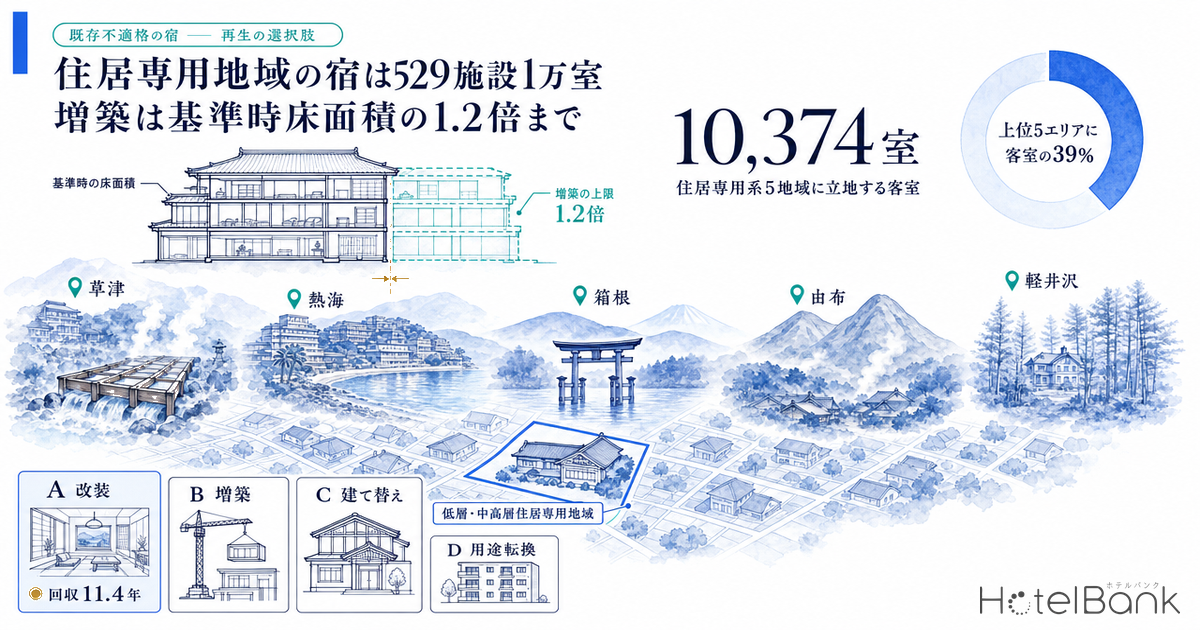
With construction costs stuck at elevated levels, more investors are buying existing inns and upgrading them instead of building new. The first question that trips them up is whether the property can be rebuilt at all. Hotels and ryokan cannot be newly built in Low-Rise or Mid/High-Rise Exclusive Residential zones, yet inns that were already operating before the zoning was designated remain standing as “existing non-conforming buildings” (kizon futekikaku). Extensions are capped at 1.2 times the floor area at the reference date (kijunji), and a rebuild that substantially changes the scale or structure is treated as new construction subject to current use restrictions. This article counts every inn located in residential-only zoning nationwide, and uses the statutes and municipal publications to lay out what can and cannot be done under four options: renovation, extension, rebuild and change of use.
First, how this piece relates to earlier ones. Hotel Development Capacity 2026: Zoning, FAR & Land Price covered site selection for new builds; other HotelBank analyses have covered area classification under city planning (61% of 2026 openings fall outside Urbanization Promotion Areas), procedural legality (buying an inn without an inspection certificate), and when renovations require a building permit. This article does not overlap with those: it focuses on existing inns that no longer conform to use restrictions and covers the permissible scope of extension, reconstruction, rebuilding and change of use.
Metric Definitions Used in This Article
- ADR (average daily rate): an estimated contracted rate (tax-exclusive equivalent), calculated by applying a property-type adjustment factor to the lowest-plan price each property publishes on major booking sites (per room, 2 guests, tax-inclusive). Reconciled against property-level results disclosed by listed hotel REITs (91 properties, most recent 3 months), the median error is about 7%. These are estimates and differ from each property’s actual contracted prices and accounting figures. Area-level ADR is the median of the properties in scope (the level of a typical property in the area).
- Zoning classification: an automated classification overlaying each property’s coordinates on the Ministry of Land, Infrastructure, Transport and Tourism (MLIT) zoning data. Properties within 30m of a zone boundary are counted separately as “classification pending”.
- Reference date (kijunji): the point at which a building ceased to conform to the rules (became existing non-conforming) as a result of the Building Standards Act and related regulations or a city-planning decision or change.
- Data sources: MetroEngines Research & Consulting / MLIT Real Estate Information Library (zoning)
- — 529 properties with 10,374 rooms sit in the five residential-only zone types where hotels and ryokan cannot be newly built. That is 0.8% of rooms in scope, but 84% of them are ryokan or hotel formats.
- — Extensions are capped at 1.2 times the floor area at the reference date. A 3,000㎡ building tops out at 3,600㎡, and because floor-area ratio (FAR) and building coverage limits must also be met, the floor area you can actually add is smaller still.
- — On the other hand, major repairs and major remodeling have no scope limit (as far as use restrictions go). As long as the use does not change, the path to adding value by refreshing rooms, baths and exteriors is open.
- — Five areas, Atami, Hakone, Kusatsu, Yufu and Karuizawa, hold 39% of the rooms. Estimated contracted ADR there ranges from ¥12,000 to ¥26,000, and that level determines how fast a renovation pays back.
- — In our model of the four options, renovation pays back in 11.4 years, extension in 26.5 years, and a rebuild yields 3.8% on the building. In the downside case even renovation takes 49.5 years, so payback does not work.
529 Properties and 10,000 Rooms in Five Residential-Only Zone Types: Only 0.8% Overall, but a Thick Layer in Hot-Spring Towns
Scope: 27,149 properties / 1,266,418 rooms (properties confirmed as operating based on major booking-site listings, excluding 13 properties for which zoning data could not be obtained). Source: MetroEngines Research & Consulting / MLIT Real Estate Information Library
The bottom line first. Inns located in the five residential-only zone types where hotels and ryokan cannot be newly built (Category 1 and 2 Low-Rise Exclusive Residential, Category 1 and 2 Mid/High-Rise Exclusive Residential, and Rural Residential) number 529 properties with 10,374 rooms, just 0.8% of the total in scope. The number is small. But look inside and ryokan and hotel formats account for 331 properties and 8,723 rooms, or 84% of the rooms, and they are concentrated in hot-spring and resort towns such as Atami, Hakone, Kusatsu, Yufu and Karuizawa. Anyone considering an acquisition in these markets cannot avoid this issue at this scale. Industrial and Exclusive Industrial zones (where hotels and ryokan also cannot be built) hold a further 33 properties and 3,850 rooms.
Separately, Category 1 Residential zones hold 1,769 properties and 39,581 rooms. Hotels and ryokan are not prohibited outright in a Category 1 Residential zone; the condition is one of scale: buildings where the total floor area devoted to that use exceeds 3,000㎡ may not be built. Of these, 157 properties with 17,553 rooms have 60 or more rooms. Room count is only a proxy for gross floor area, but it is worth noting that the larger the inn, the more likely an added floor would push it over the threshold.
What the Statutes Say: Extensions Up to 1.2x, No Scope Limit on Major Repairs and Remodeling
Checking Appended Table 2 of the Building Standards Act, hotels and ryokan are not listed as permitted uses in Category 1 and 2 Low-Rise Exclusive Residential zones, Category 1 Mid/High-Rise Exclusive Residential zones or Rural Residential zones; they are explicitly listed as buildings that must not be built in Category 2 Mid/High-Rise Exclusive Residential zones (item (ni), No. 4) and Industrial zones (item (wo), No. 2). Exclusive Industrial zones likewise exclude them, since item (wa), No. 1 refers back to item (wo). In Category 1 Residential zones, item (ho), No. 4 prohibits “buildings used for purposes other than those listed in item (ha), where the total floor area devoted to that use exceeds 3,000 square meters.”
The reason inns actually stand in these zones lies in Article 3, Paragraph 2 of the Act. It provides that where a building existing at the time a provision takes effect or becomes applicable does not conform to it, that provision does not apply. Paragraph 3, Item 2 of the same article explicitly covers cases where restrictions change due to a city-planning decision or change regarding zoning, and inns built before the zoning was designated fall under this treatment. However, under Paragraph 3, Item 3, current rules apply to any extension, reconstruction, relocation, major repair or major remodeling begun after the provision takes effect (retroactive application). The separate exemption by ordinance under Article 3, Paragraph 1, Item 3 is a different mechanism used when converting historic buildings into inns; 31 municipalities have enacted such exemption ordinances.
The exceptions are set out in Article 86-7 of the Act and its Enforcement Order. For use restrictions (Article 48, Paragraphs 1 to 14 of the Act), Order Article 137-7 defines the permissible scope. The statutory requirements are the five below, and MLIT’s “Commentary on Relaxation Measures for Existing Buildings (3rd edition)”, p.88, organizes them in the same framework.
| Type of work | Scope allowed under use restrictions (legal basis) |
|---|---|
| Extension / reconstruction | (1) Within the site as of the reference date (2) Gross floor area and building area after the works conform to the FAR and building-coverage limits relative to the site area at the reference date (3) Total floor area after extension no more than 1.2x that at the reference date (4) Floor area devoted to the non-conforming use also no more than 1.2x that at the reference date (5) No accompanying change of use (Order Art. 137-7) |
| Major repair / major remodeling | All major repairs and major remodeling not accompanied by a change of use (Order Art. 137-12, Para. 13). No cap on floor area etc. as far as use restrictions go |
| Change of use | No relaxation provided for use restrictions (the change-of-use column for Act Art. 48 (1)-(14) is marked “×” in the list on p.3 of the Commentary). Order Art. 137-19, Para. 1 treats hotels, ryokan, boarding houses, apartment buildings and dormitories as similar uses, but its proviso states this does not apply to the application of Act Art. 48 |
| Rebuild substantially changing scale or structure | In the Commentary’s definitions, reconstruction means “building a structure whose use, scale and structure do not differ significantly.” A plan exceeding this is treated as new construction subject to current use restrictions, requiring the permit procedure under the provisos to each paragraph of Act Art. 48 (the designated administrative agency holds a public hearing and obtains the consent of the Building Review Board; Act Art. 48, Para. 15) |
There are three practical implications. First, renovation is broadly permitted. As far as use restrictions go, major repairs and remodeling can be carried out without scope limits as long as the use does not change. The path to adding value by refreshing rooms, baths and exteriors is open. Second, added floor area is capped at 1.2x. A 3,000㎡ building can go up to 3,600㎡, and because it must also meet FAR and building-coverage limits, the floor area that can actually be added is often smaller. Third, a rebuild of the same scale and structure (reconstruction) is treated differently from a rebuild that makes the building larger. Which category a plan falls into is decided by the designated administrative agency for each individual plan, so consultation before acquisition is a prerequisite.
Where They Remain: 40% of Rooms in Atami, Hakone, Kusatsu, Yufu and Karuizawa
Breaking the 529 properties in the five residential-only zone types down by municipality, the top five areas account for 4,037 rooms, or 39% of the total. These are hot-spring towns and highland resorts, where zoning designed to protect the residential environment has been applied broadly and overlaps with areas where inns have clustered. Initial zoning designations were largely made in the early 1970s, but the opening years we track come from listings, so we cannot determine whether a building predates the city-planning decision. Our count shows only the fact of location, that inns currently exist where use restrictions do not permit them; it does not mean that any individual property is existing non-conforming or that it lacks a permit under Article 48. In fact, 198 of the properties are guesthouses, pensions, minshuku or vacation rentals, and private lodging operated under the Private Lodging Business Act (minpaku) is treated as a “residence” under the Building Standards Act, so it raises no regulatory issue even in residential-only zones.
| Zone | Properties | Rooms |
|---|---|---|
| Category 1 Mid/High-Rise Exclusive Residential | 159 | 4,050 |
| Category 2 Mid/High-Rise Exclusive Residential | 157 | 2,861 |
| Category 1 Low-Rise Exclusive Residential | 156 | 2,705 |
| Category 2 Low-Rise Exclusive Residential | 57 | 758 |
| Rural Residential | 0 | 0 |
Price Levels: Estimated Contracted ADR of ¥12,000-26,000 Sets the Payback Budget for Renovation
The investment decision on a turnaround hinges on how far rates can be pushed after renovation. Estimated contracted ADR (12-month average, September 2024 to August 2025) in the main areas where these properties cluster was ¥25,500 in Hakone, ¥23,500 in Yufu, ¥22,300 in Karuizawa, ¥22,100 in Atami, ¥16,200 in Kusatsu, ¥13,500 in Shirahama and ¥11,600 in Miyakojima. These are area-wide levels, not figures for the properties in residential-only zones alone.
Modeling Four Options: A 40-Room Ryokan of 3,000㎡ at the Reference Date
We compared four options using a model ryokan with 3,000㎡ of gross floor area at the reference date and 40 guest rooms, located in a Mid/High-Rise Exclusive Residential zone. Current ADR is set at ¥24,000 in light of the area levels. Construction cost uses 2025 cost per tsubo by structure based on MLIT’s “Statistics on Building Construction Starts” (steel frame ¥2.405M per tsubo, or ¥728,000 per ㎡), with 10% added for inflation during construction. Ryokan GOP margin is set at 15% currently, 18% after renovation and 25% after rebuild, reflecting the characteristics of the format. All of these are simplified estimates based on stated assumptions; actual investment decisions require a detailed feasibility study.
| Option | Investment | Rooms | Annual revenue | Annual GOP | GOP uplift vs current | Payback / yield |
|---|---|---|---|---|---|---|
| Current (do nothing) | — | 40 rooms | ¥245M | ¥36.8M | — | — |
| A. Renovation Recommended Mainly major repairs and remodeling. No scope limit under use restrictions. ¥4M per room | ¥160M | 40 rooms | ¥282M | ¥50.8M | +¥14.0M | 11.4 years |
| B. Extension up to 1.2x +600㎡ = equivalent of 8 rooms. Includes renovation A | ¥640M | 48 rooms | ¥339M | ¥60.9M | +¥24.1M | 26.5 years |
| C. Rebuild with permit Treated as new construction. Requires a permit under the provisos to Act Art. 48 | ¥2.40B | 40 rooms | ¥368M | ¥92.0M | +¥55.2M | Building yield 3.8% |
| D. Conversion to a use permitted in the zone Apartments, dormitories, etc. Uses that can be built even in Low-Rise Exclusive Residential zones | ¥450M | — | ¥40.5M | ¥28.4M (NOI) | — | NOI yield 6.3% |
A: Grow through renovation
The most flexible option under use restrictions. Rate improvement feeds directly into payback, so it works best in areas with higher ADR.
B: Extension is capped at 1.2x
Adding 8 rooms costs ¥480M and pays back in over 26 years. Using the floor area to reconfigure common areas and baths tends to work better than adding rooms.
C and D: Separate the exits
A rebuild requires obtaining a permit and yields 3.8% on the building. Conversion to a use permitted in the zone yields 6.3%, so depending on the location a residential exit can come out ahead.
Sensitivity Analysis: The Verdict on Renovation (A) Flips With ADR and GOP Margin
For option A, the most flexible of the four under use restrictions, we ran upside and downside cases. Because renovation pays back from the increment over the existing GOP (¥36.79M per year), payback lengthens sharply if rate growth falls short of the assumption.
| Scenario | ADR | Full-year occupancy | GOP margin | Investment | Annual GOP | GOP uplift vs current | Payback |
|---|---|---|---|---|---|---|---|
| Downside Limited rate growth, construction cost 15% over | ¥25,500 | 68% | 16% | ¥184M | ¥40.51M | +¥3.71M | 49.5 years |
| Base Main estimate ¥4M per room | ¥27,600 | 70% | 18% | ¥160M | ¥50.77M | +¥13.98M | 11.4 years |
| Upside Renovation lifts rates, construction cost ¥3.8M per room | ¥29,500 | 73% | 20% | ¥152M | ¥62.88M | +¥26.09M | 5.8 years |
In the downside case payback stretches to 49.5 years, meaning that even renovation effectively fails to pay back. In the upside case it is 5.8 years; the same scope of works produces the opposite conclusion. Whether a renovation succeeds depends less on the works themselves than on how far rates can be pushed afterwards.
| Post-renovation ADR | 64% | 67% | 70% | 73% | 76% |
|---|---|---|---|---|---|
| ¥25,500 | 26.2 yrs | 19.7 yrs | 15.8 yrs | 13.2 yrs | 11.3 yrs |
| ¥26,500 | 20.6 yrs | 16.2 yrs | 13.4 yrs | 11.4 yrs | 9.9 yrs |
| ¥27,600 | 16.6 yrs | 13.6 yrs | 11.4 yrs | 9.9 yrs | 8.7 yrs |
| ¥28,500 | 14.4 yrs | 11.9 yrs | 10.2 yrs | 8.9 yrs | 7.9 yrs |
| ¥29,500 | 12.5 yrs | 10.6 yrs | 9.2 yrs | 8.1 yrs | 7.2 yrs |
Set against actual levels in the areas where these properties cluster (Hakone ¥25,500, Yufu ¥23,500, Atami ¥22,100, Kusatsu ¥16,200), placing post-renovation ADR in the ¥28,000 range is realistic only for the upper tier in Hakone and Yufu. At Kusatsu, Shirahama or Miyakojima rate levels, a property is likely to land in the upper-left band of the table, where payback exceeds 20 years. Even with the same 1.2x allowance, whether renovation can pay back is determined by the area’s rate level.
Implications for Acquisition and Financing, and the Turnaround Options
Summing up from the perspective of acquisition and collateral valuation, an inn located in residential-only zoning is realistically valued as “an asset whose value is raised through renovation and small-scale extension”. A valuation based on vacant-land value that assumes a rebuild is hard to use as-is, since there is no guarantee the property can be rebuilt as an inn. Conversely, the high degree of freedom for renovation is a strength: the absence of any scope limit on major repairs and remodeling, as long as the use does not change, can work in its favor compared with similarly aged properties that trip over other regulations. Other HotelBank analysis has estimated the ADR level (a break-even of roughly ¥3,800-4,600) below which conversion to housing or dormitories becomes the better exit.
There are three routes for those seeking to rebuild or expand. The first is a permit under the provisos to each paragraph of Act Article 48. In Yokohama, the process runs from prior consultation, through a public hearing and the consent of the Building Review Board, to the permit application (fee ¥180,000). The city has set permit criteria for only five uses: daily-goods stores, restaurants and the like, offices, automobile repair shops and existing dry-cleaning plants. Accommodation is not among them, so it is reviewed case by case. The second is a Special Use District; materials from MLIT’s National Institute for Land and Infrastructure Management describe it as a method for relaxing specific uses on a limited basis without changing the zoning. The third is a District Plan, which some municipalities use to relax use restrictions according to the characteristics of a district. All of these involve building local consensus, so acquisition due diligence means confirming through municipal publications not whether a route “might be usable” but whether a provision “actually exists”.
In practice, the sequence is: (1) confirm the zoning and extent of the site on the city-planning map; (2) identify the reference date and the floor area at that date from drawings and registers; (3) consult the designated administrative agency on whether the plan counts as extension, reconstruction or major repair; and (4) estimate the headroom left under the 1.2x allowance. Without knowing the floor area at the reference date, the 1.2x allowance cannot even be calculated, so confirming the drawings and whether an inspection certificate exists is the first hurdle.
Methodology and Sources
Of the 27,162 properties confirmed as operating based on major booking-site listings, we overlaid the coordinates of those with latitude/longitude and room counts on the zoning data of the MLIT Real Estate Information Library (data as maintained in July 2026), and automatically classified each by the zoning of the polygon containing the point. Classification succeeded for 27,149 properties with 1,266,418 rooms. To allow for coordinate rounding and error near boundaries, 3,037 properties with a different zone within a 30m radius are treated as classification pending and shown separately in the text. Areas outside city-planning areas and areas with no zoning designated are counted separately as “no zoning designated” and are not mixed with figures inside zoned areas. Opening years come from listings and do not indicate the order of construction and city-planning decisions.
Related Reading
References and Sources
■ Data sources
The population is 27,162 properties nationwide confirmed as operating based on major booking-site listings and holding latitude/longitude and room counts; their coordinates were overlaid on the zoning data of the MLIT Real Estate Information Library (data as maintained in July 2026) and classified automatically (classification succeeded for 27,149 properties, 1,266,418 rooms). Area-level estimated contracted ADR is the 12-month average from September 2024 to August 2025. Construction cost per unit is from MLIT’s “Statistics on Building Construction Starts”, statutes from e-Gov Law Search, and the framework for relaxation measures from MLIT’s “Commentary on Relaxation Measures for Existing Buildings (3rd edition)”. Source: MetroEngines Research & Consulting
■ Model assumptions
The model is a ryokan with 3,000㎡ of gross floor area at the reference date and 40 rooms, located in a Mid/High-Rise Exclusive Residential zone. Current: ADR ¥24,000, full-year occupancy 70%, GOP margin 15%. After renovation: ADR ¥27,600, GOP margin 18%. After rebuild: ADR ¥35,000, full-year occupancy 72%, GOP margin 25%. Construction cost adds 10% for inflation during construction to the 2025 steel-frame cost of ¥2.405M per tsubo (¥728,000 per ㎡). The 600㎡ extension assumes 75㎡ of gross floor area per room, equivalent to 8 rooms. Change of use assumes 75% net lettable area, rent of ¥1,500 per ㎡ per month, 70% NOI margin and conversion cost of ¥150,000 per ㎡. All occupancy rates are assumed full-year figures (assuming operations as of 2026), not actual results for any particular month. The sensitivity analysis fixes investment at ¥160M and GOP margin at 18% and varies ADR and full-year occupancy. GOP margins are set values reflecting the characteristics of the format, not quotations of external statistics. Land cost excluded.
■ Limitations and caveats
Zoning classification is an automated overlay of coordinates and polygons and does not account for site shape or subdivision. Properties within 30m of a boundary are counted separately as classification pending. Opening years come from listings, so the order of construction relative to city-planning decisions or changes cannot be determined. Our count therefore shows only the fact of location, that inns currently exist where use restrictions do not permit them, and does not mean that any individual property is existing non-conforming or lacks a permit under Article 48. ADR figures are estimates and differ from actual contracted prices and accounting figures. The four options and the sensitivity analysis are simplified estimates based on stated assumptions; actual investment decisions require a detailed feasibility study. Whether a plan counts as extension, reconstruction or major repair is decided case by case by the designated administrative agency, so consultation before acquisition is a prerequisite.
■ Statutes
- Building Standards Act (Act No. 201 of 1950), Articles 3, 48, 86-7, 87 and Appended Table 2 (e-Gov Law Search, Japanese)
- Order for Enforcement of the Building Standards Act (Cabinet Order No. 338 of 1950), Articles 137-7, 137-12 and 137-19 (e-Gov Law Search, Japanese)
■ National and municipal publications
- MLIT, “Commentary on Relaxation Measures for Existing Buildings (3rd edition)”, November 2025 (Japanese)
- MLIT, “Commentary on Relaxation Measures for Existing Buildings (4th edition)”, September 2026 (this article’s statutory summary is based on the 3rd edition, but the treatment of Article 48 is the same in the 4th edition) (Japanese)
- MLIT, “Guidelines for Surveying the Current Condition of Existing Buildings (5th edition)”, September 2026 (Japanese)
- City of Yokohama, “Building Permits in Zoning Districts (Building Standards Act Article 48)” (Japanese)
- City of Shizuoka, “Building Permits and Certifications (permits under the provisos to Building Standards Act Article 48)” (Japanese)
- MLIT National Institute for Land and Infrastructure Management, “Relaxing Use Restrictions through Special Use Districts” (Japanese)
- MLIT, “Statistics on Building Construction Starts” (basis for construction cost assumptions)
■ Market data
- MetroEngines Research & Consulting — accommodation property master (coordinates, room counts, property types), estimated contracted ADR
- MLIT Real Estate Information Library — zoning data