

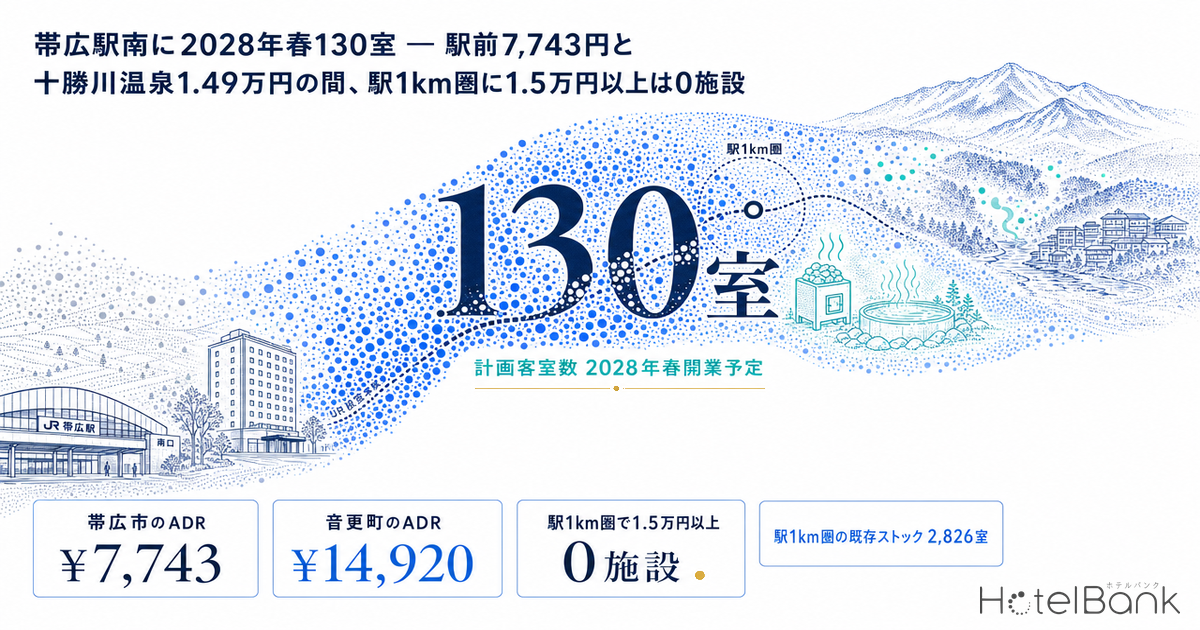
A redevelopment that combines a hotel, condominiums and retail has started on the former Nagasakiya Obihiro store site at the south exit of JR Obihiro Station. Its core is the Sauna & Spa Resort Hokkaido Hotel Obihiro Station South (サウナ&スパリゾート 北海道ホテル 帯広駅南) — 130 rooms, opening planned for spring 2028 — announced by Kachimai Holdings (勝毎ホールディングス) on May 14, 2026. The plan includes a large moor hot-spring bath, a range of saunas, and guest rooms with private saunas or open-air baths, bringing an onsen-resort product to a site one minute on foot from the station. This article looks at where these 130 rooms sit between two price bands — an estimated settled ADR of ¥7,743 in Obihiro City and ¥14,920 in Otofuke Town, home to Tokachigawa Onsen — using the stock by price band within 1 km of the station, seasonality, estimated occupancy, and the makeup of the mixed-use block.
Metric Definitions Used in This Article
| ADR (Average Daily Rate) | Estimated settled rate (tax-exclusive equivalent), calculated by applying a segment-specific adjustment factor to the lowest plan level each property publishes on OTAs (two guests per room, per-room rate, tax included). In a comparison with property-level results disclosed by listed hotel REITs (91 properties, most recent three months), the median error was about 7%. These are estimates and differ from each property’s actual settled rates and accounting figures. Area-level ADR is the median of the covered properties (the level of a typical property in the area). Property-level aggregates use the monthly average for properties with estimates in at least six months between October 2025 and September 2026. |
| OCC (Occupancy) | The share of rooms sold relative to total rooms in the area (an estimate based on OTA sales inventory). It is estimated from how inventory sold on OTAs is taken up, and differs from the actual whole-property occupancy of each property. |
| Booking curve | The trend in remaining OTA room inventory toward the check-in date. LT (lead time) = days until check-in. This article uses LT45–1 only. |
| Within 1 km of the station | A 1 km radius centered on JR Obihiro Station. We count lodging properties with prices observed in July–September 2026 (excluding properties that ended hotel operations and changed use). |
| Data source | MetroEngines Research & Consulting |
- — 130 rooms, opening planned for spring 2028: A hotel, 185 condominium units and three retail buildings are being developed together on the roughly 25,000㎡ former Nagasakiya site at the south exit of JR Obihiro Station. At about 69㎡ of gross floor area per room, the design is heavy on shared facilities.
- — ¥7,743 versus ¥14,920: Obihiro City’s estimated settled ADR (October 2025–September 2026 average) is roughly half that of Otofuke Town, home to Tokachigawa Onsen. Its seasonal swing is also wider, at 2.01x versus 1.56x.
- — No ¥15,000+ property within 1 km of the station: Of 28 properties and 2,826 rooms, 5 properties with 914 rooms sit in the ¥10,000–15,000 band. The new hotel will stand alongside existing properties in the mid band and be the first station-front property in the upper band.
- — Estimated occupancy above 90% from summer to autumn: Obihiro City averaged 92–96% per month in July–September 2026 (OTA-listed inventory basis). Fridays and Sundays are relatively low, leaving room to fill with bath-oriented stays.
- — Upper-band rooms will grow by just over 30%: Together with Hotel Tokachiya’s 185 rooms due for completion at the end of November 2027, the additions total 315 rooms — +34.5% against the 914 existing station-front rooms selling at ¥10,000 or more.
The Plan — 130 Hotel Rooms, 185 Condominiums and 3 Retail Buildings on a 25,000㎡ Block
First, the overall plan as confirmed in primary sources. According to the Kachimai Holdings release, the hotel is located at 3 Nishi 4-jo Minami 12-chome, Obihiro, with a site area of 6,200.20㎡ and gross floor area of 8,974.08㎡; construction started in May 2026 and opening is planned for spring 2028. The project owner is Obihiro Kaihatsu LLC (合同会社帯広開発), with TEPCO Real Estate as development agent, Kume Sekkei for design and supervision, Miyasaka Construction as contractor, and Kachimai Holdings as operator. Kensetsu Tsushin Shimbun reports that the building is a 10-story steel structure and that investors in Obihiro Kaihatsu LLC include Toju Holdings (登寿ホールディングス), Nakamichi Leasing and Hokkaido Electric Power.
The block as a whole is the roughly 25,000㎡ site of the former Nagasakiya Obihiro store (closed March 2024), and two other functions sit alongside the hotel. One is Mid Residence Obihiro Ekimae (ミッドレジデンス帯広駅前), a condominium sold by ES-CON JAPAN, Hoosiers Corporation and JR Hokkaido: a 14-story reinforced-concrete building with 185 units, with move-in scheduled to begin in late March 2028. The other is the retail facility Nanmo Nanmo Obihiro (ナンモナンモ帯広); according to Impress Watch, its three buildings with 5,827㎡ of gross floor area will house restaurants and other shops, and a 513-space self-park garage is also planned.
| Item | Details | Source checked |
|---|---|---|
| Name | Sauna & Spa Resort Hokkaido Hotel Obihiro Station South (サウナ&スパリゾート 北海道ホテル 帯広駅南) | Kachimai Holdings release (May 14, 2026) |
| Rooms | 130 rooms (including rooms with saunas and rooms with open-air baths) | Same as above |
| Room types | Suite 63–71㎡ / Deluxe Twin 42㎡ / Standard Twin 25㎡ | Official hotel website |
| Site / gross floor area | Site 6,200.20㎡ · GFA 8,974.08㎡ (10-story steel structure) | Company release / Kensetsu Tsushin Shimbun |
| Baths | Large moor hot-spring bath, several types of sauna, private saunas, cold plunge, outdoor cool-down area | Company release / official website |
| Facilities | Restaurant, cafe lounge, club lounge, 24-hour fitness | Official website |
| Owner / operator | Obihiro Kaihatsu LLC / Kachimai Holdings | Company release |
| Opening | Spring 2028 (planned) | Company release |
| Residential | Mid Residence Obihiro Ekimae: 14-story RC, 185 units (move-in planned from late March 2028) | ES-CON JAPAN release (February 19, 2026) |
| Retail | Nanmo Nanmo Obihiro: 3 buildings, GFA 5,827㎡, 513 parking spaces | Impress Watch (October 2025) |
The figure that stands out is gross floor area per room. Dividing 8,974.08㎡ by 130 rooms gives about 69㎡, far above the 25–35㎡ per room typical of limited-service hotels. The design can be read as allocating generous floor space to shared facilities — the large bath and saunas, the restaurant and two types of lounge — making this a property that builds bath and food-and-beverage use, not just room revenue, into its income. Total project cost has not been disclosed, so this article does not estimate investment amounts or yields.
ADR in Obihiro and Otofuke — ¥7,743 Versus ¥14,920, With Different Seasonal Swings
So what is the price structure of the market these 130 rooms will enter? According to MetroEngines Research data, Obihiro City’s estimated settled ADR averaged ¥7,743 over the 12 months from October 2025 to September 2026 (N=32 properties; 28–36 per month). Otofuke Town, home to Tokachigawa Onsen, stood at ¥14,920 (N=9 properties), roughly twice the Obihiro level. Neighboring Makubetsu Town was ¥11,937 (N=4–5 properties), in between the two. Because September 2026 includes estimates based on listed levels at the time of the survey, limiting the period to the 11 finalized months (October 2025–August 2026) puts the Obihiro average at ¥7,270. For an analysis that places Obihiro’s rate level among 393 cities and wards nationwide, see Why Hotels Feel Expensive in Obihiro, Fukui & Okayama.
Comparing the shape over the year, the two differ in more than level. In calendar 2025, Obihiro City peaked at ¥10,958 in August and bottomed at ¥5,451 in March, a peak-to-trough ratio of 2.01x. Otofuke Town, by contrast, was ¥19,314 in August and ¥12,368 in March, only 1.56x. The station-front market, driven mainly by business demand, sees rates climb sharply from summer to autumn and fall from winter to spring. The onsen-area inns stay above the ¥12,000 range throughout the year and post close to ¥16,000–18,000 even in January. Stays that include hot springs and meals appear to support rates in the snow season as well.
Year on year, Obihiro City averaged ¥7,088 in January–August 2026, essentially flat at +0.9% against ¥7,022 in the same period a year earlier. By month, June was +16.1% YoY and August −13.0% YoY, so summer rates move up and down from year to year. When planning post-opening rates, peak-month levels should be viewed as a multi-year range rather than fixed on a single year.
Setting Obihiro beside other cities in Hokkaido makes its position clearer. Comparing six regional hub cities in Hokkaido on the same basis, Obihiro City’s 12-month average of ¥7,743 is the second lowest after Kitami (¥6,897), below Hakodate at ¥8,591, Asahikawa at ¥8,617, Kushiro at ¥9,159 and Tomakomai at ¥9,203. Its seasonal swing (highest month ÷ lowest month of 2025 monthly ADR), at 2.01x, is the second largest after Asahikawa’s 2.31x. The onsen areas — Noboribetsu at 1.20x, Otofuke Town at 1.56x and Toyako Town at 1.70x — all swing less than Obihiro City. Note, however, that some non-onsen markets such as Kitami (1.29x) also swing little, so seasonality is not determined by the presence of hot springs alone.
| Type | Municipality | 12-month average ADR | N (properties) | Highest month, 2025 | Lowest month, 2025 | High ÷ low |
|---|---|---|---|---|---|---|
| Regional hub city | Obihiro City | ¥7,743 | 28–36 | Aug ¥10,958 | Mar ¥5,451 | 2.01x |
| Regional hub city | Asahikawa | ¥8,617 | 35–38 | Jul ¥13,528 | Apr ¥5,844 | 2.31x |
| Regional hub city | Hakodate | ¥8,591 | 80–88 | Aug ¥12,474 | Mar ¥6,737 | 1.85x |
| Regional hub city | Kushiro | ¥9,159 | 26–31 | Aug ¥11,988 | Mar ¥6,922 | 1.73x |
| Regional hub city | Tomakomai | ¥9,203 | 13–19 | Aug ¥10,607 | Jan ¥6,596 | 1.61x |
| Regional hub city | Kitami | ¥6,897 | 26–29 | Sep ¥7,332 | Jan ¥5,674 | 1.29x |
| Onsen area | Otofuke Town (Tokachigawa Onsen) | ¥14,920 | 9 | Aug ¥19,314 | Mar ¥12,368 | 1.56x |
| Onsen area | Toyako Town | ¥13,785 | 13–15 | Aug ¥17,206 | Apr ¥10,148 | 1.70x |
| Onsen area | Noboribetsu | ¥18,894 | 14–15 | Dec ¥20,754 | Mar ¥17,288 | 1.20x |
Stock by Price Band Within 1 km of the Station — None at ¥15,000+, 5 Properties and 914 Rooms at ¥10,000+
Next, we break down the station-front market by property. Within a 1 km radius of JR Obihiro Station there are 28 lodging properties with 2,826 rooms whose prices were observed in July–September 2026. Arranging by price band the 25 properties (2,741 rooms) for which a 12-month ADR could be calculated, 10 properties with 1,307 rooms cluster in the ¥7,500–10,000 band; together with the 8 properties and 455 rooms at ¥5,000–7,500, they account for about two-thirds of the total (64.3% on a room basis). The median property-level ADR is ¥8,411.
| 12-month ADR band | Within 1 km of Obihiro Station | Rest of Obihiro City and nearby urban areas | Tokachigawa Onsen and Makubetsu Onsen |
|---|---|---|---|
| Under ¥5,000 | 2 properties / 65 rooms | 3 properties / 88 rooms | — |
| ¥5,000–7,500 | 8 properties / 455 rooms | 7 properties / 302 rooms | — |
| ¥7,500–10,000 | 10 properties / 1,307 rooms | 1 property / 34 rooms | 1 property / 43 rooms |
| ¥10,000–12,500 | 3 properties / 549 rooms | — | 2 properties / 52 rooms |
| ¥12,500–15,000 | 2 properties / 365 rooms | — | 1 property / 170 rooms |
| ¥15,000–20,000 | — | 1 property / 117 rooms | 3 properties / 361 rooms |
| ¥20,000+ | — | — | 3 properties / 146 rooms |
| Total | 25 properties / 2,741 rooms | 12 properties / 541 rooms | 10 properties / 772 rooms |
| Median 12-month ADR | ¥8,411 | ¥6,538 | ¥16,938 |
The ¥10,000–15,000 band “between the station front and the onsen area” is not empty even within 1 km of the station. There are 3 properties with 549 rooms at ¥10,000–12,500 and 2 properties with 365 rooms at ¥12,500–15,000, so a total of 5 properties and 914 rooms already sell in this band. They are mainly properties of 100–270 rooms that promote large baths and breakfast. Above ¥15,000, by contrast, there is not a single property within 1 km of the station; the only ones in this band are Mori no Spa Resort Hokkaido Hotel (森のスパリゾート 北海道ホテル; 117 rooms, operated by Kachimai Holdings), about 1 km southwest of the station, and the ryokan cluster at Tokachigawa Onsen about 8 km away. The 10 properties and 772 rooms at Tokachigawa Onsen and Makubetsu Onsen had a median of ¥16,938, with 6 properties at ¥15,000 or more.
In other words, the market the new hotel faces has two layers. In the ¥10,000–15,000 band it will sit on the same shelf as the five existing station-front properties; at ¥15,000 and above it will be the first property within 1 km of the station. A room mix ranging from 25㎡ Standard Twins to 63–71㎡ Suites is consistent with a design that sells across both layers. The point to keep in mind is that the absence of station-front properties in the ¥15,000+ band does not in itself show that demand exists in that band. Onsen-area rates are supported by stays that include dinner, and reaching the same level at the station front requires making up for the meal component with the experience value of the baths and rooms.
Competitive Map — Existing Stock Clustered North of the Station, and the New South-Exit Block
Plotted on a map, the 28 existing properties are concentrated around Nishi 1-jo to Nishi 3-jo and Minami 9- to 12-chome at the station’s north exit, with only a few on the south-exit side. The new hotel’s site faces the south exit about 240 m from the station, across the tracks from the existing cluster. It will be farther from the north-exit dining district than existing properties, but with three retail buildings in the same block, the plan allows a stay to be completed within the hotel and the block.
On the supply side, one more project is under way in the same period. According to TRAICY (August 5, 2026), Hotel Tokachiya (ホテル十勝屋) is building a 14-story, 185-room hotel on the former North Pacific Bank site at Nishi 2-jo Minami 9-chome; construction started on June 1, 2026, with completion planned for the end of November 2027. The top floor is planned to have a large moor hot-spring bath, a sauna and an open-air bath. The two projects total 315 rooms, equivalent to +11.1% of the 2,826 existing rooms within 1 km of the station (+4.6% for the new hotel alone). Both projects put hot springs and saunas front and center; measured against the 914 existing rooms selling at ¥10,000 or more, the 315 rooms are an addition of +34.5%. The station-front upper price band is heading into a phase in which options thicken rapidly toward 2028.
Note: Information on projects at the planning stage is based on company releases, press reports and building-confirmation applications in the MLIT Building Construction Statistics. It reflects confirmation applications as of the survey date; the number of projects and rooms is expected to increase as further applications are filed, and should be read as a lower bound of the confirmed pipeline at this point.
Estimated OCC and Booking Curves — Above 90% From Summer to Autumn, With Room on Fridays and Sundays
The strength of demand can also be seen in how inventory is taken up. Obihiro City’s estimated OCC (occupancy; an estimate based on OTA-listed inventory) was 92.3% in July 2026, 92.6% in August and 95.6% in September (20 properties / 2,304 rooms covered; based on listings on major booking sites). The booking curves show take-up already at 70.2% for July, 72.7% for August and 75.5% for September 45 days before the stay date, with around 20 points added from there to one day before. The 9–10 point gain in the final two weeks is typical of a station-front market with heavy last-minute bookings from business and individual leisure travelers.
Lining the figures up by day of week reveals where there is room to complement existing demand. Averaged over the 92 days of July–September 2026, Thursday was highest at 96.1%, followed by Wednesday at 95.3% and Tuesday and Saturday at 95.2%, while Friday was 91.0% and Sunday only 88.7%. Business demand gathers midweek and weekend demand leans toward a single Saturday night — the typical shape of a business-led market. Stays built around baths and saunas tend to choose Friday departures or Sunday nights, and can be expected to add demand on the days that are relatively open in the existing market.
Note: Estimated OCC is based on how inventory sold on OTAs is taken up and differs from each property’s actual whole-property occupancy. Coverage is limited to properties listing at least 30% of their total rooms on major booking sites, and the observation spans three months from summer to autumn. For the winter-to-spring trough, refer to the seasonality shown by the monthly ADR above.
The Rate Effect of Baths and Saunas — What Our Nationwide Analyses Show
How much do hot springs and saunas contribute to rates? HotelBank has compiled nationwide data on this point in earlier work. In an analysis of 4,925 business hotels, properties whose large bath is listed with both a hot spring and a sauna (574 properties) had an estimated settled ADR +9.3% higher in a comparison matched on municipality, room-count scale, opening decade and brand (95% interval +6.5% to +12.1%). The gap varies with the municipality’s price band and is larger, at +14.8%, in mid-tier cities where the business-hotel median is ¥7,000–9,000. Obihiro City falls squarely in this mid-tier band.
There are reference figures for in-room facilities too. In an analysis of 792 ryokan and resort hotels comparing lowest-priced plans at the same property, on the same stay date and with the same meal conditions, the listed price of rooms with open-air baths exceeded that of standard rooms by a median of about ¥10,000 (+23.4%). Both figures, however, are differences observed across existing properties nationwide and do not show that the facilities cause higher rates. Nor can they be read as meaning the new Obihiro Station South hotel’s rate will be set at these percentages. It seems reasonable to keep two points as reference lines for price design: the gap for full bath facilities is larger in mid-tier cities, and the premium for in-room open-air baths is close to a fixed amount.
For reference, a simple calculation shows how room revenue for 130 rooms moves with combinations of rate and occupancy. This is an arithmetic sensitivity table, not the hotel’s plan figures or our forecast.
| Assumed annual ADR | 70% occupancy | 80% occupancy | 90% occupancy |
|---|---|---|---|
| ¥10,000 | ¥332M | ¥380M | ¥427M |
| ¥12,500 | ¥415M | ¥475M | ¥534M |
| ¥15,000 | ¥498M | ¥569M | ¥641M |
| ¥17,500 | ¥581M | ¥664M | ¥747M |
What the table shows is that one step in rate (¥2,500) and 10 points of occupancy move revenue by similar amounts. The difference between ADR ¥12,500 at 80% occupancy (¥475M) and ADR ¥15,000 at 70% occupancy (¥498M) is only about ¥20M. Strictly speaking, one step in rate has a somewhat larger effect: starting from ADR ¥12,500 and 80% occupancy, raising the rate one step adds ¥95M, while raising occupancy by 10 points adds ¥59M. In a market where rates fall in winter and spring, a design that lifts trough-season occupancy by drawing guests with the baths is likely to do more for revenue stability than setting a high year-round ADR.
Location and Catchment — Adjacent Land Price Up 20.2% in 5 Years, Resident Population Slowly Declining
Turning to the location: according to MLIT’s Land Price Publication, the 2026 price at standard site “Obihiro 5-8” (Nishi 5-jo Minami 12-chome; commercial zone, 400% floor-area ratio), immediately west of the block, was ¥65,500 per ㎡, up 3.1% year on year and up 20.2% from ¥54,500 in 2021. “Obihiro 5-1” (Nishi 2-jo Minami 9-chome; 600% floor-area ratio) in the central commercial district north of the station was ¥109,000, a rise of only 6.9% over the same five years. “Obihiro 5-7” at Odori Minami 10-chome was ¥72,000, up 30.0%. In level, the north-exit core is higher, but in growth the rise extends across a wide area around the station, and the south-exit redevelopment is proceeding within that trend.
What about catchment population? According to MLIT’s 250 m mesh future population projections, the resident population within a 1.5 km radius of Obihiro Station is expected to fall from 24,296 in 2020 to 23,359 in 2025 and 20,457 in 2040 (−15.8% versus 2020), with those aged 65 and over accounting for 32.2% as of 2025. In the Economic Census, there were 354 establishments and 2,893 employees within a 1 km radius of the station, of which office-type employees accounted for 19.5%. Because employment data at the neighborhood level tends to come out on the low side in regional cities, these figures should be treated as a guide close to a lower bound. Resident population is the usual-resident population based on the national census and does not include visitors or pass-through traffic.
| Indicator | Value | Area / date |
|---|---|---|
| Resident population | 23,359 | 1.5 km radius of station · 2025 estimate |
| Resident population in 2040 | 20,457 (−15.8% vs. 2020) | Same as above |
| Share aged 65 and over | 32.2% | Same as above · 2025 estimate |
| Establishments | 354 | 1 km radius of station · 2021 |
| Employees (office-type share) | 2,893 (19.5%) | Same as above |
This is where the point lies in placing 185 condominium units and a bath-centered hotel at the station front at the same time, in a catchment whose resident population is shrinking. The housing adds permanent residents to the block, while the retail and the hotel’s restaurants and baths take in everyday use by residents and nearby workers as well as hotel guests. Whether local use can support bath and food-and-beverage utilization in winter and spring, when lodging demand thins, is the crux of how the uses complement one another as a mixed-use development.
An Investment and Development View — Three Implications of This Plan
Creating the top of the price range at the station front
The 25 properties within 1 km of the station all fall below an ADR of ¥15,000. A product that brings the onsen-area rate band to the station front is positioned so that it does not overlap head-on with the existing cluster.
Filling the trough season with baths
Obihiro City’s ADR swings 2.01x from peak to trough, against 1.56x in Otofuke Town. A design that builds in hot springs and saunas as a way to dampen the seasonal swing works toward evening out revenue across the year.
Sharing demand with housing and retail
Residents of the 185 units and visitors using the 513 parking spaces support weekday use of the hotel’s restaurants and baths. The idea is to keep the shared floor space working on two wheels: lodging and everyday use.
Summing up so far, this can be positioned as a move in which, after a round of limited-service supply at the station fronts of regional hub cities, stay-oriented products centered on baths set out to open up the upper price band. In Obihiro, two new builds with hot springs totaling 315 rooms will follow one another from the end of 2027 to spring 2028. For lenders and operators, it is time to review supply and demand by price band, existing properties included, on the premise that rooms in the ¥10,000+ band will increase by just over 30%. For existing upper-band properties, too, it may be an opportunity to sharpen how they promote their large baths and saunas.
There are also points to bear in mind. First, summer rates fluctuate from year to year; Obihiro City in August 2026 was −13.0% YoY. Second, estimated OCC exceeds 90% in the three summer-to-autumn months observed, and winter–spring occupancy needs to be confirmed separately. Third, onsen-area rates presuppose stays with dinner, a different way of selling from the room-only model at the station front. Over the year and a half until opening, the progress of nearby projects and winter demand should be monitored continuously.
Note on ADR for future dates: ADR for September 2026 onward in this article is an estimate based on selling prices published on OTAs at the time of the survey and will change as check-in dates approach. Please note that prices currently set high may fall through last-minute adjustments. Opening dates and plan details are as of each company’s announcement and may change.
Conclusion
The Sauna & Spa Resort Hokkaido Hotel Obihiro Station South at the south exit of Obihiro Station is a plan to place 130 rooms with hot springs and saunas between two price bands: ¥7,743 in Obihiro City and ¥14,920 in Otofuke Town. The existing stock within 1 km of the station is 28 properties with 2,826 rooms, of which 5 properties with 914 rooms sell at ¥10,000 or more and none at ¥15,000 or more. While estimated OCC exceeds 90% from summer to autumn, rates fall to nearly half in winter and spring, and there is occupancy headroom on Fridays and Sundays. The block’s makeup, with 185 condominium units and three retail buildings alongside, can be read as a design that sets out to fill these troughs with local use and the baths. With a 185-room hot-spring hotel also due for completion nearby at the end of 2027, the focus after opening will be how much depth the station-front upper price band can sustain.
Related Articles
| Why Hotels Feel Expensive in Obihiro, Fukui & Okayama: 393-City Check |
References and Sources
■ Data sources
Estimated settled ADR, estimated occupancy and booking curves are aggregates estimated by MetroEngines Research & Consulting from published prices and listed inventory on OTAs (monthly aggregates by municipality, and property-level aggregates for the area within 1 km of the station, the rest of Obihiro City, and Tokachigawa Onsen / Makubetsu Onsen; N=47 properties). The plan overview is based on releases from Kachimai Holdings, ES-CON JAPAN and others and on press reports; land prices on MLIT’s Land Price Publication; population on National Land Numerical Information (250 m mesh future population projections); and establishments and employees on the Economic Census for Business Activity (2021).
■ Estimate assumptions
Room revenue in Table 4 is an arithmetic sensitivity of 130 rooms × 365 days × occupancy × ADR (room revenue only, tax-exclusive equivalent), not the hotel’s plan figures or our forecast. Property-level ADR is the monthly average for properties with estimates in at least six months between October 2025 and September 2026; municipal ADR is the 12-month simple average of monthly estimates. The seasonal swing is the highest month ÷ lowest month of monthly ADR for January–December 2025, and the 1 km station radius is determined by the distance from each property’s location coordinates to JR Obihiro Station.
■ Limitations and caveats
Estimated occupancy covers 20 properties in Obihiro City that list at least 30% of their total rooms on major booking sites, and this article uses observations for July–September 2026. Winter-to-spring occupancy cannot be shown by the same method, so the seasonality of monthly ADR is used instead. ADR for September 2026 includes estimates based on listed levels at the time of the survey. Because total project cost has not been disclosed, investment amounts and yields are not estimated. Otofuke Town and Makubetsu Town each have a single-digit number of covered properties, so a price change at one property can easily move the average.
■ Market data
| MetroEngines Research & Consulting — Estimated settled ADR (Obihiro City N=32 properties, Otofuke Town N=9 properties and others; property-level aggregation N=47 properties), estimated occupancy and booking curves (Obihiro City; 20 properties / 2,304 rooms covered) |
■ Government statistics and public data
■ Company releases and news