

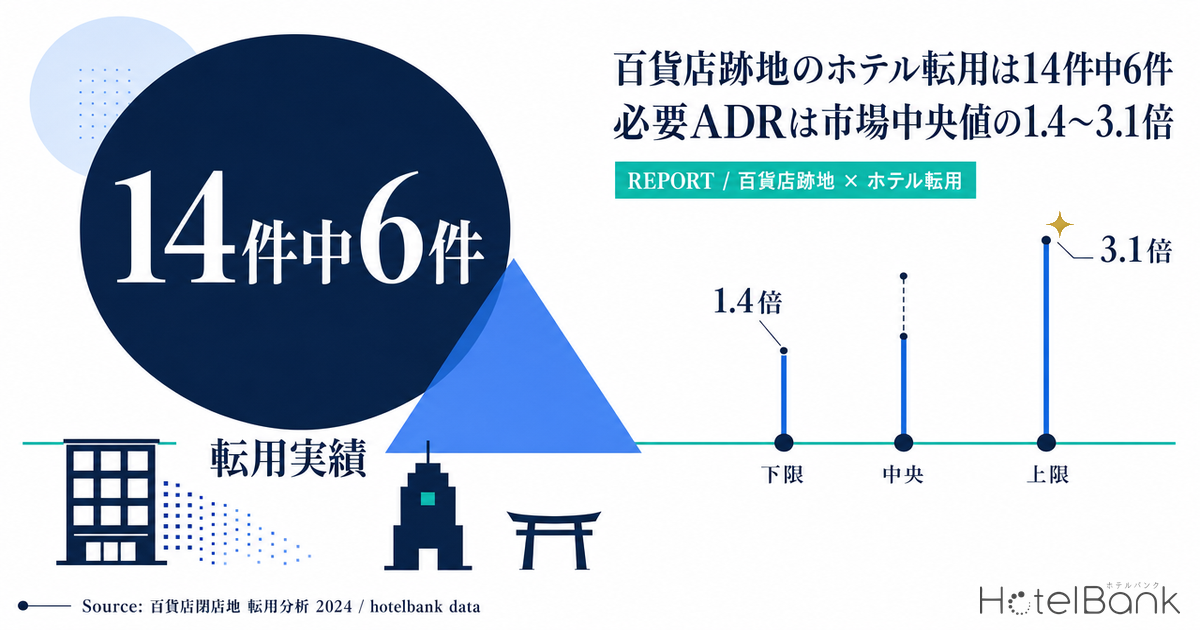
When a department store or GMS reaches the end of its useful life, the site it leaves behind is one of the rarest development opportunities a Japanese city ever sees: a large, consolidated parcel right in front of the station. Land that held tens of thousands of square meters under a single retail use almost never returns to the market in one piece in a mature city center. This report tracks 14 large retail properties that closed from 2020 onward and whose redevelopment plans were disclosed and verifiable against primary sources, and quantifies how often a hotel use is chosen for those sites — and what the locations that do choose hotels have in common. It also back-solves, location by location, the ADR level a standalone 300-room hotel would need on a former retail site, putting numbers on the conditions for feasibility.
Metric Definitions Used in This Article
- ADR (average daily rate): An estimated transacted rate derived by applying category-specific adjustment factors to the lowest-priced plan each property publishes on OTAs (double occupancy, per-room rate, tax-inclusive), stated on a tax-exclusive equivalent basis. Cross-checked against property-level disclosures by listed hotel REITs, the median error is 6.6% (covering the verified categories: business, city, resort, ryokan and capsule). These are estimates and differ from each property’s actual transacted rates and accounting figures. Area-level ADR is the median of the properties in scope (the level of a typical property in that area).
- OCC (occupancy): Rooms sold as a share of total rooms in the area (an estimate based on OTA sales inventory). In this article it is used only as a modeling assumption.
- Required ADR (back-solved): The room rate needed to meet a target NOI yield on an assumed total investment. It is a theoretical value computed on the conservative assumption that the investment is recovered from room revenue alone, and is not the business-plan figure of any actual project.
- Data sources: MetroEngines Research & Consulting / MLIT Real Estate Information Library / MLIT Building Activity Statistics Survey
- — 6 of 14 sites (42.9%) include a hotel use, but only one is a standalone hotel. The other five embed the hotel inside a mixed-use scheme with housing, offices or retail.
- — Placing an identical 300-room, 13,000 sqm building on each of seven sites, the back-solved required ADR ranges from 1.37x to 3.11x the local market median.
- — The dividing line is not parcel size but the land cost ratio. Below 30% (Utsunomiya 5%, Fukushima 6%) a standalone hotel works; above 50% (Hiroshima 53%, Shibuya 59%, Fukuoka 70%) the hotel becomes one component of a mixed-use project.
- — At Fukushima Station East Exit, rising construction costs and inflation made rent terms unworkable and the city abandoned its hotel recruitment in May 2024. A large parcel is not a sufficient condition.
- — Operating assumptions swing the answer widely: Utsunomiya’s required ADR ranges from ¥12,494 to ¥18,880 (a spread of roughly ¥6,386). Designing for operating efficiency matters as much as site selection.
Share of former department store sites that choose a hotel — and what takes their place when they do not
Start with how the sample was built. Among department stores and large retail complexes that closed from 2020 onward, we included only those whose site reuse has been disclosed and could be verified against primary sources — operator press releases, official documents from redevelopment associations, or municipal publications. Projects with undisclosed reuse, and plans reported only in the press without corroboration, were excluded. This is therefore not an exhaustive census: because the search prioritized projects with a hotel use, the hotel share reads higher here than in the true population, which we flag up front.
On that basis, the 14 sites break down as follows. Six (42.9%) include a hotel use, but only one of those is a standalone hotel; in the other five the hotel is embedded in a mixed-use development alongside housing, offices or retail. Hotels are not the single destination for these sites — three are being renewed as retail and two go to residential, so uses are genuinely dispersed.
| Former retail asset | Location | Closure | Site reuse category | Use planned or realized on the site | Opening / completion |
|---|---|---|---|---|---|
| Former Susukino Lafiler | Chuo-ku, Sapporo | May 2020 | Mixed-use + hotel | COCONO SUSUKINO (retail, cinema, 436-room hotel) | Nov 2023 / hotel Jan 2024 |
| Former Onuma Yamagata flagship | Yamagata City | Jan 2020 | Undecided / under study | Nanokamachi Block 1 East District urban redevelopment (basic-concept stage) | FY2040 (concept) |
| Former Nakago Fukushima | Fukushima City | Aug 2020 | Mixed-use (no hotel) | Fukushima Station East Exit Type 1 urban redevelopment (retail, office, housing, public) | FY2028-2029 |
| Former Marui Utsunomiya (Nakamura Daiichi Building) | Utsunomiya City | (fully vacated during the 2020s) | Standalone hotel | Ikegamicho District Superior Building Development Project (300-room hotel, F&B) | Oct 2028 |
| Former Sogo Kawaguchi | Kawaguchi City | Feb 2021 | Retail only | LaLa Terrace Kawaguchi (refurbishment reusing the existing building) | May 2025 |
| Former Tokyu Department Store main store | Shibuya-ku, Tokyo | Jan 2023 | Mixed-use + hotel | Shibuya Upper West Project (retail, hotel, housing, museum) | FY2027 |
| Former Ito-Yokado Kawasaki Minatomachi | Kawasaki-ku, Kawasaki | Jan 2025 | Public / residential | Redevelopment including a 26-storey residential tower | (not disclosed) |
| Former Niigata Mitsukoshi | Chuo-ku, Niigata | Mar 2020 | Mixed-use (no hotel) | Nishiboridori 5-bancho District Type 1 urban redevelopment (retail, office, housing) | Scale under review |
| Former Seibu Otsu | Otsu City | Aug 2020 | Public / residential | For-sale condominium (with childcare facility) | May 2024 |
| Former Takashimaya Sakai | Sakai-ku, Sakai | Jan 2026 | Retail only | HiViE Sakaihigashi (retail renewal of the station building) | Partial reopening Mar 2026 / full building spring 2027 |
| Former Oka Building Market | Kita-ku, Okayama | (demolished for redevelopment) | Mixed-use + hotel | Nodayacho 1-chome 2-3 District Type 1 urban redevelopment (housing, hotel, retail) | Schedule under review |
| Former Hiroshima Station Building ASSE | Minami-ku, Hiroshima | Mar 2020 | Mixed-use + hotel | minamoa + Hotel Granvia Hiroshima South Gate (380 rooms) | Mar 2025 |
| Former Sogo Tokushima | Tokushima City | Aug 2020 | Retail only | Amico Building (continued use as retail plus public facilities) | Phased |
| Former IMS | Chuo-ku, Fukuoka | Aug 2021 | Mixed-use + hotel | (tentative) Tenjin 1-7 Project (office, 192-room hotel, retail) | Completion scheduled May 2027 |
Uses diverge not because of the character of the site itself but because of the earning power required to carry the floor area. All six projects with a hotel sit in commercial zones within walking distance of a station, and they cluster on parcels where land prices are clearly rising: published land prices are up 20.0% YoY in Susukino, 10.7% at Hiroshima Station South Exit and 13.5% in Shibuya Dogenzaka. Where hotels dropped out of the plan, land price growth is comparatively muted.
What happens when the hotel drops out of the plan — the Fukushima Station East Exit record
Whether a hotel goes onto a site is often decided partway through the planning process. The Fukushima Station East Exit Type 1 urban redevelopment project, which includes the former Nakago Fukushima site, originally intended to incorporate a hotel in the retail block immediately adjacent to the station. In May 2024, at a plenary briefing of the city assembly, Fukushima City announced that it had abandoned the hotel recruitment. The reason given was that rising construction costs and general inflation had made operators cautious about new investment, and rent terms could not be agreed. The project outline the redevelopment association currently publishes describes a district area of roughly 2.0 ha and roughly 73,000 sqm of floor area with principal uses of “retail, offices, housing, public facilities, parking and so on” — no hotel. Completion and opening are scheduled for FY2028-2029.
The sequence carries a clear lesson for anyone assessing a former retail site. The presence of a large parcel is not by itself a sufficient condition for a hotel use; the real dividing line is whether the ADR achievable at that location balances against a total investment that now embeds higher construction costs. How many projects stall for the same reason between 2027 and 2029 is traced nationwide in Construction +41% & Labor Crunch Erase Japan’s 2027-2029 Hotel Supply. Below we put numbers on that balance.
The former-retail development pipeline in planning data
MLIT’s Building Activity Statistics Survey identifies 68 planned or under-construction hotels totaling 15,115 rooms as of the survey date. Of those, 20 are mixed-use projects listing retail, commercial, office or residential among their principal uses, and 5 have a joint-development entity — an urban redevelopment association, a superior-building development association and the like — among the project implementers. The count is small, but that does not mean former-retail development is rare: because building confirmation applications are typically filed one to two years before opening, counts for future years are structurally undercounted.
| Project site | Rooms | Principal uses | Work type | Implementer (association, etc.) | Scheduled completion | Gross floor area |
|---|---|---|---|---|---|---|
| Nihonbashi 1-chome 30-32, Chuo-ku, Tokyo | 197 | Retail, offices, hotel, apartments, etc. | New build | Nihonbashi 1-chome Central District Urban Redevelopment Association and others | Oct 2026 | 368,700 sqm |
| Dogenzaka 2-38, Shibuya-ku, Tokyo | 130 | Offices, hotel, restaurants, retail, parking | New build | Dogenzaka 2-chome South District Urban Redevelopment Association and others | Mar 2027 | 87,100 sqm |
| Kumoidori 5-chome 6, Chuo-ku, Kobe, Hyogo | 70 | Hotel, offices, retail, tourism functions, bus terminal, library | — | Kumoidori 5-chome Redevelopment Co., Ltd. | Dec 2027 | 12,000 sqm |
| Ikegamicho 2-2, Utsunomiya, Tochigi | 300 | Hotel (300 rooms), restaurants | Rebuild | Ikegamicho District Superior Building Development Association | Oct 2028 | 13,000 sqm |
| Nodayacho 1-chome 2, 3, Kita-ku, Okayama | 300 | Housing, hotel, retail | New build | Nodayacho 1-chome 2 & 3 District Redevelopment Association | Dec 2028 | 40,400 sqm |
Of these five, only Ikegamicho in Utsunomiya is classified as a “rebuild”; three of the remaining four are new builds, and the Kumoidori project in Kobe has no registered work type. The configuration of 300 rooms in 13,000 sqm of floor area — that is, 43.3 sqm of gross floor area per room — serves as the observed benchmark for the back-solve below. Note that “rebuild” in the Building Activity Statistics refers to demolishing a previous building and erecting an equivalent one; it is a different concept from a conversion that reuses the existing structural frame. In fact, within this sample the only renewal that reused an existing frame is the retail refurbishment of the former Sogo Kawaguchi, and no hotel conversion reusing an existing frame was identified within the scope tracked here.
Where the tracked sites are — which station-front parcels are coming back to market
| Establishments | 2,734 |
| Employees | 29,900 |
| Office-sector share | 23.3% |
| Resident population (2025 estimate) | 35,117 |
| 2040 outlook | -13.2% |
The catchment as a surface — the resident-population mesh around Ikegamicho, Utsunomiya
Former retail sites are casually lumped together as “prime station-front land,” but the demand structure around them differs sharply from project to project. Within a 1.5 km radius of Ikegamicho in Utsunomiya, the resident population is estimated at 35,117 for 2025 and is projected to fall 13.2% by 2040, with a senior share of 31.3%. At the same time, the 1 km radius holds 29,900 employees with an office-sector share of 23.3% — the prefectural capital retains real depth as a business center. A catchment whose residential base is slowly contracting while business demand persists is consistent with a design that anchors accommodation demand in business and wide-area visitation rather than leisure.
Back-solving feasibility — what ADR does a 300-room hotel on a former retail site require?
From here we back-solve the ADR required if an identically sized hotel were placed on each site. This is not any project’s business plan; it is a hypothetical designed to isolate the effect of location alone.
■ Modeling assumptions
- Assumed rooms: 300
- Floor area per room: 43.3 sqm (13,000 sqm / 300 rooms, taking the plan figures of the Ikegamicho, Utsunomiya project)
- Gross floor area: 13,000 sqm (approx. 3,933 tsubo)
- Construction cost per tsubo (2025 actuals): ¥2.026mn/tsubo (RC construction, nationwide; 2025 compilation based on MLIT Construction Starts Statistics)
- Construction cost per tsubo (after build-period inflation): ¥2.240mn/tsubo(assuming construction cost inflation of +5.3% in 2026 and +5.0% in 2027, compounded through the midpoint of construction for an assumed 2028 opening. The inflation rates are not drawn from any published forecast; they are modeling assumptions set conservatively relative to recent actuals)
- Construction cost per tsubo (existing-frame reuse case): ¥1.344mn/tsubo (assumed at 60% of the inflation-adjusted new-build cost. No official unit-cost statistics exist for frame-reuse refurbishment, so this is an assumption used for sensitivity analysis)
- Land acquisition cost: Published land price (commercial land, as of January 1, 2026) x required site area. Required site area = 13,000 sqm floor area / designated FAR
- Assumed OCC: 80%
- GOP margin: 35% (limited-service. Set conservatively with reference to the 38.9% achieved across the 91 properties operated by ICN (Iconia Hospitality, formerly MHM) as disclosed by Invincible Investment Corporation, used as an upper bound)
- Target NOI yield: 5.0%
- Revenue base: Room revenue only (conservatively excluding F&B and banquet income)
Required ADR = (total investment x target yield) / GOP margin / (rooms x 365 days x OCC). FAR figures are designated FARs and do not incorporate bonuses granted under redevelopment schemes(for Tenjin, Fukuoka, 800% is assumed in light of bonuses actually granted under the Tenjin Big Bang program. For Fukushima, Okayama and Hiroshima, the designated FAR at parcel level could not be identified, so 400% was used as a conservative assumption that overstates the required site area. The designated FARs at the nearest standard sites are 600% for Fukushima, 500% for Okayama and 900% for Hiroshima; using those would produce lower required ADRs than shown here).
| Site location | Published land price ¥/sqm | FAR | Land cost | Land share | Total investment | Per room | Required ADR (new build) | Market ADR median | Multiple | Required ADR (frame reuse) |
|---|---|---|---|---|---|---|---|---|---|---|
| Sapporo Susukino | 2,160,000 | 800% | ¥3.51bn | 28% | ¥12.32bn | ¥41.06mn | ¥20,090 | ¥14,704 | 1.37x | ¥14,343 (0.98x) |
| Shibuya Dogenzaka | 7,750,000 | 800% | ¥12.59bn | 59% | ¥21.40bn | ¥71.34mn | ¥34,903 | ¥23,934 | 1.46x | ¥29,157 (1.22x) |
| Fukushima Station East Exit | 168,000 | 400% | ¥0.55bn | 6% | ¥9.35bn | ¥31.18mn | ¥15,256 | ¥8,616 | 1.77x | ¥9,510 (1.10x) |
| Utsunomiya Ikegamicho | 152,000 | 400% | ¥0.49bn | 5% | ¥9.30bn | ¥31.01mn | ¥15,171 | ¥7,300 | 2.08x | ¥9,425 (1.29x) |
| Okayama Nodayacho | 528,000 | 400% | ¥1.72bn | 16% | ¥10.52bn | ¥35.08mn | ¥17,164 | ¥7,818 | 2.20x | ¥11,418 (1.46x) |
| Fukuoka Tenjin 1-7 | 12,400,000 | 800% | ¥20.15bn | 70% | ¥28.96bn | ¥96.53mn | ¥47,226 | ¥16,064 | 2.94x | ¥41,480 (2.58x) |
| Hiroshima Station South Exit | 3,100,000 | 400% | ¥10.08bn | 53% | ¥18.88bn | ¥62.95mn | ¥30,796 | ¥9,910 | 3.11x | ¥25,050 (2.53x) |
The results show clearly how location conditions bite. Ranked by how many times the market median the required ADR is, Sapporo Susukino is lowest at 1.37x, followed by Shibuya Dogenzaka at 1.46x, Fukushima Station East Exit at 1.77x, Utsunomiya Ikegamicho at 2.08x and Okayama Nodayacho at 2.20x, with Fukuoka Tenjin at 2.94x and Hiroshima Station South Exit at 3.11x highest. Susukino and Shibuya come out low because an FAR of 800% lets the same floor area sit on a smaller site, and because the estimated transacted ADR in those markets is already high. And indeed both of these sites have hotels planned or built: 436 rooms in Susukino, and a hotel alongside housing and retail in Shibuya. The same back-solve applied to general development land — not limited to former retail sites — across eight major markets is set out in Policy Rate 1.00%: Break-Even ADR Across Japan’s 8 Hotel Markets.
More important is land cost as a share of total investment. It is just 5% in Utsunomiya and 6% in Fukushima, but reaches 53% at Hiroshima Station South Exit, 59% in Shibuya and 70% at Tenjin in Fukuoka. Where land accounts for more than half of total investment, 300 hotel rooms alone cannot carry the land. That is precisely why, at this price level, former retail sites share their floor area with offices, retail and housing, and the hotel is planned as one component of a mixed-use scheme occupying part of the upper floors. Of the six projects with a hotel use, the only standalone hotel is the one in Utsunomiya, where land is cheapest — the actual choice of use matches what the model implies.
Sensitivity — how the required ADR moves when the assumptions move
| GOP 30% | GOP 35% | GOP 40% | |
|---|---|---|---|
| OCC 75% (modeling assumption as of August 2026) | ¥18,880 | ¥16,183 | ¥14,160 |
| OCC 80% (same basis) | ¥17,700 | ¥15,171 | ¥13,275 |
| OCC 85% (same basis) | ¥16,659 | ¥14,279 | ¥12,494 |
| Required ADR | vs. market median | |
|---|---|---|
| Target NOI yield 4.5% | ¥13,654 | 1.87x |
| Target NOI yield 5.0% | ¥15,171 | 2.08x |
| Target NOI yield 5.5% | ¥16,688 | 2.29x |
| Target NOI yield 6.0% | ¥18,205 | 2.49x |
The base case assumes OCC 80% (a modeling assumption as of August 2026, not an observed occupancy rate), a GOP margin of 35% and a 5.0% target NOI yield, giving a required ADR of ¥15,171. If the GOP margin improves to 40% it falls to ¥13,275, and combined with OCC 85% (again an assumption) it drops to ¥12,494. Conversely, at a 30% GOP margin and OCC 75% (same basis) it takes ¥18,880. The spread reaches roughly ¥6,386, which shows that designing for operating efficiency governs feasibility as much as — or more than — site selection. It is also why pairing with an operator that can hold down operating costs in a limited-service format keeps recurring in former-retail hotel projects.
The sensitivity above is confined to the single Utsunomiya location. Applying the same three sets of operating assumptions to all seven locations shows that while the ranking between locations does not move, the sheer difficulty of making a project work changes substantially with the assumptions.
| Site location | Market ADR median | Optimistic OCC 85% (modeling assumption as of August 2026) GOP 40%, NOI 4.5% | Middle (base) OCC 80% (same basis) GOP 35%, NOI 5.0% | Pessimistic OCC 75% (same basis) GOP 30%, NOI 5.5% |
|---|---|---|---|---|
| Sapporo Susukino | ¥14,704 | ¥14,890 1.01x | ¥20,089 1.37x | ¥27,500 1.87x |
| Shibuya Dogenzaka | ¥23,934 | ¥25,869 1.08x | ¥34,903 1.46x | ¥47,778 2.00x |
| Fukushima Station East Exit | ¥8,616 | ¥11,307 1.31x | ¥15,256 1.77x | ¥20,883 2.42x |
| Utsunomiya Ikegamicho | ¥7,300 | ¥11,244 1.54x | ¥15,171 2.08x | ¥20,767 2.84x |
| Okayama Nodayacho | ¥7,818 | ¥12,721 1.63x | ¥17,164 2.20x | ¥23,495 3.01x |
| Fukuoka Tenjin 1-7 | ¥16,064 | ¥35,003 2.18x | ¥47,226 2.94x | ¥64,647 4.02x |
| Hiroshima Station South Exit | ¥9,910 | ¥22,825 2.30x | ¥30,795 3.11x | ¥42,156 4.25x |
On a multiple basis, the optimistic case brings Sapporo Susukino down to 1.01x and Shibuya Dogenzaka to 1.08x — essentially level with the market median, meaning that if operations run to plan the project works as an extension of standard price points. Under the pessimistic case, however, even the most favorable location, Sapporo, needs 1.87x, while Hiroshima Station South Exit jumps to 4.25x and Fukuoka Tenjin to 4.02x. The relative merits of locations do not reorder when the assumptions move, but the feasibility line moves by nearly a factor of two. Before deciding whether to acquire a site, you need to settle first on how adverse an operating case you can absorb.
ADR trends in the markets these sites sit in — can they absorb the assumed room count?
Whether a market can carry the required ADR also depends on whether its rates are rising. Overlaying monthly estimated transacted ADR for three of the site markets, all three show clear peaks in summer and around the New Year, and the past year sits above the prior-year level in the same months. The trailing 13-month median is ¥7,300 for Utsunomiya City (N=45 properties), ¥7,818 for Kita-ku Okayama (N=49) and ¥14,704 for Chuo-ku Sapporo (N=136).
What matters here is that the required ADR is being compared against the market median. The median reflects the level of a typical property in that city, and a newly built 300-room hotel would naturally aim above it. Utsunomiya’s required ADR of ¥15,171 is 2.08x the market median, but that means “within reach if the product can consistently capture the upper price band of the market” — not that the project is infeasible. Large station-front parcels are among the few development opportunities with the locational qualities needed to reach for that upper band.
What makes a site likely to become a hotel — five conditions
Condition 1 Land cost below 30% of total investment
In the band occupied by Utsunomiya (5%), Fukushima (6%) and Okayama (16%), a standalone hotel is worth considering. Above 50%, the design becomes one of sharing floor area within a mixed-use scheme.
Condition 2 FAR of 600% or more
The same floor area fits on a smaller site, compressing land cost. That effect is why Susukino and Shibuya (both 800%) show the lowest required-ADR multiples.
Condition 3 A deep upper price band in the local market
Required ADR runs 1.4x to 3.1x the market median. Whether a price band at roughly twice the median can already be sustained is the dividing line.
Condition 4 A catchment that retains business demand
Utsunomiya has 29,900 employees within 1 km and an office-sector share of 23.3%. A catchment where business demand persists even as the residential base slowly shrinks supports weekday occupancy.
Condition 5 A joint-development scheme
Urban redevelopment projects and superior-building development projects support both consensus-building and up-front costs on former retail sites with many rights holders. All five pipeline projects include a joint-development entity.
Caveat Frame-reuse conversions do not appear in the statistics
With construction costs rising, the modeled required ADR for frame reuse comes out roughly 40% below new build — yet no hotel conversion reusing an existing frame was identified within the scope tracked here. The practical questions of systems replacement and code compliance are the next issue.
Conclusion
Tracking 14 large retail properties that closed from 2020 onward against primary sources, six include a hotel use and only one is a standalone hotel. These sites are absorbed by retail, housing and offices alike; a hotel is not the automatic answer. The dividing line is not the size of the parcel but the balance between the ADR achievable at that location and a total investment that now embeds relentlessly rising construction costs.
Back-solving with the common assumption of 300 rooms in 13,000 sqm across seven locations, the required ADR ranges from 1.37x to 3.11x the market median. Where land accounts for less than 30% of total investment, a standalone hotel is chosen; above 50%, the hotel appears as one component of a mixed-use scheme — and the actual choices of use line up with that structure. Cases like Fukushima Station East Exit, where the hotel drops out midway through planning, are explained by the same mechanism: rent terms could not keep pace with construction cost inflation.
Rising construction costs also suppress new supply and thereby raise the scarcity value of existing stock. Large consolidated parcels do not come to market in front of stations very often. Before deciding the use, pin down in numbers the price band achievable at that location and the land cost ratio — that is where a former-retail hotel project starts.
Related reading
- Policy Rate 1.00%: Break-Even ADR Across Japan’s 8 Hotel Markets
- Hotel vs Condo Land Rivalry: ADR-Implied Feasible Land Price Map
- Hotel Development Capacity 2026: Zoning, FAR & Land Price in 5 Markets
- Construction +41% & Labor Crunch Erase Japan’s 2027-2029 Hotel Supply
- Hotel Build Times: 2.80-Year Median, 1.96 Solo vs 4.00 Mixed-Use
References and sources
■ Data sources
The estimated transacted ADR (municipality-level median) and the tallies of planned and under-construction hotels in this article are built on price and inventory data that MetroEngines Research & Consulting collects daily from publicly listed OTA inventory. Estimated transacted ADR applies category-specific adjustment factors to each property’s lowest-priced plan; cross-checked against property-level disclosures by listed hotel REITs, the median error is 6.6% (tax-exclusive equivalent, covering the verified categories: business, city, resort, ryokan and capsule). Market median ADR is the monthly median for each municipality over the trailing 13 months (August 2025 to August 2026). Land prices, zoning and FAR come from the MLIT Real Estate Information Library (Published Land Prices as of January 1, 2026); construction cost per tsubo from MLIT Construction Starts Statistics; planned and under-construction hotels from the MLIT Building Activity Statistics Survey; and catchment data from the Economic Census (employment) and National Land Numerical Information future population projections by 250 m mesh (residents). The list of 14 sites includes only projects individually verified against primary sources: operator press releases, official redevelopment association documents and municipal publications.
■ Limitations and caveats
First, the 14 sites are not an exhaustive census. They are limited to projects whose site reuse was disclosed and verifiable against primary sources, and the search prioritized hotel uses, so the 42.9% hotel share reads higher than in the true population. Second, required ADR is a theoretical value designed to isolate differences in location conditions, not the business-plan figure of any actual project. Because it conservatively assumes recovery from room revenue alone, mixed-use projects with F&B, banquet or tenant income would require a lower ADR. Third, OCC, GOP margin and target NOI yield are all modeling assumptions, not observed occupancy or actual GOP. Fourth, FAR figures are designated FARs and exclude bonuses granted under redevelopment schemes(for Tenjin, Fukuoka, 800% is assumed in light of bonuses actually granted; for Fukushima, Okayama and Hiroshima the designated FAR at parcel level could not be identified, so 400% was used as a conservative assumption, while the designated FARs at the nearest standard sites are 600% for Fukushima, 500% for Okayama and 900% for Hiroshima). Fifth, the cost per tsubo for the existing-frame reuse case is an assumed 60% of new build; no official unit-cost statistics exist for frame-reuse refurbishment. Sixth, the Building Activity Statistics are based on building confirmation applications, and because those are typically filed one to two years before opening, counts for future years are structurally undercounted. Estimated transacted ADR is an estimate and differs from each property’s actual transacted rates and accounting figures.
■ Market data
- MetroEngines Research & Consulting — estimated transacted ADR (municipality-level median), tallies of planned and under-construction hotels
■ Government statistics and public data
- MLIT Real Estate Information Library — Published Land Prices (as of January 1, 2026) and city planning decision information (zoning)
- MLIT “Building Activity Statistics Survey” — uses, work type, implementer and scheduled completion of planned and under-construction hotels
- MLIT Construction Starts Statistics — construction cost per tsubo by structure type
- MIC / METI “Economic Census — Activity Survey” — establishments, employees, office-sector share
- MLIT National Land Numerical Information “Future population projections by 250 m mesh” — resident population, age structure, 2040 projection
- Utsunomiya City, “Superior Building Development Project”
- Okayama City, “Nodayacho 1-chome 2 & 3 District Type 1 Urban Redevelopment Project”
- Fukushima City, special page on the East Exit redevelopment and integrated east-west city planning
■ Corporate and redevelopment association disclosures
- Mitsubishi Estate, “Construction starts on the (tentative) Tenjin 1-7 Project” (May 15, 2024)
- Tokyu Land, “COCONO SUSUKINO second opening, January 31, 2024”
- Tokyu Land, “COCONO SUSUKINO” project overview
- Fukushima Station East Exit District Urban Redevelopment Association, “Project overview”
- Nodayacho 1-chome 2 & 3 District Redevelopment Association, “Project overview”
- Takashimaya, “Notice of the closure of Takashimaya Sakai”
- Invincible Investment Corporation portfolio (GOP performance of operated hotels)
■ Press and industry sources
- Shimotsuke Shimbun, “Safety ceremony held for demolition of the former Marui Utsunomiya”
- Nihon Kogyo Keizai Shimbun, “Redevelopment building in Ikegamicho, Utsunomiya: 14 storeys above ground plus one basement, 13,000 sqm”
- Kenbiya, “JR Fukushima Station East Exit redevelopment abandons hotel recruitment”
- Toshi Shogyo Kenkyusho, “minamoa opens March 24, 2025”
- Toshi Shogyo Kenkyusho, “Takashimaya Sakai closes January 7, 2026; Nankai Electric Railway’s ‘HiViE Sakaihigashi’ to follow”
- Ryutsu News, “Former Sogo Kawaguchi site: Mitsui Fudosan to renew as a retail facility”
- Impress Watch, “A new 165 m landmark on the former Tokyu Department Store main store site in Shibuya”
- Impress Watch, “A 150 m, 37-storey mixed-use tower on the former Niigata Mitsukoshi site”
- Zaikei Shimbun, “Mixed-use complex on the former Nakago site at JR Fukushima Station East Exit”
- Tokyo Economic Research Center, “List of post-closure uses of regional department stores” (December 2019; referenced as prior work)