

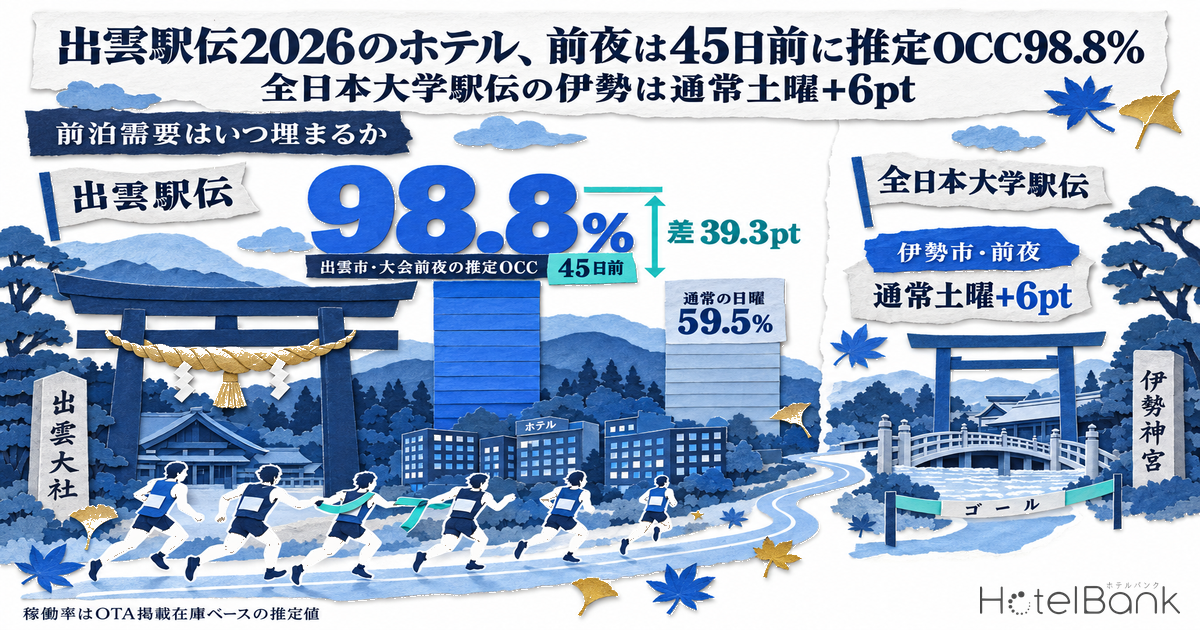
For October 11, the night before the 38th Izumo All-Japan University Invitational Ekiden (出雲駅伝; Monday, October 12, 2026, a national holiday, 9:10 a.m. start), MetroEngines Research data on booking pace at accommodation in Izumo City shows that occupancy (estimated, based on OTA-listed inventory; hereafter “estimated OCC”) had already reached 98.8% at 45 days before the stay date, with only 17 rooms left across the 49 properties and 1,420 rooms in the sample. A normal Sunday in the same city sits at just 59.5% at 45 days out, a gap of 39.3pt. By contrast, for the 58th All-Japan University Ekiden (全日本大学駅伝), which starts at 8:10 a.m. on Sunday, November 1, estimated OCC in Ise City on the finish side for the race-eve night of October 31 runs only about 6pt above a normal Saturday, and in Nagoya on the start side the event is barely visible at all. This article measures how many rooms actually sit around the start and finish points, compares race-eve inventory depletion and listed prices with the ordinary days on either side, and works out when, for how many nights, and how far the pre-race lodging demand of a single-day event spreads.
Metric Definitions Used in This Article
- Room stock: Total rooms at accommodation properties located within a 3 km or 10 km radius of a start/finish point, or within the city, for which a selling price was observed in the latest three months (stay dates July 6 – October 6, 2026), based on listings on major booking sites.
- OCC (occupancy): Rooms sold as a share of total rooms in the area (an estimate based on inventory sold through OTAs). In this article it is used only at the city/ward level, as “occupancy (estimated, based on OTA-listed inventory)”. It is an estimate derived from how inventory sold on OTAs is being depleted and differs from the actual occupancy of a whole property. The sample is a fixed set of properties that list at least 30% of their total rooms; the number of properties and rooms covered for each stay date is noted alongside the charts and tables.
- Booking curve / LT (lead time): The path of OTA rooms remaining as check-in approaches. LT is the number of days until check-in; this article uses only observations within LT45 (45 days out).
- ADR (average daily rate): An estimated settled rate (tax-exclusive equivalent), calculated by applying a segment-specific adjustment factor to the lowest-plan level each property publishes on OTAs (per room, two guests per room, tax included). Checked against property-level results disclosed by listed hotel REITs (91 properties, latest three months), the median error is about 7%. It is an estimate and differs from each property’s actual settled rates and accounting figures. Area-level ADR is the median of the properties covered (the level of a typical property in the area).
- Listed price: The per-room rate for two guests sharing one room (tax included). This article uses each property’s lowest-plan listed price; for properties that had already stopped selling, the price at the last listing was used.
- Data source: MetroEngines Research (observed as of October 5, 2026)
- — On the eve of the Izumo Ekiden (stay night of October 11, 2026), Izumo City’s occupancy (estimated, based on OTA-listed inventory) stood at 98.8% with 17 rooms left at 45 days before the stay date (49 properties, 1,420 rooms). That is 39.3pt above the 59.5% of a normal Sunday at the same point.
- — Of the nine cities and wards compared, only Izumo City (+6.5pt) saw the middle night of the three-day weekend run ahead of the first night. In the July three-day weekend, with no race, the gap was −7.4pt; this “reversal in the order of filling” is the trace of the race effect once the holiday effect is separated out.
- — On the eve of the All-Japan University Ekiden (stay night of October 31), Ise City runs 5–6pt above a normal Saturday, while the lowest-plan listed price is 1.00x a normal Saturday (N=37 properties). Inventory depletion is running ahead, leaving room on the price side.
- — Room stock around the start and finish points: 16 properties and 138 rooms within 3 km of the Naiku Ujibashi Bridge, versus 301 properties and 36,547 rooms within 10 km of the Atsuta Jingu west gate. The depth of the receiving market shapes what race eve looks like.
- — Windows remain in the surrounding cities and on the neighboring nights. Matsue City built late, from 86.4% at 45 days out to 97.6% as of October 5; Izumo City still has 263 rooms on race-day night (October 12), and outside Ise, Toba City has 284 rooms and Tsu City 274 rooms left.
The Three University Ekiden Races — Morning Starts Make a Pre-Race Night a Given
First, the outline of the three races covered. The Izumo Ekiden leaves the main torii of Izumo Taisha (Seidamari) at 9:10 a.m. and returns to the front of Izumo Dome over six legs and 45.1 km, with 22 teams competing. The All-Japan University Ekiden departs Atsuta Jingu in Nagoya at 8:10 a.m., and 27 teams carry the sash over eight legs and 106.8 km to the Ujibashi Bridge at Ise Jingu’s Naiku in Mie Prefecture. In both cases it is not realistic for athletes, staff and university officials to arrive on the morning of the race, so these are events that presuppose a stay the night before.
| Race | Date and start | Start / finish | Legs and distance | Field | Race eve |
|---|---|---|---|---|---|
| 38th Izumo All-Japan University Invitational Ekiden | Mon (holiday), October 12, 2026, 9:10 a.m. | Izumo Taisha main torii → Izumo Dome | 6 legs, 45.1 km | 22 teams | Sun, October 11 = middle night of the three-day weekend |
| 58th All-Japan University Ekiden Championship | Sun, November 1, 2026, 8:10 a.m. | Atsuta Jingu → Ise Jingu Naiku Ujibashi Bridge | 8 legs, 106.8 km | 27 teams | Sat, October 31 |
| 103rd Tokyo-Hakone Round-Trip College Ekiden Race (reference) | Sat, January 2 and Sun, January 3, 2027 | Otemachi, Tokyo ⇔ Lake Ashi, Hakone | 10 legs, 217.1 km | — | Fri (holiday), January 1 / Sat, January 2 |
Source: Compiled by the HotelBank Editorial Team from the event outlines on each race’s official website
The eve of the Izumo Ekiden falls on the middle night of a three-day weekend that includes Sports Day (October 12). In other words, “holiday-weekend lodging demand” and “pre-race lodging demand” land on Izumo City at the same time on October 11, so even when inventory has disappeared, it is not obvious at a glance which effect is responsible. The middle of this article shows a way to read the two apart. Compared with mass-participation city marathons, an ekiden has a much smaller field of runners, and the participants move as teams.
Room Stock Within 3 km and 10 km of the Start/Finish Points — 138 Rooms Within 3 km of Ujibashi, 36,547 Within 10 km of Atsuta
The table below counts the properties with an observed selling price in the latest three months inside circles of 3 km and 10 km radius drawn around each of the four start and finish points. The thinnest room stock is at the finish of the All-Japan University Ekiden: the 3 km ring around the Ujibashi Bridge at Ise Jingu’s Naiku holds only 16 properties and 138 rooms, with not a single hotel-type property. Widening to 10 km brings in the business hotels around Iseshi and Ujiyamada stations and the ryokan of Futami, for 86 properties and 2,369 rooms. In contrast, the start point at the Atsuta Jingu west gate has 301 properties and 36,547 rooms within 10 km, 15.4 times the depth of the finish side.
| Start / finish point | Within 3 km properties / rooms |
Within 10 km properties / rooms |
Of the 10 km ring: hotel types |
Ryokan | Other |
|---|---|---|---|---|---|
| Izumo Taisha main torii (Izumo, start) | 29 / 280 rooms | 67 / 1,969 rooms | 17 / 1,578 rooms | 9 / 265 rooms | 41 / 126 rooms |
| Izumo Dome (Izumo, finish) | 25 / 1,287 rooms | 69 / 2,008 rooms | 17 / 1,619 rooms | 11 / 278 rooms | 41 / 111 rooms |
| Atsuta Jingu west gate (All-Japan, start) | 23 / 2,520 rooms | 301 / 36,547 rooms | 199 / 34,607 rooms | 12 / 204 rooms | 90 / 1,736 rooms |
| Ise Jingu Naiku Ujibashi Bridge (All-Japan, finish) | 16 / 138 rooms | 86 / 2,369 rooms | 16 / 1,582 rooms | 28 / 587 rooms | 42 / 200 rooms |
Hotel types = business, city, resort and capsule hotels; Other = whole-house rentals, guesthouses, minshuku, etc. Properties with an observed selling price in the latest three months (based on listings on major booking sites). Source: Compiled by the HotelBank Editorial Team from MetroEngines Research
The Izumo Ekiden starts and finishes within Izumo City, and the two points are only 5.2 km apart in a straight line. The contents of their 3 km rings, however, are a study in contrast. On the Izumo Taisha start side, ryokan account for 6 properties and 212 rooms of the 29 properties and 280 rooms, and the rest are mostly whole-house rentals and guesthouses. The Izumo Dome finish side takes in the cluster of business hotels around Izumoshi Station, so hotel types alone reach 12 properties and 1,251 rooms. Even overlaying the two 10 km rings gives 74 properties and 2,073 rooms, a scale at which most of Izumo City as a whole (90 properties, 2,252 rooms) fits inside a single circle. The 22 teams, race officials and visiting supporters all have to be absorbed by this 2,000-room-class market.
Izumo Ekiden: start and finish points (★) with the 3 km ring (dashed) and 10 km ring (dotted); circle size shows room count. Source: Compiled by the HotelBank Editorial Team from MetroEngines Research
All-Japan University Ekiden: 3 km and 10 km rings around the finish point (★). There are no hotel-type properties within 3 km; rooms are split between the Iseshi Station area and Futami. Source: Compiled by the HotelBank Editorial Team from MetroEngines Research
Izumo City on Race Eve, Oct 11 — Estimated OCC 98.8% at 45 Days Out, 39.3pt Above a Normal Sunday
So how did this 2,000-room-class market fill on the eve of the race? For the stay night of Sunday, October 11, 2026 in Izumo City, estimated OCC at 45 days out (as of August 27) was 98.8%, with 17 rooms left against the 49 properties and 1,420 rooms in the sample. A normal Sunday at the same point (the three-day average of September 13, September 27 and October 4) was at 59.5% with 576 rooms left, meaning race-eve inventory was down to roughly one thirty-fourth of the ordinary level. The level then barely moved: 97.5% at 30 days out (36 left), 98.0% at 14 days out (28 left) and 98.6% as of October 5 (6 days out; 20 left). The small rebound in rooms left from 17 to 36 between 45 and 30 days out shows that a small amount of inventory keeps moving in and out right up to the last minute.
Izumo City, all segments. Sample: Oct 11 = 49 properties / 1,420 rooms; Oct 10 = 52 / 1,446 rooms; Oct 12 = 51 / 1,425 rooms; normal Sundays = 52–53 properties / 1,391–1,460 rooms; Matsue City Oct 11 = 52 / 3,118 rooms (based on listings on major booking sites). Source: MetroEngines Inc.; compiled by the HotelBank Editorial Team
| Stay date in Izumo City | Position | 45 days out | 30 days out | 14 days out | As of October 5 |
|---|---|---|---|---|---|
| Sat, October 10 | First night of the three-day weekend; two days before the race | 92.3% (111 left) | 99.2% (11 left) | 99.2% (11 left) | 99.7% (5 left; 5 days out) |
| Sun, October 11 | Middle night of the three-day weekend; race eve | 98.8% (17 left) | 97.5% (36 left) | 98.0% (28 left) | 98.6% (20 left; 6 days out) |
| Mon (holiday), October 12 | Night of race day | 72.8% (387 left) | 76.3% (338 left) | 81.5% (260 left) | 81.5% (263 left; 7 days out) |
| Normal Sunday (three-day average) | Sep 13, Sep 27, Oct 4 | 59.5% (576 left) | 65.1% (493 left) | 74.0% (367 left) | 76.1% (338 left; 6 days out) |
| Sun, July 19 [reference] | Middle night of the July three-day weekend (no race) | 69.1% (430 left) | 82.5% (244 left) | 91.1% (124 left) | 93.6% (89 left; 6 days out) |
Occupancy (estimated, based on OTA-listed inventory) and rooms left. Sample is 49–53 properties / 1,391–1,460 rooms for each date, except July 19 at 35 properties / 1,391 rooms (based on listings on major booking sites). Source: MetroEngines Inc.; compiled by the HotelBank Editorial Team
The row to watch in the table is the night of race day (October 12). This night, a holiday Monday, stood at 81.5% at 7 days out, only 5.7pt above a normal Sunday at the same lead time (75.8%). A race that starts at 9:10 a.m. is over around midday, and most teams are likely to head home the same day. The lodging the race adds is in effect the single night before, and 263 rooms of inventory remain on race-day night. This “open window” can be read as room for extra-night offers aimed at supporters who go sightseeing after the awards ceremony, or at independent travelers who want a quiet last day of the long weekend.
The reason race-eve inventory had all but vanished from view by 45 days out cannot be narrowed down to one from listing data alone. The possibilities include: (1) group arrangements tied to the race and sales through travel agencies went first, leaving few rooms to flow to OTAs and similar channels; (2) properties anticipated the overlap of the long weekend and the race, cut their listed allotments in advance and released rooms in small lots close to the date; and (3) early bookings by individual guests really did accumulate. It is also worth keeping in mind that the 17 rooms left are “what remains within the allotments listed on OTAs and similar channels” and do not directly show that every room in the city was sold.
Separating the Holiday Effect from the Race Effect — Only in Izumo City Did the Middle Night Outrun the First
The point to hold on to here is that October 11 is the middle night of a three-day weekend, a night that fills even without a race. In fact, on the middle night of September’s five-day Silver Week (September 20), Izumo City had also been depleted to the same level, 98.6%, at 45 days out. Looking only at the final level, the holiday effect and the race effect overlap and cannot be told apart. This article therefore focuses on sequence: within the long weekend, which night filled first?
As a rule, a three-day weekend fills from the first night (Saturday), and the middle night (Sunday) catches up later. Comparing estimated OCC at 45 days out for this October three-day weekend as “middle night (Oct 11) minus first night (Oct 10)” gives Matsue City −9.7pt, Ise City −18.3pt, Tsu City −16.3pt, Matsusaka City −30.2pt, Toba City −8.7pt, and Nagoya’s Naka Ward −4.6pt and Nakamura Ward −4.3pt: the middle night trailed the first in seven of the eight comparison cities and wards, and Oda City was level (0.0pt). Izumo City itself, in the July three-day weekend with no race, had its middle night (July 19) 7.4pt below the first night (July 18). Yet in Izumo City alone in October, the middle night was at 98.8% and the first night at 92.3%, a reversal with the middle night 6.5pt ahead.
Difference in occupancy (estimated, based on OTA-listed inventory) at 45 days out. Sample: Izumo City 49–52 properties, Matsue City 51–52, Oda City 13, Ise City 37–38, Toba City 72, Tsu City 22, Matsusaka City 10, Nagoya Naka Ward 58, Nakamura Ward 44 (based on listings on major booking sites). Izumo City in July: 33–35 properties. Source: MetroEngines Inc.; compiled by the HotelBank Editorial Team
This “reversal of sequence” is what can be read as the trace of the race effect, isolated from the holiday effect. If Izumo City’s July gap (−7.4pt) is taken as the ordinary long-weekend pattern, the distance to October’s +6.5pt is 13.9pt. By 30 days out, however, the first night is at 99.2% and the middle night at 97.5%, both nearly full, and the gap is no longer visible. For a single-day event that overlaps a holiday, the effect of the race shows up not in “how far it fills” but in “when it fills” — that is the reading the Izumo measurements support.
Listed prices tilt the same way. Comparing each property’s lowest-plan listed price at 45 days out with its normal Sundays (average of Sep 13, Sep 27 and Oct 4), October 11 in Izumo City came to a median of 1.55x (N=35 properties). July 19, with no race, was 1.25x (N=37 properties) and October 10, the first night of the three-day weekend, was 1.35x (N=40 properties), so race eve alone sits a step higher. Race-day night, October 12, falls back to 1.13x (N=46 properties). In neighboring Matsue City it is the other way round — the first night at 1.65x (N=40 properties) and the middle night at 1.45x (N=42 properties) — keeping the usual long-weekend shape.
Ise City on Race Eve, Oct 31 — About 6pt Above a Normal Saturday, but Not the Top Autumn Saturday
The eve of the All-Japan University Ekiden looks different. In Ise City, home of the finish point, estimated OCC for Saturday, October 31 was 91.3% at 45 days out (38 properties, 1,827 rooms in the sample; 159 left), 97.3% at 30 days out (49 left) and 97.5% as of October 5 (26 days out; 45 left). October 17, the Saturday two weeks earlier, was at 92.1% at the same 26 days out and 85.3% at 45 days out, so the race-eve uplift is 5–6pt. It is 18.0pt higher than the following week’s November 7 (73.3% at 45 days out), but there is nothing like the nearly 40pt departure from the ordinary-day level seen in Izumo City.
Ise City, all segments, Saturday nights. Sample is 36–38 properties / 1,813–1,827 rooms for each date (based on listings on major booking sites). Nov 7 is observed at 45 days out only. Source: MetroEngines Inc.; compiled by the HotelBank Editorial Team
Behind this is the fact that autumn Saturdays in Ise City run high to begin with. October 10, the first night of the three-day weekend, was at 99.2% at 26 days out and October 24 at 98.5% — two Saturdays in the same month that outrank race eve. The eve of the ekiden is “one of the stronger nights among Ise’s autumn Saturdays”, not a night that moves the market on its own. Listed prices bear this out: the lowest-plan listed price is at a median of 1.00x a normal Saturday (average of Sep 26, Oct 3 and Oct 17; N=37 properties), i.e. set at the same level. Given that October 10 was 1.24x and October 24 was 1.20x, October 31, where inventory depletion is running ahead, can be read as still having upside on the price side.
On the start side in Nagoya, the outline of the event is fainter still. Naka Ward, close to Atsuta Ward where Atsuta Jingu stands, was at 77.4% at 26 days out for October 31 (59 properties, 10,748 rooms; 2,430 left), and Nakamura Ward, home of Nagoya Station, at 75.3% (44 properties, 7,436 rooms; 1,840 left). Against the following week’s November 7 at 45 days out, Naka Ward was 69.7% versus 72.2% and Nakamura Ward 63.6% versus 68.4% — race eve is, if anything, lower. Even with 27 teams staying the night before, a market with 36,547 rooms within 10 km does not see its overall level move. In a race whose start and finish are 76 km apart (straight line), the same race eve is a completely different night on the “deep” side and the “thin” side.
Where Does Demand Flow? — Matsue City from 86.4% at 45 Days Out to 97.6% Just Before
When rooms at the start and finish points fill early, demand that moves later heads for the surrounding area. For the Izumo Ekiden, the receiving markets are Matsue City to the east and Oda City to the west. Izumo Dome is 30.6 km from Matsue Station in a straight line, and Izumo Taisha is 27.4 km from Odashi Station. Matsue City on October 11 started at 86.4% at 45 days out (52 properties, 3,118 rooms; 424 left), 12.4pt below Izumo City, and built to 92.9% at 30 days out, 96.4% at 14 days out and 97.6% as of October 5 (74 left), a gain of 11.2pt over 39 days. Oda City likewise rose 9.9pt, from 79.5% (13 properties, 132 rooms; 27 left) to 89.4% (14 left). Whereas Izumo City was settled at 45 days out, the 30 km ring fills between 45 days out and the final days — a clear time lag.
Race-eve occupancy (estimated, based on OTA-listed inventory). Izumo Ekiden = stay night of Oct 11 (latest = 6 days out); All-Japan University Ekiden = stay night of Oct 31 (latest = 26 days out). Properties and rooms covered are as in the table below (based on listings on major booking sites). Source: MetroEngines Inc.; compiled by the HotelBank Editorial Team
| City / ward | Straight-line distance from start/finish |
Properties / rooms covered | Race-eve estimated OCC 45 days out → latest |
Rooms left (latest) | Race-eve listed price (vs. normal day) |
Estimated settled ADR, September 2026 |
|---|---|---|---|---|---|---|
| Izumo Ekiden — race eve, Sun, October 11 | ||||||
| Izumo City | Start/finish | 49 / 1,420 rooms | 98.8% → 98.6% | 20 rooms | 1.55x (N=35) | ¥11,330 (N=36) |
| Matsue City | 30.6 km (Matsue Station) | 52 / 3,118 rooms | 86.4% → 97.6% | 74 rooms | 1.45x (N=42) | ¥11,962 (N=56) |
| Oda City | 27.4 km (Odashi Station) | 13 / 132 rooms | 79.5% → 89.4% | 14 rooms | 1.50x (N=12) | ¥10,548 (N=13) |
| All-Japan University Ekiden — race eve, Sat, October 31 | ||||||
| Ise City | 3.8 km (Iseshi Station) | 38 / 1,827 rooms | 91.3% → 97.5% | 45 rooms | 1.00x (N=37) | ¥13,815 (N=44) |
| Toba City | 11.4 km (Toba Station) | 72 / 2,223 rooms | 79.6% → 87.2% | 284 rooms | 1.00x (N=59) | ¥19,577 (N=79) |
| Matsusaka City | 21.6 km (Matsusaka Station) | 10 / 869 rooms | 89.9% → 93.0% | 61 rooms | 1.09x (N=10) | ¥6,531 (N=15) |
| Tsu City | 36.3 km (Tsu Station) | 22 / 1,581 rooms | 77.3% → 82.7% | 274 rooms | 1.08x (N=22) | ¥7,984 (N=27) |
| Nagoya, Naka Ward | Start side | 59 / 10,748 rooms | 69.7% → 77.4% | 2,430 rooms | — | ¥16,927 (N=87)* |
| Nagoya, Nakamura Ward | 5.6 km (Nagoya Station) | 44 / 7,436 rooms | 63.6% → 75.3% | 1,840 rooms | — | ¥17,440 (N=72)* |
Distances are straight-line: for the Izumo Ekiden from the finish (Matsue) and the start (Oda); for the All-Japan from the Ujibashi Bridge (within Mie Prefecture) and from the Atsuta Jingu west gate (Nagoya Station). Latest is as of October 5, 2026. Listed price is the median, across properties, of each property’s lowest-plan listed price (two guests per room, tax included) at 45 days out relative to its normal Sundays / normal Saturdays. *September was the month of the Asian Games in Nagoya. Source: Compiled by the HotelBank Editorial Team from MetroEngines Research
In terms of price level, Matsue City’s estimated settled ADR for September was about ¥12,000 (N=56), in almost the same band as Izumo City’s roughly ¥11,300 (N=36; +7.8% YoY). Moving a stay from Izumo to Matsue involves little step in rate, making this a pairing where substitution works easily as long as the travel time is acceptable. On the All-Japan University Ekiden side, Ise City is at about ¥13,800 (N=44; +5.7% YoY), while Toba City, dominated by ryokan and resorts, is about ¥5,800 higher at roughly ¥19,600 (N=79), and Matsusaka City (about ¥6,500, N=15) and Tsu City (about ¥8,000, N=27), dominated by business hotels, are conversely about ¥5,800–7,300 lower. Depending on the budget band of visitors staying the night before to support or watch, the flow splits east (Toba) and north (Matsusaka, Tsu).
As of October 5, race-eve rooms left in Ise City are down to 45, while Toba City has 284 and Tsu City 274. Tsu City is also on the roadside, with the course passing through it, and its race-eve estimated OCC is 82.7% at 26 days out, 12.5pt above the Saturday two weeks earlier (Oct 17, 70.2%). Inventory is thinning in order from the cities nearest the finish, with slack remaining outside them — which means that for properties in the surrounding area a “window still open to be captured” exists right now.
Hakone Ekiden (January 2–3, 2027) — Two Days That Overlap the New Year
The third race, the Hakone Ekiden (箱根駅伝), is a 217.1 km round trip over two days between Otemachi in Tokyo and Lake Ashi in Hakone; the 103rd edition will be held on Saturday, January 2 and Sunday, January 3, 2027. The eve nights are New Year’s Day and January 2, when New Year lodging demand is already high in both Hakone and central Tokyo. As the Izumo measurements showed, a race that overlaps a holiday cannot be distinguished by its final occupancy level; the effect shows up in the order and timing of filling. Forty-five days before the January 2 stay night is November 18, so when race-eve inventory moves around Lake Ashi — the finish of the outbound leg and the start of the return — is something to confirm again with observations from mid-November onward.
Designing for Single-Day Events — How Many Days Out It Fills, and How Many Nights It Sells
Pulling this together, the shape a morning-start single-day event leaves on a lodging market is largely determined by the depth of room stock at the start and finish points. In 2,000-room-class Izumo City, race eve was settled at 45 days out, and Matsue City and Oda City in the 30 km ring filled right up to the final days. In Ise City — also 1,800-room class, but with autumn Saturdays already high — the uplift stayed at 5–6pt. In 36,000-room-class Nagoya, the race did not register in the level of the market as a whole. The table below sets out, alongside the observed figures, the points to consider when building single-day demand that arrives only a few days a year into a property’s own plan.
| Issue | What was observed | Design implication (suggestion) |
|---|---|---|
| How many days out it fills | Race eve in Izumo City was 98.8% (17 left) at 45 days out. Ise City went from 91.3% at 45 days out to 97.3% at 30 days out. | Properties in the start/finish city will want rates, sales conditions and allotment splits decided earlier than 45 days out. Having a resale rule ready in advance for the small amount of inventory that comes back late (17 → 36 rooms) makes it easier to pick up the opportunity. |
| How many nights it sells | Izumo City: 98.6% on race eve versus 81.5% on race-day night (+5.7pt vs. a normal Sunday). The uplift is in effect one night. | With the race-eve night as the anchor, there is room to fill race-day night with a “stay one more night after watching” extension offer. The 263 rooms left on race-day night are a window of opportunity. |
| Years when it overlaps a holiday | Only in Izumo City did the middle night run 6.5pt ahead of the first. Listed prices, too: 1.55x on race eve, 1.35x on the first night. | Rather than the long-weekend rule of thumb (the first night is strongest), a design that makes race eve the axis of pricing and inventory allocation looks effective. |
| Properties in the 30 km ring | Matsue City 86.4% at 45 days out → 97.6% just before; Oda City 79.5% → 89.4%. | The 45–14 days-out window, after the start/finish city has filled, becomes the peak selling period. This is the time to strengthen information for pre-race guests, such as transport to the venue and breakfast hours. |
| Weekends that are already high | Race eve in Ise City is +5–6pt in occupancy, but the listed price is 1.00x a normal Saturday. | On nights when inventory depletion is running ahead, revenue opportunity may remain in reviewing the lowest plan and adjusting sales conditions. |
| Cities with deep room stock | In Nagoya’s Naka and Nakamura wards, race eve is below the following Saturday. | Because the market as a whole does not move, sales effort that captures team and official group demand one account at a time becomes the axis. Breakfast service timed to early-morning departures and the like can be a selling point. |
Source: MetroEngines Inc.; compiled by the HotelBank Editorial Team
The point to stress most is that in designing for single-day demand, the difference is made less by “how strong the day is” than by “how early the deadline comes”. Race eve in Izumo City had only 17 rooms left at 45 days out, so a rate review at 30 days out finds almost no inventory left to apply it to. In our article on the Omagari Fireworks in Akita, too, event-day inventory was all but settled at 45 days out. For a fixture like an ekiden, whose date can be read a year ahead, minimum-stay conditions and rate tiers can be set up early on the basis of the previous year’s results.
The other issue is the “business-as-usual night” sitting next to the high-demand night. October 12 in Izumo City and October 30 in Ise City (a Friday; 85.3% with 268 rooms left at 25 days out) have not filled to the extent race eve has. A single-day event creates a one-night peak, but whether it can be turned into a two- or three-night stay that includes the nights around it is left to the property’s own product design. Given the structure of the Shimane market ahead of Kamiarizuki, Izumo’s annual peak arrives the month after the race, and building a path that turns visitors won through October’s single-day demand into return visits in November is also worth considering.
Summary
On October 11, the eve of the Izumo Ekiden, estimated OCC in Izumo City had reached 98.8% at 45 days out, 39.3pt above a normal Sunday. Because it is also the middle night of a three-day weekend, the final level cannot be told apart from the holiday effect, but among the nine cities and wards — Izumo plus the eight comparison markets — Izumo City was the only one where the middle night ran ahead of the first, and this “reversal in the order of filling” is the trace of the race effect. For the All-Japan University Ekiden, Ise City on the finish side runs 5–6pt above a normal Saturday, while in Nagoya on the start side, with 36,547 rooms within 10 km, the market as a whole has not moved.
In Izumo, where rooms at the start and finish filled early, Matsue City 30 km away built late, from 86.4% at 45 days out to 97.6% just before the date, and outside Ise, Toba City has 284 rooms and Tsu City 274 rooms left. What a single-day event sells is basically the one night before, and there is still room for design in the nights on either side and in the surrounding areas. It is precisely for demand days that come only a few times a year that fixing conditions earlier than 45 days out, and combining the event night with its neighbors into a longer stay, widens the revenue opportunity.
⚠ Note on figures for future dates: The occupancy (estimated, based on OTA-listed inventory) and listed prices in this article for stay nights from October 10 to November 7 are based on inventory and selling prices published on OTAs and similar channels at the time of the survey (October 5, 2026), and will change as the check-in date approaches. Please note that added inventory, cancellations and last-minute price adjustments may cause the final levels to differ from the figures in this article.
Frequently Asked Questions
Q. How full is accommodation in Izumo City on the eve of the Izumo Ekiden 2026?
A. For the race-eve stay night of Sunday, October 11, 2026, occupancy (estimated, based on OTA-listed inventory) had reached 98.8% at 45 days before the stay date (as of August 27), with 17 rooms left out of the 49 properties and 1,420 rooms in the sample. As of October 5 (6 days out) it was still 98.6% with 20 rooms left. This is, however, what remains within the allotments listed on OTAs and similar channels, and does not directly show that every room in the city was sold.
Q. If race eve in Izumo City is full, where nearby is inventory still available?
A. Matsue City, 30.6 km in a straight line from Izumo Dome, was at 97.6% with 74 rooms left for the October 11 stay night as of October 5, 2026 (52 properties, 3,118 rooms), and Oda City, 27.4 km from Izumo Taisha, was at 89.4% with 14 rooms left (13 properties, 132 rooms). In Izumo City itself, race-day night on Monday, October 12 (a holiday) is at 81.5%, with 263 rooms left.
Q. What is the situation in Ise City and the surrounding area on the eve of the All-Japan University Ekiden 2026?
A. For the race-eve stay night of Saturday, October 31, 2026, Ise City, home of the finish point, was at 97.5% with 45 rooms left as of October 5 (26 days out; 38 properties, 1,827 rooms), 5–6pt above a normal Saturday. Outside it, Toba City has 284 rooms and Tsu City 274 rooms left. On the start side, Nagoya’s Naka Ward is at 77.4% and Nakamura Ward at 75.3%, with no visible change in level due to the race.
Q. When a three-day weekend and a race overlap, how can you tell which effect is at work?
A. Look not at the final level but at the sequence — which night of the long weekend filled first. In the October 2026 three-day weekend, the middle night trailed the first night at 45 days out in seven of the eight comparison cities and wards, and Oda City was level, but in Izumo City alone the middle night was 6.5pt ahead of the first. In the July three-day weekend, with no race, Izumo City’s middle night was also 7.4pt behind, and we read this reversal as the trace of the race effect.
Q. How far ahead should accommodation properties prepare for single-day events that come only a few days a year?
A. Properties in the start/finish city will want rates, sales conditions and allotment splits decided earlier than 45 days out. Race eve in Izumo City had only 17 rooms left at 45 days out, so a rate review at 30 days out finds almost no inventory left to apply it to. For properties in the 30 km ring, the 45–14 days-out window after the start/finish city has filled is the peak selling period.
Q. Is the occupancy in this article the same as official statistics or each property’s actual room occupancy?
A. No. The figures in this article are estimates based on how inventory sold on OTAs is being depleted, covering a set of properties that list at least 30% of their total rooms. Rooms sold outside the listed allotments, such as through group arrangements or travel agencies, cannot be captured, so the definition differs from a property’s actual overall occupancy and from the occupancy in the Japan Tourism Agency’s Accommodation Travel Statistics Survey (宿泊旅行統計調査).
Related Reading
References and Sources
■ Data sources
Listed inventory and selling prices collected by MetroEngines Research from public information on major booking sites (observed as of October 5, 2026). Room stock covers properties located within a 3 km or 10 km radius of a start/finish point, or within the city, for which a selling price was observed in the latest three months (stay dates July 6 – October 6, 2026). Race dates, legs and numbers of teams are from each race’s official website; public holidays are as published by the Cabinet Office.
■ Calculation assumptions
Occupancy (estimated, based on OTA-listed inventory) is “100 − 100 × listed rooms remaining ÷ total rooms”, for a set of properties that list at least 30% of their total rooms, using only observations within 45 days of the stay date. Normal Sunday is the average of September 13, September 27 and October 4; normal Saturday is the average of September 26, October 3 and October 17. The listed-price multiple is the median, across properties, of the ratio of each property’s lowest-plan listed price (two guests per room, tax included) at 45 days out to its normal-day price. All distances are straight-line. Estimated settled ADR is the city/ward median for September 2026.
■ Limitations and caveats
Rooms sold outside the listed allotments, such as through group arrangements or travel agencies, cannot be observed, and the reason race-eve inventory disappeared early cannot be pinned down to a single cause. The number of properties and rooms covered varies by stay date (49–53 properties for Izumo City; 35 for July 19). Stay dates from October 10 onward are future dates, and final levels may change with added inventory, cancellations and price adjustments. The eve of the Hakone Ekiden has not yet entered the 45-days-out observation range, so this article is limited to setting out the schedule.
- Izumo All-Japan University Invitational Ekiden official website, “Event Outline” (Inter-University Athletics Union of Japan / Izumo City)
- Prince Chichibu Cup 58th All-Japan University Ekiden Championship official website
- Tokyo-Hakone Round-Trip College Ekiden Race official website (Inter-University Athletic Union of Kanto)
- Cabinet Office, “National Holidays” (Sports Day in 2026 is October 12)
- Japan Tourism Agency, “Accommodation Travel Statistics Survey” (occupancy in the official statistics is defined differently from the estimates in this article)
- MetroEngines Research — room stock within 3 km and 10 km of the start/finish points and by city/ward; occupancy (estimated, based on OTA-listed inventory) and booking curves by city/ward; lowest-plan listed prices; estimated settled ADR by city/ward (as of October 5, 2026)