

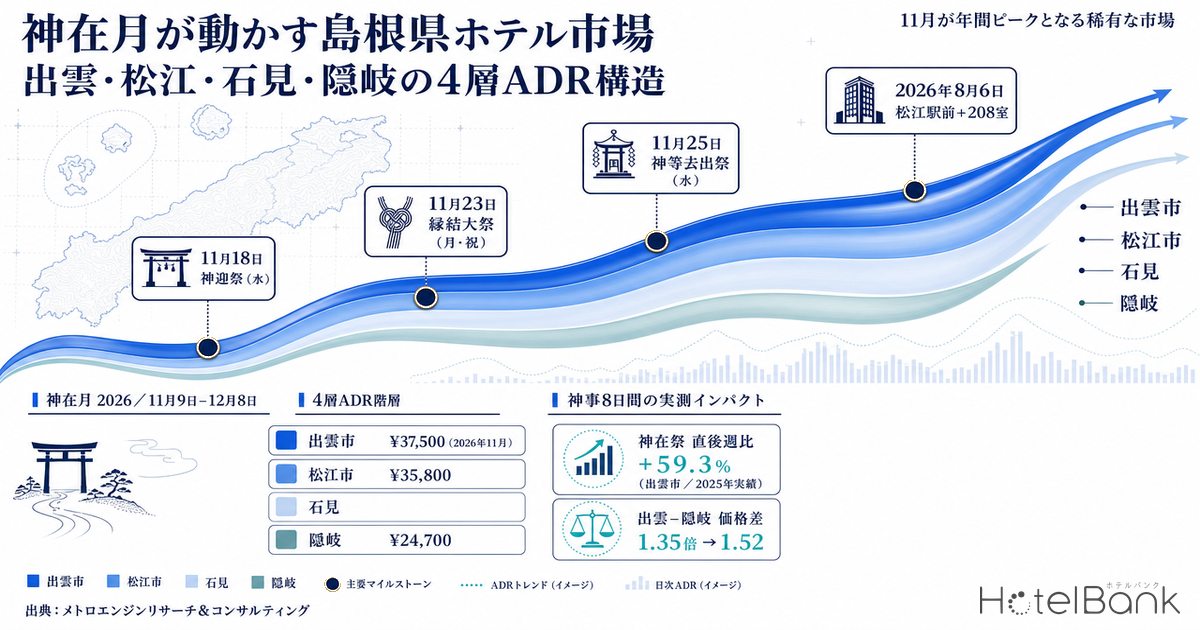
Among the prefectures of the San’in and San’yo regions, Shimane is essentially the only one where average November prices exceed those of August. Kamiarizuki — the “Month of the Gods,” when, by tradition, the deities of all Japan gather at Izumo during the tenth month of the old lunar calendar — is the one tourism asset in Japan that generates nationwide religious visitation in late autumn. In 2026, Kamiarizuki runs from Monday 9 November to Tuesday 8 December. Within that window, the rites at Izumo Taisha Grand Shrine are concentrated in the eight days from Wednesday 18 November to Wednesday 25 November.
This article uses pricing data from MetroEngines Research together with Shimane Prefecture’s official tourism statistics to quantify the structure of the prefecture’s lodging market, which divides into four tiers: Izumo, Matsue, Iwami, and Oki. It also examines what the addition of 208 rooms in front of Matsue Station in August 2026 means for that structure.
Metric Definitions Used in This Article
- ADR (average daily rate): An estimated settled rate (tax-exclusive equivalent), calculated by applying category-specific adjustment coefficients to the lowest published plan level each property lists on OTAs and similar channels (double occupancy, per-room rate, tax-inclusive). Reconciled against property-level results disclosed by listed hotel REITs (reconciliation unit: property × month), the median error is approximately 7%. These are estimates and differ from each property’s actual transaction prices and accounting figures. Area-level ADR is the median across the properties covered (the level of a typical property in that area).
- Listed price: The average price across all plans published on OTAs and similar channels (double occupancy, per-room rate, tax-inclusive, spanning room-only through meal-inclusive plans). This is the primary metric used in this article for area comparisons and daily trends.
- Number of listed properties: The number of properties for which a plan on sale could be confirmed as of the survey date for the given check-in date. Properties that drop to zero fall out of the aggregation, so a decline in property count may reflect inventory sell-through, a suspension of sales, or non-listing.
- Data source: MetroEngines Research (tracking approximately 168,000 properties in Japan, of which approximately 27,000 properties and 1.26 million rooms confirmed active on OTAs form the analysis set). Ryokan, minshuku, and simple lodging houses not listed on OTAs are not included.
- — November is the annual peak: Shimane’s November 2025 listed price of ¥28,600 exceeded August’s ¥28,000. Among the five San’in and San’yo prefectures, Shimane is the only one where November ÷ August tops 100% (102.3%).
- — A four-tier structure, and the gaps are widening: November listed prices for Izumo City, Matsue City, Iwami, and Oki are ¥37,500 / ¥35,800 / ¥31,000 / ¥24,700. The Izumo–Oki gap widens from 1.35× (2025) to 1.52× (2026 estimate).
- — The measured Kamiarisai impact is +59.3%: Across the eight days of the 2025 Kamiarisai festival, Izumo City’s listed price ran +59.3% above the following week; Matsue City ran +27.1%. Demand concentrated first in Izumo City and spilled over to Matsue only on weekends.
- — 2026 peaks on a Wednesday: Both the god-welcoming and god-farewell rites fall on Wednesdays. As of the survey date, Matsue City exceeds Izumo City on 18–20 November (Wed–Fri), indicating that overflow demand on weekdays is beginning to be priced in.
- — Supply is 209 properties and 8,330 rooms, 57.9% of them under 20 rooms: 55.6% of rooms are concentrated in Matsue City. In August 2026, 208 rooms are added in front of Matsue Station (2.5% of the prefecture total, 4.5% of Matsue City).
The prefecture where November beats August — Shimane’s demand calendar runs against the national grain
In Japan’s lodging market, the annual price peak normally falls in August, when summer holidays and homecoming travel overlap. In Shimane, however, the monthly listed price for 2025 hit its annual high in November at ¥28,600, edging past August’s ¥28,000. The same pattern appears in 2026 sales conditions: as of the survey date, November stands at ¥32,000 against ¥30,800 for August.
That this is specific to Shimane becomes clear against neighboring prefectures. Calculating “November listed price ÷ August listed price” for 2025, Shimane is the only one above 100%, at 102.3%. Tottori is at 97.9%, Hiroshima 98.6%, Okayama 90.6%, and Yamaguchi 84.2% — in every case November falls short of August. Tourism demand in the San’in region is inherently heavier in summer; only Shimane’s November is lifted as an exception.
Source: MetroEngines Research & Consulting (2025 actuals, listed-price basis / Shimane N=309–292 properties, Tottori N=214–208, Hiroshima N=517–511, Okayama N=317–312, Yamaguchi N=239–243)
The same tendency holds for estimated settled ADR. Across the 30 months from January 2024 to June 2026, Shimane’s highest estimated settled ADR was ¥12,600 in November 2025, with December of the same year second at ¥11,900. In the sense that annual price formation clusters in late autumn and early winter, Shimane’s demand calendar is plainly out of step with the national norm.
Source: MetroEngines Research & Consulting (listed price, monthly / N=271–354 properties)
Overlaying three years shows the November spike reproducing every year. November 2024 was ¥25,700, November 2025 ¥28,600, and November 2026 stands at ¥32,000 as of the survey date. Year on year, that is +11.4% for 2025 and +11.9% for 2026 — double-digit gains stacked two years running. Note that figures from August 2026 onward are estimates based on prices listed on OTAs as of the survey date, and will move as the check-in date approaches.
Izumo, Matsue, Iwami, Oki — a four-tier ADR hierarchy widening to 1.5×
Shimane’s lodging market divides into four tiers, both geographically and in demand structure: Izumo City, home to the approach town in front of Izumo Taisha; Matsue City, the prefectural capital, with Lake Shinji and Tamatsukuri Onsen; the Iwami region, which includes the Iwami Ginzan Silver Mine along with Tsuwano, Hamada, and Masuda; and the Oki Islands in the Sea of Japan. These four tiers sort cleanly by price level.
| Tier | Nov 2025 listed price |
Nov 2026 listed price (est.) |
YoY | Properties covered (Nov 25 / Nov 26) |
|---|---|---|---|---|
| Izumo City (shrine approach / Shinmon-dori) | ¥33,300 | ¥37,500 | +12.5% | 72 / 74 |
| Matsue City (business + Lake Shinji / Tamatsukuri) | ¥31,900 | ¥35,800 | +12.4% | 77 / 86 |
| Iwami (Hamada, Masuda, Oda, Gotsu, Tsuwano) | ¥28,500 | ¥31,000 | +9.0% | 86 / 81 |
| Oki (Okinoshima, Ama, Nishinoshima) | ¥24,600 | ¥24,700 | +0.2% | 22 / 24 |
Source: MetroEngines Research & Consulting (municipal listed prices weighted by property count; November 2026 is an estimate based on listing levels as of the survey date)
What stands out is that the gaps themselves are widening. The price difference between Izumo City and Oki was ¥8,700 (1.35×) in November 2025; in 2026 sales conditions it opens to ¥12,800 (1.52×). The benefit of a demand event like Kamiarizuki works most strongly on the tiers closest to the shrine, and barely reaches the islands.
Source: MetroEngines Research & Consulting (listed price, November only)
This hierarchy also maps onto property-category mix. Looking at listed prices by municipality × category as of May 2026, ryokan in Matsue City sit at ¥46,300 (N=29 properties) and ryokan in Izumo City at ¥45,800 (N=18 properties), forming a high-price band, while business hotels in the two cities come in far lower at ¥17,600 (N=17 properties) and ¥15,800 (N=14 properties) respectively. A tourism band and a business band coexisting within the same city, with price ranges nearly 3× apart, is characteristic of a San’in prefectural capital.
| Municipality | Ryokan | Vacation rental | City hotel | Business hotel | Guesthouse |
|---|---|---|---|---|---|
| Matsue City | ¥46,330 N=29 | ¥41,202 N=14 | ¥21,817 N=5 | ¥17,627 N=17 | ¥20,341 N=11 |
| Izumo City | ¥45,756 N=18 | ¥34,914 N=22 | ¥22,033 N=3 | ¥15,782 N=14 | ¥30,285 N=5 |
| Tsuwano Town | ¥47,411 N=3 | ¥67,371 N=3 | — | — | — |
| Gotsu City | ¥46,379 N=6 | ¥33,475 N=3 | — | — | — |
| Oda City | ¥40,389 N=9 | ¥43,112 N=5 | — | — | ¥15,101 N=4 |
| Hamada City | ¥38,775 N=7 | ¥26,486 N=6 | — | ¥12,418 N=7 | — |
| Okinoshima Town | ¥28,972 N=6 | — | — | — | ¥16,935 N=3 |
| Masuda City | ¥15,161 N=4 | — | — | ¥14,107 N=6 | — |
Source: MetroEngines Research & Consulting (listed price by municipality × category, May 2026 / double occupancy, tax-inclusive)
Read as a grid, Shimane’s price structure is determined not by a hierarchy of municipalities but by a hierarchy of categories. The ryokan band sits side by side at around ¥45,000 regardless of east or west — Matsue City ¥46,330, Izumo City ¥45,756, Tsuwano Town ¥47,411, Gotsu City ¥46,379 — while the business hotel band spreads more than ¥5,000, from ¥17,627 in Matsue City down to ¥12,418 in Hamada City. The four-tier ADR hierarchy can be explained by how much of which category each tier holds. Izumo City tops Matsue City because it has a higher share of ryokan and vacation rentals; Oki sits at the bottom because the high-rate categories themselves are thin there. Put the other way, in municipalities with room to shift their category mix, the tier ordering is not fixed.
Shimane’s official statistics corroborate this tiered structure. According to the preliminary results of the 2025 Tourism Trends Survey, total overnight guests for the prefecture were 3.60 million guest-nights, a decrease of 20,000 guest-nights from the prior year. By region, however, the movements diverge. The Izumo region recorded 2,781,000 guest-nights, +2.0% year on year (−7.4% versus 2019); the Iwami region 693,000 guest-nights, −10.2% year on year (+1.6% versus 2019); and the Oki region 123,000 guest-nights, +6.5% year on year and +27.4% versus 2019 — the strongest recovery of the three. Overnight stays by international guests totaled 112,689 guest-nights, an increase of 25,529 guest-nights from the prior year.
In other words, Izumo, where prices are highest, saw volume rise slightly; Oki, where prices are lowest, posted the strongest growth rate in the prefecture; and Iwami, in between, lost volume. The ordering by price and the ordering by growth rate do not match. This asymmetry is the starting point for reading Shimane’s lodging market. Note, too, that slicing the same San’in region at the city level — including the Tottori side — produces a different contour from the prefecture-level tiers described here.
The 2025 Kamiarisai — eight days that lifted prices by 59%
The most accurate gauge of Kamiarizuki’s demand impact is daily data from past actuals. In 2025, the Kamiarisai at Izumo Taisha ran from Saturday 29 November to Saturday 6 December, with the god-welcoming rite and Kamimukae-sai held at 19:00 on 29 November and the god-farewell Karasade-sai at 16:00 on 6 December. The comparison below sets those eight days against the week immediately following.
Source: MetroEngines Research & Consulting (daily listed price, double occupancy, tax-inclusive / Izumo City N=41–70 properties, Matsue City N=64–77 properties)
Izumo City’s daily listed price averaged ¥44,300 in the week before the festival (25–28 November), against ¥54,500 during the festival period (29 November–6 December). In the week right after it ended (7–10 December), the level drops to ¥34,200. That puts the festival period +59.3% above the following week and +22.9% above the preceding week. Between 6 and 7 December the price fell from ¥55,500 to ¥38,500 in a single day — a 31% break.
The movement in listed property counts is equally telling. Where Izumo City normally shows prices for 65–70 properties, the count fell to 41 on 29 November, the day of the god-welcoming rite. On 5 and 6 December, around the Karasade-sai, it held at just 56. By 7 December, after the festival, it was back to 70. This is the classic pattern of on-sale inventory disappearing on specific dates and returning the following week. Given Izumo City’s total stock of 1,657 rooms, it is fair to read those days as the city effectively reaching the ceiling of its capacity.
Matsue City, by contrast, averaged ¥47,900 during the festival period against ¥37,700 in the following week, or +27.1% — less than half the response of Izumo City’s +59.3%. Moreover, Matsue City’s listed property count held steady at 64–77 throughout the period, meaning inventory never ran dry. Matsue moved sharply on 29 November (Sat) at ¥57,400 and 6 December (Sat) at ¥59,600 — both Saturdays. Matsue’s November was shaped more by day of week than by Kamiarizuki itself.
The structure this reveals is clear. Kamiarizuki demand concentrates first in Izumo City and spills over into Matsue City only on weekends. On weekday rite days, Matsue still had capacity to spare.
2026 peaks on a Wednesday — the year the day-of-week structure changes
Kamiarizuki 2026 runs from Monday 9 November to Tuesday 8 December. The rites at Izumo Taisha are: the god-welcoming rite and Kamimukae-sai at 19:00 on Wednesday 18 November; Kamiarisai at 09:00 on Thursday 19 November; the Kenkoku-sai grain offering, Kamiarisai, and the Enmusubi Taisai matchmaking festival at 10:00 on Monday 23 November (a public holiday); and Kamiarisai and Enmusubi Taisai at 10:00 on Wednesday 25 November, followed by the Karasade-sai at 16:00 the same day. The core of lodging demand falls in the eight days from 18 to 25 November.
The decisive difference from 2025 is the day of week. In 2025 both the Kamimukae-sai and the Karasade-sai fell on Saturdays, so the festival’s entry and exit both landed on the weekend. In 2026, the Kamimukae-sai falls on a Wednesday and the Karasade-sai on a Wednesday. The only weekend overlap is Saturday 21 and Sunday 22 November, plus Monday 23 November, the Labor Thanksgiving Day holiday.
Source: MetroEngines Research & Consulting (daily average of sales prices listed on OTAs as of the survey date / Izumo City N=42–73 properties, Matsue City N=74–84 properties. Subject to change.)
Sales conditions as of the survey date show this day-of-week shift already being priced in. Izumo City is highest on Wednesday 18 November at ¥65,000, with the listed property count at 42 — far below the 65–73 seen on surrounding days. From 19 to 22 November prices run in a ¥55,000–¥61,000 range with listed property counts of only 53–59. This is a snapshot taken 114 days out and does not indicate confirmed sell-outs, but it does show Izumo City bracing early on both price and inventory for the rite days.
And the movement in Matsue City is the biggest change this year. The listed price for Thursday 19 November is ¥63,900; Wednesday 18 November is ¥61,200; Friday 20 November is ¥62,300. Despite being weekdays, these levels sit above Izumo City. Given that in 2025 actuals Matsue exceeded Izumo only on Saturdays, this marks a clear change in posture. The listed property count, moreover, is stable at 74–84 across the month: prices are being raised while inventory is retained.
Matsue City to Izumo City is roughly 30 minutes by rail, with a transfer to the Ichibata Electric Railway to reach Izumo Taisha. With the center of the rites falling on weekdays in 2026, Matsue has more room than in 2025 to function as the overflow destination once accommodation inside Izumo City fills. Matsue’s weekday prices rising into the tourism band looks like the result of pricing in that overflow demand.
209 properties, 8,330 rooms — a supply structure where 58% are under 20 rooms
Shimane’s lodging supply is extremely skewed by scale. Within MetroEngines Research’s coverage, there are 209 operating properties with approximately 8,330 rooms in the prefecture. The breakdown is as follows.
Source: MetroEngines Research & Consulting (operating properties, room-count master, N=209 properties)
| Room-count band | Properties | Share of properties | Rooms | Share of rooms |
|---|---|---|---|---|
| 200 rooms and over | 2 | 1.0% | 1,097 | 13.2% |
| 100–199 rooms | 23 | 11.0% | 3,379 | 40.6% |
| 50–99 rooms | 17 | 8.1% | 1,187 | 14.2% |
| 20–49 rooms | 46 | 22.0% | 1,421 | 17.1% |
| 1–19 rooms | 121 | 57.9% | 1,246 | 15.0% |
Source: MetroEngines Research & Consulting
The 121 properties that make up 57.9% of all properties account for only 15.0% of rooms. Conversely, the 25 properties with 100 rooms or more (12.0% of the total) hold 53.8% of rooms. It is an extremely long-tailed structure, with a thin layer of large properties able to flex inventory upward at demand peaks. The revised Hotel Business Act that took effect on 15 June 2026, permitting single-room operations, is likely to widen this small-scale base further.
By municipality, Matsue City accounts for 64 properties and 4,630 rooms, or 55.6% of the prefecture’s rooms. Izumo City follows with 43 properties and 1,657 rooms (19.9%). Matsue City has 16 properties of 100 rooms or more totaling 3,196 rooms, against just 6 properties and 899 rooms in Izumo City. Izumo City, where Kamiarizuki demand converges, has only about one-third of Matsue City’s capacity to absorb it. On the Iwami side, supply is dispersed: 480 rooms in Hamada City, 389 in Masuda City, 215 in Oda City, 196 in Tsuwano Town, and 173 in Gotsu City. The four Oki municipalities together hold 263 rooms.
208 rooms in front of Matsue Station — can one property serve both the business and tourism bands?
Against that structure, new supply in 2026 is starkly polarized. MetroEngines Research counts 12 openings in 2026 (on an OTA-listing-confirmed basis). One of them has 208 rooms; the remaining 11 are small properties of between 1 and 38 rooms.
This table is compiled on an OTA-listing-confirmed basis. Only about 19% of openings are listed on OTAs in advance, and more than half are listed after opening, so the count of openings from the second half of 2026 onward may rise as further listings appear (please read it as a current lower bound). We recommend reading it alongside the building-plan pipeline on a confirmation-application basis (MLIT, Construction Statistics Survey).
| Property | Category | Rooms | Opening |
|---|---|---|---|
| Daiwa Roynet Hotel Matsue Ekimae (ダイワロイネットホテル松江駅前) | Business hotel | 208 | 2026-08-06 |
| Natural Hot Spring Yuya Tenjin (天然温泉 湯屋天神) | Hot-spring bath facility | 38 | 2026-05-07 |
| Peace INN Masuda Eki Kita (ピースINN益田駅北) | — | 35 | 2026-04-01 |
| First Cabin Matsue (ファーストキャビン松江) | Capsule hotel | 32 | 2026-01-19 |
| Migioku (Fureaikan) / Okibase and others | Guesthouse | 2–4 | During 2026 |
| Four whole-house rentals near Izumo Taisha | Vacation rental | 1 each | During 2026 |
Source: MetroEngines Research & Consulting (OTA-listing-confirmed basis, 2026 openings N=12) / company press releases
In Shimane’s context, 208 rooms is a conspicuously large figure. It equals 2.5% of the prefecture’s 8,330 rooms and 4.5% of Matsue City’s 4,630. There are currently only two properties of 200 rooms or more in the prefecture; this will be the third. For the Daiwa House Group it is a first entry into the San’in region, sited about a three-minute walk from the north exit of JR Matsue Station, with a large communal bath and sauna, a fitness room, and meeting rooms. It opens on 6 August 2026 — three months before Kamiarizuki.
The question this raises is whether those 208 rooms will make the business band or the tourism band their main battleground. As of May 2026, Matsue City’s business hotel band sits at ¥17,600 (N=17 properties) and the ryokan band at ¥46,300 (N=29 properties), with a wide gap between them. Meanwhile, on the rite days of November 2026, listed prices across Matsue City lift to ¥55,000–¥64,000. Whether a single property can run at business-demand rates in normal periods and swing all the way up to the tourism band at the once-a-year demand peak — Kamiarizuki is the window in which that capability can be measured most sharply.
Listed prices for Shimane’s business hotel band (N=51–54 properties) were ¥16,800 in November 2025 and, as of the survey date, ¥17,500 for November 2026. That +4.3% year on year falls far short of the prefecture-wide +11.9%. The business band is the category that benefits least from Kamiarizuki. Put the other way, the room for a newly built business hotel in front of the station to go after tourism demand exists clearly, expressed as that price gap. A configuration with a large communal bath and sauna, plus fitness and meeting rooms, can also be read as equipment for switching between weekday business demand and weekend and rite-day tourism demand within the same building.
Source: MetroEngines Research & Consulting (operating properties with 40 rooms or more. Circle size indicates room count.)
On the map, Shimane’s room stock concentrates in four clusters — around Matsue Station, Tamatsukuri Onsen, around Izumo City Station, and the approach town in front of Izumo Taisha — with the space between them thinly filled by small properties in Iwami and Oki. Kamiarizuki demand flows first into the shrine approach and the area around Izumo City Station, then spreads secondarily to the Matsue Station area and Tamatsukuri Onsen. Iwami and Oki are effectively cut off from this flow.
Oki — a second layer moving in antiphase to Kamiarizuki
Of the four tiers, only Oki is independent of the prefecture’s demand calendar. Listed prices across the three Oki municipalities (Okinoshima, Ama, and Nishinoshima) fall from ¥26,300 in October 2025 to ¥24,600 in November. While the prefecture as a whole sets its annual high in November, Oki peaks in October and enters a downswing in November. This is because ferries and high-speed boats are the only means of access, and travel becomes difficult from late autumn onward as seas turn rough.
By growth rate, however, Oki is the strongest in the prefecture. According to Shimane’s 2025 Tourism Trends Survey, overnight guests in the Oki region totaled 123,000 guest-nights, +6.5% year on year and +27.4% versus pre-pandemic 2019 — the only one of the prefecture’s three regions to sit well above 2019. Set against the Izumo region at −7.4% versus 2019 and the Iwami region at +1.6%, Oki’s resilience stands out. The Oki Islands are certified as a UNESCO Global Geopark, and demand for stays built around natural assets appears to be steadily gaining depth.
On the supply side, the four Oki municipalities have just 14 operating properties and 263 rooms in total. At an average of 18.8 rooms per property, this is a small-scale composition with no structural ability to expand capacity quickly even as demand grows. In 2026, log-house whole-house rentals and guesthouses have opened in Ama Town, so small-scale, high-value-added supply is accumulating gradually. This is not a tier that will chase Kamiarizuki peak demand, but as the fastest-growing layer in the prefecture, the question for Oki is how far it can raise rates during the July–October green season.
As for the Iwami region, overnight guests in 2025 were down 10.2% year on year, putting volume in an adjustment phase, while listed prices rose 9.0%, from ¥28,500 in November 2025 to ¥31,000 in November 2026. The region holds tourism anchors including the Iwami Ginzan Silver Mine (Oda City), Tsuwano, and the Aquas aquarium in Hamada, and its ryokan bands sit at high levels as of May 2026: ¥40,400 in Oda City (N=9 properties) and ¥47,400 in Tsuwano Town (N=3 properties). That said, in municipalities such as Tsuwano Town where the property count is in single digits, movements at individual properties shift the average substantially, so these figures should be read with a margin.
Conclusion — how to allocate a “once-a-year November” across the prefecture
The structure of Shimane’s hotel market established in this article can be organized into five points.
First, Shimane is a rare market whose annual price peak falls in November. Its November 2025 listed price exceeded August’s, in contrast to the four neighboring prefectures, which all peak in August. A religious observance — Kamiarizuki — creates a late-autumn demand mountain unlike any other in the country.
Second, prices within the prefecture sort into four tiers — Izumo City, Matsue City, Iwami, and Oki — and the gaps between them are widening. The listed-price gap between Izumo City and Oki is set to open from 1.35× to 1.52×.
Third, the demand impact of Kamiarizuki concentrates in Izumo City. In 2025 actuals, Izumo City’s listed price across the eight days of the Kamiarisai reached +59.3% above the following week, while Matsue City stopped at +27.1%.
Fourth, because the center of the rites falls on Wednesdays in 2026, the day-of-week structure changes. In sales conditions as of the survey date, there are stretches where Matsue City’s listed prices for 18–20 November (Wed–Fri) exceed Izumo City’s, indicating that weekday overflow demand is beginning to be priced in.
Fifth, supply is extremely small in scale and dispersed. Of 209 properties, 57.9% have fewer than 20 rooms, and 55.6% of rooms are concentrated in Matsue City. Into this structure, 208 rooms arrive in front of Matsue Station in August 2026 — a scale equal to 2.5% of the prefecture and 4.5% of Matsue City.
Kamiarizuki is Shimane’s once-a-year opportunity to draw high-rate demand from across the country. Since Izumo City’s 1,657 rooms cannot absorb all of it, where and how the overflow is captured will determine the prefecture’s overall revenue. The 208 rooms in front of Matsue Station will be placed most directly in front of the question of how to allocate a single building between everyday business demand and a once-a-year tourism peak. Kamiarizuki, three months after opening, will be the first field test of that potential.
⚠ Note on prices for future dates: Prices in this article for August 2026 and later are estimates based on sales prices published on OTAs as of the survey date, and will change as the check-in date approaches. Please note that levels may move up or down from current figures as new plans are added or prices are adjusted. Changes in the number of listed properties may also reflect inventory sell-through, a suspension of sales, or non-listing, and therefore do not indicate confirmed sell-outs.
Frequently Asked Questions
Q. Why do hotel prices in Shimane peak in November?
A. Because of the religious visitation generated by Kamiarizuki, the “Month of the Gods,” when the deities of all Japan are said to gather at Izumo during the tenth month of the old lunar calendar. Shimane’s monthly listed price for 2025 was ¥28,600 in November, above August’s ¥28,000. Among the five San’in and San’yo prefectures, Shimane is the only one whose November ÷ August ratio exceeds 100% (102.3%); Tottori is at 97.9%, Hiroshima 98.6%, Okayama 90.6%, and Yamaguchi 84.2%, all with November below August.
Q. When is the 2026 Kamiarisai, and which period is the core of lodging demand?
A. Kamiarizuki 2026 runs from Monday 9 November to Tuesday 8 December. The rites at Izumo Taisha are: the god-welcoming rite and Kamimukae-sai on Wednesday 18 November; Kamiarisai on Thursday 19 November; the Kenkoku-sai and Enmusubi Taisai on Monday 23 November (a public holiday); and Kamiarisai, Enmusubi Taisai, and the Karasade-sai on Wednesday 25 November. The core of lodging demand is the eight days from 18 to 25 November.
Q. How much do hotel prices rise during the Kamiarisai?
A. In 2025 actuals, Izumo City’s daily listed price averaged ¥54,500 during the festival period (29 November–6 December), or +59.3% against ¥34,200 in the week immediately after (7–10 December). Matsue City averaged ¥47,900 over the same period against ¥37,700 in the following week, or +27.1% — less than half the response of Izumo City. Demand concentrates first in Izumo City and spills over into Matsue City only on weekends.
Q. How much do room rates differ between areas within Shimane?
A. Listed prices for November 2026 (estimated as of the survey date) are ¥37,500 in Izumo City (N=74 properties), ¥35,800 in Matsue City (N=86 properties), ¥31,000 in Iwami (N=81 properties), and ¥24,700 in Oki (N=24 properties). The gap between Izumo City and Oki is set to widen from ¥8,700 (1.35×) in November 2025 to ¥12,800 (1.52×), with the benefit of Kamiarizuki working most strongly on the tiers closest to the shrine.
Q. What does Shimane’s lodging supply structure look like?
A. There are 209 operating properties with approximately 8,330 rooms. The 121 properties that make up 57.9% of all properties have fewer than 20 rooms, while the 25 properties with 100 rooms or more (12.0% of the total) hold 53.8% of rooms — a long-tail structure. By municipality, Matsue City accounts for 64 properties and 4,630 rooms, or 55.6% of the prefecture’s rooms, and Izumo City for 43 properties and 1,657 rooms (19.9%).
Q. What impact will the 208-room Daiwa Roynet Hotel Matsue Ekimae, opening in August 2026, have?
A. Its 208 rooms equal 2.5% of the prefecture’s 8,330 rooms and 4.5% of Matsue City’s 4,630. There are currently only two properties of 200 rooms or more in the prefecture, making this the third. Matsue City’s business hotel band stands at ¥17,627 (N=17 properties) as of May 2026 against a ryokan band of ¥46,330 (N=29 properties) — a wide price gap — so the question is how to allocate a single building between everyday business demand and the Kamiarizuki tourism peak.
References and Sources
■ Data sources
Monthly and daily listed prices and estimated settled ADR for the 18 municipalities of Shimane Prefecture (January 2024 – November 2026; prefecture N=271–354 properties / municipality N=3–86 properties), the room-count master for operating properties (N=209 properties, approx. 8,330 rooms), listed prices by category (as of May 2026), and the list of new supply opening in 2026 (OTA-listing-confirmed basis, N=12). On the demand side, regional overnight-guest figures from the preliminary 2025 results of Shimane Prefecture’s Tourism Trends Survey were used.
■ Calculation assumptions
Listed prices are double occupancy, per room, tax-inclusive, and include all plans from room-only through meal-inclusive. Prices for the four tiers (Izumo City / Matsue City / Iwami / Oki) were calculated by weighting municipal listed prices by the number of properties covered in each month. Iwami covers Hamada City, Masuda City, Oda City, Gotsu City, and Tsuwano Town; Oki covers Okinoshima Town, Ama Town, and Nishinoshima Town. Values from August 2026 onward are forward estimates based on sales prices listed on OTAs as of the survey date (approximately 114 days before the check-in date) and are not final. Rite schedules are confirmed dates for 2025 actuals; 2026 is based on published schedules.
■ Limitations and caveats
(1) Ryokan, minshuku, and simple lodging houses not listed on OTAs are excluded from the population, so the small-scale segment may in reality be larger than this aggregation suggests. (2) In municipalities such as Oki and Tsuwano Town, where the property count runs from single digits to the low teens, movements at individual properties shift the average substantially. (3) A decline in the number of listed properties may reflect inventory sell-through, a suspension of sales, or non-listing, and does not confirm a sell-out. (4) Forward estimates will move up or down as the check-in date approaches, through new plan additions and price adjustments. (5) Estimated settled ADR covers only verified categories (business, city, resort, ryokan, capsule), so its population does not match that of the listed-price aggregations.
■ Market data
- MetroEngines Research — Shimane monthly listed prices and estimated settled ADR (by prefecture, municipality, and category), daily listed prices, and the room-count master for operating properties
- MetroEngines Research & Consulting — New openings in 2026 (OTA-listing-confirmed basis, N=12)
■ Public statistics and government sources
- Shimane Prefecture, “Tourism Trends Survey” (Tourism Promotion Division, Commerce, Industry and Labor Department)
- “Shimane Prefecture releases preliminary 2025 Tourism Trends Survey results: overnight guests down 20,000 guest-nights year on year” (Kanko Keizai Shimbun)
- Izumo City, “Results of the Tourism Trends Survey”
■ Rite schedules and property information
- Shimane Kanko Navi, “[Kamiarisai] Traffic restrictions and parking around Izumo Taisha” (Shimane Prefecture official tourism information site)
- “Full schedule of the 2026 Kamiarisai at Izumo Taisha” (Shimane no Torisetsu)
- Daiwa House Industry, “Daiwa Roynet Hotel Matsue Ekimae to open on Thursday 6 August 2026” (news release)
- Daiwa Roynet Hotel Matsue Ekimae official site
- Shimane Kanko Navi (Shimane Prefecture official tourism information site)