

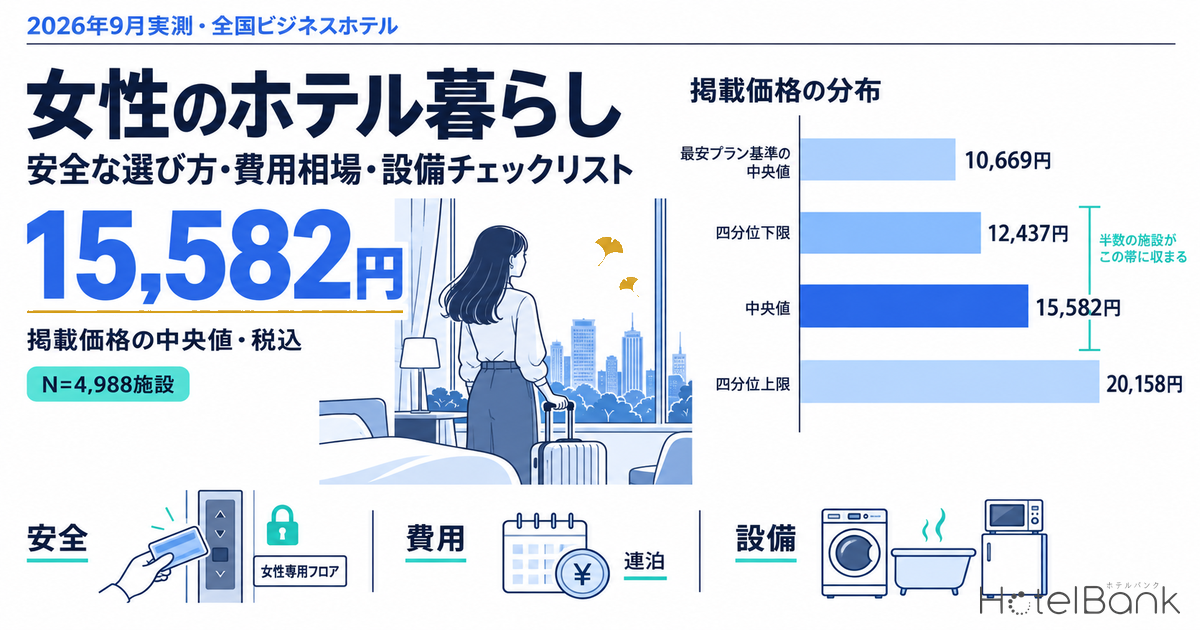
For a woman starting to live in a hotel on her own, the answer comes down to three steps. (1) Narrow down properties for safety by checking which security features they have, (2) build your budget from the median listed price, and (3) use a living-facilities checklist to confirm the hotel suits a long stay. When the HotelBank Editorial Team measured OTA listed prices for business hotels across Japan, the September 2026 median was ¥15,582 per room per night (N=4,988 properties; tax-inclusive per-room rate searched for two guests; average across all plans), and the median based on the cheapest plan was ¥10,669. Using these measured figures as the foundation, this article walks through how to choose a hotel in the order of safety, cost and facilities.
- — The median listed price for business hotels nationwide is ¥15,582 per room per night / the median of monthly average listed prices across the 4,988 properties with price observations in September 2026 (tax-inclusive per-room rate searched for two guests; average across all plans). The cheapest-plan median is ¥10,669.
- — A simple 30-night total ranges from about ¥320,000 to about ¥605,000 / about ¥320,000 at the cheapest-plan median, about ¥467,000 at the all-plan median, and about ¥605,000 at the upper-quartile level. These are upper-end guides that come down with long-stay plans and how you schedule the days of the week.
- — Safety can be screened in advance by “facility conditions” / four conditions — women-only floors, key-card access control for guest-room floors, interior corridors with a 24-hour staffed front desk, and locked women’s public baths — can be checked before your stay through booking-site filters and the property’s official website.
- — The regional gap is up to about ¥6,700 per night / across 10 major prefectures, business-hotel listed prices range from ¥21,784 in Tokyo (N=991 properties) to ¥15,044 in Osaka (N=554 properties). Over 30 nights, that is a difference of about ¥200,000.
- — The three facilities that matter on a long stay: laundry, bathing and a microwave / differences you would not notice over one or two nights affect you every day over 30 nights. Check for an in-room washer-dryer, a large communal bath and powder room, and a microwave and refrigerator before booking.
Safety: “You Can Search by These Conditions” — How to Read Security Features for Women
The first thing to check when a woman lives in a hotel is the security features the property provides. The following conditions can be confirmed through booking-site filters or the room and facility pages on each hotel’s official website, and properties that meet them are easier to choose as a base for a long stay.
- Women-only floors (ladies’ floors): some properties operate their elevators so that they stop at those floors only for guests holding a key card. You can search for them under labels such as “ladies’ room” or “women-only floor.”
- Key-card access control for elevators and guest-room floors: some properties also require a key card to unlock the entrance doors late at night, so outsiders cannot reach the guest-room floors.
- Interior corridors and a 24-hour staffed front desk: there are staff around even when you return late at night. On a long stay, this is also reassuring for receiving parcels and handling matters while you are out.
- Locked women’s public baths: some properties lock the entrance with a PIN that changes daily or a dedicated key card. If you choose a property with a large communal bath, check this as well.
- Consideration at check-in: some properties do not read room numbers out loud, and some promote an enhanced range of amenities for women.
Nationwide business-hotel chains also include properties with women-only floors or rooms designed for women, and the participating locations can be checked on each company’s official website. Each chain has different strengths, so the quickest approach is to use the facility conditions above as your criteria and look for properties that meet them in the city where you want to stay. For a comparison of specific properties, a useful reference is the comparison of business hotels near stations in Sendai, Hiroshima and Sapporo (HotelPicks, in Japanese), which examines key-card controls and public-bath locking for women traveling alone on business.
Measured Costs: The Median Listed Price for Business Hotels Nationwide Is ¥15,582 per Night
Of the 6,392 business hotels operating across Japan, the HotelBank Editorial Team took the 4,988 properties with price observations in September 2026, calculated each property’s monthly average listed price (average across all plans; tax-inclusive per-room rate searched for two guests), and took the median.
| Metric (September 2026, N=4,988 properties) | Per room per night (tax included) |
|---|---|
| Median listed price (all-plan average basis) | ¥15,582 |
| Median based on the cheapest plan | ¥10,669 |
| Lower 25% to upper 25% range (interquartile range) | ¥12,437–¥20,158 |
Source: HotelBank Editorial Team research (listed prices published on OTAs, as of September 2026). Because these are per-room rates searched for two guests, the listed amount for a single guest varies by plan.
The interquartile range is the band between the lower-25% point and the upper-25% point when properties are sorted by price, and it contains half of all properties. In other words, half of the properties fall within a range of ¥12,400 to ¥20,200 per night (both on an all-plan average basis). The level also varies by the prefecture you stay in. The listed prices for the same month in 10 major prefectures (daily average per property, aggregated as the area median, then averaged over the month; 2 guests per room; tax included) are as follows.
| Prefecture | Business-hotel listed price (September 2026) | Properties covered |
|---|---|---|
| Tokyo | ¥21,784 | N=991 |
| Aichi | ¥21,724 | N=327 |
| Hokkaido | ¥19,964 | N=418 |
| Kyoto | ¥19,201 | N=368 |
| Fukuoka | ¥18,713 | N=353 |
| Kanagawa | ¥16,632 | N=216 |
| Miyagi | ¥16,489 | N=139 |
| Hiroshima | ¥16,063 | N=186 |
| Okinawa | ¥15,795 | N=210 |
| Osaka | ¥15,044 | N=554 |
Source: HotelBank Editorial Team research (listed prices published on OTAs, as of September 2026, 2 guests per room, tax included).
When converting to a monthly amount, it is realistic to think in terms of a range. Stacking the distribution above over 30 nights gives the following. Each figure is simply the nightly rate added up 30 times, and serves as an upper-end guide assuming no discounts at all. In actual hotel living, the standard approach is to bring the per-night cost down by using long-stay and monthly plans, centering your stay on weekdays, and booking outside peak periods. Which type of discount to use depends on the purpose of your stay; how to choose between multi-night plans, subscriptions and workation plans is covered in “Remote Work Hotel Living in Japan: 3 Options.” The practical steps, from budgeting to handling your resident registration and belongings, are explained in detail in “How to Start Hotel Living in Japan: 5 Steps.”
| Reference level (September 2026, N=4,988 properties) | Per room per night | Simple 30-night total |
|---|---|---|
| Median based on the cheapest plan | ¥10,669 | approx. ¥320,000 |
| Lower-25% level (lower quartile, all-plan average basis) | ¥12,437 | approx. ¥373,000 |
| Median (all-plan average basis) | ¥15,582 | approx. ¥467,000 |
| Upper-25% level (upper quartile, all-plan average basis) | ¥20,158 | approx. ¥605,000 |
Source: HotelBank Editorial Team research (listed prices published on OTAs, as of September 2026). The 30-night column is an editorial estimate that multiplies the per-room nightly rate by 30; actual payments tend to be lower depending on long-stay or monthly plans, how you schedule days of the week, and when you book. Living costs other than taxes and service charges (food, laundry, transport) are not included.
Facilities Checklist: 7 Items That Support Life on a Long Stay
Differences in facilities you would not notice on a one- or two-night trip affect you every day when you live somewhere for 30 nights. Checking the following seven items on the official website’s room and facility pages before viewing or booking reduces the chance of choosing the wrong place.
- Laundry: with an in-room washer-dryer, you do not need to go out to a shared space late at night, and you can travel lighter. If the property has a coin laundry on site, check the number of machines, the prices and how easy it is to dry clothes in your room. How to find laundry facilities and typical prices are summarized in “Hotel Laundry in Japan: Free–¥600 a Wash, 5 Room-Drying Steps.”
- Large communal bath and powder room: being able to soak in a bath helps you recover from fatigue on a long stay. Also check how the women’s bath is locked, its opening hours, and the quality of the hair dryers and amenities.
- Desk and Wi-Fi: if you will be working remotely, having a wide desk and a separate chair makes a big difference to how easy it is to work.
- Microwave and refrigerator: whether these are in the room or on a shared floor changes how freely you can manage your meals. A property with a kitchenette also makes cooking for yourself an option.
- Amenities: properties with an amenity bar for women (makeup remover, toner, hair ties, etc.) mean fewer top-up purchases on a long stay.
- Storage and hangers: on a long stay, the amount of clothing storage matters. Check the number of hangers in the open closet and whether there are drawers.
- Housekeeping frequency on multi-night stays: properties that let you choose the cleaning interval, or request only a daily towel change, are easier to fit to your daily rhythm.
Even after narrowing properties down with these seven items, lifestyle constraints remain, such as how your address is handled and the difficulty of cooking for yourself. The likely inconveniences and ways to ease them are summarized in “6 Downsides of Hotel Living in Japan and How to Fix Them,” which you can use as a check before deciding on a stay.
To Search in More Detail
For comparisons of specific properties, the following articles (in Japanese) go into detail.
Compares five properties — including Tokyu Stay Sapporo Odori (東急ステイ札幌大通), where every room has a washer-dryer, and Hotel Intergate Hiroshima (ホテルインターゲート広島), which locks its women’s public bath with a PIN that changes daily — by guest-floor access control, public-bath hours and the route from the station.
Compares five properties that accommodate month-long stays — including MIMARU Tokyo Ikebukuro (MIMARU東京 池袋), where every room has an induction kitchen, and Citadines Shinjuku Tokyo (シタディーン新宿東京), where every room has a full kitchen — by kitchen, laundry facilities and how long-stay plans are handled.
Frequently Asked Questions
Q. What safety measures should a woman check first when living in a hotel?
A. The quickest route is to look at the property’s security features first and narrow down your candidates. The four highest priorities are (1) women-only floors (where elevators stop on those floors only for guests with a key card), (2) key-card access control for elevators and guest-room floors, (3) interior corridors and a 24-hour staffed front desk, and (4) locked women’s public baths (with a PIN that changes daily or a dedicated key card). All of these can be checked before booking through booking-site filters or the room and facility pages on each hotel’s official website.
Q. How much does hotel living cost a woman for one month?
A. Looking at accommodation alone, simply stacking the listed prices of business hotels nationwide as of September 2026 over 30 nights gives about ¥320,000 to about ¥605,000. That is about ¥320,000 at the cheapest-plan median of ¥10,669, about ¥467,000 at the all-plan median of ¥15,582, and about ¥605,000 at the upper-quartile level of ¥20,158 (N=4,988 properties; tax-inclusive per-room rate searched for two guests). These are upper-end guides that assume no discounts; using long-stay or monthly plans and centering your stay on weekdays will lower what you actually pay. Food, laundry and transport are not included.
Q. How much do costs vary by area?
A. As of September 2026, among 10 major prefectures, business-hotel listed prices were highest in Tokyo at ¥21,784 (N=991 properties) and lowest in Osaka at ¥15,044 (N=554 properties), a gap of about ¥6,700 per night. Over 30 nights, that is a difference of about ¥200,000. Aichi (¥21,724), Hokkaido (¥19,964) and Kyoto (¥19,201) follow Tokyo, while Kanagawa (¥16,632), Miyagi (¥16,489), Hiroshima (¥16,063) and Okinawa (¥15,795) sit in a band close to the national median of ¥15,582 (all for 2 guests per room, tax included).
Q. How do I find hotels with women-only floors?
A. The basic approach is to filter booking-site searches by labels such as “ladies’ room” or “women-only floor.” Nationwide business-hotel chains also include properties with women-only floors or rooms designed for women, and the participating locations can be checked on each company’s official website. Because each chain has different strengths, rather than searching by brand, it is faster to narrow down by “the city where you want to stay” × “the facility conditions you need,” then confirm the remaining properties on their official websites.
Q. Which room facilities matter most on a multi-night stay?
A. Differences you would not notice over one or two nights affect you every day over 30 nights. The three highest priorities are an in-room washer-dryer (so you do not need to go out to a shared space late at night, and you can travel lighter), a large communal bath and powder room, and a microwave and refrigerator. It also helps to check for a wide desk and a separate chair, amenities for women, the number of hangers in the open closet, and whether you can choose the housekeeping frequency on multi-night stays — this reduces stress during your stay.
Q. How can I reduce the cost of hotel living?
A. The amounts in this article are upper-end guides built by stacking nightly rates, so there is room to bring them down. There are three standard approaches: (1) use long-stay or monthly plans, (2) center your stay on weekdays, and (3) book outside high-demand periods. In addition, because the level of listed prices differs considerably by area, simply moving one station over can help if your workplace or errands allow it. How to choose between multi-night plans, subscriptions and workation plans is covered in the related article introduced in the body of this article.
Methodology and Sources
■ Data Sources
The nationwide listed price is the median of each property’s monthly average listed price (average across all plans) for the 4,988 properties with price observations in September 2026, out of 6,392 business hotels operating across Japan (HotelBank Editorial Team research). The price basis is the per-room rate searched for two guests, tax included. The cheapest-plan median of ¥10,669 was aggregated in the same way for the same population using each property’s cheapest plan. The prefecture figures represent a “typical property” level, obtained by aggregating each property’s daily average into the area median and then averaging over the month; because the order of aggregation differs from the nationwide figure, the two cannot be added or subtracted as figures on the same basis. The number of properties covered is shown for each prefecture in Table 2. All figures are as of September 2026.
■ Estimation Assumptions
The 30-night amounts in Table 3 are editorial estimates that multiply each Table 1 per-room nightly rate by 30, rounded to the nearest ¥1,000. They include no discounts, multi-night benefits or member rates, and serve as upper-end guides that stack the regular nightly rate 30 times. The regional gap of “about ¥200,000 over 30 nights” is an approximation obtained by multiplying the ¥6,740 difference between Tokyo (¥21,784) and Osaka (¥15,044) by 30. Living costs other than accommodation (food, laundry, transport, daily necessities) are not included in the estimates.
■ Limitations and Notes
Listed prices are not actual transaction prices, and payments tend to come down when long-stay plans, monthly plans or member rates are used. Because these are per-room rates searched for two guests, the listed amount for a single guest varies by plan. The median and interquartile range show the spread across properties and do not predict the rate of any specific property. Whether security features and room facilities exist and how they are operated (which floors are women-only, how public baths are locked, whether housekeeping frequency can be chosen) vary by property and over time, so please confirm with each property’s official information before booking. This article does not guarantee the safety of any property; it organizes the conditions you should check.
■ Market Data
- HotelBank Editorial Team research — Distribution of listed prices for business hotels nationwide (N=4,988 properties, as of September 2026, 2 guests per room, tax included)
- HotelBank Editorial Team research — Business-hotel listed prices by prefecture (10 major prefectures, as of September 2026, 2 guests per room, tax included)
- HotelBank Editorial Team research — Number of business hotels operating nationwide (6,392 properties, as of September 2026)
Related Articles