

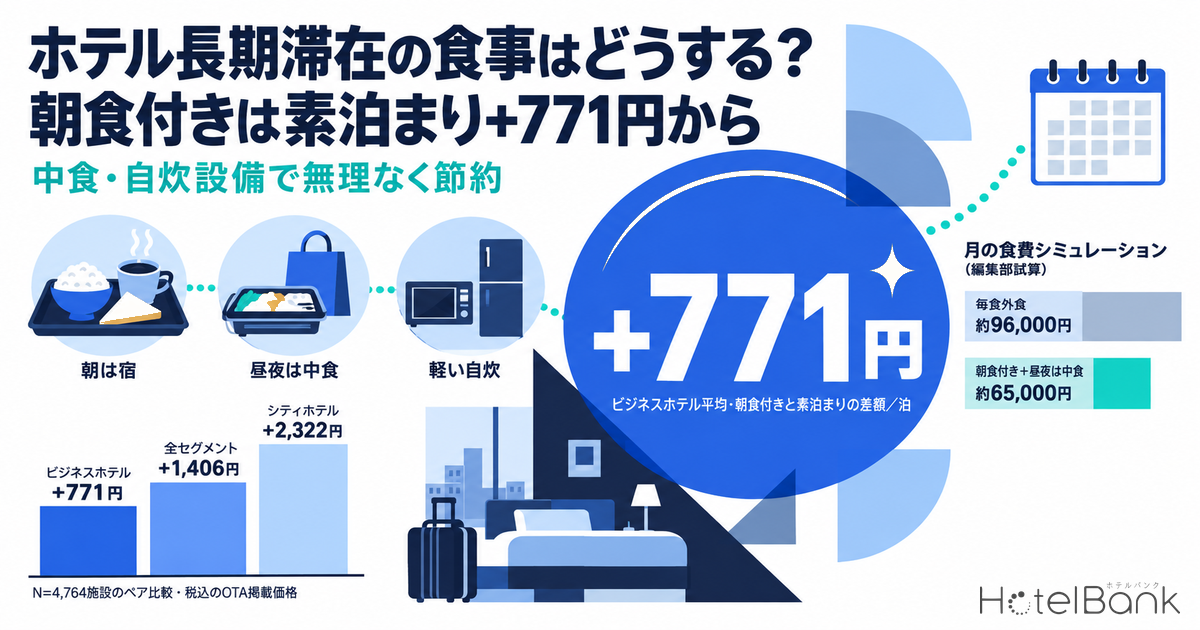
Once a long hotel stay or a run of consecutive nights begins, the biggest headache is how to organise meals every day. The short answer: the basic pattern is a three-part setup — breakfast from the hotel’s breakfast-included plan, lunch and dinner as ready-made food from convenience stores and supermarkets, and light cooking in the room when you have the time. Pair-comparing published plan prices at 4,764 properties nationwide, the difference between a breakfast-included plan and a room-only plan averaged ¥1,406 per night, and just ¥771 at business hotels (both per person in a single-occupancy room, tax-inclusive OTA published prices, as of September 2026, HotelBank Editorial Team research). That works out to getting breakfast every morning for the same as, or less than, eating breakfast out. Starting from this measured data, this article walks through three ways to keep food costs down on a long stay without strain.
- — Breakfast adds just +¥771 a night at business hotels / a measured figure from pair-comparing only properties that sell both a breakfast-included and a room-only plan (N=3,126 properties, single occupancy, tax-inclusive OTA published prices, as of September 2026). Across all segments the gap is +¥1,406 (N=4,764 properties).
- — About ¥840 per person for two sharing a room / at business hotels the gap for a double-occupancy room averages ¥1,679 per room (N=3,019 properties, same timing). That is the same as, or less than, one breakfast out, so you can leave every morning’s meal to the hotel.
- — Switching lunch and dinner to ready-made food saves about ¥31,000 over 30 days / roughly ¥65,000 for a breakfast-included plan plus ready-made lunch and dinner, against about ¥96,000 for eating out at every meal (editorial estimate; meal prices are assumptions). Only the ¥771 gap is a measured value.
- — In-room cooking facilities are found through “how you search” / three routes: property type (apartment hotels and residence-style properties), facility filters, and plan names carrying “weekly” or “monthly”. Even a middle option with a microwave and fridge rather than a full kitchen moves your food budget.
- — Breakfast satisfaction can outweigh the price gap / the Dormy Inn chain (Kyoritsu Maintenance) scores an average of 4.47 out of 5 for breakfast, its highest-rated category (70 properties in the chain, 241,432 guest reviews over the most recent 24 months, compiled September 2026, HotelBank Editorial Team research).
The basic long-stay meal pattern: “breakfast at the hotel, lunch and dinner sourced outside”
On a one- or two-night trip, eating out for every meal is no problem, but once a stay stretches to a week or a month, food becomes the biggest expense after the room itself. Managing meals on a long stay is easier to think through when broken into three parts.
- 1. Breakfast-included plan — the measured gap over room-only starts from ¥771 a night. If the gap is cheaper than breakfast out, leaving mornings to the hotel is the rational choice.
- 2. Nakashoku (ready-made meals) — buy from convenience stores, supermarkets and delis and eat in your room. The trick is to make “close by” a condition when you choose where to stay.
- 3. In-room cooking facilities — rooms with a microwave or kitchenette can be found if you know which search conditions to use. Even “light cooking” that is just reheating makes a big difference to food costs.
How you combine these three can change a month’s food bill by tens of thousands of yen for the same stay. Let’s look at each in turn.
Breakfast-included vs room-only: a measured gap from ¥771 a night
If you have been choosing room-only on the assumption that “breakfast-included is expensive”, take a look at the actual gap. The table below shows the result of a pair comparison by the HotelBank Editorial Team, covering only properties that list both a “breakfast-included” and a “room-only” plan (OTA published prices, tax-inclusive, as of September 2026, all 47 prefectures).
| Segment | Room-only average | Breakfast-included average | Gap per night | Properties |
|---|---|---|---|---|
| Business hotels | ¥12,947 | ¥13,717 | +¥771 (+6.0%) | N=3,126 |
| All segments | ¥17,350 | ¥18,757 | +¥1,406 (+8.1%) | N=4,764 |
| City hotels | ¥21,506 | ¥23,829 | +¥2,322 (+10.8%) | N=745 |
Single occupancy, tax-inclusive OTA published prices. Pair comparison of properties listing both breakfast-included and room-only plans only (as of September 2026, HotelBank Editorial Team research).
At business hotels, the main battleground for long stays, the gap averages ¥771 a night. That is about the same as a café morning set or a chain restaurant’s breakfast, and a buffet lets you adjust how much you eat. For double occupancy, the business-hotel gap averages ¥1,679 per room (N=3,019 properties, same timing), or about ¥840 per person. The decision to “leave breakfast to the hotel” holds up on the measured data too. The gap does vary by area: a tally of business hotels in just Tokyo, Osaka and Kyoto as of August 2026 showed a range of +¥565 to +¥2,174. Reading Hotel Long-Stay Meals in Japan: 3 Patterns and the Breakfast Gap, which breaks the gap down by area and sets out what kind of meals you can have in the room by room facility, makes it easier to decide for your destination (this article tallies 4,764 properties nationwide as of September 2026, so the levels cannot be compared directly).
In many cases breakfast satisfaction outweighs the price gap. For example, the Dormy Inn chain (Kyoritsu Maintenance), known for its large public baths and breakfasts, scored an average of 4.47 out of 5 for breakfast — its highest-rated category — across 241,432 guest reviews at 70 properties in the chain compiled by the HotelBank Editorial Team (most recent 24 months, compiled September 2026). Actual reviews include comments such as “a breakfast buffet with local specialities” (posted July 2026, HotelBank Editorial Team research), and some properties also serve a free late-night noodle service, “Yonaki Soba”. Choosing a chain where the hotel provides some “food to look forward to” during a run of nights also helps when you are keeping a long stay going.
Lunch and dinner as “nakashoku” — choose a hotel near a convenience store or supermarket
Eating out for lunch and dinner every day makes food costs balloon quickly. The long-stay staple is “nakashoku”: ready-made food bought from convenience stores, supermarkets and delis and eaten in the room. What makes the difference here is checking on a map at the booking stage whether there is a supermarket or convenience store within a few minutes’ walk. The longer the stay, the more the daily burden depends on whether you can buy groceries and daily necessities on foot.
When nakashoku is your mainstay, there are three things to check.
- Supermarket opening hours — if you are after evening-discounted deli food, what matters is whether the store is open when you get back from work or sightseeing.
- Where the microwave is — usability changes depending on whether it is in the room or shared next to the front desk or on each floor. A shared one is still perfectly practical.
- Drugstores sell food too — drinks, cup noodles and frozen food are often cheaper at drugstores.
A concrete method for narrowing down to places near convenience stores and supermarkets from the area-selection stage is explained in detail in Hotels Near Convenience Stores & Supermarkets: National Ranking.
Where to find hotels with a microwave or kitchenette
“Cooking in a hotel” is no longer anything special. Properties with a microwave or simple kitchen in the room are found efficiently with the following conditions.
- Filter by property type — properties described as an “apartment hotel”, “residence-style” or “extended-stay hotel” often have a kitchen and washer-dryer as standard.
- Filter by facilities — add “microwave (in room)”, “kitchenette” or “kitchen” to the filters on booking sites.
- Search by plan name — properties with plans labelled “weekly”, “monthly” or “consecutive-night discount” often have facilities set up for long-stay guests.
If you don’t need a full kitchen, a middle option with just a “microwave and fridge” is realistic. As long as you can reheat deli food and keep drinks and batch-prepared food, you can cut food costs substantially without cooking. For a comparison of properties focused on this middle option, see the comparison of five long-stay hotels with a microwave and fridge in every room (innippon, in Japanese).
How a month’s food bill changes — estimates by combination
How much does a month’s food bill change when you combine the three methods? The table below is an editorial estimate assuming eating out costs ¥700 for breakfast, ¥1,000 for lunch and ¥1,500 for dinner, and ready-made food ¥600 for lunch and ¥800 for dinner (meal prices are assumptions for the estimate; only the ¥771 breakfast-plan gap uses the measured value shown above).
| Pattern | Per day | 30-day equivalent |
|---|---|---|
| A: Eat out at every meal | About ¥3,200 | About ¥96,000 |
| B: Breakfast-included plan + ready-made lunch and dinner | About ¥2,200 | About ¥65,000 |
| C: Breakfast-included plan + ready-made lunch and dinner (using a microwave) | About ¥1,800 | About ¥54,000 |
Editorial estimate. Breakfast in both B and C is counted at the measured breakfast-plan gap of ¥771/night (above, business-hotel average). Eating out is assumed at ¥700 for breakfast, ¥1,000 for lunch and ¥1,500 for dinner; ready-made food at ¥600 for lunch and ¥800 for dinner; and, for C with a microwave, ¥450 for lunch and ¥600 for dinner. All meal prices are assumptions for the estimate and vary by region and store.
Simply switching breakfast to the hotel’s breakfast-included plan and lunch and dinner to ready-made food makes a difference of about ¥30,000 a month. Use frozen food and batch-prepared meals in a room with a microwave and the cost of ready-made meals drops another notch (Table 2, pattern C: about ¥1,800 a day, or about ¥54,000 over 30 days). The key is not to overdo it. On a long stay, “something you can keep up” comes first; a plan that lasts is one where weekdays are built on breakfast-included plus ready-made food, while you still enjoy eating out a few times a week. Alongside food, the other lever is the consecutive-night discount on the room itself; measured rates for how many nights it takes before discounts kick in are set out in Japan Hotel Long-Stay Discounts: 15% at 7 Nights, 20% at 30 Nights.
Where to look next
For a comparison of specific hotels, these articles go into detail.
Five long-stay hotels with a microwave and fridge in every room — keeping the cost of eating out down on consecutive nights, even without cooking (innippon, in Japanese)
Compares five properties — Tokyu Stay Okinawa Naha, Sapporo Odori, Hakata, Osaka Hommachi and Ikebukuro — by room facilities, consecutive-night plans and price range. Every room has a microwave and fridge, so you can build your meals during a run of nights by reheating deli food and storing batch-prepared meals.
Once a business trip passes three nights, stop staying in a “hotel” — Top 5 apartment-style stays with a kitchen and washer-dryer where you live like a local (HotelPicks, in Japanese)
Five apartment-style properties from Tokyo, Osaka, Fukuoka and Sapporo with a kitchen and washer-dryer in the room. The options suit long stays where you want to cook properly, including Tokyu Stay Hakata and MIMARU Osaka Namba Station and MIMARU Tokyo Ueno East, whose large rooms of around 40 m² also work when family joins you.
Frequently Asked Questions
Q. How much more does a breakfast-included plan cost than room-only?
A. Pair-comparing only properties that list both breakfast-included and room-only plans, the gap per night averaged ¥771 at business hotels (N=3,126 properties), ¥1,406 across all segments (N=4,764 properties) and ¥2,322 at city hotels (N=745 properties) (all single occupancy, tax-inclusive OTA published prices, as of September 2026, HotelBank Editorial Team research). At business hotels, the main battleground for long stays, that is about the same as a café morning set or a chain restaurant’s breakfast.
Q. How much will food cost for a month on a long stay?
A. In this article’s editorial estimate, eating out at every meal costs about ¥3,200 a day, or about ¥96,000 over 30 days; a breakfast-included plan with ready-made lunch and dinner costs about ¥2,200 a day, or about ¥65,000 over 30 days; and lowering the cost of ready-made meals further in a room with a microwave brings it to about ¥1,800 a day, or about ¥54,000 over 30 days. Meal prices are assumptions for the estimate; the only measured value used is the breakfast-plan gap of ¥771/night. Costs vary by region and store, so read these as a guide to levels.
Q. What is nakashoku?
A. It refers to buying ready-to-eat food from convenience stores, supermarkets, delis and similar shops and eating it in your room. It sits between eating out and cooking for yourself, and is the long-stay staple for lunch and dinner. It is easier to use if you cover three points: checking on a map when choosing where to stay whether there is a supermarket or convenience store within a few minutes’ walk, the supermarket’s opening hours, and whether the microwave is in the room or shared.
Q. How do I find hotels with a microwave or kitchen in the room?
A. There are three ways to search. The first is to filter by property type: properties described as an “apartment hotel”, “residence-style” or “extended-stay hotel” often have a kitchen and washer-dryer as standard. The second is to add “microwave (in room)”, “kitchenette” or “kitchen” to the facility filters on booking sites. The last is to look at properties with plans labelled “weekly”, “monthly” or “consecutive-night discount”. If you don’t need a full kitchen, a middle option with just a microwave and fridge is realistic.
Q. What is the breakfast gap when two people stay?
A. For double occupancy at business hotels, the gap between breakfast-included and room-only averaged ¥1,679 per room (N=3,019 properties, as of September 2026). That is about ¥840 per person, not very different from ¥771 for single occupancy. Leaving breakfast to the hotel makes sense for two people as well.
Q. How should I decide between breakfast-included and room-only?
A. The starting point is whether that property’s gap is lower than what you would spend on breakfast out. If the gap is around ¥771, it is the same as or less than breakfast out, so leaving mornings to the hotel also wins on convenience. However, the gap varies by area: a tally of business hotels in just Tokyo, Osaka and Kyoto as of August 2026 showed a range of +¥565 to +¥2,174. Check the actual gap at your destination before deciding. If breakfast content and ratings matter to you, it is worth looking at the breakfast’s reputation as well as the gap.
Methodology and Sources
■ Data sources
The breakfast-included vs room-only gap is a HotelBank Editorial Team tally of OTA published prices, covering all 47 prefectures and extracting only properties that list both a “breakfast-included” and a “room-only” plan for a pair comparison (as of September 2026). The price basis is single occupancy, price per room, tax-inclusive. Property counts are N=3,126 for business hotels, N=4,764 for all segments and N=745 for city hotels, each shown alongside the body text and tables. The double-occupancy gap of ¥1,679 is a tally of N=3,019 properties at the same timing. The area range (+¥565 to +¥2,174) is a tally of business hotels in just Tokyo, Osaka and Kyoto as of August 2026; because the population and timing differ, it is not set side by side with the national figures. The breakfast-category rating of 4.47 tallies 241,432 guest reviews at 70 Dormy Inn chain properties over the most recent 24 months (compiled September 2026).
■ Calculation assumptions
The one-month food cost estimate assumes eating out at ¥700 for breakfast, ¥1,000 for lunch and ¥1,500 for dinner; ready-made food at ¥600 for lunch and ¥800 for dinner; and ready-made food with a microwave at ¥450 for lunch and ¥600 for dinner, simply adds up 30 days and rounds to the nearest thousand yen. All these meal prices are assumptions for the estimate, not measured values. The only measured value used is the breakfast-plan gap of ¥771/night (business-hotel average), at which breakfast is counted in patterns B and C. The room rate itself and other living costs such as drinks, treats, extra orders when eating out and coin laundry are not included as inputs.
■ Limitations and caveats
Published prices are not actual transaction prices; using consecutive-night plans, monthly plans or member rates moves the amount paid downward, so the amounts in this article are an upper-end guide. The gap is the difference between plans within the same property, and breakfast content, format (buffet or set meal) and serving hours differ by property, so the value of breakfast cannot be compared on price alone. The tally is limited to properties listing both plans at the same time, so properties that sell only breakfast-included or only room-only are not in the population. The food cost estimate depends on its assumptions, and results change with local prices, stores and where you shop. Whether rooms have facilities and whether they can be used (where the microwave is, whether cooking is allowed) follows each property’s rules, so check each property’s information before booking.
■ Market data
- HotelBank Editorial Team research — pair comparison of breakfast-included and room-only plans by OTA published price (N=4,764 properties, as of September 2026)
- HotelBank Editorial Team research — breakfast-category ratings in guest reviews (N=241,432 reviews, 70 properties, most recent 24 months, compiled September 2026)
Related Articles
- Hotel Long-Stay Meals in Japan: 3 Patterns (eating out, ready-made, in-room) and Switching to a Room with a Kitchen
- Hotels Near Convenience Stores & Supermarkets for Long Stays and Self-Catering: National Ranking by Area
- Business Hotels for Long Stays: 6 Checks and 3 Ways to Cut Costs
- Japan Hotel Long-Stay Discounts: How Many Nights? 15% at 7 Nights, 20% at 30 Nights
- 6 Downsides of Hotel Living and a Quick Guide to Fixes — Easing the Hassles of Address, Laundry and Cooking
- What Is a Monthly Hotel? Plans for a Month of Consecutive Nights With No Lease, and Typical Costs