

The 20th Asian Games (Aichi-Nagoya 2026) opened on Saturday, September 19, 2026, and run for 16 days through the closing ceremony on Sunday, October 4. The first weekend, including the opening ceremony, has now passed its stay dates, so how far inventory was drawn down can be read as a settled result. This article fixes as its population the 397 properties in Aichi Prefecture that list at least 30% of their total rooms on OTAs and similar channels, and measures, for each night around the opening ceremony, the share of properties with zero rooms left and the number of rooms remaining, set against the same weekdays before the Games. It then looks at the closing weekend (October 3 and 4) municipality by municipality to see where room remains to absorb demand.
The supply-side design of using cruise ships as the athletes’ village was covered in our earlier article, Asian Games 2026: 1,500 Ship Rooms vs Nagoya’s 28,986-Room Stock. This article focuses on how demand was absorbed.
Metric Definitions Used in This Article
- Target properties: 397 properties with 33,134 rooms in Aichi Prefecture that are listed on OTAs and similar channels and whose OTA allocation was at least 30% of total rooms on ordinary days before the Games (September 11–14, 2026), based on listings on major booking sites. Each date is aggregated over the properties whose inventory could be observed on that date, and N (number of properties) is shown with each table and chart.
- Share of sold-out properties: the share of target properties with zero rooms left on OTAs and similar channels at that point in time (judged on room counts, not on the number of plans).
- Rooms remaining / remaining-room rate: the total number of rooms still available for sale on OTAs and similar channels, and that total as a share of total rooms.
- LT (lead time): the number of days before the stay date. LT1 = the day before the stay date. This article uses only observations at LT45 or less.
- ADR (average daily rate): an estimated settled rate (tax-exclusive equivalent), calculated by applying a segment-specific correction factor to the lowest plan price each property publishes on OTAs (per room, 2 guests, tax-inclusive). Checked against property-level results disclosed by listed hotel REITs (91 properties, most recent 3 months), the median error is about 7%. It is an estimate and differs from each property’s actual settled prices and accounting figures. Area-level ADR is the median of the target properties (the level of a typical property in the area).
- Data source: MetroEngines Research
Key Takeaways
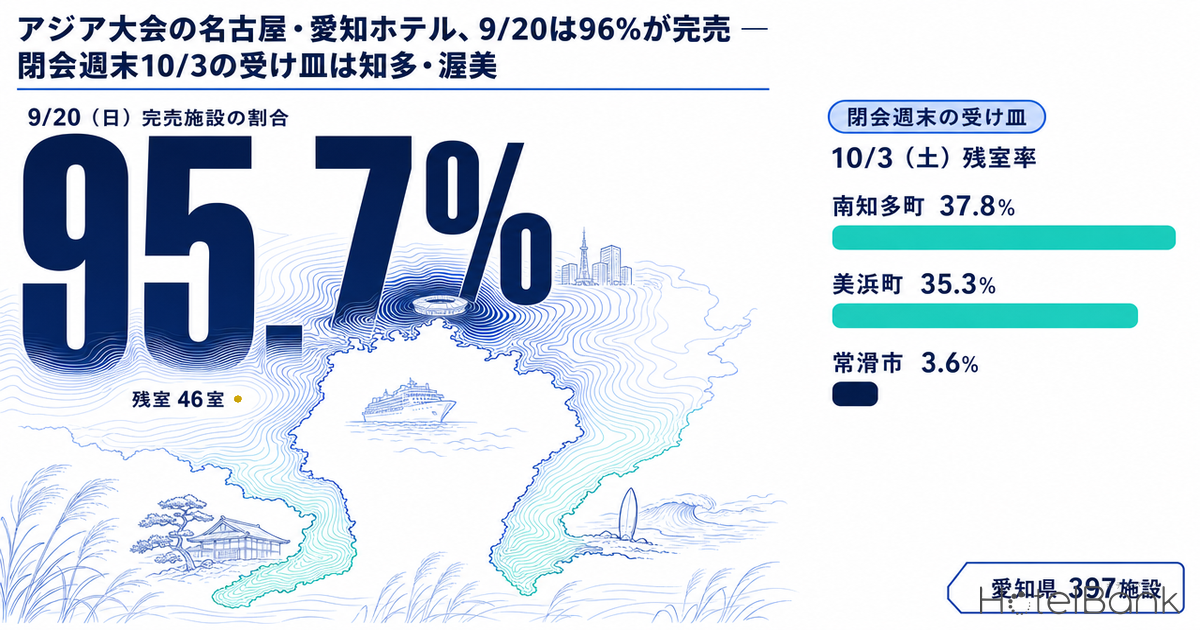
- On Sunday, September 20, the day after the opening ceremony, 95.7% of the 391 target properties had zero rooms left as of the day before. Just 46 of 31,719 rooms remained, a sharp turn from 32.6% and 7,524 rooms on the pre-Games Sunday (September 13).
- Against the same weekday before the Games, the gaps were +18.4pt on Friday, +37.8pt on Saturday, +63.1pt on Sunday and +37.4pt on Monday (Respect for the Aged Day). Demand landed more heavily on the night after the opening ceremony than on the ceremony night itself.
- The closing weekend looks different. Compared 19 days before the stay date, Saturday, October 3 had a remaining-room rate of 10.6%, lower than the 19.2% on Saturday, October 10, the first day of the post-Games three-day weekend. Sunday, October 4, however, was at 27.1%, level with the 27.0% on Sunday, October 11.
- Capacity for October 3 varies widely by municipality. Venue cities filled first — Tokoname 3.6%, Toyohashi 2.4%, Toyota 5.1% — while the resort areas of the Chita and Atsumi peninsulas still have room: Minamichita 37.8%, Mihama 35.3%, Tahara 31.8%.
Setting the population: fixing “30%+ OTA allocation” on ordinary pre-Games days
When aggregating property-level inventory, the standard practice is to exclude properties whose OTA allocation is less than 30% of total rooms. A small allocation can reflect several things — selling mainly through other channels such as the official website or travel agencies, adding inventory as the stay date approaches, or contracts with only a small OTA allocation in the first place — so few remaining rooms does not necessarily signal strong demand.
However, if this 30% test is applied separately for each stay date, then the earlier a date sells out, as during the Games, the smaller the maximum observable allocation becomes, and the more properties drop out of the aggregate. In fact, with a per-date test, the population shrinks from 182 properties on Saturday, September 12 before the Games to 101 on Saturday, September 19 and 87 on Sunday, September 20. The properties that filled up fastest would simply vanish from the denominator.
This article therefore fixes as its population the 397 properties with 33,134 rooms that met the 30%+ allocation test on any of the ordinary pre-Games days of September 11–14, and tracks how the inventory of that same group changed by date. By municipality, it consists of 128 properties in Nagoya (18,014 rooms), 80 in Minamichita, 17 in Gamagori, 16 each in Toyota and Tahara, and others.
Settled results for the four nights around the opening ceremony: 95.7% of properties had zero rooms left on September 20
First, the four nights around the opening ceremony (September 18–21), whose results are now in, are set against the same weekdays before the Games (September 4–7 and September 11–14). The comparison uses the snapshot on the day before the stay date (LT1), which shows how much of the inventory bookable on OTAs for that night was ultimately left.
| Day | Stay date during the Games | Share of sold-out properties | Rooms remaining (remaining-room rate) | Pre-Games: week of Sep 4–7 | Pre-Games: week of Sep 11–14 |
|---|---|---|---|---|---|
| Fri | Sep 18 (eve of the opening ceremony) | 53.8% | 1,906 rooms (6.0%) | 30.3% / 7,191 rooms | 35.4% / 5,555 rooms |
| Sat | Sep 19 (opening ceremony) | 80.0% | 439 rooms (1.4%) | 42.4% / 4,081 rooms | 42.2% / 5,053 rooms |
| Sun | Sep 20 (day 2 of the Games) | 95.7% | 46 rooms (0.1%) | 29.5% / 7,732 rooms | 32.6% / 7,524 rooms |
| Mon | Sep 21 (Respect for the Aged Day) | 89.8% | 182 rooms (0.6%) | 35.8% / 6,979 rooms | 52.4% / 3,584 rooms |
Source: compiled by HotelBank Editorial Team from MetroEngines Research (Aichi Prefecture, 390–397 target properties / 31,658–33,134 rooms, based on listings on major booking sites, as of the day before each stay date)
On Saturday, September 19, the day of the opening ceremony, 80.0% of properties had zero rooms left, with 439 rooms remaining. On the two pre-Games Saturdays the share was around 42%, so the gap is +37.8pt (vs September 12). The following night, Sunday, September 20, was even tighter: 95.7% of properties sold out, and only 46 rooms were left out of a population of 31,719. The pre-Games Sundays stood at 29.5% and 32.6%; in normal times Sunday is the weekend night with the most unsold inventory. That night became the most fully booked of the Games period.
Monday, September 21 (Respect for the Aged Day) was also high at 89.8%. The control Monday, September 14, at 52.4%, ran above a normal Monday, possibly because Games-related travel had already begun ahead of the ships’ arrival at Nagoya Port on September 15; against Monday, September 7 (35.8%), the gap widens to +54.0pt. Friday, September 18 reached 53.8%, only 18–24pt above the pre-Games Fridays. The demand peak ran not on the eve of the opening ceremony but from the ceremony night into the middle day of the holiday weekend.
Source: compiled by HotelBank Editorial Team from MetroEngines Research (Aichi Prefecture, 390–397 target properties, based on listings on major booking sites, as of the day before each stay date)
When did the inventory go? On the opening-ceremony Saturday, only 10% of rooms were left 45 days out
Beyond the results, it is worth comparing how fast the inventory disappeared. The chart below plots, for each Saturday stay date, the remaining-room rate from 45 days before the stay date to the day before. Before the Games, Saturday, September 12 had 36.1% of inventory left at 45 days out, easing gradually to 15.3% on the day before — the typical shape of an ordinary weekend that fills toward the end.
By contrast, Saturday, September 19, the opening-ceremony night, had a remaining-room rate of just 10.3% at 45 days out, with 42.7% of properties already sold out. In other words, about 90% of the prefecture’s inventory had been taken more than 45 days before the stay date. Saturday, September 26, within the Games period, follows the same shape: 7.3% at 45 days out and 4.0% at the September 23 observation (3 days before the stay date), almost the same level as the opening-ceremony Saturday.
Saturday, October 3, the last Saturday of the Games, sits between the two. At 45 days out it had 19.2%, about half the inventory of an ordinary Saturday, but it has drawn down slowly since, and 8.5% (2,818 rooms) remained at the September 23 observation (10 days before the stay date). Saturday, October 10, the first day of the post-Games three-day weekend, still had a sizeable 18.2% at the 17-days-out snapshot.
Source: compiled by HotelBank Editorial Team from MetroEngines Research (Aichi Prefecture, 390–397 target properties / approx. 32,000–33,000 rooms, based on listings on major booking sites. Sep 26, Oct 3 and Oct 10 are interim figures up to the observation of September 23, 2026)
The closing weekend at the same lead time: Oct 3 looks like the post-Games three-day weekend, Oct 4 close to normal
Because October 3 and 4 have not yet arrived, they are compared not on settled figures but with every date aligned to the same point, 19 days before the stay date (LT19). LT19 is the most recent snapshot at which observations are complete for every date through Monday, October 12 (Sports Day), after the Games.
| Day | Pre-Games (Sep 11–14) | Opening week (Sep 18–21) | Closing week (Oct 2–4) | Post-Games (Oct 9–12) |
|---|---|---|---|---|
| Fri | 7.1% / 32.3% | 27.6% / 13.0% | 21.2% / 12.6% | 11.5% / 29.3% |
| Sat | 17.4% / 28.3% | 65.6% / 4.0% | 34.0% / 10.6% | 36.2% / 19.2% |
| Sun | 8.6% / 35.3% | 86.2% / 0.8% | 10.5% / 27.1% | 20.6% / 27.0% |
| Mon | 19.1% / 27.6% | 79.8% / 2.7% | — | 11.2% / 36.2% |
Each cell shows “share of sold-out properties / remaining-room rate”. The Monday of the closing week (Oct 5) falls outside the Games and is left blank. Oct 12 is Sports Day; Sep 21 is Respect for the Aged Day.
Source: compiled by HotelBank Editorial Team from MetroEngines Research (Aichi Prefecture, 387–397 target properties, based on listings on major booking sites, 19 days before each stay date)
Compared at the same 19 days out, the character of the closing weekend becomes clear. Saturday, October 3 shows 34.0% of properties sold out and a 10.6% remaining-room rate, short of the opening-ceremony night of September 19 (65.6% and 4.0%). Against Saturday, October 10, the first day of the post-Games three-day weekend, the share of sold-out properties is almost the same (36.2%), yet the remaining-room rate is nearly half (10.6% vs 19.2%). Fewer rooms remain even though the number of sold-out properties is unchanged, which is likely because inventory is being absorbed first at the larger urban hotels with more rooms.
Sunday, October 4, the day of the closing ceremony, shows 10.5% sold out and a 27.1% remaining-room rate — close to the pre-Games Sunday (September 13) at 8.6% and 35.3%, and almost the same remaining-room rate as Sunday, October 11, the middle day of the post-Games three-day weekend. For athletes and officials, the closing-ceremony night tends to be a day to leave rather than a night to stay, so the Games’ effective end point can be read as the night of October 3. In the latest snapshot (the September 23 observation), October 3 (10 days out) had 2,818 rooms (8.5%) left and October 4 (11 days out) had 7,920 rooms (24.0%).
Capacity by municipality: venue cities fill first, while Chita and Atsumi still have room
So where is the closing-weekend inventory left? The target properties are split by municipality, and the table sets the settled figures for September 20 against the remaining-room rates for October 3 and October 10 at 19 days out. The Venue column shows whether a Games competition venue is located within the municipality.
| Municipality | Venue | Target properties | Sep 20 rooms left (Sep 13) | Oct 3 remaining rate 19 days out | Oct 10 remaining rate 19 days out | Oct 3 rooms left as of Sep 23 |
|---|---|---|---|---|---|---|
| Nagoya | Yes | 128 | 27 rooms (3,873) | 11.2% | 20.1% | 1,454 rooms (8.1%) |
| Toyota | Yes | 16 | 0 rooms (88) | 5.1% | 17.7% | 35 rooms (3.3%) |
| Okazaki | Yes | 10 | 2 rooms (137) | 4.3% | 9.5% | 26 rooms (3.1%) |
| Toyohashi | Yes | 11 | 2 rooms (396) | 2.4% | 11.4% | 54 rooms (4.0%) |
| Tokoname | Yes | 8 | 0 rooms (1,126) | 3.6% | 27.9% | 84 rooms (2.8%) |
| Kariya | Yes | 6 | 1 room (86) | 2.9% | 32.2% | 9 rooms (1.4%) |
| Anjo | Yes | 10 | 0 rooms (94) | 8.7% | 12.9% | 64 rooms (7.1%) |
| Ichinomiya | Yes | 9 | 0 rooms (149) | 10.4% | 6.2% | 52 rooms (9.5%) |
| Gamagori | Yes | 17 | 1 room (178) | 10.9% | 15.2% | 62 rooms (6.9%) |
| Inuyama | — | 12 | 1 room (165) | 7.9% | 18.3% | 54 rooms (9.5%) |
| Shinshiro | Yes | 10 | 0 rooms (86) | 19.4% | 10.5% | 52 rooms (16.6%) |
| Nishio | Yes | 11 | 0 rooms (35) | 21.2% | 20.3% | 40 rooms (18.9%) |
| Tahara | Yes | 16 | 9 rooms (95) | 31.8% | 21.6% | 152 rooms (27.3%) |
| Mihama | — | 10 | 0 rooms (26) | 35.3% | 24.8% | 51 rooms (38.3%) |
| Minamichita | — | 80 | 2 rooms (279) | 37.8% | 22.7% | 305 rooms (33.6%) |
| Other | — | 43 | 1 room (711) | 9.8% | 14.4% | 324 rooms (10.2%) |
“Venue” marks municipalities with a Games competition venue. “Other” is the total for municipalities not listed among the 15 in the table (Tokai, Komaki, Handa, Toyokawa and others).
Source: compiled by HotelBank Editorial Team from MetroEngines Research (Aichi Prefecture, 397 target properties, based on listings on major booking sites). Venue locations compiled by HotelBank Editorial Team from published materials
On the night of September 20, inventory disappeared across almost the entire prefecture regardless of municipality. Nagoya had 27 rooms left across 128 properties, Minamichita 2 rooms across 80 properties, and Tokoname went from 1,126 rooms on the pre-Games Sunday to zero. On the opening weekend, the whole prefecture — including resort areas far from the venues — was used up as capacity.
By the closing weekend on October 3, the gap between municipalities widens. Comparing the remaining-room rate at 19 days out with the post-Games October 10, the urban municipalities with venues are clearly lower on October 3: Tokoname 3.6% vs 27.9%, Kariya 2.9% vs 32.2%, Toyohashi 2.4% vs 11.4%, Toyota 5.1% vs 17.7% and Nagoya 11.2% vs 20.1%. In venue cities where competition continues, Games demand is still holding inventory even on the closing weekend.
The resort areas of the Chita and Atsumi peninsulas are the contrast. Minamichita has a remaining-room rate of 37.8% for October 3, 15.1pt higher than the 22.7% for October 10. Mihama shows 35.3% vs 24.8%, and Tahara, home to the surfing venue, 31.8% vs 21.6%, so there is more inventory on the closing weekend. Even at the September 23 observation, 305 rooms remained in Minamichita, 152 in Tahara and 51 in Mihama. While inventory in the venue cities thins, the ryokan and guesthouses of the peninsulas still have capacity for the closing weekend.
Source: compiled by HotelBank Editorial Team from MetroEngines Research (Aichi Prefecture, 397 target properties, based on listings on major booking sites, 19 days before each stay date)
The rate backdrop: estimated ADR over the three pre-Games months was flat to slightly down year on year
What about rates during a period when inventory moved this much? Settled estimated ADR is finalised monthly, and the September 2026 figure is fixed only after the month closes. Here we check the year-on-year change for the three months up to just before the Games.
| Area | Jun 2026 | Jul 2026 | Aug 2026 | N (Aug) |
|---|---|---|---|---|
| Aichi Prefecture | ¥7,864 (−1.6%) | ¥8,185 (−3.3%) | ¥8,555 (−5.5%) | 505 |
| Nakamura Ward, Nagoya | ¥9,299 (+5.4%) | ¥9,387 (+4.3%) | ¥9,566 (+0.6%) | 71 |
| Naka Ward, Nagoya | ¥8,293 (−0.2%) | ¥8,534 (−7.3%) | ¥8,810 (−11.0%) | 88 |
YoY in parentheses. Estimated settled ADR (tax-exclusive equivalent), median of target properties in the area.
Source: compiled by HotelBank Editorial Team from MetroEngines Research
Estimated ADR for Aichi Prefecture as a whole was ¥7,900 in June (−1.6% YoY), ¥8,200 in July (−3.3%) and ¥8,600 in August (−5.5%). Nakamura Ward, home to Nagoya Station, ran above the prior year at +0.6% to +5.4%, while Naka Ward, which includes Sakae, fell below the prior year in July and August. Up to just before the Games, rates in the prefecture ran flat to slightly below the prior year.
Against that backdrop, the fact that more than 90% of inventory vanished on the opening weekend means Games demand showed up first as rooms being absorbed, before any rise in rates. Estimated ADR for September and October is finalised only after each month closes, and how far rates during the Games exceeded the prior year will be re-examined once settled figures are available.
Putting it into operations: three opportunities left for the closing weekend
1. On the opening weekend, the real peak was “the night after”. Against 80.0% on Saturday, September 19, the following Sunday, September 20 reached 95.7%. On the first day of a major sporting event, guests staying on after watching overlap with those arriving the night before the next day’s competition. Sunday is normally the night with the most unsold inventory, so when event demand lands on it, the lift is largest. When building a rate calendar, there is room to treat the night after the opening ceremony as part of the same peak, not just the ceremony night itself.
2. Weight the closing weekend toward Saturday, and go after general demand on Sunday. At 19 days out, Saturday, October 3 had thinner inventory than the first day of the post-Games three-day weekend, while Sunday, October 4 was close to an ordinary pre-Games Sunday. The closing-day night can be used as capacity for non-Games demand such as leisure and business.
3. Resort areas in Chita and Atsumi still have closing-weekend capacity. In Minamichita, Mihama and Tahara, the October 3 remaining-room rate is above that of the first day of the post-Games three-day weekend. These areas were also almost fully booked on September 20, which has already shown they are within reach of Games demand. There looks to be an opportunity to step up communication — including access and shuttle information — aimed at spectators and officials who cannot find rooms in Nagoya or the venue cities. The spread of demand beyond Nagoya was also confirmed in Asian Games 2026: Toyohashi +18.7pt, Kuwana +14.4pt Beyond Nagoya, which looked at the snapshot 37 days before the opening.
The Asian Para Games follow from October 18 to 24. For our view of demand during the Para Games, see Asian Para Games 2026: Aichi Weekdays Run 12pt Above the Next Week.
⚠ Note on data for future dates: The share of sold-out properties, rooms remaining and remaining-room rates shown for stay dates from September 26 onward are interim figures based on inventory listed on OTAs and similar channels as of the September 23, 2026 observation, not settled figures. They will change as the stay date approaches due to inventory returned by cancellations, inventory added by properties, new plans and other factors. Zero rooms left on OTAs reflects OTA sales status at that point in time and does not mean the entire property is full.
Frequently Asked Questions
Q. How full were hotels in Nagoya and Aichi during the Asian Games?
A. On Sunday, September 20, 2026, the day after the opening ceremony, 95.7% of the 391 target properties in Aichi Prefecture had zero rooms left on OTAs as of the day before, with 46 of 31,719 rooms remaining. Within Nagoya alone, 27 rooms were left across 128 properties. On the pre-Games Sunday (September 13) the figures were 32.6% and 7,524 rooms.
Q. Can I still find a room for the closing weekend (October 3 and 4)?
A. As of the September 23, 2026 observation, 2,818 rooms (8.5% remaining) were left in the prefecture for Saturday, October 3, and 7,920 rooms (24.0%) for Sunday, October 4. For October 3 these included 1,454 rooms in Nagoya, 305 in Minamichita and 152 in Tahara; the resort areas of Chita and Atsumi have more room than the venue cities. Inventory changes daily.
Q. Did the Games affect municipalities far from the venues?
A. Yes. On September 20, Minamichita (2 rooms left across 80 properties) and Mihama (0 rooms left), neither of which hosts a venue, were also almost full. On the closing weekend of October 3, however, these areas have higher remaining-room rates than on the first day of the post-Games three-day weekend, so they still have capacity to absorb demand.
Related Articles
- Asian Games 2026: 1,500 Ship Rooms vs Nagoya’s 28,986-Room Stock
- Asian Games 2026: Toyohashi +18.7pt, Kuwana +14.4pt Beyond Nagoya
- Asian Para Games 2026: Aichi Weekdays Run 12pt Above the Next Week
- Aichi Day-of-Week OCC: Sunday 12.6pt Below Saturday on 92-Day Data
References and Sources
- MetroEngines Research — property-level inventory trends in Aichi Prefecture (stay dates September 4 to October 12, 2026; observations within 45 days of the stay date, up to the September 23, 2026 observation) and estimated settled ADR (June 2025 to August 2026)
- Aichi-Nagoya Asian Games and Asian Para Games Organising Committee official website
- 2026 Asian Games (overview of dates and competition venues, in Japanese)
- NAGOYAJIN, “List of all 54 venues of the Aichi-Nagoya Asian Games” (in Japanese)
- Japan Tourism Agency, “Overnight Travel Statistics Survey” (in Japanese)