

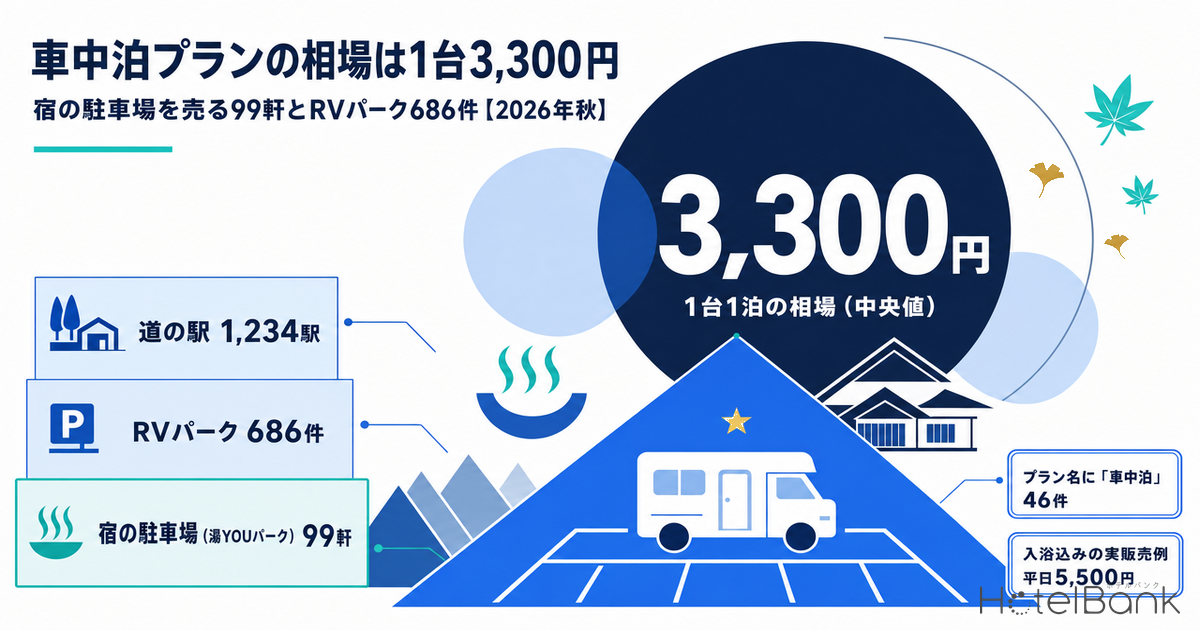
With Japan’s autumn driving season under way, facilities catering to travelers on the road keep multiplying. The Japan RV Association (JRVA) counted 686 certified car-camping sites, known as “RV Parks,” nationwide as of the end of August 2026 (announced September 4, 2026), and the Ministry of Land, Infrastructure, Transport and Tourism (MLIT) lists 1,234 registered Michi-no-Eki roadside stations as of September 4, 2026. For hotels and ryokan, these figures have usually been read as demand that leaks away from their guest rooms.
There is another way to read them. What car campers pay for is “a safe place to park,” “a toilet” and “a bath” – and many lodging properties already have all three. This article works backward from the prices of plans actually on sale and from public data to ask whether a property can price its parking lot and bathing facilities as a product sold per car.
How this differs from earlier coverage: HotelBank has already published Japan’s 50 Smart Interchanges: Median 1,130 Hotel Rooms Within 10 km and Obon Road Trips: Why Car Travelers Pick Expressway-IC Hotels. Both deal with car travelers who stay in guest rooms. This article is about how to monetize car travelers who do not book a room – a different audience.
Metric Definitions Used in This Article
- ADR (average daily rate): an estimated contracted rate (tax-excluded equivalent), calculated by applying a segment-specific adjustment factor to the lowest-priced plan each property publishes on OTAs and other channels (per room, based on double occupancy, tax included). Checked against property-level results disclosed by listed hotel REITs (91 properties, most recent three months), the median error is about 7%. These are estimates and differ from each property’s actual contracted rates and accounting figures. Area-level ADR is the median of the properties covered (the level of a typical property in the area).
- Room stock: the total room count of properties for which room prices were observed in the most recent three months (June 17 – September 17, 2026). The definition excludes registered properties with no actual operations, and does not include ryokan, minshuku or simple lodgings that are not listed on OTAs or similar channels.
- Expressway-access mention rate: the share of guest reviews whose comments on location include a statement to the effect that “an expressway interchange is close by” or “it is easy to reach by car” (reviews posted in the last 24 months, i.e., from September 2024 onward). This measures how often the point is mentioned, not a rating score.
- Data sources: MetroEngines Research / Japan RV Association / MLIT / Kurumatabi Club Co., Ltd. (specified in each section)
- — Facilities for car campers have grown to 686 RV Parks and 1,234 roadside stations, but only 99 properties open their parking lots through the Yu-YOU Park (湯YOUパーク) program – just 0.26% of the 38,174 properties we observe.
- — Of 4.066 million published plan names, only 46 (0.001%) contain “car camping” (車中泊). Sixteen of them bundle bathing, so the value is concentrated in “parking space + bath.”
- — The going rate is ¥3,300 per car per night (median of 377 listed spaces; middle 50% at ¥2,500-¥3,850). That is about 35% of the national median estimated contracted ADR of roughly ¥9,500, earned with almost no per-night variable cost.
- — A real plan that bundles the property’s own baths sells at ¥5,500 on weekdays (Sengokuhara Shinanoki Ichinoyu). Opening 10 spaces of a 100-car lot at 50% utilization yields about ¥1.5 million over the 91 days of autumn, or about ¥2.65 million with bathing included.
- — The five prefectures that rank high on both demand (share of reviews mentioning car access) and supply (RV Parks per 10,000 hotel rooms) are Shiga, Shizuoka, Mie, Yamanashi and Fukushima.
Three Tiers of Car-Camping Facilities: 686 RV Parks, 1,234 Roadside Stations, 99 Lodging Parking Lots
Car-camping facilities fall into three tiers by operator and charging model, and the tier determines what it means for a lodging property.
| Scheme | Count | Operator / registrar | Charge | What it means for lodging properties |
|---|---|---|---|---|
| RV Park | 686 | Japan RV Association (certification) | Paid (set by each site) | A property’s parking lot can be certified if it meets the requirements |
| Michi-no-Eki (roadside station) | 1,234 | MLIT (registration) | Parking generally free | A free alternative, but designed as a rest stop for napping, not for overnight stays |
| Yu-YOU Park | 99 | Kurumatabi Club Co., Ltd. (JRVA subsidiary) | Paid (designed to include bathing) | A framework that uses surplus parking at ryokan, hotels and day-use hot springs |
Source: Japan RV Association (as of end-August 2026, announced September 4, 2026) / MLIT, list of Michi-no-Eki (as of September 4, 2026) / Kurumatabi Club Co., Ltd., list of Yu-YOU Park partners (partner count as of September 18, 2026)
What stands out is the scale of the third tier. Yu-YOU Park, the framework through which lodging properties open their parking lots to car campers, has 99 partner facilities. By contrast, MetroEngines observed room prices at 38,174 properties with 1,593,959 rooms in Japan over the most recent three months. Properties that own parking but have registered it as a car-camping product account for only 0.26% of the properties we can observe.
By region, Hokuriku/Koshinetsu has the most Yu-YOU Park partners at 20, followed by Kanto (12), Chugoku (12) and Tohoku (10). By prefecture, Nagano leads with 12. The partners cluster where hot-spring destinations and car travel overlap, while Shikoku has only 4.
Source: Compiled by the HotelBank Editorial Team from Japan RV Association RV Park listings (checked September 17, 2026; 597 listed sites) / Kurumatabi Club Co., Ltd., list of Yu-YOU Park partners (as of September 18, 2026)
* Prefecture-level RV Park counts cover the 597 sites tallied from the official search site’s listings. They differ from the 686 certified sites announced by the association because, according to the official FAQ, some sites have not yet been added to the listings; treat the prefecture rankings as a trend based on listings.
Only 46 of 4.07 Million Published Plan Names Say “Car Camping” – Productization Has Barely Begun
The schemes for hosting car campers are falling into place, but examples of properties selling a plan with “car camping” in its name are still very rare. Of the published plan names MetroEngines has collected (4,066,359 after de-duplication), just 46 contained “car camping” (車中泊) – 0.001%.
Breaking these 46 down shows what a car-camping plan actually bundles.
| Element in plan name | Count | Share | What it tells us |
|---|---|---|---|
| Bathing / hot spring / bath | 16 | 34.8% | Explicitly bundles bathing – the main justification for the price |
| RV Park (certification shown) | 16 | 34.8% | Uses the association’s certification in the name as a trust signal |
| Room only (no meals) | 13 | 28.3% | States that no meals are included, avoiding confusion with guest-room products |
| Power / outlet / charging | 7 | 15.2% | Power is a differentiator; few properties offer it |
| Toilet | 4 | 8.7% | A 24-hour toilet is a requirement, but it is not used as a selling point |
Source: Compiled by the HotelBank Editorial Team from MetroEngines Research (published plan names N=4,066,359; 46 containing “car camping”)
The pattern shows that the value of a car-camping plan is concentrated in the combination of “parking space + bath.” Names bundling bathing are the most common at 16, while only 7 mention power. Installing electrical hookups requires construction work, but many properties already operate a large communal bath or day-use bath. In other words, the product already exists on a combination that needs almost no additional investment.
Where Car Travelers Are Concentrated: Shiga 0.86%, Shizuoka 0.68% vs. 0.23% Nationwide
To narrow down where productizing car camping would pay off, we started with demand-side signals. We calculated, by prefecture, the share of guest reviews whose comments on location mention the proximity of an expressway interchange or easy car access. Of the 8,676,710 reviews posted since September 2024, 20,295 contained such a mention (0.23% nationwide).
Source: HotelBank Editorial Team research (analysis of N=8,676,710 guest reviews posted September 2024 – September 2026)
Shiga ranks first at 0.86%, 3.7 times the national average, followed by Shizuoka (0.68%), Tokushima (0.61%), Fukushima (0.59%) and Niigata (0.57%). All are prefectures crossed by expressways linking major metropolitan areas, or regions that are more realistically reached by car than by rail. Conversely, in metro areas with strong rail hubs such mentions barely appear: Tokyo 0.08%, Kanagawa 0.08% and Osaka 0.14%. This matches our earlier finding that hotel parking is valued very differently depending on how strong a city’s rail hub is.
Next, we look at supply-side density. Counting RV Parks per 10,000 rooms of room stock highlights the prefectures where car-camping capacity is large relative to guest rooms.
Source: Compiled by the HotelBank Editorial Team from Japan RV Association RV Park listings (checked September 17, 2026) / MetroEngines Research (room stock N=38,174 properties, 1,593,959 rooms)
Yamanashi (11.65), Shiga (11.55), Ibaraki (11.01), Wakayama (10.61) and Mie (10.16) top the list. Tokyo, with its deep room stock, is at 0.05, Osaka at 0.45 and Kanagawa at 1.24 – an order of magnitude or more lower. Shiga, Shizuoka, Mie, Yamanashi and Fukushima rank high on both the demand-side mention rate and supply-side density: the depth of car-borne demand and the depth of car-camping capacity overlap there.
Where Demand and Capacity Overlap: A 47-Prefecture Map
Circle size shows the combined number of RV Parks and Yu-YOU Parks; color shows the expressway-access review mention rate. Where dark circles cluster, both car-borne demand and car-camping capacity are deep.
Source: Japan RV Association RV Park listings (checked September 17, 2026) / Kurumatabi Club Co., Ltd. (as of September 18, 2026) / HotelBank Editorial Team research (reviews N=8,676,710)
| Prefecture | RV Parks | Yu-YOU Parks | Roadside stations | Room stock (rooms) | RV Parks per 10,000 rooms | Expressway-access mention rate | Est. ADR (autumn 2025) |
|---|---|---|---|---|---|---|---|
| Yamanashi | 24 | 2 | 22 | 20,606 | 11.65 | 0.43% | ¥11,600 |
| Shiga | 14 | 1 | 20 | 12,119 | 11.55 | 0.86% | ¥9,100 |
| Ibaraki | 23 | 5 | 16 | 20,884 | 11.01 | 0.33% | ¥6,900 |
| Wakayama | 15 | 2 | 36 | 14,142 | 10.61 | 0.18% | ¥9,500 |
| Mie | 23 | 3 | 18 | 22,629 | 10.16 | 0.46% | ¥11,100 |
| Tokushima | 7 | 0 | 18 | 7,425 | 9.43 | 0.61% | ¥6,100 |
| Nara | 7 | 0 | 18 | 8,838 | 7.92 | 0.14% | ¥14,500 |
| Fukushima | 22 | 0 | 37 | 28,079 | 7.84 | 0.59% | ¥7,500 |
| Hyogo | 31 | 4 | 37 | 41,253 | 7.51 | 0.24% | — |
| Shizuoka | 41 | 2 | 27 | 54,651 | 7.50 | 0.68% | ¥13,200 |
| Fukui | 8 | 1 | 21 | 11,031 | 7.25 | 0.34% | ¥11,100 |
| Shimane | 7 | 0 | 29 | 10,209 | 6.86 | 0.20% | ¥10,700 |
| Chiba | 38 | 1 | 29 | 56,826 | 6.69 | 0.18% | ¥10,100 |
| Kagawa | 9 | 2 | 18 | 13,494 | 6.67 | 0.35% | ¥8,000 |
| Tottori | 6 | 3 | 17 | 9,305 | 6.45 | 0.13% | ¥8,600 |
| Saga | 5 | 3 | 11 | 8,017 | 6.24 | 0.33% | ¥12,200 |
| Yamaguchi | 9 | 2 | 24 | 14,757 | 6.10 | 0.40% | ¥7,500 |
| Aomori | 9 | 1 | 28 | 14,791 | 6.08 | 0.18% | ¥8,000 |
| Gifu | 13 | 3 | 55 | 21,551 | 6.03 | 0.33% | ¥11,900 |
| Gunma | 14 | 1 | 33 | 23,247 | 6.02 | 0.33% | ¥12,000 |
Source: Japan RV Association / Kurumatabi Club Co., Ltd. / MLIT, list of Michi-no-Eki / MetroEngines Research / HotelBank Editorial Team research
* Top 20 prefectures by RV Parks per 10,000 rooms of room stock. Estimated ADR is the average estimated contracted ADR for September-November 2025. Hyogo is not shown because the number of properties covered is too thin.
The Going Rate Is ¥3,300 per Car per Night – Median of 377 Listed Spaces
So what is one parking space worth as a product? From the official RV Park listings, we tallied the per-car, per-night price of the 377 spaces that displayed a price. The median was ¥3,300, and the middle 50% ranged from ¥2,500 to ¥3,850.
Source: Compiled by the HotelBank Editorial Team from Japan RV Association RV Park listings (checked September 17, 2026; N=377 spaces with a price shown in the prefecture search results)
The ¥3,000-¥3,999 band is the thickest at 43.2%, followed by ¥2,000-¥2,999 at 28.1%. Another 11.1% of spaces are priced at ¥5,000 or more; the top of the range is formed by designs that bundle bathing, power, private baths and the like.
Placing this rate next to room rates clarifies where it sits. The national median estimated contracted ADR for autumn 2025 (September-November) was about ¥9,500, so ¥3,300 per car is about 35% of that level. Unlike a guest room, however, a parking space incurs almost none of the per-night variable costs of cleaning, linen and amenities, so a larger share of the same revenue stays with the property.
A Real-World Example: Pricing of the “Car-Camping Beginner Plan” at Sengokuhara Shinanoki Ichinoyu
At the upper end of the range there is an instructive real-world example. On June 4, 2026, Ichinoyu Co., Ltd., which operates hot-spring ryokan in Hakone, announced the sale of a “Car-Camping Beginner Plan” at Sengokuhara Shinanoki Ichinoyu (仙石原品の木一の湯). Promoting itself as a “Michi-no-Yu” (road-side bath) rather than a Michi-no-Eki, the company designed the plan to open its ryokan facilities to car campers.
| Item | Details |
|---|---|
| Property | Sengokuhara Shinanoki Ichinoyu (Sengokuhara, Hakone-machi, Ashigarashimo-gun, Kanagawa) |
| Price (per car, tax incl.) | Weekdays ¥5,500 / peak periods ¥6,600 / nights before holidays ¥7,700 |
| Included | Car camping in a designated parking lot, unlimited use of the large communal bath during opening hours, 24-hour toilet, microwave, towels |
| Regular bath fee | ¥1,400 (unlimited use during opening hours under the plan) |
| Options | Portable power station rental ¥1,100 / free drinks in the lobby ¥1,100 per person |
| Sales period | June 10 – September 30, 2026 (planned) |
| Capacity | Limited to one car per day |
| Vehicle restriction | Vehicles 5 m or longer and 2 m or wider are not accepted |
Source: Ichinoyu Co., Ltd. press release (June 4, 2026). Contents checked by the HotelBank Editorial Team on September 17, 2026
The weekday price of ¥5,500 is ¥2,200 above the ¥3,300 median of listed RV Park spaces. The clearest justification for the gap is the regular bath fee of ¥1,400: for two people, bathing alone is worth ¥2,800. Bundling the property’s own baths with the parking fee supports a price above the going rate for a bare space. Limiting it to one car per day can also be read as an operational design that keeps the plan from competing with existing overnight guests for parking.
Search data also shows interest in this product. HotelBank receives traffic from property name × car camping searches such as “一の湯 車中泊” (Ichinoyu car camping) and “箱根 一の湯 車中泊” (Hakone Ichinoyu car camping), suggesting that accepting car campers can become a product that generates branded searches for the property.
Model Case: A Roadside Ryokan With a 100-Car Lot Opening 10 Spaces Earns ¥0.9-2.1 Million in Autumn
Using the figures measured so far, we estimate the revenue scale of productizing a parking lot. The model assumes a ryokan on a trunk road with a 100-car lot that opens part of it to car campers. This is a simple estimate based on public data; an actual decision requires checking each property’s parking utilization and facility conditions.
| Assumption | Setting | Basis |
|---|---|---|
| Period | 91 days of autumn (September 1 – November 30) | Autumn driving season |
| Spaces opened | 10 / 20 / 30 spaces (out of 100) | Surplus after securing parking for overnight guests |
| Price per space | ¥3,300 per car per night (bathing charged separately) | Median of 377 listed RV Park spaces |
| With bathing bundled | ¥5,820 per car per night | ¥3,300 + ¥1,400 day-use bath × 1.8 people on average |
| Space utilization | Three scenarios: 30% / 50% / 70% | Range to test sensitivity |
Source: Compiled by MetroEngines Research and the HotelBank Editorial Team
| Spaces opened | 30% utilization | 50% utilization | 70% utilization | 50% utilization, bathing incl. |
|---|---|---|---|---|
| 10 spaces | ¥900,900 | ¥1,501,500 | ¥2,102,100 | ¥2,648,100 |
| 20 spaces | ¥1,801,800 | ¥3,003,000 | ¥4,204,200 | ¥5,296,200 |
| 30 spaces | ¥2,702,700 | ¥4,504,500 | ¥6,306,300 | ¥7,944,300 |
Source: Compiled by MetroEngines Research and the HotelBank Editorial Team (simple estimate for the 91 days of autumn)
Ten spaces at 50% utilization bring in about ¥1.5 million over the three autumn months, or about ¥2.65 million with bathing bundled. Expanding to 30 spaces with bathing at 50% utilization gives about ¥7.94 million. Per space, that is revenue of about ¥150,000 over the 91 days of autumn at 50% utilization. On a full-year basis (365 days, 40% utilization), 10 spaces would generate around ¥4.8 million.
This upside matters most for roadside properties whose parking lots sit empty on weekdays. It is the same idea as converting idle assets into lodging – but here the direction is productizing an asset the property already owns, without building anything.
Getting Started This Autumn: Certification Depends on Operations, Not Facilities
Reviewing the RV Park certification requirements published by the Japan RV Association shows that few items require new capital investment. Most can be met by designing opening hours and operating rules for existing facilities.
| Requirement | Details | Typical situation at lodging properties |
|---|---|---|
| Parking space | 4 m wide × 7 m long | Achievable by merging existing spaces or repainting lines |
| Toilet | Available 24 hours | The issue is opening indoor toilets at night and separating guest flows |
| Power | 100V power available (20A or more per car recommended) | The item most likely to require new electrical work |
| Bathing facility | Nearby (within 15 minutes by car) | An on-site large bath is the strongest differentiator |
| Waste disposal | Must be possible | Can be handled within existing waste-disposal arrangements |
| Access | Relaxed entry/exit restrictions (can come and go at any time) | The issue is consistency with an unstaffed front desk at night |
| Signage | Installed (logo provided by the association) | Low cost to introduce |
| Consecutive nights | Multi-day stays allowed | Requires a sales unit designed differently from room inventory |
Source: Compiled by the HotelBank Editorial Team from the Japan RV Association’s RV Park certification requirements (checked September 17, 2026)
The only facility item that requires significant investment is power. As noted above, just 7 of the 46 published plan names mention power, so offering it remains a clear opportunity for differentiation at this point. At the same time, as the Ichinoyu example shows, a design that meets power demand without construction – offering portable power station rental (¥1,100) as a paid option – also works.
Summary: Capacity Has Grown to 686 RV Parks, but Only 99 Lodging Properties Take Part
The key points of this article are as follows.
First, the schemes are in place. There are 686 RV Parks and 1,234 roadside stations. At least on paper, car campers are increasingly unlikely to be stuck for a place to park.
Second, lodging properties have barely begun to participate. Only 99 properties open their parking lots through Yu-YOU Park, and only 46 of 4.07 million published plan names contain “car camping.” Tens of thousands of properties nationwide meet the basic conditions of parking and bathing facilities, but very few have put a price on them as a product.
Third, the pricing reference points are clear. The going rate for a bare space is ¥3,300 per car per night (median). Bundling the property’s own baths, a real plan sells at ¥5,500 on weekdays. Against the national median estimated contracted ADR of about ¥9,500, even a bare space earns about 35% of that rate with almost no variable cost.
Fourth, the regions where it pays off can be identified. Shiga, Shizuoka, Mie, Yamanashi and Fukushima rank high on both the review mention rate of car-borne guests and RV Park density relative to room stock. These are the regions with the most room to launch this product in the autumn driving season.
Car camping is not something that happens outside the property. It is a product-design question for lodging operators: whether to put a price tag on the parking lots and baths they already own.
Related Reading
- Japan’s 50 Smart Interchanges: Median 1,130 Hotel Rooms Within 10 km
- Obon Road Trips: Why Car Travelers Pick Expressway-IC Hotels
- Rental-Car Inbound: Parking Mentioned 2.9x More in Traditional Chinese Reviews
- Japan’s 12 National Cycle Routes: 29,454 Rooms and an Autumn ADR Peak
- Pet-Friendly Hotels in Japan: 81-Property Review Ranking, Autumn 2026
References and Sources
■ Car-camping facilities and schemes
- Japan RV Association, “Car-camping facility ‘RV Park’ now at 686 sites nationwide” (September 4, 2026)
- Japan RV Association, “JRVA-certified car-camping facility ‘RV Park'” (certification requirements; checked September 17, 2026)
- RV-Park.jp (RV Park listings; prefecture counts and displayed prices; checked September 17, 2026)
- Kurumatabi Club Co., Ltd., “List of Yu-YOU Park partners” (99 partner facilities as of September 18, 2026)
- Kurumatabi Club Co., Ltd., “About Yu-YOU Park”
■ Government statistics and public data
- MLIT, “List of Michi-no-Eki” (1,234 stations as of September 4, 2026; prefecture counts tallied from this list)
- MLIT press release, “65th registration of Michi-no-Eki – 1,234 stations nationwide” (September 4, 2026)
■ Company announcements
■ Market data
- MetroEngines Research – estimated contracted ADR (September-November 2025, by prefecture), room stock (38,174 properties / 1,593,959 rooms with price observations June 17 – September 17, 2026), tally of published plan names (N=4,066,359)
- HotelBank Editorial Team research – analysis of location mentions in guest reviews (N=8,676,710 posted September 2024 – September 2026)