

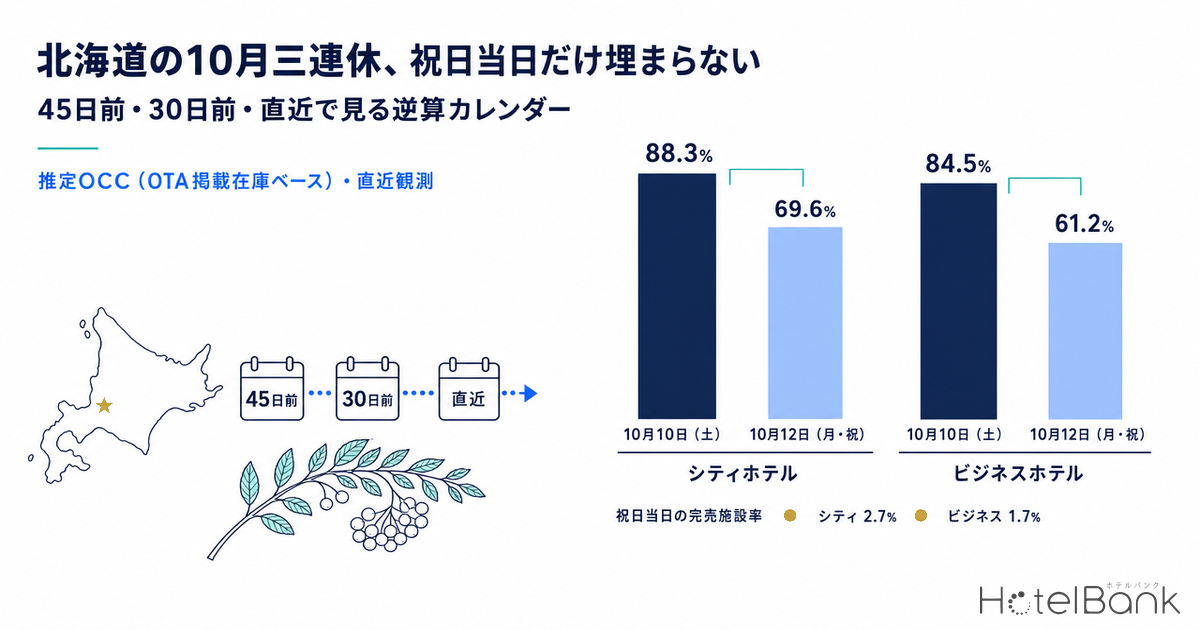
This article tracks booking pace for city hotels and business hotels in Hokkaido across the October 2026 long weekend (Saturday October 10, Sunday October 11 and Monday October 12, which is Sports Day), starting 45 days before each stay date. At the latest observation (as of September 14, 2026), estimated OCC (OTA-listed-inventory basis) for city hotels was 88.3% for October 10 against 69.6% for October 12, the holiday itself; for business hotels the figures were 84.5% and 61.2%. That is a gap of 18.7 to 23.3 points inside the same long weekend. The share of properties sold out on the holiday itself was only 2.7% for city hotels and 1.7% for business hotels, which means the final day of the long weekend is still broadly open across the market. Below we break the four days down at three fixed points — 45 days out, 30 days out and the latest reading — and set them out as a countdown calendar with specific dates attached.
Scope: Hokkaido city hotels N=37 properties / 8,831 rooms; business hotels N=229 properties / 26,304 rooms (a fixed cohort based on listings across major booking sites). The price metric in this article is estimated settled ADR (the transaction price level estimated from OTA and other sales data, on a tax-excluded equivalent basis); occupancy is an estimate on an OTA-listed-inventory basis. Definitions for both are given at the end of the article. Data as of September 15, 2026.
• ADR (average daily rate) = an estimated settled rate (tax-excluded equivalent) calculated by applying a property-type correction coefficient to the lowest listed plan level each property publishes on OTAs (per room, for two guests in one room, tax included). Cross-checked against property-level results disclosed by listed hotel REITs (91 properties, most recent three months), the median error is approximately 7%. These are estimates and differ from each property’s actual transaction prices and accounting figures.
• ADR at the area level (prefecture, municipality) is the median of the estimated settled rates of the properties in scope (the level of a typical property in that area).
• Where listed prices are mentioned, they are per-room rates for two guests in one room (tax included).
• OCC (occupancy) = sold rooms as a share of total rooms in the area (an estimate based on OTA sales inventory).
• Source: MetroEngines Research (continuous tracking of OTA public pricing for approximately 168,000 properties in Japan, of which approximately 27,000 have confirmed occupancy data)
- — A gap of 18.7 to 23.3 points between Saturday and the holiday itself: as of September 14, 2026, estimated OCC was 88.3% on October 10 against 69.6% on October 12 for city hotels, and 84.5% against 61.2% for business hotels (N=37 properties and N=229 properties).
- — The ranking was settled 45 days out: the order of the four days (Sat > Fri > Sun > holiday Monday) never changed between 45 days out and the latest reading, and the build-up was concentrated in the 15 days from 45 to 30 days out (+2.3 to +5.6pt for city hotels, +6.6 to +8.1pt for business hotels).
- — The holiday itself sits below an ordinary Monday: at 30 days out, October 12 was 9.0pt lower for city hotels and 7.7pt lower for business hotels than October 5, and the sold-out share was 2.7% and 1.7%. Rather than pricing the long weekend as a single block, price this date as a weekday that has lost its demand.
Booking curves across the four days — roughly 20 points between Saturday and the holiday
We start with how estimated OCC moved from 45 days before the stay date through to the latest reading for the four days from Friday October 9 to Monday October 12 (a public holiday). For Hokkaido city hotels (N=37 properties, 8,831 rooms), the order was already set 45 days out — October 10 (Sat) at 81.9%, October 9 (Fri) at 77.4%, October 11 (Sun) at 71.9% and October 12 (Mon, holiday) at 64.8% — and that ranking never changed through to the latest reading. We applied the same 45-day, 30-day and latest fixed points to the Saturdays of August in Hokkaido City Hotels: Only Aug 15 Trails at 78.7% OCC, 45 Days Out.
Source: Compiled by the HotelBank Editorial Team from MetroEngines Research
Business hotels (N=229 properties, 26,304 rooms) show the same shape, but the curves are clearly steeper. The gain from 45 days out to the latest reading was +3.0 to +6.4 points for city hotels, against +7.4 to +10.3 points for business hotels. That is the signature of a shorter-lead-time segment, where listed inventory sells through later in the window.
Source: Compiled by the HotelBank Editorial Team from MetroEngines Research
Set out in figures, the picture is as follows. The sold-out share is the estimated proportion of properties for which no listed inventory can be confirmed on OTAs and similar channels.
| Stay date | OCC, 45 days out | OCC, 30 days out | OCC, latest | 45 → 30 days out | Sold-out share, latest |
|---|---|---|---|---|---|
| City hotels (N=37 properties, 8,831 rooms) | |||||
| October 9 (Fri) | 77.4% | 79.7% | 80.4% | +2.3pt | 5.4% |
| October 10 (Sat) | 81.9% | 87.5% | 88.3% | +5.6pt | 8.1% |
| October 11 (Sun) | 71.9% | 75.8% | 76.6% | +3.9pt | 5.4% |
| October 12 (Mon, holiday) | 64.8% | 69.3% | 69.6% | +4.5pt | 2.7% |
| Business hotels (N=229 properties, 26,304 rooms) | |||||
| October 9 (Fri) | 64.9% | 71.6% | 74.2% | +6.7pt | 5.2% |
| October 10 (Sat) | 74.2% | 82.3% | 84.5% | +8.1pt | 23.6% |
| October 11 (Sun) * | 63.4% | 70.7% | 72.0% | +7.3pt | 4.4% |
| October 12 (Mon, holiday) | 53.8% | 60.4% | 61.2% | +6.6pt | 1.7% |
The latest reading is the observation as of September 14, 2026 (25 days out for October 9, 26 days out for October 10, 27 days out for October 11 and 28 days out for October 12). * For October 11, business hotels are N=228 properties, 26,207 rooms. Because city hotels are N=37 properties, the sold-out share moves in increments of roughly 2.7 points per property. Source: Compiled by the HotelBank Editorial Team from MetroEngines Research
What stands out is the asymmetry in the sold-out share. For business hotels, 23.6% of properties had no confirmable listed inventory for October 10 (Sat) at the latest reading, against 1.7% for October 12 (Mon, holiday) in the same long weekend. Saturday is running out of headroom at the top while the holiday itself remains broadly open, and both conditions coexist within the same three days.
The holiday itself does not even reach an ordinary Monday
To isolate the effect of the long weekend, we compared it with the preceding week — Friday October 2 to Monday October 5 — holding lead time constant at 30 days out. Comparing figures observed on different dates makes it impossible to tell a difference in pace from a difference in timing, so both weeks are cut at the same point: 30 days before the stay date.
| Day of week | Preceding week (Oct 2-5) | Long-weekend week (Oct 9-12) | Difference | Preceding week | Long-weekend week | Difference |
|---|---|---|---|---|---|---|
| All at 30 days before the stay date | City hotels (N=37 properties) | Business hotels (N=229 properties) | ||||
| Friday | 77.8% | 79.7% | +1.9pt | 70.4% | 71.6% | +1.2pt |
| Saturday | 81.3% | 87.5% | +6.2pt | 77.0% | 82.3% | +5.3pt |
| Sunday | 77.3% | 75.8% | -1.5pt | 67.4% | 70.7% | +3.3pt |
| Monday | 78.3% | 69.3% | -9.0pt | 68.1% | 60.4% | -7.7pt |
Source: Compiled by the HotelBank Editorial Team from MetroEngines Research
Saturday is the only day the long weekend lifts. October 10 (Sat) ran 6.2 points above an ordinary Saturday for city hotels and 5.3 points above for business hotels. October 12, the holiday itself, sat below an ordinary Monday (October 5) — 9.0 points lower for city hotels and 7.7 points lower for business hotels. At the same 30-day point, the pattern is visible: turning the Monday into a holiday removes business and corporate weekday demand, and leisure demand is not filling the space it leaves.
This “Monday hole” is consistent with how travellers build a three-day weekend within Hokkaido. If the dominant pattern is a two-night trip staying on October 10 (Sat) and October 11 (Sun) and using October 12 (Mon, holiday) to travel home, then accommodation demand on the holiday itself is structurally thin. In other words, October 12 is not “day three of the long weekend” but a date to price afresh as a weekday that has lost its demand (for the structure of the Sunday and Monday troughs in an ordinary week, see Hokkaido Business Hotels Aren’t Weekend-Led: Thu 95.4% Ties Sat 95.4%).
The seasonal shape of estimated settled ADR — city hotels below last year in summer, business hotels still above
To frame the pricing range, we look at Hokkaido’s estimated settled ADR (tax-excluded equivalent) with the years overlaid. On a year-on-year basis comparing confirmed months against confirmed months, city hotels moved into negative territory from April 2026 onwards: August 2026 was ¥17,800 (N=75 properties), down 11.3% year on year, and July was also ¥17,800 (N=75 properties), down 5.7%. A strong start to the year means the January-August average is roughly flat at +0.7% year on year, but the fact that prices did not extend through the summer peak months matters for how October is planned.
Business hotels, by contrast, held above last year on a confirmed-month basis: August 2026 was ¥11,300 (N=438 properties), up 2.5% year on year, and July was ¥11,200 (N=432 properties), up 4.1%. The January-August average was +5.3%. The direction of ADR is clearly diverging between the two property types.
Solid lines = confirmed figures; dotted lines = estimates based on current sales conditions (the bases differ, so they should not be compared directly with confirmed figures). Source: Compiled by the HotelBank Editorial Team from MetroEngines Research
For October 2026, estimated settled ADR stands at ¥14,600 for city hotels (N=75 properties) and ¥12,000 for business hotels (N=397 properties). These are estimates based on current sales conditions, however, and will move with how the remaining inventory sells. Because a direct comparison with confirmed figures has to wait until the month closes, this article uses the October level only as a centre line for thinking about the pricing range across the four days.
The seasonal shape worth holding on to is that, on confirmed figures, October in Hokkaido sits between September and November. For city hotels in 2025 the path was September ¥16,500 (N=74 properties) → October ¥14,700 (N=73 properties) → November ¥12,300 (N=73 properties); for business hotels it was September ¥10,000 (N=419 properties) → October ¥8,700 (N=419 properties) → November ¥7,900 (N=421 properties). October is partway down the slope. The long weekend is a single peak standing on that downslope, not a sign that the month as a whole is strong.
For revenue managers running city and business hotels in Hokkaido — implications and an action plan
(1) The ranking barely moves after 45 days out. Drop the assumption that a date will overtake the others later. The order of the four days (Sat > Fri > Sun > holiday Monday) was settled 45 days out and never changed through to the latest reading. Line up your own pickup ranking at 45 days out, and where a date sits differently from the market, that date is likely to carry a problem specific to your property — price, how inventory is released, or plan structure. If you intend to correct it towards the shape of the market, treat 30 days out as the end of the window in which you can still move.
(2) The build-up after 30 days out is small. Tighten by 30 days out; open up after that. In the 15 days from 45 to 30 days out, city hotels added 2.3 to 5.6 points and business hotels 6.6 to 8.1 points. Those 15 days are where pricing can be tightened; the gain after that is comparatively limited. Put the other way, for any date that has not reached target at 30 days out, switching to a decision to open up from that point on leaves less on the table.
(3) Design Saturday and the holiday itself as separate products. On October 10 (Sat) the sold-out share was 23.6% for business hotels and 8.1% for city hotels, so the top of the market is filling up; on October 12 (Mon, holiday) the figures were 1.7% and 2.7%. With inventory conditions that different inside one long weekend, a single flat long-weekend rate across all four days will leave money on the table on Saturday and unsold rooms on the holiday.
(4) The holiday itself is not “day three of the long weekend” but a weekday that has lost its demand. On the lead-time-matched comparison at 30 days out, October 12 was 9.0 points below an ordinary Monday (October 5) for city hotels and 7.7 points below for business hotels. Working from the premise that business demand disappears on that date, there is room to consider multi-night conditions that capture the second and third nights, and stay-design measures such as check-out times.
Translated into a countdown calendar with dates attached, the above looks as follows. Every trigger is assessed by comparing your own figures against the market values shown in this article.
| Timing | Action | Decision trigger | Objective |
|---|---|---|---|
| Today to this week (25 to 28 days before the long weekend) | Re-check the price on remaining allocation for October 10 (Sat) and decide the order in which the cheaper plans are closed | If your own OCC for October 10 is above the market estimate of 88.3% (city) or 84.5% (business) and yet your price is at the same level as the Saturday of the week before the long weekend | Avoid leaving rate on the table on the peak-demand date |
| Today to this week | Remove minimum-length-of-stay and multi-night conditions on October 12 (Mon, holiday) to make a two-night stay from October 11 easier to book | If the market sold-out share for October 12 remains at 2.7% (city) and 1.7% (business) and your own property is also short of target on that date | Fill a thin holiday date from the multi-night side |
| Two weeks out (September 25 to 28) | Release additional allocation for October 11 (Sun) and October 12 (Mon, holiday) | If the market build-up from 45 to 30 days out for October 11 stays at +3.9pt (city) and +7.3pt (business) and your own property is below that range | Create capacity to receive short-lead-time demand |
| Two weeks out | Re-price October 9 (Fri) as the eve of the long weekend rather than leaving it on the weekday rate | If estimated market OCC for October 9 is 80.4% (city) and 74.2% (business) — the second-highest of the four days — and your own setting is identical to an ordinary Friday | Reflect pre-stay demand in the rate |
| Immediately before (from October 5) | Decide whether to move the price for October 12 into a band below the October market centre line (estimated settled ADR of ¥14,600 for city hotels and ¥12,000 for business hotels) | If the market for October 12 is still tracking around 69.6% (city) and 61.2% (business) close in, and your own property is at a similar level | Secure the last one or two nights |
| Looking to next month | Start observing the next three-day weekend (Saturday November 21 to Monday November 23, a public holiday) at the same three points: 45 days out, 30 days out and the latest reading | After verifying whether “the ranking at 45 days out is the final ranking” held again over the October long weekend | Make the countdown framework a standing routine at your property |
Source: Compiled by the HotelBank Editorial Team from MetroEngines Research
None of these guarantee a result, and whether they apply depends on your own demand and channel mix. Market figures are best used as a yardstick for checking whether your own numbers can be explained.
Summary — breaking the long weekend down with three yardsticks
The October 2026 long weekend in Hokkaido can be organised around three points.
First, the ranking is decided 45 days out. For both city and business hotels, the order of estimated OCC across the four days (Sat > Fri > Sun > holiday Monday) was unchanged from 45 days out through to the latest reading. The dates worth working on are precisely those where your own ranking differs from the market.
Second, the main battleground for building occupancy is the 15 days from 45 to 30 days out. The gain over that period was +2.3 to +5.6 points for city hotels and +6.6 to +8.1 points for business hotels. Make the decision to tighten here, and switch to a decision to open up after that.
Third, treat the holiday itself as a weekday, not as part of the long weekend. On the lead-time-matched comparison at 30 days out, October 12 was 9.0 points below an ordinary Monday for city hotels and 7.7 points below for business hotels. The sold-out share also stays in single digits, at 2.7% for city hotels and 1.7% for business hotels. A flat long-weekend rate costs the most on this date.
Estimated settled ADR for October currently stands at around ¥14,600 for city hotels and around ¥12,000 for business hotels (both estimates based on current sales conditions). How far above that centre line October 10 can be placed, and how far below it October 12 has to sit, is what will decide RevPAR across the four days.
About the data
- Definition of estimated OCC (OTA-listed-inventory basis): occupancy on an OTA-listed-inventory basis = 100 − 100 × rooms remaining on OTA listings ÷ total rooms. Scope is a fixed cohort of properties that list at least 30% of their total rooms on OTAs (the same set of properties for every stay date; the “N=X properties” figures in this article are that property count). It is an estimate based on how listed OTA inventory is selling through, and its definition differs from actual room occupancy (it reads high, because rooms not listed are counted on the sold side).
- Booking curves: based on observations from 45 days before the stay date through to the latest reading. The “latest” reading in this article is the observation as of September 14, 2026, which is 25 days out for October 9, 26 days out for October 10, 27 days out for October 11 and 28 days out for October 12.
- Definition of estimated settled ADR: the transaction price level (tax-excluded equivalent) estimated from OTA and other sales data (lowest listed plan level × property-type coefficient, as an ensemble across multiple channels). Past months are confirmed figures; the current and future months are estimates based on current sales conditions. Cross-checked against published operating results, the median error is 6.6%.
- Breakdown of N: for the booking curves, Hokkaido city hotels N=37 properties and 8,831 rooms, business hotels N=229 properties and 26,304 rooms (for October 11, business hotels alone are N=228 properties and 26,207 rooms). For estimated settled ADR, Hokkaido city hotels N=73-75 properties and business hotels N=397-441 properties (varying by month; the N for each month is given alongside the figures in the text).
- Data as of September 15, 2026. Sales conditions and inventory change daily, so the figures in this article are a snapshot at the time of extraction.
References and sources
- National holidays (Cabinet Office, Government of Japan) — primary source confirming that Monday October 12, 2026 is Sports Day
- When is Sports Day in 2026? The origin of Monday October 12 and why it changed from Health and Sports Day (Tokyo Gas Uchicoto) — confirmation that Sports Day 2026 falls on Monday October 12
- Public holidays and long weekends in October 2026 [Sports Day] (Best Calendar) — confirmation that October 10 to 12 forms a three-day weekend
Related reading
- Hokkaido Business Hotels Aren’t Weekend-Led: Thu 95.4% Ties Sat 95.4%
- Hokkaido City Hotels: Only Aug 15 Trails at 78.7% OCC, 45 Days Out
- Hokkaido Silver Week: Sep 20 Peaks, Ryokan 96.4%, Only Business Dips
- Hokkaido ADR H1 2026: City −5.7%, Business +4.1%, April the Turn
- Japan Autumn ADR 2026: 20 Prefectures Peak in Nov, Kyoto +81.8%