

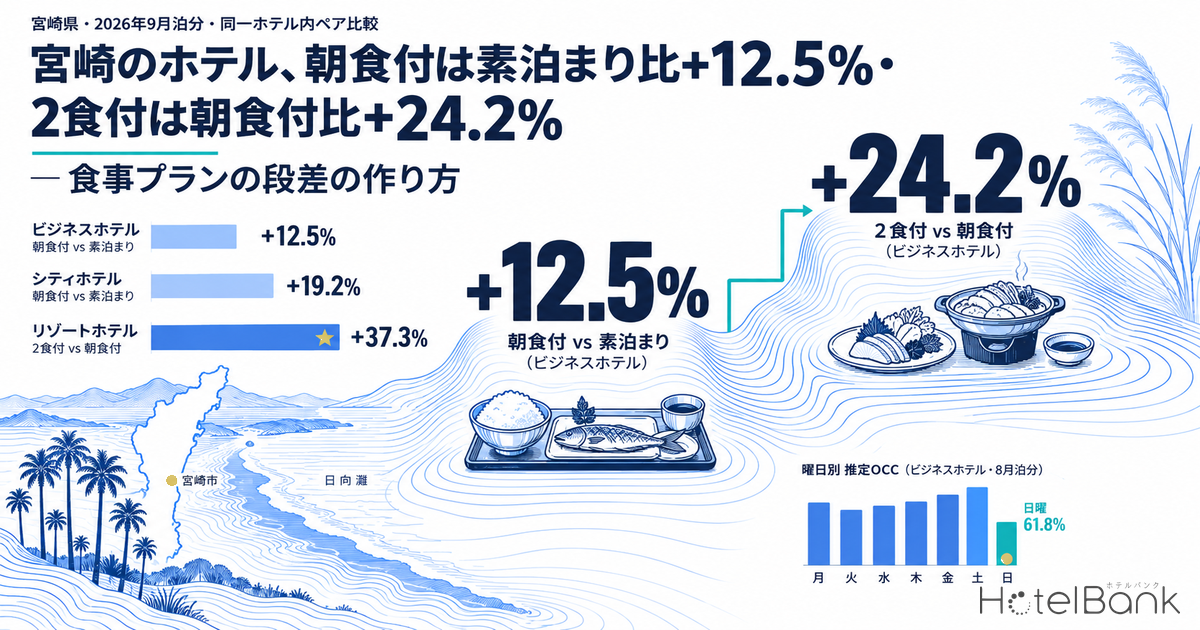
Line up the meal plans that hotels in Miyazaki sell inside the same building — room-only, breakfast-included and half-board — as matched pairs, and a clear price step appears for each property type. As of September 2026, business hotels price breakfast-included plans +12.5% above room-only (N=34 properties), and half-board +24.2% above breakfast-included (N=21 properties). City hotels put breakfast at +19.2% over room-only (N=11 properties), while resort hotels jump +37.3% from breakfast-included to half-board (N=7 properties): the higher the property tier, the wider the dinner-side step. Meal premiums tend to be set by a cost-plus rule of thumb, but knowing what percentage step the market actually runs on changes how you price breakfast as an add-on and which days you weight half-board toward. This article maps Miyazaki’s step structure using same-property paired comparisons, then covers how to set the step, which days to sell it on, and how to unwind it if you have gone too far.
Scope: hotel-type properties in Miyazaki (business hotels, city hotels, resort hotels and similar; ryokan excluded). Meal premiums are paired comparisons covering only properties that sell both meal types in the same building, N=55 properties (overall, breakfast-included vs room-only). The price metric in this article is the settled ADR estimate (the settled price level estimated from OTA and other sales data, tax-excluded equivalent); occupancy is an estimate based on OTA-listed inventory. Both definitions appear at the end of the article. Data as of 14 September 2026.
- — +12.5% / +24.2%: the steps at Miyazaki business hotels for breakfast-included (vs room-only, N=34 properties) and half-board (vs breakfast-included, N=21 properties) on September 2026 stays. The half-board step is the most restrained of the six Kyushu prefectures.
- — +12.5–13.1%: how the breakfast premium at business hotels moved across June–September 2026 stays (N=34–35 properties). The market does not shift the step month to month; it holds it as a design value for the whole season.
- — Sunday 61.8%: the day-of-week low in estimated OCC (based on OTA-listed inventory) for business hotels on August 2026 stays, 25.8 points below Thursday at 87.6%. Half-board has room to be weighted toward that trough day.
Compare within the same property — in Miyazaki, the step is built differently by property type
If you calculate a meal premium by subtracting the average of room-only plans from the average of breakfast-included plans, you end up mixing low-priced properties that do not sell breakfast at all with properties whose breakfast is their signature — and reading a property-type gap as a meal gap. What we use here is a paired comparison restricted to properties that sell both meal types inside the same building, matching plans from the same property in the same month. Differences in location and grade cancel out, so what remains is purely the relative gap: how much of an uplift the market is actually transacting at when a meal is added. Ryokan are excluded from the aggregation because meals included is their standard and no room-only counterpart exists to compare against.
On September 2026 stays in Miyazaki, the breakfast step sits within a +11–19% range regardless of property type, while the half-board step (vs breakfast-included) spreads much wider at +24–37%. Against +12.5% for business hotels (N=34 properties), city hotels come in at +19.2% (N=11 properties). Resort hotels keep a modest +11.8% (N=7 properties) on the breakfast step, but the moment dinner is added it leaps to +37.3% (N=7 properties). The structure is straightforward: the more the dinner is the purpose of the stay, the thicker the dinner-side step.
Source: MetroEngines Research; compiled by the HotelBank Editorial Team
| Property type | Breakfast-included vs room-only | N (paired properties) | Half-board vs breakfast-included | N (paired properties) |
|---|---|---|---|---|
| Business hotels | +12.5% | 34 | +24.2% | 21 |
| City hotels | +19.2% | 11 | +26.4% | 6 |
| Resort hotels | +11.8% | 7 | +37.3% | 7 |
| Overall (ryokan excluded) | +12.4% | 55 | +29.6% | 37 |
September 2026 stays, paired comparison on a two-guest basis. Figures are relative gaps between plans (%), not price levels. Source: MetroEngines Research; compiled by the HotelBank Editorial Team
The other thing worth noting is that this step barely moves month to month. Setting aside +9.4% on May 2026 stays (N=35 properties), the breakfast premium at business hotels has held in the +12–13% band: June +12.9% (N=35 properties), July +12.7% (N=35 properties), August +13.1% (N=34 properties), September +12.5% (N=34 properties). The half-board step (vs breakfast-included) is similarly flat, from +25.0% in May to +24.2% in September (N=21 properties in both). In other words, the market treats the meal premium not as a variable to flex with daily supply and demand, but as a structural design value held through the season. Put the other way: if your property alone swings its step around from month to month, it will look out of line with the market. The same paired-comparison method applied to the neighbouring prefecture in Oita Meal Premiums: Business Breakfast +10.6%, Half-Board +39.3% shows almost exactly the same pattern of type-by-type spread and month-to-month stability.
| Type of step / stay month | May 2026 | Jun | Jul | Aug | Sep |
|---|---|---|---|---|---|
| Business: breakfast-included vs room-only (N=34–35) | +9.4% | +12.9% | +12.7% | +13.1% | +12.5% |
| Business: half-board vs breakfast-included (N=21) | +25.0% | +27.2% | +25.8% | +24.2% | +24.2% |
| City: breakfast-included vs room-only (N=11) | +14.4% | +13.6% | +13.5% | +13.3% | +19.2% |
| Resort: half-board vs breakfast-included (N=6–7) | +42.6% | +41.4% | +39.0% | +36.4% | +37.3% |
N in each cell is the number of properties for which a pair could be formed (it varies by month). Source: MetroEngines Research; compiled by the HotelBank Editorial Team
Where Miyazaki sits within Kyushu — mid-pack on breakfast, restrained on dinner
To judge whether your own breakfast premium is too high, the quickest yardstick is the range for the same property type in neighbouring prefectures. Lining up breakfast-included vs room-only for business hotels across the six Kyushu prefectures on September 2026 stays, the widest is Kagoshima at +14.9% (N=56 properties), followed by Nagasaki at +14.1% (N=52 properties). Miyazaki sits mid-pack at +12.5% (N=34 properties), ahead of Kumamoto at +12.1% (N=45 properties) and Oita at +11.0% (N=37 properties), while supply-heavy Fukuoka is thinnest at +8.0% (N=145 properties). The pattern suggests that the larger the city and the deeper the pool of room-only demand, the more the breakfast step gets compressed.
Source: MetroEngines Research; compiled by the HotelBank Editorial Team
On half-board (vs breakfast-included) at business hotels, however, Miyazaki at +24.2% (N=21 properties) is the most restrained of the six, against Oita at +31.0% (N=19 properties) and Kumamoto at +30.7% (N=17 properties). In prefectures with hot-spring destinations, dinner-led stay packages are easier to sustain; Miyazaki’s business hotels appear to treat dinner as an option that can be added, priced at a thinner step. Read the other way, that is headroom: a property able to design a dinner built around local ingredients could sit a notch above the prefectural norm and still stay within the market range. As for why Fukuoka carries the thinnest breakfast step in Kyushu, Fukuoka Settled ADR Slows +14.4% to +3.6% — Breakfast Premium Next? digs into that alongside the rate trend.
Splitting the prefecture further, the breakfast premium in Miyazaki City is +10.3% at business hotels (N=19 properties) and +13.3% overall (N=29 properties). Miyakonojo comes in at +14.9% for business hotels (N=5 properties) and Nobeoka at +11.8% (N=7 properties) — the regional cities carry a wider step than the prefectural capital. The logic: the fewer dining options nearby, the more necessary an in-house breakfast becomes, and the more readily the step is accepted. Miyazaki City is the only municipality with enough half-board pairs (vs breakfast-included) to report, at +28.2% overall (N=15 properties) and +22.4% for business hotels (N=8 properties).
| Municipality / property type | Breakfast-included vs room-only | N (paired properties) |
|---|---|---|
| Miyakonojo, business hotels | +14.9% | 5 |
| Nobeoka, business hotels | +11.8% | 7 |
| Miyazaki City, business hotels | +10.3% | 19 |
| Miyazaki City, city hotels | +27.3% | 6 |
| Miyazaki City, overall (ryokan excluded) | +13.3% | 29 |
September 2026 stays. Municipalities with fewer than 5 paired properties are not shown. Source: MetroEngines Research; compiled by the HotelBank Editorial Team
The base the step sits on — Miyazaki’s settled ADR estimate and the day-of-week demand trough
Because meal premiums are designed as percentages, their yen value only makes sense when read together with the underlying room rate. The settled ADR estimate for business hotels in Miyazaki, on a finalised basis, was ¥6,278 for August 2026 stays (N=87 properties), down 5.0% year on year. July stays came in at ¥6,038 (N=86 properties), also down 5.0% — the finalised summer months ran slightly below last year. City hotels, by contrast, rose: ¥7,984 for August 2026 stays (N=20 properties), up 13.0% year on year, and ¥7,306 for July stays (N=20 properties), up 9.2%. The trend is split by property type.
The current month (September 2026 stays) is an estimate based on the sales position as of now: ¥8,588 for business hotels (N=84 properties) and ¥9,867 for city hotels (N=19 properties). These are not finalised figures and will move with sales and inventory from here. A direct comparison against finalised figures should wait for the month to close.
| Stay month / property type | Settled ADR estimate | N (properties) | Basis | YoY |
|---|---|---|---|---|
| July 2026, business hotels | ¥6,038 | 86 | Finalised | -5.0% |
| August 2026, business hotels | ¥6,278 | 87 | Finalised | -5.0% |
| July 2026, city hotels | ¥7,306 | 20 | Finalised | +9.2% |
| August 2026, city hotels | ¥7,984 | 20 | Finalised | +13.0% |
| September 2026, business hotels | ¥8,588 | 84 | Estimate based on the sales position as of now | — |
| September 2026, city hotels | ¥9,867 | 19 | Estimate based on the sales position as of now | — |
Year-on-year comparisons are made only between finalised figures. Estimates and finalised figures are not compared directly. Source: MetroEngines Research; compiled by the HotelBank Editorial Team
What a step set in percentage terms is worth in yen depends on the room-only price beneath it. The table below is a worked example applying the step levels seen in this article to assumed room-only prices; it is simple multiplication, not observed data. A property with a ¥10,000 room-only rate applying +12.5% adds ¥1,250 for breakfast, but if the base falls to ¥9,500 (a 5.0% year-on-year decline), the same +12.5% shrinks to ¥1,188. If the cost of breakfast is unchanged, that ¥62 comes straight out of the food-and-beverage margin. Check not only the percentage of the step but whether the uplift reliably clears the cost of breakfast, across both axes.
| Room-only price (assumed) | +10.3% Miyazaki City, business | +12.5% Prefecture, business | +14.9% Miyakonojo, business | +19.2% Prefecture, city |
|---|---|---|---|---|
| ¥8,000 | ¥824 | ¥1,000 | ¥1,192 | ¥1,536 |
| ¥10,000 | ¥1,030 | ¥1,250 | ¥1,490 | ¥1,920 |
| ¥12,000 | ¥1,236 | ¥1,500 | ¥1,788 | ¥2,304 |
| ¥14,000 | ¥1,442 | ¥1,750 | ¥2,086 | ¥2,688 |
| ¥16,000 | ¥1,648 | ¥2,000 | ¥2,384 | ¥3,072 |
Room-only prices are assumptions. Step percentages are from the Miyazaki paired comparison for September 2026 stays (Miyazaki City business hotels N=19 properties, prefecture business hotels N=34 properties, Miyakonojo business hotels N=5 properties, prefecture city hotels N=11 properties). Uplift amounts are rounded to the nearest yen. Source: MetroEngines Research; compiled by the HotelBank Editorial Team
The clue for deciding which days to sell half-board on is the day-of-week demand trough. Averaging estimated OCC (based on OTA-listed inventory) for Miyazaki business hotels by day of week, August 2026 stays (31 days, cohort of 37–40 properties / 3,536–3,787 rooms) peak at 87.6% on Thursday with weekdays running in the 80s, while Sunday sits at 61.8%, conspicuously low. Monday also dips somewhat, at 74.5%. For September 2026 (1–14, cohort of 29–42 properties / 2,347–3,929 rooms) the Sunday trough is deeper still: 52.8% on Sunday, 72.0% on Friday and 73.8% on Saturday, against 84.5% on Wednesday and 85.1% on Thursday.
Source: MetroEngines Research; compiled by the HotelBank Editorial Team
In areas driven by business demand, the flow of business travel breaks between Friday and Sunday. In Miyazaki that trough is concentrated on Sunday: on August stays the monthly low was 51.9% on Sunday 16 August and the high 93.7% on Thursday 20 August, a spread of more than 40 points within the same month. For September, within the 1–14 window, the low was 41.2% on Sunday 6 September and the high 95.3% on Saturday 12 September. Sunday leaves inventory unsold; weekdays fill — once you can read that shape, where to place a meal-heavy plan follows naturally. Pushing half-board hard on a Thursday that fills anyway risks nothing more than diluting rooms that would have sold room-only with food cost. The Sunday trough is common to other Kyushu prefectures too; Kagoshima Business Hotels: Sun 60.8% vs Wed 77.4% — Two OCC Troughs covers a pattern in which the trough splits in two.
For revenue managers running hotels in Miyazaki — implications and action plan
(1) Set the reasonable band for the breakfast premium using the property-type range as upper and lower bounds. For September 2026 stays, Miyazaki business hotels sit at +12.5% (N=34 properties) and city hotels at +19.2% (N=11 properties), with municipalities ranging from Miyazaki City at +10.3% (N=19 properties) to Miyakonojo at +14.9% (N=5 properties). If the gap between your breakfast-included and room-only plans, divided by the room rate, falls well outside that range, start not with cost but with how far you are from the range. Below it, the work put into breakfast may not be reaching the rate; above it, you may be undercutting the pulling power of the room-only side yourself.
(2) The step is a season-long design value, not a monthly variable. The breakfast premium at business hotels has barely moved across June–September 2026 stays, at +12.5–13.1% (N=34–35 properties). The market does not use the meal step as a demand-management tool. Taking demand swings on the room-only rate and leaving the meal step fixed keeps the plan hierarchy coherent.
(3) Weight half-board toward the trough days. Estimated OCC for business hotels shows a clear Sunday trough — 61.8% on August stays and 52.8% over 1–14 September — while weekdays run in the 80s. Half-board, with its longer on-site stay and in-house spend, has more upside allocated to those trough days than to weekdays that fill on room-only anyway. At +24.2% (N=21 properties), Miyazaki business hotels carry the most restrained half-board step of the six Kyushu prefectures, so a property that can build a dinner around local ingredients has room to test a notch above the prefectural norm.
(4) Do not lose sight of the rate trend underneath, which is split by property type. On a finalised basis, the settled ADR estimate for August 2026 stays was down 5.0% year on year at business hotels (¥6,278 / N=87 properties) and up 13.0% at city hotels (¥7,984 / N=20 properties). A meal premium designed in percentage terms automatically shrinks in yen when the base falls. Where the rate is running below last year, holding the step percentage while leaving the meal content and cost unchanged thins the food-and-beverage margin first.
| Horizon | Action | Trigger | Aim |
|---|---|---|---|
| Today to this week | Convert the gap between your breakfast-included and room-only plans into a ratio and compare it with the property-type range | Your ratio falls well below the +12.5% (business) / +19.2% (city) range, or runs to nearly double it | Confirm first whether the step is out of line with the market |
| Today to this week | Pull the recent booking position by day of week and identify your own trough day | As with the market Sunday (61.8% on August stays, 52.8% over 1–14 September), one day of the week alone carries heavy remaining inventory at your property | Decide which day to weight meal-inclusive plans toward |
| Within two weeks | Widen half-board allocation on the trough day only, and return weekdays to room-only and breakfast-included as the mainstay | Weekday estimated OCC tracks the market at around 80% while the trough day alone stays persistently below 60% | Avoid diluting days that fill with food cost, and capture in-house spend on days that do not |
| Within two weeks | Decide in advance how to unwind an over-wide step (start by reviewing the room-only setting and content rather than cutting the price of meal-inclusive plans) | Your half-board step runs well above the prefectural +24.2% and the booking mix of meal-inclusive plans falls short of plan | Bring the step back into the market range without making discounting routine |
| Looking to next month | Ahead of the autumn produce season, refresh the dinner content and then decide whether to hold the step or move it up a notch | Your half-board step is below the prefectural norm (business +24.2%) and there is room to differentiate the dinner | Lift Miyazaki’s restrained dinner step, backed by the content to justify it |
| Looking to next month | Switch to holding the meal step fixed and handling demand swings on the room-only rate | Your step swings widely month to month rather than settling into the stable +12.5–13.1% shape the market showed over June–September stays | Keep pricing coherent across plans and stabilise the perceived value of the meal |
Source: MetroEngines Research; compiled by the HotelBank Editorial Team
In summary — three yardsticks for measuring the step
To turn Miyazaki’s meal premiums into a pricing design, keep these three yardsticks to hand.
1. The property-type range. Breakfast-included runs +11.8–19.2% above room-only (business +12.5% / N=34 properties, city +19.2% / N=11 properties, resort +11.8% / N=7 properties), and half-board +24.2–37.3% above breakfast-included. Whether your own step sits inside that band is the first checkpoint.
2. Stability over time. The breakfast premium at business hotels does not move across June–September 2026 stays, holding at +12.5–13.1% (N=34–35 properties). The market standard is to treat the step not as something to flex with demand but as a design value defended through the season.
3. Where the demand trough sits. By day of week, estimated OCC shows a clear Sunday trough (61.8% on August stays, 52.8% over 1–14 September). Meal-heavy plans belong on that trough day, not on the weekdays that fill. Where you place the plan matters as much as how wide the step is.
A meal premium is a question of cost and margin, but it is equally a question of how inventory is allocated across the plan lineup. Testing the two separately — whether the percentage is right, and which day it is sold on — is the starting point for designing the step.
About the data
· Definition of estimated OCC (based on OTA-listed inventory): OTA-listed-inventory occupancy = 100 − 100 × rooms still listed on OTAs ÷ total rooms. Coverage is a fixed cohort of properties that list at least 30% of their total rooms on OTAs (the same set of properties for each stay date). It is an estimate based on how inventory offered for sale on OTAs is being taken up, and its definition differs from actual room occupancy (it reads high because rooms not listed are counted on the sold side). The day-of-week estimated OCC in this article covers business hotels in Miyazaki for August 2026 (31 days, cohort of 37–40 properties / 3,536–3,787 rooms) and 1–14 September 2026 (cohort of 29–42 properties / 2,347–3,929 rooms).
· Booking curve: based on observations from 45 days before the stay date up to the most recent reading.
· Definition of the settled ADR estimate: the settled price level (tax-excluded equivalent) estimated from OTA and other sales data (lowest-plan level × property-type coefficient, ensembled across multiple channels). Past months are finalised figures; the current and future months are estimates based on the sales position as of now. Median error against published operating results is 6.6%.
· How meal premiums are aggregated: a paired comparison covering only properties that sell both meal types (for example room-only and breakfast-included) inside the same building, computing the relative gap (%) for each pair. Properties that sell only one meal type are excluded from the comparison, so differences in property grade are unlikely to contaminate the meal gap. Ryokan are excluded from the aggregation because meals included is their standard and no comparison with room-only is possible. The figures are relative gaps between plans, not price levels. Two-guest basis.
· Breakdown of N: meal premiums (Miyazaki, September 2026 stays) = 55 properties overall (breakfast-included vs room-only) / 37 properties (half-board vs breakfast-included); business hotels 34 / 21; city hotels 11 / 6; resort hotels 7 / 7. Municipal figures are shown only where 5 or more pairs could be formed. Settled ADR estimate = 84–87 business hotels and 19–20 city hotels in Miyazaki. Kyushu prefecture comparison (business hotels, breakfast-included vs room-only) = Fukuoka 145 properties, Kagoshima 56, Nagasaki 52, Kumamoto 45, Oita 37, Miyazaki 34.
· Data as of 14 September 2026. Sales positions and inventory change daily, so the figures in this article are a snapshot at the time of retrieval.
Related reading
- Miyazaki Booking Curves by Type: Ryokan +13.8pt Fri→Sat, City Capped
- Oita Meal Premiums: Business Breakfast +10.6%, Half-Board +39.3%
- Fukuoka Settled ADR Slows +14.4% to +3.6% — Breakfast Premium Next?
- Kagoshima Business Hotels: Sun 60.8% vs Wed 77.4% — Two OCC Troughs
- Chiba Breakfast Premium +11.9%, Half-Board +32.0%: Two Price Ladders
- Niigata City Hotels: Half-Board +42.7% vs Breakfast-Only Plans
- Kagawa Meal Premiums: Breakfast +9.1%, Half-Board +29.1% (Sep 2026)
- Mie Meal Premiums: Breakfast +9–19%, Half Board +36–39% (Sept 2026)