

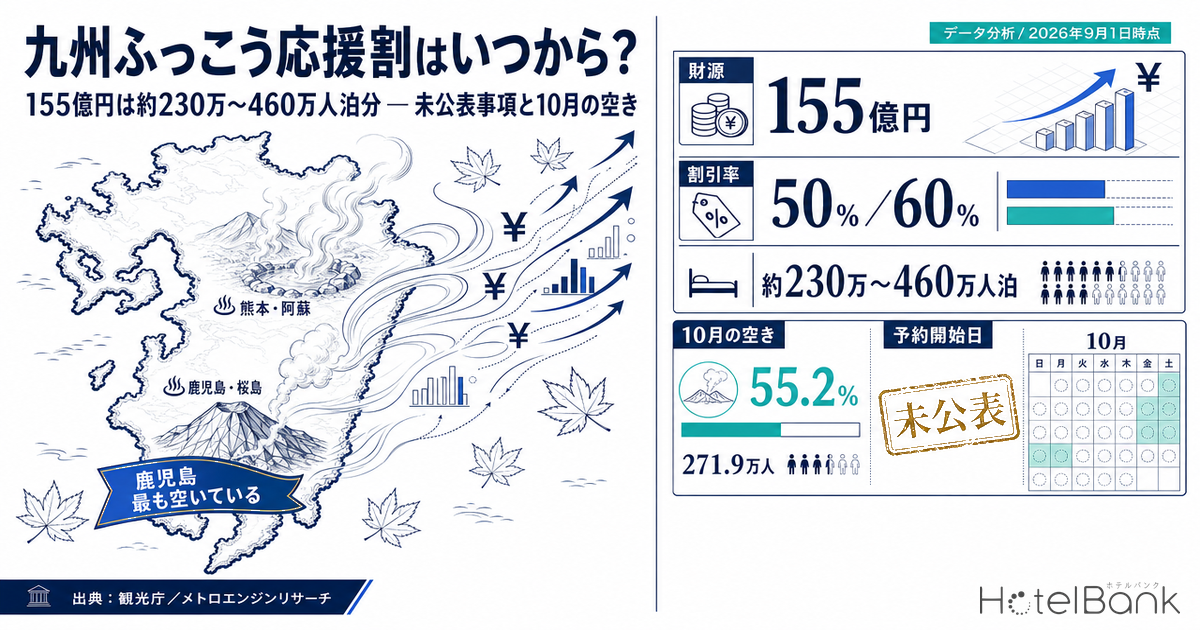
When can you actually book the “Kyushu Fukko Ouenwari” — the Kyushu earthquake-recovery travel subsidy, commonly shortened to “Kyushu Ouenwari”? The short answer: as of September 1, 2026, the booking start date has still not been announced. What the Japan Tourism Agency set out on August 28 was only the skeleton of the scheme — a 50% discount across all seven Kyushu prefectures, and 60% in Kumamoto and Kagoshima, for stays from Thursday, October 1 onward. The booking start date, the end of the discount period, whether regional coupons are included, and the exclusion conditions are all left to each prefecture to decide, and none of them have been announced yet.
What did become fixed, however, through reporting on August 27–28 and a Cabinet decision, is the funding. The Kyushu Fukko Ouenwari is financed by ¥15.5 billion from the Ministry of Land, Infrastructure, Transport and Tourism (MLIT) reserve fund, disbursed as subsidies to the seven Kyushu prefectures according to the extent of damage, as part of a recovery and reconstruction support package totalling roughly ¥147.8 billion for the 2026 Kumamoto Earthquake. A fixed budget figure means we can calculate, in advance, how many people this scheme can actually put in a hotel room. That is the subject of this article. We apply the scheme’s discount rates to the prevailing prices in the seven Kyushu prefectures to derive the subsidy per person per night, divide ¥15.5 billion by it, and express the size of the pot in person-nights. We also look back at what the 2016 Kyushu Fukko-wari actually achieved, using accommodation statistics, and update the October inventory picture to the latest observation (August 30, 2026).
Metric Definitions Used in This Article
- Listed price: the average price of all plans published on accommodation booking sites. Per-room rate for two guests in one room (tax included). This article uses prefecture-level averages for October 2026 stays, aggregated as of August 2026.
- ADR (estimated settled ADR): an estimated transacted rate (tax-excluded equivalent) calculated by applying property-type correction coefficients to each property’s lowest published plan level (two guests in one room, per-room rate). Cross-checked against property-level results disclosed by listed hotel REITs (91 properties, most recent three months), the median error is approximately 7%. It is an estimate and differs from each property’s actual transacted prices and accounting figures. Area-level ADR is the median of the properties covered (the level of a typical property in the area).
- OTA-listed-inventory occupancy rate (estimated): the share of rooms listed on accommodation booking sites that are either already booked or withdrawn from sale (room basis). Calculated as
100 − 100 ×listed remaining rooms ÷ total rooms. It is an estimate based on how listed inventory is being taken up on booking sites, and is defined differently from a property’s actual overall occupancy rate. - Scheme details: discount rates, caps, eligible regions and the start date for eligible stays are based on Japan Tourism Agency public materials (updated August 28, 2026). The funding amount is based on reporting from August 27–28, 2026 and the Cabinet decision.
- Data sources: MetroEngines Research / Japan Tourism Agency “Accommodation Travel Statistics Survey”
- — The booking start date was still unannounced as of September 1, 2026. It is set by each prefecture, and the end of the discount period, regional coupons, exclusion conditions and the treatment of existing reservations were all likewise unannounced at that point.
- — What is fixed is the ¥15.5 billion in funding (MLIT reserve fund). It forms part of the roughly ¥147.8 billion recovery and reconstruction support package for the 2026 Kumamoto Earthquake, and the allocation by prefecture has not been disclosed.
- — The person-nights ¥15.5 billion can cover: about 2.3 million on a listed-price basis, about 4.6 million on an estimated-settled-ADR basis. The true figure sits between the two.
- — The most recent month-by-prefecture comparison available shows 4.49 million guest nights across the seven Kyushu prefectures in October 2016. ¥15.5 billion covers only half a month to one month of October accommodation demand.
- — The 2016 Fukko-wari ran on roughly ¥18 billion and was used by 2.719 million people. This time the funding is about 86% of that, the 50% floor on the discount rate is higher than in 2016’s second phase, and the pot will be drawn down faster than it was then.
- — October inventory is most open in Kagoshima (55.2% all-day average). Across the seven prefectures, October 12 and 13 are the loosest dates and October 10 and 24 the tightest. Observed August 30, 2026.
When does Kyushu Ouenwari start? What was and wasn’t settled as of September 1
In the four days since the August 28 announcement, almost all the new information has concentrated on a single point: the funding. The substance of the scheme — discount rates, caps, eligible regions, start date — has not moved from the Japan Tourism Agency material published on August 28. What Jiji Press reporting on August 27 and the Cabinet decision on August 28 did make clear is that the money comes from MLIT’s ¥15.5 billion reserve fund, that this forms part of a recovery and reconstruction support package totalling roughly ¥147.8 billion for the 2026 Kumamoto Earthquake, and that it will be disbursed to the seven Kyushu prefectures as subsidies according to the extent of damage.
| Item | Status | Details |
|---|---|---|
| Funding | Newly settled | ¥15.5 billion from MLIT’s reserve fund, disbursed as subsidies to the seven Kyushu prefectures. Part of a recovery and reconstruction support package for the 2026 Kumamoto Earthquake totalling roughly ¥147.8 billion |
| Allocation method | Newly settled | Allocated to the seven Kyushu prefectures according to the extent of damage (amounts by prefecture not disclosed) |
| Discount rate | Settled (Aug 28) | 50% of travel and accommodation charges (per person per night). 60% in Kumamoto and Kagoshima |
| Cap | Settled (Aug 28) | Accommodation-only products and one-night travel packages including transport: ¥20,000 / packages including transport of two nights or more: ¥30,000 / multi-destination itineraries staying in two or more prefectures: ¥35,000 |
| Eligible stays from | Settled (Aug 28) | Travel and accommodation products of one night or more in the Kyushu region, for stays from Thursday, October 1, 2026 onward |
| Eligible regions | Settled (Aug 28) | The seven Kyushu prefectures (Kumamoto, Kagoshima, Fukuoka, Saga, Nagasaki, Oita, Miyazaki). Okinawa is not mentioned |
| Booking start date | Not disclosed | Set by each prefecture. None of the seven had announced one as of September 1 |
| End of eligible period | Not disclosed | Eligibility runs from stays on October 1; how long it lasts is set by each prefecture |
| Regional coupons | Not disclosed | Neither their existence nor their value appears in the published materials |
| Exclusion conditions | Not disclosed | Eligible properties, eligible products, booking methods and the treatment of existing reservations are all decided by each prefecture |
| Allocation by prefecture | Not disclosed | Described only as “according to the extent of damage”; no breakdown has been given |
Source: compiled by the HotelBank Editorial Team from the Japan Tourism Agency’s “2026 Kumamoto Earthquake Related Information” (updated August 28, 2026) and reporting from August 27–28, 2026 (as of September 1, 2026)
How to read the scheme’s skeleton itself — the price band at which the ¥20,000 cap starts to bite, and how to choose between hot-spring destinations straddling a prefectural border — is covered in Kyushu Fukko Ouenwari: 60% Off in Kumamoto, Kagoshima, ¥20,000 Cap. To avoid repetition, we will confirm only the key points here. Once the per-person, per-night rate exceeds ¥40,000 in the 50% group or roughly ¥33,333 in the 60% group, the discount is capped at ¥20,000. Average prices at Kyushu accommodation are far below that threshold in all seven prefectures, so at most properties the headline discount rate applies in full. With that established, we turn to the funding.
How many person-nights is ¥15.5 billion? Two bases for the calculation
The subsidy is determined by “travel and accommodation charge per person per night × discount rate.” How many person-nights ¥15.5 billion can cover therefore depends on what you assume the per-person, per-night rate to be. We use two bases here.
The first is the listed price — the average across all plans published on accommodation booking sites, expressed per room for two guests, tax included. Because unsold higher-priced plans stay visible in the listings, this runs above the price actually transacted. The second is the estimated settled ADR, which applies property-type corrections to the lowest published plan level to estimate the transacted rate (tax-excluded equivalent). It is cross-checked against property-level results disclosed by listed hotel REITs, with a median error of about 7%. The true average transacted rate sits between the two, which is why the person-night figure is presented as a range.
| Prefecture | Discount | Listed-price basis | Estimated-settled-ADR basis | ||||
|---|---|---|---|---|---|---|---|
| 2 guests/room | Per person | Subsidy | 2 guests/room | Per person | Subsidy | ||
| Kumamoto | 60% | ¥25,710 | ¥12,855 | ¥7,713 | ¥13,368 | ¥6,684 | ¥4,010 |
| Kagoshima | 60% | ¥17,816 | ¥8,908 | ¥5,345 | ¥9,685 | ¥4,843 | ¥2,906 |
| Oita | 50% | ¥35,618 | ¥17,809 | ¥8,905 | ¥15,696 | ¥7,848 | ¥3,924 |
| Fukuoka | 50% | ¥28,229 | ¥14,115 | ¥7,057 | ¥14,118 | ¥7,059 | ¥3,530 |
| Nagasaki | 50% | ¥21,218 | ¥10,609 | ¥5,305 | ¥11,746 | ¥5,873 | ¥2,937 |
| Saga | 50% | ¥30,958 | ¥15,479 | ¥7,740 | ¥14,533 | ¥7,267 | ¥3,633 |
| Miyazaki | 50% | ¥17,442 | ¥8,721 | ¥4,361 | ¥9,805 | ¥4,903 | ¥2,451 |
| 7-prefecture average subsidy | ¥6,632 | ¥3,341 | |||||
| Person-nights covered by ¥15.5bn | approx. 2.34 million | approx. 4.64 million | |||||
Source: compiled by the HotelBank Editorial Team from MetroEngines Research. October 2026 stays. Listed price is the all-plan average (two guests in one room, tax included; N = Kumamoto 673, Kagoshima 741, Oita 797, Fukuoka 891, Nagasaki 514, Saga 222, Miyazaki 296 properties); estimated settled ADR is the prefecture-level median for the same month (tax-excluded equivalent; N = Kumamoto 382, Kagoshima 302, Oita 446, Fukuoka 456, Nagasaki 246, Saga 150, Miyazaki 155 properties). The subsidy figures apply the scheme’s discount rates to the per-person, per-night amount, capped at ¥20,000. The seven-prefecture average is a simple average
Figure: estimated subsidy per person per night across the seven Kyushu prefectures (October 2026 stays). Dashed lines show the simple seven-prefecture average. Source: compiled by the HotelBank Editorial Team from MetroEngines Research
On a listed-price basis, the subsidy per person per night averages about ¥6,600 across the seven prefectures; dividing ¥15.5 billion by that gives about 2.34 million person-nights. On an estimated-settled-ADR basis the subsidy falls to about ¥3,300 and the person-nights covered rise to about 4.64 million. Weighting by room count barely changes the result — about 2.30 million person-nights on the listed basis and about 4.55 million on the settled-ADR basis. In short, the ¥15.5 billion pot is worth roughly 2.3 to 4.6 million person-nights.
By prefecture, the largest subsidy is Oita’s ¥8,905 (listed-price basis), followed by Saga at ¥7,740 and Kumamoto at ¥7,713. Oita and Saga are on the 50% rate, but their listed price levels are high enough to rival Kumamoto’s 60%. At the other end, Miyazaki is the smallest at ¥4,361. With the same funding, lower-priced prefectures can cover more person-nights — Miyazaki and Kagoshima have a smaller subsidy per person, so the same budget supports more stays there. That said, allocation is made according to the extent of damage, so this structure will not translate directly into the size of each prefecture’s pot. The allocation by prefecture had not been disclosed as of September 1.
2.3 to 4.6 million person-nights — how many months of Kyushu demand is that?
A person-night count on its own conveys little; it needs a denominator. Here we use prefecture-level data from the Japan Tourism Agency’s “Accommodation Travel Statistics Survey.” The most recent data in that survey that allows a direct prefecture-by-month comparison is from 2016, when total guest nights across the seven Kyushu prefectures in October 2016 came to 4.49 million. Kyushu accommodation demand has grown since then, so this is a conservative denominator.
Figure: person-nights covered by ¥15.5 billion compared with reference scales. Source: compiled by the HotelBank Editorial Team from MetroEngines Research / Japan Tourism Agency “Accommodation Travel Statistics Survey” / Nikkei reporting (March 2017)
Against that denominator, the 2.34 million person-nights on the listed-price basis equal about 52% of October accommodation demand across the seven Kyushu prefectures — roughly half a month. Even the 4.64 million on the estimated-settled-ADR basis comes to about 103%, or exactly one month. Of course, not everyone staying in Kyushu will use the discount, so this does not mean the pot will be exhausted in half a month or a month. But it is worth registering that ¥15.5 billion, measured against the scale of Kyushu accommodation demand, is in the region of “roughly one month’s worth, if that.”
For reference, we count 152,293 rooms listed on accommodation booking sites across the seven Kyushu prefectures. Filling all 31 days of October with two guests per room gives a theoretical ceiling of 9.44 million person-nights, of which 2.34 million is 24.8% and 4.64 million is 49.1%. On either denominator, ¥15.5 billion lands in the range of “a quarter to a half of Kyushu’s October accommodation capacity.”
What the 2016 Kyushu Fukko-wari actually did
Reading how fast the pot will be drawn down requires a precedent. The “Kyushu Fukko-wari” implemented after the 2016 Kumamoto Earthquake was funded with roughly ¥18 billion in the fiscal 2016 supplementary budget and ran from July to December. Discount rates were designed to step down over time: in the first phase (July–September), up to 70% in Kumamoto and Oita and 50% in the other five prefectures; in the second phase (October–December), up to 50% in Kumamoto and Oita and 40% in the other five. In the event, 2.719 million people used it between July and December, exceeding the 1.5 million person-night target by a factor of 1.8 (Nikkei, March 2017).
How the scheme fed through to demand shows up clearly in the accommodation statistics. Comparing total guest nights across the seven Kyushu prefectures with the same period a year earlier, the seven-prefecture total had fallen to -10.5% in April–June, immediately after the earthquake, but recovered to -4.4% in July–December, while the Fukko-wari was running. The recovery varied by prefecture: Oita, which was heavily damaged and eligible for the maximum 70%, went from -31.6% in April–June to +1.8%, above the prior year, in July–December, and Kumamoto came back from -2.3% to -0.2%, essentially level with the prior year.
Figure: year-on-year change in total guest nights across the seven Kyushu prefectures in 2016, comparing April–June (immediately after the earthquake) with July–December (while the Kyushu Fukko-wari ran). Source: compiled by the HotelBank Editorial Team from the Japan Tourism Agency “Accommodation Travel Statistics Survey”
Nagasaki, by contrast, was still at -14.6% in July–December, a sluggish recovery that stands in sharp contrast to Saga (-0.6%) and Miyazaki (-2.2%), which had the same 50%→40% discount rates. Even at identical discount rates, prefectures recovered very differently — and that dispersion is part of why this round’s allocation is being made “according to the extent of damage.” Note also that the 2.719 million users in 2016 amount to roughly one-tenth of the 27.58 million guest nights recorded across the seven Kyushu prefectures over the same July–December window. Stays booked with the Fukko-wari accounted for about one in ten of all Kyushu accommodation demand. How closely the scale of damage matched the drop in demand varied considerably by prefecture: seismic intensity decays with distance from the epicentre, but cancellations do not decay in the same way.
A smaller pot and a higher rate than 2016 — which is why you move early
Set 2016 and 2026 side by side and a clear relationship emerges: a smaller budget and a higher discount rate.
| Item | 2016 Kyushu Fukko-wari | 2026 Kyushu Fukko Ouenwari |
|---|---|---|
| Budget | approx. ¥18 billion (FY2016 supplementary budget) | ¥15.5 billion (MLIT reserve fund) = about 86% of 2016 |
| Discount rate | Phase 1 (Jul–Sep): up to 70% Kumamoto/Oita, 50% other five Phase 2 (Oct–Dec): up to 50% Kumamoto/Oita, 40% other five | 60% Kumamoto/Kagoshima, 50% other five (whether rates change by phase is not disclosed) |
| Top-rate prefectures | Kumamoto and Oita | Kumamoto and Kagoshima |
| Period | July–December 2016 (six months) | From stays on October 1, 2026 (end date not disclosed) |
| Result / projection | 2.719 million users (1.8× the 1.5 million person-night target) | Pot of roughly 2.3–4.6 million person-nights (our estimate) |
| Subsidy per person | ¥18bn ÷ 2.719 million = approx. ¥6,600 (actual) | Listed-price basis approx. ¥6,600 / estimated-settled-ADR basis approx. ¥3,300 |
Source: compiled by the HotelBank Editorial Team from the Japan Tourism Agency’s “2026 Kumamoto Earthquake Related Information” (updated August 28, 2026), Nikkei reporting (March 2017), Jiji Press reporting (August 27, 2026) and MetroEngines Research
What matters here is the floor on the discount rate. In 2016 the second phase (October–December) had already stepped down to 50% for Kumamoto and Oita and 40% for the other five prefectures. This time the floor is 50%, with 60% in the top two prefectures — and the start is October 1, which in 2016 terms means “applying close to first-phase rates during what was the second phase.” A higher subsidy per person than in 2016’s second phase means the same sum of money covers fewer person-nights. The budget is 86% of 2016’s and the unit subsidy is higher than it was then. Both push in the same direction, so it is natural to read the pot as being drawn down faster than in 2016.
There is one further difference from 2016. That year, demand was spread across six months from July to December. This time, eligibility is fixed from stays on October 1, yet the booking start date has not been announced. That sets up a situation where pent-up demand floods in the moment bookings open. For readers, the only useful preparation while waiting is to narrow the shortlist down completely.
How open is October? Latest reading (observed August 30, 2026)
Narrowing the shortlist means knowing where October still has room. We aggregated the share of rooms listed on accommodation booking sites that are either already booked or withdrawn from sale, by stay date across October. The observation date is August 30, 2026, so it includes the state of play after the August 28 announcement.
Figure: take-up of OTA-listed inventory by stay date in October 2026 (Kumamoto N=481 / Kagoshima N=510 / Oita N=576 / Fukuoka N=607 properties; observed August 30, 2026). Source: compiled by the HotelBank Editorial Team from MetroEngines Research
| Prefecture | October all-day avg |
Mon–Thu avg |
Fri–Sat avg |
Monthly high | Monthly low | vs Aug 26 |
|---|---|---|---|---|---|---|
| Kumamoto (60%) | 69.9% | 67.5% | 73.8% | Oct 17 (Sat) 80.8% | Oct 12 (Mon) 64.9% | +1.7pt |
| Kagoshima (60%) | 55.2% | 53.3% | 58.3% | Oct 3 (Sat) 62.4% | Oct 13 (Tue) 48.9% | +0.0pt |
| Oita (50%) | 70.9% | 68.2% | 75.2% | Oct 10 (Sat) 84.8% | Oct 12 (Mon) 65.8% | +0.7pt |
| Fukuoka (50%) | 75.4% | 72.5% | 80.1% | Oct 24 (Sat) 89.6% | Oct 26 (Mon) 69.7% | +1.3pt |
| Nagasaki (50%) | 76.2% | 76.8% | 76.7% | Oct 21 (Wed) 87.0% | Oct 12 (Mon) 68.0% | +0.7pt |
| Saga (50%) | 72.5% | 69.1% | 78.1% | Oct 10 (Sat) 86.3% | Oct 1 (Thu) 65.3% | +0.5pt |
| Miyazaki (50%) | 69.9% | 66.8% | 75.5% | Oct 24 (Sat) 90.7% | Oct 1 (Thu) 62.3% | +0.6pt |
Source: compiled by the HotelBank Editorial Team from MetroEngines Research. Share of OTA-listed rooms that are already booked or withdrawn from sale (room basis), by stay date in October 2026, observed August 30, 2026. Day-of-week averages are simple averages of Monday–Thursday and Friday–Saturday respectively; Sunday is excluded. “vs Aug 26” is the difference against the August 26, 2026 observation using the same aggregation method (October all-day average). N = Kumamoto 481, Kagoshima 510, Oita 576, Fukuoka 607, Nagasaki 376, Saga 173, Miyazaki 226 properties
Looking at the four-day change, Kumamoto moved furthest at +1.7pt, followed by Fukuoka at +1.3pt, while Kagoshima was flat at +0.0pt. Note, though, that those four days include the August 28 announcement but also the natural take-up of inventory as lead time shortens. Four days is too short a window to separate the two contributions. It should be read only as the fact that Kagoshima’s inventory had not moved even immediately after the announcement.
On levels, Kagoshima stands out as the most open of the seven. Its October all-day average is 55.2%, weekdays are at 53.3%, and Tuesday, October 13 sits at 48.9%, below half. Kagoshima is the only prefecture that combines the 60% discount with genuine inventory headroom, making it the first choice if you want both the higher rate and freedom over dates. Nagasaki is the opposite: at 76.8% even on weekdays, it is the tightest of the seven, and October 20–22 (Tue–Thu) reaches 83–87%. Kagoshima also has a wide internal spread of rates by district, a structure covered in Kagoshima’s Capital Is Its Cheapest: ADR ¥6,819 vs Kirishima ¥14,330.
Across all seven prefectures, the most open date is Monday, October 12 at 64.1%, followed by the 13th (Tue) at 65.0%, the 5th (Mon) at 65.7%, the 1st (Thu) at 66.3%, the 19th (Mon) at 66.4% and the 26th (Mon) at 66.6%. The tightest are Saturday, October 10 at 79.8%, Saturday, October 24 at 79.0% and Sunday, October 11 at 75.5%. The first day of the three-day weekend (October 10–12) and every Saturday will fill regardless of any discount. A finer breakdown of October inventory headroom by prefecture and price band is in Kyushu Subsidy: Kumamoto & Kagoshima Hold 34.9% of Oct Unsold Rooms.
Weekdays win on price as well. Comparing October listed prices (two guests in one room, tax included) between weekdays (Mon–Thu) and Saturdays, Fukuoka runs ¥21,777 on weekdays against ¥41,550 on Saturdays — a factor of 1.91 — with Saga at 1.55× and Oita at 1.37×. The discount rate is the same either way, but the lower starting price on a weekday reliably means you pay less. If there is no particular reason to stay on a Saturday, simply choosing a weekday cuts the bill nearly in half.
What to do before the booking start date is announced
While the booking start date remains unannounced, the only thing to do now is to reach a state where you will not hesitate the moment bookings open. Updating our earlier practical advice with the latest inventory data gives these four points.
| Action | Specifically |
|---|---|
| 1. Narrow by price band | For the 60% group (Kumamoto, Kagoshima), stay at ¥33,000 or less per person per night — ¥67,000 or less for two guests in one room; for the 50% group, ¥40,000 or less per person, ¥80,000 or less for two. Within that range the cap does not bite and the headline discount rate applies in full |
| 2. Narrow by date | Build around weekdays. Across the seven prefectures the most open dates are Monday, October 12 and Tuesday, October 13, followed by the 5th (Mon), 1st (Thu), 19th (Mon) and 26th (Mon). Avoid Saturday October 10, Saturday October 24 and Sunday October 11 |
| 3. Choose the prefecture | To get both the higher rate and availability, Kagoshima (60%; October all-day average 55.2%). For a two-night trip crossing a prefectural border, consider structuring it as a multi-destination itinerary, which raises the cap to ¥35,000 |
| 4. Keep bookings provisional | Whether existing reservations qualify for the discount is not disclosed. Because you may need to rebook, keep reservations within the window where no cancellation fee applies. The treatment of different booking channels (travel agents, the property’s own site, accommodation booking sites) is also undisclosed, so do not lock yourself into a single channel |
Source: compiled by the HotelBank Editorial Team from the Japan Tourism Agency’s “2026 Kumamoto Earthquake Related Information” (updated August 28, 2026) and MetroEngines Research (observed August 30, 2026)
How to choose between hot-spring destinations that straddle a prefectural border — Kurokawa Onsen on the Kumamoto side versus Yufuin on the Oita side, and how a 10pt difference in the scheme feeds through to the effective rate — is examined against prevailing prices in Kyushu Subsidy: 10pt Border Step Cuts Kurokawa-Yufuin Gap to ¥665. The reading of the scheme’s skeleton itself is in Kyushu Recovery Subsidy Set: 60%/50% Split, ¥20,000 Cap Hits Top 10%, and the seven-prefecture baseline measured against the 2016 recovery curve is set out in Kumamoto Quake 2026: 2016 Recovery Curve as Kyushu’s 7-Pref Benchmark.
⚠ A note on prices and inventory for future dates: the listed prices, estimated settled ADR and inventory take-up for October 2026 stays in this article are all estimates based on information published on accommodation booking sites as of August 30, 2026, and will move as the check-in date approaches. Demand may concentrate in particular once bookings open under the Kyushu Fukko Ouenwari, so current levels will not necessarily persist. The estimate of person-nights covered by ¥15.5 billion likewise assumes current price levels; actual discount amounts and eligibility conditions will depend on each prefecture’s implementation guidelines.
Frequently Asked Questions
When can I book the Kyushu Fukko Ouenwari (Kyushu Ouenwari)?
Not disclosed as of September 1, 2026. The Japan Tourism Agency has stated that “the specific booking start date and discount period are set by each prefecture,” so you will need to wait for the implementation guidelines from each of the seven Kyushu prefectures. What is settled goes only as far as stays from Thursday, October 1, 2026 onward being eligible; the booking start date, the end of the discount period, whether regional coupons exist, the exclusion conditions and the treatment of existing reservations had all not been announced as of that date.
How much is the funding, and who provides it?
¥15.5 billion from MLIT’s reserve fund, disbursed to the seven Kyushu prefectures as subsidies. It forms part of a recovery and reconstruction support package for the 2026 Kumamoto Earthquake totalling roughly ¥147.8 billion, approved by the Cabinet on August 28, 2026. Allocation across the seven prefectures is stated to follow the extent of damage, but the amounts by prefecture had not been disclosed as of September 1.
How many people can stay on ¥15.5 billion?
Applying the scheme’s discount rates to October 2026 accommodation price levels across the seven Kyushu prefectures, the subsidy per person per night averages about ¥6,600 on a listed-price basis and about ¥3,300 on an estimated-settled-ADR basis. Dividing ¥15.5 billion by those gives about 2.3 million to about 4.6 million person-nights, with the true figure likely somewhere between. For reference, the most recent prefecture-level comparison available shows 4.49 million guest nights across the seven Kyushu prefectures in October 2016 (Japan Tourism Agency).
Is the pot bigger than the 2016 Kyushu Fukko-wari?
No, it is smaller. 2016 ran on roughly ¥18 billion, so this round’s ¥15.5 billion is about 86% of that. On top of that, the floor on the discount rate is 50%, higher than in 2016’s second phase (October–December: 50% for Kumamoto and Oita, 40% for the other five), so the subsidy per person is higher than it was then. With a smaller budget and a higher unit subsidy, it is natural to read the pot as being drawn down faster than in 2016. The 2016 outturn was 2.719 million users over the six months from July to December.
How much did the 2016 Fukko-wari restore Kyushu accommodation demand?
Comparing total guest nights across the seven Kyushu prefectures with the same period a year earlier in the Japan Tourism Agency’s “Accommodation Travel Statistics Survey,” the seven-prefecture total had fallen to -10.5% in April–June 2016 immediately after the earthquake, and recovered to -4.4% in July–December while the Fukko-wari ran. By prefecture, Oita went from -31.6% to +1.8% and Kumamoto from -2.3% to -0.2%.
Which October dates are easiest to book?
On inventory take-up as of August 30, 2026, the loosest dates on a seven-prefecture average are Monday, October 12 and Tuesday, October 13, followed by the 5th (Mon), 1st (Thu), 19th (Mon) and 26th (Mon). The tightest are Saturday October 10, Saturday October 24 and Sunday October 11. By prefecture, Kagoshima is the most open of the seven at an October all-day average of 55.2%, and is the only prefecture that combines eligibility for the 60% discount with genuine flexibility over dates.
Is it safe to book October stays now?
Whether reservations already in place will qualify for the discount is not disclosed. Since you may need to rebook onto an eligible product once the guidelines are published, the safe course is to keep reservations within the window where no cancellation fee applies. Eligible booking channels are also undisclosed, so it is best not to lock yourself into a single channel.
Methodology and Sources
■ Scheme information Discount rates, caps, eligible regions and the start date for eligible stays follow the Japan Tourism Agency’s “2026 Kumamoto Earthquake Related Information” (updated August 28, 2026). The funding amount (¥15.5 billion from MLIT’s reserve fund) and the total recovery and reconstruction support package (roughly ¥147.8 billion) are based on reporting from August 27–28, 2026 and the Cabinet decision of the latter date. The booking start date, the end of the discount period, whether regional coupons exist, the exclusion conditions and the allocation by prefecture were all undisclosed as of September 1, 2026, and are explicitly treated as “not disclosed” in this article.
■ Price data Listed prices are prefecture-level all-plan averages compiled from public information on accommodation booking sites, for October 2026 stays, two guests in one room, tax included (as of August 2026; N = Kumamoto 673, Kagoshima 741, Oita 797, Fukuoka 891, Nagasaki 514, Saga 222, Miyazaki 296 properties). The estimated settled ADR is the prefecture-level median for the same month (tax-excluded equivalent; N = Kumamoto 382, Kagoshima 302, Oita 446, Fukuoka 456, Nagasaki 246, Saga 150, Miyazaki 155 properties), calculated by applying property-type correction coefficients to each property’s lowest published plan level. Cross-checked against property-level results disclosed by listed hotel REITs (91 properties, most recent three months), the median error is approximately 7%. Because October 2026 is a future month in both cases, these are estimates based on selling prices published at the observation date and will change.
■ Person-night estimate The subsidy per person per night was calculated by halving the two-guests-per-room price to a per-person figure, applying the scheme’s discount rates (50% across the seven Kyushu prefectures; 60% in Kumamoto and Kagoshima) and capping the result at ¥20,000. The seven-prefecture average is a simple average, with a room-count-weighted version (based on rooms listed on accommodation booking sites; 152,293 rooms across the seven prefectures) also given for reference. Person-nights are obtained by dividing ¥15.5 billion by the subsidy per person per night. Because listed prices are tax-inclusive while the estimated settled ADR is a tax-excluded equivalent, the two are treated as the upper and lower bounds of the subsidy. Since not everyone will use the discount, this person-night figure is “the theoretical ceiling the funding can cover,” not a forecast of take-up.
■ Inventory data The share of OTA-listed rooms that are already booked or withdrawn from sale (room basis) was aggregated by stay date across October 2026. The observation date is August 30, 2026 (August 26, 2026 was aggregated by the same method for comparison). N = Kumamoto 481, Kagoshima 510, Oita 576, Fukuoka 607, Nagasaki 376, Saga 173, Miyazaki 226 properties. This is an estimate based on how listed inventory is being taken up on accommodation booking sites, and is defined differently from a property’s actual overall occupancy rate. Day-of-week averages are simple averages of Monday–Thursday and Friday–Saturday respectively; Sunday is excluded.
■ Accommodation statistics Total guest nights across the seven Kyushu prefectures were aggregated from prefecture-level, monthly data in the Japan Tourism Agency’s “Accommodation Travel Statistics Survey” (statistics ID: 0003313520, via e-Stat). The most recent data in that survey allowing a direct prefecture-by-month comparison is from 2016, which is the basis for this article’s 2016 analysis and for the 4.49 million person-night denominator (October 2016). Kyushu accommodation demand has grown since then, so it is a conservative denominator.
■ Limitations and caveats Because each prefecture’s implementation guidelines are undisclosed, this article’s person-night estimate applies only the scheme’s discount rates and caps mechanically. The actual number of person-nights covered may change depending on the allocation by prefecture, eligible properties, eligible products, booking channels and the treatment of existing reservations. Our coverage is also limited to properties listed on accommodation booking sites and excludes ryokan, minshuku and simple lodging houses that are not listed. The comparison with 2016 should likewise be treated as a reference point, since price levels, booking channels and the composition of inbound demand differ between then and now.
Related Reading
- Kyushu Fukko Ouenwari: 60% Off in Kumamoto, Kagoshima, ¥20,000 Cap——the price band at which the ¥20,000 cap starts to bite, post-discount amounts by prefecture and property type, and the cross-border “20% rule,” set out from the guest’s perspective
- Kyushu Recovery Subsidy Set: 60%/50% Split, ¥20,000 Cap Hits Top 10%——the state of play as of August 28, when the scheme’s skeleton was settled, and what properties should prepare
- Kyushu Subsidy: Kumamoto & Kagoshima Hold 34.9% of Oct Unsold Rooms——where October’s unsold rooms are concentrated, by prefecture and price band
- Kyushu Subsidy: 10pt Border Step Cuts Kurokawa-Yufuin Gap to ¥665——how the prefectural border bites, tested against prevailing prices at Kurokawa Onsen and Yufuin
- Kumamoto Quake 2026: 2016 Recovery Curve as Kyushu’s 7-Pref Benchmark——where the seven Kyushu prefectures stand, measured against the 2016 recovery curve
- Kyushu Travel Subsidy Due Aug 28: ¥3,200-¥6,300 ADR, Rate Beats Cap——what we read from past schemes’ subsidy rates before the announcement, and how that call held up
References & Sources
■ Scheme and government materials
- Japan Tourism Agency, “2026 Kumamoto Earthquake Related Information (including the Kyushu Fukko Ouenwari)” (updated August 28, 2026)
- Japan Tourism Agency, “2026 Kumamoto Earthquake Related Information” (disaster-related information)
■ Government statistics
- Japan Tourism Agency, “Accommodation Travel Statistics Survey,” Table 2: total guest nights by year, month (12 categories) and property location (e-Stat statistics ID: 0003313520)
■ Media reporting
- Jiji Press, “Kyushu travel ‘Ouenwari’ to go ahead; recovery fund under consideration — Kumamoto earthquake support measures” (August 27, 2026)
- Travel Watch, “Travel support ‘Kyushu Fukko Ouenwari’ confirmed to start in October. ¥20,000 off per night, up to ¥35,000 subsidy for tours” (August 28, 2026)
- Nishinippon Shimbun, “‘Kyushu Fukko Ouenwari’: 60% off in Kumamoto and Kagoshima, 50% off in Fukuoka and four other prefectures, from October” (August 28, 2026)
- Travel Voice, “Japan Tourism Agency to launch ‘Kyushu Fukko Ouenwari’ in October: 50% off travel and accommodation charges, 60% in Kumamoto and Kagoshima” (August 28, 2026)
- Nikkei, “Kyushu Fukko-wari used by 2.719 million people, 1.8× the target” (March 2017)
- imidas current-affairs glossary, “Kyushu Fukko-wari” (2016 budget scale, discount rates and phased design)
■ Market data
- MetroEngines Research — listed prices for the seven Kyushu prefectures (October 2026 stays, two guests in one room, tax included), estimated settled ADR, and take-up of OTA-listed inventory (observed August 26 and August 30, 2026)