

Can you use the hotel points you earned on a company-paid business trip for your own holiday? The short answer: no statute in Japan sets out who owns those points, so your employer’s work rules and travel expense policy govern. If the policy says personal use is allowed, you can use them that way; if it says “do not earn points” or “points belong to the company,” you follow that. At a company whose policy is silent, checking once with HR or accounting is the surest route, and a safer way to accumulate points than staying quiet. This article sets out the legal position using only statutory text and public documents, then covers the clauses to check in your policy, the official earn rates of the major hotel chains, and how much a single night is worth back based on listed business hotel prices.
This article organises general information and is not legal advice. For a specific situation, consult a lawyer, a certified social insurance and labour consultant, or the relevant department at your employer.
- — There is no statutory rule. No provision and no unified administrative interpretation defines who owns the points, so the decision rests on the work rules and the business travel expense policy.
- — The text of the Penal Code does not make embezzlement an automatic outcome. Article 252 covers “the property of another which is in one’s own possession,” and points are not tangible property. In practice the issue is usually handled as a matter of workplace discipline.
- — For public servants there is a stated government position. A 2009 written answer from the House of Representatives framed air miles earned on official travel around a strict separation of public and private, to be “used appropriately from the standpoint of reducing public expenditure.” It is a useful yardstick for reading a private-sector policy.
- — Six clauses decide it. Payment method / whether earning is permitted / ownership and use / reporting duty / booking channel / accommodation cap. The answer turns above all on whether the company pays a fixed allowance (per-diem style) or reimburses actual cost.
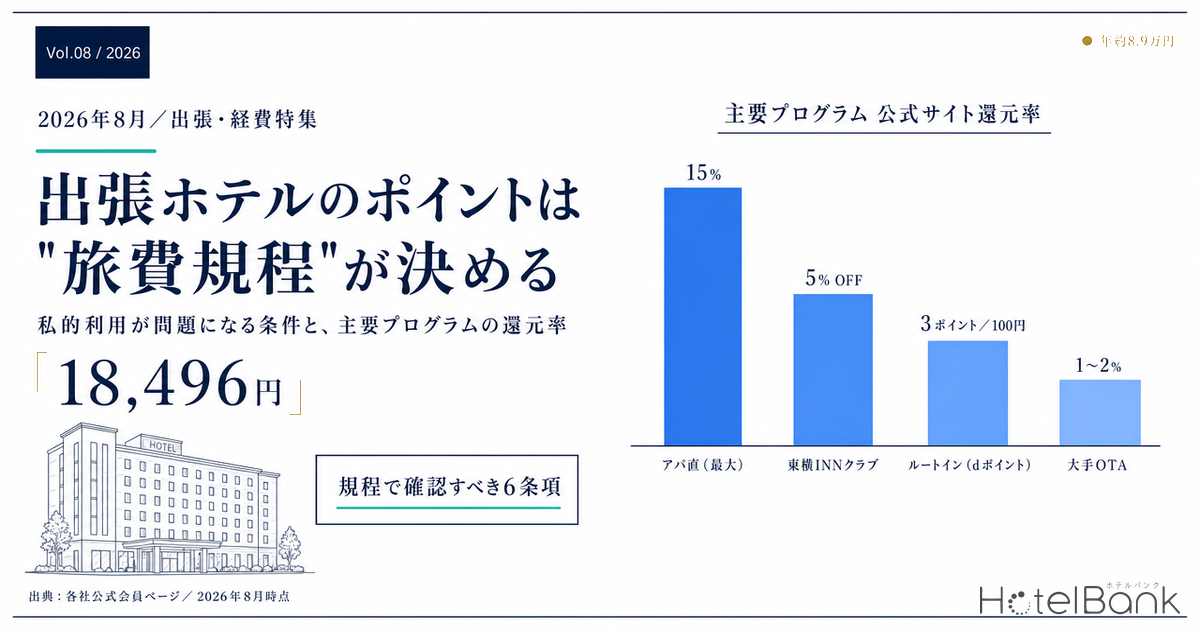
- — The sums run to about ¥89,000 a year. At the ¥18,496 listed price for a Tokyo business hotel, ten nights a month puts the gap between a 1% and a 5% earn rate at roughly ¥7,400 a month, or about ¥89,000 a year. The policy decides whether that difference stays with the company or with the individual.
The conclusion: the travel expense policy decides who owns the points
Hotel points earned on a business trip carry two natures at once. The company paid the cost, but the points are credited to the booker’s personal membership account; where the company wants to receive them instead, it has to go through the corporate desk each chain provides. That mismatch — company money, personal account — is the starting point of the ownership debate.
There is little published case law between employers and employees on this point, and no unified interpretation from any administrative agency. So there is currently thin ground for asserting flatly that “the points belong to the company” or “they belong to the individual,” and in practice the deciding axis is what the work rules, the business travel expense policy and the expense settlement policy say. If the policy states that “points and miles earned in connection with business travel belong to the company” or that “they must not be used privately,” then using them otherwise can be grounds for disciplinary action as a breach of workplace discipline. Conversely, there are cases where the policy is silent and the company tacitly permits or accepts personal use. Which one applies is unknowable until you read your own policy.
Where “private use” sits in the text of the Penal Code
Against the worry that “this might be embezzlement,” it is worth reading the provisions themselves. The Penal Code (Act No. 45 of 1907) states the following (e-Gov Law Search, text in force as of August 2026).
- Article 252 (Embezzlement): “A person who embezzles the property of another which is in the person’s own possession shall be punished by imprisonment for not more than five years.”
- Article 253 (Embezzlement in the Course of Trade): “A person who embezzles the property of another which is in the person’s own possession in the course of trade shall be punished by imprisonment for not more than ten years.”
- Article 246 (Fraud), paragraph 2: “The same shall apply to a person who obtains an unlawful profit, or causes another to obtain an unlawful profit, through the methods prescribed in the preceding paragraph.”
What the embezzlement provision covers is “the property of another which is in one’s own possession.” Points are a contractual benefit under the membership terms, not tangible property. And whether those points can be called “the property of another (the company)” itself turns, as above, on what the policy says. It is hard to read the statutory wording as making embezzlement an automatic outcome, which is precisely why the practical debate is usually handled as a question of obligations under the work rules and of discipline rather than of criminal liability. That said, choosing an expensive room against policy in order to earn points, or claiming expenses inflated by not deducting the points earned, can be examined for disciplinary action or fraud as a separate matter (improper expense claims) from the ownership of the points. It is worth keeping the points question and the expense settlement question apart.
Public servants: the “separation of public and private” set out in a Diet answer
While private-sector case law is thin, the government’s thinking on public servants survives in written answers to the Diet. A written answer of 6 March 2009 from the House of Representatives (Cabinet, House of Representatives Question No. 155 of the 171st Diet) states that for air miles earned by Ministry of Foreign Affairs staff flying on official travel under the Travel Expenses Act, a policy of “using them appropriately from the standpoint of reducing public expenditure” has applied since 1 January 2009. The earlier written answer (Cabinet, House of Representatives Question No. 40 of the 171st Diet) stated that each ministry and agency would earn and use them “on the premise of putting in place a system under which they are appropriately managed and used in a form that separates public from private.” The subject is airline miles, but the framing — a benefit arising from public money goes back into saving public money — is also a useful yardstick when reading a company travel expense policy.
On the tax side, National Tax Agency Taxanswer No. 1907 treats an individual’s earning and use of company-issued points from their own purchases in the same way as “a discount in an ordinary commercial transaction,” with no tax return required. However, the same page notes that where points granted by a company operating a shared points scheme are used, this is not regarded as equivalent to a discount, and the value of the points used is included in gross revenue as temporary income or similar. The d POINT and Ponta points used by Route Inn Hotels fall within these shared points schemes. In any event this explanation assumes a transaction the individual paid for themselves, and does not address personal use of points attached to travel costs borne by an employer.
Six clauses to check in the work rules and the travel expense policy
When you read the policy, working through the following six points in order settles how you should handle points at your own company.
| Clause to check | What to look for | How to read the result |
|---|---|---|
| 1. Designated payment method | Corporate card or a travel management company, or personal outlay | With a corporate card or company-arranged booking, points are usually managed through the company’s own arrangements |
| 2. Whether earning points and miles is permitted | An explicit “do not earn” or “you may earn” | If it is stated, that is the answer. Some companies prohibit earning them at all |
| 3. Ownership and use | “Belongs to the company” / “applied to the next trip” / “personal use permitted” | Under the offset type, the correct use is to lower the cost of the next trip with the points you have banked |
| 4. Reporting and declaration duty | Reporting of points earned, entry on the expense claim | Staying silent at a company that requires reporting is a procedural breach before you even get to how you use them |
| 5. Designated booking channel | A corporate contract site, a designated booking site, or the official site | Where a channel is designated, how the points are credited is decided there too |
| 6. Accommodation cap and reimbursement of actual cost | The cap, and whether it is actual cost or a fixed amount | Under a fixed allowance (per-diem style), the design usually leaves both the difference and the points with the individual |
The sixth item, the fixed allowance, is the single largest fork where the type of policy changes the answer: at a company that pays a fixed daily allowance and accommodation rate, the design usually leaves both the choice of where to stay and the points that come with it to the employee’s discretion. Whether the accommodation cap the policy sets actually matches market prices is examined prefecture by prefecture in Outdated Travel Allowances? Actual ADR vs. Rank Limits in 47 Prefectures.
Earn rates and how account ownership works at the major programmes (checked on official sites, August 2026)
Assuming your company permits it, the quickest way to decide where to bank points is to line up each programme’s official terms. All of the following are conditions published on the membership pages of each company’s official site; earn rates and benefits are subject to change without notice.
| Programme | Main earn rate when booking on the official site | Joining fee / annual fee | How the account and eligibility work |
|---|---|---|---|
| APA Hotel membership (APA Chokuyoyaku, the direct booking channel) | Up to 12% under the member status tier; up to 15% when paying with the affiliated card carrying the member number. Participating hotels earn 3% of the pre-tax room rate. The app’s one-second check-in adds 1% | Stated on the official site | Credited to the member’s own account. Online bookings made outside the official site still earn 1% |
| Toyoko Inn Club | 5% off at any time; one free single night after ten stays; up to ¥400 off when booking on the official site or app | Joining fee ¥1,500 (students ¥1,000); no annual fee | Present the member’s own card or digital membership card on the day of the stay; applies to the room the member occupies |
| Comfort Hotel Choice Guest Club | 1 choice per ¥220 (incl. tax) of room charge; 100 choices convert to a ¥500 discount coupon (¥22,000 of spend for ¥500, an effective rate of about 2.3%) | Free | 300 choices a year confers GOLD status. Choices can also be directed to charitable donations |
| Super Hotel membership | Booking on the official site earns points worth ¥500 a night regardless of the room rate (with additions by member rank). 1 point equals ¥1 as a cash rebate, up to ¥30,000 per night | Free | The QR code on the My Page account is the membership card. Point exchange vouchers are available for accompanying guests other than the booker |
| Route Inn Hotels | d POINT at 3 points per ¥100 (excl. tax) of room charge (the official site notes that the rate differs by hotel brand). Choice of d POINT or Ponta, not both. Benefits such as 200 Ponta points for opting into eco housekeeping on consecutive nights | Free, as a member of the shared points scheme | Credited to the d POINT or Ponta shared points account, held in the individual’s name |
| Major online travel agencies (accommodation booking sites) | Typically around 1–2% of the room charge; some periods add more through campaigns | Free | Credited to the booker’s personal account on the booking site. Using a corporate booking service can allow the company to manage them instead |
Source: the membership and points information pages on each company’s official site (accessed August 2026; for APA Hotel, the content published on its official membership page as of May 2026). The earn rate for online travel agencies shows the range of standard earning conditions across the major operators.
The point to grasp about account ownership is that most chain-direct points are conditioned on the member personally staying. Toyoko Inn Club applies its benefits when the member presents their own membership card, while Super Hotel is designed to distribute points to accompanying guests other than the booker through vouchers. Where the company arranges the stay under a corporate contract, each chain provides a corporate desk (corporate login, corporate booking) separate from individual membership — so which of the two channels the booking runs through very largely decides who gets the points.
What one night’s listed price returns (September 2026 stays, listed price)
To see the earn-rate gap as an actual sum, apply it to listed business hotel prices. The table below shows the prefecture-level median of listed prices on booking sites (as of August 2026, for September 2026 stays, two guests per room, incl. tax). Because the single-occupancy price common on business trips is normally lower than this, read the returned amounts as an indication.
| Prefecture | Business hotel listed price (per night, two per room, incl. tax) | Properties in the sample | 1% return | 3% return | 5% return |
|---|---|---|---|---|---|
| Tokyo | ¥18,496 | 949 properties | ¥185 | ¥555 | ¥925 |
| Hokkaido | ¥19,123 | 398 properties | ¥191 | ¥574 | ¥956 |
| Aichi | ¥18,926 | 290 properties | ¥189 | ¥568 | ¥946 |
| Osaka | ¥14,241 | 521 properties | ¥142 | ¥427 | ¥712 |
| Fukuoka | ¥14,112 | 342 properties | ¥141 | ¥423 | ¥706 |
Source: public booking-site data compiled by the HotelBank Editorial Team (listed prices as of August 2026, for September 2026 stays, median per-room rate incl. tax for two guests per room in the “business hotel” category; N = the number of properties shown in each row).
For a traveller staying ten nights a month in Tokyo, the gap between 1% and 5% is about ¥7,400 a month, or roughly ¥90,000 a year. Whether that sum accrues to the company or stays with the individual changes with the policy set out above. From the company’s side, if employees register for the official programmes and stay at properties under corporate contract, the resulting benefits can be turned back into savings on travel costs — which is why a policy provision stating “applied to the next business trip” has a logic to it. How much accommodation costs differ from prefecture to prefecture is compared in Business Hotel Price Surge: National ADR Analysis & 10 Cost-Effective Prefectures.
How to bank points sensibly when your company allows it
Where the policy permits personal use, or requires the points to be applied to the next trip, the way to accumulate them comes down to four points.
- Narrow the chains you stay at to one or two. Direct-booking points are usually designed so that benefits thicken with the number of stays: Toyoko Inn Club’s “one free single night after ten stays,” APA Hotel’s status tiers and Super Hotel’s annual rank all reward concentrating on the same chain. How to combine the number of nights and the days of the week for consecutive stays at one chain is set out in APA Hotel Multi-Night Stays: Day Mix Saves 10%, Monthly Plan 29%.
- Book through the official site or official app. As the table above shows, the return through the direct channel is thicker than the standard earning on a booking site. APA Hotel still credits 1% on online bookings made elsewhere, but 3% or more through its own direct channel.
- Carry the membership card digitally. Presenting it at check-in makes sure the discount, the points for that night and the stay count all accumulate. Keeping the card on your phone means you can produce it immediately every time; how to set up Toyoko Inn’s digital membership card is explained in Toyoko Inn Club Card in the App: ¥1,500 Join Fee and 5% Off Rules.
- Check the expiry and the settlement rules first. Super Hotel’s points expire at the end of the same month one year after they are earned, and standard accommodation plans are explicitly stated to be eligible. To use them up within the window, working them off at each check-in is the surer approach.
If you want specific property names for the cities you pass through on business, a selection made for travellers driving a company car, chosen on free parking and early departures, is a useful reference: Top 5 roadside and station-front hotels in North Kanto — Utsunomiya, Takasaki and Maebashi (HotelPicks, in Japanese). Chains that earn direct-booking points, such as Hotel Route-Inn Utsunomiya Yuinomori (ホテルルートイン宇都宮ゆいの杜), feature near the top.
To restate the conclusion on ownership: the law does not answer it, the answer is in your company’s policy, and where the policy is silent, check before you use them. Keep to that order and there is very little scope for earning points to become a problem in itself.
This article is not legal advice. On the interpretation of work rules and travel expense policies, and on the possibility of disciplinary action, consult your employer’s HR or general affairs department, or a lawyer or certified social insurance and labour consultant.
Where to look next
For choosing specific properties at your destination, these articles go deeper (both in Japanese).
Five station-front business hotels within a three-minute walk of a highway bus terminal — reading the night-before and morning-after stay for overnight and daytime coach trips by terminal access and room count (innippon, in Japanese)
Covering four terminal areas — Busta Shinjuku, OCAT, Hakata Bus Terminal and the Meitetsu Bus Center — it compares five properties including Odakyu Hotel Century Southern Tower (小田急ホテルセンチュリーサザンタワー), Hotel Monterey Grasmere Osaka (ホテルモントレ グラスミア大阪), Toyoko Inn Hakata-eki Bus Terminal-mae (東横INN博多駅バスターミナル前) and Meitetsu Grand Hotel (名鉄グランドホテル) on distance from the boarding point, room count and check-in time. Toyoko Inn Hakata-eki Bus Terminal-mae starts its free breakfast at 6:30.
Hotels you can park at, for travellers working a territory by car — Top 5 roadside and station-front hotels in North Kanto (Utsunomiya, Takasaki, Maebashi) where free parking and an early start pay off (HotelPicks, in Japanese)
It selects five properties in Utsunomiya, Takasaki and Maebashi with parking free for guests, comparing Hotel Route-Inn Utsunomiya Yuinomori (ホテルルートイン宇都宮ゆいの杜, 165 free surface parking spaces, EV charger, large communal bath), HOTEL1-2-3 Maebashi Mercury (HOTEL1-2-3 前橋マーキュリー, more than 200 free surface spaces) and Hotel Selac Pal Takasaki (ホテルシーラックパル高崎, breakfast from 6:00) on the type of parking and the breakfast start time.
What it adds up to — a quick table of earn rate by number of nights
To bring the ownership question down to concrete sums, the earn rates that appear in each company’s official terms in Table 2 are applied directly to the Tokyo business hotel listed price confirmed in Table 3 (¥18,496 a night). Each cell is the simple product of listed price, earn rate and number of nights, with no weighting for probability or attainability.
| Earn rate \ annual nights | 1 night/month, 12 a year | 2 nights/month, 24 a year | 5 nights/month, 60 a year | 10 nights/month, 120 a year | 20 nights/month, 240 a year |
|---|---|---|---|---|---|
| 1% | ¥2,220 | ¥4,439 | ¥11,098 | ¥22,195 | ¥44,390 |
| 3% | ¥6,659 | ¥13,317 | ¥33,293 | ¥66,586 | ¥133,171 |
| 5% | ¥11,098 | ¥22,195 | ¥55,488 | ¥110,976 | ¥221,952 |
| 12% | ¥26,634 | ¥53,268 | ¥133,171 | ¥266,342 | ¥532,685 |
| 15% | ¥33,293 | ¥66,586 | ¥166,464 | ¥332,928 | ¥665,856 |
There are three ways to read it. On the pessimistic case (12 nights a year at 1%), ¥2,220 a year — not a sum that justifies the effort of reading the policy. On the middle case (60 nights a year at 3%), ¥33,293 a year, which reaches a level that is meaningful as a saving on company travel costs if the policy assigns ownership. On the optimistic case (120 nights a year at 12%), ¥266,342 a year — at which point the risk of quietly using them personally is not negligible in monetary terms either. Comparing 1% and 5% in the ten-nights-a-month column gives a gap of ¥88,781 a year, matching the “about ¥90,000 a year” mentioned at the top of this article.
One more thing: a percentage-based return and a flat-amount return swap places depending on the price level. Under a design like Super Hotel’s, where points worth ¥500 a night accrue regardless of the room rate, the effective rate rises as the price falls.
| Percentage earn rate | Nightly rate equivalent to a flat ¥500 |
|---|---|
| 1% | ¥50,000 |
| 3% | ¥16,667 |
| 5% | ¥10,000 |
So if your trips are mostly under ¥10,000 a night, the flat ¥500 beats a 5% award; if they are mostly in higher-priced city-centre properties, the percentage award grows faster. As Table 3 shows, listed prices vary by more than ¥4,000 between prefectures, so which chain you should consolidate on depends on the price band of your destinations. Note that Table 3 is based on two guests per room, and the amount actually paid for the single occupancy common on business trips is normally lower, so all of the sums above should be read as an upper-bound indication.
Frequently asked questions
Q. Can I use hotel points earned on a business trip for my own holiday?
A. It depends on your company’s work rules and business travel expense policy. There is little statutory text and no unified administrative interpretation defining who owns the points, so if the policy says they “belong to the company” or “must not be used privately,” using them otherwise can be grounds for disciplinary action as a breach of workplace discipline. Where the policy is silent, checking with general affairs or accounting before using them is the surest course.
Q. Would using them quietly amount to embezzlement?
A. Article 252 of the Penal Code (Embezzlement) covers “the property of another which is in one’s own possession,” and points are a contractual benefit under the membership terms, not tangible property. Whether they can be called “the property of another (the company)” also turns on what the policy says, so it is hard to read the statutory wording as making embezzlement an automatic outcome. In practice this is an area handled as a question of obligations under the work rules and of discipline rather than of criminal liability. That said, choosing an expensive room against policy in order to earn points, or claiming expenses inflated by not deducting the points earned, is a separate problem: an improper expense claim.
Q. How are public servants treated?
A. A written answer of 6 March 2009 from the House of Representatives (Cabinet, House of Representatives Question No. 155 of the 171st Diet) states that for air miles earned by Ministry of Foreign Affairs staff flying on official travel under the Travel Expenses Act, a policy of using them appropriately from the standpoint of reducing public expenditure has applied since 1 January 2009. The earlier written answer (Cabinet, House of Representatives Question No. 40 of the 171st Diet) stated that each ministry and agency would earn and use them “on the premise of putting in place a system under which they are appropriately managed and used in a form that separates public from private.”
Q. Where in the policy should I look to decide?
A. Six places. (1) The designated payment method (corporate card or company arrangement versus personal outlay), (2) whether earning points and miles is permitted, (3) ownership and use (company ownership, application to the next trip, personal use permitted), (4) any reporting or declaration duty, (5) the designated booking channel, and (6) the accommodation cap and reimbursement of actual cost. Where (6) is a fixed allowance (per-diem style) in particular, the design usually leaves both the difference and the points with the individual.
Q. Is tax payable on the points?
A. National Tax Agency Taxanswer No. 1907 treats an individual’s earning and use of company-issued points from their own purchases in the same way as “a discount in an ordinary commercial transaction,” with no tax return required. However, a note on the same page states that where points granted by a company operating a shared points scheme are used, this is not regarded as equivalent to a discount, and the amount used is included in gross revenue as temporary income or similar. Route Inn Hotels’ d POINT and Ponta points fall within these shared points schemes. Note also that this explanation assumes a transaction the individual paid for themselves, and does not address personal use of points attached to travel costs borne by an employer.
Q. Which earns more points, the official site or an online booking site?
A. As Table 2 shows, chain-direct returns are generally set thicker than the standard 1–2% or so earned through the major online travel agencies (accommodation booking sites). However, if your company designates a booking channel, that designation takes precedence. Direct-booking points are also mostly conditioned on the member personally staying, and where the company arranges the booking under a corporate contract each chain’s corporate desk is used — so which channel the booking runs through very largely decides who owns the points.
Related reading
- Outdated Travel Allowances? Actual ADR vs. Rank Limits in 47 Prefectures
- Government Per-Diem vs Market ADR — 47-Prefecture Gap Visualized (2026)
- Business Hotel Price Surge: National ADR Analysis & 10 Cost-Effective Prefectures
- Toyoko Inn Club Card in the App: ¥1,500 Join Fee and 5% Off Rules
- APA Hotel Multi-Night Stays: Day Mix Saves 10%, Monthly Plan 29%
- Business Hotels for Long Stays: 6 Checks and ¥16,722 a Night in Tokyo
- Vessel Hotels: Under-18s Sleep Free — 7 Japanese Chains Compared
References and sources
■ Data sources
Statutes and government positions are taken from primary sources: the text in force on e-Gov Law Search, written answers of the House of Representatives, and National Tax Agency Taxanswer (accessed August 2026). Each chain’s earn conditions follow the descriptions on the official membership pages listed below (accessed August 2026; for APA Hotel only, the content published on its official membership page as of May 2026). Accommodation prices are public booking-site data compiled by the HotelBank Editorial Team: listed prices retrieved as of August 2026 for September 2026 stays, in the “business hotel” category, two guests per room, per-room rate incl. tax, aggregated by prefecture, with the number of properties in the sample (N) shown alongside in Table 3.
■ Calculation assumptions
The amounts in Tables 4 and 5 take only the Tokyo listed price of ¥18,496 from Table 3 and the official earn rates and flat awards that appear in Table 2 as inputs, and are derived by the simple calculation of listed price x earn rate x number of nights (for Table 5, ¥500 divided by the earn rate). The annual night counts are 1, 2, 5, 10 and 20 nights a month multiplied by 12, with no weighting for probability or attainability. Additions by member rank, bonus-point plans, coupons, and points that expire unused within the validity period are not taken into account.
■ Limitations and caveats
This article organises general information and is not legal advice. Published case law and unified administrative interpretations on the ownership of points are thin, and this article makes no assertion beyond what the statutory text and public documents state. Earn rates and benefits may be changed by each company without notice, and Route Inn Hotels states officially that the earn rate differs by hotel brand. Comfort Hotel plans to renew its membership programme in January 2027. The listed prices in Table 3 are based on two guests per room, and the amount paid for the single occupancy common on business trips is normally lower, so the returned amounts in Tables 3 and 4 are an upper-bound indication. APA Hotel’s earn conditions are based on the description on its official site, but automated retrieval of that page was not possible at the time of writing, so the word-by-word verification carried out for the other five companies could not be performed.
■ Primary source links
- e-Gov Law Search, “Penal Code (Act No. 45 of 1907),” Articles 246, 252 and 253 (in Japanese)
- House of Representatives, “Written answer to the re-submitted question concerning restraint in the earning of air miles by Ministry of Foreign Affairs staff on official travel” (Cabinet, House of Representatives Question No. 155 of the 171st Diet, 6 March 2009) (in Japanese)
- House of Representatives, “Written answer to the same question” (Cabinet, House of Representatives Question No. 40 of the 171st Diet, 30 January 2009) (in Japanese)
- National Tax Agency Taxanswer No. 1907, “Treatment where an individual earns or uses company-issued points” (in Japanese)
- Toyoko Inn, “Toyoko Inn Club Card membership” (joining fee ¥1,500, students ¥1,000; no annual fee; one free night after ten stays; 5% off at any time; up to ¥400 off on the official site) (in Japanese)
- Comfort Hotel, “Choice Guest Club” (free; 1 choice per ¥220 of room charge; a ¥500 discount coupon per 100 choices; GOLD at 300 choices a year) (in Japanese)
- Super Hotel, “Member benefits and points system” (¥500 a night regardless of room rate; 1 point equals ¥1, up to ¥30,000 per night; valid until the end of the same month one year after earning) (in Japanese)
- Route Inn Hotels, “Official site booking benefits” (3 points per ¥100 of room charge, excl. tax) (in Japanese)
- Route Inn Hotels, “Point Concierge” (Ponta and d POINT cannot be combined — one or the other; Eco DE Route Inn benefits) (in Japanese)