

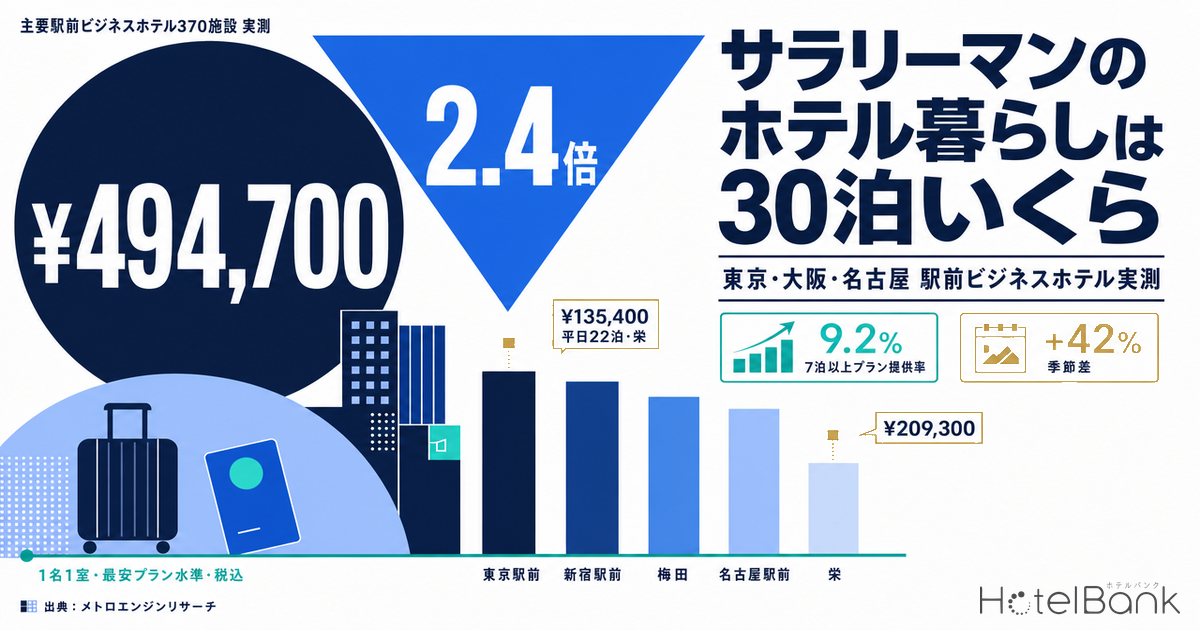
Hotel living is no longer an unusual choice for salaried workers in Japan. A long business trip runs across the turn of the month; company housing at a new posting is not ready in time; a gap opens up between moving out and moving in — working life regularly produces stretches that are too short to justify a lease and too long for a few nights in a business hotel. This article uses measured prices from 370 business hotels around the main stations of Tokyo, Osaka and Nagoya to show what 30 nights of hotel living actually costs, how the cost of keeping a home running lands on top of it, and how far a company’s business-travel expense policy will stretch.
Metric Definitions Used in This Article
- Listed price (single occupancy, lowest-plan level): For each property we take the cheapest rate published on OTAs and similar channels for that day — one record per property per day — take the median across all properties for each day, and average over the period. It is a per-room rate for single occupancy, tax included. Every 30-night figure in this article uses this basis. It sits at a different level from the double-occupancy basis used in other HotelBank articles.
- Day-of-week split: Aggregated by check-in day into three groups — Mon–Thu, Fri–Sat, and Sun. Where this article says “weekday,” it means Mon–Thu and does not include Sunday.
- ADR (average daily rate): An estimated settled rate (tax-excluded equivalent) derived by applying a category-specific adjustment factor to the lowest published plan level on OTAs. Cross-checked against property-level results disclosed by listed hotel REITs, the median error is roughly 7%. It is an estimate and differs from each property’s actual transacted prices and accounting figures. Area-level ADR is the median across the covered properties.
- Data source: MetroEngines Research
- — Thirty nights near Tokyo Station comes to about ¥495,000, versus about ¥209,000 in Sakae, Nagoya. The same “30 nights in a business hotel near the station” varies by a factor of 2.4 depending on the area.
- — The 22-weekday-night pattern, going home at weekends, costs about ¥135,000 in Sakae and about ¥147,000 near Namba Station. Fewer nights and avoiding the Friday–Saturday premium both work in your favour.
- — For solo postings, the cost of the family home does not disappear: about ¥123,000 a month in Tokyo’s 23 wards, ¥88,000 in Osaka City and ¥87,000 in Nagoya City sits on top of the hotel bill.
- — The flat lodging allowance in travel-expense policies averages ¥8,878 for rank-and-file staff. Osaka and Nagoya station areas (¥6,200–¥7,500 Mon–Thu) fit inside it, but ¥15,400 near Tokyo Station exceeds even the ¥12,889 actual-cost cap.
- — Only 34 of the 370 properties (9.2%) offer a plan of 7 nights or more, and just 7 go to 30 nights or more. Around Osaka Station/Umeda the count is zero out of 45, so the availability of options differs sharply by area.
Three patterns of hotel living for salaried workers — different durations, different payers
“Hotel living” gets treated as one thing, but for company employees it splits into three patterns, and the duration, who pays, and what happens to the home are completely different in each. Comparing total cost without separating the three leads to the wrong decision.
| Pattern | Typical duration | Who pays for the room | The home | What matters most |
|---|---|---|---|---|
| 1. Long business trip | 2 weeks to 3 months | The company (reimbursed under the travel-expense policy) | Kept as is | Choosing areas and days that fit inside the policy’s lodging cap |
| 2. Solo posting away from family | 6 months to several years (of which 1–3 months right after arrival) | Company allowances and housing support plus the employee | Family stays, home is maintained (double burden) | Flexibility as a bridge until company housing or a leased unit is arranged |
| 3. Between moves or jobs | 2 weeks to 1 month | In principle entirely the individual | Already vacated, or not yet moved into | Avoiding deposit, key money and agency fees altogether |
Source: Compiled by the HotelBank Editorial Team
What drives the sense of cost is the difference between patterns 1 and 2. In pattern 1 the company pays, so the question shifts from “total cost” to whether the nightly rate fits inside the policy. In pattern 2, the rent, utilities and communications for the home the family still lives in do not go away, and the housing cost at the new posting is added on top. Framing that as a straight “lease or hotel” choice compares the wrong things. The sections below put numbers on the two separately.
What 30 nights really costs — ¥494,700 near Tokyo Station, ¥209,300 in Sakae, a 2.4x gap
Using listed prices collected by MetroEngines Research, we aggregated the single-occupancy, lowest-plan level for business hotels within a 1 km radius of the main stations of Tokyo, Osaka and Nagoya. The universe is 491 properties across six areas, of which the 370 with observable prices during the aggregation window (check-in 1 June to 31 July 2026, a completed measurement period) form the sample. For each property we picked one cheapest rate per day, took the median across properties for each day, then averaged over the period.
Source: MetroEngines Research; compiled by the HotelBank Editorial Team
For a straight 30-night stay covering every day of the week, the total is highest near Tokyo Station at about ¥495,000, followed by Shinjuku Station at about ¥364,000. Osaka and Nagoya land in the ¥200,000s, with the lowest, Sakae in Nagoya, at about ¥209,000. The same “30 nights in a business hotel near the station” varies 2.4-fold by area.
The realistic pattern for many employees is going home on Friday. Checking in Monday and out Friday, repeated four and a half weeks, comes to roughly 22 nights and drops the expensive Friday and Saturday nights. On that basis Sakae falls to about ¥135,000 and Namba Station to about ¥147,000, because the smaller number of nights and the avoided Friday–Saturday premium both work in the same direction.
| Area (1 km radius of the station) | Properties | Mon–Thu | Fri–Sat | Sun | Fri–Sat premium | 30 nights straight | 22 weekday nights |
|---|---|---|---|---|---|---|---|
| Tokyo Station (Chiyoda / Chuo) | 32 | ¥15,400 | ¥20,400 | ¥13,000 | +32.3% | ¥494,700 | ¥339,100 |
| Shinjuku Station | 48 | ¥10,900 | ¥15,500 | ¥10,600 | +41.9% | ¥363,900 | ¥239,900 |
| Osaka Station / Umeda | 45 | ¥7,500 | ¥9,200 | ¥7,100 | +23.0% | ¥236,800 | ¥164,200 |
| Namba Station | 121 | ¥6,700 | ¥9,100 | ¥7,000 | +35.4% | ¥222,100 | ¥147,400 |
| Nagoya Station | 66 | ¥7,100 | ¥9,300 | ¥7,000 | +30.8% | ¥230,900 | ¥156,300 |
| Sakae (Nagoya) | 58 | ¥6,200 | ¥8,900 | ¥6,500 | +45.1% | ¥209,300 | ¥135,400 |
Check-in 1 June to 31 July 2026. Of 491 properties across the six areas, the 370 with observable prices were aggregated (N=370). Source: MetroEngines Research; compiled by the HotelBank Editorial Team
The size of the Friday–Saturday premium also differs by area: +45.1% in Sakae, +41.9% near Shinjuku Station and +35.4% near Namba Station — the closer an area sits to nightlife districts, the more weekends lift the rate. Osaka Station/Umeda, at +23.0%, is the opposite case: where business demand dominates, weekends move the price less. For an employee who goes home at weekends, the areas with the steepest premium are precisely where a weekday-only pattern pays off most.
One more thing that is easy to miss is how cheap Sunday check-in is. In all six areas Sunday sits below Mon–Thu; near Tokyo Station it is ¥13,000, about 15% under the Mon–Thu level. Arriving on Sunday evening so you can start work first thing Monday is therefore no worse financially — and often more sensible than travelling on Monday morning and carrying the risk of being late.
Source: MetroEngines Research; compiled by the HotelBank Editorial Team / Sanro Research Institute, “FY2025 Survey on Domestic and Overseas Business Travel Expenses”
Note that these figures represent “booking each night separately at the standard rate,” so they sit near the upper bound. In practice there is room to use consecutive-night discounts and long-stay plans, which brings the amount down. For how many nights it takes before discounts start to bite, see our measured study of Japan hotel long-stay discounts.
The home does not disappear — a solo posting doubles up rent, utilities and communications
What makes hotel living for employees fundamentally different from the usual “lease versus hotel” comparison is that the thing being compared is not replaced. On a solo posting, the home the family lives in remains; on a long business trip, the rent on your own flat keeps being debited while you are away. The hotel bill is not something you pay instead — it is something you pay on top.
Public statistics give the size of what it sits on top of. According to the Ministry of Internal Affairs and Communications’ 2023 Housing and Land Survey (as of 1 October 2023), monthly rent for privately rented housing (dwellings for exclusive residential use, excluding zero-rent units) is ¥100,530 in Tokyo’s 23 special wards, ¥65,701 in Osaka City and ¥65,237 in Nagoya City. To that, the same survey’s monthly common-area and management fees are added (¥4,310 in the special wards, ¥4,594 in Osaka City, ¥3,824 in Nagoya City). The Family Income and Expenditure Survey’s 2025 average for single-person working households puts utilities and water at ¥11,222 a month and communications at ¥6,943.
| Item | Tokyo 23 wards | Osaka City | Nagoya City |
|---|---|---|---|
| Rent (privately rented housing, per month) | ¥100,530 | ¥65,701 | ¥65,237 |
| Common-area and management fees | ¥4,310 | ¥4,594 | ¥3,824 |
| Utilities and water (single-person working household) | ¥11,222 | ¥11,222 | ¥11,222 |
| Communications (same source) | ¥6,943 | ¥6,943 | ¥6,943 |
| A. Total monthly cost of keeping the home | ¥123,005 | ¥88,460 | ¥87,226 |
| B. Hotel, 30 nights straight (cheapest area / most expensive area) | ¥363,900 / ¥494,700 | ¥222,100 / ¥236,800 | ¥209,300 / ¥230,900 |
| C. Hotel, 22 weekday nights (same basis) | ¥239,900 / ¥339,100 | ¥147,400 / ¥164,200 | ¥135,400 / ¥156,300 |
| C ÷ A (22 weekday nights as a multiple of keeping the home) | 1.95–2.76x | 1.67–1.86x | 1.55–1.79x |
Sources: Ministry of Internal Affairs and Communications, “2023 Housing and Land Survey” and “Family Income and Expenditure Survey (2025 average, single-person working households)”, plus MetroEngines Research; compiled by the HotelBank Editorial Team
What the bottom of the table shows is that narrowing the hotel side to “22 weekday nights” pulls the burden into a range of 1.5 to 2.8 times the cost of keeping the home: 1.55x in Sakae, Nagoya, and 1.67x near Namba Station. Take 30 straight nights near Tokyo Station and it widens to 4.0x. The combination of area and number of nights alone swings the multiple by roughly 2.6 times within the same “hotel living.”
Company allowances change the picture again. The Ministry of Health, Labour and Welfare’s 2025 General Survey on Working Conditions (for November 2024) puts the average monthly payment per worker at ¥49,300 for solo-posting and separation allowances and ¥18,700 for housing allowances. The solo-posting allowance alone covers about 36% of 22 weekday nights in Sakae, Nagoya (¥135,400). Where an employer pays both the allowance and housing support, spending the first few months of a posting in a hotel is well within reach in cash terms.
Note also that this comparison excludes the upfront costs on the rental side. Renting a new place at the posting means a deposit, key money, agency fees and advance rent, and restoration costs may arise on move-out. The shorter the posting, the more heavily those entry and exit costs weigh on a per-month basis. Put the other way round, using a hotel while the length of the posting is still unclear is a way of not buying contractual risk. For the full lease-versus-hotel total comparison, see our comparison against rent and living costs in Tokyo’s 23 wards.
How far the travel-expense policy stretches — Tokyo Station is over the cap
For the long-business-trip pattern, the first thing to check is the lodging level written into the employer’s business-travel expense policy. According to the Sanro Research Institute’s “FY2025 Survey on Domestic and Overseas Business Travel Expenses” (surveyed June–August 2025, 161 responding companies), companies that pay a flat lodging allowance for domestic travel pay ¥8,878 for rank-and-file staff on a single nationwide rate, and ¥11,262 for the top-tier metropolitan category. Where actual costs are reimbursed, the cap is ¥10,490 for rank-and-file staff on a single nationwide rate and ¥12,889 for the top-tier category.
Set those levels beside the measured Mon–Thu figures from the previous section and the conclusion differs completely by region.
| Area | Measured Mon–Thu | Gap vs flat rate, all regions (¥8,878) | Gap vs actual-cost cap, top tier (¥12,889) | How to read it |
|---|---|---|---|---|
| Tokyo Station | ¥15,400 | +¥6,500 | +¥2,500 | Even the top-tier actual-cost cap falls short |
| Shinjuku Station | ¥10,900 | +¥2,000 | −¥2,000 | Fits if the policy has a top-tier category |
| Osaka Station / Umeda | ¥7,500 | −¥1,400 | −¥5,400 | Fits even the single flat rate |
| Namba Station | ¥6,700 | −¥2,200 | −¥6,200 | Fits even the single flat rate |
| Nagoya Station | ¥7,100 | −¥1,800 | −¥5,800 | Fits even the single flat rate |
| Sakae (Nagoya) | ¥6,200 | −¥2,700 | −¥6,700 | Fits even the single flat rate |
Sources: Sanro Research Institute, “FY2025 Survey on Domestic and Overseas Business Travel Expenses”, and MetroEngines Research; compiled by the HotelBank Editorial Team
The four Osaka and Nagoya areas fit inside even the single nationwide flat rate (¥8,878) from Monday to Thursday. In other words, at a company whose policy has no regional tiers, a posting in the Kansai or Chubu region rarely causes a problem in practice. The problem is Tokyo. The measured Mon–Thu rate of ¥15,400 near Tokyo Station is about ¥2,500 above the ¥12,889 top-tier actual-cost cap. Over 22 nights in a month that is a gap of roughly ¥55,000, forcing a choice between paying it yourself, obtaining approval for a higher grade each time, or shifting area. Moving to Shinjuku Station brings it to ¥10,900, inside the top-tier category — so a difference of a few kilometres, central Tokyo versus the west side of the Yamanote Line, decides whether you fit the policy.
There is also a point about how policies operate over a long stay. Most are written as a per-night cap, so even if a consecutive-night discount or long-stay plan lowers your nightly rate, the design often does not pass any benefit back to the employee. Conversely, where lodging is paid as a fixed allowance, the difference from a cheaper room may stay in your pocket. Which method applies, and how the difference is treated, is worth reading in the policy itself — the wording on lodging caps, regional tiers and how savings are handled is where the practical answer lives.
One more point concerns the tax treatment once a long business trip starts to resemble a genuine transfer. Under the National Tax Agency’s rules, travel expenses paid to an employee travelling for business are non-taxable to the extent they are within what is ordinarily considered necessary. Where a stay in one location becomes prolonged and the reality moves closer to a transfer, the question of whether the payment is travel expense or salary can arise. Because the answer depends on the individual circumstances, it is safest to confirm the treatment with the accounting or HR department once the period looks likely to run to several months.
Long-stay plans are scarce near stations — only 34 of 370 properties offer 7 nights or more
The assumption that “a long stay must come with a cheaper plan” is only half true for business hotels near major stations. Looking at published plan names for September 2026 check-in across the 370 properties in the sample, 210 properties (56.8%) offered a plan conditional on consecutive nights. More than half have some form of multi-night plan.
The breakdown tells a different story, though. Most use short thresholds such as “2 nights or more” or “3 nights or more”; only 34 properties (9.2%) published a plan built around 7 nights or more, and just 7 properties (1.9%) offered a monthly plan of 30 nights or more. Dedicated plans matching the length people mean by “hotel living” are, in business hotels near stations, the exception.
Published plans for September 2026 check-in (N=370 properties). Source: MetroEngines Research; compiled by the HotelBank Editorial Team
The gap between areas is large too. Ten of 66 properties near Nagoya Station, nine of 58 in Sakae and ten of 121 near Namba Station carry a plan of 7 nights or more, while Osaka Station/Umeda has zero out of 45, Tokyo Station three out of 32 and Shinjuku Station two out of 48. The pattern reads as: the denser the business demand and the higher the rate near a central station, the less need there is to price for long stays. Which means that if you are hunting for a long-stay plan, look one station away rather than directly in front of the station, or pick an area such as Nagoya where the options still exist.
Looking at what is actually being sold reveals the design behind the price. Comfort Hotel advertises a 7-night plan and a 30-night monthly plan on its official site, combining them with an “eco stay” that skips daily housekeeping, adding free breakfast, and setting a 12:00 check-in / 12:00 check-out window. On housekeeping it states explicitly that rooms are cleaned on the 4th night, the 7th night and every 3 nights thereafter for hygiene reasons — trading cleaning frequency for more time in the room and more value at the table. Our own collected listings confirm that several properties of the same brand in Osaka and Nagoya continued to publish these 7-night and 30-night plans for September 2026 check-in.
Super Hotel takes a different approach: rather than a chain-wide long-stay plan, weekly and monthly plans are set at the property level. Several properties around Nagoya Station published multi-night-only plans combining natural hot springs and a freshly baked bread breakfast buffet. On a long stay, eating out and the comfort of bathing shape quality of life substantially, so breakfast included and a large communal bath ease the real burden more than the nightly rate alone suggests.
In the extended-stay segment, the product itself can switch depending on the number of nights. Tokyu Stay’s medium-to-long-stay plans can be searched for weekly stays of 7 to 29 nights on the official site, online booking runs to 31 nights, and 32 nights or more is handled through a separate enquiry form. There is no product literally called a “monthly plan” — worth knowing when you request a quote for a longer stay.
In practice, three things matter more than price when choosing a plan. First, housekeeping frequency: multi-night plans are often discounted on the assumption of no cleaning, and extra cleaning may cost more. Second, cancellation and shortening terms: some 30-night plans do not allow the stay to be shortened, so if your posting dates may move, booking night by night can be safer. Third, laundry: whether the building has a laundry room, and how many machines, matters more the longer you stay. For how to keep a long stay comfortable, see our guide to hotel living in Japan.
When you start matters — Tokyo business hotels differ 40% between January and April
If you have any say over the month a posting or long trip begins, seasonality is not something to ignore. Tracking MetroEngines Research’s estimated settled ADR for business hotels in Tokyo month by month, April 2026 was the highest at ¥17,800 and January the lowest of the peak months at ¥12,600 — a gap of about 42% between January and April (the lowest month among the confirmed January–July figures is June at ¥11,900). The 2025 shape was the same, ¥11,900 in January against ¥17,100 in April, so the seasonal pattern has now repeated for two years.
N=890–925 properties (varies by month). Source: MetroEngines Research; compiled by the HotelBank Editorial Team
The awkward part is that April, when corporate reassignments cluster, is also the most expensive month of the year. On top of that, the 2025 figures show a high autumn as well — ¥15,300 in October and ¥16,500 in November — so second-half transfer timing is not cheap either. January–February and June–July, by contrast, stayed in the ¥11,900–¥13,300 range in both years. If your start date can move by a few weeks, crossing a month boundary can be worth several thousand yen a night, or tens of thousands of yen over a month.
Conclusion — the deciding question for each of the three patterns
With the numbers in place, return to the three patterns from the opening.
1. The long business trip turns on whether the nightly rate fits the policy, not on the total. The main station areas of Osaka and Nagoya run ¥6,200–¥7,500 Monday to Thursday, inside even the single nationwide flat rate (¥8,878 for rank-and-file staff). Tokyo, at ¥15,400 in front of the central station, exceeds the cap, so the practical answer is to move towards Shinjuku or obtain approval at a higher grade.
2. The solo posting starts from the fact that the cost of keeping the home does not go away, and hinges on whether you can shape the stay into the 22-weekday-night pattern. That is ¥135,400 in Sakae, Nagoya, or ¥147,400 near Namba Station — 1.55 to 1.67 times the cost of keeping a home (¥87,226 in Nagoya City, ¥88,460 in Osaka City). At an employer paying the average solo-posting allowance (¥49,300 a month) plus a housing allowance (¥18,700), bridging the first few months in a hotel until company or leased housing is settled is entirely realistic.
3. The gap between moves or jobs is short enough to finish within a month, so its greatest benefit is avoiding deposit, key money, agency fees and advance rent altogether. Here the decision rests less on the absolute total than on how you value not signing a contract at all.
What holds across all three is that the choice of area and days of the week moves the total more than anything else. Thirty straight nights near Tokyo Station (¥494,700) versus 22 weekday nights in Sakae (¥135,400) is a 3.7-fold difference — far larger than any gap a consecutive-night discount can close. Before hunting for a plan, design the area of the stay and the rhythm of going home first. That is the right order.
⚠ A note on prices for future dates: The 30-night estimates in this article are based on confirmed measured values for check-in in June–July 2026, whereas the availability of long-stay plans reflects the survey of September 2026 check-in dates. Room prices and plan availability move as the check-in date approaches. When you actually book, please confirm the latest terms on each property’s official site or equivalent.
Frequently Asked Questions
Q. How much does hotel living cost a salaried worker per month?
A. Measured across 370 business hotels near the main stations of Tokyo, Osaka and Nagoya (single occupancy, lowest-plan level, tax included), 30 straight nights came to about ¥495,000 near Tokyo Station, ¥364,000 near Shinjuku Station, ¥237,000 at Osaka Station/Umeda, ¥231,000 near Nagoya Station and ¥209,000 in Sakae. Going home at weekends and staying 22 weekday nights brings Sakae down to about ¥135,000.
Q. Can I stay within my company’s business-travel expense policy?
A. The main station areas of Osaka and Nagoya run ¥6,200–¥7,500 Monday to Thursday, so they fit even a single nationwide flat rate (¥8,878 for rank-and-file staff, Sanro Research Institute FY2025 survey). Near Tokyo Station the level is ¥15,400, about ¥2,500 above even the top-tier metropolitan actual-cost cap of ¥12,889.
Q. What happens to the cost of my home if I live in a hotel on a solo posting?
A. If the family stays, rent, common-area fees, utilities and communications all continue. That works out at roughly ¥123,000 a month in Tokyo’s 23 wards, about ¥88,000 in Osaka City and about ¥87,000 in Nagoya City, required on top of the hotel bill (based on the Housing and Land Survey and the Family Income and Expenditure Survey).
Q. Does every hotel have a long-stay discount plan?
A. Of the 370 properties in the sample, 210 (56.8%) published a plan conditional on consecutive nights, but only 34 (9.2%) required 7 nights or more and only 7 (1.9%) went to 30 nights or more. At Osaka Station/Umeda the count was zero out of 45. Availability differs sharply by area.
Q. Does the timing of the start affect the cost?
A. The estimated settled ADR for business hotels in Tokyo peaked at about ¥17,800 in April 2026 against about ¥12,600 in January, a gap of roughly 42% (the lowest among the confirmed January–July figures is June at about ¥11,900). Because April, when reassignments cluster, coincides with the most expensive month, shifting the arrival date is far from trivial where it is possible.
Related Reading
- Is Hotel Living Cheaper Than Rent in Tokyo? Break-Even at 24 Nights
- Japan Hotel Long-Stay Discounts: 15% at 7 Nights, 20% at 30 Nights
- A Month of Hotel Living in Japan: ¥554,900 in Tokyo, or ¥100,000
- Hotel Living: Keep Residence Registration Home, or File Within 14 Days
- Hotel Living in Japan: 4 Room Criteria, Packing & Daily Routines
- Hotel Living for a New Job: 1 Month Max, ¥17,238 Median Night in Tokyo
- Tokyo Business Hotel ADR 12-Month Trend: 30% Central vs Outer Ward Gap
- Weekday ADR in Tokyo, Nagoya, Osaka & Fukuoka: Business Demand Recovery 2026
References and Sources
■ Data sources
We extracted 491 business hotels within a 1 km radius of six main stations in Tokyo, Osaka and Nagoya (Tokyo, Shinjuku, Umeda, Namba, Nagoya and Sakae) and aggregated the 370 with observable prices for check-in between 1 June and 31 July 2026. For each property we took one cheapest rate per day (single occupancy, tax included), calculated the median across all properties for each day, then averaged over the period. Long-stay plan availability covers September 2026 check-in (N=370 properties); monthly estimated settled ADR for Tokyo business hotels covers N=890–925 properties. The cost of keeping a home is from the Ministry of Internal Affairs and Communications’ “2023 Housing and Land Survey” and “Family Income and Expenditure Survey (2025 average, single-person working households)”; travel-policy lodging levels are from the Sanro Research Institute’s “FY2025 Survey on Domestic and Overseas Business Travel Expenses” (161 responding companies).
■ Estimation assumptions
“30 nights straight” sums 30 nights at the Mon–Thu, Fri–Sat and Sun levels in the day-of-week mix of the aggregation period. “22 weekday nights” assumes Monday check-in to Friday check-out repeated four and a half times, summing 22 nights at the Mon–Thu level only. Both are guides to booking each night separately at the standard rate and do not incorporate consecutive-night discounts or long-stay plans. The cost of keeping a home is the monthly total of rent, common-area fees, utilities and water, and communications; one-off costs such as deposits, key money, agency fees and restoration are excluded. Utilities, water and communications use the national average applied identically to all three cities.
■ Limitations and caveats
Listed prices are the lowest published plan level at each property and differ from actual transacted prices and accounting revenue per room. The estimated settled ADR is likewise an estimate. Property grades vary widely even within one area, so the median does not represent any individual property. The 30-night estimates rest on confirmed measurements for June–July 2026, whereas plan availability was observed for September 2026 check-in, so the two are from different points in time. Prices and terms shift as the check-in date approaches, so confirm the latest conditions on each property’s official site when booking. Company coverage and allowances vary by employer, and the levels here are survey averages.
■ Room price data
- MetroEngines Research — listed prices at business hotels near major stations (check-in 1 June to 31 July 2026, N=370 properties), consecutive-night conditions in published plans (September 2026 check-in), and monthly estimated settled ADR for Tokyo business hotels (N=890–925 properties)
■ Government statistics and public data
- Statistics Bureau of Japan, “2023 Housing and Land Survey” — survey results (rent and common-area fees for rented dwellings / statistical table IDs 0004021478 and 0004021436)
- Statistics Bureau of Japan, “Family Income and Expenditure Survey (Income and Expenditure)” — survey results (2025 average, single-person working households / statistical table ID 0003000797)
- Ministry of Health, Labour and Welfare, “2025 General Survey on Working Conditions — Summary of Results” (Table 18, average payment per worker by type of allowance, November 2024)
- National Tax Agency, “Basic Circular on the Income Tax Act, Article 9 (non-taxable income)”
■ Industry surveys and company official information
- Sanro Research Institute, “FY2025 Survey on Domestic and Overseas Business Travel Expenses” (surveyed June–August 2025, 161 responding companies)
- Comfort Hotel official site — 7-night plan and 30-night monthly plan
- Tokyu Stay official site — medium-to-long-stay plans (up to 31 nights)
- Super Hotel official site — plans and services