

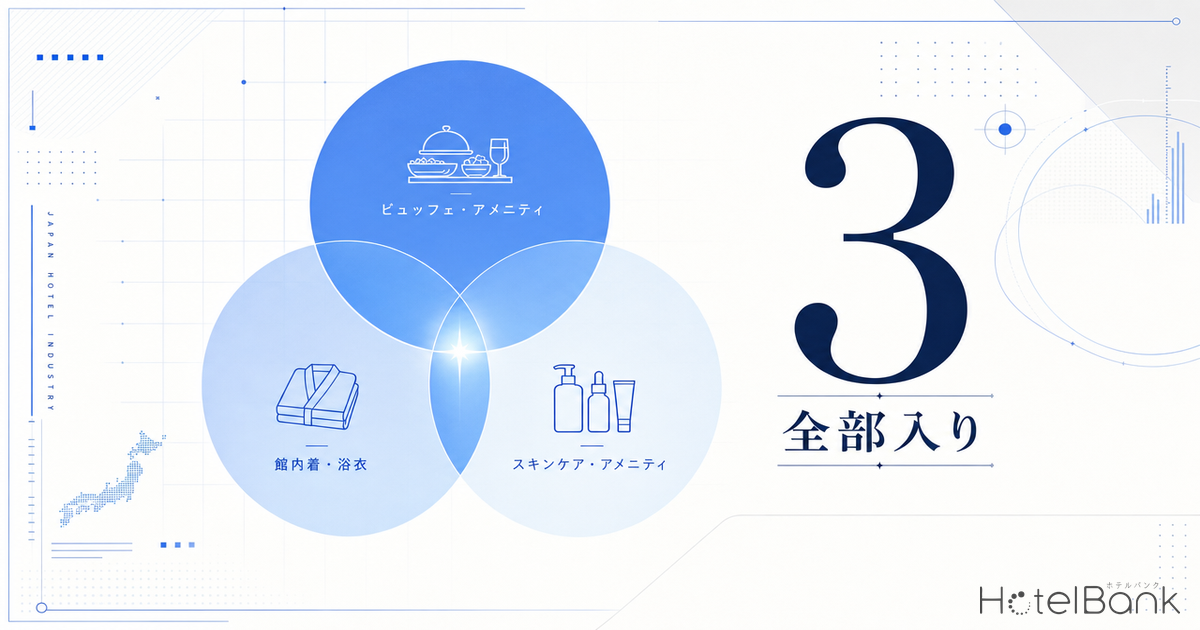
What guests expect from amenities goes well beyond “a toothbrush is provided.” A made-to-order breakfast buffet, loungewear or yukata for relaxing on premises, and skincare items down to toner and emulsion — when all three of these are simultaneously well-stocked, how are those hotels evaluated in guest reviews? In this article, we extract the top 30 properties by mention frequency across three amenity perspectives — choose-your-own breakfast buffet, loungewear/yukata, and skincare items — from NLP-analyzed “tag” data of guest reviews, and identify the “all-inclusive” hotels that rank in all three perspectives. We then overlay a review score threshold of 4.5 or higher, and stratify average ADR levels by hotel grade to read the relationship between amenity completeness and price range.
Metric Definitions Used in This Article
- Amenity mention frequency: The share of guest reviews containing content relevant to each perspective (choose-your-own breakfast buffet / loungewear / skincare items), based on NLP analysis. This is “how often mentioned,” not a star score — the two are different metrics.
- Review score: Guests’ overall rating on a 5-point scale.
- ADR (Average Daily Rate): The average of listed sale prices on OTAs and similar channels. Differs from the actual transacted price. Per-room rate for double occupancy (tax included), averaged across all plans (from room-only to plans with meals).
- Hotel grade: Stratified by ADR level (Budget through Luxury).
- Data sources: HotelBank Editorial Team research (NLP analysis) / MetroEngines Research & Consulting
- — “All-inclusive” hotels ranking in all three perspectives (breakfast buffet, loungewear, skincare) narrow down to just three properties (one each in Tokyo, Chiba, and Aichi).
- All-inclusive breadth and a review score of 4.5+ rarely coexist. The highest-rated property stops at two perspectives — a hot-spring resort at 4.63 — confirming that breadth and overall satisfaction are different themes.
- Amenity completeness is the main battleground of the budget-to-mid tier. Among the 70 qualifying properties, average ADR runs from ¥10,500 to ¥32,200, and the upper-mid tier and above have zero qualifying properties.
Extracting Top Mention Frequencies for Each of the Three Perspectives
First, for each of the three amenity perspectives, we extracted the top 30 properties by mention frequency in guest reviews. The aggregation covers a 24-month review window, and each perspective requires positive mentions with at least 8 minimum mentions per property. Combining the three perspectives, 76 unique properties (after removing duplicates) make up the 90 slots across the rankings.
For the choose-your-own breakfast buffet perspective, mentions tend to emphasize the flow from room to dining venue and the “pick what you like” experience. For the loungewear/yukata perspective, voices like “amenities are abundant, and loungewear and towels are clean every day” — directly tied to in-stay comfort — are frequent. For skincare items, comments like “the small skincare amenities with toner and emulsion are a real help — I don’t need to bring my own” praise the practical benefit of carrying less luggage. In every case, these are amenities that guests actively note as “I’m glad it was there.” For a deeper look at what specifically drives breakfast satisfaction, see our related coverage on breakfast value drivers.
Source: HotelBank Editorial Team research (NLP analysis, mention frequency among top 5 properties per perspective)
Just Three “All-Inclusive” Hotels Rank in All Three Perspectives
Cross-referencing the three top-30 lists, the “all-inclusive” properties that rank in all three perspectives narrow down to just three. Being evaluated horizontally across amenities as different in character as breakfast buffet, loungewear, and skincare signals that the property’s overall provisioning and service design extends thoroughly across the board. All three properties have large review sample sizes exceeding 5,000 reviews, giving high stability to their ratings.
| Property | Location | Review Score | Reviews | Avg. ADR | Grade |
|---|---|---|---|---|---|
| Anshin Oyado Premier Shimbashi Shiodome (安心お宿プレミア 新橋汐留店) | Tokyo | 4.38 | 5,535 | ¥12,100 | Budget |
| Grand Nikko Tokyo Bay Maihama (グランドニッコー東京ベイ 舞浜) | Chiba | 4.25 | 61,606 | ¥30,200 | Mid |
| Hotel Silk Tree Nagoya (ホテル シルク・トゥリー名古屋) | Aichi | 4.09 | 13,694 | ¥8,200 | Budget |
Source: HotelBank Editorial Team research (NLP analysis) / MetroEngines Research & Consulting
What stands out is that the grade distribution of these three properties is two Budget and one Mid. Anshin Oyado Premier Shimbashi Shiodome (180 rooms, ADR approximately ¥12,100) — a capsule-style property — still bundles large communal baths, choice amenities, and loungewear, generating high satisfaction by concentrating function into amenities. Grand Nikko Tokyo Bay Maihama (707 rooms, ADR approximately ¥30,200), a large resort hotel serving family demand, earns support for an amenity design that accompanies families closely, with comments like “you can choose what you want from the morning buffet, and allergen labeling was provided.” Hotel Silk Tree Nagoya (208 rooms, ADR approximately ¥8,200) sees heavy business and extended-stay use, with skincare and loungewear that reduce luggage lifting the comfort floor for multi-night guests.
A Different Layer Emerges When We Overlay Review Score 4.5+
Layering a “review score of 4.5 or higher” threshold changes the picture. The three all-inclusive properties scoring across all three perspectives come in at 4.38, 4.25, and 4.09 — none reaching 4.5. When we widen the field to properties common to two perspectives, however, properties exceeding 4.5 appear. The headline example is Mori to Onsen Resort Anda no Mori Izu Ippekiko (森と温泉リゾート アンダの森 伊豆いっぺき湖) — 68 rooms, ADR approximately ¥27,400. It ranks in the top tier for both breakfast buffet and loungewear, and its review score of 4.63 is the highest in this candidate group.
The breadth of “all-inclusive” and the height of a “4.5+” rating do not necessarily coexist at the same property. This indicates that expanding the variety of amenities and maximizing overall stay satisfaction are separate design themes. Anda no Mori Izu Ippekiko covers two perspectives, but the overall stay experience as a hot-spring resort is highly valued, and the “way of spending time” — relaxing in loungewear and enjoying choice in dining — shows up in its score. Comments like “a trip with my nearly 3-year-old” and “they were so delighted” suggest that the experiential value for families is the source of its high rating.
Source: HotelBank Editorial Team research (NLP analysis) / MetroEngines Research & Consulting
Lining up the review scores of the candidate properties, two groups emerge around the 4.5 line: “all-inclusive but under 4.5” and “limited in perspectives but above 4.5.” From a stay-selection standpoint, the read for readers is that those who value breadth across amenities should look at the three all-inclusive properties, while those prioritizing overall stay satisfaction should look at the 4.5+ properties. All of the properties share a posture of building on amenities as a starting point of strength — these are less “areas for improvement” than “polished individual identities.” For a deeper look at how review scores themselves are shaped along different axes, see also our coverage of Tokyo Popular Hotels: Language-Based Review Gap Analysis — How Japanese and Inbound Guests’ Evaluation Axes Differ.
Amenity Completeness Is a Battle Fought in the Budget-to-Mid Tier
Among the 76 properties appearing in the top rankings of the three perspectives, 70 with available ADR were stratified by grade, and a clear tendency emerged. Budget at 31 properties (avg. ADR approximately ¥10,500), Economy at 17 (approximately ¥19,300), and Mid at 22 (approximately ¥32,200) — almost entirely concentrated from Budget to Mid. Qualifying properties in the Upper-Mid and Luxury tiers were zero.
Source: MetroEngines Research & Consulting (N=70 properties, ADR-available subset) / HotelBank Editorial Team research
This distribution tells us that the “variety” of amenities is not the exclusive turf of the high-end tier. On the contrary, concrete, practical amenities like a choose-your-own breakfast buffet, loungewear, and skincare items are actively leveraged in the Budget-to-Mid tier as “cost-performance weapons” that lift guests’ felt satisfaction relative to the price. In the higher-tier segments, the center of review attention tends to shift to space, service, and the quality of food itself, and individual amenity mentions are less likely to climb into rankings.
Looking at average ADR by tier, the Budget level — around ¥10,500 — still lifts guests’ felt value by bundling multiple amenities. As a direction for operations seeking to maximize satisfaction within a limited room rate, this carries strong potential. At the Mid tier (avg. ¥32,200), amenity completeness combines with breakfast and resort experience, making horizontal evaluation like “all-inclusive” easier to win. For how breakfast quality maps to ADR, see Breakfast Score Analysis That Works in the Rainy Season — Grade-Specific TOP 5 and the Breakfast Premium (ADR Differential).
| Grade | Qualifying Properties | Avg. ADR | Characteristics |
|---|---|---|---|
| Budget | 31 | ¥10,500 | Function-concentrated model with rich amenities; core of value rating |
| Economy | 17 | ¥19,300 | Practical amenities work for business and extended stays |
| Mid | 22 | ¥32,200 | Wins cross-perspective evaluation by combining with breakfast and resort experience |
| Upper-Mid | 0 | — | Review focus shifts to space and service |
| Luxury | 0 | — | Food and space themselves are at the center of the rating |
Source: MetroEngines Research & Consulting (N=70 properties) / HotelBank Editorial Team research
Conclusion — Amenities Are a Differentiation Engine Within a Price Band
What emerges from looking across the three amenity perspectives is a structure in which the breadth of “all-inclusive” and the overall satisfaction of “4.5+” do not necessarily cluster at the same property. All-inclusive properties hitting all three perspectives total three (one each in Tokyo, Chiba, and Aichi). On the other hand, even with only two perspectives, a hot-spring resort that earns a review score of 4.63 also exists. As an axis for choosing a stay, this gives readers material to decide by their own priority — breadth across amenities, or overall stay satisfaction.
And what the grade stratification revealed is that amenity completeness is a differentiation engine for the Budget-to-Mid tier. From the average ¥10,500 of Budget to the ¥32,200 of Mid, concrete and practical amenities have become a powerful weapon for boosting satisfaction relative to price. In the Upper-Mid tier and above, the center of review evaluation shifts to space, service, and food — this also reflects a healthy market structure in which each price band attracts support through its own strengths. Satisfaction design built on amenities as the starting point still has room to grow, regardless of price band.
⚠ Note on ADR levels: The ADR figures in this article are averages of listed sale prices on OTAs and similar channels at the time of survey, and differ from actual transacted prices. Grade brackets are convenience-based classifications grounded in ADR levels.
Related Reading
- Breakfast Score Analysis That Works in the Rainy Season — Grade-Specific TOP 5 and the Breakfast Premium (ADR Differential)
- Tokyo Popular Hotels: Language-Based Review Gap Analysis — How Japanese and Inbound Guests’ Evaluation Axes Differ
References & Sources
■ Review & Market Data
- HotelBank Editorial Team research (NLP analysis) — Mention frequency by tag in guest reviews (24-month window, top 30 per perspective, 76 unique properties)
- MetroEngines Research & Consulting — Average ADR based on listed OTA prices (N=70 properties, ADR-available subset), grade-based stratification