

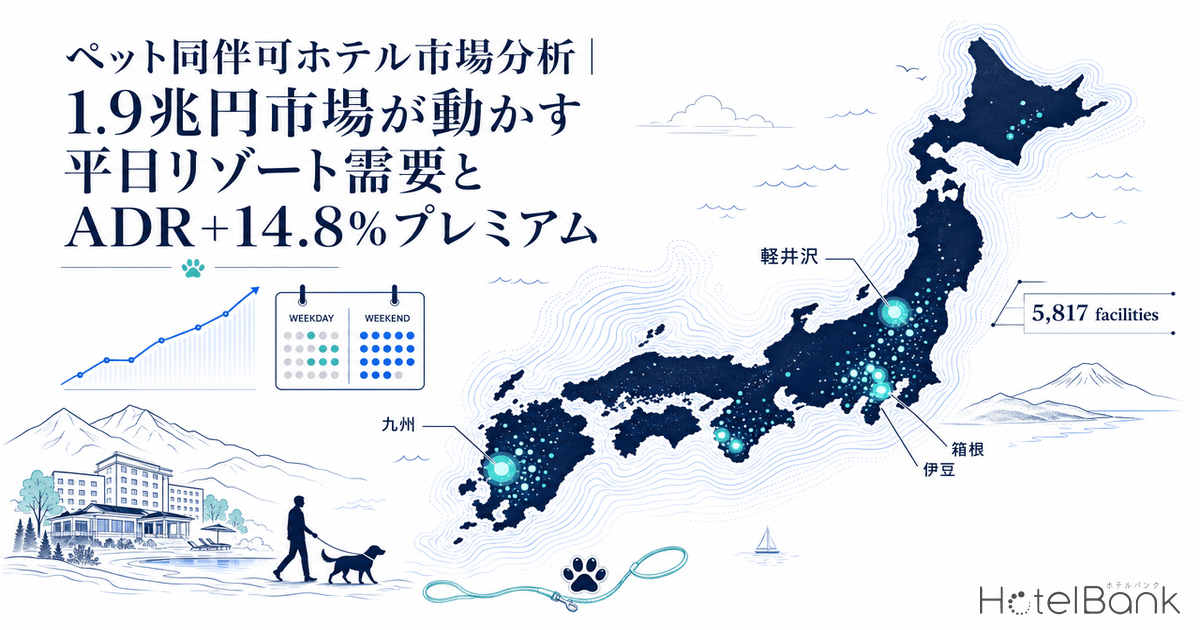
Japan’s domestic pet-related market expanded to approximately ¥1.91 trillion in FY2024 and is projected to reach approximately ¥1.93 trillion in FY2025, with the ¥2 trillion milestone now firmly in sight. The number of dogs kept as pets has also stabilized, edging from 6.796 million to approximately 6.82 million. What sets apart the hotels that are capturing this pet-friendly demand? In this article, MetroEngines Research examines 5,817 pet-friendly properties out of the 27,000 nationwide facilities it tracks, analyzing ADR, weekday/weekend composition, and penetration rates across resort areas to decode how pet-friendly hotels are becoming a key driver of weekday resort demand.
Metric Definitions Used in This Article
- ADR (Average Daily Rate): The average of listed prices published on OTAs and similar platforms. This differs from actual transacted prices. Rates are per room for double occupancy (tax included), averaged across all plans (room-only through meal-inclusive).
- Sellout Rate: The percentage of plans that had closed for booking at the time of survey. This differs from the overall room occupancy rate of a property.
- Pet-Friendly: Properties flagged with any of 10 pet-related tags — including “pets allowed,” “pet-friendly,” “pet-compatible,” “dogs welcome,” etc. — in the amenity/facility data collected by MetroEngines Research.
- Data Sources: Compiled by HotelBank Editorial Team from MetroEngines Research data
The ¥1.9 Trillion Market Today and Stabilizing Dog Ownership
According to the latest survey published by Yano Research Institute in August 2025, Japan’s total pet-related market size (retail value basis) reached ¥1.9108 trillion in FY2024 (+2.6% YoY) and is projected to hit ¥1.9257 trillion in FY2025 (+0.8% YoY). While growth is decelerating, the absolute value has increased by over ¥400 billion in ten years, making the breakthrough past the ¥2 trillion line merely a matter of time.
The growth is driven by pet food and various service sectors catering to increasingly sophisticated owner needs. The service market — encompassing grooming, veterinary care, insurance, and even funeral services — is diversifying and advancing, with accommodation naturally extending this trend. Pet hotels and lodging facilities co-located with veterinary clinics are no longer unusual, and the presence of “pet-friendly” as a keyword in the tourism and leisure sector is rapidly growing.
On the demand side, the number of dogs kept as pets stood at approximately 6.796 million according to the Japan Pet Food Association’s 2024 National Dog and Cat Ownership Survey. While this represents a slight decline from 6.844 million the previous year, the rate of decrease has clearly narrowed, showing signs of stabilization. The subsequent 2025 survey recorded approximately 6.82 million, shifting from stabilization to a slight uptick. While the structural decline in household ownership rates continues, rising average number of pets per household is providing support. The polarization of “fewer households own dogs, but those that do invest more heavily” is likely a contributing factor pushing up accommodation rates.
Source: Compiled by HotelBank Editorial Team from Yano Research Institute “Pet Business Survey (2025)” and Japan Pet Food Association “National Dog and Cat Ownership Survey”
5,817 Pet-Friendly Hotels Nationwide with ~14.8% ADR Premium
Of the approximately 33,900 active hotels tracked by MetroEngines Research, 5,817 properties — approximately 17.1% of the total — were flagged with pet-friendly tags such as “pets allowed,” “pet-friendly,” “pet-compatible,” or “dogs welcome” in their amenity and facility information. Since these flags are based on self-reporting by properties, some unlisted facilities may also accept pets under certain conditions. The figures in this article should be interpreted as representing “properties that publicly market themselves as pet-friendly.”
Aggregating approximately 4.8 million price records for check-ins between May 15–22, 2026, the average ADR for pet-friendly hotels was ¥42,800, compared to ¥37,300 for non-pet-friendly general hotels. The difference of approximately ¥5,500 translates to a premium of +14.8%. During the same period, the sellout rate was 32.5% for pet-friendly and 19.0% for general hotels, with pet-friendly properties showing 13.5 percentage points higher sales absorption. This can be read as evidence that the demand side is accepting this price range. For longitudinal trends in demand and revenue opportunities compared to an earlier survey period (when the dog population was 6.79 million), our initial analysis of the pet-friendly hotel market focusing on ADR and revenue opportunities provides the foundation, and this article serves as its sequel.
What is important here is the breakdown of pet-friendly hotels. By grade, there were 1,061 Upper-tier, 805 Luxury, and 484 High-grade properties, with mid-to-upper grades accounting for the majority. While Budget (706) and Economy (539) segments also have some supply, the volume zone lies at mid-range and above. Being pet-friendly is not simply an on/off feature of “pets allowed” — costs vary significantly depending on room specifications (carpeting, dedicated bathing facilities, dog runs) and the quality of pet amenities (bowls, pet sheets, etc.). The concentration in mid-to-upper grades likely reflects the fact that the business model of recovering investment costs through room rates works at this price range.
Source: Compiled by HotelBank Editorial Team from MetroEngines Research (check-in May 15–22, 2026, N=approx. 4.8M records, double occupancy, tax included)
Penetration and Pricing Across 5 Resort Areas: Nasu and Izu-Atami Show Notable Premiums
Next, we extracted five major resort areas — Karuizawa, Nasu, Izu-Atami, Hakone, and Niseko — for check-ins during the green season (June 1–21, 2026) and compared pet-friendly hotel penetration rates and ADR. Area definitions are: Karuizawa Town; Nasu Town, Nasushiobara City, and Nasukarasuyama City; Izu City, Izunokuni City, Higashiizu Town, Minamiizu Town, Nishiizu Town, and Atami City; Hakone Town; and Niseko Town and Kutchan Town.
Penetration rates (pet-friendly share of active properties) were: Hakone 19.6%, Niseko 17.7%, Karuizawa 16.7%, Izu-Atami 16.1%, and Nasu 7.4%. While Hakone, Niseko, Karuizawa, and Izu-Atami are at or above the national average (17.1%), Nasu registers lower, likely because new pet-friendly properties are dispersed across Tochigi Prefecture as a whole. As the table below shows, ADR also varies significantly by area.
| Resort Area | Pet-Friendly Properties | Penetration | Pet-Friendly ADR | General ADR | Premium |
|---|---|---|---|---|---|
| Hakone | 46 | 19.6% | ¥77,500 | ¥67,100 | +15.6% |
| Izu-Atami | 70 | 16.1% | ¥66,100 | ¥55,300 | +19.6% |
| Karuizawa | 20 | 16.7% | ¥65,000 | ¥62,800 | +3.5% |
| Nasu | 19 | 7.4% | ¥45,100 | ¥36,400 | +23.7% |
| Niseko | 29 | 17.7% | ¥46,700 | ¥54,100 | -13.6% |
Source: Compiled by HotelBank Editorial Team from MetroEngines Research (check-in June 1–21, 2026, N=131 pet-friendly / 595 general properties, double occupancy, tax included, all-plan average)
The standout finding is the clear premium in three areas: Nasu at +23.7%, Izu-Atami at +19.6%, and Hakone at +15.6%. These areas are 2–3 hours from central Tokyo by bullet train or expressway, with a strong family car culture, supporting robust “drive-and-stay” demand for dog owners. The supply base of Atami’s market structure is detailed in our in-depth analysis of 76 ryokan with 2,508 rooms in Atami, which also provides useful context for understanding the base on which pet-friendly demand rides. Meanwhile, Karuizawa’s surprisingly modest +3.5% can be interpreted as reflecting the area’s already-high overall ADR, which narrows the relative premium headroom.
Niseko was the only area where pet-friendly hotel ADR fell below general hotels (¥46,700 vs. ¥54,100, -13.6%). While Niseko’s ADR is strongly governed by inbound demand, the June green season sees thinner leisure demand compared to winter. High-end condominiums and foreign-branded luxury properties cannot maintain winter pricing, causing general property ADR to skew upward, while pet-friendly properties — primarily targeting domestic families — operate in a different price band. This is an interesting signal suggesting that “pet-friendly” and “high-end” do not necessarily overlap. The demand structure of Niseko and Karuizawa’s green season is also analyzed in our Summer Resort 3-Region Comparison 2026: Niseko, Okinawa & Karuizawa — ADR, Booking Pace & FX Sensitivity.
Source: Compiled by HotelBank Editorial Team from MetroEngines Research (June 1–21, 2026, double occupancy, tax included)
“Weekday Demand Savior” Test: Do Pet-Friendly Hotels Boost Weekday ADR?
One of the major challenges in resort hotel management is addressing the demand curve that skews heavily toward weekends while leaving weekdays with empty rooms. Families are constrained by school calendars, business travelers are virtually absent in resort areas, and inbound visitors are year-round but fluctuate with exchange rates and seasonal factors. Against this backdrop, is “pet-friendly” working as a catalyst for filling weekdays? To test this, we compared weekday (Monday–Friday) and weekend (Saturday–Sunday) ADR between pet-friendly and general hotels for check-ins from June 1–14, 2026.
The results show that nationally, weekday ADR was ¥39,300 for pet-friendly and ¥34,300 for general hotels. Weekend rates were ¥45,700 for pet-friendly and ¥39,700 for general. Pet-friendly hotels maintain a +14.6% premium over general hotels even on weekdays, which is nearly identical to the weekend premium (+15.1%). In other words, pet-friendly demand is characterized not by “being expensive only on weekends” but by “selling at comparable rates on weekdays as well.”
When narrowing the analysis to the five resort areas for the same period, an even clearer structure emerges. Weekday resort ADR was ¥62,800 for pet-friendly and ¥53,500 for general (premium +17.3%), while weekend rates were ¥70,700 for pet-friendly and ¥59,700 for general (+18.3%). Resort areas naturally show larger weekend premiums, but for pet-friendly properties, weekday ADR reaches the mid-¥60,000 range — a remarkable ¥9,000+ markup over general resort weekday rates. Against the typical “weekday resort” challenge of downward pricing pressure, pet-friendly demand is clearly drawing a defensive line.
The sellout rate dynamics in the chart below are even more interesting. Nationally, weekday sellout rates were 23.9% for pet-friendly and 13.6% for general (difference +10.3 pts), while weekend rates were 28.0% for pet-friendly and 16.4% for general (+11.6 pts). Approximately one in four pet-friendly hotels is restricting sales even on weekdays — a sales absorption curve distinctly different from general resort hotels that typically struggle with weekday vacancies. In resort areas specifically, pet-friendly weekday sellout rates were 17.2% and weekend 22.5%, somewhat lower than national figures but still showing a 6.6-point gap versus general resorts (weekday 15.1%, weekend 15.9%) on the weekend side. Beyond the increasing flexibility of remote work and paid leave, the likely high proportion of senior dog owners who are not constrained by children’s school schedules may be boosting off-peak sales absorption.
Source: Compiled by HotelBank Editorial Team from MetroEngines Research (check-in June 1–14, 2026, N=2,995 weekday / 3,000 weekend properties)
However, this is an observation based on national aggregation, and resort area-specific weekday ADR is treated as reference values in this article due to sample size constraints. Even so, the trend is clear: pet owners exist as a segment that relatively boosts weekday resort demand. To the ongoing debate of “is it inbound or MICE that fills weekday lulls?”, there is value in adding “pet-friendly investment” as another option to consider.
Glamping and Vacation Rentals: The Natural Fit of Whole-Unit Rentals and Pets
Looking at the pricing structure of pet-friendly hotels, beyond upper-grade properties, another significant volume zone consists of “vacation rentals,” “cottages,” and “villas.” These overlap with the rapidly growing segment of whole-unit rental properties — a category that saw 475 new openings nationwide in 2026, with a notable concentration of vacation rental formats in suburban resort areas.
Whole-unit rentals are structurally well-suited for pet accompaniment. There are no encounters with other guests in shared lobbies, corridors, or elevators, and dogs can play freely in private gardens or outdoor spaces. Capital investment is contained at the unit level, and operators can choose pet-friendliness on a property-by-property basis. Glamping facilities share this advantage — dome and glamping tent formats with minimal shared space are structurally easy to operate as pet-friendly. Indeed, reviewing 2026 new opening data reveals a series of small-scale whole-unit vacation rental openings in resort areas, including Villa Kaedekura (Tochigi), RisoVillage1 (Gifu), The Villa Kotoshiro (Shimane), Shogetsu-so Moonlight Villa (Shizuoka), and Girasole Kitakaruizawa (Gunma).
A emblematic development is “Wanwan Paradise Nara Ikoma” (formerly Kamenoi Hotel Yamato Heguri, 42 rooms), which opened on April 11, 2026 in Ikoma, Nara. This is a textbook example of rebranding an existing hot spring lodging facility into a pet-specialized property, equipping rooms with cages, pet sheets, and dedicated bowls, and providing indoor/outdoor dog runs and paw-washing stations. Its bold operational policy of no breed or head-count restrictions is designed to reliably capture large-dog and multi-pet households — a segment that has traditionally struggled to find accommodation. This rebrand, with the courage to change its core target market, represents a viable revitalization template for mid-sized hot spring hotels in regional areas.
On the high-end side, Hoshino Resorts (星野リゾート) has been expanding its dog-friendly plans nationwide, starting with KAI Kusatsu. The glamping segment has recently settled into an ADR range of ¥40,000–¥60,000, and pet-friendly whole-unit rentals naturally connect to that range. Under the common thread of pet-friendliness, rebranded mid-sized hot spring hotels, high-end resorts, and vacation rentals/glamping are gradually forming a pricing ecosystem — and that is the landscape of 2026.
2026 New Openings Spotlight: Pet-Friendly and Whole-Unit Rental Properties
Below is a summary of major properties that opened or were rebranded in 2026 — as tracked by MetroEngines Research — that either prominently feature pet-friendliness or are structurally well-suited for pet-friendly operation as whole-unit rental or small-scale villa properties.
| Opening Date | Property Name | Location | Type | Rooms |
|---|---|---|---|---|
| 2026/4/11 | Wanwan Paradise Nara Ikoma (わんわんパラダイス 奈良生駒) | Ikoma, Nara | Hot Spring Rebrand | 42 |
| 2026/4/24 | BLANC YATSUGATAKE | Yamanashi | Vacation Rental | 19 |
| 2026/4/26 | Yotei Dream One (ようていドリームワン) | Hokkaido | Vacation Rental | 6 |
| 2026/4/30 | Livemax Resort Yatsugatake Kogen (リブマックスリゾート八ヶ岳高原) | Yamanashi | Resort Hotel | 15 |
| 2026/5/11 | RisoVillage1 | Gifu | Vacation Rental | 1 |
| 2026/6/9 | Girasole Kitakaruizawa (ジラソーレ北軽井沢) | Gunma | Vacation Rental | 1 |
| 2026/6/20 | Villa Kaedekura (ヴィラ楓倉) | Tochigi (Nasu Area) | Vacation Rental | 1 |
| 2026/7/14 | M’s OceanII Uruma | Okinawa | Vacation Rental | 1 |
Source: Compiled by HotelBank Editorial Team from MetroEngines Research (extracted from 50 new 2026 openings based on pet-friendliness affinity)
The table reveals that small-scale vacation rental openings are dispersed across suburban resort areas reachable by car — Nasu, Yatsugatake, Kitakaruizawa, Hokkaido, and Okinawa. While large-scale rebrands like Wanwan Paradise Nara Ikoma serve as symbolic cases, the underlying current is one of 1-to-few-room micro-properties spreading broadly across these regions. Viewing both together, the pet-friendly market is experiencing the simultaneous progression of “headline-making flagship properties” and “long-tail supply expansion across the map” — a healthy growth phase.
Revenue Management Implications: Designing the ROI Scenario
From the data presented thus far, several revenue opportunities emerge from investing in pet-friendly conversion. First, the ADR premium is +14.8% nationally, expanding to +15–24% in top resort areas. For a resort hotel in the ¥40,000 ADR range, an additional ¥6,000–¥9,000 per night is realistically achievable. Second, the 13.5-percentage-point gap in sellout rates suggests a structure where demand exceeds supply. Pet-friendly conversion is positioned to deliver on both “rate uplift” and “accelerated sales absorption.”
Of course, investment costs are not zero. Room specification changes (carpet removal, paw-washing stations, dedicated ventilation, dog runs), ongoing costs for pet amenities, additional cleaning processes, and staffing for incident response are all involved. Nevertheless, as the supply distribution concentrated in upper grades demonstrates, the ROI logic works more easily in the ¥30,000+ ADR range. Conversely, in the sub-¥15,000 ADR range typical of business hotels, cost absorption headroom is thin, making the best approach to pet-friendly conversion one focused on either “resort + upper grade” or “whole-unit rental” formats.
As a proposal, three scenarios are envisioned. First, regional mid-sized hot spring hotels adopting a Wanwan Paradise-style rebrand strategy, switching their target from a declining legacy demand base to dog-owner households. Second, high-end resort hotels converting a portion of existing rooms (10–20%) to pet-friendly to boost weekday ADR and sales absorption. Third, new vacation rental developments built pet-friendly from the ground up, positioning dog owners as their primary customer base. Each targets different customer segments and investment scales, but all participate in the same ecosystem under the common thread of “capturing pet-friendly demand.”
Conclusion: The Next Resort Demand Wave Driven by a ¥1.9 Trillion Market
This article has presented five key findings from MetroEngines Research’s nationwide data: (1) pet-friendly hotels account for 5,817 properties, or 17.1% of all tracked facilities; (2) they command a +14.8% ADR premium and +13.5-point sellout rate premium; (3) across five resort areas, Nasu, Izu-Atami, and Hakone show significant premium differentials; (4) they maintain a +14.6% weekday premium with strong sales absorption; and (5) they show high affinity with whole-unit rentals and vacation properties, with 2026 new openings demonstrating geographic expansion.
The ¥1.9 trillion pet-related market, 6.82 million pet dogs, and the structural shift of rising average pets per household represent a trend the hotel industry cannot afford to ignore. Whether you are a weekend-heavy resort hotel, a regional hot spring hotel exploring rebranding options, or a vacation rental owner entering the market — capturing pet-friendly demand presents a realistic revenue opportunity from each of these positions. Connecting to the ¥40,000–¥60,000 price range that has been established in the glamping segment, pet-friendly hotels are also poised to become a force that pushes up the ADR floor over the next several years.
Note on Forward-Looking ADR: The ADR figures in this article represent the average of listed prices published on OTAs at the time of survey and are subject to change as check-in dates approach. Please note that prices currently set high may decline due to last-minute discounting. Additionally, pet-friendly flags are based on self-reporting by properties, so please confirm actual pet policies and conditions directly with the accommodation.
Related Articles
- Pet-Friendly Hotel Market in the Era of 6.79 Million Dogs: ADR and Revenue Opportunity Analysis
- Summer Resort 3-Region Comparison 2026: Niseko, Okinawa & Karuizawa — ADR, Booking Pace & FX Sensitivity
- Summer 2026 Hotel Market: 5-Area Comparison of ADR, Sellout Rates & YoY Trends
- Atami Ryokan Market Analysis 2026: 76 Properties, 2,508 Rooms — Market Structure and ADR Trends
- Silver Week 2026: ADR Analysis and Booking Curves for the First 9-Day Holiday in 11 Years
External References
- Yano Research Institute “Pet Business Survey (2025)”
- Japan Pet Food Association “National Dog and Cat Ownership Survey”
- Wanwan Paradise Nara Ikoma (Official)