

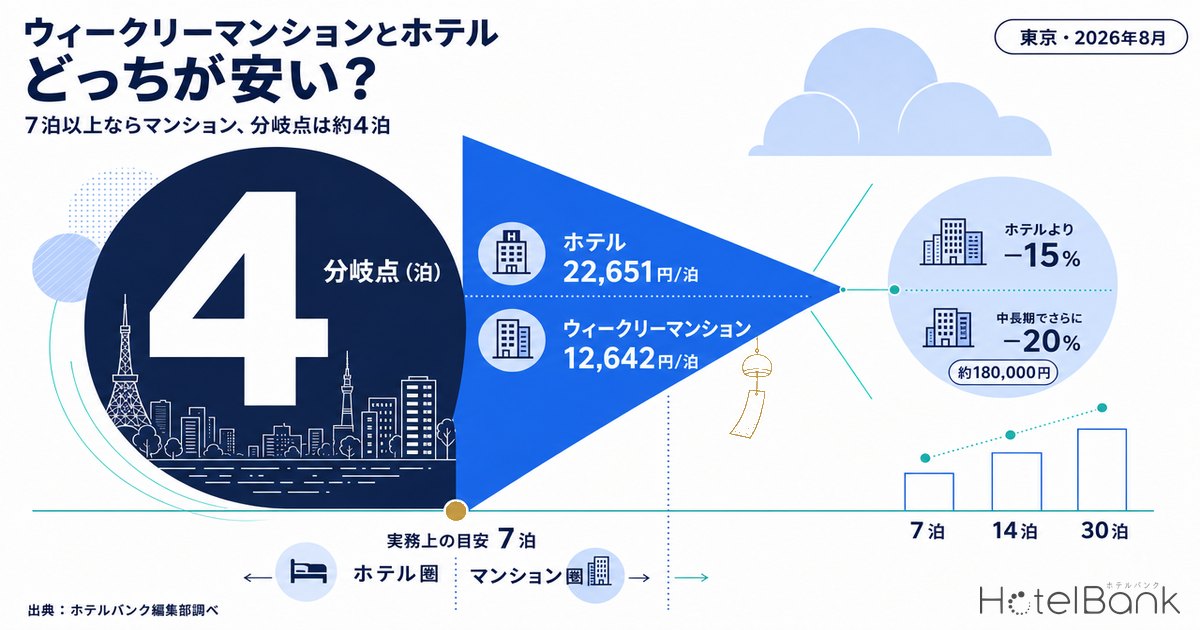
When you need somewhere to stay in Tokyo for anywhere from one week to just under a month, which is cheaper — a weekly apartment or a hotel? The short answer: on a total-cost basis, weekly apartments tend to come out cheaper from seven nights onward. Calculated from actual Tokyo hotel rates and the published fee schedules of a major weekly-apartment operator, the point where the two lines cross is about four nights. In practice, however, weekly apartments are contracted by the week, so the working rule of thumb is “six nights or fewer: hotel; seven nights or more: weekly apartment.” This article compares total costs for 7, 14 and 30 nights using data as of August 2026, and shows how the break-even point is calculated.
• Listed price = the monthly average of the selling prices each property publishes on OTAs (per room, tax included). Because higher-priced room types are also included in the denominator, it runs above what guests actually pay and should be read as an upper-bound reference.
• Estimated transacted price = an estimated per-night rate derived by applying property-type correction factors to the listed price. Cross-checked against per-property results disclosed by listed hotel REITs (184 property-months, April–May 2026), the median error is about 7.5%. It is an estimate and differs from any individual property’s actual transacted rates or accounting figures.
• All totals assume per room, tax included, accommodation cost only (for weekly apartments, the usage fee plus the cleaning fee); food, parking and other non-lodging expenses are excluded.
• Hotel prices are per-room amounts quoted for two people in one room. Because the totals assume a full room charge even for single occupancy, properties offering single-occupancy plans may come in below these figures (the hotel side is an upper-bound estimate).
• Source: HotelBank Editorial Team analysis (2,409 properties in Tokyo / stays in July 2026, aggregated 23 August 2026)
- — The calculated break-even point is about four nights. Fixed cost (¥30,000 cleaning fee) ÷ (hotel nightly rate ¥12,642 − apartment daily rate ¥5,000) = roughly 3.9 nights, at which point the totals reverse.
- — The practical threshold is seven nights. Weekly apartments are contracted by the week and most have a seven-night minimum; for a stay of just a few nights, the paperwork and move-in/move-out effort weigh relatively heavily.
- — The gap is about ¥24,000 at seven nights and about ¥200,000 at 30 nights. Tokyo totals come to roughly ¥65,000 / ¥180,000 for a weekly apartment versus roughly ¥88,500 / ¥379,300 for a hotel on an actual-rate basis.
- — Property grade moves the break-even point. For a higher-end unit in Tokyo’s five central wards (¥200,000 per month, ¥50,000 cleaning fee) it pushes out to about 8.4 nights, leaving the two roughly even at the seven-night mark.
- — Hotels win at six nights or fewer. They can be extended or shortened one night at a time and include cleaning and linen changes. Even beyond seven nights, extended-stay hotels’ long-stay plans (−15% for 7+ nights, −20% for 30+ nights) keep the total in check.
The answer: total cost at 7, 14 and 30 nights (Tokyo, per room, tax included)
The comparison uses matched assumptions. On the hotel side we take the average listed price per night across 2,409 properties in Tokyo (stays in July 2026, per room, tax included, aggregated 23 August 2026) and apply the long-stay discounts measured below — −15% for seven nights or more and −20% for 30 nights or more. We also run the same totals using the estimated average of prices actually transacted. On the weekly apartment side we use a standard model for a single-occupancy unit in a residential area of Tokyo’s 23 wards: a ¥5,000 daily usage fee including utilities, plus a ¥30,000 move-out cleaning fee and no contract handling fee. Both sides assume per room, tax included.
| Length of stay | Weekly apartment (standard model total) |
Hotel (built up from estimated actual rates) |
Hotel (listed price + long-stay discount) |
|---|---|---|---|
| 7 nights | approx. ¥65,000 | approx. ¥88,500 | approx. ¥134,800 |
| 14 nights | approx. ¥100,000 | approx. ¥177,000 | approx. ¥269,500 |
| 30 nights | approx. ¥180,000 | approx. ¥379,300 | approx. ¥543,600 |
Hotel figures apply −15% (7+ nights) and −20% (30+ nights) to the average listed price of ¥22,651 per night across 2,409 Tokyo properties (July 2026, N=2,409 properties, aggregated 23 August 2026). The actual-rate build-up uses the estimated average transacted price of ¥12,642 per night (same month, N=1,136 properties) × number of nights. The weekly apartment figures follow a standard model based on a major operator’s published fee structure (verified 26 August 2026). Source: HotelBank Editorial Team analysis.
Figure 1: Total payment by length of stay (7, 14 and 30 nights).
Even at seven nights, the weekly apartment total is about ¥24,000 lower than the hotel build-up on actual rates. At 14 nights the gap widens to roughly ¥77,000, and at 30 nights to about ¥200,000. The longer the stay, the larger the weekly apartment’s advantage. For a breakdown of what a full week in a hotel actually costs — and why moving your check-in day barely changes the total — see A Week of Hotel Living: Seven Nights in Tokyo Costs About ¥88,000.
The hotel side: actual Tokyo rates and long-stay discounts
The hotel benchmark is the monthly average of OTA listed prices (tax included, per room) across 2,409 properties in Tokyo, which came to ¥22,651 per night for stays in July 2026 (aggregated 23 August 2026). Because the listed-price average also includes higher-priced room types, prices actually transacted run below it. The estimated average transacted price for the same month was ¥12,642 per night (N=1,136 properties); that estimate was validated against 184 property-months (April–May 2026) with a median error of 7.5%. In the total-cost comparison we show both series — the listed average as an upper-bound reference and the transacted estimate as the real-world reference.
Consecutive nights bring further discounts on top of that. OTAs sell plans with explicit night-count conditions such as “7 nights or more” and “30 nights or more,” and measurements across extended-stay hotel chains put the median discount at −15% for seven nights or more and −20% for 30 nights or more (21 properties, N=5,603; and 13 properties, N=2,702; as of August 2026). A 14-night stay can also use the −15% of the 7-night-plus plans. The detail on how discounts scale by night count and where the break-even lies is collected in How Many Nights Before Hotel Long-Stay Discounts Kick In? 15% at 7 Nights, 20% at 30 Nights.
The weekly apartment side: how the pricing is structured
A weekly apartment total takes the form “daily usage fee × number of days + fixed costs.” On the official site of major operator At Inn (アットイン), the “fee system” page (verified 26 August 2026) states that the total consists of “usage fee (rent + utilities) + cleaning fee + residential insurance,” with deposits, key money, brokerage fees, guarantee fees and contract handling fees all at zero, and internet usage also at zero. Utilities being included in the daily usage fee is a feature hotels do not offer. Note that the standard model in this article builds up only the usage fee and the cleaning fee, and excludes residential insurance premiums (which vary by property and period). Including them would put the weekly apartment total slightly above the figures shown here. There is also a middle option — the “monthly hotel,” where you can stay for a month at a time without signing a lease; What Is a Monthly Hotel? A Month-Long Stay With No Lease Required sets out how its cost structure differs from the apartment format.
On market levels, the operator’s published explainer “What do monthly apartments in Tokyo cost?” (published 3 March 2026) puts the monthly rate for single-occupancy studio to 1K units at roughly ¥100,000–¥400,000 in the five central wards (Minato, Chuo, Chiyoda, Shibuya and Shinjuku), roughly ¥100,000–¥200,000 in residential areas of the 23 wards, and roughly ¥70,000–¥150,000 in the Tama area. Utilities are typically a flat charge of around ¥400–¥1,000 per day, and move-out cleaning fees generally run ¥10,000–¥50,000. The standard model in this article (¥5,000 per day, ¥30,000 cleaning fee) is based on the midpoint of the 23-ward residential range — ¥150,000 of the ¥100,000–¥200,000 monthly band — divided by 30 days. For a finer, line-item breakdown of what a one-week stay costs, see our itemised guide to weekly apartment costs for a one-week stay.
Where is the break-even point? Working it out
Because a weekly apartment carries a fixed cleaning cost, the shorter the stay, the heavier the effective per-night burden. The number of nights at which the two reverse is given by “fixed cost ÷ (hotel nightly rate − apartment daily usage fee).”
| Basis of comparison | Hotel nightly rate | Apartment daily rate | Fixed cost | Break-even |
|---|---|---|---|---|
| Estimated actual rate × standard model | ¥12,642 | ¥5,000 | ¥30,000 | approx. 3.9 nights |
| Listed price (−15% applied) × standard model | ¥19,253 | ¥5,000 | ¥30,000 | approx. 2.1 nights |
| Estimated actual rate × higher-end central unit (¥200,000 per month, ¥50,000 cleaning fee) |
¥12,642 | ¥6,667 | ¥50,000 | approx. 8.4 nights |
Break-even = fixed cost ÷ (hotel nightly rate − apartment daily rate). Beyond that number of nights, the weekly apartment total comes in lower. Source: HotelBank Editorial Team analysis (as of August 2026).
Figure 2: Cumulative total by number of nights. The weekly apartment starts higher because of the fixed cost, and the lines cross at about 3.9 nights. This is a theoretical value that sets aside the weekly-contract constraint; in reality most properties cannot be booked for six nights or fewer. The formulas are: weekly apartment = ¥5,000 × nights + ¥30,000; hotel = ¥12,642 × nights. Source: HotelBank Editorial Team analysis (as of August 2026).
Under standard assumptions the break-even point is about four nights. Measured against listed hotel prices, it reverses at just over two nights. Choose a higher-end unit in the five central wards, on the other hand, and the break-even pushes past eight nights, leaving the two roughly even at seven. In other words, “which is cheaper” moves with the grade of the property — but the data’s answer is that for a standard unit in the 23 wards it is around four nights, and on any set of assumptions the weekly apartment is clearly cheaper from 14 nights onward.
Even with a calculated break-even of four nights, though, weekly apartments are — as the name suggests — contracted by the week, and most have a one-week minimum. The contract paperwork and the move-in/move-out effort also weigh relatively heavily on a stay of only a few nights. The realistic practical threshold is seven nights.
Beyond price: which suits whom
Total cost is not the only axis; the style of your stay also decides which fits better.
Who hotels suit
People whose stay length is not yet fixed, or who are staying six nights or fewer. Hotels can be extended or shortened one night at a time and have clear cancellation terms. A stay that comes with cleaning, linen changes and breakfast suits training courses and business trips where you want to focus on work. Even beyond seven nights, choosing an extended-stay hotel with a washer-dryer and kitchenette in every room and using its long-stay plan keeps the total down while preserving the rhythm of daily life. The fastest way to identify hotels equipped for long stays is to filter on facilities and contract terms, as in 5 extended-stay hotels near major hospitals with late-night entry.
Who weekly apartments suit
People staying seven nights or more with fixed dates. Utilities are included in the daily rate, and a unit with a kitchen and washing machine compresses total living costs — including eating out and laundry. For temporary housing or long training stints in the 14- and 30-night range, the total gap runs from ¥77,000 to ¥200,000, which more than justifies the contracting effort. Once a stay stretches far enough that the comparison shifts to rent and living costs on a standard lease, the advantage swaps back again; on where that line falls, Is Hotel Living Expensive? Compared With Rent and Living Costs, the Answer Is “It Depends on How Long” tests it against listed prices across Tokyo’s 23 wards.
For a closer look
For property-by-property comparisons, these articles go deeper.
Compares five extended-stay hotels suited to consecutive-night business trips of several days to several weeks, including Tokyu Stay Suidobashi (washer-dryer and kitchenette in every room, 24-hour front desk) and Minn STATION Ai Nagoya (kitchen-equipped, keyless entry). Useful for its angle of selecting on the presence of weekly and monthly plans plus facilities outside the room.
A worked example of the “six nights or fewer: hotel” case, for short business trips and conference stays. Compares five properties on walking distance and facilities — Hilton Yokohama, where every room is 31 m² or larger, and JR-East Hotel Mets Premier Yokohama Sakuragicho, which lends out portable displays and printers — for assembling three nights from a work perspective.
Frequently asked questions
Which is cheaper, a weekly apartment or a hotel?
On a total-cost basis, weekly apartments tend to be cheaper from seven nights onward. Under standard Tokyo assumptions, seven nights costs about ¥65,000 (versus about ¥88,500 for a hotel on an actual-rate build-up) and 30 nights about ¥180,000 (versus about ¥379,300), a gap of roughly ¥24,000 at seven nights and roughly ¥200,000 at 30.
At how many nights does the price reverse?
About 3.9 nights on the calculation — fixed cost ¥30,000 ÷ (hotel nightly rate ¥12,642 − apartment daily rate ¥5,000). Measured against listed hotel prices (¥19,253 after the long-stay discount) it is about 2.1 nights; for a higher-end unit in the five central wards (¥6,667 per day, ¥50,000 cleaning fee) it is about 8.4 nights. The answer moves with the assumptions.
Why is “seven nights or more” still the rule of thumb?
Because weekly apartments are contracted by the week and most have a one-week minimum. The contract paperwork and move-in/move-out effort also weigh relatively heavily on a stay of a few nights, so even with a calculated break-even of four nights, seven is the realistic practical threshold.
What is included in a weekly apartment’s fee?
Under At Inn’s published fee system, the base charge consists of “usage fee (rent + utilities) + cleaning fee + residential insurance,” with deposits, key money, brokerage fees, guarantee fees, contract handling fees, management and common-area fees, and internet costs all stated as zero (verified 26 August 2026).
What do weekly and monthly apartments cost in Tokyo?
For single-occupancy studio to 1K units, monthly rates are cited at roughly ¥100,000–¥400,000 in the five central wards (Minato, Chuo, Chiyoda, Shibuya and Shinjuku), roughly ¥100,000–¥200,000 in residential areas of the 23 wards, and roughly ¥70,000–¥150,000 in the Tama area. Utilities are typically a flat charge of around ¥400–¥1,000 per day, and move-out cleaning fees commonly run ¥10,000–¥50,000 (per an explainer published 3 March 2026).
How much do hotel long-stay discounts actually save?
Measured across plans with explicit night-count conditions, the median discount was −15% for seven nights or more and −20% for 30 nights or more (21 properties, N=5,603; and 13 properties, N=2,702; as of August 2026). A 14-night stay can also use the −15% of the 7-night-plus plans.
References and sources
■ Data sources
Hotel prices are from HotelBank Editorial Team analysis aggregating OTA listed prices in Tokyo (stays in July 2026, N=2,409 properties / estimated transacted price N=1,136 properties, aggregated 23 August 2026, per room, tax included, based on quotes for two people in one room). Long-stay discount rates are measured from the sales plans of extended-stay hotel chains (7+ nights: 21 properties, N=5,603 / 30+ nights: 13 properties, N=2,702; as of August 2026). Weekly apartment figures come from published materials of operator At Inn (fee system / verified 26 August 2026; What do monthly apartments in Tokyo cost? / published 3 March 2026).
■ Calculation assumptions
The weekly apartment standard model is a single-occupancy unit in a residential area of the 23 wards: a ¥5,000 daily usage fee (the ¥150,000 midpoint of the ¥100,000–¥200,000 monthly band ÷ 30 days, utilities included) plus a ¥30,000 move-out cleaning fee (the midpoint of the typical ¥10,000–¥50,000 range). The higher-end central unit is ¥6,667 per day (¥200,000 per month ÷ 30 days) plus a ¥50,000 cleaning fee. The hotel side shows two series side by side: the listed price of ¥22,651 per night with −15% (7+ nights) and −20% (30+ nights) applied, and the estimated transacted price of ¥12,642 per night built up as is. Break-even = fixed cost ÷ (hotel nightly rate − apartment daily rate). Amounts are tax included and cover accommodation only; food, parking and other non-lodging expenses are excluded.
■ Limitations and caveats
(1) Hotel prices are per-room amounts quoted for two people in one room; at properties offering single-occupancy plans, the amount actually paid may be lower (the hotel side is an upper-bound estimate). (2) The estimated transacted price is an estimate validated against per-property disclosures by listed hotel REITs with a median error of about 7.5% (184 property-months, April–May 2026); it differs from any individual property’s actual transacted rates or accounting figures. (3) The weekly apartment standard model builds up only the usage fee and cleaning fee and excludes residential insurance; including it would put the total slightly above the figures here. (4) Market levels, cleaning fees and utility charges are representative values based on the published ranges of a single operator, and actual amounts vary by property. (5) The calculated break-even is a theoretical value that sets aside the commercial constraint of weekly contracting. (6) Listed prices are monthly averages, so swings between peak and off-peak periods are smoothed out.
Related reading
- A Week of Hotel Living: Seven Nights in Tokyo Costs About ¥88,000 — Changing Your Start Day Barely Moves the Total
- What Is a Monthly Hotel? A Month-Long Stay With No Lease Required — How It Differs From a Monthly Apartment, and What It Costs
- Is Hotel Living Expensive? Compared With Rent and Living Costs, the Answer Is “It Depends on How Long” — Tested Against Listed Prices in Tokyo’s 23 Wards
- Choosing a Business Hotel for a Long Stay: Six Criteria — Tokyo’s Listed Price Is ¥16,722 per Night, Plus Three Ways to Cut Costs
- How Many Nights Before Hotel Long-Stay Discounts Kick In? 15% at 7 Nights, 20% at 30 Nights
- Six Downsides of Hotel Living and How to Handle Them — 30 Nights Costs About ¥500,000
- What Does Two Weeks of Hotel Living Cost? Measured Consecutive-Night Prices and How to Bring Them Down
- How Cheap Can a Month of Hotel Living Get? Measured Costs and How to Pick the Lowest Option