

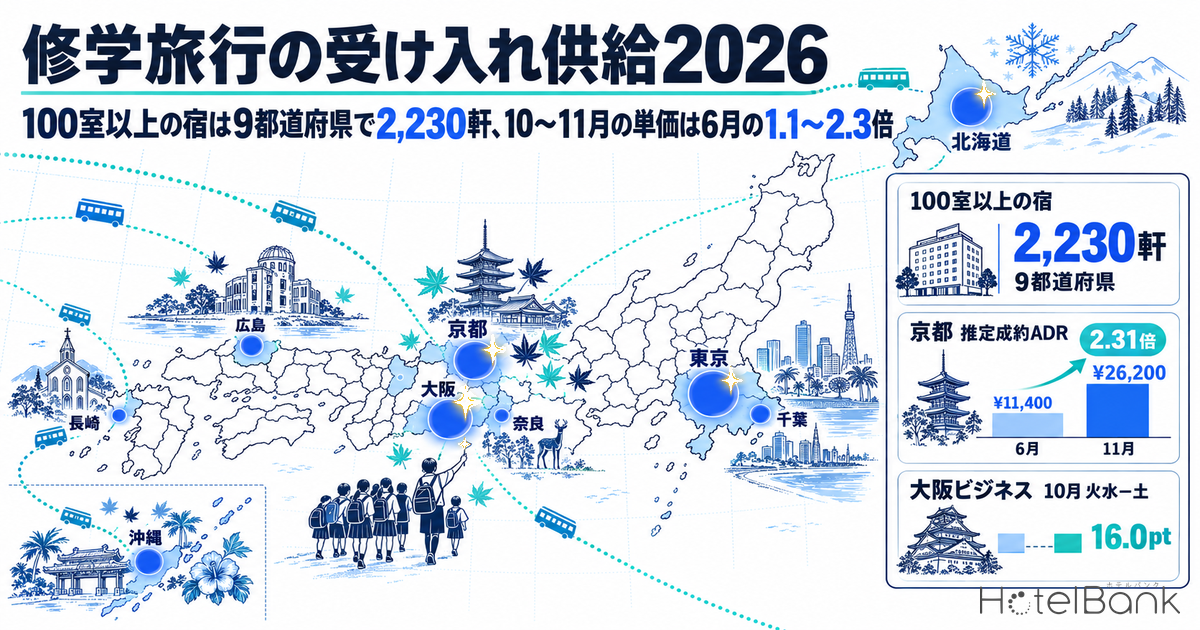
School trip lodging is demand that moves in large blocks on weekdays in October and November. In December 2024, Japan’s Ministry of Education, Culture, Sports, Science and Technology (MEXT) asked boards of education nationwide to consider more flexible trip timing, citing growing difficulty in securing chartered buses and accommodation. This article covers the nine main destination prefectures — Kyoto, Nara, Osaka, Tokyo, Chiba, Okinawa, Hiroshima, Nagasaki and Hokkaido — and counts, from the perspective of hotel operators and local governments: (1) the gap in estimated settled ADR between peak and off-peak periods, (2) how many properties in each prefecture are large enough to house a school group of 200–300 students under one roof, and (3) how much room for school groups remains, as seen in the weekday-versus-weekend difference in inventory sell-through.
Metric Definitions Used in This Article
- ADR (Average Daily Rate): An estimated settled rate (tax-exclusive equivalent), calculated by applying segment-specific adjustment factors to the lowest-plan rate each property publishes on OTAs (per room, double occupancy, tax-inclusive). Checked against property-level results disclosed by listed hotel REITs (184 property-months, April–May 2026), the median error is about 7.5%. These are estimates and differ from each property’s actual transaction prices and accounting figures. Area-level ADR is the median of the properties covered (the level of a typical property in the area). Values for October 2026 onward are estimates based on rates listed as of the survey date (September 30, 2026).
- OCC (Occupancy Rate): Rooms sold as a share of total rooms in the area (an estimate based on OTA inventory; consistency checks against REIT monthly disclosures show accuracy within a few points). As an estimate based on the sell-through of inventory offered on OTAs, it differs from a property’s actual overall occupancy. In this article, weekday means check-in dates Monday–Thursday and weekend means Friday–Saturday.
- LT (Lead Time): Days until check-in. LT0 = same day. Booking curves in this article use only observation points within LT45.
- Supply universe: 12,669 properties with 672,099 rooms in the nine prefectures that are listed on major OTAs and had selling rates observable for the first week of October 2026 (the scope tracked by MetroEngines Research; not a full census — ryokan, minshuku and youth facilities not listed on OTAs are excluded).
- Data sources: MetroEngines Research (rates and inventory); Japan School Tour Bureau (JSTB, trip timing and costs); MEXT, the Ministry of Land, Infrastructure, Transport and Tourism (MLIT) and the Japan Tourism Agency (notices and leaflet)
- — 2,230 properties with 100+ rooms (495,833 rooms) across the nine prefectures. This is the supply that can roughly house a 300-student school in a single property: Tokyo 722, Osaka 437, Hokkaido 347, Kyoto 211. Nara has only 24 and Nagasaki 59, so planning that also counts 50–99-room properties (1,109 in total), suited to groups of around 200, matters there.
- — Peak-season rates reach up to 2.3x June levels. October runs 1.1–1.9x June and November 1.0–2.3x. Kyoto’s estimated settled ADR is ¥11,400 in June versus ¥21,300 in October and ¥26,200 in November. Okinawa and Hokkaido show small gaps and can absorb demand that cannot be accommodated in autumn.
- — 64.4% in October–December: In JSTB’s FY2024 survey, 679 of 1,054 domestic high school trips took place in October–December. In a notice dated December 12, 2024, MEXT called for more flexible timing and identified accommodation’s off-peak periods as “December–March, Sundays and Mondays.”
- — Weekday room for school groups is deepest in business/city hotels in Osaka, Chiba and Hokkaido. In the interim figures for October check-ins (LT3–31), Osaka business hotels are at 65.6% on Tuesdays/Wednesdays versus 81.6% on Saturdays — a 16.0pt gap. Kyoto is at 86.5% even on weekdays, pointing to scope for shifting autumn Kyoto demand to neighboring prefectures.
MEXT’s Request and the Latest Survey — Trips Concentrate in October–December, Costs Up 1.1x in Five Years
The starting point is a MEXT notice dated December 12, 2024, “On Flexible Consideration of the Timing of School Trips” (6 Ukesho Jisei No. 19). Following a request from MLIT’s Passenger Transport Division (Road Transport Bureau) and the Japan Tourism Agency’s Tourism Industry Division (administrative notice of November 28, 2024), it asked prefectural and designated-city boards of education to consider flexible trip timing in light of local conditions, noting that chartered buses and accommodation have become hard to arrange, especially in the periods when school trips concentrate. The attached leaflet identifies relatively quiet periods for chartered buses as “July–August and December–April; Sundays, Mondays and Saturdays” and for accommodation as “December–March; Sundays and Mondays” (accommodation based on the Japan Tourism Agency’s Overnight Travel Statistics Survey, FY2023 results; buses based on a September 2024 survey by the Nihon Bus Association). The leaflet also cites a Nihon Bus Association estimate that the number of bus drivers will fall to 98,000 by FY2028, 22,000 short of the 120,000 required.
The latest primary source on the demand side is JSTB’s “Domestic School Trips Conducted in FY2024: Survey Summary (High Schools) — Preliminary Edition,” published in November 2025. Of 4,774 high schools nationwide, 3,200 were sampled and 1,076 responded (33.6% response rate). 961 schools (89.3%) traveled domestically and 98 (9.1%) overseas; overseas trips doubled from 47 schools (4.2%) in the previous survey. By timing, there were 238 trips in October, 211 in November and 230 in December — these three months alone account for 64.4% of all 1,054 trips. By school type, October saw 164 trips by public schools versus 74 by private schools, so public schools form the autumn peak, while in February (24 public, 43 private) and March (9 and 49) private schools dominate. In other words, the winter periods proposed for dispersion are already being used, ahead of others, by private schools.
Source: Compiled by the HotelBank Editorial Team from JSTB, “Domestic School Trips Conducted in FY2024: Survey Summary (High Schools) — Preliminary Edition” (N=1,054 trips)
Destinations cluster in the Kansai region, Okinawa and the Tokyo metropolitan area. By destination prefecture (2,179 total, multiple counting), the order is Osaka 290 (13.3%), Okinawa 273 (12.5%), Kyoto 230 (10.6%), Tokyo 220 (10.1%), Chiba 187 (8.6%), Hokkaido 132 (6.1%), Hyogo 123, Hiroshima 112, Nara 102, Kanagawa 82 and Nagasaki 71 — the nine prefectures covered here account for nine of the top 11. Compared with FY2023, Okinawa fell from 303 (12.8%) to 273 and Osaka took first place. In a January 2025 contribution, JSTB’s chairman noted that Okinawa expected an 11.1% year-on-year decline in school trip visitors in FY2025, and that schools are being forced to consider changing destinations or cutting the number of nights to contain costs.
| Fiscal year | Total | Transport | Accommodation | Activities | Other |
|---|---|---|---|---|---|
| 2019 | ¥102,737 | ¥50,833 | ¥30,412 | ¥7,405 | ¥13,271 |
| 2022 | ¥105,333 | ¥48,299 | ¥33,460 | ¥7,679 | ¥14,705 |
| 2023 | ¥110,707 | ¥51,080 | ¥33,617 | ¥9,844 | ¥13,937 |
| 2024 | ¥114,623 | ¥53,244 | ¥34,398 | ¥10,586 | ¥13,629 |
| 2019→2024 | +11.6% | +4.7% | +13.1% | +43.0% | +2.7% |
Source: Compiled by the HotelBank Editorial Team from JSTB preliminary edition, “Travel Costs (Average for Public and Private High Schools).” The total and each component are averaged separately, so the components do not sum to the total
In FY2024 the total cost per student was ¥114,623, of which accommodation was ¥34,398 (30.0%). Versus FY2019, the total is up 11.6% and accommodation up 13.1%, but the largest increase is in hands-on activity costs (+43.0%) — schools’ budgets are shifting from “what is paid to the hotel” toward “the substance of learning.” Since the accommodation cost is the total for the whole itinerary, it works out to about ¥17,200 per student per night for a 3-day/2-night trip and about ¥11,500 for 4 days/3 nights. These figures are school-side payments that include meals and arrangement fees, so note that the basis differs from this article’s estimated settled ADR (lowest room-only rate, double occupancy, tax-exclusive equivalent). Still, placing the two numbers side by side reveals the outline of the demand: “a budget in the low ¥10,000s per night, 3–4 students per room, filling around 100 rooms in one property on weekdays.”
The Rate Gap — Estimated Settled ADR in Nine Prefectures: October–November Up to 2.3x June
Next, we compare how much hotel rates differ between peak and off-peak periods, using MetroEngines Research’s estimated settled ADR (prefecture median) from February 2026 to January 2027. Figures through August 2026 are finalized history; September onward are estimates based on rates listed as of the survey date (September 30, 2026).
Source: MetroEngines Research; compiled by the HotelBank Editorial Team
| Prefecture | Feb | Mar | Jun | Sep | Oct | Nov | Dec | Jan | Oct ÷ Jun | Nov ÷ Jun |
|---|---|---|---|---|---|---|---|---|---|---|
| Kyoto N=592 | ¥12,892 | ¥20,273 | ¥11,362 | ¥13,243 | ¥21,256 | ¥26,191 | ¥17,334 | ¥13,628 | 1.87x | 2.31x |
| Nara N=134 | ¥12,094 | ¥13,276 | ¥9,803 | ¥12,336 | ¥15,015 | ¥17,883 | ¥14,472 | ¥14,046 | 1.53x | 1.82x |
| Osaka N=643 | ¥8,690 | ¥9,646 | ¥8,070 | ¥8,716 | ¥11,135 | ¥11,403 | ¥10,738 | ¥10,126 | 1.38x | 1.41x |
| Tokyo N=1,104 | ¥13,855 | ¥15,895 | ¥12,146 | ¥13,718 | ¥19,048 | ¥18,809 | ¥17,491 | ¥13,663 | 1.57x | 1.55x |
| Chiba N=412 | ¥9,743 | ¥10,166 | ¥8,995 | ¥11,254 | ¥11,950 | ¥11,986 | ¥12,298 | ¥12,034 | 1.33x | 1.33x |
| Okinawa N=507 | ¥13,596 | ¥11,736 | ¥11,373 | ¥11,771 | ¥12,731 | ¥11,254 | ¥11,702 | ¥11,186 | 1.12x | 0.99x |
| Hiroshima N=286 | ¥7,746 | ¥8,311 | ¥7,625 | ¥11,907 | ¥12,475 | ¥12,415 | ¥10,426 | ¥10,288 | 1.64x | 1.63x |
| Nagasaki N=252 | ¥8,290 | ¥7,531 | ¥7,122 | ¥10,030 | ¥11,665 | ¥11,207 | ¥11,041 | ¥10,452 | 1.64x | 1.57x |
| Hokkaido N=898 | ¥10,598 | ¥8,646 | ¥10,334 | ¥12,857 | ¥12,370 | ¥11,113 | ¥12,484 | ¥13,085 | 1.20x | 1.08x |
Source: MetroEngines Research; compiled by the HotelBank Editorial Team (estimated settled ADR, prefecture median, tax-exclusive equivalent. February–August 2026 are finalized; September 2026–January 2027 are estimates based on rates listed as of September 30, 2026. N is the number of properties covered in October)
The size of the gap varies widely by prefecture. Kyoto goes from ¥11,400 in June to ¥21,300 in October (1.87x) and ¥26,200 in November (2.31x), as school trips coincide with the period when autumn-foliage demand pushes up leisure rates (the price floor that groups create on autumn weekdays is covered in Autumn School Trips: Weekday Rate Floors in 5 Areas). Tokyo (1.57x in October), Hiroshima (1.64x), Nagasaki (1.64x) and Nara (1.53x) also exceed 1.5x. By contrast, the gaps are small in Okinawa (1.12x in October, 0.99x in November), Hokkaido (1.20x and 1.08x) and Chiba (1.33x). Okinawa and Hokkaido peak in summer and are relatively calm in autumn; the absence of a rate peak when high school autumn trips concentrate means hotels taking groups there give up less high-rate leisure business in autumn.
February–March and June — Windows Where Group Budgets and Regular Rates Converge
Conversely, in February–March rates sit at 60–80% of October levels: in February, Kyoto ¥12,900, Nara ¥12,100, Osaka ¥8,700, Tokyo ¥13,900, Hiroshima ¥7,700 and Nagasaki ¥8,300. The “December–March” period that the MEXT leaflet identifies as accommodation’s off-peak is also when school trip budgets (low ¥10,000s per night) and regular hotel rates come closest. In March, Kyoto alone has already climbed to ¥20,300 with spring break and the run-up to cherry blossom season, so for Kyoto the window closes in February. June is near the annual low in all nine prefectures — Kyoto ¥11,400, Nara ¥9,800, Osaka ¥8,100, Hiroshima ¥7,600, Nagasaki ¥7,100 — and as the latter half of junior high schools’ spring trip season (May–June), June is also a month in which private high schools ran 31 trips.
Supply — 2,230 Properties with 100+ Rooms Can House a 300-Student School Under One Roof
To house a school trip in a single property, 200–300 students plus about ten teachers must stay in the same building. Typical allocations are 3–4 students per room in hotels (twin plus extra bed, or triple) and 4–6 per room in ryokan (Japanese-style rooms), so a 200-student group fills 50–70 rooms and a 300-student group 75–100 rooms with students alone. To take groups while keeping some rooms for general guests, the rule of thumb is 100+ rooms for 300 students and 50+ rooms for 200. On this basis, we counted by room-count band the 12,669 properties in the nine prefectures that are listed on major OTAs and had selling rates observable for the first week of October 2026.
| Prefecture | 300+ rooms | 150–299 rooms | 100–149 rooms | 50–99 rooms | <50 rooms | 100+ rooms total | All |
|---|---|---|---|---|---|---|---|
| Kyoto | 24 hotels 9,939 rooms | 102 hotels 20,129 rooms | 85 hotels 10,339 rooms | 116 hotels 8,367 rooms | 1,808 hotels 15,217 rooms | 211 hotels 40,407 rooms | 2,135 hotels 63,991 rooms |
| Nara | 1 hotels 330 rooms | 13 hotels 2,629 rooms | 10 hotels 1,313 rooms | 13 hotels 1,033 rooms | 284 hotels 3,322 rooms | 24 hotels 4,272 rooms | 321 hotels 8,627 rooms |
| Osaka | 99 hotels 46,277 rooms | 212 hotels 43,633 rooms | 126 hotels 15,213 rooms | 165 hotels 11,334 rooms | 629 hotels 10,003 rooms | 437 hotels 105,123 rooms | 1,231 hotels 126,460 rooms |
| Tokyo | 112 hotels 60,855 rooms | 361 hotels 72,852 rooms | 249 hotels 30,833 rooms | 298 hotels 21,642 rooms | 1,330 hotels 17,372 rooms | 722 hotels 164,540 rooms | 2,350 hotels 203,554 rooms |
| Chiba | 38 hotels 22,317 rooms | 62 hotels 12,531 rooms | 53 hotels 6,430 rooms | 75 hotels 5,778 rooms | 896 hotels 8,265 rooms | 153 hotels 41,278 rooms | 1,124 hotels 55,321 rooms |
| Okinawa | 35 hotels 13,353 rooms | 80 hotels 16,616 rooms | 63 hotels 7,732 rooms | 113 hotels 8,246 rooms | 1,895 hotels 14,208 rooms | 178 hotels 37,701 rooms | 2,186 hotels 60,155 rooms |
| Hiroshima | 9 hotels 4,022 rooms | 58 hotels 12,154 rooms | 32 hotels 3,899 rooms | 62 hotels 4,317 rooms | 468 hotels 5,866 rooms | 99 hotels 20,075 rooms | 629 hotels 30,258 rooms |
| Nagasaki | 4 hotels 1,425 rooms | 39 hotels 7,402 rooms | 16 hotels 1,888 rooms | 68 hotels 5,105 rooms | 415 hotels 5,002 rooms | 59 hotels 10,715 rooms | 542 hotels 20,822 rooms |
| Hokkaido | 50 hotels 20,337 rooms | 190 hotels 38,440 rooms | 107 hotels 12,945 rooms | 199 hotels 14,099 rooms | 1,605 hotels 17,090 rooms | 347 hotels 71,722 rooms | 2,151 hotels 102,911 rooms |
| 9-prefecture total | 372 hotels 178,855 rooms | 1,117 hotels 226,386 rooms | 741 hotels 90,592 rooms | 1,109 hotels 79,921 rooms | 9,330 hotels 96,345 rooms | 2,230 hotels 495,833 rooms | 12,669 hotels 672,099 rooms |
Source: MetroEngines Research; compiled by the HotelBank Editorial Team (properties listed on major OTAs with selling rates observable for October 1–7, 2026. Room counts are as registered in the property master, N=12,669 properties)
There are 2,230 properties with 100+ rooms (495,833 rooms) across the nine prefectures: Tokyo 722 (164,540 rooms), Osaka 437 (105,123), Hokkaido 347 (71,722), Kyoto 211 (40,407), Okinawa 178 (37,701) and Chiba 153 (41,278), followed by Hiroshima 99, Nagasaki 59 and Nara 24. Set against each prefecture’s share of school trip destinations, the gaps stand out. Nara is the 9th most popular destination for high schools (102 trips) and was the 2nd for junior high schools in FY2023 at 18.7%, yet it has only 24 properties with 100+ rooms and just one with 300+. Nara is established as a “pass-through” destination visited on day trips from hotels in Kyoto or Osaka; rather than adding in-prefecture supply, it is more realistic to plan around “split lodging” that includes 50–99-room properties (13) able to take a 200-student group split across buildings, together with partnerships with hotels in Kyoto and Osaka.
Nagasaki has the same structure: 59 properties with 100+ rooms, but 68 with 50–99 rooms, for 127 in total. Nagasaki ranks alongside Hiroshima as a destination for peace education (the 2nd most common focus activity for high schools, 387 trips), but with 60% of Hiroshima’s 99 properties of 100+ rooms, the practical premise is to split a 200-student school across two properties or combine it with surrounding areas such as Sasebo, Unzen and Shimabara. Tokyo, Osaka and Hokkaido, on the other hand, have 300–700 properties with 100+ rooms each — enough depth to take multiple schools on the same day even during the autumn peak.
Source: MetroEngines Research; compiled by the HotelBank Editorial Team (breakdown of properties with 100+ rooms by category, N=2,230 properties)
By category, nearly all properties with 100+ rooms are business and city hotels; ryokan total fewer than 50 (Hokkaido 29, Nagasaki 5, Kyoto 3, Chiba 3, etc.). Of Kyoto’s 211 properties with 100+ rooms, 143 are business hotels, 43 city hotels and only 3 ryokan. The large ryokan that were the traditional home of school trips barely exist in Kyoto, at least on the basis of major OTA listings, and supply for “one-building” group stays has effectively shifted to hotels. Okinawa’s mix is different — 88 resort and 71 business hotels — with resort hotels as the main group venues. Hokkaido has all four types (192 business, 58 city, 54 resort, 29 ryokan), giving schools a choice of formats as a winter alternative.
Day of Week and Weekday Room — Interim Figures for October Check-ins and the Weekday Gap in June and September
September 2026 (Finalized) and June — Weekday vs. Weekend Sell-through
Where demand that cannot be accommodated at the peak can be shifted becomes clear from weekday sell-through. First, for the most recent finalized month, we compare estimated weekday (Mon–Thu) and weekend (Fri–Sat) OCC by category for September 2026 (fixed cohort, within LT45). June values are shown alongside.
| Prefecture | Category | Sample | Sep weekday | Sep weekend | Weekday − weekend | Jun weekday / weekend |
|---|---|---|---|---|---|---|
| Kyoto | Business | 190 hotels / 19,644 rooms | 84.2% | 87.5% | -3.3pt | 81.5% / 88.0% |
| Kyoto | City | 36 hotels / 5,050 rooms | 84.5% | 87.4% | -2.9pt | 82.1% / 88.6% |
| Kyoto | Ryokan | 81 hotels / 1,554 rooms | 85.2% | 86.5% | -1.2pt | 80.4% / 88.7% |
| Nara | Business | 22 hotels / 2,613 rooms | 79.5% | 86.0% | -6.5pt | 73.7% / 84.8% |
| Nara | Ryokan | 39 hotels / 886 rooms | 84.2% | 88.8% | -4.6pt | 79.9% / 86.0% |
| Osaka | Business | 285 hotels / 47,820 rooms | 79.8% | 82.3% | -2.5pt | 76.3% / 84.1% |
| Osaka | City | 34 hotels / 7,905 rooms | 80.4% | 86.0% | -5.5pt | 77.5% / 86.3% |
| Osaka | Ryokan | 21 hotels / 417 rooms | 80.3% | 84.5% | -4.2pt | 74.2% / 85.4% |
| Tokyo | Business | 539 hotels / 78,439 rooms | 90.7% | 90.1% | +0.6pt | 91.0% / 93.5% |
| Tokyo | City | 54 hotels / 17,294 rooms | 89.9% | 90.9% | -1.0pt | 89.2% / 94.0% |
| Tokyo | Resort | 12 hotels / 1,024 rooms | 83.7% | 89.7% | -6.0pt | 82.6% / 90.9% |
| Tokyo | Ryokan | 19 hotels / 561 rooms | 90.2% | 95.6% | -5.5pt | 80.9% / 94.0% |
| Chiba | Business | 85 hotels / 10,199 rooms | 85.1% | 86.8% | -1.6pt | 87.5% / 88.9% |
| Chiba | City | 24 hotels / 7,297 rooms | 85.1% | 90.2% | -5.0pt | 80.9% / 86.7% |
| Chiba | Resort | 35 hotels / 2,806 rooms | 79.2% | 83.6% | -4.4pt | 76.3% / 88.0% |
| Chiba | Ryokan | 60 hotels / 1,662 rooms | 69.3% | 75.1% | -5.7pt | 64.4% / 78.5% |
| Okinawa | Business | 134 hotels / 12,582 rooms | 86.0% | 89.0% | -3.0pt | 84.2% / 90.1% |
| Okinawa | Resort | 182 hotels / 16,530 rooms | 86.8% | 89.3% | -2.6pt | 85.4% / 89.0% |
| Hiroshima | Business | 93 hotels / 11,030 rooms | 92.4% | 87.8% | +4.6pt | 83.5% / 86.3% |
| Hiroshima | City | 14 hotels / 1,662 rooms | 90.1% | 87.8% | +2.2pt | 77.7% / 85.7% |
| Hiroshima | Ryokan | 38 hotels / 978 rooms | 87.0% | 85.1% | +2.0pt | 79.0% / 85.8% |
| Nagasaki | Business | 57 hotels / 4,752 rooms | 80.8% | 78.0% | +2.8pt | 79.2% / 77.2% |
| Nagasaki | City | 15 hotels / 1,483 rooms | 80.1% | 85.9% | -5.7pt | 78.8% / 82.5% |
| Nagasaki | Resort | 28 hotels / 2,239 rooms | 74.6% | 79.4% | -4.9pt | 68.9% / 77.4% |
| Nagasaki | Ryokan | 40 hotels / 1,513 rooms | 67.4% | 71.2% | -3.8pt | 61.6% / 74.3% |
| Hokkaido | Business | 222 hotels / 25,913 rooms | 93.8% | 92.8% | +1.0pt | 89.2% / 90.7% |
| Hokkaido | City | 35 hotels / 8,550 rooms | 91.4% | 89.9% | +1.5pt | 87.6% / 90.3% |
| Hokkaido | Resort | 84 hotels / 9,065 rooms | 85.4% | 85.7% | -0.3pt | 76.4% / 84.4% |
| Hokkaido | Ryokan | 164 hotels / 7,210 rooms | 87.3% | 89.9% | -2.6pt | 80.3% / 86.2% |
Source: MetroEngines Research; compiled by the HotelBank Editorial Team (estimated OCC based on OTA-listed inventory; fixed cohort of properties listing at least 30% of total rooms on OTAs; only segments with 10+ properties shown. Weekday = Mon–Thu and weekend = Fri–Sat check-in dates, daily averages)
In September the weekday–weekend gap was small in all nine prefectures, and in Hokkaido and Hiroshima business hotels sold more on weekdays than on weekends — a month in which autumn leisure and business travel fill weekdays. Gaps remained for ryokan in Chiba (weekday 69.3%, weekend 75.1%), resorts in Nagasaki (74.6%, 79.4%) and city hotels in Osaka (80.4%, 86.0%). Going back to June, there was roughly 10pt of weekday room at business hotels in Nara (73.7%, 84.8%) and Osaka (76.3%, 84.1%), resorts in Chiba (76.3%, 88.0%) and Hokkaido (76.4%, 84.4%), and ryokan in Nagasaki (61.6%, 74.3%). Since June rates are also near the annual low, proposing to extend junior high schools’ spring trip season into late June suits both hotels and schools. A rate comparison of business hotels as June alternatives is explored in School Trip Timing Dispersion vs Hotel Price Surge: June 2026 Alternative Business Hotel ADR.
Interim Figures for October and November — Tuesday/Wednesday vs. Saturday
Next are the upcoming months of October and November. October check-in dates are already at LT3–31, so comparing sell-through on Tuesdays/Wednesdays with Saturdays shows how much weekday room remains during the peak. November figures are interim at LT35–45, with bookings still to build, so read them only as “how much is left at this point.”
Source: MetroEngines Research; compiled by the HotelBank Editorial Team (business hotels; eight Tuesdays/Wednesdays and five Saturdays in October 2026; latest observation point for each date = LT3–31, as of September 30, 2026)
| Prefecture | Category | Sample | Oct Tue/Wed | Oct Sat | Gap | Nov Tue/Wed (LT35–45) | Nov Sat (LT35–45) |
|---|---|---|---|---|---|---|---|
| Kyoto | Business | 199 hotels / 19,571 rooms | 86.5% | 91.7% | -5.2pt | 76.9% | 81.9% |
| Kyoto | City | 37 hotels / 5,084 rooms | 87.4% | 93.4% | -6.0pt | 83.6% | 86.2% |
| Kyoto | Ryokan | 125 hotels / 2,321 rooms | 75.8% | 81.3% | -5.5pt | 72.7% | 78.7% |
| Nara | Business | 22 hotels / 2,613 rooms | 78.0% | 83.3% | -5.3pt | 77.2% | 73.4% |
| Nara | Ryokan | 50 hotels / 1,111 rooms | 81.4% | 87.2% | -5.8pt | 78.2% | 86.6% |
| Osaka | Business | 301 hotels / 49,277 rooms | 65.6% | 81.6% | -16.0pt | 52.0% | 77.2% |
| Osaka | City | 40 hotels / 9,042 rooms | 81.1% | 91.9% | -10.8pt | 75.7% | 88.4% |
| Osaka | Ryokan | 24 hotels / 662 rooms | 72.6% | 71.4% | +1.2pt | 59.9% | 63.2% |
| Tokyo | Business | 561 hotels / 80,951 rooms | 79.4% | 82.5% | -3.1pt | 61.1% | 68.2% |
| Tokyo | City | 53 hotels / 16,290 rooms | 86.5% | 92.3% | -5.8pt | 75.2% | 84.0% |
| Tokyo | Resort | 12 hotels / 998 rooms | 83.4% | 87.2% | -3.8pt | 78.4% | 90.0% |
| Tokyo | Ryokan | 25 hotels / 648 rooms | 79.9% | 93.2% | -13.3pt | 69.5% | 91.3% |
| Chiba | Business | 96 hotels / 11,171 rooms | 71.8% | 80.3% | -8.5pt | 55.4% | 79.9% |
| Chiba | City | 27 hotels / 7,991 rooms | 70.6% | 76.1% | -5.5pt | 46.1% | 75.2% |
| Chiba | Resort | 41 hotels / 4,376 rooms | 66.0% | 79.0% | -13.0pt | 65.3% | 75.1% |
| Chiba | Ryokan | 72 hotels / 1,861 rooms | 53.8% | 67.2% | -13.4pt | 44.0% | 58.4% |
| Okinawa | Business | 140 hotels / 12,924 rooms | 78.2% | 86.0% | -7.8pt | 65.2% | 78.7% |
| Okinawa | Resort | 199 hotels / 16,686 rooms | 83.4% | 86.5% | -3.1pt | 74.9% | 78.0% |
| Hiroshima | Business | 98 hotels / 11,141 rooms | 74.8% | 84.7% | -9.9pt | 57.4% | 69.0% |
| Hiroshima | City | 14 hotels / 1,683 rooms | 86.2% | 90.5% | -4.3pt | 83.8% | 83.8% |
| Hiroshima | Ryokan | 43 hotels / 1,115 rooms | 79.0% | 91.4% | -12.4pt | 73.2% | 85.8% |
| Nagasaki | Business | 62 hotels / 4,910 rooms | 85.8% | 81.3% | +4.5pt | 69.2% | 84.7% |
| Nagasaki | City | 16 hotels / 1,513 rooms | 87.2% | 86.6% | +0.6pt | 78.6% | 90.3% |
| Nagasaki | Resort | 30 hotels / 2,199 rooms | 78.5% | 86.0% | -7.5pt | 80.3% | 89.9% |
| Nagasaki | Ryokan | 50 hotels / 1,756 rooms | 74.8% | 80.6% | -5.8pt | 74.0% | 86.7% |
| Hokkaido | Business | 221 hotels / 26,694 rooms | 77.6% | 86.8% | -9.2pt | 57.6% | 64.2% |
| Hokkaido | City | 37 hotels / 8,831 rooms | 81.8% | 89.1% | -7.3pt | 67.5% | 74.0% |
| Hokkaido | Resort | 92 hotels / 9,304 rooms | 72.3% | 83.2% | -10.9pt | 66.3% | 72.8% |
| Hokkaido | Ryokan | 169 hotels / 7,253 rooms | 74.9% | 82.8% | -7.9pt | 60.9% | 70.1% |
Source: MetroEngines Research; compiled by the HotelBank Editorial Team (October = eight Tuesdays/Wednesdays and five Saturdays; November = four Tuesday–Thursday dates (November 4, 5, 10 and 11, excluding the November 3 holiday) and two Saturdays; average of the latest observation point for each date. November figures are interim at LT35–45 and not final. Only segments with 10+ properties shown)
In the October interim figures, the largest weekday–Saturday gap is at Osaka business hotels (Tue/Wed 65.6%, Sat 81.6%, a 16.0pt gap; 301 properties, 49,277 rooms), followed by ryokan in Chiba (53.8%, 67.2%; 13.4pt gap), ryokan in Tokyo (79.9%, 93.2%), resorts in Chiba (66.0%, 79.0%), ryokan in Hiroshima (79.0%, 91.4%) and resorts in Hokkaido (72.3%, 83.2%). Kyoto is high even on weekdays — business hotels at 86.5% Tue/Wed vs. 91.7% Saturday, city hotels at 87.4% vs. 93.4% — showing in numbers how little room there is to layer school trips onto Kyoto during foliage season. Osaka’s rates have turned negative year on year in the wake of the 2025 Expo period (estimated settled ADR of ¥11,100 in October), and with 437 properties of 100+ rooms just 30 minutes from Kyoto, Osaka is the deepest receptacle for schools that cannot be accommodated in Kyoto in autumn.
November figures are still interim, but there are weekday gaps at business hotels in Osaka (Tue/Wed 52.0%, Sat 77.2%), city hotels in Chiba (46.1%, 75.2%), business hotels in Chiba (55.4%, 79.9%), Hiroshima (57.4%, 69.0%), Hokkaido (57.6%, 64.2%) and Tokyo (61.1%, 68.2%). November will continue to fill with leisure bookings, so these gaps will not necessarily remain. However, since school trips are usually arranged more than a year in advance, the practical decision for hotels is “at what rate to open next fiscal year’s November weekdays to groups,” and this year’s interim figures serve as input for deciding how to sell next year’s weekdays.
Implications for Hotel Operators and Local Governments — Which Window, at What Scale
Putting this together, school trip hosting can be designed along three axes: timing × day of week × scale.
Timing — Prefectures with Large Rate Gaps Should Expand Group Allocations in December–March and June
The first axis is timing. In Kyoto, Tokyo, Hiroshima, Nagasaki and Nara, where the rate gap widens to around 2x, autumn weekdays are when high leisure rates and group budgets are furthest apart, so hotels have more revenue opportunity by limiting group allocations in autumn and expanding them in December–March and June. In Okinawa, Hokkaido and Chiba, where the gap is small, taking groups in autumn does not mean giving up much leisure rate, so these prefectures can readily serve as receptacles for schools shifted away from Kyoto and Tokyo in autumn.
Day of Week — Lock In Hard-to-Fill Nights with Sunday and Monday Check-ins
The second axis is day of week. The MEXT leaflet identifies Sundays and Mondays as accommodation’s quiet days, and the weekday (Mon–Thu) vs. weekend (Fri–Sat) gap in this article points the same way. A 3-day/2-night itinerary checking in on Sunday (Sunday and Monday nights) or a 4-day/3-night itinerary checking in on Monday (Monday–Wednesday nights) lets hotels lock in their hardest-to-fill nights with groups. Chartered buses’ quiet days — Sunday, Monday and Saturday — are also consistent with Sunday departures.
Scale — Single-Property Stays at 100+ Rooms and Split Lodging at 50–99 Rooms
The third axis is scale. Properties with 100+ rooms that can house a 300-student school under one roof are concentrated in Tokyo, Osaka and Hokkaido, while Nara and Nagasaki must assume split lodging that includes 50–99-room properties. For local government officials attracting school trips, knowing “how many schools’ worth of capacity exists in the prefecture” by room-count band determines the precision of proposals to schools and travel agencies. For Nara, 24 properties with 100+ rooms plus 13 with 50–99 rooms, and for Nagasaki 59 plus 68, set the upper limit on how many schools can be attracted and when.
Kyoto City’s continued exemption of school trip students from its lodging tax (for each municipality’s lodging tax and exemption rules, see Japan Lodging Tax 2026: Rates by City and Exemptions) and Okinawa Prefecture’s publication of school trip arrivals by school type and month are both examples of local governments “counting” educational travel as they court it. In FY2024, Okinawa received 2,084 schools and 358,521 students, concentrated in May–June and October–December. The supply counts and rate gaps in this article can be combined with such municipal statistics as a basis for next year’s dispersion proposals.
Summary
64.4% of school trip lodging demand falls in October–December, and MEXT is calling for more flexible timing. From the hotel side, estimated settled ADR in the nine prefectures widens to 1.1–1.9x June levels in October and 1.0–2.3x in November; in Kyoto, Tokyo, Hiroshima and Nagasaki, autumn group hosting and high leisure rates are furthest apart. Meanwhile there are 2,230 properties with 100+ rooms across the nine prefectures, concentrated in Tokyo, Osaka and Hokkaido, and Okinawa and Hokkaido show small autumn rate gaps. In the October interim figures, Osaka business hotels still have 16.0pt of weekday room, and in November weekdays are open at business/city hotels in Chiba, Hiroshima, Hokkaido and Tokyo. Shifting demand that cannot be accommodated at the peak toward prefectures with small rate gaps, toward December–March and June, toward itineraries checking in on Sunday or Monday, and toward cities with deep supply of 100+-room properties is the design on which conditions line up for both hotels and schools.
⚠ Note on ADR and OCC for future dates: ADR for October 2026 onward in this article is estimated from selling rates published on OTAs as of the survey date (September 30, 2026) and will change as check-in dates approach. Estimated OCC for October and November reflects interim figures for each check-in date (LT3–45), not finalized occupancy. Please note that rates currently set high may fall with last-minute discounting, and that remaining weekday rooms may fill with future bookings.
Frequently Asked Questions
Q. What is the basis for using “100+ rooms” as the benchmark for a 300-student school?
A. Hotels typically allocate 3–4 students per room, so 300 students fill 75–100 rooms on their own, and 100+ rooms are needed to leave space for teachers and general guests. Ryokan allocate 4–6 per room, so fewer rooms are needed. This is only a rule of thumb; whether a property can actually host a group depends on its room-type mix and the capacity of its dining facilities.
Q. Can estimated settled ADR be compared directly with school trip accommodation costs?
A. No. Estimated settled ADR is an estimate based on the lowest room-only rate for double occupancy, tax-exclusive equivalent, while JSTB’s accommodation cost (¥34,398) is the school-side payment for the whole itinerary, including meals and arrangement fees. This article places them side by side to see when group budgets and regular hotel rates come closest.
Q. Why is estimated OCC not shown for February–March?
A. The estimated OCC data used here began observation in March 2026, and its reliable range is limited to check-in dates from May 2026 onward. For February–March, we rely on estimated settled ADR (finalized values) and the off-peak classification in the MEXT leaflet, which is based on the Japan Tourism Agency’s Overnight Travel Statistics Survey (FY2023 results).
Q. Which prefectures are best suited to absorb school trips that cannot be accommodated during the autumn peak?
A. Candidates are Okinawa (1.12x June in October, 0.99x in November) and Hokkaido (1.20x and 1.08x), where the October–November rate gap is small, and Osaka, which has 437 properties with 100+ rooms and showed a 16.0pt gap between Tuesday/Wednesday and Saturday sell-through at business hotels in the October interim figures. Osaka is 30 minutes from Kyoto, well placed to take schools that cannot be accommodated in Kyoto in autumn.
Q. How should Nara and Nagasaki, with few 100+-room properties, design their hosting?
A. Nara Prefecture has 24 properties with 100+ rooms and 13 with 50–99 rooms; Nagasaki Prefecture has 59 and 68. Assuming split lodging that divides a 200-student school between two 50–99-room properties, it is realistic for Nara to partner with hotels in Kyoto and Osaka, and for Nagasaki to combine with surrounding areas such as Sasebo, Unzen and Shimabara.
Related Articles
References and Sources
■ Data Sources
Listed rate and inventory data collected by MetroEngines Research from major OTAs. Estimated settled ADR covers the nine prefectures from February 2026 to January 2027 (prefecture median; N=134–1,104 properties in October); room-count band counts cover 12,669 properties and 672,099 rooms with selling rates observable for October 1–7, 2026; estimated OCC uses a fixed cohort of properties listing at least 30% of total rooms on OTAs (June and September 2026 finalized; October and November interim). Demand-side data come from JSTB’s FY2024 preliminary report (N=1,054 trips); policy context from the MEXT notice and the MLIT/Japan Tourism Agency leaflet.
■ Calculation Assumptions
Single-property benchmarks assume 3–4 students per room in hotels and 4–6 per room in ryokan, setting 100+ rooms for 300 students and 50–99 rooms for 200. The rate gap is each month’s estimated settled ADR divided by the June value. Weekday means Mon–Thu and weekend Fri–Sat check-in dates; October compares Tuesdays/Wednesdays, and November Tuesdays–Thursdays (excluding holidays), with Saturdays. Per-night accommodation cost is JSTB’s accommodation cost of ¥34,398 divided by the number of nights.
■ Limitations
The universe consists of properties listed on major OTAs and is not a full census; ryokan, minshuku and youth facilities not listed on OTAs are excluded. Room counts are each property’s registered room count and do not reflect the room-type mix, dining venues or large-bath capacity that determine whether a group can be hosted. ADR from September 2026 onward is estimated from rates listed as of September 30, and estimated OCC for October–November is interim, not final. Estimated settled ADR is for double occupancy, tax-exclusive equivalent, and differs in basis from school-side accommodation costs (including meals and arrangement fees).
■ Government Notices and Public Materials
- MEXT Elementary and Secondary Education Bureau, “On Flexible Consideration of the Timing of School Trips (Notice)” (6 Ukesho Jisei No. 19, December 12, 2024), with the attached MLIT/Japan Tourism Agency leaflet, “Request for Flexible Consideration of the Timing of School Trips”
- Japan Tourism Agency, Overnight Travel Statistics Survey (underlying data for the leaflet’s accommodation peak/off-peak classification, FY2023 results)
- Okinawa Prefecture Tourism Policy Division, “FY2024 School Trip Arrivals Survey Results”
■ Educational Travel Statistics
- Japan School Tour Bureau, “Domestic School Trips Conducted in FY2024: Survey Summary (High Schools) — Preliminary Edition” (November 2025)
- Japan School Tour Bureau, Educational Travel Annual Report “Data Book 2025” (trips conducted in FY2024)
- Travel Voice — Contribution by JSTB Chairman Takeuchi (竹内秀一) (January 27, 2025) — Okinawa school trip visitors expected to fall 11.1% in FY2025; total trip cost at public junior high schools ¥61,168 (FY2023)
- Travel Voice — Contribution by the same chairman on rising school trip costs and municipal subsidies (June 30, 2025)
■ Market Data
- MetroEngines Research — estimated settled ADR (nine prefectures, February 2026–January 2027), property counts by room-count band (N=12,669 properties), estimated OCC (fixed cohort within LT45; June, September, October and November 2026 check-ins)