

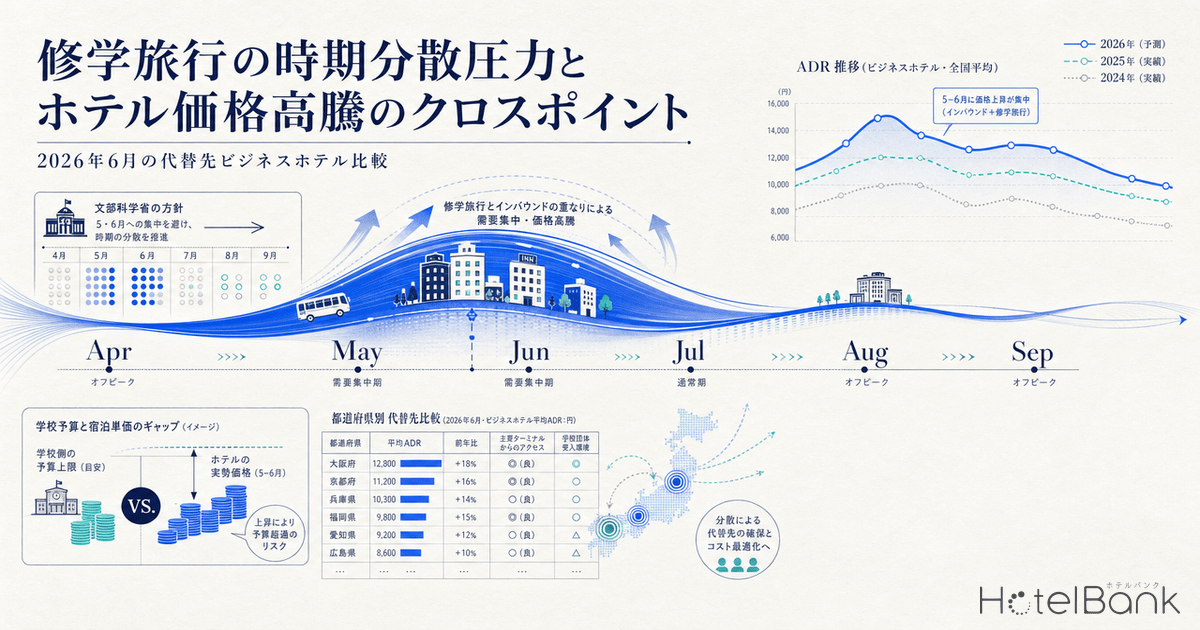
On December 12, 2024, Japan’s Ministry of Education, Culture, Sports, Science and Technology (MEXT) issued a notice urging boards of education nationwide to flexibly reconsider the timing of school trips, avoiding peak periods when chartered buses and accommodation are difficult to secure. About a year and a half later, as of June 2026, ADR in Kyoto reached ¥40,100 and Tokyo ¥34,800, both posting double-digit year-on-year increases. Based on data from MetroEngines Research (メトロエンジンリサーチ), this article examines the gap between the price levels of May–June—the main school trip season—and group block reservation budget ceilings, the business hotel ADR of alternative candidate areas in the Kanto outskirts, Tohoku, and Kyushu, and the market impact if timing dispersion progresses from FY2027 onward.
Metric Definitions Used in This Article
- ADR (Average Daily Rate): Average of selling prices publicly listed on OTAs and similar channels. This differs from actual transaction prices. Per-room rate (tax included) for double occupancy, averaged across all plans (room-only through meal-included plans).
- Sold-out Rate: Share of plans that had closed reservations on OTAs at the time of survey. This differs from a property-wide occupancy rate.
- Data Source: MetroEngines Research (メトロエンジンリサーチ)
MEXT’s Call and the Persistent May–June Concentration
The notice “On Flexible Consideration of School Trip Timing” issued by MEXT in December 2024 was prompted by the chartered bus driver overtime regulations (the so-called 2024 Problem) and the tightening of accommodation supply driven by surging inbound demand, asking schools to avoid the traditional concentration periods of May–June and September–December. A prefectural busy/slack calendar was also attached jointly with the Japan Tourism Agency, clearly positioning timing dispersion of educational travel as a policy issue.
Looking across FY2026 school trip plans, however, the structure in which May–June implementation dominates at both junior high and high schools shows little sign of major change. Constraints unique to educational sites—school event calendars, periodic exam schedules, and exam preparation periods—reflect a reality that cannot be easily moved. Meanwhile, inbound demand has strengthened year by year, and the hotel markets in the Kansai and Tokyo metropolitan areas now have a structure where the seasons in which educational travel can move easily overlap with the inbound peak.
Source: MetroEngines Research, compiled by HotelBank Editorial Team
The chart above overlays monthly ADR for Kyoto and Tokyo across 2024, 2025, and 2026. Kyoto was nearly flat from ¥34,400 in June 2024 to ¥34,500 in June 2025, but in June 2026 it surged to ¥40,100—up 16.4% year-on-year. Tokyo showed the same pattern, rising to ¥34,800 in June 2026, up 15.1% year-on-year. The price levels of Kyoto and Tokyo, the principal school trip destinations, have risen by more than 15% compared with the time MEXT issued its notice at the end of 2024.
The Gap Between Group Block Reservations and Price Levels
School trip accommodation budgets are typically capped by each school operator. Many municipalities set a guideline of around ¥10,000–¥13,000 per night at public junior high schools, and ¥13,000–¥17,000 at public high schools. These figures are per student; converted to double occupancy, the de facto ceiling per room is the low ¥20,000s to low ¥30,000s.
| Prefecture | June 2026 ADR | YoY | Sold-out Rate | Properties |
|---|---|---|---|---|
| Kyoto | ¥40,100 | +16.4% | 15.4% | N=1,465 |
| Tokyo | ¥34,800 | +15.1% | 17.2% | N=1,570 |
| Osaka | ¥26,400 | +18.4% | 14.8% | N=798 |
| Nara | ¥37,900 | +9.7% | 13.8% | N=241 |
Source: MetroEngines Research, compiled by HotelBank Editorial Team
Even Kyoto’s June business hotel average of ¥23,200 is near the upper end of the per-person budget cap, and looking at the all-category average—which includes city hotels and ryokan—the level is one at which group block reservations are difficult to make work. In practice, hotels sometimes set aside a fixed allotment of rooms for school trip blocks, but those allotments have been shrinking year by year as inbound demand grows.
Tokyo’s level of ¥34,800 tells the same story; in particular, the business hotel category within the 23 wards has risen to ¥28,900. The traditional style of staying within the 23 wards while conducting Tokyo-area study programs is becoming difficult to fit within the budget envelope, and an increasing number of schools are being forced to disperse to the outer Tokyo metropolitan area, including Chiba, Saitama, and Kanagawa.
Source: MetroEngines Research, compiled by HotelBank Editorial Team
Alternative Business Hotels: Kanto Outskirts, Tohoku, and Kyushu
This brings attention to the business hotel markets in regions away from the traditional destinations. The table below summarizes areas where school trip lodging can realistically fit within budget and where it is easier to secure rooms for group bookings. All figures are average ADR for the business hotel category in June 2026.
| Prefecture | Business Hotel ADR | Sold-out Rate | Properties | Educational Travel Theme |
|---|---|---|---|---|
| Fukushima | ¥14,400 | 14.6% | N=131 | Disaster studies / Aizu history |
| Miyazaki | ¥14,600 | 14.2% | N=86 | Mythology / Community-based learning |
| Iwate | ¥16,300 | 11.6% | N=79 | Disaster studies / Hiraizumi World Heritage |
| Kumamoto | ¥16,400 | 14.5% | N=112 | Kumamoto Castle / Aso / Minamata |
| Ibaraki | ¥16,600 | 11.2% | N=165 | JAXA / Science and technology |
| Nara | ¥18,400 | 17.2% | N=32 | Ancient history / Temples and shrines |
| Hiroshima | ¥18,500 | 16.9% | N=171 | Peace studies / Miyajima |
| Miyagi | ¥18,700 | 17.4% | N=135 | Disaster studies / Matsushima |
| Kyoto | ¥23,200 | 21.4% | N=328 | Traditional destination (reference) |
| Tokyo | ¥28,900 | 23.7% | N=936 | Traditional destination (reference) |
Source: MetroEngines Research, compiled by HotelBank Editorial Team
Source: MetroEngines Research, compiled by HotelBank Editorial Team
The average business hotel ADR in Fukushima and Miyazaki is in the ¥14,000s—more than 40% lower than Kyoto and nearly 50% lower than Tokyo. Iwate, Kumamoto, and Ibaraki also fall within the ¥16,000s, putting them in a price range where group blocks can be assembled within school trip budgets. Sold-out rates of 10–15% are also lower than in inbound-concentrated regions, indicating a structure in which group allotments are easier to secure.
What stands out is that all of these areas have clear thematic appeal as educational travel destinations: disaster studies (Tohoku prefectures), peace studies (Hiroshima), community-based and rural-village experiences (Miyazaki, Kumamoto), and science and technology (Ibaraki). These are regions that can offer learning experiences different from the temple/shrine tours and urban culture programs of Kyoto and Tokyo, and they are becoming practical options both in price and in their capacity to accommodate groups.
Timing Dispersion Scenarios from FY2027 Onward
So how would prices actually move if timing dispersion were to advance? Looking at Kyoto’s monthly ADR trend reveals the size of the gap between the May–June concentration period and current off-peak months other than the summer slack of July–August.
Source: MetroEngines Research, compiled by HotelBank Editorial Team
Kyoto’s 2025–2026 monthly trend suggests that shifting school trips to autumn or later may not necessarily be advantageous in market terms. October 2025 ¥41,000, November ¥47,500, and December ¥44,700—Kyoto’s autumn-foliage-season ADR is in fact above the early-summer concentration period. Likewise, March 2026 ¥46,500 and April ¥50,300, with cherry blossom and the new fiscal year season recording the year’s highest levels.
By contrast, September at ¥35,500 is close to June’s ¥34,500, a period when competition with inbound demand is comparatively eased. If school trips were to shift into early September or mid-to-late February—valleys in inbound demand—even Kyoto’s average business hotel ADR could be expected to fall to the ¥18,000s. However, balancing this with school event calendars and exam preparation periods is a challenge, and cross-cutting coordination among boards of education, MEXT, and the Japan Tourism Agency would be indispensable.
Another structural change is that, as school trip timing disperses, the operations of business hotel chains would also be affected. Regional-city business hotels are troubled by the gap between weekday business demand and weekend leisure demand, and school trip groups are positioned as a unique segment characterized by weekday, high-volume, low-rate stays. If timing disperses, the importance of school trips as a stable revenue source for these regional business hotels could rise.
The Structural Shift Required of the Educational Travel Industry
The price impact of MEXT’s call may be limited in any single year, but over a three-to-five-year horizon it could drive structural change across the educational travel industry. First, diversification of destinations. Areas such as Toyama, the Tohoku prefectures, and the Kyushu interior—not previously among the main school trip candidates—will enter the field of consideration on both price and group-receiving capacity grounds.
Second, seasonal dispersion. If September or February implementations increase from FY2027 onward, off-peak demand in Kyoto and Nara could be lifted, advancing year-round ADR leveling. This is also consistent with the Japan Tourism Agency’s policy of leveling tourism demand.
Third, a review of pricing structures. The traditional model of setting aside annual school trip blocks at low rates is already a burden in a hotel industry that has shifted to dynamic pricing, and hotels themselves are calling for a review of rate structures. Public dialogue channels between boards of education and the lodging industry will need to be more formally established.
Summary
Kyoto’s June 2026 ADR of ¥40,100 and Tokyo’s ¥34,800 are clearly disconnected from the conventional school trip budget envelope. The timing dispersion that MEXT called for in December 2024 has become an urgent issue for the educational travel industry, but in reality, near-term dispersion is hard to achieve because of school calendar constraints. At the same time, alternative-destination business hotel ADRs in Fukushima, Miyazaki, Iwate, Kumamoto, and Ibaraki sit within the ¥14,000–¥16,000 range—within budget—and offer clearly defined educational themes.
In a scenario where timing dispersion advances to a degree from FY2027 onward, the inbound demand troughs of September and February are likely to be utilized, and for regional business hotels, school trips would gain a stronger role as a stable revenue source. The sophistication of school trips and their integration with regional content will become a medium- to long-term theme for both the education and hotel industries.
Note on Future-Date ADRs: The ADRs in this article are averages of selling prices publicly listed on OTAs at the time of survey, and they fluctuate as check-in dates approach. Prices that are currently set high may decline through last-minute markdowns, so please keep this in mind.