

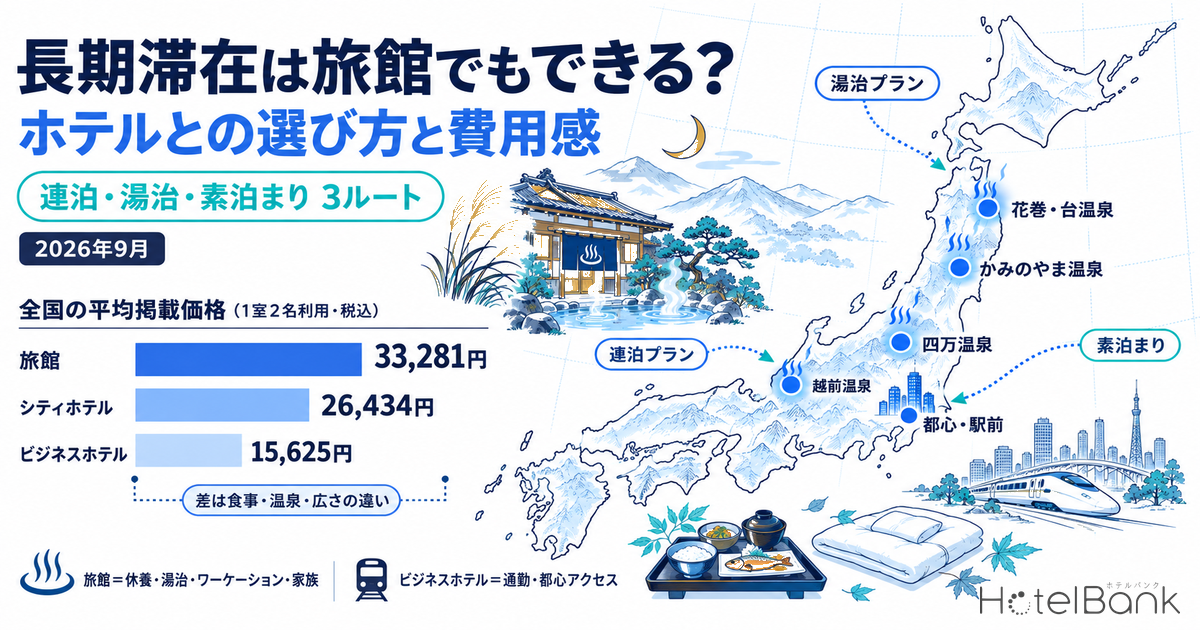
“For a long stay in Japan, should I book a ryokan or a hotel?” The short answer: a ryokan works perfectly well for a long stay. There are three routes in — multi-night plans, toji (hot-spring cure) plans, and room-only stays — and for rest, hot-spring recuperation, a workation or a family stay, the ryokan has the edge. If your stay revolves around a weekday commute or access to the city center, the business hotel wins. This article uses nationwide OTA listed prices (as of September 2026) to set out what each option costs, how to choose by purpose, and how to find a multi-night ryokan plan.
- — You can stay long-term at a ryokan. The three ways in are multi-night plans, toji plans, and room-only stays.
- — The nationwide average listed price (September 2026, per room for two guests, tax included) is about ¥33,300 for ryokan and about ¥15,600 for business hotels. The gap reflects whether meals, hot springs and space are included.
- — Choose a ryokan for rest, toji, workations and family stays; choose a business hotel for commuting and city access. What you actually pay depends on early-booking plans and which days of the week you stay.
Yes, You Can Stay Long-Term at a Ryokan — Three Routes
Ryokan are often assumed to be built only for short one-night, two-meal stays, but in practice they offer three distinct ways to accommodate a long stay.
1. Multi-night plans. Some ryokan design their meals around consecutive nights, for example by changing the menu daily from the second night onward. The culture of staying several nights survives most strongly at long-established inns in hot-spring towns. If a ryokan spells out how it handles multi-night guests on the cuisine page or FAQ of its official website, you can take that as a sign it is well suited to long stays.
2. Toji plans. Long stays at ryokan originated with toji, the tradition of staying at a hot spring to recuperate, and toji inns with rates built around stays of roughly a week still operate in hot-spring towns across Japan. At inns with a shared kitchen for self-catering you control your own food budget, while inns that serve simple, rotating daily set meals are designed so that you can eat there every day without tiring of it. For a stay focused on recuperation or rest, this is the strongest route.
3. Room-only stays. Choose a plan without meals and a ryokan can be used just like a business hotel: a place to sleep, plus a hot spring. Mixing nights when you eat out with nights when you dine at the inn gives you far more freedom over meals during a long stay.
What It Costs: Ryokan vs Business Hotels in Nationwide Listed Prices
In nationwide OTA listed prices compiled by the HotelBank Editorial Team (as of September 2026, per room for two guests, tax included), the average listed price was about ¥33,300 for ryokan (N=6,590 properties) and about ¥15,600 for business hotels (N=7,900 properties). For reference, city hotels averaged about ¥26,400 (N=1,383 properties).
| Category | Average listed price (per room for two guests, tax included) | Properties counted |
|---|---|---|
| Ryokan | ¥33,281 | 6,590 |
| City hotel | ¥26,434 | 1,383 |
| Business hotel | ¥15,625 | 7,900 |
Source: HotelBank Editorial Team (nationwide aggregation of OTA listed prices, as of September 2026). Figures are averages of listed prices; actual booking rates vary by plan and season.
The difference is about ¥17,700 per night, but the right way to read it is as a difference in what is included. Ryokan listed prices are dominated by plans with dinner and breakfast, and the figure bundles in large communal hot-spring baths, open-air baths and a stay in a spacious Japanese-style room. In other words, the ryokan price is the price of the whole stay — accommodation plus two meals plus the hot spring — while the business hotel price covers only the function of sleeping. The two numbers are not on the same footing: you are buying different things.
As a rough back-of-the-envelope guide, seven nights comes to about ¥233,000 at a ryokan (two guests in one room, meals included in most cases) and about ¥109,000 at a business hotel (same basis, mostly room-only, with food costs on top). On the ryokan side you can bring the figure down further by choosing a room-only or toji plan; on the business hotel side, once you add the cost of eating out and paying for bathing facilities, the real gap is often narrower than the headline numbers suggest.
Stays That Suit a Ryokan, Stays That Suit a Business Hotel
Neither is better in absolute terms — the purpose of your stay decides. Here is where each one is strongest.
Who benefits most from a ryokan
- Rest and toji: You can bathe in the hot spring every day and never have to think about meals. For “a week to recover,” the ryokan is designed for exactly that purpose.
- Workations: A large Japanese-style room gives you space to spread out your work, and the hot spring provides a clean break between work sessions. Check the Wi-Fi and whether the room has a desk before you book.
- Long family stays: Japanese-style rooms make it easy to sleep alongside small children, and the whole family can stay in one room. With meals included, nobody has to plan what to eat during the stay.
Who benefits most from a business hotel
- Weekday commuting or travel to a work site: Locations near stations, 24-hour front desks and rates built around single occupancy are optimized for long stays on business trips or solo work assignments away from home.
- Priority on city access: Options are concentrated around stations in urban areas, which suits late returns and early departures. Facilities for multi-night guests, such as coin laundries and microwaves, are also standard.
For a cost simulation and facilities checklist on the business hotel side, see Business Hotels for Long Stays: 6 Checks and ¥16,722 a Night in Tokyo, which is the place to start if you are planning a commuter-style stay. The rest of this article digs into how to find the right ryokan.
How to Find a Multi-Night Plan, and What to Check Before You Book
Start your search with the words “renpaku” (consecutive nights), “toji” and “daily-changing menu.” On an OTA, narrow the results to properties whose plan names include “renpaku,” and once you have candidates, look at the cuisine page and FAQ on each official website. A ryokan that states in writing how it handles menus for multi-night guests is one that hosts such guests as a matter of routine. Sekizenkan Honkan (積善館本館) in Shima Onsen, for example, states on its official website that menus for guests staying consecutive nights are prepared on a daily-changing basis — a sign that the multi-night culture of the toji inn is still alive there.
There are three things to confirm before booking.
1. Can you skip meals on some days? Can you set aside a night during your stay to eat out? At a ryokan that lets you switch between a two-meal plan and room-only on a day-by-day basis, you can keep meals varied even over a long stay. It is easy to ask by phone or email how a given inn handles this, and the way they respond also tells you how used they are to multi-night guests.
2. Timing of cleaning and futon service. Some ryokan clean the room every day during a multi-night stay; others make it optional. If you will spend long hours in the room working or napping, an inn that lets you choose the cleaning time is more comfortable.
3. What you pay comes down to early-booking plans and how you arrange the days of the week. Even at the same ryokan and in the same room, choosing an early-booking or prepaid plan and building your stay around Sunday through Thursday changes the total considerably. Simply placing Friday and Saturday at the edge of your stay rather than in the middle — or leaving them out — moves the total. Optimizing the cost of a multi-night stay works better when you think of it as designing the plan and the days of the week, rather than hunting for discounts.
For a comparison of ryokan that publicly commit to a multi-night menu design, see How to Change the Second Night’s Kaiseki: Three Ryokan Whose Kitchens Redesign the Menu for Consecutive Stays (in Japanese).
Where to Look in More Detail
For comparisons of specific inns, the following articles (in Japanese) go into detail.
A comparison limited to ryokan that state their multi-night menu changes on their official websites. It reads the official wording of three inns: Sekizenkan Honkan (積善館本館) in Shima Onsen, which writes that menus for consecutive nights change daily; Meigetsuso (名月荘) in Kaminoyama Onsen, which offers a menu different from the first night; and Heisei (平成) in Echizen Onsen, which declares that even the same course is entirely different in content.
Start here if you are searching via the toji route. It introduces four inns that carry on the self-catering toji tradition at Dai Onsen in Hanamaki, Iwate: Nakajima Ryokan (中嶋旅館), Ryokan Kanegaya (旅館かねがや), Kankoso (観光荘) and Matsudaya Ryokan (松田屋旅館). All four have free-flowing spring water straight from the source and stand within a few minutes’ walk of each other, and with indicative prices from ¥28,000 per night per room for two guests, they are easy to build into a long toji stay.
Frequently Asked Questions
Q. Can I stay at a ryokan for a week or longer?
A. Yes. There are three routes: multi-night plans that change the menu daily on the assumption of consecutive nights, toji plans designed for stays of about a week, and room-only stays without meals. A ryokan that states on its official website how it handles menus for multi-night guests can be judged to host such guests routinely.
Q. How much does a long stay cost at a ryokan compared with a business hotel?
A. As of September 2026, the nationwide average listed price (per room for two guests, tax included) is about ¥33,300 for ryokan and about ¥15,600 for business hotels. Ryokan prices are dominated by plans that include two meals and hot springs, while business hotels are mostly room-only, so the real gap can narrow once you add the cost of eating out and bathing facilities.
Q. Can I skip meals on some days during a long ryokan stay?
A. It depends on the inn. Some ryokan accept day-by-day switches from a two-meal plan to room-only, so the surest approach is to confirm by phone or email before booking.
Q. How can I keep the cost of a multi-night stay down?
A. Choosing an early-booking or prepaid plan and building your nights around Sunday through Thursday is effective. Simply placing Friday and Saturday at the edge of your stay, or leaving them out, changes the total.
Methodology and Sources
■ Data source
HotelBank Editorial Team. Nationwide aggregation by property category of publicly listed prices on Japanese OTAs (as of September 2026). Ryokan N=6,590 properties, city hotels N=1,383 properties, business hotels N=7,900 properties.
■ Calculation assumptions
All prices are averages of listed prices per room for two guests, tax included. The seven-night figures are a simple calculation of the average listed price multiplied by seven nights, and do not factor in multi-night discounts, early-booking discounts, day-of-week differences or differences in meal conditions.
■ Limitations and caveats
Listed prices are not transacted booking prices, and because plan composition differs (ryokan are mostly meal-inclusive, business hotels mostly room-only), the gap between categories is not a price difference on like-for-like terms. Please check each property’s official website for its rates and multi-night arrangements. The description of menus at Sekizenkan Honkan is based on the inn’s official website (Sekizenkan Honkan).
Related Articles