

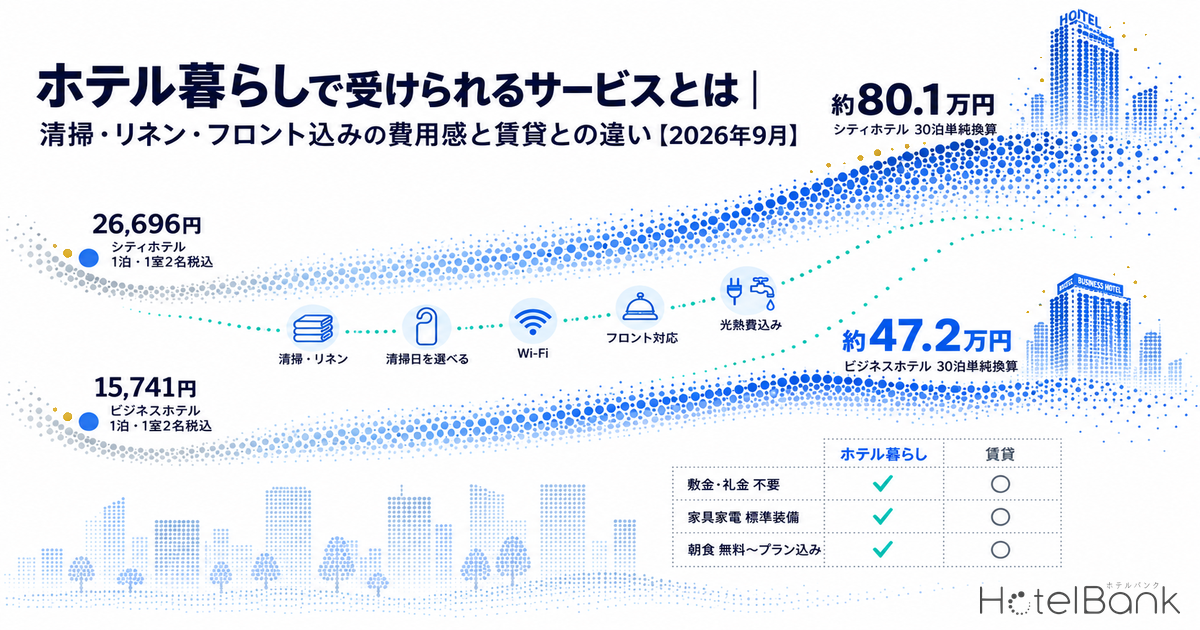
The biggest difference between hotel living and renting an apartment is that housekeeping, linen changes, front-desk service, utilities and Wi-Fi are all included in the room rate. Tasks you would either pay for separately or do yourself as a renter come as standard, “service included,” at a hotel. This article lays out the standard scope of services you get when living in a hotel in Japan, checks how cleaning and amenity routines change on multi-night and long-stay plans using the chains’ published plan terms, and then works through a monthly cost estimate based on listed prices.
- — The biggest difference from renting: housekeeping, linen changes, utilities, Wi-Fi and front-desk service are included in the room rate. Utilities and water, which cost a single-person household about ¥13,000 a month in a rental, are not billed separately.
- — Housekeeping during multi-night stays is increasingly “choose the days you want it”. Toyoko Inn (東横INN) cleans every third day, with its “ECO Stay” towel change, trash collection and bed-making on the other days; Comfort Hotel (コンフォートホテル) lets guests pick cleaning or towel-change days by hanging a card on the door (at some hotels).
- — The nationwide listed average (September 2026, per room for 2 guests, tax included) is about ¥15,700 per night for business hotels (N=7,453 properties) and about ¥26,700 for city hotels (N=1,253 properties). Simply multiplied by 30 nights, that is about ¥472,000 / ¥801,000.
- — Assuming a long-stay discount of 10–20%, a 30-night business-hotel stay comes down to about ¥378,000–¥425,000. Single occupancy, a weekday-centered schedule and choice of area can bring it down further.
- — The shortcut to choosing a property is to work backward from services and check four points: how housekeeping is chosen, how laundry works, meals, and front-desk hours.
Hotel Living Is “Service Included” by Default: Quick Comparison with Renting
The cost of living in a rental can be broken down into “rent + utilities + internet + furniture and appliances + the effort of cleaning and laundry.” With hotel living, much of this is built into the room rate from the start. For typical business and city hotels, the standard scope looks like this:
| Item | Hotel living | Renting |
|---|---|---|
| Room cleaning | Included (many properties let you choose the frequency on multi-night stays) | Do it yourself |
| Towel and linen changes | Included (frequency depends on property and plan) | Wash them yourself |
| Utilities and water | Included | Billed separately (about ¥13,000/month on average for single-person households) |
| Wi-Fi | Free at most properties | Requires an internet contract |
| Front-desk service (receiving parcels, help with problems) | Included (hours depend on the property) | None (parcel lockers etc. depend on the building) |
| Furniture and appliances | Bed, desk, refrigerator and TV as standard | Buy and move in yourself |
| On-site laundry | Coin laundry on site is common (some formats have in-room washer-dryers) | Install a washing machine |
| Breakfast | Free or included in the plan at many properties | Cook or eat out |
| Deposit, key money, guarantor | Not required (start with just a reservation) | Upfront costs such as deposit, key money, agency fee and advance rent |
Note: Typical example for business and city hotels. The exact scope and frequency differ by property and plan, so check the official website before booking. Rental utility and water costs are from the Statistics Bureau of Japan, Ministry of Internal Affairs and Communications, “Family Income and Expenditure Survey (Income and Expenditure),” single-person households, 2025 average (¥13,333/month).
The biggest payoff is time. Cleaning, laundry, taking out the trash and dealing with broken equipment all become the hotel’s job, so the hours you used to spend on housework become free time. And with no tenant screening or guarantor, you can book and start on the day you decide — something unique to hotel living. It also helps to know in advance how to request cleaning, breakfast and parcel handling during a long stay: ask the front desk at check-in about cleaning-day requests, breakfast hours and whether parcels addressed to guests are accepted and stored.
Long-Stay Plans Change How Cleaning and Amenities Work: Checking Published Plan Terms
For a one-night stay, a full daily clean is a given, but for multi-night and long-stay plans each chain publishes how it handles cleaning and linens. Let’s look at representative published examples.
Toyoko Inn’s (東横INN) Weekly and Monthly Plans offer standing long-stay discounts of up to 10% off for 7–29 nights and up to 15% off for 30–31 nights. The terms state that rooms are cleaned once every three days, and on the other days staff still enter to change towels, collect trash and straighten the bed under its “ECO Stay” service. In other words, even on a long-stay plan, towels and bedding are refreshed every day. Toyoko Inn also publishes that breakfast is free at all its hotels and that booking through its official website or app always gets the best price (Source: Toyoko Inn official website, “Weekly Plan / Monthly Plan” and “Stable, Reliable Prices and Service,” accessed September 2026). For the overall picture of how much listed prices drop at 7 and 30 nights, see Japan Hotel Long-Stay Discounts: 15% at 7 Nights, 20% at 30 Nights.
Comfort Hotel (コンフォートホテル) changes bed sheets and pillowcases during multi-night stays only for guests who request it (excluding some hotels). In addition, from cleaning carried out on or after September 1, 2026, some of its hotels (seven properties including Tomakomai, Sendai West Exit and Kariya) have moved to cleaning rooms on multi-night stays in principle once every three days. On other days, guests who want cleaning hang a blue card, and guests who want towels and toothbrushes replaced hang a white card, on the outside of the door by 10:00 that day (on scheduled cleaning days, cleaning and towel changes are done regardless of cards). Because a single card lets you choose which days you want cleaning or fresh towels, the system also works well for people who mostly work remotely and want to stay in the room during the day (Source: Comfort Hotel official website, “SDGs Initiatives,” and the notice “Room Cleaning During Multi-Night Stays at Some Hotels from Cleaning Carried Out on September 1, 2026” (August 13, 2026), accessed September 2026).
Beyond these, apartment-style and extended-stay hotels with in-room washer-dryers and kitchens are typically designed to put cleaning on a weekly schedule in exchange for letting guests prioritize their own pace of life. Several subscription services that let you move between hotels nationwide for a fixed monthly fee have also appeared (the terms of each service can be checked on its official website). It helps to remember that “hotel living” splits into two choices: a stay where you receive daily services, or a stay where you take more freedom in how you live.
What It Costs: A Monthly Estimate for “Service Included” Living
So how much does this service-included lifestyle cost? Based on listed prices as of September 2026 (per room for 2 guests, tax included) aggregated by the HotelBank Editorial Team from public OTA data, the nationwide average listed price is about ¥15,700 per night for business hotels (N=7,453 properties) and about ¥26,700 per night for city hotels (N=1,253 properties).
| Category | Average listed price (per night, per room for 2 guests, tax incl.) | Simple 30-night conversion |
|---|---|---|
| Business hotels (N=7,453 properties) | ¥15,741 | approx. ¥472,000 |
| City hotels (N=1,253 properties) | ¥26,696 | approx. ¥801,000 |
Source: HotelBank Editorial Team research (aggregated public OTA data, listed prices as of September 2026). The 30-night figure is a rough guide obtained by simply multiplying the average listed price.
Depending on how much of a long-stay discount you assume, the 30-night estimate changes as follows. The discount rates are placeholders based on the “up to 10% / up to 15%” published for Toyoko Inn’s Weekly and Monthly Plans and the “about 20%” observed in our article measuring 30-night market rates.
| Category | No discount | 10% long-stay discount | 15% long-stay discount | 20% long-stay discount |
|---|---|---|---|---|
| Business hotels | approx. ¥472,000 | approx. ¥425,000 | approx. ¥401,000 | approx. ¥378,000 |
| City hotels | approx. ¥801,000 | approx. ¥721,000 | approx. ¥681,000 | approx. ¥641,000 |
Source: Simple calculation based on HotelBank Editorial Team research (aggregated public OTA data, listed prices as of September 2026). Discount rates are placeholders; actual discounts vary by property, season and plan.
You may feel that ¥472,000 a month is expensive, but this is a high-side estimate that simply multiplies the nationwide average listed price for 2 guests per room by 30. In actual hotel living, what you pay drops considerably through four levers: (1) choosing cheaper single-occupancy rooms and plans, (2) using long-stay discounts such as the Weekly and Monthly Plans mentioned above, (3) building your schedule around weekdays and Sundays, and (4) choosing areas outside city centers. This amount also includes housekeeping, linens, utilities, Wi-Fi and front-desk service, and there are no upfront costs such as a deposit, key money or furniture and appliances. So when comparing with renting, the right approach is to compare the total of “rent + utilities + internet + time spent on housework.” For a detailed Tokyo comparison of how long you need to stay before hotel living beats rent, see Is Hotel Living Cheaper Than Rent in Tokyo? Break-Even at 24 Nights.
4 Points for Choosing a Hotel by Working Backward from Services
Satisfaction with hotel living depends less on price than on whether the property offers the services your life actually needs. Check the following four points on the official website before booking.
- Can you choose how cleaning and linens are handled? The best property differs for someone who wants daily cleaning and someone who wants to work in the room during the day. Properties where you can choose the frequency, for example by hanging a card, can accommodate either style.
- How laundry works: Is it an on-site coin laundry or an in-room washer-dryer? If you like to wash at night and take it out in the morning, an in-room machine is more comfortable.
- How meals fit together: At properties with free breakfast, one meal every morning is part of your fixed cost. If you want to cook, extended-stay properties with a kitchenette and microwave are candidates. For an equipment comparison of hotels that actually offer month-long plans, see “Shinjuku, Shibuya, Ikebukuro: 5 Extended-Stay Hotels with Monthly Plans” (in Japanese).
- Front-desk hours and parcels: When living in a hotel, parcel deliveries come up more often than you might expect. It is reassuring to check whether the front desk is open 24 hours and whether it accepts and stores parcels.
To Explore Further
For detailed comparisons of specific properties, these articles go deeper (both in Japanese).
Compares five properties including Citadines Shinjuku Tokyo (シタディーン新宿東京), MIMARU Tokyo Ikebukuro (MIMARU東京 池袋) and lyf Shibuya Tokyo (lyf渋谷東京) by whether rooms have kitchens, laundry facilities and how month-long plans are handled. From apartment-style hotels with IH stoves and cookware in every room to shared-kitchen formats, it gives a concrete picture of hotel-living options on the west side of central Tokyo.
Selects five apartment-style properties in Tokyo, Osaka, Fukuoka and Sapporo with in-room washer-dryers and kitchens, including Tokyu Stay Hakata (東急ステイ博多) and MIMARU Osaka Namba STATION (MIMARU大阪 難波STATION). It explains how to choose a place where you can stay as if you live there, focusing on multi-night rates and the quality of everyday living infrastructure.
Frequently Asked Questions
Q. What is included in the room rate when living in a hotel?
At typical business and city hotels, the room rate includes room cleaning, towel and linen changes, utilities and water, Wi-Fi, front-desk service, and built-in furniture and appliances such as a bed, desk, refrigerator and TV. Many properties also offer breakfast free or as part of the plan. The exact scope differs by property and plan, so check the official website before booking.
Q. Is the room cleaned every day during a multi-night stay?
It depends on the property. Toyoko Inn cleans rooms once every three days on multi-night stays and provides its “ECO Stay” service on other days, with towel changes, trash collection and bed-making. At some Comfort Hotel properties, you can request cleaning or towel changes on the days you want by hanging a card on your door.
Q. How much does hotel living cost per month?
As of September 2026, the nationwide average listed price (per room for 2 guests, tax included) is about ¥15,700 per night for business hotels (N=7,453 properties) and about ¥26,700 for city hotels (N=1,253 properties). Simply multiplied by 30 nights, that is about ¥472,000 and ¥801,000; assuming a 10–20% long-stay discount, business hotels come to about ¥378,000–¥425,000. Single-occupancy rooms and a weekday-centered schedule can lower this further.
Q. What should I compare when weighing hotel living against renting?
The basic approach is to compare totals that include not just rent but utilities and water (about ¥13,000 a month on average for single-person households), internet, furniture and appliances, upfront costs such as a deposit and key money, and the time spent on cleaning and laundry. With hotel living, much of this is included in the room rate.
Q. What should I check when choosing a property for hotel living?
It is easier to choose if you check four points on the official website: whether you can choose the frequency of cleaning and linen changes, whether laundry is an on-site coin laundry or an in-room washer-dryer, how meals fit together (breakfast, kitchen, microwave), and front-desk hours and whether parcels can be received.
Methodology and Sources
Listed prices are per-room rates (2 guests per room, tax included) for stay dates in September 2026, aggregated by the HotelBank Editorial Team from public OTA data. Each chain’s cleaning and plan terms are based on the information published on the official websites below.
- Toyoko Inn (東横INN), “Weekly Plan / Monthly Plan”
- Toyoko Inn (東横INN), “Room Cleaning During Multi-Night Stays (ECO Stay)”
- Toyoko Inn (東横INN), “Stable, Reliable Prices and Service”
- Comfort Hotel (コンフォートホテル), “SDGs Initiatives”
- Comfort Hotel (コンフォートホテル), “Room Cleaning During Multi-Night Stays at Some Hotels from Cleaning Carried Out on September 1, 2026” (August 13, 2026)
- TEPCO Energy Partner, “Kurahiro”: average utility costs for people living alone (summary of the Statistics Bureau of Japan “Family Income and Expenditure Survey (Income and Expenditure),” single-person households, 2025 average)
■ Data Sources
Prices: listed prices published on OTAs, aggregated by the HotelBank Editorial Team (nationwide, stay dates in September 2026; business hotels N=7,453 properties, city hotels N=1,253 properties). Services: information published on the official websites of Toyoko Inn and Comfort Hotel (accessed September 2026). Utilities and water: Statistics Bureau of Japan, “Family Income and Expenditure Survey (Income and Expenditure),” single-person households, 2025 average.
■ Calculation Assumptions
The 30-night estimates are a simple “average listed price × 30 nights” calculation, and the long-stay discount rates in Table 3 (10%, 15%, 20%) are placeholders. The average listed price is the per-room rate for 2 guests, not a per-person amount. Accommodation tax and additional costs such as meals and laundry are not included.
■ Limitations
Listed prices are the public prices at the time of aggregation and may differ from actual booking rates and availability. Re-aggregating under the same conditions on September 23 gave ¥15,625 for business hotels (7,900 properties) and ¥26,434 for city hotels (1,383 properties), within 1% of the values in this article. Cleaning frequency and how to request it by card vary by property, and even within the same chain some arrangements apply only to certain hotels. Please check the latest information on the official website before booking.
Related Articles
- Is Hotel Living Cheaper Than Rent in Tokyo? Break-Even at 24 Nights
- Japan Hotel Long-Stay Discounts: 15% at 7 Nights, 20% at 30 Nights
- Monthly Hotels in Japan: No Lease, 20% Off at 30 Nights (Aug 2026)
- How to Start Hotel Living in Japan: 5 Steps, ¥479,000 for 30 Nights
- 6 Downsides of Hotel Living in Japan: ¥502,000 per 30 Nights & Fixes