

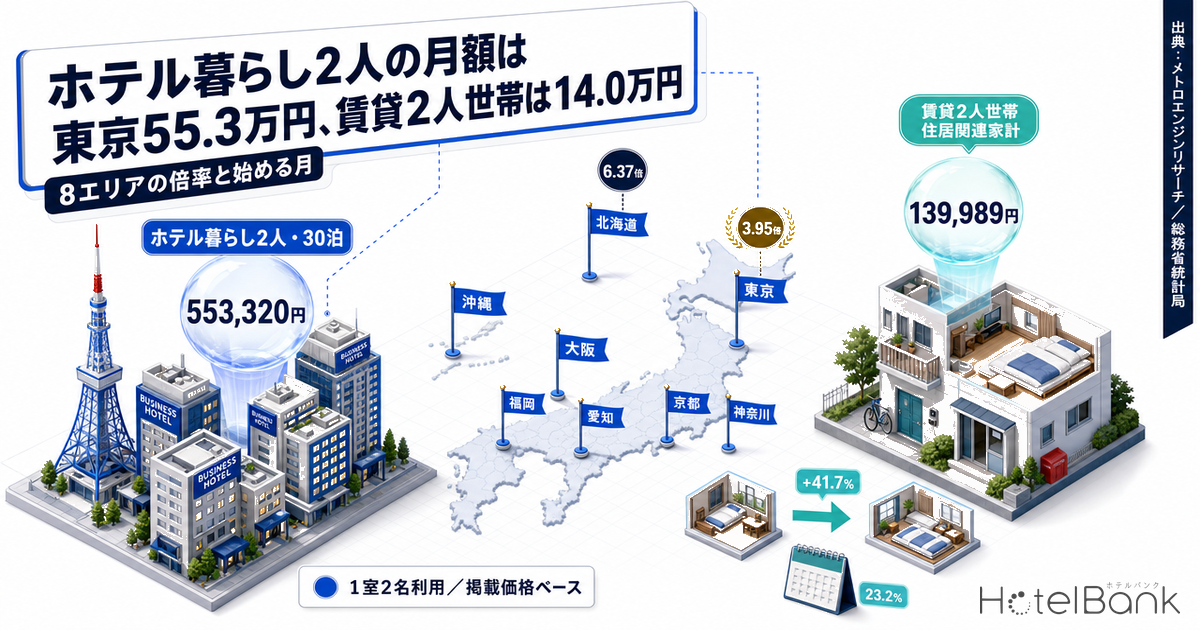
When a couple starts thinking about “hotel living,” the first thing they want to know comes down to one question: how much per month, and how much more is that than renting today? Hotel rates are quoted per room on a double-occupancy basis, so the room rate barely changes whether one person or two are staying — while on the rental side, rent goes up when a household grows to two. We checked in yen exactly how far that asymmetry closes the gap, using both listed accommodation prices and government statistics.
Metric Definitions Used in This Article
- Listed price: the average of the accommodation prices each property publishes on OTAs and similar channels, expressed as the per-room rate for two guests in one room (tax included). It averages all plans, from room-only to meals-included, and differs from actual transacted rates. Figures by area or category are aggregates of the properties covered.
- Housing-related household spending for a two-person rental household: the monthly rent of two-person households living in rented housing from the Statistics Bureau of Japan’s Housing and Land Survey (2023), plus the monthly utilities/water and furniture/household-goods spending for two-person households from the Statistics Bureau’s Family Income and Expenditure Survey (2025). Food, communications and transport are excluded because both options incur them.
- Data sources: MetroEngines Research (accommodation prices) / Statistics Bureau of Japan (rent, household spending) / Ministry of Land, Infrastructure, Transport and Tourism (floor-area standards)
- This article does not cover occupancy (OCC) or estimated settled ADR. All accommodation costs are on a listed-price basis.
- — Two people, 30 nights at a Tokyo business hotel = about ¥553,300 for one room. That is the trailing 12-month average listed price of ¥18,444 (September 2025–August 2026, N=822–972 properties per month) × 30 nights. Per person, about ¥276,700.
- — A two-person rental household spends about ¥140,000 a month on housing (Tokyo: rent ¥105,734 + utilities/water ¥22,691 + furniture and household goods ¥11,564). The hotel option is 3.95× that.
- — Going from one person to two raises rent by 41.7% (+¥31,097) in Tokyo, while the hotel room rate does not move. Nationally, rent still rises 28.0%. This is the only place where the gap narrows for a couple.
- — The smallest premium is in Tokyo (3.95×) and the largest in Hokkaido (6.37×). Accommodation prices do not fall as steeply across regions as rent does, so the ratio widens outside the big cities.
- — The month you start moves the nightly rate by up to 23.2%. Over the trailing 12 months in Tokyo, August 2026 was the trough at ¥16,722 and April 2026 the peak at ¥20,603 — a difference of ¥116,430 over 30 nights.
■ Assumptions behind the estimates
All calculations use the conditions below. Getting these straight first makes it easy to swap the tables later in the article for your own case.
| Item | Setting | Basis / caveats |
|---|---|---|
| Number of guests | Two guests, one room | Listed prices are themselves quoted per room for two guests (tax included) |
| Length of stay | 30 nights = one month | A straight ×30. Long-stay discounts, day-of-week variation and cleaning frequency are not included |
| Nightly rate | Trailing 12-month average (September 2025–August 2026) | A single month is too exposed to peak/off-peak swings. The single-month figure for August 2026 is shown for reference |
| Rent on the rental side | Monthly rent of two-person households living in rented housing (excluding zero-rent housing) | Statistics Bureau of Japan, Housing and Land Survey 2023. These are prefectural averages; newer units near stations run higher |
| Utilities and furnishings on the rental side | Utilities/water ¥22,691 + furniture and household goods ¥11,564 (national, two-person households) | Statistics Bureau of Japan, Family Income and Expenditure Survey 2025. The national average is applied uniformly to every area |
| Costs not included | Food, communications and transport; rental move-in costs (deposit, key money, moving); hotel laundry costs | Either common to both options or highly individual. Each is discussed separately in the text |
Source: MetroEngines Research / Statistics Bureau of Japan, Housing and Land Survey and Family Income and Expenditure Survey; compiled by the HotelBank Editorial Team
Hotel living for two runs ¥553,300 a month; a two-person rental household spends ¥140,000
Start with Tokyo. According to MetroEngines Research, the listed price for business hotels in Tokyo was ¥16,722 per night as of August 2026 (N=967 properties), and ¥18,444 on the trailing 12-month average that smooths out peak and off-peak months. Extended to 30 nights, that is ¥553,320 for one room, or ¥276,660 per person.
Now the rental side. In the Statistics Bureau of Japan’s Housing and Land Survey (2023), two-person households renting in Tokyo paid ¥105,734 a month in rent. Adding the ¥22,691 in utilities/water and ¥11,564 in furniture and household goods that two-person households spend in the Family Income and Expenditure Survey (2025) brings the total to ¥139,989. The hotel option works out to 3.95× that.
The monthly difference is ¥413,331. Utilities, cleaning, bedding and Wi-Fi are all bundled into the hotel rate, so putting these two figures side by side is a like-for-like comparison — and it is still close to four times. The line that “per person it is half the price” is a comparison between hotels; measured against renting, the absolute gap stays this wide.
The ¥22,691 utilities figure is worth breaking down: electricity ¥12,144, gas ¥4,663, water and sewerage ¥4,221, and other fuel ¥1,662 (all 2025, two-person households, national average). In hotel living these are folded into the room rate and effectively fall to zero — but against the gap in accommodation costs, that only closes a little over ¥20,000 a month.
Source: MetroEngines Research / Statistics Bureau of Japan, Housing and Land Survey (2023) and Family Income and Expenditure Survey (2025); compiled by the HotelBank Editorial Team
“The room rate is the same for two” only pays off when set against the rental increment
So where does being a couple actually help? The answer shows up when you compare the increment each option charges for moving from one occupant to two.
On the rental side, one-person households in Tokyo pay ¥74,637 and two-person households ¥105,734 — an increase of ¥31,097 a month (+41.7%). Nationally, rent goes from ¥53,430 to ¥68,393, up ¥14,963 (+28.0%). More people means more rooms and more floor area, so rent rises accordingly.
Hotel listed prices, by contrast, are quoted for two guests in one room, so the per-room rate does not change when a second person joins. In other words, looking only at the added cost of a second person, renting costs ¥15,000–¥31,000 more per month and a hotel costs ¥0. That single point is where hotel living gains relative ground for a couple; everything else about the structure is the same as it is for one person.
The practical conclusion is clear. Hotel living is most worth considering for two people in areas where rent jumps sharply with household size — that is, in cities where rent levels are high to begin with. Where rent is cheap, the rental increment for a second person is small, so the gap against hotels barely narrows. The next section tests this across eight areas.
| Area | One-person rent | Two-person rent | Increment | Increase | Hotel room-rate increment |
|---|---|---|---|---|---|
| Tokyo | ¥74,637 | ¥105,734 | +¥31,097 | +41.7% | ¥0 |
| Kanagawa | ¥61,806 | ¥83,760 | +¥21,954 | +35.5% | ¥0 |
| Kyoto | ¥51,739 | ¥68,882 | +¥17,143 | +33.1% | ¥0 |
| Osaka | ¥52,553 | ¥67,166 | +¥14,613 | +27.8% | ¥0 |
| Fukuoka | ¥45,880 | ¥57,464 | +¥11,584 | +25.2% | ¥0 |
| Aichi | ¥50,036 | ¥61,831 | +¥11,795 | +23.6% | ¥0 |
| Hokkaido | ¥41,389 | ¥49,987 | +¥8,598 | +20.8% | ¥0 |
| Okinawa | ¥45,797 | ¥52,112 | +¥6,315 | +13.8% | ¥0 |
| National | ¥53,430 | ¥68,393 | +¥14,963 | +28.0% | ¥0 |
Source: Statistics Bureau of Japan, Housing and Land Survey (2023; main households in rented housing, excluding zero-rent housing); compiled by the HotelBank Editorial Team
By category — a 19× spread between business hotels and deluxe hotels
Next, the level by category. Tokyo listed prices are shown for both the single month of August 2026 and the trailing 12-month average, converted to 30 nights and expressed as a multiple of the housing-related spending of a two-person rental household in Tokyo (¥139,989).
Capsule hotels and hostels are excluded from this table. Both are normally sold per person, per pod or per bed, so their prices do not carry the same meaning as this article’s “two guests, one room” assumption. Using them as a couple calls for a different framing.
| Category | Aug 2026 per night (2 guests/room) | Trailing 12-month avg. per night (2 guests/room) | 30 nights (per room) | 30 nights (per person) | vs. two-person rental household | Properties covered |
|---|---|---|---|---|---|---|
| Business hotel | ¥16,722 | ¥18,444 | ¥553,320 | ¥276,660 | 3.95× | N=822–972 |
| Ryokan | ¥34,874 | ¥31,773 | ¥953,190 | ¥476,595 | 6.81× | N=42–65 |
| City hotel | ¥39,479 | ¥38,586 | ¥1,157,580 | ¥578,790 | 8.27× | N=99–118 |
| Vacation rental | ¥37,821 | ¥53,164 | ¥1,594,920 | ¥797,460 | 11.39× | N=103–220 |
| Deluxe hotel | ¥76,308 | ¥89,460 | ¥2,683,800 | ¥1,341,900 | 19.17× | N=43–57 |
* Properties covered is the monthly minimum–maximum over the trailing 12 months. Note that the number of listed vacation rentals swings widely month to month (103–220 properties), and the average moves with it. * The multiple is against Tokyo’s ¥139,989 for a two-person rental household.
Source: MetroEngines Research / Statistics Bureau of Japan, Housing and Land Survey and Family Income and Expenditure Survey; compiled by the HotelBank Editorial Team
Realistically, the entry point for a long stay as a couple is the business hotel level — around ¥553,000 a month. Ryokan and city hotels run 1.7–2.1× that, and deluxe hotels 4.9×, which is not a price band anyone sustains as monthly housing.
Vacation rentals deserve a second look. The multiple is a high 11.39×, but many units come with a kitchen and laundry facilities, which pulls down spending outside the room rate. The Family Income and Expenditure Survey (2025) puts food spending for two-person households at ¥79,340 a month, of which ¥10,805 is dining out. Living in a room without a kitchen pushes the share of restaurant and prepared food up, so that food budget swells by tens of thousands of yen. On room rate alone, vacation rentals look expensive; on a total that includes food and laundry, the gap is not as wide as the table suggests.
The smallest multiple is Tokyo’s 3.95×, the largest Hokkaido’s 6.37×
“Move to the regions and hotel living gets cheap” is true in absolute yen, but it reverses once you measure against renting. Calculating the multiple across eight areas, the lowest is Tokyo at 3.95× and the highest Hokkaido at 6.37×.
Source: MetroEngines Research / Statistics Bureau of Japan, Housing and Land Survey (2023) and Family Income and Expenditure Survey (2025); compiled by the HotelBank Editorial Team
| Area | Business hotel trailing 12-month avg. | 30 nights (per room) | Two-person household rent | Housing spending (+ utilities & furnishings) | Multiple | Properties covered |
|---|---|---|---|---|---|---|
| Tokyo | ¥18,444 | ¥553,320 | ¥105,734 | ¥139,989 | 3.95× | N=822–972 |
| Kanagawa | ¥16,735 | ¥502,050 | ¥83,760 | ¥118,015 | 4.25× | N=202–214 |
| Osaka | ¥14,796 | ¥443,880 | ¥67,166 | ¥101,421 | 4.38× | N=479–532 |
| Fukuoka | ¥13,415 | ¥402,450 | ¥57,464 | ¥91,719 | 4.39× | N=326–347 |
| Aichi | ¥14,179 | ¥425,370 | ¥61,831 | ¥96,086 | 4.43× | N=303–324 |
| Kyoto | ¥18,576 | ¥557,280 | ¥68,882 | ¥103,137 | 5.40× | N=313–353 |
| Okinawa | ¥16,792 | ¥503,760 | ¥52,112 | ¥86,367 | 5.83× | N=190–205 |
| Hokkaido | ¥17,881 | ¥536,430 | ¥49,987 | ¥84,242 | 6.37× | N=382–408 |
* Housing spending = two-person household rent in the area + the national average of ¥22,691 for utilities/water and ¥11,564 for furniture and household goods. Because the national average is applied uniformly, actual utility bills in cold regions will run higher than this.
Source: MetroEngines Research / Statistics Bureau of Japan, Housing and Land Survey (2023) and Family Income and Expenditure Survey (2025); compiled by the HotelBank Editorial Team
Why does it work out this way? Rent differs 2.1× between Tokyo and Hokkaido, while business hotel listed prices are ¥18,444 and ¥17,881 — just 3.1% apart. Accommodation prices are set by leisure and business travel demand, so they do not vary regionally the way housing costs do. The result is that the cheaper the rent, the larger the apparent premium of a hotel.
Hokkaido and Okinawa carry an additional wrinkle. Both have wide seasonal swings: over the trailing 12 months, Hokkaido moved between ¥15,196 and ¥20,243, and Okinawa between ¥15,391 and ¥19,947. Pick the off-season and the multiple falls; land in the peak and it overshoots the estimate badly. For a couple considering hotel living outside the major cities, the choice of timing matters as much as the choice of area.
The starting month moves the nightly rate by up to 23.2% — Tokyo’s past 12 and next 5 months
Even at the same Tokyo business hotels, the monthly total shifts considerably with when you stay. Over the trailing 12 months, August 2026 was the cheapest at ¥16,722 and April 2026 the most expensive at ¥20,603. That is ¥3,881 a night, or ¥116,430 over 30 nights — far more than a couple of months of utility bills.
Source: MetroEngines Research; compiled by the HotelBank Editorial Team
The pattern: cherry-blossom season in March and April, and the autumn-foliage-to-year-end stretch from October to December, run high. The cheap months are midsummer August and the new year in January. If you want to try hotel living as a couple, starting in one of the trough months and deciding whether to continue before the peak arrives is the least strained way to structure it.
Listings are already up for the months ahead. From September 2026 the levels are ¥18,496, ¥20,479, ¥20,539 and ¥20,079, with January 2027 at ¥18,128 — high again from autumn into year-end. That said, these are estimates based on prices published as of the survey date, and they move as the check-in date approaches.
Floor area, laundry and consecutive-night cleaning — three conditions that bite for two
Setting the money aside, here are the issues specific to a long stay as a couple. All of them grow heavier the longer the stay runs.
The first is floor area. Under the Basic Plan for Housing (National Plan) adopted by Cabinet decision on March 19, 2021, the Ministry of Land, Infrastructure, Transport and Tourism set a minimum housing floor-area standard — the space deemed essential for a healthy and cultured life — of 30 m² for a two-person household, and an induced floor-area standard, the basis for a more comfortable standard of living, of 55 m² for a two-person urban household. In the current plan adopted on March 27, 2026, however, both standards were removed and replaced with wording that the housing to be supplied and circulated should be “housing exceeding roughly 40 m².” For reference, the Statistics Bureau of Japan’s Housing and Land Survey (2023) puts the total floor area per dwelling for privately rented housing (dedicated dwellings) at 37.62 m² in Tokyo’s 23 wards and 44.05 m² nationally. Guest room sizes vary widely by property, so the practical move is to check the square metres on the official website of the property you are considering and set it against these 30 m² and 55 m² benchmarks, plus the roughly 40 m² the current plan indicates. How to choose between twin rooms, connecting rooms and the rest is covered in Hotel Living for Two in Tokyo: ¥8,361 a Night, ¥251,000 a Month.
The second is laundry. Two people simply generate twice the washing. The Family Income and Expenditure Survey (2025) shows two-person households spending ¥500 a month on clothing-related services, which is not a budget built around sending things out to be cleaned. In other words, home laundry has to be replaced by an in-house coin laundry or a laundromat. How to find in-house laundry facilities and the practicalities of drying clothes in a room are covered in Hotel Laundry in Japan: Free–¥600 a Wash, 5 Room-Drying Steps. Choosing an extended-stay hotel or serviced apartment with a washer-dryer in the room removes both the effort and the cost at once.
The third is how often the room is cleaned on consecutive nights. Housekeeping does not necessarily come every day on a long stay: some properties clean every second or third night, and some offer a discount for declining cleaning altogether. In a room holding two people’s daily belongings, how you handle that choice bears directly on how comfortable the stay is. Cleaning frequency on consecutive nights, whether there is an in-house laundry, and the room’s floor area are the three things to confirm on the property’s official information before booking.
It is also worth netting off the move-in costs that renting carries. Deposits, key money, agency fees and moving expenses are excluded from the monthly comparison in this article, but in practice the rental side involves an upfront outlay in the hundreds of thousands of yen. A hotel, by contrast, costs almost nothing to start, and ending the stay means only changing a reservation. For a temporary home of a few months, those upfront costs and that flexibility close part of the monthly gap. How staying a month without signing a lease works is explained in Monthly Hotels in Japan: No Lease, 20% Off at 30 Nights (Aug 2026).
What changes when a child joins
Going from two people to three pushes rent up further. In rented housing in Tokyo, two-person households pay ¥105,734 and three-person households ¥121,270, an increment of ¥15,536 (+14.7%). Compared with the +41.7% jump from one person to two, the increase is gentler — rent rises most steeply for the second occupant.
On the hotel side, the outcome depends on how the property treats children sharing a bed. Where a property lets elementary-school-age children and younger share a bed free of charge, two adults plus one child can still stay at the two-guests-in-one-room rate. Where a per-person charge is added, the “zero increment” advantage that applies to a couple no longer holds. The rules on children sharing beds differ by property, so always check the accommodation terms on the official site or the conditions shown at booking.
How listed prices move as the party grows to three or four, and how sharply the options narrow at five or more, sit outside the scope of this article, which is confined to the two-person household comparison.
Two ways to narrow the gap — long-stay discounts and the month you stay
Every figure so far is a mechanical estimate that multiplies the listed price by 30. In practice there are two ways to come down from it.
The first is the long-stay discount. Plans aimed at extended stays typically change the discount rate at night-count thresholds, and knowing where those thresholds sit changes the monthly total at the very same property. We measured the going rates in Japan Hotel Long-Stay Discounts: 15% at 7 Nights, 20% at 30 Nights; applying the discount rate for the number of nights you plan to stay to the estimates here gets you closer to a realistic monthly figure.
The second is choosing the month. As the previous section showed, Tokyo’s trough and peak are ¥3,881 apart per night, or ¥116,430 over 30 nights. Discounts and month selection work independently, so combining both means the multiples in Table 4 will not hold as printed. Put the other way round, paying rack rate for 30 nights in a peak month is the worst possible way in.
Because the two effects are independent, here is the combined result up front. Stay month runs down the rows and long-stay discount rate across the columns, showing the total for 30 nights in one room and the multiple against the ¥139,989 that a two-person rental household in Tokyo spends on housing.
| Stay month | No discount | 15% (7-night level) | 20% (30-night level) |
|---|---|---|---|
| Cheapest month (August 2026) ¥16,722 a night | ¥501,660 3.58× | ¥426,420 3.05× | ¥401,340 2.87× |
| Trailing 12-month average ¥18,444 a night | ¥553,320 3.95× | ¥470,310 3.36× | ¥442,650 3.16× |
| Most expensive month (April 2026) ¥20,603 a night | ¥618,090 4.42× | ¥525,390 3.75× | ¥494,460 3.53× |
* Nightly rates are Tokyo business hotel listed prices (two guests per room, tax included; N=822–972 properties per month). The discount rates apply our measured long-stay market rates (15% at 7 nights, 20% at 30 nights) as assumptions; whether a discount applies, and at what rate, varies by property and plan. Multiples are against the ¥139,989 in housing spending of a two-person rental household in Tokyo.
Reading it is straightforward: the best way in (30-night discount in the cheapest month) costs ¥401,340 a month at 2.87×, the standard way in (12-month average, no discount) ¥553,320 at 3.95×, and the worst way in (rack rate for 30 nights in the most expensive month) ¥618,090 at 4.42×. The spread is ¥216,750 a month — about ¥151,980 below and ¥64,770 above this article’s ¥553,300 benchmark. Turn that around and it says that pursuing both the month and the discount still only gets you down to 2.87× renting. There is room to narrow the gap, but no room to reach parity with renting. That is what Table 5 shows.
Source: MetroEngines Research (listed prices) / Statistics Bureau of Japan, Housing and Land Survey (2023) and Family Income and Expenditure Survey (2025); compiled by the HotelBank Editorial Team
The total for stretching the stay to two months and 60 nights is covered in 60 Nights in a Japanese Hotel: ¥790,000 in Tokyo, ¥488,000 in Osaka. For the full picture of how to begin, including residence registration and what to do with your belongings, How to Start Hotel Living in Japan: 5 Steps, ¥479,000 for 30 Nights is the place to start.
Conclusion — the advantage of being two comes down to “zero increment”
Measured in yen, hotel living for a couple costs about ¥553,300 a month at a Tokyo business hotel — 3.95× the roughly ¥140,000 a two-person rental household spends on housing. That gap holds even after bundling in utilities, cleaning, bedding and Wi-Fi, so bringing the monthly figure itself close to renting is difficult.
Being two does carry one clear advantage, though. Rent rises 28.0% nationally and 41.7% in Tokyo when a household goes from one person to two, while the hotel room rate does not move at all. The more people in the party, the smaller the per-person disadvantage becomes. That “zero increment” property is precisely what makes hotel living worth considering as a couple.
And the smallest multiple turned up, unexpectedly, in Tokyo — where rent is highest. Outside the major cities, accommodation prices do not fall as far as rent does, so the comparison turns less favourable. If you are choosing an area, hotel living makes more sense in cities where rent levels are high and accommodation supply is deep. From there it becomes a question of how far the combination of long-stay discounts and stay month can pull the estimate down.
A note on prices for future dates: the listed prices for September 2026 onward in this article are estimates based on the selling prices published on OTAs and similar channels as of the survey date, and they move as the check-in date approaches. Prices set high at present may be adjusted down at the last minute — or up.
Frequently asked questions
Q. Does hotel living cost more per night for two people than for one?
Listed prices are quoted per room for two guests, so as long as two of you share one room the per-room rate is essentially unchanged. Differences do arise at properties with single-occupancy rates, or on plans where breakfast is charged per person. Check the occupancy conditions on the booking screen.
Q. How much does a couple’s hotel living cost per month in Tokyo?
At the trailing 12-month average listed price of ¥18,444 for business hotels, 30 nights comes to ¥553,320 per room, or ¥276,660 per person. Using the single-month August 2026 figure of ¥16,722 gives ¥501,660 per room. Both are mechanical calculations that exclude long-stay discounts.
Q. Which is cheaper, renting or a hotel?
By the month, renting is far cheaper: in Tokyo, housing spending of ¥139,989 against ¥553,320 for a hotel, a multiple of 3.95×. Renting does carry move-in costs, however — deposit, key money and moving — where a hotel carries almost none. For stays of a few months or less, those upfront costs and the freedom from a contract close part of the gap.
Q. Is hotel living cheaper outside the major cities?
The monthly figure itself is lower — ¥402,450 in Fukuoka, for example, against Tokyo. Measured as a multiple of renting, though, the regions come out more expensive: 6.37× in Hokkaido and 5.83× in Okinawa against Tokyo’s 3.95×. Rent varies widely by region, while accommodation prices differ by only 3.1% between Tokyo and Hokkaido.
Q. When is the cheapest time to start?
Over the trailing 12 months in Tokyo, August and January were cheap, while March–April and October–December ran high. The gap between the cheapest and most expensive months is ¥3,881 a night, or ¥116,430 over 30 nights. Starting in one of the trough months keeps the initial outlay down.
Related reading
- Japan Hotel Long-Stay Discounts: 15% at 7 Nights, 20% at 30 Nights
- Hotel Living for Two in Tokyo: ¥8,361 a Night, ¥251,000 a Month
- Monthly Hotels in Japan: No Lease, 20% Off at 30 Nights (Aug 2026)
- 60 Nights in a Japanese Hotel: ¥790,000 in Tokyo, ¥488,000 in Osaka
- How to Start Hotel Living in Japan: 5 Steps, ¥479,000 for 30 Nights
- Hotel Laundry in Japan: Free–¥600 a Wash, 5 Room-Drying Steps
References and sources
■ Accommodation price data
- MetroEngines Research — listed prices by category for Tokyo and seven other areas (two guests per room, per-room rate, tax included), September 2025–January 2027
■ Government statistics
- Statistics Bureau of Japan, 2023 Housing and Land Survey, Table 123-1-2 — monthly rent by type of dwelling and household size (main households in rented housing, excluding zero-rent housing)
- Statistics Bureau of Japan, 2023 Housing and Land Survey, Table 10-1 — total floor area per dwelling by type of dwelling, tenure and building type
- Statistics Bureau of Japan, Family Income and Expenditure Survey (income and expenditure, two-or-more-person households) — expenditure by purpose and household size (2025: utilities/water, furniture and household goods, food, and clothing-related services for two-person households)
- Ministry of Land, Infrastructure, Transport and Tourism, “Induced and minimum housing floor-area standards under the Basic Plan for Housing (National Plan)” (MLIT White Paper 2022, Reference 8-3) — the plan adopted by Cabinet decision on March 19, 2021 set a minimum floor-area standard of 30 m² and an urban induced floor-area standard of 55 m² for two-person households
- Ministry of Land, Infrastructure, Transport and Tourism, “New Basic Plan for Housing (National Plan) adopted by Cabinet decision” (March 27, 2026) — the current plan removes the minimum and induced floor-area standards and describes housing size as “housing exceeding roughly 40 m²”