

Every July, the FUJI ROCK FESTIVAL — one of Japan’s largest outdoor music festivals — takes over the Naeba Ski Resort in Yuzawa Town, Niigata. In 2026 it runs across three days: Friday July 24, Saturday July 25, and Sunday July 26. The venue sits in a mountain valley at roughly 900m elevation with only a limited number of lodgings within walking distance, so every year a stream of attendees finds themselves with a ticket but nowhere to stay. In this article, drawing on publicly listed OTA inventory data collected by MetroEngines Research, we visualize the daily booking progress (as of the survey date, June 8, 2026 — about 46 days before the three peak days) for accommodations within 5km, 10km, and 20km of the Naeba venue (the latter centered on Echigo-Yuzawa Station).
Metric Definitions Used in This Article
- ADR (Average Daily Rate): The average of publicly listed sales prices on OTAs and similar channels. This differs from actual transacted prices. Per-room rate for double occupancy (2 guests / 1 room, tax included), averaged across all plans (from room-only to plans with meals).
- Remaining-Room Rate: The share of rooms still bookable as of the survey date, out of the rooms each property publicly lists on OTAs (room basis). The denominator is the inventory posted on OTAs, not the property’s entire in-house inventory.
- LT (Lead Time): The number of days until the check-in date. LT0 = same day.
- Data Source: MetroEngines Research (based on collection of publicly listed OTA inventory and prices)
- — Demand is concentrated on Saturday, July 25. Yuzawa Grand Hotel jumps from ¥106,000 (Fri) to ¥151,300 (Sat), a +43% spike, with both price and inventory tightest on Saturday.
- — Within the venue’s 5km walking radius, OTA inventory rarely appears. The strong practice of routing rooms to official tours and direct bookings means “OTA sold out” does not necessarily mean “completely unavailable.”
- — Remaining rooms are distributed in the 10–20km ring around Echigo-Yuzawa Station. As of the survey date, hot-spring inns toward Minakami, Shima, and the Minakami area still had rooms left at a remaining-room rate around 20%.
- — Targeting a “single Saturday night” faces the fiercest competition; booking a multi-night stay starting Friday makes it easier to find rooms in some cases (as of the survey date June 8, 2026 — about 46 days before peak).
Demand Is Concentrated on Saturday, July 25
When the three days of inventory data are lined up, the factor that stands out most clearly is the day-of-week effect. Fuji Rock opens on Friday, but the pre-night and same-day demand for Saturday (July 25) — when the marquee acts are stacked — is overwhelmingly strong. At most properties whose OTA listed prices we could confirm as of the survey date, Saturday’s sales price was far above Friday’s and Sunday’s.
For example, at large properties near Echigo-Yuzawa Station, a room priced at ¥106,000 on Friday jumps to ¥151,300 on Saturday — a +43% increase — making the price staircase toward the peak day vivid. This directly reflects the concentration of demand, and means that “when to stay” is the first thing that determines how hard it is to secure a room.
Source: Compiled by HotelBank Editorial Team from MetroEngines Research (double occupancy, tax included; as of survey date 2026/6/8. N=11 properties with OTA listed prices available for all three days)
Sunday (July 26), meanwhile, is the festival’s final day; perhaps because many attendees head home after the evening performances, accommodation demand settles to around Friday’s level or below. In both price and inventory terms, the three days trace a “mountain-shaped” demand curve peaking on Saturday.
Within the 5km Radius, “Walkable” Lodgings Barely Appear on OTAs
Within a 5km radius of the Naeba venue, pensions, lodges, and small inns cluster densely, led by Naeba Prince Hotel (1,216 rooms). To the extent MetroEngines Research can track, 86 properties are located within this 5km ring. Yet for the great majority of these walkable properties, almost no OTA inventory can be confirmed during the festival period.
This is not a situation one can immediately judge as “already sold out.” Lodgings around the Naeba venue commonly route much of their inventory through the festival’s official tours (packages bundling accommodation + entry tickets + transfers), direct bookings, and priority holds for regular guests, and it is standard practice for them not to list many rooms on OTAs in the first place. Precisely because of the scarcity of being within walking distance, the reality is closer to “rooms are hard to see via general OTA channels from the outset.”
In fact, one of the few properties within the 5km ring where OTA inventory movement could be tracked — St. Moritz Ichibankan (24 rooms, 0.6km from the venue), very close to the site — had already progressed to a 0% remaining-room rate (OTA listed basis) for Saturday, July 25, as of the survey date. The smaller the inventory posted on OTAs, the faster it fills when it does appear — a textbook pattern for walkable lodgings.
Remaining Rooms Are Distributed Around Echigo-Yuzawa Station (the 10–20km Ring)
So where should attendees with “a ticket but no room” aim? The data points to a clear answer: the 10–20km ring centered on Echigo-Yuzawa Station. The Naeba venue is reachable from this area by shuttle and local buses, and the room counts at hot-spring inns and resort hotels here are substantial. Most of the properties whose inventory trends could be tracked on OTAs are also concentrated in this ring.
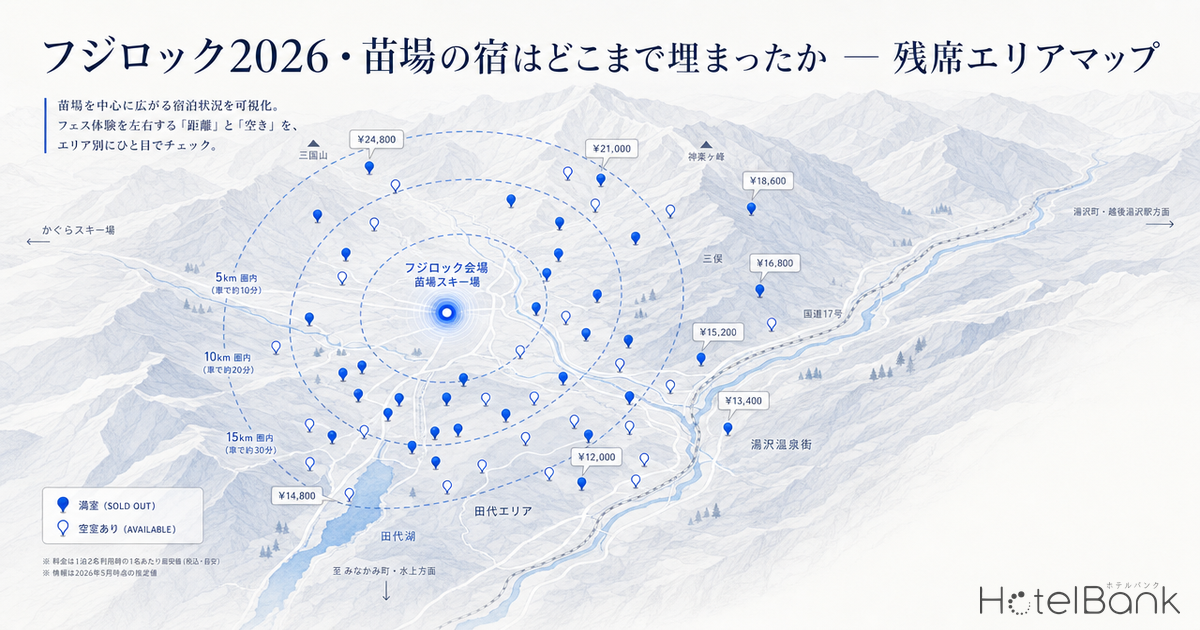
The map below overlays concentric circles at 5km, 10km, and 20km from the Naeba venue (center) with the Saturday, July 25 remaining-room status of properties whose OTA inventory could be tracked. Darker blue markers (fewer rooms left) cluster near the venue and in front of the station, while lighter markers (more rooms available) spread toward the hot-spring areas a little farther from the station. Beyond Fuji Rock, we also track across summer festivals how OTA prices and inventory move around each venue in our daily analysis of OTA prices and inventory across Japan’s three major summer-festival areas.
Source: Compiled by HotelBank Editorial Team from MetroEngines Research (N=25 properties whose OTA inventory could be tracked)
Even around the same station, the way remaining rooms appear varies. While some properties had their OTA listed inventory nearly filled by Saturday, hot-spring inns toward Minakami, Shima, and the Minakami area — across a valley from Yuzawa Station — still had rooms left at a remaining-room rate around 20% as of the survey date. For those willing to be a bit farther from the venue, a zone with options remaining across all three days does exist. Within the same Niigata / Echigo area, large events can also shift accommodation supply and demand significantly, as seen around major regional art festivals in the region.
One-Night Stays and Three-Night Stays Consume Inventory at Different Speeds
Lining up the three-day remaining-room rates by property reveals another structure. Inventory drains differently between lodgings targeted for “Saturday only” and those booked “straight through all three days.” The graph below shows the remaining-room rate (OTA listed basis) for each day at the main properties whose OTA prices and inventory could be tracked for all three days.
Source: Compiled by HotelBank Editorial Team from MetroEngines Research (remaining-room rate = share of bookable rooms against OTA listed inventory; as of survey date 2026/6/8)
At many properties, only Saturday’s (the 25th) remaining-room rate stands out as exceptionally low, while Friday and Sunday retain slack, tracing a “V” shape. This means spot demand for a single Saturday night has eaten into inventory first. Conversely, properties with low remaining-room rates across all of Friday–Sunday are likely ones where straight three-night bookings locked up rooms early. When festival attendees search for lodging, looking for “Saturday only” faces the fiercest competition, whereas booking a multi-night stay that includes a Friday arrival and Sunday departure can make rooms relatively easier to find in some cases.
Price & Remaining-Room Summary for Major Properties
Below we summarize, in order of distance from the venue, the properties whose OTA prices and inventory could be tracked as of the survey date. Prices are for double occupancy, tax included, averaged across all plans; the remaining-room rate is the share of bookable rooms on an OTA listed basis. Note that this is strictly a snapshot as of the survey date (June 8) and will fluctuate with future new plan additions and cancellations.
| Property | Distance to venue | Rooms | Saturday ADR | Fri→Sat increase | Saturday remaining-room rate |
|---|---|---|---|---|---|
| St. Moritz Ichibankan (サンモリッツ一番館) | 0.6km | 24 rooms | ¥127,500 | +28% | 0% |
| Hoshi Onsen Chojukan (法師温泉 長寿館) | 6.2km | 33 rooms | ¥114,600 | +11% | 0% |
| Kaikake Onsen (貝掛温泉) | 9.4km | 22 rooms | ¥62,800 | −4% | Rooms available |
| Angel Grandia Echigo Nakazato Onsen (エンゼルグランディア越後中里温泉) | 13.8km | 329 rooms | ¥144,200 | +36% | 4% |
| NASPA New Otani (NASPAニューオータニ) | 15.5km | 214 rooms | ¥120,600 | +7% | 0% |
| Trip7 Yuzawa Tenku Onsen Hotel (Trip7湯沢天空温泉ホテル) | 16.1km | 220 rooms | ¥123,600 | +24% | 17% |
| Yuzawa Grand Hotel (湯沢グランドホテル) | 16.4km | 87 rooms | ¥151,300 | +43% | 0% |
| Minakami Hotel Juraku (みなかみホテルジュラク) | 16.2km | 96 rooms | ¥105,500 | +30% | 1% |
| Hotel Yu-no-Jin (ホテル湯の陣) | 17.5km | 108 rooms | ¥56,600 | +40% | 24% |
| Tatsumikan (辰巳館) | 18.2km | 41 rooms | ¥104,100 | +24% | 10% |
Source: Compiled by HotelBank Editorial Team from MetroEngines Research (as of survey date 2026/6/8, based on OTA listed prices / inventory)
A Practical Game Plan for “Ticket in Hand, No Room Yet” Attendees
From the data as of the survey date (about 46 days before the festival), let us organize a practical room-hunting strategy into three points.
First, prioritize the single Saturday night. Demand concentrates on Saturday, July 25, making it the toughest in both price and inventory terms. Friday and Sunday have relatively more slack, so if possible, booking a multi-night stay with a Friday arrival plus the Saturday night can make rooms easier to find than searching for Saturday alone.
Second, do not judge the walkable zone (5km ring) by OTAs alone. Lodgings very close to the Naeba venue commonly do not list much inventory on OTAs, so “sold out on OTAs” does not necessarily mean “completely unavailable.” It is worth combining channels beyond OTAs, such as the official tours, direct inquiries to properties, and cancellation waitlists.
Third, remaining rooms are distributed in the 10–20km ring around Echigo-Yuzawa Station. In particular, hot-spring inns toward Minakami, Shima, and the Minakami area — across a valley from the station — included properties still holding rooms at a remaining-room rate around 20% as of the survey date. If you can tolerate the travel time to the venue, this is the most realistic zone in which to secure a room.
⚠ Note on data for future dates: The prices and remaining-room rates in this article are values that were publicly listed on OTAs as of the survey date (June 8, 2026 — about 46 days before the three peak days), and they fluctuate as the check-in date approaches. With more than a month until the festival, remaining rooms will continue to shift due to new plan additions and cancellations on the lodging side. Please read this article not as a declaration of sold-out status but as a “snapshot of an ongoing booking situation.”
Summary
For lodgings in the Naeba / Echigo-Yuzawa area around FUJI ROCK FESTIVAL ’26 (July 24–26), three structures clearly emerge as of the survey date: “demand is concentrated on Saturday, July 25,” “the 5km walkable ring rarely shows OTA inventory,” and “remaining rooms are distributed in the 10–20km ring around Echigo-Yuzawa Station.” The key to securing a room is to approach the scarce lodgings very close to the venue via channels outside OTAs, and to lock in the large hot-spring hotels around the station early via OTAs. There is still time before the festival and inventory is fluid, but the underlying skeleton — a demand peak centered on Saturday and a ring-by-ring distribution of remaining rooms — is unlikely to change much for a while.
Related Reading
References & Sources
- FUJI ROCK FESTIVAL ’26 Official Site (event dates: July 24, 25, 26, 2026)
- FUJI ROCK FESTIVAL ’26 | FESTIVAL INFORMATION
- MetroEngines Research — collected data on publicly listed OTA inventory and prices (Naeba / Echigo-Yuzawa area, as of survey date June 8, 2026)