

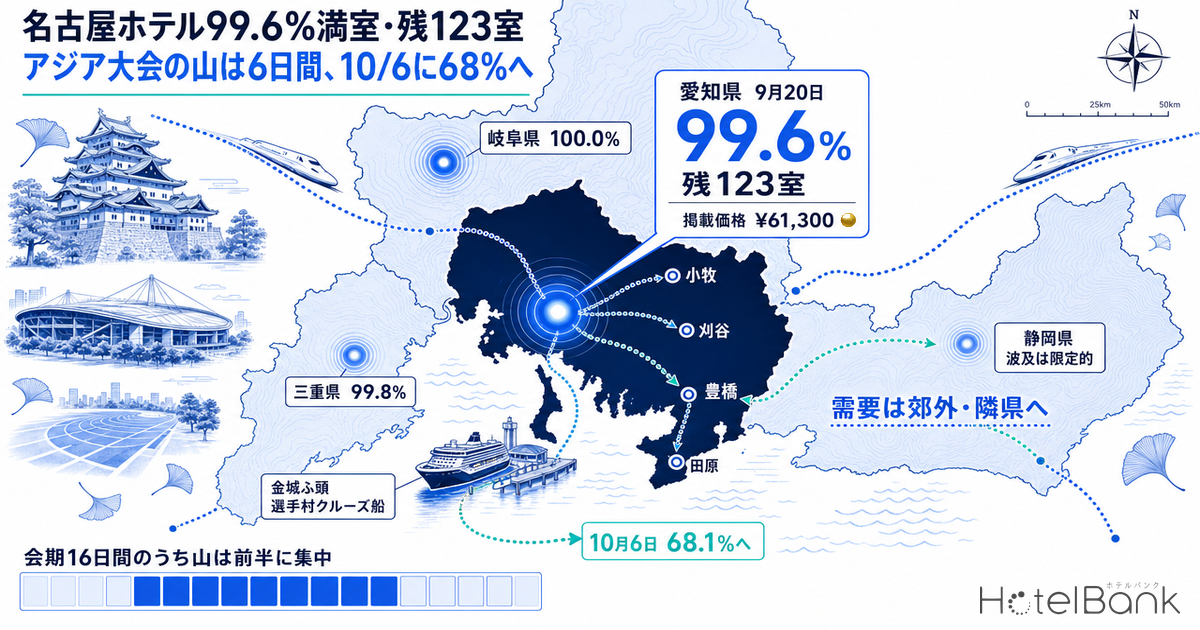
The 20th Asian Games (2026 / Aichi-Nagoya) opened on Saturday, September 19, 2026. This article is a follow-up to “Asian Games 2026: 1,500 Ship Rooms vs Nagoya’s 28,986-Room Stock”, published before the opening. That piece examined a supply design that skipped building an athletes’ village and covered it with a 1,500-room cruise ship instead. Two days into the Games, there is now enough measured data to trace what actually happened on the accommodation side.
The conclusion first. Aichi Prefecture’s estimated occupancy reached 99.6% on Sunday, September 20 — the day after the opening — with just 123 rooms left unsold. But demand did not spread evenly across the 16-day Games period: it is concentrated in the first stretch, September 19-26. By Tuesday, October 6 — two days after the closing ceremony — estimated occupancy is on course to fall back to 68.1%, and the week of the Asian Para Games opening on October 18 sits, at the same lead time, closer to “an ordinary Saturday with no event” than to the Asian Games period.
Metric Definitions Used in This Article
- OCC (occupancy): the share of sold rooms against total rooms in the area (an estimate based on OTA sales inventory). Because it is derived from how listed OTA inventory is absorbed, it differs from a property’s actual overall occupancy.
- Rooms available: the number of rooms still sellable at each observation point (room basis, not a count of rate plans).
- LT (lead time): days remaining until check-in. LT0 = same day. This article uses only observations within LT45.
- Listed price: the average price shown on OTAs and similar channels at the time of survey (double occupancy, per room, tax included). Because it differs from the actual settled rate (ADR), this article avoids the term ADR and uses “listed price”.
- Data source: MetroEngines Research
- — Estimated occupancy of 99.6% with 123 rooms left on Sunday, September 20, 2026. The 328 properties and 33,635 rooms tracked on OTAs across Aichi had effectively run out of sellable inventory.
- — The demand peak was about six days, not the full 16-day Games period. Compared at the same lead time (LT36), September 19-21 and 26 ran 6 to 21 points above the closing stretch and the days after it.
- — October 4, the day of the closing ceremony, is at 76.5%; October 6, when the ship departs, is at 68.1% with 10,960 rooms left. For hotels, the Games end the night before the closing ceremony, not on it.
- — The spillover crossed prefectural borders. Estimated occupancy on September 20, 2026 was 100.0% in Gifu and 99.8% in Mie. Shizuoka, by contrast, gained only +6.6pt versus the pre-Games baseline.
- — The Asian Para Games opening on October 18 come with no ship. The LT36 snapshot for October 24 is 78.4%, almost level with October 17 (79.5%), a Saturday with no event.
The first two days measured — 123 rooms left on September 20, listed price ¥61,300
Using the 328 properties and 33,635 rooms in Aichi whose sales activity can be confirmed on OTAs and similar channels, we tracked estimated daily occupancy through September 2026. Weekdays in the first half of September ran in the 78-87% range, but the level shifts from Tuesday, September 15, the day the cruise ship serving as the athletes’ accommodation base entered Kinjo Pier at the Port of Nagoya.
September 15 came in at 94.9% and Wednesday, September 16 at 97.1% — weekdays, yet above the Saturday of the first week of September (88.2% on September 5). Saturday, September 19, the day of the opening ceremony, reached 98.6% with 460 rooms left, and the following day, September 20, hit 99.6% with 123 rooms left. With 123 rooms remaining against a base of 33,635, the prefecture as a whole had effectively lost its sellable inventory.
Listed prices moved with it. Weekdays in early September sat at ¥14,000-15,000; September 19 was ¥54,900 and September 20 ¥61,300. This does not mean “the average hotel in the prefecture quadrupled its rate.” It is the result of cheaper inventory selling out first, leaving only higher-priced rooms still listed. It is an accurate picture of what a traveller searching at that moment would see, but it is a different thing from the average settled rate.
Source: MetroEngines Research; compiled by the HotelBank Editorial Team (Aichi, N=328 properties / 33,635 rooms, September 1-20, 2026)
The peak is six days, not sixteen — comparing at the same lead time
The idea that “everything is sold out for the whole Games” is not accurate in the data. Because bookings accumulate as a function of days remaining (LT), lining up occupancy rates across different check-in dates is not a valid comparison. So for each check-in date we extracted the estimated occupancy at the same lead time — four snapshots at LT45, LT40, LT36 and LT30.
| Check-in date | Context | LT45 | LT40 | LT36 | LT30 |
|---|---|---|---|---|---|
| 9/19 (Sat) | Asian Games opening ceremony | 90.4% | 91.4% | 91.9% | 93.8% |
| 9/20 (Sun) | Day 2 of the Games | 93.5% | 94.5% | 95.5% | 96.4% |
| 9/26 (Sat) | Saturday during the Games | 93.3% | 93.8% | 94.2% | 95.3% |
| 10/3 (Sat) | Final Saturday of the Games | 84.8% | 85.5% | 85.8% | 88.0% |
| 10/10 (Sat) | Saturday after the closing | 71.1% | 72.8% | 74.5% | 77.8% |
| 10/17 (Sat) | Saturday before the Para Games | 76.8% | 78.7% | 79.5% | 82.1% |
| 10/24 (Sat) | Asian Para Games closing ceremony | 74.9% | 77.0% | 78.4% | — |
| 10/31 (Sat) | Saturday after both Games | 69.6% | — | — | — |
Source: MetroEngines Research; compiled by the HotelBank Editorial Team (Aichi, N=367-371 properties, observations within LT45 only)
Read the LT36 column vertically and the structure appears. September 19, the opening ceremony, is at 91.9%; September 20 at 95.5%; September 26, a Saturday during the Games, at 94.2%. But October 3, the final Saturday of the Games, drops to 85.8%, and October 10, after the closing, sits at 74.5%. In other words, a gap of 6 to 21 points between the first half and the closing stretch was already visible 36 days out.
Games demand did not fill the period evenly. It landed on the first weekend — the three-day holiday of September 19-21, which includes the opening ceremony — and on the Saturday that followed (September 26). September 19 to 21 is a long weekend containing Respect for the Aged Day, so the opening ceremony and a calendar peak coincided.
Source: MetroEngines Research; compiled by the HotelBank Editorial Team (Aichi, LT45-LT30, observations within LT45 only)
The mid-Games trough and the October 6 cliff — from 123 rooms to 10,960
Lining up inventory for the second half of the Games (September 21 – October 4) and the days after the closing, using the most recent snapshots observable at the time of writing (LT3-LT21), two distinct “landing points” emerge.
The first is a weekday trough during the Games. Wednesday, September 23 (Autumnal Equinox Day) shows an estimated 89.1% with 3,607 rooms left and a listed price of ¥25,300. Two days earlier, Monday, September 21 (Respect for the Aged Day) was at 99.0% with 321 rooms left and ¥53,600 — a completely different picture, even though both are public holidays. Once the long weekend ended, domestic leisure demand dropped out and spectator demand clustered on weekends. Wednesday, September 30 shows the same pattern at 90.9% and ¥26,700.
The second is the cliff around the closing ceremony. October 3, the final Saturday of the Games, is at 91.8% with 2,817 rooms left, but Sunday, October 4 — the day of the closing ceremony — falls sharply to 76.5% with 8,058 rooms left. Monday, October 5 is at 71.9%, and Tuesday, October 6, when the cruise ship departs, is at 68.1% with 10,960 rooms left. The listed price also reverts, from ¥35,600 on October 3 to ¥17,300 on October 6.
A closing-ceremony day turning quiet is consistent with how event accommodation generally behaves. Delegations and officials head home as the event closes, so the night of the closing day tends to be a day people leave rather than a day they stay. From a hotel’s point of view, the Games end the day before the closing ceremony, not on it.
Source: MetroEngines Research; compiled by the HotelBank Editorial Team (Aichi, N=368-370 properties, latest observation at LT3-21 for each date)
Inventory did not vanish only inside Nagoya — 179 properties measured
We aggregated inventory absorption at the individual property level across the seven days from September 19 to 25. Of the 800 properties covered in Aichi, 340 had observable inventory data within the period. From those, we narrowed to the 179 properties whose OTA-listed allocation is at least 30% of total rooms (properties with a small listed allocation were excluded because a low room count can reflect direct-booking-led channel strategy, drip-feeding inventory, or simply a small contracted allocation to OTAs, rather than genuine supply and demand).
Of those 179 properties, 54 averaged less than 5% rooms available across the seven days. They were spread across more than 12 municipalities and wards: eight in Naka-ku, Nagoya; six in Minamichita; five in Toyota; and three each in Toyohashi, Nakamura-ku (Nagoya), Handa and Inuyama. Among the 100 properties with the lowest availability, 76 are outside the city of Nagoya.
| Property | Location | Type | Rooms | Avg. rooms available | Days observed sold out | OTA allocation |
|---|---|---|---|---|---|---|
| Wind City Hotel (ウィンドシティホテル) | Tahara | Business hotel | 105 | 0.1% | 7 of 7 | 34.3% |
| Comfort Hotel Toyohashi (コンフォートホテル豊橋) | Toyohashi | Business hotel | 132 | 0.1% | 6 of 7 | 39.4% |
| Castle Inn Komaki (キャッスルイン小牧) | Komaki | Business hotel | 101 | 0.3% | 7 of 7 | 33.7% |
| Tokai City Hotel (東海シティホテル) | Tokai | Business hotel | 55 | 0.5% | 7 of 7 | 30.9% |
| Tabist Samotokan Owariasahi (Tabist さもと館 尾張旭) | Owariasahi | Ryokan | 20 | 0.7% | 7 of 7 | 40.0% |
| Dormy Inn PREMIUM Nagoya Sakae (ドーミーインPREMIUM名古屋栄) | Naka-ku, Nagoya | Business hotel | 212 | 0.7% | 6 of 7 | 34.9% |
| Super Hotel Nagoya Ekimae (スーパーホテル 名古屋駅前) | Nakamura-ku, Nagoya | Business hotel | 139 | 0.8% | 7 of 7 | 50.4% |
| Sanco Inn Nagoya Nishiki -Shikinoyu- (三交イン名古屋錦~四季乃湯~) | Naka-ku, Nagoya | Business hotel | 149 | 0.8% | 6 of 7 | 34.2% |
| Midorikan (みどり館) | Handa | Business hotel | 47 | 0.9% | 6 of 7 | 74.5% |
| Kariya Plaza Hotel (刈谷プラザホテル) | Kariya | Business hotel | 60 | 0.9% | 7 of 7 | 43.3% |
| Smile Hotel Nagoya Sakae (スマイルホテル名古屋栄) | Naka-ku, Nagoya | Business hotel | 142 | 1.1% | 7 of 7 | 36.6% |
| Park Hotel Kariya (パークホテル刈谷) | Kariya | Business hotel | 80 | 1.1% | 7 of 7 | 57.5% |
Source: MetroEngines Research; compiled by the HotelBank Editorial Team (Aichi, September 19-25, 2026; 340 of 800 covered properties had observable data, of which the 179 with OTA allocation of 30% or more were aggregated)
Tahara, Toyohashi, Komaki, Tokai, Owariasahi, Handa, Kariya — the top of the list is filled with suburban and surrounding cities that are not competition venues at all. After the areas around Nagoya’s main terminals filled early, demand was pushed out to whatever was reachable by rail or car. Signs of this were visible before the opening: the snapshot taken 37 days out, broken down by municipality in Asian Games 2026: Toyohashi +18.7pt, Kuwana +14.4pt Beyond Nagoya, showed the same suburban shift. Several properties were observed sold out on all seven days of the first week, which shows that inventory disappeared regardless of property size.
Spillover across prefectural borders — Gifu 100.0%, Mie 99.8%, Shizuoka limited
The push-out crossed prefectural lines as well. For the four prefectures of Aichi, Gifu, Mie and Shizuoka, we compared average estimated occupancy and average listed price before the Games (September 1-14) with the period from the ship’s arrival onward (September 15-20).
| Prefecture | Properties / rooms | 9/1-14 avg. OCC | 9/15-20 avg. OCC | Change | 9/20 OCC | Listed price change |
|---|---|---|---|---|---|---|
| Aichi | 328 properties / 33,635 rooms | 83.7% | 96.9% | +13.2pt | 99.6% | +126% |
| Gifu | 225 properties / 10,493 rooms | 83.0% | 93.3% | +10.3pt | 100.0% | +60% |
| Mie | 223 properties / 13,089 rooms | 78.6% | 88.6% | +10.0pt | 99.8% | +83% |
| Shizuoka | 690 properties / 29,829 rooms | 80.3% | 86.9% | +6.6pt | 94.4% | +24% |
Source: MetroEngines Research; compiled by the HotelBank Editorial Team (properties with confirmed OTA activity in each prefecture, September 1-20, 2026)
On Sunday, September 20, estimated occupancy was 100.0% in Gifu and 99.8% in Mie — on par with Aichi’s 99.6%, meaning inventory disappeared not just in the host prefecture but across two neighbours as well. Aichi posted the largest listed-price increase at +126%, but Mie (+83%) and Gifu (+60%) were also substantial.
Shizuoka, by contrast, gained only +6.6pt with listed prices up 24%. Although it is connected to Nagoya by the Tokaido Shinkansen, the prefecture stretches a long way east to west and most of its accommodation is concentrated in the eastern side, around Izu and Atami. The result suggests that the strength of spillover is set not by distance but by whether the area is realistically within commuting range.
Source: MetroEngines Research; compiled by the HotelBank Editorial Team (Aichi N=328 / Gifu N=225 / Mie N=223 / Shizuoka N=690, September 2026)
The Asian Para Games open October 18 with no ship — booking pace so far
There is one point the earlier article did not cover. Fourteen days after the Asian Games close, the 5th Asian Para Games (2026 / Aichi-Nagoya) run from Sunday, October 18 to Saturday, October 24, 2026, with 18 sports and 502 events and an expected 2,400-2,700 athletes plus 1,200-1,300 team officials.
The accommodation design differs from the Asian Games. According to the organising committee, the mobile accommodation facility built at Garden Pier in the Port of Nagoya (container-sized housing units for roughly 2,000 people) will be used for both events, but the cruise ship is a measure limited to the Asian Games, and Garden Pier alone will serve as the accommodation base for the Asian Para Games. The 1,500 rooms of floating inventory leave the Port of Nagoya on October 6.
| Item | 20th Asian Games | 5th Asian Para Games |
|---|---|---|
| Dates | September 19 (Sat) – October 4 (Sun), 2026 | October 18 (Sun) – 24 (Sat), 2026 |
| Accommodation base | Kinjo Pier (cruise ship) + Garden Pier | Garden Pier only |
| Cruise ship | Costa Serena, approx. 1,500 rooms, approx. 290m long | None |
| Ship berthing | September 15 – October 6, 2026 (22 days) | — |
| Ship capacity | Approx. 4,000 people in total, 43 countries and regions, 18 sports | — |
| Garden Pier | Mobile accommodation for approx. 2,000 people | Mobile accommodation for approx. 2,000 people |
Source: compiled by the HotelBank Editorial Team from materials released by the Aichi-Nagoya Asian Games and Asian Para Games Organising Committee
So how is the market pricing in this second wave? Returning to the same-lead-time snapshots, Saturday, October 24 — the day of the Asian Para Games closing ceremony — is at 78.4% at LT36. That places it not with September 26 (94.2%), a Saturday during the Asian Games, but almost exactly alongside October 17 (79.5%), a Saturday with no event.
That said, October 24 is 34 days out at the time of writing, so there is still room for bookings to build. All that can be said at this point is that “as of the LT36 checkpoint, the kind of front-loaded inventory absorption seen during the Asian Games has not been observed.” How weekdays behave during the Para Games period is examined ahead of time in Asian Para Games 2026: Aichi Weekdays Run 12pt Above the Next Week.
The difference in scale explains the background. The Asian Games involve roughly 15,000 athletes and staff alone, before media and officials are added. The Asian Para Games, by contrast, total roughly 3,600-4,000 athletes and officials combined. If the roughly 2,000-person capacity at Garden Pier absorbs about half of that, the accommodation demand reaching the open market is just under 2,000 people — about 1,000 rooms at double occupancy. Against the 28,986 total rooms in the city of Nagoya cited in the earlier article, that is around 3%, not a scale that can drain inventory on its own the way September did.
What this means for hotel operations — three takeaways
1. Read big-event demand as a peak, not as a period. In this data, inventory went effectively to zero only on September 19-21 and 26 out of a 16-day Games period; the Wednesdays of September 23 and 30 sat at an estimated 89-91% with listed prices less than half the Games peak. Applying a single flat rate calendar across the whole period loses money at both ends — leaving revenue on the table on peak days and unsold rooms in the troughs. There is room to look at the day-of-week and long-weekend layout first, then design the peaks and troughs separately.
2. The closing day is not a demand day. Saturday, October 3 is at 91.8% against 76.5% on Sunday, October 4. The day the closing ceremony takes place is one of the softest days of the entire period. For event-linked pricing, setting the end point at the night before the final day rather than the final day itself fits reality better. Put the other way round, the closing day and the day after can be used as a window to go after ordinary leisure and business demand.
3. Pushed-out demand reaches surrounding cities and neighbouring prefectures. Gifu at 100.0% and Mie at 99.8% show that a major event can become a demand event for hotels 30-60 minutes from the host area. The same phenomenon shows up in properties in Tahara, Toyohashi, Komaki and Kariya lining up with availability under 1%. Leaving the rate calendar untouched on the grounds of being far from the host venue simply forfeits the opportunity.
And the second wave calls for a different design from the first. October 18-24 has no external capacity in the form of a 1,500-room ship — but the demand is smaller too. Current booking pace looks little different from an ordinary October. Rather than transposing the Asian Games figures directly, this is a period to judge by watching how bookings build around LT30.
⚠ A note on data for future dates: The estimated occupancy rates, rooms available and listed prices shown for check-in dates from September 21, 2026 onward are estimates based on inventory listed on OTAs and similar channels as of the time of writing (September 20, 2026). They will shift as the check-in date approaches through new rate plans, cancellations and price adjustments. The Asian Para Games period (October 18-24) in particular is still more than 30 days out in lead time, leaving room for bookings to build.
Frequently asked questions
Q. How full were hotels in Aichi during the Asian Games?
A. Estimated occupancy on Sunday, September 20, 2026 was 99.6%, with 123 rooms left (Aichi, N=328 properties / 33,635 rooms). Saturday, September 19, the day of the opening ceremony, was at 98.6% with 460 rooms left. Wednesday, September 23, however, was at 89.1% with 3,607 rooms left — the figures vary widely from day to day even within the Games period.
Q. Can the general public book the cruise ship’s 1,500 rooms?
A. No. The cabins on the Costa Serena are for delegations and event officials, operating as an accommodation base for approximately 4,000 people in total from 43 countries and regions across 18 sports. The ship is berthed at Kinjo Pier in the Port of Nagoya from September 15 to October 6, 2026.
Q. What happens to Nagoya hotels once the Games end?
A. As of Sunday, October 4, the day of the closing ceremony, the estimate is 76.5% with 8,058 rooms left, and by Tuesday, October 6, when the ship departs, it is on course to return to an estimated 68.1% with 10,960 rooms left. Listed prices also fall, from ¥35,600 on October 3 to ¥17,300 on October 6.
Q. Will the cruise ship also be used for the Asian Para Games?
A. No. According to the organising committee, the accommodation base for the Asian Para Games (October 18-24, 2026) is solely the mobile accommodation facility at Garden Pier in the Port of Nagoya (capacity for approximately 2,000 people); the cruise ship is a measure limited to the Asian Games.
Q. Were hotels in neighbouring prefectures affected?
A. Yes. Estimated occupancy on September 20, 2026 was 100.0% in Gifu and 99.8% in Mie, almost level with Aichi. Against the pre-Games period (September 1-14), that is +10.3pt for Gifu and +10.0pt for Mie. Shizuoka, by contrast, gained only +6.6pt.
Related reading
- Asian Games 2026: 1,500 Ship Rooms vs Nagoya’s 28,986-Room Stock (the earlier article)
- Asian Games 2026: Toyohashi +18.7pt, Kuwana +14.4pt Beyond Nagoya
- Asian Para Games 2026: Aichi Weekdays Run 12pt Above the Next Week
References and sources
■ Data source
Daily observations of sales inventory and listed prices published on OTAs and similar channels, aggregated by MetroEngines Research. For the four prefectures of Aichi, Gifu, Mie and Shizuoka, covering check-in dates from September 1 to October 9, 2026, using only observations within a lead time of 45 days. The base populations are 328-371 properties (33,635 rooms) in Aichi, 225 properties (10,493 rooms) in Gifu, 223 properties (13,089 rooms) in Mie and 690 properties (29,829 rooms) in Shizuoka. The property-level inventory aggregation is limited to the 340 properties, out of 800 covered in Aichi, with observable data during the period, and further to the 179 whose OTA-listed allocation is at least 30% of total rooms.
■ Assumptions
Estimated occupancy is an estimate based on how OTA sales inventory is absorbed; it is not a property’s actual overall occupancy. The same-lead-time comparison (LT45 / LT40 / LT36 / LT30) aligns the days remaining for each check-in date, removing apparent differences caused by varying observation dates. The approximate accommodation demand reaching the open market during the Asian Para Games assumes that the roughly 2,000-person capacity at Garden Pier in the Port of Nagoya absorbs about half of the 3,600-4,000 athletes and team officials, with the remaining just-under-2,000 people converted at double occupancy to approximately 1,000 rooms. Listed price is an average at double occupancy, per room, tax included, and is not a settled rate.
■ Limitations and caveats
Figures shown for check-in dates from September 21, 2026 onward are interim values as of the time of writing (September 20, 2026) and will shift through new rate plans, cancellations and price adjustments. The Asian Para Games period (October 18-24) in particular is at a lead time of more than 30 days, leaving considerable room for bookings to build. Because properties with a small OTA-listed allocation are excluded from the aggregation, the occupancy of properties run primarily on direct bookings is not reflected. This article also shows a contemporaneous correspondence between the Games schedule and inventory absorption; it does not establish causation.
■ Market data
- MetroEngines Research — estimated occupancy, rooms available and listed prices for Aichi, Gifu, Mie and Shizuoka (September 1 – October 9, 2026; Aichi N=328-371 properties)
- MetroEngines Research — property-level inventory trends (September 19-25, 2026; 340 of 800 Aichi properties with observable data, of which the 179 with OTA allocation of 30% or more were aggregated)
■ Official and press sources
- The 20th Asian Games (2026 / Aichi-Nagoya) official site
- Aichi-Nagoya Asian Games and Asian Para Games Organising Committee, “On establishing the delegation accommodation base at Garden Pier, Port of Nagoya”
- The 5th Asian Para Games (2026 / Aichi-Nagoya) Games Master Plan
- Japanese Paralympic Committee, “Aichi-Nagoya 2026 Asian Para Games — Games overview”
- Costa Crociere S.p.A., “A ‘floating hotel’ for athletes and event officials” (press release)
- Nikkei, “Asian Games accommodation cruise ship unveiled — no athletes’ village, 4,000 people at the Port of Nagoya”
- City of Nagoya, “The 20th Asian Games and the 5th Asian Para Games”