

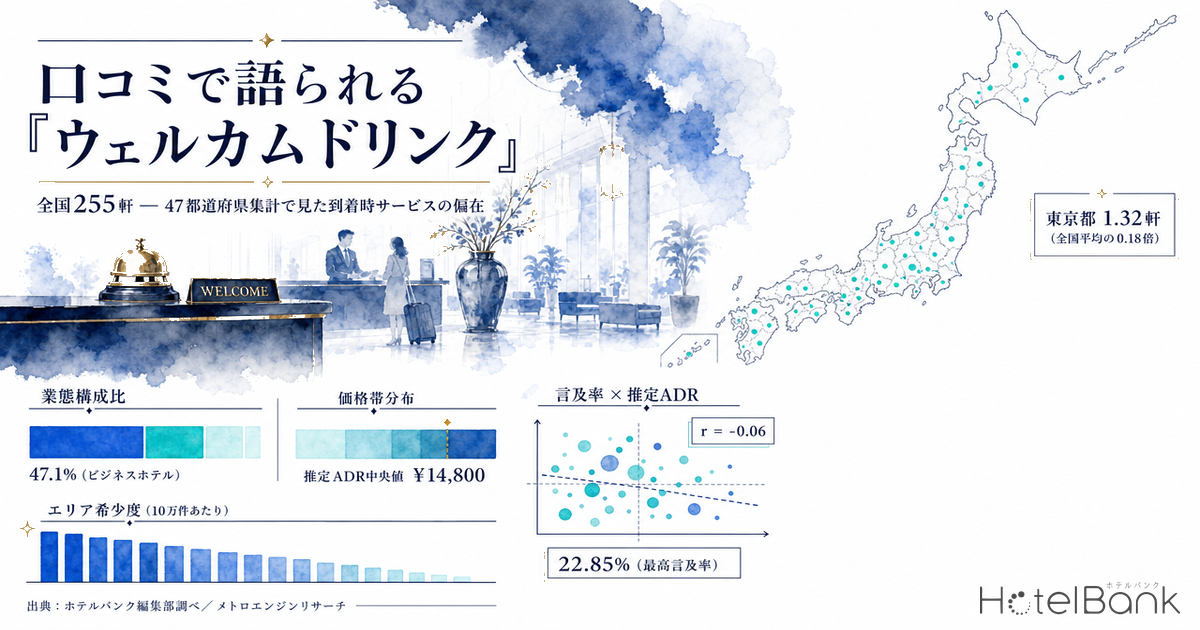
A single drink handed over at check-in. The cost is a few dozen yen for a cup of coffee, or somewhere in the low hundreds for a draft beer — one of the smallest investment units anywhere in a hotel’s service lineup. And yet this “drink on arrival” appears in guest reviews with surprising frequency. The HotelBank Editorial Team took the granular tags assigned through NLP analysis of guest reviews and, for all 47 prefectures, tallied one prefecture at a time the reviews that mention arrival-time service such as welcome drinks and welcome sweets. What emerged was a narrow distribution of 255 properties nationwide, and a structure in which nearly half of them are business hotels.
Metric Definitions Used in This Article
- Mention count / mention rate: Among guest reviews posted in the most recent 24 months, the number that refer to drinks or sweets served on arrival (welcome drinks, welcome sweets, beverage service at check-in, and similar), and that number as a share of the property’s total review count. The mention rate is an indicator of how often something is talked about — it is not a rating score. It does not indicate the quality of the service, nor any ranking of merit between properties.
- Extraction conditions: Most recent 24 months, positive context, 20 or more total reviews, 10 or more relevant mentions. These conditions were applied to each of the 47 prefectures separately and tallied at the prefecture level (a single nationwide query is truncated at the top 100 results).
- ADR (average daily rate): An estimated transacted rate (tax-exclusive equivalent) calculated by applying property-type correction coefficients to the lowest published plan level each property lists on OTAs (two guests per room, per-room rate, tax included). Cross-checked against property-level actuals disclosed by listed hotel REITs (91 properties, most recent 3 months), the median error is approximately 7%. These are estimates and differ from each property’s actual transacted prices or accounting figures. This article uses the 12-month average for July 2025 through June 2026. Area-level ADR is the median across the covered properties (the level of a typical property in that area).
- Data sources: Reviews — HotelBank Editorial Team research / Prices — MetroEngines Research
- — 255 properties nationwide: Tallying all 47 prefectures one at a time, we extracted the properties whose arrival-time drink and sweets service is talked about in reviews. A total of 5,020 mentions, spread across 45 prefectures (Akita and Shiga returned zero).
- — 47.1% are business hotels: Ryokan 32.9%, resort hotels 12.2%, city hotels 6.3%. This is not a signature of luxury resorts — the main battleground is the limited-service segment.
- — Median estimated ADR ¥14,800: Properties under ¥15,000 make up the majority (51.4%), and the correlation between estimated ADR and mention rate is r = -0.06 — essentially none. A touchpoint that works at any price level.
- — Tokyo has 1.32 properties per 100,000 reviews: 0.18× the national average of 7.2. Aichi, Osaka, Kyoto and Fukuoka also fall below average, leaving untapped white space in the major metros.
Tallying All 47 Prefectures One at a Time — 255 Properties, Two Prefectures at Zero
First, a word on how the population was built. Extracting mentions of arrival-time service in a single nationwide query hits a return-count ceiling and caps the population. So for this article we tallied each of the 47 prefectures individually and summed the results. Even the prefecture with the most hits had only 20 properties, so no prefecture came close to the ceiling.
This method yielded 255 properties and a total of 5,020 mentions. Those 255 properties hold 182,801 reviews between them, which works out to a simple average of 2.7% of reviews per property touching on arrival-time service. 45 prefectures had at least one qualifying property; Akita and Shiga had none. That said, a separate tally for Akita shows 53 mentions over 24 months spread across 24 properties. In other words, it is not that the service does not exist — it is that mentions are not concentrated enough at any single property to reach the 10-mention threshold.
The total volume of reviews covered across the 47 prefectures was approximately 3.56 million. Extracting 255 properties from that pool gives a national average of 7.2 properties per 100,000 reviews. That “how many properties per 100,000 reviews” metric becomes important in the area analysis later on.
Top 30 by Mention Count — A 14% Mention Rate at the Top, 119 Mentions at No. 2
The table below lists the 30 properties with the most mentions. Top of the list is Chateraise Hotel Danrokan (シャトレーゼホテル談露館) in Kofu, Yamanashi, with 132 mentions and a 14.07% mention rate. The property rebranded to the Chateraise Hotel Group in June 2023, and its official information advertises welcome sweets — a complimentary cake of the day for guests, served 14:00–17:00 — alongside in-house ice cream service from 8:00 to 22:00. It is a case of a confectionery-maker lineage converting the arrival touchpoint directly into product strength. Chateraise Hotel Isawa (シャトレーゼホテル石和), from the same group, ranks fourth with a 22.85% mention rate — the highest figure in the entire dataset.
Second place, Oriental Hotel Tokyo Bay (オリエンタルホテル東京ベイ) in Urayasu, recorded 119 mentions. The hotel operates a guests-only welcome lounge on the second floor, offering coffee, three kinds of tea, a seasonal drink, beer and sparkling wine, plus freshly griddled pancakes and hotel-made cookies, all self-service and complimentary from 14:00 to 23:00. Against a total of 3,930 reviews the mention rate is 3.03% — hardly high — but the sheer size of the base pushed the absolute count up. High mention rates tend to appear at smaller properties, while high absolute counts tend to appear at large ones — the two need to be read side by side.
| # | Property | Prefecture | Type | Mentions | Mention rate | Total reviews | Est. ADR |
|---|---|---|---|---|---|---|---|
| 1 | Chateraise Hotel Danrokan (シャトレーゼホテル談露館) | Yamanashi | City Hotel | 132 | 14.07% | 938 | ¥16,700 |
| 2 | Oriental Hotel Tokyo Bay (オリエンタルホテル東京ベイ) | Chiba | Deluxe Hotel | 119 | 3.03% | 3,930 | — |
| 3 | Shoho, Utsukushigahara Onsen, Shinshu Matsumoto (信州松本 美ヶ原温泉 翔峰) | Nagano | Ryokan | 95 | 8.80% | 1,080 | ¥36,600 |
| 4 | Chateraise Hotel Isawa (シャトレーゼホテル石和) | Yamanashi | Ryokan | 93 | 22.85% | 407 | ¥16,900 |
| 5 | Sakura Terrace The Gallery (サクラテラスザギャラリー) | Kyoto | Business Hotel | 84 | 3.38% | 2,487 | ¥20,300 |
| 6 | Karatsu Seaside Hotel (唐津シーサイドホテル) | Saga | Resort Hotel | 82 | 8.49% | 966 | ¥17,400 |
| 7 | Super Hotel Premier JR Nara Station (スーパーホテル PremierJR奈良駅) | Nara | Business Hotel | 71 | 5.86% | 1,211 | ¥9,800 |
| 8 | Richmond Hotel Premier Asakusa (リッチモンドホテルプレミア浅草) | Tokyo | Business Hotel | 67 | 2.69% | 2,487 | ¥27,000 |
| 9 | Fujinoya Yutei (富士野屋夕亭) | Yamanashi | Ryokan | 53 | 7.48% | 709 | ¥19,000 |
| 10 | Richmond Hotel Premier Sendai Ekimae (リッチモンドホテルプレミア仙台駅前) | Miyagi | Business Hotel | 51 | 4.64% | 1,098 | ¥14,900 |
| 11 | SAKURA TERRACE | Kyoto | Business Hotel | 49 | 3.09% | 1,586 | ¥15,900 |
| 12 | Kobe Port Tower Hotel (神戸ポートタワーホテル) | Hyogo | City Hotel | 44 | 2.47% | 1,780 | ¥13,100 |
| 13 | Ibusuki Kaijo Hotel (指宿海上ホテル) | Kagoshima | Resort Hotel | 44 | 9.21% | 478 | ¥11,900 |
| 14 | Hotel Keihan Universal Tower (ホテル京阪 ユニバーサル・タワー) | Osaka | City Hotel | 43 | 1.14% | 3,759 | ¥28,700 |
| 15 | Kinugawa Onsen Hotel (鬼怒川温泉ホテル) | Tochigi | Ryokan | 43 | 4.37% | 983 | ¥26,200 |
| 16 | Harazuru Grand Sky Hotel (原鶴グランドスカイホテル) | Fukuoka | City Hotel | 40 | 4.59% | 871 | ¥16,200 |
| 17 | Imagine Hotel & Resort Hakodate (イマジン ホテル&リゾート函館) | Hokkaido | Resort Hotel | 40 | 3.00% | 1,335 | ¥15,000 |
| 18 | Super Hotel Yamaguchi Yuda Onsen (スーパーホテル 山口湯田温泉) | Yamaguchi | Business Hotel | 38 | 6.92% | 549 | ¥8,700 |
| 19 | Kuretake Inn Yaizu Ekimae (くれたけイン焼津駅前) | Shizuoka | Business Hotel | 37 | 7.09% | 522 | ¥6,600 |
| 20 | Kobe Meriken Park Oriental Hotel (神戸メリケンパークオリエンタルホテル) | Hyogo | City Hotel | 36 | 0.83% | 4,317 | ¥35,100 |
| 21 | Hotel Maiyukuru Shogetsu (ホテルマイユクール祥月) | Kanagawa | Ryokan | 36 | 5.66% | 636 | ¥27,900 |
| 22 | Super Hotel Premier Musashi-Kosugi Ekimae (スーパーホテル Premier武蔵小杉駅前) | Kanagawa | Business Hotel | 34 | 6.02% | 565 | ¥13,500 |
| 23 | Tendo Hotel (天童ホテル) | Yamagata | Ryokan | 34 | 5.59% | 608 | ¥19,400 |
| 24 | Hotel Hillarys Shinsaibashi (ホテルヒラリーズ心斎橋) | Osaka | Business Hotel | 34 | 2.49% | 1,365 | ¥13,100 |
| 25 | Izumo Green Hotel Morris (出雲グリーンホテルモーリス) | Shimane | Business Hotel | 33 | 5.12% | 645 | ¥8,000 |
| 26 | Super Hotel Premier Hakata Station Chikushi-guchi Natural Hot Spring (スーパーホテル Premier博多駅・筑紫口天然温泉) | Fukuoka | Business Hotel | 33 | 7.40% | 446 | ¥14,600 |
| 27 | Dogashima New Ginsui (堂ヶ島 ニュー銀水) | Shizuoka | Resort Hotel | 33 | 3.46% | 954 | ¥25,200 |
| 28 | Oarai Hotel (大洗ホテル) | Ibaraki | Resort Hotel | 32 | 4.16% | 770 | ¥35,900 |
| 29 | Sakaide Plaza Hotel (坂出プラザホテル) | Kagawa | Business Hotel | 32 | 6.91% | 463 | ¥7,300 |
| 30 | Vessel Inn Sapporo Nakajima Park (ベッセルイン札幌中島公園) | Hokkaido | Business Hotel | 32 | 2.89% | 1,108 | ¥15,000 |
Source: HotelBank Editorial Team research (most recent 24 months, N=255 properties across 45 prefectures, 10+ mentions and 20+ total reviews) / Estimated ADR from MetroEngines Research (average for July 2025–June 2026, rounded to the nearest ¥100). Property names follow each hotel’s current official naming.
The chain lineup is also telling. Of the 255 properties, 33 are Super Hotel locations — the largest single presence. The chain runs a welcome bar (a complimentary drink service for guests) at some locations and marks the participating hotels with a cocktail icon on the property list on its official site. Next come Vessel Inn with 7, Kuretake Inn with 5, Richmond Hotel with 4 and Comfort Hotel with 4, with several other business hotel chains appearing at scales of two to eight properties. Building the service into a brand-wide standard puts multiple properties on the review playing field simultaneously — that is the structure showing up here.
Skew by Property Type — 47% Business Hotels, 33% Ryokan
Split the 255 properties by type and an unexpected concentration appears. The largest group is business hotels at 120 properties (47.1%), followed by ryokan at 84 (32.9%), resort hotels at 31 (12.2%) and city hotels at 16 (6.3%), plus 2 deluxe hotels and 2 others. The phrase “welcome drink” most readily evokes a luxury resort lounge, but what guests actually talk about sits in the limited-service segment. This pattern — where the touchpoints guests talk about cluster by property type — is not unique to arrival-time service.
Source: HotelBank Editorial Team research (NLP analysis of reviews, N=255 properties) / MetroEngines Research (estimated transacted ADR, N=251 properties in scope)
There is a reason for the skew. Limited-service hotels have few experiential touchpoints beyond the guest room and breakfast, so large communal baths, freshly baked bread and welcome bars become the main battleground for differentiation. At resorts and city hotels, by contrast, strong experiences such as restaurants, pools, spas and views dominate how guests narrate their stay, so the drink on arrival is relatively easy to bury. Indeed, the median mention rate by type is 3.15% for business hotels and 3.19% for ryokan, against 2.48% for resort hotels and 1.88% for city hotels — the more experiential elements a type offers, the lower the figure.
| Property type | Properties | Share | Total mentions | Median mention rate | Median est. ADR | Gap vs. same-prefecture, same-type median |
|---|---|---|---|---|---|---|
| Business Hotel | 120 | 47.1% | 2,254 | 3.15% | ¥9,900 | +18.6% |
| Ryokan | 84 | 32.9% | 1,499 | 3.19% | ¥22,700 | +44.7% |
| Resort Hotel | 31 | 12.2% | 641 | 2.48% | ¥17,900 | +24.3% |
| City Hotel | 16 | 6.3% | 467 | 1.88% | ¥14,300 | -4.1% |
| Other (deluxe, auberge, etc.) | 4 | 1.6% | 159 | — | — | — |
Source: HotelBank Editorial Team research (N=255 properties) / Estimated ADR from MetroEngines Research (251 properties in ADR scope; ADR rounded to the nearest ¥100)
The Relationship with Price — It Is Not “Because the Rate Is High”
The next question to test is whether arrival-time service is a marker of the high-rate segment, or a differentiation tool in the mid-price band. For the 251 of the 255 properties where an estimated ADR could be calculated, we grouped the 12-month average estimated transacted ADR into price bands.
The result is unambiguous. 71 properties (28.3%) sit under ¥10,000 and 58 (23.1%) between ¥10,000 and ¥15,000, so 129 in total (51.4%) fall below ¥15,000. Meanwhile, only 32 properties (12.7%) are at ¥30,000 or above. The overall median is ¥14,800, the first quartile ¥9,300 and the third quartile ¥22,600. Arrival-time service, in other words, is distributed less as a symbol of the luxury tier than as a hospitality device whose main battleground is the mid-price band.
Source: HotelBank Editorial Team research (NLP analysis of reviews, N=255 properties) / MetroEngines Research (estimated transacted ADR, N=251 properties in scope)
Going a step further, we plotted estimated ADR against mention rate for each of the 251 properties. If the story were “high rates get you talked about,” the plot should slope upward — but the actual correlation coefficient is r = -0.06, essentially none. Price level explains nothing at all about how much arrival-time service gets discussed. Put differently, whether it is an ¥8,000 business hotel or a ¥35,000 ryokan, this touchpoint leaves the same mark in reviews.
Source: HotelBank Editorial Team research (NLP analysis of reviews, N=255 properties) / MetroEngines Research (estimated transacted ADR, N=251 properties in scope)
A different picture emerges, though, when each property is compared against the level of its own prefecture and type. Measuring each property’s estimated ADR against the median estimated ADR for its prefecture × property type, 184 of the 251 (73%) sat above their local level. The median gap is +25.4%; by type, ryokan are at +44.7% (72 of 84 above), business hotels at +18.6% (86 of 120), resort hotels at +24.3%, and city hotels at -4.1%.
These figures need to be read carefully. The 10-or-more-mentions extraction condition inevitably selects properties with large review counts — that is, larger, better-known properties with more extensive facilities. A substantial part of the tendency to sit above local levels may reflect that selection effect. It is not possible to read a causal claim that arrival-time service pushed rates up. What can be read is only the concurrent fact that a high share of properties with this touchpoint are able to hold a higher price position within the same trade area and the same property type.
Area Scarcity — The Bigger the Metro, the Less It Is Talked About
By prefecture, the highest absolute counts are Hokkaido with 20 properties, Shizuoka with 19, Kanagawa with 13, Okinawa with 11 and Yamanashi with 10. But because both accommodation supply and total review volume differ enormously by prefecture, comparing absolute counts means little. So we divided by each prefecture’s analyzed review volume and normalized to qualifying properties per 100,000 reviews. The national average is 7.2.
What surfaced is a void in the major metros. Tokyo comes in at 1.32 — less than a fifth of the national average. Despite holding the country’s largest market at more than 530,000 reviews, only seven properties there are talked about for arrival-time service. Next are Aichi at 1.97 (2 properties), Osaka at 2.78 (7), Kyoto at 3.16 (6) and Fukuoka at 4.17 (5) — the major metropolitan markets all falling below the national average.
Source: HotelBank Editorial Team research (NLP analysis of guest reviews, N=255 properties across 45 prefectures)
At the opposite end, density is high in regional prefectures: Tottori at 27.2, Ibaraki at 25.3, Nara at 23.9, Yamaguchi at 20.2 and Aomori at 19.6. Smaller markets do make each individual property loom larger, but even so the picture is clear — the drink on arrival functions as a touchpoint that gets talked about outside the big cities, while remaining relatively untapped within them.
| Prefecture | Qualifying properties | Analyzed reviews | Properties per 100,000 | vs. national average |
|---|---|---|---|---|
| Tokyo | 7 | 531,318 | 1.32 | 0.18× |
| Aichi | 2 | 101,551 | 1.97 | 0.27× |
| Osaka | 7 | 252,047 | 2.78 | 0.39× |
| Kyoto | 6 | 189,810 | 3.16 | 0.44× |
| Fukuoka | 5 | 119,996 | 4.17 | 0.58× |
| Chiba | 7 | 139,263 | 5.03 | 0.70× |
| Hyogo | 7 | 113,698 | 6.16 | 0.86× |
| Hiroshima | 6 | 84,126 | 7.13 | 0.99× |
| Nagano | 9 | 117,653 | 7.65 | 1.07× |
| Kanagawa | 13 | 160,424 | 8.10 | 1.13× |
| Hokkaido | 20 | 229,528 | 8.71 | 1.21× |
| Okinawa | 11 | 108,134 | 10.17 | 1.42× |
| Shizuoka | 19 | 147,427 | 12.89 | 1.80× |
Source: HotelBank Editorial Team research (the 13 prefectures with 80,000 or more analyzed reviews. National average of 7.2 = 255 qualifying properties ÷ approximately 3.56 million analyzed reviews)
Practical Implications — A Low-Cost Touchpoint That Owns the Entrance to Memory
From the data so far, three points stand out for operators.
First, the size of the investment and the way it lodges in memory are out of proportion. When food and beverage value is monetized directly, it shows up clearly in price. Comparing room-only and breakfast-included plans within the same hotel, MetroEngines Research data shows a premium of +22.2% (approximately ¥9,400) in Tokyo and +27.7% (approximately ¥7,300) in Osaka on a published-price basis as of April 2026. Breakfast is unambiguously a product being sold, and it carries the corresponding investment in kitchen, staffing and procurement. The drink on arrival, by contrast, needs little more than a beverage dispenser, cups, and a corner of the lobby. At a cost of tens to a few hundred yen per night, it buys a foothold in how guests narrate their stay — a fundamentally different cost-effectiveness structure.
Second, the room to adopt it lies with city hotels and urban resorts by type, and with the major metros by geography. City hotels sit at just 16 qualifying properties with a median mention rate of 1.88% — the lowest on both counts. Combined with the fact that Tokyo, Osaka, Nagoya, Kyoto and Fukuoka all fall below the national average, this reads as mid-to-large urban properties still holding unclaimed room to be talked about in this space. A design like the Oriental Hotel Tokyo Bay welcome lounge, placing a complimentary self-service point on the lobby circulation path, is a leading example that it works perfectly well in a city setting.
Third, the leverage from chain standardization is large. Super Hotel topped the list at 33 properties not through single-property ingenuity but as a result of building the service into brand specification. It also matters that the participating locations are shown with an icon on the official site, so guests can identify them before booking. If you offer it but never communicate it, it cannot become a reason to choose you at the search and comparison stage. Conversely, where the touchpoint can be tied to the group’s core business — as at Chateraise Hotel Danrokan and Isawa, with confectionery manufacturing — it becomes a distinctive appeal that is hard for others to imitate. A mention rate of 22.85% is a measure of how strong that differentiation is.
In addition, the absence of correlation with price (r = -0.06) means this initiative can work regardless of price position. In the economy band and in the high-rate band alike, the arrival touchpoint gets talked about in the same way. It is not a measure to introduce after raising rates, but one that can be taken up irrespective of rate — that is probably the most practical implication in this data.
Conclusion
Tallying all 47 prefectures one at a time, the properties talked about for arrival-time drink and sweets service number 255 nationwide, spread across 45 prefectures. 47.1% of them are business hotels, the median estimated ADR is ¥14,800, and properties under ¥15,000 make up the majority. The reality is that this functions less as a symbol of the high-rate segment than as a differentiation tool in the mid-price band.
At the same time, qualifying properties per 100,000 reviews come to just 1.32 in Tokyo (0.18× the national average), with every major metropolitan market below the national figure. Herein lies the paradox: the lowest-cost touchpoint is least talked about in the most fiercely competitive markets. Considerable room remains — at mid-to-large urban properties and in the city hotel segment — to design the first impression of a stay without any large capital investment inside the building.
Related Reading
References and Sources
■ Data sources
We matched a tally of granular tags assigned through NLP analysis of guest reviews (most recent 24 months, positive context) against estimated transacted ADR calculated from OTA published prices (12-month average, July 2025–June 2026). The review tally was not run nationwide in one pass: identical conditions were applied to each of the 47 prefectures and the results summed.
■ Calculation assumptions
The extraction conditions were 20 or more total reviews, 10 or more relevant mentions, and positive context. Area density was normalized to qualifying properties per 100,000 reviews by dividing by each prefecture’s analyzed review count. Estimated ADR is an estimate derived by applying property-type correction coefficients; cross-checked against property-level actuals disclosed by listed hotel REITs (91 properties, most recent 3 months), the median error is approximately 7%.
■ Limitations and caveats
The mention rate is an indicator of how often something is talked about; it does not indicate service quality or any ranking of merit between properties. The 10-mention threshold tends to select large, well-known properties with high review counts, and the comparison against local levels (184 of 251 above) contains a substantial share of that selection effect. A prefecture returning zero does not mean the service is not offered — in Akita, 53 mentions over 24 months were spread across 24 properties. No causal relationship between arrival-time service and rate or rating can be determined from this tally.
■ Review and price data
- HotelBank Editorial Team research — NLP analysis of guest reviews (most recent 24 months, tallied separately for each of the 47 prefectures, 255 qualifying properties and 5,020 total mentions, 182,801 total reviews at the covered properties, approximately 3.56 million analyzed reviews)
- MetroEngines Research — Estimated transacted ADR (12-month average, July 2025–June 2026, 251 properties in scope), median ADR by prefecture × property type, and price comparison by meal plan type within the same hotel
■ Official property information
- Chateraise Hotel Danrokan, “Rebranding to the Chateraise Group” (rebrand opening June 1, 2023; welcome sweets 14:00–17:00, ice cream service 8:00–22:00)
- Oriental Hotel Tokyo Bay, “Welcome Lounge and Amenities” (complimentary for guests, 14:00–23:00)
- Super Hotel official site (welcome bar locations are indicated by an icon on the hotel list)
- Shoho, Utsukushigahara Onsen, Shinshu Matsumoto — official site (welcome drink offered as an official-booking benefit)