

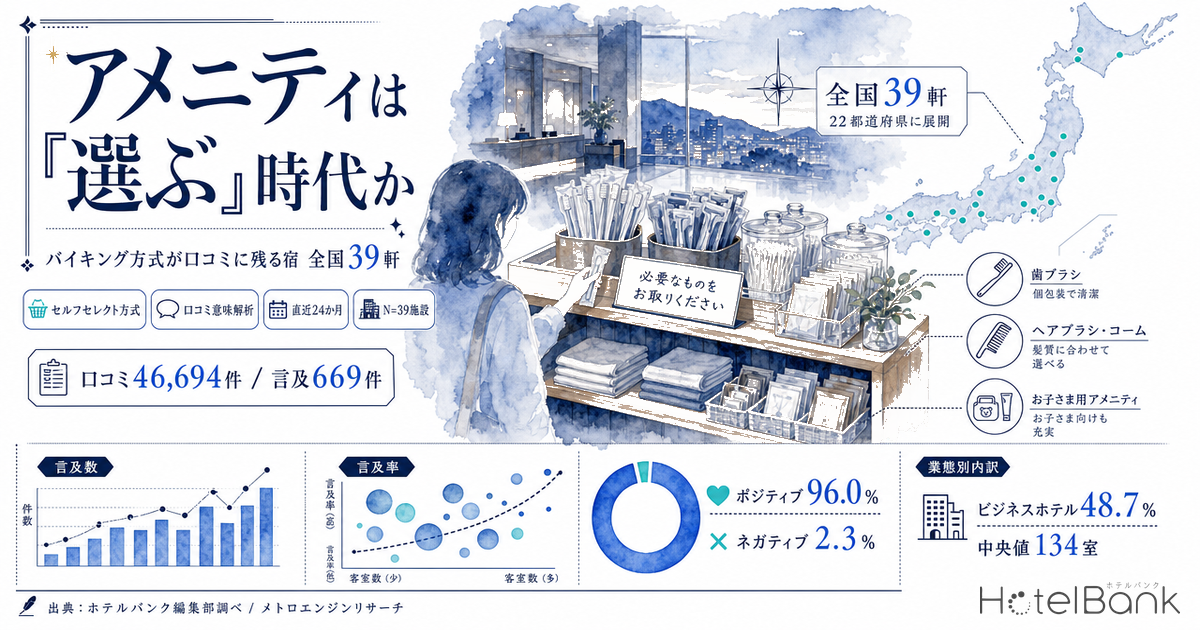
The toothbrush, razor and cotton swabs placed in every guest room. Anyone working in hospitality knows from experience that a certain share of these are neither used nor taken home — they are simply discarded. The response that has spread across the industry is the “amenity buffet”: a fixture placed at the front desk or by the elevator hall, from which guests select only what they actually need. It is an out-of-room operation designed to cut waste and lift guest satisfaction at the same time.
For this article we ran semantic analysis on guest review text, extracted mentions relating to “amenity buffets, self-select amenities and amenity bars,” and compiled the 39 hotels across Japan for which a meaningful volume of such mentions was confirmed over the trailing 24 months. Where our earlier coverage examined the breadth of amenity offerings, this piece reads the market along a different axis: the delivery method (self-selection).
Metric Definitions Used in This Article
- Mention count: the number of guest reviews posted in the trailing 24 months in which a reference to an amenity buffet, self-select amenities or an amenity bar was confirmed.
- Mention rate: mention count ÷ that property’s total review count. The mention rate measures how frequently a topic appears in reviews — it is not a satisfaction score. Properties with a smaller review base tend to produce higher ratios, and the metric does not rank properties against one another.
- Positive / negative: a breakdown produced by analysing the context surrounding each mention. Neutral mentions that fall into neither class also exist.
- Extraction criteria: properties with at least 20 total reviews and at least 10 mentions of the topic in question. The period covered is the trailing 24 months (as of August 2, 2026).
- Data source: HotelBank Editorial Team research (semantic analysis of guest reviews). Property attributes and room counts from MetroEngines Research.
- — 39 hotels nationwide — of 46,694 guest reviews posted over the trailing 24 months, 669 mentioned amenity buffets or self-select amenities. The properties meeting the extraction criteria were spread across 22 prefectures.
- — 96.0% positive — in the unrestricted-sentiment tabulation (42 properties, 725 mentions), negative mentions numbered just 17, or 2.3%.
- — Business hotels account for 48.7%, with a median of 134 rooms. Urban hotels in the 150–250 room range sit at the centre of the distribution, and the Greater Tokyo area (Tokyo plus three neighbouring prefectures) accounts for only 13 properties, or 33.3%.
- — Only 5 properties overlap with the breakfast-buffet topic — yet on the children’s-amenity topic, 6 of the 14 qualifying properties nationwide (43%) overlap, pointing to headroom in the family segment.
- — Mention rate is not a performance metric — the spread from 0.25% to 8.09% around a 1.75% median is explained mainly by review-base size and does not rank one property above another.
39 Hotels Nationwide — The Shape of the Self-Select Amenity Cohort
Thirty-nine properties nationwide met the extraction criteria. Together they attracted 46,694 reviews, of which 669 touched on the amenity buffet. On a simple average, roughly 1.4 in every 100 reviews of these properties raises the topic.
The highest mention count at a single property was 55 at Oriental Hotel Tokyo Bay (Urayasu, Chiba; 511 rooms), followed by 42 at Richmond Hotel Sendai (Sendai, Miyagi; 272 rooms) and 36 at Hotel Silk Tree Nagoya (Nagoya, Aichi; 208 rooms). The upper ranks are dominated by mid-to-large urban hotels — properties of a scale that can permanently house a fixture near the front desk.
Source: HotelBank Editorial Team research (semantic analysis of guest reviews, N=39 properties, 46,694 total reviews)
This ranking, however, reflects absolute mention counts. Larger properties with more reviews accumulate more mentions on any topic. Indeed, Oriental Hotel Tokyo Bay, first by volume, carries a mention rate of 1.42% against its 3,876 total reviews — hardly an outlier in proportional terms.
Mention Rate ≠ Rating — Smaller Properties Surface When Measured Proportionally
The median mention rate is 1.75%, with a range of 0.25% to 8.09% — a spread of more than thirtyfold. Most of that gap is explained not by the character of the property but by the size of its review base. Plotting total reviews against mention rate makes the structure plain.
Source: HotelBank Editorial Team research (bubble size = mention count, N=39 properties)
Properties with fewer than 1,000 total reviews cluster in the zone above a 4% mention rate: Hotel Season (Mito, Ibaraki; 89 rooms) at 6.01%, Hotel Actel Nagoya Nishiki (Nagoya, Aichi; 156 rooms) at 6.51%, and Enoca Hotel (Fujisawa, Kanagawa; 9 rooms) at 5.76%. At the other end, Kobe Meriken Park Oriental Hotel and Grand Nikko Tokyo Bay Maihama — both with more than 4,000 reviews — sit at around 0.3%.
It bears repeating that a high mention rate does not mean a high rating. The mention rate captures how often a topic appears; whether it appears alongside positive sentiment has to be measured separately. The next section examines that breakdown.
Negative Mentions at 2.3% — How Guests Actually Receive It
Re-running the tabulation without restricting sentiment to positive mentions widens the set to 42 properties and 725 mentions. The breakdown is 696 positive and 17 negative (2.3% of all mentions), with the remaining 12 falling into neither class. Twelve of the 42 properties recorded at least one negative mention.
| Category | Count | Share |
|---|---|---|
| Positive mentions | 696 | 96.0% |
| Negative mentions | 17 | 2.3% |
| Classified as neither | 12 | 1.7% |
| Total (42 properties) | 725 | 100.0% |
Source: HotelBank Editorial Team research (unrestricted-sentiment tabulation, N=42 properties, 725 mentions)
Review text includes remarks such as “a great selection of amenities you can choose yourself…”, “the amenity bar was well stocked…” and “the amenities were all there — you really can travel empty-handed…”. For travellers who want to pack light, the self-select format appears to work as a reassurance: you know in advance what will be available.
That said, it would be premature to read a 2.3% negative share as proof of “a format with virtually no complaints.” Reviews tend to record what left an impression; cases where the fixture is quietly used and never mentioned never enter the tabulation at all. The safer reading is simply that within the range of what guests wrote, the topic is discussed overwhelmingly in positive contexts.
What Is This Tabulation Actually Capturing? Validating the Tag
In Japanese, the word baikingu (“Viking,” the local term for buffet) appears just as often in the context of breakfast buffets. Whether the tabulation has mistakenly swept up dining chatter goes directly to the credibility of the analysis. To check, we compared our 39 properties against the rankings for other review topics extracted by the same method.
Source: HotelBank Editorial Team research (overlap between each topic’s top-ranked properties and the 39 in this article)
The result was unambiguous. Only 5 of the 39 overlapped with the top 100 properties on the breakfast-buffet topic (Oriental Hotel Tokyo Bay, Grand Nikko Tokyo Bay Maihama, Kobe Meriken Park Oriental Hotel, Hotel Gracery Sapporo and Premier Hotel -CABIN PRESIDENT- Osaka). The hotels talked about for their breakfast buffets and the hotels talked about for self-select amenities are, for practical purposes, two different groups.
Overlap with other amenity-related topics is comparatively higher: 15 properties overlap with the top 100 for basic amenity sets (toothbrush, razor and the like), 11 with the top 82 for skincare, and 9 with loungewear and yukata. The standout is children’s amenities: only 14 properties nationwide met the criteria on that topic, yet 6 of them (43%) also appear among our 39. That suggests stocking children’s toothbrushes and slippers on the self-select fixture is an operation families tend to remember.
Some methodological caveats should also be stated. Quoted fragments drawn from review text are not necessarily the sentence on which the topic classification was based — another sentence from the same review may be returned instead. And a phrase such as “the amenities were excellent” may not reveal whether the guest meant a fixture-based offering or items stocked in the room. The 39 properties here are therefore best read not as a complete list of hotels operating a self-select format, but as the group of properties for which the topic was observed in reviews in meaningful volume.
Half Are Business Hotels — A Format Suited to Mid-Sized Urban Properties
Broken out by category, business hotels account for 19 of the 39 (48.7%), close to half. City hotels and resort hotels contribute 7 each, ryokan 4, and deluxe and capsule hotels 1 each.
Source: MetroEngines Research (property classification), HotelBank Editorial Team research (N=39 properties)
By room count, the median is 134 rooms, and 21 of the 39 have 150 rooms or fewer. The range runs from Enoca Hotel (Fujisawa, Kanagawa) with 9 rooms to Sotetsu Grand Fresa Tokyo-Bay Ariake (Koto, Tokyo) with 912, but the centre of the distribution sits with urban hotels in the 100–250 room range.
There is a logic to this skew. The more rooms a property has, the larger the waste lot generated by stocking every room individually — and the greater the operational efficiency gained by consolidating everything into a single fixture at the front desk. At small properties, by contrast, the floor space for a fixture and the labour of restocking weigh relatively heavily. Somewhere around 150–250 rooms appears to be the range where waste reduction and operational load balance most easily.
There is a chain-development angle as well. Among the 39, four groups appear twice each: Richmond Hotel (Sendai and Tokyo Suidobashi), Super Hotel (Kyoto-Shijo Kawaramachi and Tokyo-Otsuka), Anda no Mori (Osaka Tennoji Tower and Izu Ippekiko), and the Matsue Urban Hotel Group (Matsue New Urban Hotel and Matsue Urban Hotel). Where the format is rolled out as a brand-wide standard, it tends to surface in reviews at several properties at once.
Spread Across 22 Prefectures — Not a Greater Tokyo Phenomenon
The 39 properties are located across 22 prefectures. Kanagawa leads with 5, followed by Chiba and Tokyo with 4 each and Shizuoka with 3. The Greater Tokyo area (Tokyo plus three neighbouring prefectures) accounts for 13 properties, or 33.3%, leaving the remaining 26 scattered nationwide.
Source: HotelBank Editorial Team research, MetroEngines Research (property locations, N=39 properties across 22 prefectures)
Shimane contributes 2 (Matsue New Urban Hotel and Matsue Urban Hotel) and Nagano 2 (Hotel New Nagano NeXT and Hotel Abest Nagano Ekimae) — regional cities fielding multiple entries. Thirteen prefectures, including Hokkaido, Okinawa, Kagoshima, Ehime, Okayama and Fukuoka, register one property each. The distribution shows that this is not a practice confined to large hotels in major metropolitan markets; it has spread to station-front business hotels in regional cities as well.
The Full List: 39 Hotels Nationwide
All 39 properties are listed in descending order of mention count. To repeat: the mention rate reflects how often the topic appears, not a ranking of property quality.
| # | Hotel | Prefecture | Category | Rooms | Total reviews | Mentions | Mention rate |
|---|---|---|---|---|---|---|---|
| 1 | Oriental Hotel Tokyo Bay オリエンタルホテル東京ベイ | Chiba | Deluxe Hotel | 511 | 3,876 | 55 | 1.42% |
| 2 | Richmond Hotel Sendai リッチモンドホテル仙台 | Miyagi | Business Hotel | 272 | 983 | 42 | 4.27% |
| 3 | Hotel Silk Tree Nagoya ホテル シルク・トゥリー名古屋 | Aichi | Business Hotel | 208 | 1,545 | 36 | 2.33% |
| 4 | Sotetsu Grand Fresa Tokyo-Bay Ariake 相鉄グランドフレッサ 東京ベイ有明 | Tokyo | City Hotel | 912 | 2,489 | 28 | 1.12% |
| 5 | Matsue New Urban Hotel 松江ニューアーバンホテル | Shimane | Ryokan | 101 | 1,152 | 27 | 2.34% |
| 6 | Anshin Oyado Premier Shimbashi-Shiodome (luxury capsule hotel) 豪華カプセルホテル 安心お宿プレミア 新橋汐留店 | Tokyo | Capsule Hotel | 180 | 1,221 | 24 | 1.97% |
| 7 | Anda no Mori Osaka Tennoji Tower アンダの森 大阪天王寺タワー | Osaka | City Hotel | 113 | 934 | 23 | 2.46% |
| 8 | Hotel Fujita Fukui ホテルフジタ福井 | Fukui | City Hotel | 354 | 697 | 22 | 3.16% |
| 9 | Hotel Dream Gate Maihama ホテルドリームゲート舞浜 | Chiba | Business Hotel | 80 | 516 | 22 | 4.26% |
| 10 | Hotel New Nagano NeXT ホテルニューナガノ ネクスト | Nagano | Business Hotel | 115 | 1,047 | 18 | 1.72% |
| 11 | Kagoshima Plaza Hotel Tenmonkan かごしまプラザホテル天文館 | Kagoshima | Business Hotel | 220 | 987 | 18 | 1.82% |
| 12 | Hotel KSP ホテル ケイエスピー | Kanagawa | City Hotel | 73 | 713 | 17 | 2.38% |
| 13 | Hotel Abest Nagano Ekimae ホテルアベスト長野駅前 | Nagano | Business Hotel | 84 | 680 | 17 | 2.50% |
| 14 | Hotel Gracery Sapporo ホテルグレイスリー札幌 | Hokkaido | Business Hotel | 440 | 2,228 | 17 | 0.76% |
| 15 | Sanco Inn Iseshi-Ekimae Main Bldg. Shikinoyu / Annex Grande 三交イン伊勢市駅前「本館」~四季乃湯~・「別館」Grande | Mie | Business Hotel | 129 | 1,132 | 17 | 1.50% |
| 16 | Hotel Season ホテル シーズン | Ibaraki | Business Hotel | 89 | 283 | 17 | 6.01% |
| 17 | Ikaho Onsen Fukuichi 伊香保温泉 福一 | Gunma | Ryokan | 83 | 651 | 15 | 2.30% |
| 18 | Grand Nikko Tokyo Bay Maihama グランドニッコー東京ベイ 舞浜 | Chiba | Resort Hotel | 707 | 6,097 | 15 | 0.25% |
| 19 | Hotel Pasela no Mori ホテル パセラの森 Closed as of January 5, 2026 | Kanagawa | Resort Hotel | 43 | 173 | 14 | 8.09% |
| 20 | Dogashima New Ginsui 堂ヶ島 ニュー銀水 | Shizuoka | Resort Hotel | 123 | 958 | 14 | 1.46% |
| 21 | Premier Hotel -CABIN PRESIDENT- Osaka プレミアホテル-CABIN PRESIDENT-大阪 | Osaka | Business Hotel | 239 | 1,641 | 14 | 0.85% |
| 22 | Matsue Urban Hotel 松江アーバンホテル | Shimane | Business Hotel | 110 | 315 | 14 | 4.44% |
| 23 | Atema Kogen Resort Belnatio あてま高原リゾートベルナティオ | Niigata | Resort Hotel | 155 | 860 | 13 | 1.51% |
| 24 | Kobe Meriken Park Oriental Hotel 神戸メリケンパークオリエンタルホテル | Hyogo | City Hotel | 323 | 4,279 | 12 | 0.28% |
| 25 | BREATH HOTEL | Kanagawa | Resort Hotel | 21 | 280 | 12 | 4.29% |
| 26 | Anda no Mori Izu Ippekiko (forest & onsen resort) 森と温泉リゾート アンダの森 伊豆いっぺき湖 | Shizuoka | Resort Hotel | 68 | 1,495 | 12 | 0.80% |
| 27 | Enoca Hotel | Kanagawa | Business Hotel | 9 | 191 | 11 | 5.76% |
| 28 | Hotel Actel Nagoya Nishiki ホテルアクテル名古屋錦 | Aichi | Business Hotel | 156 | 169 | 11 | 6.51% |
| 29 | Hotel Meilleur Cour Shozuki ホテルマイユクール祥月 | Kanagawa | Ryokan | 38 | 629 | 11 | 1.75% |
| 30 | Richmond Hotel Tokyo Suidobashi リッチモンドホテル東京水道橋 | Tokyo | Business Hotel | 196 | 974 | 11 | 1.13% |
| 31 | Hotel Leon Hamamatsu ホテルレオン浜松 | Shizuoka | Business Hotel | 144 | 622 | 10 | 1.61% |
| 32 | Super Hotel Tokyo-Otsuka スーパーホテル 東京・大塚 | Tokyo | Business Hotel | 80 | 347 | 10 | 2.88% |
| 33 | Rihga Royal Gran Okinawa リーガロイヤルグラン沖縄 | Okinawa | City Hotel | 157 | 822 | 10 | 1.22% |
| 34 | Super Hotel Kyoto-Shijo Kawaramachi スーパーホテル 京都・四条河原町 | Kyoto | Business Hotel | 177 | 1,468 | 10 | 0.68% |
| 35 | Daiwa Roynet Hotel Sendai ダイワロイネットホテル仙台 | Miyagi | Business Hotel | 270 | 1,345 | 10 | 0.74% |
| 36 | Hiyori Hotel Maihama 日和ホテル舞浜 | Chiba | Resort Hotel | 80 | 696 | 10 | 1.44% |
| 37 | Dogo Yaya 道後やや | Ehime | Ryokan | 65 | 400 | 10 | 2.50% |
| 38 | Ark Hotel Okayama アークホテル岡山 | Okayama | City Hotel | 181 | 907 | 10 | 1.10% |
| 39 | The BREAKFAST HOTEL Fukuoka Nakasu The BREAKFAST HOTEL福岡中洲 | Fukuoka | Business Hotel | 134 | 892 | 10 | 1.12% |
Source: HotelBank Editorial Team research (semantic review analysis, trailing 24 months), MetroEngines Research (property attributes)
On operating status: checking sales-performance data for the listed properties, we confirmed via the operator’s official website that one of the 39 — Hotel Pasela no Mori (Yokohama, Kanagawa) — closed permanently on January 5, 2026. It remains in the list because reviews posted during the tabulation period met the extraction criteria, but the property can no longer be booked. For the other 38, sales data over the trailing 90 days has been confirmed (as of August 2, 2026).
A Design That Lets Guests Choose — And the Twin Opportunity It Creates
The immediate catalyst for the spread of the self-select format was the Act on Promotion of Resource Circulation for Plastics, which took effect in April 2022. For the lodging industry, five items — toothbrushes, hairbrushes, combs, razors and shower caps — were designated as specified plastic products, and operators were asked to work toward rationalising their use. As the Ministry of the Environment explains, this is not a ban on provision or a mandate to charge for these items, but a framework under which operators set their own targets and pursue rationalisation.
Within that framework, switching from uniform in-room placement to self-selection of only what is needed functions as an approach that structurally reduces the volume discarded unused. What the data in this article adds is that the same change is also being discussed positively as part of the guest experience: 96.0% of the 725 mentions across 42 properties were observed in positive contexts.
A further revenue opportunity connects here. Paid packages built around amenities already exist — Hotel Gracery Ginza, for instance, sold a “casual beauty plan with hotel-select amenities” in 2022. The amenity bar permanently installed in that hotel’s lobby is itself free of charge, so a self-select fixture and a paid package can coexist. Installing the fixture is fundamentally a cost-reduction measure, but where the “pleasure of choosing” adds experiential value on top, it carries potential as raw material for package differentiation and upselling.
The high overlap with the children’s-amenity topic (6 of 14 properties) likewise points to headroom in family demand. Adding children’s items to the fixture line-up is an area where relatively small incremental investment can capture both family satisfaction and review visibility. On the sourcing side, too, domestic case studies in bamboo amenities and horizontal recycling schemes continue to accumulate, widening the range of options.
Conclusion
Analysing guest reviews from the trailing 24 months identified 39 properties nationwide with a meaningful volume of mentions relating to amenity buffets and self-select amenities. Of those mentions, 96.0% appeared in positive contexts — insofar as the topic surfaces in reviews at all, it is received favourably.
Business hotels make up roughly half the set, the median room count is 134, and the properties are spread across 22 prefectures. This is not a measure confined to large hotels in Greater Tokyo; it has taken root at mid-sized hotels in regional cities as well. That only 5 properties overlap with the breakfast-buffet topic further confirms that the tabulation is capturing amenity delivery method rather than dining.
At the same time, two cautions apply: the mention rate is strongly influenced by review-base size and therefore does not rank properties against one another, and a considerable number of properties running the format may simply never appear in reviews. The 39 here are not a complete list but a sample of properties operating the format in a way that stays with guests. The shift from “placing” amenities to “letting guests choose” them remains worth watching as a measure with room to work on both waste reduction and experiential value.
Related Reading
- Identifying “All-Inclusive” Amenity Hotels — Buffet × Loungewear × Skincare Triple Crown
- Japan’s “All-In” Amenity Hotels: Just 3 Excel Across 3 Categories
- Hotels Chosen for Value for Money: National TOP 30 (21.6% of Reviews)
References and Sources
■ Data sources
Semantic analysis of guest reviews (HotelBank Editorial Team research). Mentions relating to “amenity buffets, self-select amenities and amenity bars” were extracted from the text of reviews posted over the trailing 24 months, and mention counts, mention rates and sentiment breakdowns were tabulated at property level (as of August 2, 2026). Property classification, room counts and locations, together with verification of sales performance for the listed properties, are from MetroEngines Research.
■ Assumptions and tabulation criteria
The extraction criteria were at least 20 total reviews and at least 10 mentions of the topic in question. Thirty-nine properties nationwide met these criteria (46,694 total reviews, 669 mentions). Tabulating without restricting sentiment widens the set to 42 properties and 725 mentions, comprising 696 positive, 17 negative and 12 classified as neither. The mention rate is calculated as “mention count ÷ that property’s total review count,” and category, room count and location are based on property attribute data. The validity of the tag was verified by cross-checking the number of overlapping properties against the top rankings for other topics, including breakfast buffets.
■ Limitations and caveats
The mention rate reflects how often a topic appears, not a satisfaction score. Properties with a smaller review base tend to produce higher ratios, and the metric does not rank properties against one another. Quoted fragments from review text are not necessarily the sentence on which the topic classification was based, and phrases such as “the amenities were excellent” may not reveal whether a fixture-based offering or in-room stocking was meant. The 39 properties in this article are therefore not a complete list of hotels operating a self-select format, but the group for which the topic was observed in reviews in meaningful volume. Properties running the format that is quietly used and never mentioned do not enter the tabulation.
■ Review and property data
- HotelBank Editorial Team research — semantic analysis of guest reviews (trailing 24 months, as of August 2, 2026; N=39 properties / 46,694 total reviews, 669 mentions)
- MetroEngines Research — property classification, room counts and locations, and verification of sales performance for the listed properties
■ Legislation and policy
- Ministry of the Environment — dedicated site for the Act on Promotion of Resource Circulation for Plastics
- Ministry of the Environment — “Plastic Resource Circulation”
■ Official property information