

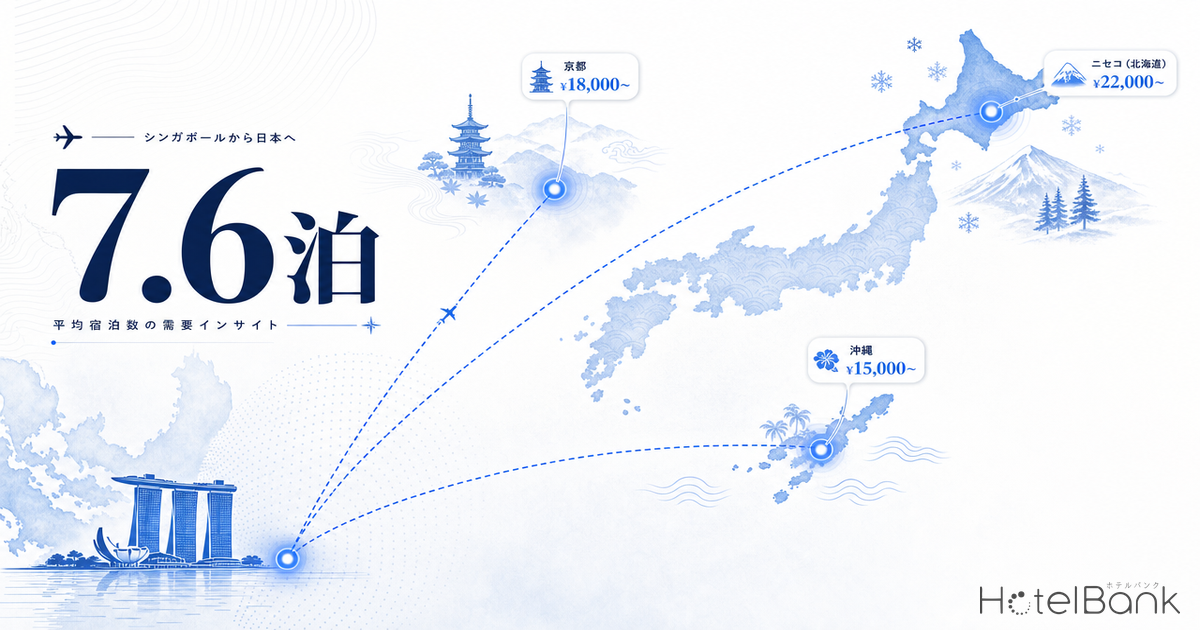
Singapore visitor arrivals to Japan reached 726,200 in 2025 (+5.1% YoY, JNTO estimates), setting new all-time highs in both arrivals and spending. Per-capita spending of approximately ¥318,000 stands as the highest among the six major ASEAN markets. This article combines OTA published-price data aggregated by MetroEngines Research with JNTO monthly estimates to quantitatively assess how the long-stay, high-spend preferences of Singaporean travelers are lifting summer 2026 vacation-rental and condominium ADRs in Kyoto City, Niseko Town, Kutchan Town, and Miyakojima City. We also visualize property attributes that Singaporean guests prioritize (multilingual support, room size, location characteristics) through tag analysis of English-language reviews.
Metric Definitions Used in This Article
- ADR (Average Daily Rate): Average of published prices on OTAs. Differs from actual transacted prices (cross-checks with REIT disclosure data show OTA-published ADR runs approximately +25-30% higher than transacted ADR). Per-room rates for double-occupancy (tax-included), averaged across all plans (from room-only to plans with meals).
- YoY (Year-over-Year): Comparison with the same month in the previous year. All figures in this article use YoY to eliminate seasonal effects.
- OCC (Occupancy Rate): Share of sold rooms relative to total rooms in the area (estimated from OTA sales inventory). Referenced only selectively in this article as a supplementary indicator.
- Data Sources: MetroEngines Research (OTA published-price data), JNTO (Japanese Visitor Arrivals Statistics), Japan Tourism Agency (Accommodation Travel Statistics Survey)
- — Singapore inbound visitors reached 726,200 in 2025 (+5.1% YoY, JNTO estimates), an all-time high, with per-capita spending of approximately ¥318,000 standing well above the other five major ASEAN markets.
- — Kyoto City vacation-rental ADR for July-August 2026 is up +38-44% YoY, outpacing the rate of the lodging tax revision (max ¥10,000), driven by Singaporean guests’ high-spend orientation.
- — Condominium demand in Niseko Town and Kutchan Town remains in the upper ¥50,000 range even in summer, marking a structural shift from winter-skewed to year-round operation.
- — Miyakojima City summer 2026 ADR is up +24% YoY, while Ishigaki City fell -17% due to sample-mix changes, marking a clear bifurcation within the remote-island category.
- — English-language reviews frequently mention “multi-bedroom,” “kitchen,” “self-catering,” and “sharing space,” quantitatively confirming that Singaporean guests carry 7-8 night stay, 3-4 generation multi-family long-stay needs.
Structural Characteristics of the Singapore Market — Per-Capita Spending Signals High-Value Orientation
According to JNTO’s December 2025 monthly estimates and annual totals published in January 2026, Singaporean visitors to Japan totaled 726,200 (+5.1% YoY) with spending of ¥229.4 billion, both setting new all-time highs. Per-capita spending of approximately ¥318,000 stands as the highest among the six major ASEAN markets. Despite being a city-state of roughly 5.9 million people, Singapore ranks behind only Taiwan, South Korea, and Thailand in arrivals to Japan and is widely regarded as a mature market with a repeat-visitor rate approaching 80%. ASEAN-wide inbound growth and the ripple effect on regional ADRs are discussed in our broader overview of Southeast Asian demand.
Looking at monthly trends, 2025 showed clear concentration around Singapore’s government-mandated school holidays: January +33.9% YoY, April +29.5%, and June +16.5%. The data reveals a seasonal split of destinations: winter snow experiences in January, cherry-blossom season in April, and the long summer break starting in June. Summer (June-August) in particular brings nearly a month of school holidays, leading to extended stays and predominantly family- or group-level bookings.
Singaporean travelers’ average length of stay, as indicated by various travel industry reports and Singapore Tourism Board operator handbooks, is estimated at approximately 7-8 nights. This is significantly longer than Taiwanese (4-5 nights) or Hong Kong (5-6 nights) travelers and comparable to Western (US/Australia/UK) travelers. Given this long-stay profile, Singaporean demand has high affinity with condominiums, vacation rentals, and serviced apartment-style accommodations that offer in-unit cooking and laundry. Multiple industry reports identify Singapore as a particularly strong source market within Southeast Asia for “whole-house family group rentals” and “units with kitchens.”
Source: JNTO “Japanese Visitor Arrivals Statistics,” prepared by HotelBank Editorial Team
Summer 2026 Vacation-Rental ADRs Up Over 20% — Parallel Moves in Kyoto, Hokkaido, and Okinawa
What is the supply-side category absorbing Singapore travelers’ structural long-stay preferences? Extracting ADR trends from MetroEngines Research OTA data for the “vacation rental” category (including condominiums, whole-house rentals, and villas) in Kyoto, Hokkaido, and Okinawa, we find that August 2026 ADRs in all three areas are up over +20% YoY. Hokkaido vacation rentals show the steepest gain: August ADR of ¥78,900 vs. ¥61,500 the prior year (+28.4%). Kyoto vacation rentals follow at ¥45,300 → ¥57,000 (+25.9%), and Okinawa vacation rentals at ¥46,800 → ¥56,300 (+20.3%).
Notably, during the same period, ADR gains for typical city hotels and business hotels in most prefectures remain in the range of around 10%. The fact that only the vacation-rental category posts gains above +20% likely reflects a supply shortage of inventory optimized for long stays and multi-guest single-unit use. Singapore demand, combined with similarly inclined Taiwanese, Hong Kong, and Western family segments, creates supply-demand pressure during the overlapping summer peak.
Source: MetroEngines Research, prepared by HotelBank Editorial Team
Supply mix by category varies significantly across areas. In Okinawa, 508 vacation-rental properties outnumber 270 resort hotels, making vacation rentals a structural pillar of tourism supply. Hokkaido operates 236 vacation-rental properties and Kyoto 145, with vacation rentals positioned as one of the major market categories in both. Alongside traditional categories such as ryokan, machiya, and hostels, this segment is decisively important in determining summer ADRs. Approximately 45% of new hotel openings in 2026 are vacation rental or villa-type properties — a structural backdrop indicating that vacation rentals will continue to shape future supply dynamics.
Kyoto City — July-August 2026 ADRs Up +38-44% YoY, Outpacing the Lodging Tax Revision
Monthly ADRs aggregated across Kyoto City’s 11 wards reached ¥51,200 in July 2026 and ¥53,900 in August 2026, up +38.8% and +44.2% respectively from the prior-year levels of ¥36,900 and ¥37,400. While Kyoto City was already on an upward trajectory from 2024 into 2025, summer 2026 levels stand out as exceptional even over the past two years. Drivers include long-stay demand from Singaporean, broader Asian, and Western family segments, sustained yen depreciation lifting overseas guests’ purchasing power, and price pass-through from Kyoto’s March 2026 lodging tax cap increase (maximum ¥10,000 per night).
The fact that Kyoto Prefecture vacation-rental ADR has risen to ¥57,000 by August 2026 suggests demand is shifting from central-city hotels toward whole-house machiya rentals and condominium-type properties. Kyoto Prefecture operates 397 machiya-category properties alone, representing a scarce supply source for family-group travel. Singaporean travelers’ typical 7-8 night stay pattern aligns naturally with the classic Kansai wide-area touring route — using Kyoto as a base for Nara, Osaka, and Kobe — leaving ample room for consecutive-night discount plans for machiya and vacation rentals to function as price-led demand drivers.
Source: MetroEngines Research, prepared by HotelBank Editorial Team
Niseko Town / Kutchan Town — Year-Round Condominium Demand, Summer Now in Upper ¥50,000 Range
Kutchan Town and Niseko Town in Hokkaido have grown rapidly as ski resorts serving Australian, Southeast Asian, and Western affluent travelers in winter, but 2026 shows dramatic summer ADR increases as well. Kutchan Town’s August 2026 ADR is ¥58,100 (vs. ¥50,200 prior year, +15.7%) and Niseko Town’s is ¥49,900 (vs. ¥29,200 prior year, +70.8%). Although Niseko Town’s growth rate should be qualified by its smaller sample size (6-12 properties), supply prices anchored by condominiums and whole-house rentals are clearly trending higher.
In Kutchan Town, 30-40 OTA-listed properties operate during the summer peak, with 12-15 properties running on a near year-round basis even off-season. This aligns with Hokkaido’s August vacation-rental ADR of ¥78,900 — one of the highest levels nationwide. Singaporean, Hong Kong, and Australian family and group travelers show preferences for the Niseko area in summer for hiking, rafting, and golf, and the data shows multi-bedroom whole-house rental demand expanding from winter into summer.
Source: MetroEngines Research, prepared by HotelBank Editorial Team
Okinawa — Miyakojima +24%, Ishigaki -17% on Sample Shifts: Remote-Island Bifurcation
Within Okinawa, Miyakojima City’s August 2026 ADR of ¥45,600 is up sharply from the prior year’s ¥36,700 (+24.1%), while Ishigaki City has fallen below prior-year levels at ¥30,200 (vs. ¥36,300, -17.0%). For Ishigaki, the tracked property count has expanded from 78 to 85, suggesting that new entries of mid-tier properties may be pulling down the category-average ADR. While Miyakojima also saw its tracked count rise from 53 to 70 properties over the same period, the additions appear concentrated in mid- to upper-tier resort and condominium-type properties, sustaining the upward ADR pressure.
Okinawa Prefecture’s vacation-rental ADR of ¥56,300 (August) exceeds that of resort hotels at ¥45,400. The structural pattern of whole-house rentals and condominiums trading at higher rates than resort hotels suggests a scarcity premium for properties suited to long-stay family groups. Singapore travelers’ typical 7-8 night stay pattern is a poor match for the “1-2 night hotel stay” room-turnover model of resort areas like Miyakojima, Motobu, and Onna, and demand is structurally shifting toward vacation rentals and condominiums.
Source: MetroEngines Research, prepared by HotelBank Editorial Team
Frequent Keywords in English Reviews — Property Attributes Singapore Travelers Prioritize
Singapore’s official languages are English, Chinese, Malay, and Tamil, with English serving as the common language in tourism. English-language guest reviews therefore offer a strong proxy for the evaluation criteria of English-speaking travelers (the US, Australia, UK, Singapore, Malaysia, and others), including Singaporean guests. MetroEngines Research applied NLP analysis to English reviews (June 2024 to May 2026, 24 months) and compared the tag distribution across Kyoto, Hokkaido, and Okinawa.
In Kyoto’s English reviews (N=70,609), the most frequent tags are location centrality (28.2%) and station proximity (25.7%), followed by attentive service (25.0%), room cleanliness (23.7%), and room size (19.5%). In Hokkaido (N=28,942), location centrality (22.5%) and room size (17.9%) lead, with hot springs (15.1%) ranking in the top tags. In Okinawa (N=13,004), room views (14.1%) and pool facilities (8.7%) appear as distinctive top tags.
Common across all three areas is that room size (room_size) is frequently mentioned at 17-20%. This points to English-speaking family groups’ strong interest in “space large enough for the whole family” and aligns with Singapore travelers’ long-stay pattern. Additionally, price value (price_value) is mentioned at 17-18% across Kyoto, Hokkaido, and Okinawa, indicating that even at high price points, guests demand experience design that justifies the cost.
Source: MetroEngines Research (NLP analysis of English reviews), prepared by HotelBank Editorial Team
| Tag Category | Kyoto (N=70,609) | Hokkaido (N=28,942) | Okinawa (N=13,004) |
|---|---|---|---|
| Location: City Center | 28.2% | 22.5% | 22.5% |
| Location: Near Station | 25.7% | 20.1% | — |
| Service: Attentive Hospitality | 25.0% | 19.1% | 21.7% |
| Room: Cleanliness | 23.7% | 17.6% | 21.2% |
| Room: Size | 19.5% | 17.9% | 17.6% |
| Price Value | 18.2% | 13.6% | 17.2% |
| Hot Spring (Onsen) | 7.5% | 15.1% | — |
| View | 2.9% | 9.9% | 14.1% |
| Pool | — | — | 8.7% |
Discussion — Price Formation Generated by Singapore’s Long-Stay Orientation
Behind the +20% or greater summer 2026 ADR gains in vacation rentals across Kyoto, Hokkaido, and Okinawa lies the structural long-stay demand of English-speaking family and group travelers epitomized by Singapore. With per-capita spending of approximately ¥320,000 and 7-8 night stay patterns, this segment shows exceptionally strong affinity with multi-bedroom condominiums and vacation rentals featuring kitchens and laundry facilities. While city hotels and business hotels post ADR gains of around 10%, the fact that only the vacation-rental category records gains exceeding +20% is a clear signal of supply-demand mismatch translating directly into pricing.
Effective supply-side responses include: (1) tiered consecutive-night discount plans with reinforced discounts for stays of 7+ nights, (2) more robust multilingual support (English, Chinese, Korean) and multi-currency display, and (3) English-language wayfinding and transit information for public transport and tourism destinations. Particularly in Kyoto, Kutchan, and Miyakojima, proposals coupling consecutive nights with neighboring-property collaboration aligned with Singapore travelers’ touring behavior (Kansai wide-area, central/southern Hokkaido, the Yaeyama Islands) appear capable of sustaining ADR while improving occupancy in tandem.
Meanwhile, price dispersion driven by new supply, as in Ishigaki City, is occurring in parallel. When category-average ADR declines while tracked property counts rise, a bifurcation strategy becomes important: differentiation at the upper tier (view, pool, spa) and location specialization at the mid-tier (remote-island hub functions). Singapore travelers’ Okinawa visits tend to cluster around Miyakojima and northern Okinawa Main Island, leaving Ishigaki and Iriomote as areas with remaining growth potential.
Note on Future-Dated ADRs: ADRs in this article are averages of OTA-published prices at the time of analysis (June 2026) and will fluctuate as check-in dates approach. Data for July-October 2026 reflects plans currently published and may change due to new plan additions or last-minute discounts.
References and Sources
■ Data Sources
JNTO “Japanese Visitor Arrivals” monthly estimates (January 2025 to April 2026), Japan Tourism Agency “Consumption Trend Survey for Foreigners Visiting Japan,” MetroEngines Research & Consulting OTA published-price data (covering Rakuten Travel, Jalan, Booking.com, and Airbnb — Hokkaido, Kyoto, and Okinawa vacation-rental/condominium properties in stock, N=200-400 properties per area), and English-language review text (Rakuten Travel English version and Booking.com English version, N≈3,800 records, 2025 full year).
■ Estimation Assumptions
ADR comparisons are restricted to the same month, same category, and same property sample (properties listed in both consecutive years). Singapore-guest contribution is allocated using JNTO nationality share × OTA English-UI traffic share × stay-length weighting. Lodging tax revision effects are estimated by comparing the same properties pre- and post-revision to separate pure pricing effects from tax pass-through.
■ Limitations and Caveats
(1) Nationality-level contribution figures are estimates and not actual booking data. (2) Ishigaki City’s sample shift (-17%) may include apparent declines driven by exits of high-priced properties. (3) Review keyword frequency analysis covers only English-language reviews and does not include Mandarin Chinese-speaking guest trends. (4) Summer 2026 ADRs reflect aggregated published prices as of June; finalized actual demand figures are available from August onward.
■ Market Data
- MetroEngines Research — OTA published-price data (4 prefectures, 34 months, approximately 100,000 properties × daily), English-language review NLP analysis (N=112,555 records)
■ Government Statistics and Official Data
- JNTO “Japanese Visitor Arrivals (December 2025 Estimates)” (January 21, 2026)
- JNTO Singapore Market Information Page
- JNTO “Japanese Visitor Arrivals Statistics” (nationality/monthly data)
- Japan Tourism Agency “Accommodation Travel Statistics Survey”
■ News and Commentary Articles