

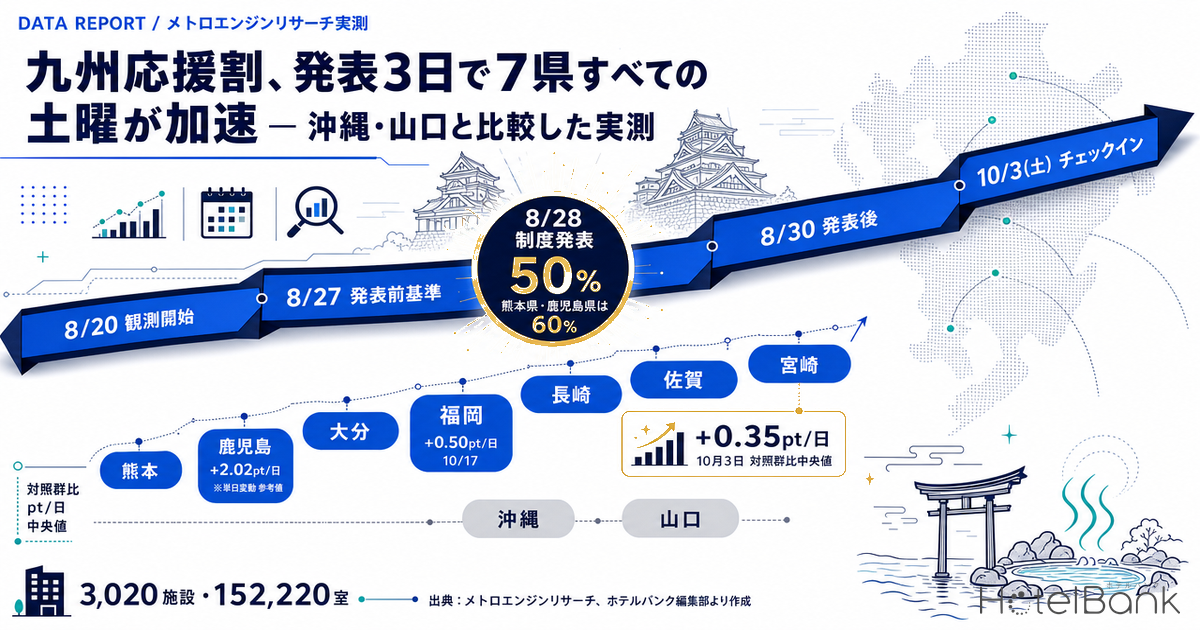
On August 28, 2026, the Japan Tourism Agency released an outline of the “Kyushu Fukko Ouenwari” travel subsidy, a programme aimed at restoring tourism demand after the 2026 Kumamoto Earthquake. From stays on October 1 onward, travel and accommodation charges in the seven Kyushu prefectures will be discounted by 50% (60% in Kumamoto and Kagoshima). At that point, however, only the framework had been published: neither the booking-open dates for each prefecture nor the list of participating operators had been released. In other words, not a single booking could yet be made.
Would demand move anyway? This article tracks October check-in dates across the seven Kyushu prefectures and two control prefectures (Okinawa and Yamaguchi), following the daily pace of OTA-listed inventory sell-through and listed prices before and after the announcement, to measure what “the announcement alone” did to bookings. The short answer: for October Saturdays, all seven Kyushu prefectures sold through inventory faster than the control group. On late-October weekdays, that gap does not appear.
Metric Definitions Used in This Article
- OCC (occupancy rate): the share of sold rooms against total rooms in the area (an estimate based on OTA sales inventory). It reflects sell-through of inventory offered on OTAs and differs from a property’s actual overall occupancy.
- Listed price: the average price publicly offered on OTAs by properties in the target area (double occupancy, per room, tax included, averaged across all plans from room-only to meal-inclusive). It differs from the actual transacted price. In this article it is treated separately from “ADR (estimated settled rate)”.
- LT (lead time): days remaining until the check-in date. LT0 = same day.
- vs. control (pt/day): each prefecture’s “daily OCC gain after the announcement minus its daily pace before the announcement”, less the average of the same figure for the two control prefectures (Okinawa and Yamaguchi). A positive value indicates an increment that seasonal booking progression alone does not explain.
- Data source: MetroEngines Research
- — The Japan Tourism Agency announced the “Kyushu Fukko Ouenwari” subsidy on August 28, 2026. Booking-open dates for each prefecture remain unpublished, so travellers cannot yet make a single reservation.
- — On the three October Saturdays (the 3rd, 10th and 17th), all seven Kyushu prefectures sold through OTA-listed inventory faster than the control group (Okinawa and Yamaguchi). Median values vs. control were +0.35 / +0.23 / +0.30 pt/day.
- — Weekdays responded far more weakly. For October 27 (Tue), Kumamoto came in at -0.08 and Kagoshima at -0.67 pt/day, below the control group. What moved first was weekend leisure demand.
- — Listed prices rose at the same time in several prefectures (for October 17 check-in: Kumamoto and Miyazaki +3.5%, Kagoshima +2.9%, Saga +2.6%). Control-group Yamaguchi also moved +1.6%, however, so intent cannot be identified from public data.
- — The observation window is only three days after the announcement and the gaps vs. control are around 1pt, so this is not a claim of statistical significance. Fresh observation will be needed once booking-open dates are published.
Study design — why Okinawa and Yamaguchi serve as the control group
Inventory heading into October sells through day by day, subsidy or no subsidy. The bare fact that “OCC rose after the announcement” therefore tells us nothing. What matters is how far the sell-through pace in the seven Kyushu prefectures diverged from the pace outside Kyushu over the same period and for the same check-in dates.
Okinawa and Yamaguchi were placed in the control group. Okinawa is a leisure market in western Japan like Kyushu, yet falls outside the subsidy; Yamaguchi neighbours Kyushu and shares its transport catchment, but is likewise excluded. Our pre-announcement estimate of net rates based on the subsidy ratios of earlier programmes is set out in Kyushu Travel Subsidy Due Aug 28: net rates and how hotels should prepare. The sample covers 3,020 properties and 152,220 rooms across the seven Kyushu prefectures, and 1,384 properties and 65,814 rooms in the two control prefectures (as of October 17, 2026 check-in).
The observation window runs from August 20 to August 30, 2026. Straddling the August 28 announcement date, we compared the daily pace before the announcement (August 20 to August 27, seven days) with the pace after it (August 27 to August 30, three days). Five check-in dates were taken — October 3, 10 and 17 (all Saturdays) and October 13 and 27 (both Tuesdays) — to see whether the response differed by date.
Note on observation: August 28 was a collection day on which the number of observed properties fell to roughly 20-30% of normal across every prefecture. For that reason we use August 27 and August 30 — both days with a normal level of observed properties — as the comparison endpoints, and draw no daily interpretation from the August 28 figure alone.
October 3 (Sat) — within three days, all seven prefectures outpaced the control group
Start with October 3, the first Saturday in the subsidy period. Plotting cumulative change with August 27 OCC set to zero, Kyushu and the control group advance along similar slopes before the announcement; from August 28 the Kyushu slope steepens.
Source: MetroEngines Research; compiled by the HotelBank Editorial Team
Kumamoto accelerated from +0.37pt per day before the announcement to +0.70pt after, and Fukuoka from +0.26pt to +0.40pt. The control group in fact decelerated: Okinawa went from +0.33pt/day to +0.30pt/day and Yamaguchi from +0.56pt/day to +0.17pt/day. Averaged across the two control prefectures, the post-announcement change is a deceleration of -0.21pt/day, and that becomes the baseline for “what would have happened without the subsidy”.
As a result, all seven Kyushu prefectures came out positive vs. control. The median is +0.35pt/day.
| Prefecture | 8/27 OCC | 8/30 OCC | 3-day change | Pre-ann. pt/day | Post-ann. pt/day | vs. control pt/day | 8/27 Listed price | 8/30 Listed price | % change |
|---|---|---|---|---|---|---|---|---|---|
| Kumamoto | 74.5% | 76.6% | +2.1pt | +0.37 | +0.70 | +0.54 | ¥31,252 | ¥31,320 | +0.2% |
| Kagoshima | 56.7% | 62.4% | +5.7pt | +0.09 | +1.90 | +2.02 | ¥22,015 | ¥22,363 | +1.6% |
| Oita | 75.5% | 76.5% | +1.0pt | +0.23 | +0.33 | +0.31 | ¥37,171 | ¥37,384 | +0.6% |
| Fukuoka | 83.2% | 84.4% | +1.2pt | +0.26 | +0.40 | +0.35 | ¥39,618 | ¥40,160 | +1.4% |
| Nagasaki | 74.1% | 75.1% | +1.0pt | +0.07 | +0.33 | +0.47 | ¥25,990 | ¥26,269 | +1.1% |
| Saga | 75.1% | 75.7% | +0.6pt | +0.14 | +0.20 | +0.27 | ¥34,223 | ¥34,467 | +0.7% |
| Miyazaki | 69.1% | 69.5% | +0.4pt | +0.20 | +0.13 | +0.14 | ¥20,019 | ¥20,368 | +1.7% |
| Okinawa (control) | 80.7% | 81.6% | +0.9pt | +0.33 | +0.30 | — | ¥32,941 | ¥32,359 | -1.8% |
| Yamaguchi (control) | 77.5% | 78.0% | +0.5pt | +0.56 | +0.17 | — | ¥25,973 | ¥26,598 | +2.4% |
N = 3,020 properties / 152,220 rooms across the seven Kyushu prefectures; 1,384 properties / 65,814 rooms across the two control prefectures. Source: MetroEngines Research; compiled by the HotelBank Editorial Team
Kagoshima’s +2.02pt/day is an order of magnitude above the other prefectures, and the figure warrants a caveat. The prefecture’s October 3 inventory was flat — indeed slightly rising — through August 27, then jumped a step across August 28, the day on which observed properties were reduced. August 29 and 30 both returned to normal observation levels and the higher level held, so this is not fully explained by a gap in observation; even so, because most of the change is concentrated in a single day, we would rather not treat the number on the same footing as the other prefectures. Kagoshima does combine a 60% discount rate with the largest inventory slack in Kyushu — OCC of 56.7% as of August 27 — so the conditions for high sensitivity to the announcement were in place.
The response differs completely by check-in date
Lining the same analysis up across five check-in dates shows that the response depends strongly on the date.
Source: MetroEngines Research; compiled by the HotelBank Editorial Team
On the three Saturdays (October 3, 10 and 17), all seven Kyushu prefectures were positive vs. control in every case. Median values vs. control were +0.35pt/day for October 3, +0.23pt/day for October 10 and +0.30pt/day for October 17.
Weekdays look different. On October 13 (Tue) six of the seven prefectures were positive, but the median stopped at +0.14pt/day and Miyazaki tipped slightly negative at -0.05pt/day. By October 27 (Tue), Kumamoto — on the 60% discount rate — stood at -0.08pt/day and Kagoshima at -0.67pt/day, decelerating relative to the control group. Five of the seven Kyushu prefectures were positive.
| Check-in date | Kumamoto | Kagoshima | Oita | Fukuoka | Nagasaki | Saga | Miyazaki | Median | Positive prefectures |
|---|---|---|---|---|---|---|---|---|---|
| Oct 3 (Sat) | +0.54 | +2.02 | +0.31 | +0.35 | +0.47 | +0.27 | +0.14 | +0.35 | 7/7 |
| Oct 10 (Sat) | +0.23 | +0.23 | +0.13 | +0.23 | +0.12 | +0.37 | +0.19 | +0.23 | 7/7 |
| Oct 13 (Tue) | +0.18 | +0.10 | +0.06 | +0.27 | +0.14 | +0.16 | -0.05 | +0.14 | 6/7 |
| Oct 17 (Sat) | +0.23 | +0.38 | +0.30 | +0.50 | +0.30 | +0.22 | +0.15 | +0.30 | 7/7 |
| Oct 27 (Tue) | -0.08 | -0.67 | +0.35 | +0.41 | +0.26 | +0.24 | +0.25 | +0.25 | 5/7 |
Figures vs. control = each prefecture’s (post-announcement pt/day minus pre-announcement pt/day) less the average of the same value for the two control prefectures (Okinawa and Yamaguchi). Pre-announcement = the seven days from August 20 to August 27, 2026; post-announcement = August 27 to August 30. N = 3,020 properties / 152,220 rooms across the seven Kyushu prefectures; 1,384 properties / 65,814 rooms across the two control prefectures (as of October 17, 2026 check-in). Source: MetroEngines Research; compiled by the HotelBank Editorial Team
Because the programme covers “travel and accommodation products of one night or more” broadly, weekdays are not disadvantaged by the scheme’s design. That the response nonetheless concentrated on Saturdays is consistent with a reading in which leisure weekend travel demand moved first at the announcement stage, while weekday business demand has yet to move. The weakening response as October runs later also fits: with booking-open dates unpublished, the nearer weekends — where the choice of dates is narrowest — filled first.
October 17 (Sat), broken down by prefecture
Of the three Saturdays, October 17 excludes Kagoshima’s anomalous move and shows all seven prefectures stably positive, so it is worth a prefecture-level look.
| Prefecture | 8/27 OCC | 8/30 OCC | 3-day change | Pre-ann. pt/day | Post-ann. pt/day | vs. control pt/day | 8/27 Listed price | 8/30 Listed price | % change |
|---|---|---|---|---|---|---|---|---|---|
| Kumamoto | 79.3% | 80.8% | +1.5pt | +0.41 | +0.50 | +0.23 | ¥33,625 | ¥34,786 | +3.5% |
| Kagoshima | 59.8% | 60.9% | +1.1pt | +0.13 | +0.37 | +0.38 | ¥23,367 | ¥24,056 | +2.9% |
| Oita | 79.1% | 80.2% | +1.1pt | +0.21 | +0.37 | +0.30 | ¥38,053 | ¥38,180 | +0.3% |
| Fukuoka | 78.5% | 80.2% | +1.7pt | +0.21 | +0.57 | +0.50 | ¥37,253 | ¥37,234 | -0.1% |
| Nagasaki | 78.4% | 79.5% | +1.1pt | +0.21 | +0.37 | +0.30 | ¥27,386 | ¥27,444 | +0.2% |
| Saga | 70.9% | 71.5% | +0.6pt | +0.13 | +0.20 | +0.22 | ¥34,618 | ¥35,508 | +2.6% |
| Miyazaki | 71.7% | 72.6% | +0.9pt | +0.30 | +0.30 | +0.15 | ¥19,571 | ¥20,251 | +3.5% |
| Okinawa (control) | 79.2% | 79.9% | +0.7pt | +0.26 | +0.23 | — | ¥32,375 | ¥32,342 | -0.1% |
| Yamaguchi (control) | 78.1% | 78.8% | +0.7pt | +0.50 | +0.23 | — | ¥26,978 | ¥27,410 | +1.6% |
N = 3,020 properties / 152,220 rooms across the seven Kyushu prefectures; 1,384 properties / 65,814 rooms across the two control prefectures (as of October 17, 2026 check-in). Source: MetroEngines Research; compiled by the HotelBank Editorial Team
The largest figure vs. control is Fukuoka’s +0.50pt/day. Fukuoka holds the largest room count in Kyushu at 54,266 rooms, and its OCC as of August 27 was 78.5%, mid-pack. Kagoshima follows at +0.38pt/day, with Oita and Nagasaki at +0.30pt/day. Kumamoto, on the 60% discount rate, comes in at +0.23pt/day — the prefectures with the higher discount rates did not necessarily move the most.
In absolute three-day OCC change, Fukuoka gained +1.7pt, Kumamoto +1.5pt, and Kagoshima, Oita and Nagasaki +1.1pt each. Control-group Okinawa gained +0.7pt and Yamaguchi likewise +0.7pt. The gaps are around 1pt, and given an observation window of only three days, this is not a level at which a statistically significant effect can be asserted. We limit ourselves to presenting the fact that, over the three days after the announcement, sell-through on the Kyushu side ran faster than in the control group.
Listed prices rose at the same time in several prefectures
Alongside inventory sell-through, listed prices also moved. Ranking the change in listed price from August 27 to August 30 for October 17 check-in gives the following.
Source: MetroEngines Research; compiled by the HotelBank Editorial Team
Kumamoto and Miyazaki both moved +3.5%, Kagoshima +2.9% and Saga +2.6%. In yen terms, Kumamoto went from ¥33,600 to ¥34,800, Miyazaki from ¥19,600 to ¥20,300 and Kagoshima from ¥23,400 to ¥24,100. Fukuoka, at -0.1%, Nagasaki at +0.2% and Oita at +0.3% were essentially flat.
The control group was not still, however. Yamaguchi moved +1.6% over the same period (and +2.4% for October 3 check-in), so small movements in listed prices occur routinely regardless of the subsidy. We therefore go no further than stating the fact that listed prices rose at the same time in several prefectures. The increase could reflect a repricing of display rates in anticipation of the discount, or ordinary price adjustment in response to rising demand. Public price data alone cannot distinguish the intent.
What this means for revenue management in practice
Three moves are visible for operators at the announcement stage.
First, the dates that respond are skewed. Sell-through ran ahead on early- and mid-October Saturdays, while late-October weekdays did not move. When booking-open dates are published and real demand starts to arrive, building a price ladder in order of the dates that fill fastest lets you capture the upside directly. Conversely, the late-October weekdays that have not yet responded are the dates with the most room left to create demand.
Second, the more inventory slack a prefecture holds, the more headroom it has. Kagoshima’s OCC as of August 27 was the lowest in Kyushu — 56.7% for October 3 and 59.8% for October 17 — leaving that many more rooms to absorb the increment the programme brings. That calls for a different strategy than dates where, as of August 27, Fukuoka had reached 82.1% for October 10 and Saga 85.0%. Where the inventory slack across the seven prefectures is concentrated is set out separately in Kumamoto and Kagoshima hold 34.9% of October’s unsold rooms. On dates already running high occupancy, the design of which price band the remaining rooms are offered at is what drives revenue.
Third, public price levels can move from the moment of the announcement. Because a cap is set (¥20,000 for a single night of accommodation alone), the effect of the discount on the net rate varies by price band. There is real value in working out whether your own core price band hits the cap, and then considering a review of listed prices. The traveller’s-eye view of which dates and price bands deliver the biggest saving is set out in How much cheaper is the Kyushu Fukko Ouenwari subsidy?. This point is covered in detail in the design of the Kyushu Fukko Ouenwari subsidy and how the cap bites.
Limitations of this analysis
The observation here rests on the short window of three days after the announcement and does not claim statistical significance. In some prefectures the gap is under 1pt, which can fall within ordinary day-to-day booking variation. Booking-open dates for every prefecture were still unpublished as of writing (August 31, 2026), and how the sell-through pace changes once reservations actually open will require fresh observation.
In addition, Okinawa and Yamaguchi as a control group are not fully independent of Kyushu demand trends. If a substitution effect operates — demand flowing out of Kyushu, or failing to flow in, because those prefectures fall outside the subsidy — then the control values are themselves affected by the programme. In that case the figures vs. control in this article may overstate the effect.
Even so, the fact that all seven Kyushu prefectures sold through faster than the control group on three October Saturdays at a stage when not a single booking could be made suggests that the announcement itself can function as a starting point for demand formation. That is the case for starting on price and inventory design without waiting for the booking-open dates.
Related reading
- Kyushu Recovery Subsidy Set: 60%/50% Split, ¥20,000 Cap Hits Top 10%
- Kyushu Subsidy: Kumamoto & Kagoshima Hold 34.9% of Oct Unsold Rooms
- Kyushu Subsidy: 10pt Border Step Cuts Kurokawa-Yufuin Gap to ¥665
- Booking Curves Across 47 Prefectures: +4.1pt Median Pickup from T-45
- Kumamoto Day-of-Week Occupancy Inverts by Type: Thu 88.3% vs Sat 89.9%
- Kyushu Travel Subsidy Due Aug 28: ¥3,200-¥6,300 ADR, Rate Beats Cap
- Kyushu Fukko Ouenwari: 60% Off in Kumamoto, Kagoshima, ¥20,000 Cap
References and Sources
– Data source
Daily observation from August 20 to August 30, 2026 of OTA-listed room inventory sell-through (a room-based metric: the share of OTA-listed rooms that are booked or closed out, not a property’s overall occupancy rate) and listed prices (double occupancy, per room, tax included, averaged across all plans) for the seven Kyushu prefectures (Kumamoto, Kagoshima, Oita, Fukuoka, Nagasaki, Saga, Miyazaki) and the two control prefectures (Okinawa, Yamaguchi). Check-in dates are the five dates October 3, 10, 13, 17 and 27, 2026. Observation scale: 3,020 properties / 152,220 rooms across the seven Kyushu prefectures and 1,384 properties / 65,814 rooms across the two control prefectures (as of October 17 check-in). The programme outline is from Japan Tourism Agency releases; cancellation volumes are from press reports.
– Calculation assumptions
Pre-announcement pace = (August 27 OCC – August 20 OCC) / 7 days; post-announcement pace = (August 30 OCC – August 27 OCC) / 3 days. Figures vs. control = each prefecture’s (post-announcement pace – pre-announcement pace) less the simple average of the same value for the two control prefectures. A positive value means an increment that seasonal booking progression does not explain. August 28, on which observed properties fell to roughly 20-30% of normal, is excluded from daily interpretation, and August 27 and August 30 — both at normal levels — are used as the endpoints.
– Limitations and caveats
(1) Post-announcement observation covers only three days and the gaps vs. control are under 1pt in most prefectures, so no claim of statistical significance is made. (2) Control-group Okinawa and Yamaguchi fall outside the subsidy but are not independent of Kyushu demand; if a substitution effect operates, the figures vs. control overstate the effect. (3) OCC is an estimate based on OTA-listed inventory and differs from a property’s actual overall occupancy. (4) Listed price is the average of publicly displayed prices, not the actual settled rate (ADR). The intent behind price increases cannot be identified from public data. (5) Booking-open dates for each prefecture were unpublished as of writing (August 31, 2026), and the sell-through pace after reservations open requires separate observation.
- Japan Tourism Agency, “2026 Kumamoto Earthquake related information (including the Kyushu Fukko Ouenwari subsidy)”
- Japan Tourism Agency, “2026 Kumamoto Earthquake related information” — disaster information
- Travel Voice, “Japan Tourism Agency to launch the Kyushu Fukko Ouenwari subsidy in October: 50% off travel and accommodation, 60% in Kumamoto and Kagoshima” (August 28, 2026)
- Travel Voice, “Kumamoto Earthquake: accommodation cancellations in the prefecture expected to reach about 65,000 room nights and about ¥900 million” (August 3, 2026)
- MetroEngines Research — daily observation of OTA-listed inventory and listed prices for the seven Kyushu prefectures plus Okinawa and Yamaguchi (August 20 to August 30, 2026; 4,404 properties / 218,034 rooms)