

Urban parks are a third category of development site — neither private land nor surplus public land sold off at auction. Opening publicly owned natural assets to private lodging businesses is also advancing under Japan’s Ministry of the Environment national park programme, but urban parks are built on a fundamentally different legal chassis. The Park-PFI scheme (formally the public solicitation-based establishment and management system, Article 5-2 of the Urban Park Act), created by the 2017 amendment to that Act, had spread to 203 parks as of 31 March 2026 according to Ministry of Land, Infrastructure, Transport and Tourism (MLIT) figures, with facilities already in service at 131 of them. The scheme was designed with restaurants and retail kiosks in mind, but nothing in the statute excludes lodging facilities.
For hotel investment, however, the scheme contains one decisive variable. The validity period of an approved establishment and management plan “shall not exceed twenty years” (Article 5-2, Paragraph 5). You do not buy the land — but in exchange, the business period itself is capped by law. This article quantifies how far that twenty-year figure dictates the structure, scale and required ADR of a hotel that can be built in an urban park, working backwards from the statute, the National Tax Agency’s statutory useful lives, construction starts statistics and market ADR.
Metric Definitions Used in This Article
- ADR (average daily rate): an estimated settled rate (tax-exclusive equivalent) calculated by applying a segment-specific adjustment coefficient to the lowest published plan level each property lists on OTAs (double occupancy, per-room rate, tax-inclusive). Cross-checked against property-level actuals disclosed by listed hotel REITs (91 properties, most recent three months), the median error is approximately 7%. These are estimates and differ from each property’s actual transaction prices and accounting figures. Area-level ADR is the median across the properties covered — the level of a typical property in that area.
- OCC (occupancy rate): sold rooms as a share of total rooms in the area (estimated from OTA sales inventory). The OCC figures used in this article’s calculations are business-plan assumptions, not measured results.
- Simple payback period: total investment ÷ annual NOI (= annual revenue × (GOP margin − park usage fee rate)). This is a coarse indicator that ignores interest, tax, residual value and inflation; an investment decision requires a more rigorous cash-flow analysis.
- Data sources: MetroEngines Research & Consulting / MLIT / National Tax Agency / e-Stat
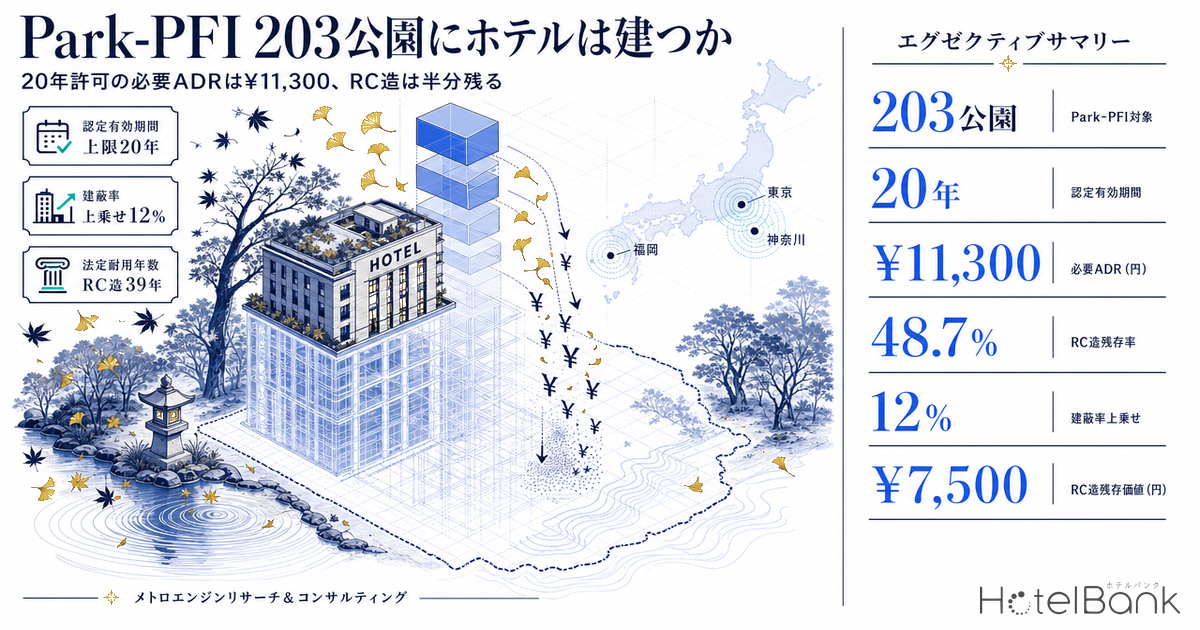
- — The validity period of a Park-PFI approval is 20 years at most (Urban Park Act, Article 5-2, Paragraph 5). As of 31 March 2026 the scheme had been adopted at 203 parks, with solicited facilities in service at 131 of them.
- — Reinforced concrete carries a statutory useful life of 39 years, so 48.7% of construction cost remains undepreciated at year 20. Wood-frame and light-gauge steel structures have useful lives of 17 years or less and depreciate fully inside the 20-year window.
- — A 100-room reinforced concrete hotel needs an ADR of ¥11,300 to reach simple payback within 20 years (assuming 80% full-year OCC). Only Tokyo, Kanagawa, Hyogo and Fukuoka reach that level on estimated settled ADR.
- — The building coverage ceiling is in principle 2% plus 10% for solicited facilities, 12% in total. Neighbourhood-block parks, which make up 80.0% of Japan’s 115,917 urban parks, average 1,591 m², capping building footprint at just 191 m².
- — A project selected under the PFI Act can run up to 30 years (Article 5, Paragraph 4). The required ADR for reinforced concrete falls to ¥7,500, bringing all eight prefectures examined here into viable territory.
Executive summary — the 20-year ceiling picks the structure
Start with the conclusion. For hotel investment, the Park-PFI 20-year ceiling bites not as a constraint on location but as a constraint on structure. Under the National Tax Agency’s statutory useful lives for buildings used as inns and hotels, reinforced concrete runs 39 years and wood frame 17 years. In a framework where the business period ends at 20 years, reinforced concrete reaches expiry with 48.7% of construction cost still undepreciated, while wood-frame and light-gauge steel structures are written off in full. The intuition that low-capex formats suit parks is underwritten not merely by cheapness but by an accounting fit: the depreciation schedule fits inside the permit period.
And there is a way out of the constraint. Article 5, Paragraph 4 of the same Urban Park Act allows an establishment and management period of up to 30 years, but only where the work is carried out as a project selected under the PFI Act. A 100-room reinforced concrete hotel that only pencils out at Tokyo- or Kanagawa-level pricing under a 20-year window sees its required ADR fall to around ¥7,500 under a 30-year window. The question of putting a hotel in an urban park is therefore not whether to use Park-PFI, but which permit period to go after.
Reading the scheme as an investment period — three exemptions and the 10-year renewal in practice
Park-PFI grants three exemptions as a package. Organised by statutory provision, they look as follows. All derive from the Urban Park Act and its Enforcement Order, and note that local government discretion (the ratio set by municipal ordinance) enters at several points.
| Exemption | Ordinary establishment and management permit | Under Park-PFI | Statutory basis |
|---|---|---|---|
| Establishment and management period | 10 years (renewals also within 10 years) | Approval valid for up to 20 years | Art. 5(3) / Art. 5-2(5) |
| Building coverage ratio | Ratio set by ordinance with reference to 2/100 in principle | Additional allowance set by ordinance with reference to 10/100 | Art. 4(1) proviso / Enforcement Order Art. 6(2) / Art. 5-9(1) |
| Occupancy structures | Subject to the occupancy permit requirements of Art. 7 | Convenience-enhancing facilities (bicycle parking, information signage, etc.) permitted on conformity with technical standards | Art. 5-9(2) |
| (Reference) Project selected under the PFI Act | — | Up to 30 years, within the term of the project contract | Art. 5(4) |
In practice, the internal structure of that period is easily overlooked. The 7th-edition operating guidelines state explicitly that “within the validity period of the approval, an establishment and management permit may be granted for up to 20 years. However, since the establishment and management permit period is 10 years at most, the approved operator must apply to renew the permit before it expires.” In other words, a 20-year permit is not issued in one piece: you reach 20 years by renewing a 10-year permit once. Because the park administrator is obliged to grant permits applied for under an approved plan, renewal is highly probable — but a financing structure must be built on the fact that an administrative act is interposed in year 10.
A second point: the building coverage uplift is not cumulative with other exemptions. The guidelines state that “where recreation facilities, sports facilities and solicited park facilities are present, the building coverage ratio for these buildings as a whole falls within the ratio set by ordinance with reference to 2/100, plus the ratio set by ordinance with reference to 10/100.” If existing management buildings, amenity facilities or a gymnasium already consume floor area, only the remainder can be allocated to a hotel.
Adoptions peaked at 34 parks in FY2021 and have since run at 20–30 parks a year. Parks are classified by the fiscal year in which the solicitation guidelines were published, and unsuccessful or withdrawn projects are not listed as of the end of FY2025. MLIT reports a further 187 parks where use of the scheme is under consideration. For the origins of the scheme itself and movement on individual projects, see our earlier Park-PFI hotel investment analysis of Japan’s public park hotel market.
Where the 203 parks are — Tokyo 18, Fukuoka 17, six prefectures at zero
Tabulated by prefecture from published material, the 203 parks are spread across 41 prefectures; Akita, Niigata, Shimane, Tokushima, Ehime and Kumamoto have no adoptions at all. The leaders are Tokyo with 18, Fukuoka 17, Kanagawa 14, Aichi 13 and Osaka 13 — the top five alone account for 75 parks, or 36.9%. Adoption is skewed towards metropolitan areas where designated cities and special wards act as park administrators, so the map of the scheme overlaps with the map of deep lodging demand.
| Tokyo | 18 parks |
| Fukuoka | 17 parks |
| Kanagawa | 14 parks |
| Aichi | 13 parks |
| Osaka | 13 parks |
| Saitama | 9 parks |
| Hokkaido, Hyogo, Chiba, Okinawa | 7 parks each |
20 years vs statutory useful life — what structure leaves behind at expiry
This is the core of the analysis. Under the National Tax Agency’s table of useful lives for depreciable assets, buildings used as inns and hotels carry statutory useful lives ranging from 15 to 39 years depending on structure — a 2.6-fold spread. The Park-PFI business period, by contrast, is capped at 20 years regardless of structure. Overlay the two and the question of which structures fit inside the 20-year vessel answers itself mechanically.
| Structure | Cost per m² (JPY, 2024) | Construction cost (JPY 10k/room) | Statutory useful life (inn / hotel use) | Depreciation at year 20 | Undepreciated at year 20 (JPY 10k/room) |
|---|---|---|---|---|---|
| Steel-framed reinforced concrete (SRC) | 983,286 | 3,442 | 39 years | 51.3% | 1,677 |
| Reinforced concrete (RC) | 525,732 | 1,840 | 39 years | 51.3% | 896 |
| Steel frame (members over 4 mm) | 499,219 | 1,747 | 29 years | 69.0% | 542 |
| Steel frame (members over 3 mm to 4 mm) | 499,219 | 1,747 | 24 years | 83.3% | 291 |
| Steel frame (members 3 mm or less) | 499,219 | 1,747 | 17 years | 100% | 0 |
| Concrete block | 320,757 | 1,123 | 36 years | 55.6% | 499 |
| Wood frame / synthetic resin | 373,198 | 1,306 | 17 years | 100% | 0 |
| Wood frame with mortar finish | — | — | 15 years | 100% | 0 |
Cost per m² rose sharply in 2024 from the prior year. SRC in particular rests on a small base of just 17 construction starts, where large, high-end projects push the unit cost up. Read the figures as material for relative comparison between structures and treat the absolute values as ranges.
Here is how to read it. Building a 100-room reinforced concrete hotel (3,500 m² gross) costs roughly ¥1.84bn, and at year 20 about ¥896m remains undepreciated. Whether the business period ends with demolition of the facility, transfer to the park administrator, or succession by another operator through re-solicitation, the investment does not work unless the project contract settles in advance where that ¥896m lands. Conversely, with wood frame or light-gauge steel the book value reaches zero at 20 years, and all that remains at expiry is a choice: demolish, or win the re-solicitation and keep operating. That difference shapes what lodging facilities in parks look like.
A 12% coverage ratio decides which parks qualify — 80% of Japan’s 115,917 parks physically cannot host a hotel
After period comes area. According to MLIT’s Urban Park Database, at the end of FY2024 (as of 31 March 2025) Japan had 115,917 urban parks and equivalent sites covering 131,242.58 hectares. The composition is extremely skewed: neighbourhood-block parks account for 92,677 sites, or 80.0% of the total. Their average area is 1,591 m², so even using the full 12% building coverage allowance, the building footprint caps out at 191 m².
| Category | Sites | Share | Area (ha) | Average area (m²) | Max footprint at 12% coverage (m²) |
|---|---|---|---|---|---|
| Neighbourhood-block park | 92,677 | 80.0% | 14,741.7 | 1,591 | 191 |
| Urban green space | 9,573 | 8.3% | 17,474.1 | 18,254 | 2,190 |
| Neighbourhood park | 5,929 | 5.1% | 10,701.9 | 18,050 | 2,166 |
| District park | 1,658 | 1.4% | 8,824.1 | 53,221 | 6,387 |
| Comprehensive park | 1,411 | 1.2% | 26,724.5 | 189,401 | 22,728 |
| Special-purpose park | 1,409 | 1.2% | 13,624.5 | 96,696 | 11,604 |
| Sports park | 849 | 0.7% | 13,309.5 | 156,766 | 18,812 |
| Wide-area park | 221 | 0.2% | 15,354.5 | 694,772 | 83,373 |
| National government park | 17 | 0.0% | 4,343.3 | 2,554,900 | 306,588 |
A 100-room reinforced concrete hotel with 3,500 m² of gross floor area needs a 700 m² footprint at five storeys, implying a park of 5,833 m² (0.58 ha). Build to eight storeys and 3,646 m² (0.36 ha) suffices. Mapped onto the categories, anything from a neighbourhood park (1.8 ha average) upwards works on paper, while a neighbourhood-block park does not. Summing the categories at neighbourhood-park scale and above gives roughly 11,500 sites, or 9.9% of the total. Eight in ten urban parks drop out on area before the regulatory discussion even begins.
Conversely, even 191 m² in a neighbourhood-block park is enough for four or five cottages of 40 m² each. Low-capex formats suit parks not only because unit costs are low. It is because the small footprint per unit allows multiple units to be arranged within the 12% coverage vessel.
There is also room to fall outside the coverage denominator entirely. Article 4, Paragraph 1 of the Urban Park Act applies to “buildings” as defined in Article 2, Item 1 of the Building Standards Act. For structures built on vehicles, such as trailer houses, an established administrative practice since Ministry of Construction Notices No. 419 (1 December 1987) and No. 170 (31 March 1997) holds that they are not treated as buildings so long as they remain capable of being moved at any time and at will. Remove the wheels, fix the unit to the ground or leave no access route for relocation, and it will be judged a building — so this applies only where the operating requirements are genuinely met. Within those limits, choosing mobile units carries real meaning for building coverage.
Working backwards to the required ADR — ¥11,300 on a 20-year window, ¥7,500 on 30 years
Now translate these constraints into revenue terms. The assumptions are set out below. All figures are estimates and do not guarantee the viability of any individual project.
・Construction cost = cost per m² by structure for lodging use, e-Stat “Statistics on Building Construction Starts”, 2024 (JPY/m²)
・Gross floor area per room = 35 m² (limited-service hotel assumption); cottages at 40 m² per unit
・Cost of designated park facilities = an additional 15% on construction cost (under Park-PFI the operator builds surrounding pathways and plazas in addition to the solicited park facilities; the actual share varies by project under the solicitation guidelines)
・GOP margin 35% (set conservatively below the level of actuals disclosed by Invincible Investment Corporation for properties under management contract)
・Park usage fee = 3% of revenue (the fee under Art. 5-2(2)(iv); the actual amount depends on the minimum in the solicitation guidelines and the operator’s proposal)
・Simple payback period = total investment ÷ (annual revenue × (GOP margin − usage fee rate)). Interest, tax and land cost are treated as zero (Park-PFI involves no land acquisition cost)
| Structure | Total investment (JPY 10k/room) | 10-year window (ordinary permit) | 20-year window (Park-PFI approval) | 30-year window (PFI Act project) |
|---|---|---|---|---|
| Steel-framed reinforced concrete (SRC) | 3,958 | ¥42,356 | ¥21,178 | ¥14,119 |
| Reinforced concrete (RC) | 2,116 | ¥22,646 | ¥11,323 | ¥7,549 |
| Steel frame | 2,009 | ¥21,504 | ¥10,752 | ¥7,168 |
| Wood frame / synthetic resin | 1,502 | ¥16,076 | ¥8,038 | ¥5,359 |
| Concrete block | 1,291 | ¥13,817 | ¥6,908 | ¥4,606 |
Set these required ADRs against market ADR in the prefectures where Park-PFI is most widely adopted. Trailing 12-month average estimated settled ADR compiled by MetroEngines Research (August 2025 to July 2026) is as follows.
| Prefecture | Park-PFI parks | Estimated settled ADR 12-month average | Properties covered | Structures viable on a 20-year window |
|---|---|---|---|---|
| Tokyo | 18 | ¥14,631 | 1,130 | RC, steel frame and wood frame all viable (SRC falls short) |
| Kanagawa | 14 | ¥14,199 | 573 | RC, steel frame and wood frame all viable |
| Hyogo | 7 | ¥13,690 | 544 | RC, steel frame and wood frame all viable |
| Fukuoka | 17 | ¥11,781 | 469 | RC roughly at break-even (¥11,323); steel frame and wood frame viable |
| Osaka | 13 | ¥10,724 | 644 | Steel frame roughly at break-even; wood frame viable |
| Chiba | 7 | ¥10,186 | 413 | Wood frame and concrete block in viable territory |
| Aichi | 13 | ¥8,818 | 507 | Wood frame roughly at break-even (¥8,038) |
| Saitama | 9 | ¥8,037 | 216 | Wood frame at break-even; concrete block viable |
The reading is unambiguous. Making a 100-room reinforced concrete hotel work under a 20-year Park-PFI window requires a market where a typical property sells at ¥11,300 or more. That is limited to the Tokyo, Kanagawa, Hyogo and Fukuoka class; in ¥8,000-level markets such as Aichi and Saitama, you have to come down to wood frame or light structures to get inside the payback window. Yet the same 100-room reinforced concrete building, if a 30-year window can be secured as a project selected under the PFI Act, needs only ¥7,500 — and all eight prefectures examined here move into viable territory. For hotel development in urban parks, choosing between the Park-PFI route and going after a 30-year period under the PFI Act shifts the class of asset you can put on the site by a full step.
Sensitivity analysis — the conditions for fitting 100 concrete rooms into 20 years are narrow
A required ADR is only a single point estimate. Flexing ADR and OCC to see how the simple payback period moves shows just how thin the region around the 20-year line is.
| ADR \ OCC (full-year assumption) | 70% | 75% | 80% | 85% |
|---|---|---|---|---|
| ¥9,000 | 28.8 yrs | 26.8 yrs | 25.2 yrs | 23.7 yrs |
| ¥10,000 | 25.9 yrs | 24.2 yrs | 22.6 yrs | 21.3 yrs |
| ¥11,000 | 23.5 yrs | 22.0 yrs | 20.6 yrs | 19.4 yrs |
| ¥12,000 | 21.6 yrs | 20.1 yrs | 18.9 yrs | 17.8 yrs |
| ¥14,000 | 18.5 yrs | 17.3 yrs | 16.2 yrs | 15.2 yrs |
| ¥16,000 | 16.2 yrs | 15.1 yrs | 14.2 yrs | 13.3 yrs |
At ¥12,000 and 80% OCC, payback takes 18.9 years — leaving just 1.1 years of headroom against a 20-year permit. Payback completes exactly as the period expires, and almost nothing is left for the investor. Making reinforced concrete work on a 20-year window realistically means targeting a ¥14,000-plus price band, or building the plan around continuation through renewal and re-solicitation after the approval period ends.
For reference, consider recent actuals from a listed hotel REIT. Invincible Investment Corporation reported monthly operating results for July 2026 covering 101 domestic hotels (of the 112 domestic hotels held at the start of the fiscal period ending December 2026, those operated by Iconia Hospitality Co., Ltd. and its subsidiaries): occupancy 86.3%, ADR ¥15,100 and RevPAR ¥13,039 (year on year, occupancy +1.9pt, ADR −1.0%, RevPAR +1.2%). That a portfolio centred on limited-service hotels reaches this level suggests that in a favourable urban location, 20-year payback on reinforced concrete is within realistic reach. These are results for stabilised properties, however, and a more conservative view is warranted for a newly built asset in its ramp-up phase.
The low-capex market today — the formats among 1,315 openings in 2026 that work on unit rates
The other viable answer is the low-capex format. Within MetroEngines Research’s coverage, 1,315 lodging facilities were confirmed to have opened in 2026, averaging 26 rooms. The small-scale, low-rise unit formats that could sit in a park break down as follows.
| Format | Openings | Average units | Maximum | Main concentrations |
|---|---|---|---|---|
| Vacation rental | 629 | — | — | — |
| Cottage | 47 | 10.4 | 59 | Nagano 7, Hokkaido 4, Okinawa 4 |
| Pension | 13 | 5.4 | 10 | Nagano 4, Shizuoka 3 |
| Glamping | 12 | 7.8 | 28 | Okinawa 2, otherwise dispersed |
| Lodge | 8 | 8.8 | 15 | Nagano 2, Niigata 2 |
| (For comparison) Business hotels 145 / city hotels 38 / resort hotels 60 | ||||
Cottages, glamping and lodges together come to just 67 openings, but their significance as an investment structure is large. A single wood-frame cottage of 40 m² costs roughly ¥17.17m to build including designated park facility costs. To reach simple payback in 20 years, the required nightly rate per unit is ¥13,400 at 55% OCC, or ¥11,300 at 65% OCC, on a full-year business-plan basis. Whole-unit rentals for four to six guests routinely price at ¥25,000 to ¥40,000 per unit, so the payback range is reachable even at half occupancy — in sharp contrast to a reinforced concrete hotel that cannot get there without assuming 80% OCC.
Wood frame also reaches the end of its statutory useful life at 17 years, and wood frame with mortar finish at 15. Depreciation finishes inside the 20-year business period, leaving no undepreciated balance at expiry. The advantage of the low-capex format lies less in being cheap than in having depreciation, payback and permit period all fit into the same 20-year vessel.
Financing — what it means to hold neither freehold nor leasehold
What an operator obtains under Park-PFI is not a right in land. It is a standing, based on an administrative disposition in the form of an establishment and management permit, to install and manage park facilities. Three practical issues follow.
First, only the building can be pledged as security. Ownership of the solicited park facilities vests in the operator, so a mortgage over the building itself is conceivable, but the site belongs to the park administrator — in most cases a local government — and cannot be taken as collateral. In ordinary hotel development, land accounts for the bulk of collateral value, so leverage has to be structured differently at the same project scale.
Second, succession to the operator’s standing requires the park administrator’s approval. Article 5-8 of the Urban Park Act provides that a general successor to the party that submitted the approved plan, and a person who acquires ownership or other necessary title to the solicited park facilities established and managed under the approved plan, may succeed to the approved standing with the park administrator’s approval. Put the other way round, a third party who acquires the building through enforcement of a security interest cannot necessarily continue the business: an administrative judgment in the form of approval is interposed. In a project finance structure, how that approval process is reflected in the project contract and the direct agreement becomes the practical focus.
Third, measures for business failure are required in advance. The operating guidelines list, among the matters desirable to include in solicitation guidelines, “where operation of the solicited park facilities by the approved operator becomes difficult, succeeding the business to another private operator with the park administrator’s approval under Article 5-8, or taking a deposit at the start of the business to be applied to the cost of removing the solicited park facilities”. Where the design calls for a removal-cost deposit up front, that amount has to be booked as a cash outflow at commencement.
These are constraints, but they should be read together with the benefits on the other side. Zero land acquisition cost — or no land rent, replaced by a park usage fee — is substantial upside in a market where land prices keep rising. This connects directly to the fixed-term business leasehold structure examined in our analysis of leasehold hotel development and supportable ground rent across nine markets, where working backwards to the maximum supportable ground rent showed viability up to 1.38 times the land price that the freehold approach could bear. Park-PFI sits on the same continuum, positioned as a scheme that compresses land cost further in exchange for surrendering business period and collateral structure.
Summary of viability conditions
Condition A Low capex, short useful life
Wood-frame or light-gauge steel cottages and cabins. With a useful life of 17 years or less, depreciation fits inside the 20-year window, and at 40 m² per unit four or five units fit even on a neighbourhood-block park. Payback in 20 years is reached at 55% full-year OCC and ¥13,400 per unit. This is the only realistic option for the neighbourhood-block parks that make up eight in ten of Japan’s 115,917 urban parks.
Condition B High-ADR market × reinforced concrete
Limited to markets with estimated settled ADR of ¥11,300 or more. Tokyo, Kanagawa, Hyogo and Fukuoka qualify, and they also overlap with the prefectures leading Park-PFI adoption. Because payback completes at almost the same moment the period expires, the plan has to be designed around continuation through renewal and re-solicitation. Eligible sites are neighbourhood parks and above — about 9.9% of the total.
Condition C A 30-year window as a PFI Act project
Go after the 30-year window under Article 5, Paragraph 4. Required ADR for reinforced concrete falls to ¥7,500, bringing all eight prefectures examined here into viable territory. Even SRC comes to ¥14,100, within Tokyo’s price level. Putting a full-scale hotel into an urban park effectively presupposes designing for this route.
Park-PFI is not a scheme that lets you build anything you like in a park. It is a scheme in which a 20-year period ceiling and a 12% building coverage ratio sharply narrow the structure, scale and price band of the asset you can put on the site. That is precisely why the room for design is so clearly defined. Choose a low-capex, short-useful-life format and fit it cleanly into the 20-year vessel; push reinforced concrete payback into 20 years in a high-ADR market; or go after the 30-year period itself as a project selected under the PFI Act. Deciding between those three branches at the outset is the starting point for anyone approaching urban parks as a third category of development site.
Frequently asked questions
Related reading
References and sources
■ Data sources
Scheme details and counts are from MLIT, “Status of use of the public solicitation-based establishment and management system (Park-PFI), as of 31 March 2026” and the “Urban Park Database (end of FY2024)”; statutory provisions from the Urban Park Act and its Enforcement Order; statutory useful lives from the National Tax Agency, “Table of useful lives for principal depreciable assets” (inn and hotel use); construction cost per m² from e-Stat, “Statistics on Building Construction Starts” (statistics ID: 0003114547; 2024, lodging use, nationwide, all building owners). Estimated settled ADR by prefecture is from MetroEngines Research & Consulting (12-month average, August 2025 to July 2026; properties covered is the monthly median). REIT actuals are figures published by Invincible Investment Corporation.
■ Calculation assumptions
All assumptions are set out in the section on working backwards to the required ADR. In summary: 35 m² of gross floor area per room (40 m² per cottage unit); designated park facility costs added at 15% of construction cost; GOP margin 35%; park usage fee at 3% of revenue; straight-line depreciation. Simple payback period = total investment ÷ (annual revenue × (GOP margin − usage fee rate)), treating interest, tax, land cost, residual value and inflation as zero. All OCC figures are business-plan assumptions for full-year operation, not measured results.
■ Limitations and caveats
(1) Required ADR and payback periods are coarse indicators that exclude interest, tax and residual value, and do not guarantee the viability of any individual project. (2) Construction cost per m² is a national average from construction starts statistics; SRC rests on only 17 starts in 2024, a small base prone to upward bias. (3) The 12% building coverage ratio is a guide of 2% plus 10%; actual ratios vary by municipal ordinance, and area consumed by existing facilities is not deducted. (4) Maximum footprint is a mechanical calculation against average area by category and does not reflect the shape, zoning or urban planning constraints of individual parks. (5) Estimated settled ADR applies segment-specific adjustments to OTA published prices and differs from actual transaction prices. (6) The handling of business period and building coverage varies by project under the applicable solicitation guidelines.
■ Legislation and schemes
- Urban Park Act (Act No. 79 of 1956) | e-Gov Law Search — Art. 4 (building coverage), Art. 5(3) and (4) (establishment and management permit period), Art. 5-2(5) (20-year validity of approval), Art. 5-8 (succession of standing), Art. 5-9 (exemptions)
- MLIT City Bureau, “Guidelines on the Operation of the Urban Park Act (7th edition)”, December 2024
- MLIT City Bureau, Parks, Green Spaces and Landscape Division, “Parks and greenery: use of Park-PFI and related schemes” — hosts the “Guidelines on using Park-PFI to improve the quality of urban parks (May 2025 revision)”
- MLIT, “Status of use of the public solicitation-based establishment and management system (Park-PFI), as of 31 March 2026” — 203 parks, 131 in service, 187 under consideration
- Ministry of Construction, Housing Bureau, Building Guidance Division notice, “Treatment of trailer houses under the Building Standards Act” (1 December 1987, Notice No. 419) and related notices
■ Government statistics
- MLIT, “Urban Park Database | Status of urban park development by category (end of FY2024, as of 31 March 2025)” — 115,917 sites, 131,242.58 ha nationwide
- e-Stat, “Statistics on Building Construction Starts”, by use and structure / number of buildings, floor area and estimated construction cost (statistics ID: 0003114547) — lodging use, nationwide, all building owners, 2022–2024
- e-Stat, “Statistics on Building Construction Starts”, by use and building owner / number of buildings, floor area and estimated construction cost (statistics ID: 0003114490) — lodging use, nationwide, 2011–2024
- National Tax Agency, “Table of useful lives for principal depreciable assets” — statutory useful lives for buildings by structure (inn and hotel use)
■ REIT and market data
- Invincible Investment Corporation, “Notice concerning portfolio operating results (July 2026)” (25 August 2026) — occupancy 86.3% / ADR ¥15,100 / RevPAR ¥13,039 on a 101 domestic hotel basis (properties operated by Iconia Hospitality); year on year, occupancy +1.9pt, ADR −1.0%, RevPAR +1.2%
- Invincible Investment Corporation, “Hotel operating results” — monthly operating results by property. The domestic hotel total is compiled on a 103-property basis, a different population from the 101-property basis in the release above
- MetroEngines Research & Consulting — estimated settled ADR by prefecture (August 2025 to July 2026) and data on facilities opening in 2026 (based on confirmed OTA listings, N=1,315)