

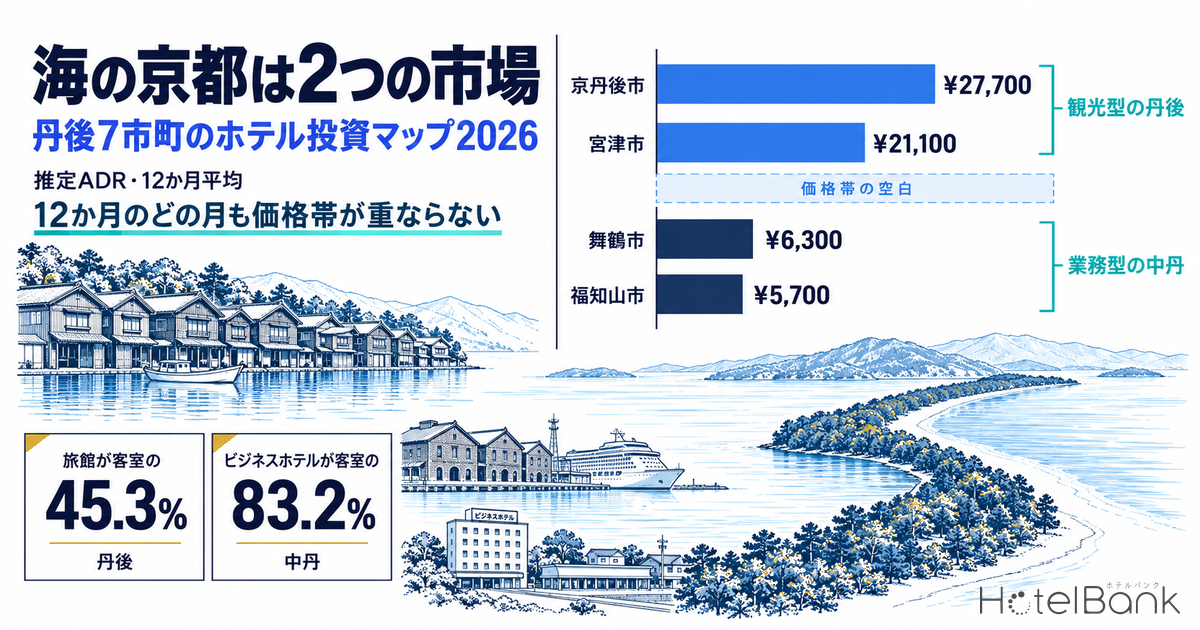
The seven municipalities that make up “Kyoto by the Sea” in northern Kyoto Prefecture are not a single hotel market. Lining up MetroEngines Research estimated ADR (average daily rate) as a 12-month average for September 2025 to August 2026, Kyotango comes to ¥27,700 and Miyazu to ¥21,100, against ¥6,300 for Maizuru and ¥5,700 for Fukuchiyama. Inside one tourism zone, a leisure-driven Tango and a business-driven Chutan sit side by side with rates roughly four times apart.
This article breaks that two-tier structure down to the level of 270 properties and 5,162 rooms, and reads the price bands left empty between and above the two markets as entry points for investment. Seasonal swings in rates are covered in Japan Hotel ADR Swings Up to 4.9x by Season: 633 Municipalities Ranked and Crab Season Opens Nov 6: Echizen Room Rates Jump 3.2x in One Month, and the nationwide comparison of gaps within a prefecture in Japan Intra-Prefecture ADR Gaps Reach 5.2x: 368 Municipalities Ranked. Seasonal amplitude is not the subject here, and Kyoto City is out of scope.
Metric Definitions Used in This Article
- ADR (average daily rate): an estimated transacted rate (tax-exclusive equivalent) calculated by applying a correction factor for each property type to the lowest-plan level each property publishes on OTAs (two guests in one room, price per room, tax included). Checked against the property-level results disclosed by listed hotel REITs (91 properties, most recent three months), the median error is about 7%. These are estimates and differ from each property’s actual transacted rates and accounting figures. Area-level ADR is the median of the properties covered (the level of a typical property in the area); this article uses the 12-month average of the monthly values for September 2025 to August 2026.
- Ryokan rates: ryokan mostly sell plans that include meals, so their estimated ADR includes the equivalent of meal charges. Note that this is not the same thing as the room rate of a limited-service hotel.
- Properties covered: properties tracked by MetroEngines Research with a price observation in the most recent three months (June 27 to September 26, 2026). Across the seven municipalities that is 270 properties and 5,162 rooms (as listed on major booking sites). Limited to the property types for which estimated ADR can be calculated (ryokan, business, city and resort hotels), there are 141 properties and 4,288 rooms with at least six months of observations.
- Reference values: Ine (N=3), Yosano (N=2) and Ayabe (N=4), where fewer than five properties enter the estimated ADR calculation, are treated as reference values.
- Data source: MetroEngines Research & Consulting
Source: MetroEngines Research & Consulting / Kyoto Prefecture, “2024 Kyoto Prefecture Tourist Arrivals Survey Report”
- — Leisure-driven Kyotango at ¥27,700 and Miyazu at ¥21,100 versus business-driven Maizuru at ¥6,300 and Fukuchiyama at ¥5,700. Estimated ADR (12-month average, September 2025 to August 2026) is roughly four times apart
- — The price bands do not overlap in any of the 12 months. Even Miyazu’s lowest month (¥12,100) is about 1.7 times Maizuru’s highest month (¥7,200)
- — In Tango, ryokan hold 45.3% of rooms at 13.5 rooms per property; in Chutan, business hotels hold 83.2% at 40.1 rooms per property (N=270 properties, 5,162 rooms)
- — Two empty cells: Chutan at ¥10,000–20,000 with 50+ rooms and Tango at ¥30,000+ with 50+ rooms both have zero properties
- — The viability threshold for a new build, at 80% assumed occupancy (full year), is around ¥12,000 in Chutan and ¥38,000–43,000 in Tango. The ¥37,000 median of Tango’s upper band is already close
Conclusion — Two Markets, Leisure and Business; the Gaps Are “Chutan at ¥10,000–20,000” and “Tango at ¥30,000+ with 50+ Rooms”
The conclusion first. One: the four Tango municipalities (Kyotango, Miyazu, Ine and Yosano) and the three Chutan cities (Maizuru, Fukuchiyama and Ayabe) are separate markets on every count — rate level, property type, property size and source of demand. Tango is a small-scale, leisure-driven market where ryokan hold 45.3% of rooms and the average property has 13.5 rooms. Chutan is a business-driven market where business hotels hold 83.2% of rooms and the average property has 40.1 rooms.
Two: the price bands of the two markets do not overlap in any of the 12 months. Even the lowest month of Tango’s two main cities (Miyazu in June 2026, ¥12,100) is about 1.7 times the highest month in Chutan (Maizuru in August 2026, ¥7,200).
Three: mapped by price band and size, there are two gaps. In Chutan, 99% of the rooms with an estimated ADR are below ¥10,000, and there is no property at ¥10,000–20,000 with 50 or more rooms. In Tango there are 38 properties at ¥30,000 or more, but all have fewer than 50 rooms; there is no property at ¥30,000+ with 50 or more rooms. The sections below confirm this structure step by step and then set it against the viability threshold for new builds to sort out the entry points for investment.
Estimated ADR in the Seven Municipalities — Kyotango ¥27,700 and Miyazu ¥21,100 vs Maizuru ¥6,300 and Fukuchiyama ¥5,700
Lined up, the estimated ADR of the seven municipalities shows a large step between the top four and the bottom three. Even limited to the four cities with thick samples (Kyotango N=74–82, Miyazu N=29–30, Maizuru N=17–18, Fukuchiyama N=8–11), the two leisure-driven cities cluster in the ¥20,000s and the two business-driven cities at around ¥6,000. Ine (¥39,900) and Yosano (¥27,100) fall on the Tango side and Ayabe (¥5,800) on the Chutan side, but all three are reference values because fewer than five properties are counted.
Source: MetroEngines Research & Consulting (estimated ADR, 12-month average for September 2025 to August 2026; lighter bars are reference values with fewer than five properties)
Against the same period a year earlier (September 2024 to August 2025), the two leisure-driven cities rose: Kyotango by +3.2% and Miyazu by +5.8%. The business-driven cities were roughly flat, with Maizuru at -0.5% and Fukuchiyama at +1.4%. Business-driven rates stay within a narrow ¥5,500–7,200 range all year, which points to stable pricing built mainly on corporate demand. The leisure-driven market is in a phase of rising rate levels; the business-driven market is marked by the stability of its level.
| Area | Municipality | Properties | Rooms | Avg. rooms per property | Largest property type | Estimated ADR (12-month avg.) | ADR sample (N) | YoY | Commercial land price change (2026) |
|---|---|---|---|---|---|---|---|---|---|
| Tango | Kyotango | 130 | 1,709 | 13.1 | Ryokan (79 properties) | ¥27,720 | 74–82 | +3.2% | -2.2% |
| Tango | Miyazu | 65 | 1,010 | 15.5 | Ryokan (23 properties) | ¥21,109 | 29–30 | +5.8% | -0.5% |
| Tango | Ine | 14 | 67 | 4.8 | Other / vacation rentals | ¥39,921 (reference) | 3 | +9.1% | — |
| Tango | Yosano | 4 | 92 | 23.0 | Business hotels and others | ¥27,124 (reference) | 2 | +12.2% | -1.2% |
| Chutan | Maizuru | 28 | 1,408 | 50.3 | Business hotels (13 properties) | ¥6,251 | 17–18 | -0.5% | -0.8% |
| Chutan | Fukuchiyama | 18 | 720 | 40.0 | Business hotels (6 properties) | ¥5,697 | 8–11 | +1.4% | -1.0% |
| Chutan | Ayabe | 11 | 156 | 14.2 | Farm stays / business hotels | ¥5,778 (reference) | 4 | ±0.0% | 0.0% |
Source: MetroEngines Research & Consulting (property and room counts cover properties with a price observation in the most recent three months, N=270 properties) / Kyoto Prefecture, “2026 Prefectural Land Price Survey: Average Year-on-Year Change by Municipality” (commercial land; Ine has no commercial survey site)
No Overlap in Any of the 12 Months — the Leisure Market’s Lowest Month Beats the Business Market’s Highest
Setting each city’s annual rate range side by side makes the separation of the two markets clearer still. Each band below connects the lowest and the highest of a city’s 12 months. The seasonal swing itself was covered in earlier articles, so the only question here is whether the bands overlap.
Source: MetroEngines Research & Consulting (estimated ADR, minimum to maximum of the monthly values for September 2025 to August 2026; the four cities with N of 8 or more)
Kyotango’s band runs from ¥15,600 to ¥43,600 and Miyazu’s from ¥12,100 to ¥27,900. Maizuru is at ¥5,800–7,200 and Fukuchiyama at ¥5,500–6,200, leaving a gap of about ¥5,000 between the bottom of the leisure band and the top of the business band. In other words, when Tango inns cut rates in the off-season they do not come down into Chutan’s price band, and when Chutan hotels raise rates in peak season they do not reach Tango’s. Under the same “Kyoto by the Sea” banner, there is almost no price competition between the two markets.
Supply Takes a Different Shape — Tango Is Ryokan at 13.5 Rooms per Property, Chutan Is Business Hotels at 40.1
The make-up of supply is just as contrasting. The four Tango municipalities have 213 properties and 2,878 rooms, of which ryokan account for 106 properties and 1,305 rooms (45.3% of rooms). There are also many small inns such as minshuku guesthouses, vacation rentals and cottages, and only nine properties have 50 or more rooms. The three Chutan cities have 57 properties and 2,284 rooms, of which business hotels account for 22 properties and 1,900 rooms (83.2% of rooms), with 18 properties at 50 rooms or more. Room counts are of a similar order, but Tango is a market of many small inns, while in Chutan mid-sized business hotels carry the rooms.
Source: MetroEngines Research & Consulting (N=270 properties; circle size = room count)
Tango, 4 municipalities (leisure-driven)
213 properties, 2,878 rooms / 13.5 rooms per property
Ryokan: 106 properties, 1,305 rooms (45.3%)
50+ rooms: 9 properties, 973 rooms
Main locations: Yuhigaura, Kumihama, Taiza, Amanohashidate, the funaya boathouses of Ine
Chutan, 3 cities (business-driven)
57 properties, 2,284 rooms / 40.1 rooms per property
Business hotels: 22 properties, 1,900 rooms (83.2%)
50+ rooms: 18 properties, 1,799 rooms
Main locations: around Nishi-Maizuru, Higashi-Maizuru and Fukuchiyama stations
As the map shows, Chutan’s rooms gather in front of three stations — Nishi-Maizuru, Higashi-Maizuru and Fukuchiyama — while Tango’s rooms are scattered along the coastline and around Amanohashidate. In Chutan, on May 1, 2026, R Inn Fukuchiyama (アールイン福知山), a one-minute walk from Fukuchiyama Station, reopened under a new brand as APA Hotel Kyoto Fukuchiyama Ekimae (アパホテル〈京都福知山駅前〉, 91 rooms). The station-front business market is seeing new movement in the form of a national brand reviving an existing hotel.
Sources of Demand — Overnight Tourism Spending Is ¥18.7 Billion in Tango, While Workers Cluster Around Chutan’s Stations
The two-tier structure is borne out on the demand side as well. According to Kyoto Prefecture’s tourist arrivals survey (2024), the Kyoto by the Sea area received 1.355 million overnight visitors, 74% of the 1.821 million overnight visitors to the prefecture outside Kyoto City. Splitting tourism spending by municipality into day trips and overnight stays, spending by overnight visitors totals ¥18.72 billion in the four Tango municipalities against ¥2.21 billion in the three Chutan cities, a gap of about 8.5 times. Overnight stays account for 82% of tourism spending in Kyotango and 68% in Miyazu: these are places where visitors stay and spend.
Source: compiled by MetroEngines Research & Consulting from Kyoto Prefecture, “2024 Kyoto Prefecture Tourist Arrivals Survey Report”, Table 9 (tourism spending by municipality, day-trip and overnight)
Maizuru receives 2.283 million tourist arrivals, second only to Miyazu (3.006 million), but about 80% of its tourism spending comes from day-trippers. What supports hotel demand in Chutan is more likely business demand that does not show up in tourism statistics — business trips, construction work, public-sector travel and the like. Indeed, comparing the number of workers within a 1 km radius of the main stations in the Economic Census (2021), the Fukuchiyama Station area has 7,440, the Higashi-Maizuru Station area 5,829 and the Nishi-Maizuru Station area 5,405, roughly 2 to 2.8 times the Miyazu Station area (2,635) or Mineyama, the centre of Kyotango (2,785). Maizuru also hosts a Japan Maritime Self-Defense Force base, which adds business demand around the base.
| Location (1 km radius) | Area | Establishments | Workers | Of which office-type |
|---|---|---|---|---|
| Fukuchiyama Station area | Chutan | 893 | 7,440 | 11.1% |
| Higashi-Maizuru Station area | Chutan | 873 | 5,829 | 6.9% |
| Nishi-Maizuru Station area | Chutan | 713 | 5,405 | 10.7% |
| Ayabe Station area | Chutan | 401 | 3,089 | 7.7% |
| Mineyama (around Kyotango City Hall) | Tango | 289 | 2,785 | 5.8% |
| Miyazu Station area | Tango | 463 | 2,635 | 11.6% |
Source: compiled by MetroEngines Research & Consulting from the Ministry of Internal Affairs and Communications and the Ministry of Economy, Trade and Industry, “Economic Census for Business Activity” (2021, small-area boundaries of the 2020 Population Census). Figures are workers at establishments, not resident population
Chutan also has room to grow on the tourism side. Kyoto Maizuru Port is scheduled to receive a record 22 cruise ship calls in 2026, a large increase from 13 in 2025 (announced by Maizuru City). Passengers on a port-call day are basically day visitors, but pre- and post-cruise stays based at the port, and stays by people working on the cruises, could become upper-end demand for the station-front hotels.
The Price Band × Size Map — the Gaps Concentrate in Two Cells
So how is the space between the two markets filled? Comparing the 141 properties and 4,288 rooms with an estimated ADR by share of rooms in each estimated ADR band, 99% of Chutan’s rooms are concentrated below ¥10,000, and only two properties with 21 rooms in total (about 1%) are at ¥10,000 or more. Tango is spread widely up and down, with 42.4% at ¥10,000–20,000 and 26.4% at ¥30,000 or more.
Source: MetroEngines Research & Consulting (share of rooms across the 141 properties and 4,288 rooms with an estimated ADR; Tango 112 properties and 2,172 rooms, Chutan 29 properties and 2,116 rooms)
What fills Tango’s ¥10,000–20,000 band, however, is 34 small ryokan with fewer than 20 rooms (356 rooms) and four properties with 50 or more rooms (520 rooms). Those four include resort hotels under international brands, and their median estimated ADR is ¥12,800. Across all seven municipalities, properties with 50 or more rooms in the ¥10,000–20,000 band are limited to these four on the Tango side.
Source: MetroEngines Research & Consulting (N=141 properties; property-level estimated ADR is the median of the monthly values for September 2025 to August 2026)
Tango, 4 municipalities (112 properties, 2,172 rooms)
| Size / Estimated ADR | Under ¥10,000 | ¥10,000–20,000 | ¥20,000–30,000 | ¥30,000+ |
|---|---|---|---|---|
| Under 20 rooms | 6 / 71 | 34 / 356 | 22 / 202 | 27 / 272 |
| 20–49 rooms | 1 / 32 | 2 / 44 | 1 / 33 | 11 / 302 |
| 50+ rooms | 3 / 288 | 4 / 520 | 1 / 52 | 0 |
Chutan, 3 cities (29 properties, 2,116 rooms)
| Size / Estimated ADR | Under ¥10,000 | ¥10,000–20,000 | ¥20,000–30,000 | ¥30,000+ |
|---|---|---|---|---|
| Under 20 rooms | 2 / 31 | 0 | 1 / 1 | 0 |
| 20–49 rooms | 7 / 265 | 1 / 20 | 0 | 0 |
| 50+ rooms | 18 / 1,799 | 0 | 0 | 0 |
Source: MetroEngines Research & Consulting (properties with an estimated ADR and at least six months of observations)
Dense Cells already filled
Chutan, under ¥10,000, 50+ rooms holds 18 properties and 1,799 rooms. Tango, under 20 rooms holds 89 properties across all price bands.
WS-1 Upscale limited-service in Chutan
Chutan, ¥10,000–20,000, 50+ rooms has zero properties. A mid-priced band that would take both station-front business demand and upper-end port and tourism demand.
WS-2 Mid-sized upper band in Tango
Tango, ¥30,000+, 50+ rooms has zero properties. All 38 properties at ¥30,000 or more have fewer than 50 rooms.
Viability Threshold for New Builds — Estimated ADR of ¥12,000–17,000 for Upscale Limited-Service in Chutan, ¥38,000–57,000 for the Mid-Sized Upper Band in Tango
An empty cell does not in itself mean an investment opportunity. With construction costs now higher, we ran a simple back-calculation of the rate at which a new build becomes viable. The assumptions come in two steps: the 2025 hotel construction cost based on the Ministry of Land, Infrastructure, Transport and Tourism’s building starts statistics (steel frame, ¥2.405 million per tsubo; one tsubo is about 3.3 m²), and that cost with escalation during the construction period priced in (Turner & Townsend forecasts of +5.3% for 2026 and +5.0% for 2027). Gross floor area is set at 10 tsubo per room for a limited-service hotel and 20 tsubo per room for an upscale ryokan or resort with hot-spring baths and food and beverage, and land cost is not included. GOP margins of 50% for limited-service and 30% for resort are used, and we solve for the estimated ADR at which GOP equals 7% of the building investment.
| Item | WS-1: Chutan, upscale limited-service (80 rooms) | WS-2: Tango, upscale ryokan / resort (50 rooms) |
|---|---|---|
| Gross floor area | 800 tsubo (approx. 2,645 m²) | 1,000 tsubo (approx. 3,306 m²) |
| Building investment (2025 cost level) | ¥1.92 billion | ¥2.41 billion |
| Building investment (with escalation during construction) | ¥2.13 billion | ¥2.66 billion |
| GOP margin assumption | 50% | 30% |
| Required estimated ADR at 80% assumed occupancy (full year) | ¥11,500–¥12,700 | ¥38,400–¥42,500 |
| Required estimated ADR at 70% assumed occupancy (full year) | ¥13,200–¥14,600 | ¥43,900–¥48,600 |
| Required estimated ADR at 60% assumed occupancy (full year) | ¥15,400–¥17,000 | ¥51,200–¥56,700 |
| Current reference level | Median of Chutan properties with 50+ rooms: ¥6,600 Median of Tango properties with 50+ rooms in the ¥10,000–20,000 band: ¥12,800 | Median of the 38 Tango properties at ¥30,000+: ¥36,800 Of which, median for 20–49 rooms: ¥35,300 |
Source: estimated from the Ministry of Land, Infrastructure, Transport and Tourism, “Building Starts Statistics” (archi-book 2025 compilation); Turner & Townsend, “International Construction Market Survey”; Invincible Investment Corporation IR and Relo Hotel Solutions (GOP margin benchmarks); and MetroEngines Research & Consulting (reference levels). In each range the left figure is at the 2025 cost level and the right figure is after escalation
WS-1 needs an estimated ADR of around ¥12,000 even at 80% assumed occupancy (full year), almost double the median of Chutan properties with 50 or more rooms (¥6,600). It is roughly level with the ¥12,800 achieved by the four properties of the same size on the Tango side, so as a rate ceiling it is not an unrealistic level. WS-2 needs ¥38,000–43,000 at 80% assumed occupancy (full year), close to the ¥37,000 median of Tango’s ¥30,000+ band. In other words, rates in Tango’s upper band are approaching a level that could support a mid-sized new build, and what decides success from there is how much occupancy can be built.
Put the other way, the two empty cells are not necessarily empty for lack of demand; one reason appears to be that the viability threshold for a new build sits slightly above the current price bands. Rising construction costs also work to hold back new supply, which is an upside for existing properties in the form of a calmer competitive environment.
To show how rate and occupancy act just short of the threshold, the table below sets estimated ADR against assumed full-year occupancy. The values are GOP as a share of building investment (with escalation during construction priced in: ¥2.13 billion for WS-1 and ¥2.66 billion for WS-2), on the same assumptions as Table 5. Shaded cells are at or above the 7% benchmark.
| Case | Estimated ADR | 60% occupancy (full year) | 70% occupancy (full year) | 80% occupancy (full year) |
|---|---|---|---|---|
| WS-1: Chutan, upscale limited-service (80 rooms) | ¥8,000 | 3.3% | 3.8% | 4.4% |
| ¥10,000 | 4.1% | 4.8% | 5.5% | |
| ¥12,000 | 4.9% | 5.8% | 6.6% | |
| ¥14,000 | 5.8% | 6.7% | 7.7% | |
| ¥16,000 | 6.6% | 7.7% | 8.8% | |
| WS-2: Tango, upscale ryokan / resort (50 rooms) | ¥30,000 | 3.7% | 4.3% | 4.9% |
| ¥35,000 | 4.3% | 5.0% | 5.8% | |
| ¥40,000 | 4.9% | 5.8% | 6.6% | |
| ¥45,000 | 5.6% | 6.5% | 7.4% | |
| ¥50,000 | 6.2% | 7.2% | 8.2% |
Source: estimated by MetroEngines Research & Consulting on the same assumptions as Table 5 (assumed full-year occupancy, GOP margin and construction cost). Excludes land acquisition cost, pre-opening cost and food and beverage revenue
WS-1 clears 7% at an estimated ADR of ¥14,000 with 80% assumed occupancy (full year), but needs ¥16,000 at 70%. For WS-2 the benchmarks are ¥45,000 at 80% and ¥50,000 at 70%: adding 10 points of occupancy delivers the same effect at a lower rate than moving the rate up one step. For anyone targeting the upper band in Tango, the reading is that building off-season demand carries the same weight as setting the rate.
Note: this is a simplified estimate, and an actual investment decision requires a detailed feasibility study. Land acquisition cost, pre-opening cost and food and beverage revenue are not included.
Location and Land — Land Prices Roughly Flat, With Road Extension and Cruise Calls as Tailwinds
In Kyoto Prefecture’s 2026 prefectural land price survey (released September 16, 2026), the average year-on-year change for commercial land in the seven municipalities ranges from 0.0% in Ayabe to -2.2% in Kyotango; nothing like the rises in Kyoto City’s Higashiyama Ward (+12.7%) or Shimogyo Ward (+9.6%) is taking place. In terms of acquisition cost, these are locations where, unlike in Kyoto City, investors are not chased by rising land prices.
On access, work is progressing on the Omiya-Mineyama Road of the San’in-Kinki Expressway (from the provisionally named Omiya-Mineyama IC to Kyotango-Omiya IC, 5 km, project cost about ¥16 billion), which will improve road access to central Kyotango (announced by Kyotango City). Together with the increase in cruise calls at Maizuru Port, demand tailwinds are in place for both the leisure-driven and the business-driven market.
Entry Points for Investment — Upgrading Existing Stock, Mid-Sized Upscale Ryokan, Upscale Limited-Service by the Station
On this basis, the possible entry points for investment in Kyoto by the Sea can be sorted into three.
| Route | Target cell | Supporting data | Points to note |
|---|---|---|---|
| A. Upgrading existing ryokan in Tango (renovation, extension, rebranding) | Tango, ¥30,000+, 20–49 rooms | Of the 38 properties at ¥30,000+, 11 properties with 302 rooms operate at 20–49 rooms. Median ¥35,300. Overnight tourism spending in Tango is ¥18.7 billion | Investment is easier to contain than in a new build. The design of the food and hot-spring experience decides the rate |
| B. Mid-sized upper band in Tango (new build, major renovation) | Tango, ¥30,000+, 50+ rooms (WS-2) | Currently zero properties. The viability threshold is ¥38,000–43,000 at 80% assumed occupancy (full year), close to the upper band median of ¥37,000 | Levelling out occupancy is the key. Building off-season demand is a precondition |
| C. Upscale limited-service by Chutan’s stations | Chutan, ¥10,000–20,000, 50+ rooms (WS-1) | Currently zero properties. 5,400–7,400 workers within 1 km of the stations. 22 cruise calls in 2026 | Requires rates about double the current price band. Renovating existing stock to contain investment is also an option |
Source: compiled from materials published by MetroEngines Research & Consulting, Kyoto Prefecture, the Ministry of Internal Affairs and Communications, the Ministry of Economy, Trade and Industry, and Maizuru City
Route A already has a working example. Yuhi Roman Ichiboukan (夕日浪漫 一望館) at Yuhigaura Onsen in Kyotango is adding a four-storey new wing, with new guest rooms featuring semi-open-air hot-spring baths with a view and a dining room with a live kitchen, and is scheduled for a grand opening on November 1, 2026 as Umibe no Onsen Shokutabi Ichiboukan (海辺の温泉 食旅 一望館). This approach — adding rooms and food experiences to an existing inn to move into the upper band — fits well with Tango’s supply structure of many small ryokan.
Note that none of the properties held by the seven listed hotel REITs (lists of holdings based on each REIT’s disclosures, as of September 2026) are in the seven municipalities. Northern Kyoto Prefecture is a region that institutional investors’ portfolios have not yet reached, and a market where local capital, operating companies and turnaround funds play the leading role. For regional financial institutions, assessing the two markets, with their different rate bands, by separate yardsticks is likely to be the starting point for lending decisions.
Summary
Kyoto by the Sea consists of two markets: leisure-driven Tango, with an estimated ADR in the ¥20,000s, and business-driven Chutan, at around ¥6,000. The two differ not only in rate but also in property type (ryokan at 45.3% versus business hotels at 83.2%), property size (13.5 versus 40.1 rooms per property) and source of demand (¥18.7 billion of overnight tourism spending versus workers around the stations), and their price bands do not overlap in any of the 12 months.
The gaps are in two cells: Chutan at ¥10,000–20,000 with 50 or more rooms, and Tango at ¥30,000+ with 50 or more rooms. The viability thresholds for new builds are an estimated ADR of ¥12,000–17,000 and ¥38,000–57,000 respectively, both slightly above the current price bands. Tango’s upper band is already approaching that level, making the upgrading of existing ryokan and mid-sized upscale ryokan realistic entry points. In Chutan, whether station-front business demand and upper-end port demand can be bundled together is the key to making limited-service hotels at ¥10,000–20,000 work.
Methodology: Estimated ADR is the 12-month average of MetroEngines Research monthly values by municipality (September 2025 to August 2026). Year-on-year change compares it with the 12-month average for September 2024 to August 2025. Property-level estimated ADR is the median of the monthly values for the same period, limited to properties with at least six months of values. Property and room counts cover properties with a price observation in the most recent three months and exclude properties not listed on major booking sites. Tourism statistics, employment statistics and land prices are used as published.
Related Articles
- Japan Intra-Prefecture ADR Gaps Reach 5.2x: 368 Municipalities Ranked
- Japan Hotel ADR Swings Up to 4.9x by Season: 633 Municipalities Ranked
- Crab Season Opens Nov 6: Echizen Room Rates Jump 3.2x in One Month
References and Sources
■ Data sources
MetroEngines Research estimated ADR (monthly values by municipality and property-level monthly medians, September 2025 to August 2026) and property and room stock (270 properties and 5,162 rooms with a price observation in the most recent three months). On the demand side, Kyoto Prefecture’s tourist arrivals survey (2024) and the Economic Census for Business Activity (2021); for land, the Kyoto Prefecture land price survey (2026).
■ Assumptions of the estimate
Construction cost is ¥2.405 million per tsubo for steel frame (2025), with escalation during construction priced in at +5.3% for 2026 and +5.0% for 2027. Gross floor area per room is 10 tsubo for limited-service and 20 tsubo for upscale ryokan / resort; GOP margins are 50% and 30%. The estimated ADR at which GOP equals 7% of the building investment is back-calculated, with occupancy as an assumed full-year value (60–80%). Land acquisition cost, pre-opening cost and food and beverage revenue are not included.
■ Limitations and caveats
Estimated ADR is estimated from prices published on OTAs, with a median error of about 7% when checked against REIT-disclosed results. Ryokan figures include the equivalent of meal charges and are not the same thing as limited-service room rates. Ine, Yosano and Ayabe are reference values with fewer than five properties. Properties not listed on major booking sites are not included. Occupancy in the estimate is an assumption, not an actual result.
■ Market data
- MetroEngines Research & Consulting — estimated ADR (by municipality and by property), property and room stock (N=270 properties, 5,162 rooms)
■ Government statistics and public data
- Kyoto Prefecture, “Tourist Arrivals and Tourism Spending in Kyoto Prefecture, 2024”
- Kyoto Prefecture, “2024 Kyoto Prefecture Tourist Arrivals Survey Report”
- Kyoto Prefecture, “2026 Prefectural Land Price Survey: Average Year-on-Year Change by Municipality” (released September 16, 2026)
- Ministry of Internal Affairs and Communications and Ministry of Economy, Trade and Industry, “Economic Census for Business Activity” (2021)
- Ministry of Land, Infrastructure, Transport and Tourism, “Building Starts Statistics”
- Kyotango City, “Omiya-Mineyama Road (San’in-Kinki Expressway)”
- Maizuru City, “Cruise calls at Kyoto Maizuru Port in 2026 to reach a record 22” (PR TIMES)
■ Industry reports
- archi-book, “How much does hotel construction cost per tsubo? (2026 edition)” (compiled from building starts statistics)
- Turner & Townsend, “International Construction Market Survey” (construction cost escalation forecasts)
- Invincible Investment Corporation, hotel portfolio (GOP margin reference)
- Relo Hotel Solutions, “What is GOP?” (GOP margin benchmarks by property type)
■ News and press releases
- Release on the rebranding of Umibe no Onsen Shokutabi Ichiboukan, Yuhigaura Onsen, Kyoto by the Sea (NEWSCAST)
- APA Hotel, “An APA Hotel for Fukuchiyama, Kyoto Prefecture: APA Hotel Fukuchiyama Ekimae (provisional name) to open after rebranding in May 2026 (planned)” (PR TIMES)
- Umibe no Onsen Shokutabi Ichiboukan official website