

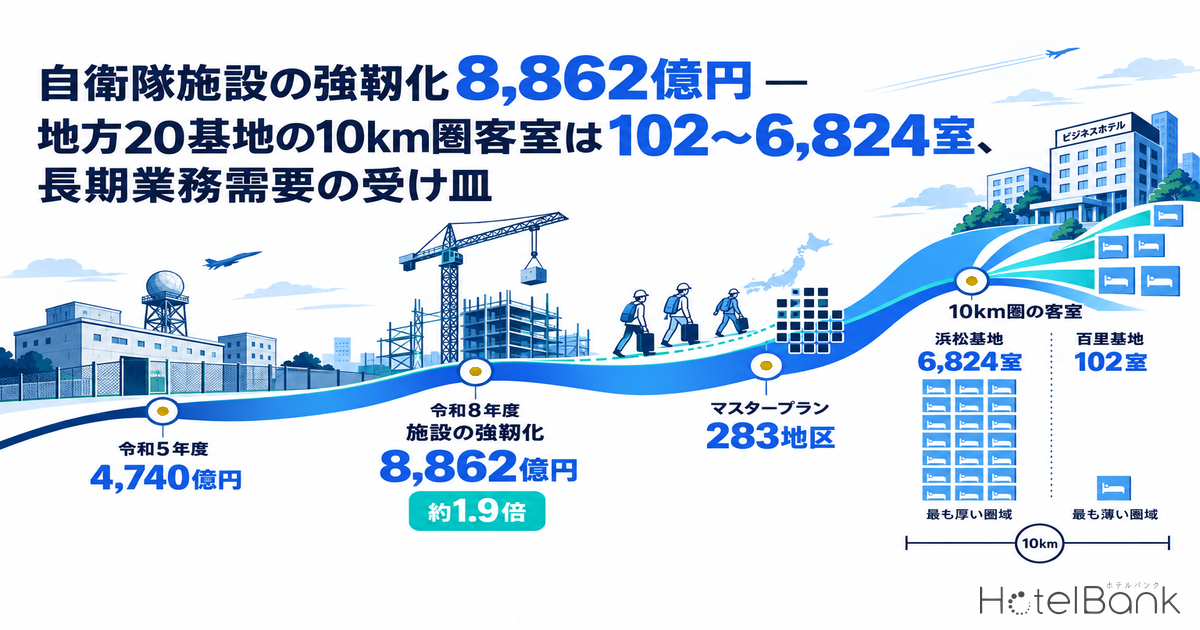
Japan’s Ministry of Defense has divided all Self-Defense Force camps, bases and related sites into 283 districts and is preparing a “master plan” for consolidating and rebuilding more than 20,000 buildings. The FY2026 budget allocates approximately ¥886.2 billion (contract basis) to “facility resilience” — roughly 1.9 times the ¥474.0 billion of FY2023, in just three years. Rebuilding work is mostly carried out under multi-year contracts running two to three years, generating sustained weekday demand from contractors, designers and construction supervisors staying in the same town. This article takes the 20 camps and bases named in Ministry of Defense documents, counts the hotel rooms actively listed within a 10km radius of each, and quantifies where the capacity to absorb long-term business demand is thick and where it is thin.
Where this article sits: HotelBank has previously covered construction-phase lodging demand created by private capital investment — factories, data centres and petrochemical turnarounds (worker lodging in Chitose and Tomakomai、data centre construction lodging demand、the 2026 petrochemical turnaround year). This article deals with a different demand source, public facility programmes, and the geography of the districts covered barely overlaps with those earlier pieces. It also differs in demand source from our coverage of lodging supply in Futaba District, Hamadori and of labour in the lodging industry.
Metric Definitions Used in This Article
- ADR (average daily rate): an estimated settled rate (tax-exclusive equivalent) derived by applying a category-specific adjustment coefficient to each property’s lowest published plan rate on online travel agencies (two guests per room, per-room price, tax included). Cross-checked against property-level results disclosed by listed hotel REITs (91 properties, most recent three months), the median error is about 7%. These are estimates and differ from any property’s actual transacted rates or accounting figures. Catchment ADR in this article is the median across properties within the 10km radius for which an estimate was available.
- OCC (occupancy rate): the share of rooms sold against total rooms in the area (an estimate based on online travel agency inventory). It is aggregated over a fixed cohort of properties that list at least 30% of their total rooms on OTAs, and because unlisted rooms are counted on the sold side, it runs higher than true room occupancy. It is used at the municipal level only; occupancy for individual properties is not calculated.
- Rooms within the 10km catchment: the total rooms at lodging properties within a 10km radius of each camp or base’s representative point whose selling prices were confirmed listed between June and August 2026 (based on listings on major booking sites). “Business-category” means rooms at properties classified as business hotels, city hotels or capsule hotels.
- Data source: MetroEngines Research (the analysis covers approximately 27,000 actively operating properties among those tracked by MetroEngines Research)
- — approx. ¥886.2bn FY2026 “facility resilience” (contract basis) is about 1.9 times the ¥474.0 billion of FY2023. Planned procurement of 710 construction and 775 consultancy contracts is spread across 10 regional bureaus.
- — 39,422 rooms Rooms within 10km of the 20 districts outside the major metropolitan areas (791 properties, listings confirmed June–August 2026). Business-category rooms account for 30,981 (79%).
- — 6,824 rooms vs 102 rooms The thickest catchment (Hamamatsu Air Base) and the thinnest (Hyakuri Air Base). Five catchments fall under 1,000 rooms: Ominato, Nyutabaru, Tsuiki, Miho and Hyakuri.
- — 0.9%〜61.0% Share of business-category rooms taken by an assumed 50-person standing team. It swings widely with catchment depth: 0.9% around Hamamatsu Air Base, 20.1% around Miho and 61.0% around Hyakuri.
- — 75.1% on weekdays Estimated OCC for Komatsu in July 2026 (Saturday 83.2%). Sasebo is also at 76.8% on weekdays — weekday rooms still have headroom.
The primary sources: 283 districts, 20,000+ buildings and ¥886.2 billion in FY2026
First, the provenance of the figures. The phrases “283 districts” and “more than 20,000 buildings” appear in the Ministry of Defense’s Progress and Budget for the Fundamental Reinforcement of Defense Capabilities: Overview of the FY2024 Budget Proposal as follows.
“Toward the consolidation and rebuilding of more than 20,000 Self-Defense Force facilities, contracts have been concluded for basic-policy formulation work (1 contract) and master-plan preparation work (15 contracts) covering all camps, bases and related sites (283 districts), and preparation has commenced.”
— Ministry of Defense, Overview of the FY2024 Budget Proposal (progress status, facility resilience)
The following Overview of the FY2025 Budget reports progress as “master plans for the consolidation and rebuilding of Self-Defense Force facilities are being prepared in sequence, and design and construction work has commenced,” explaining in a note that “all camps, bases and related sites are divided into 283 districts; the current condition of buildings and lifelines is surveyed and assessed, and a master plan is prepared covering structural reinforcement according to each facility’s function and importance, together with relocation and consolidation to secure separation distances.” In other words, the 283-district master plans are moving from the drafting stage into design and construction. Separately, the Ministry of Defense’s FY2023 administrative program review materials indicate that there are roughly 23,000 Self-Defense Force buildings nationwide, of which about 40% — 9,900 buildings — were built under the older seismic design standards.
The FY2026 amount, meanwhile, can be confirmed in the key items of Progress and Budget for the Fundamental Reinforcement of Defense Capabilities: Overview of the FY2026 Budget (April 8, 2026). “Facility resilience” comes to approximately ¥886.2 billion (approximately ¥878.4 billion excluding other fields), and the largest single line within it is “renewal of existing facilities” at ¥436.8 billion. The document describes this line as “promoting structural reinforcement of buildings and the relocation and consolidation of facilities, in order to add protective performance including countermeasures against ageing and earthquakes.”
Source: compiled by MetroEngines Research & Consulting from the Ministry of Defense Overview of the FY2025 Budget allocation table (FY2023–FY2025, contract basis) and Overview of the FY2026 Budget key items (FY2026)
The figure has risen four years running: ¥474.0 billion in FY2023, ¥631.3 billion in FY2024, ¥695.3 billion in FY2025 and approximately ¥886.2 billion in FY2026 — up about 27.5% on FY2025. The Defense Buildup Program sets a framework of roughly ¥4 trillion for “facility resilience” over five years (allocation table in the Overview of the FY2025 Budget), and the four-year total has already reached about ¥2.7 trillion. The documents state facility contract terms of “two to three years,” so the accumulating contract value means a growing number of sites where work continues across multiple years.
| FY2026 “facility resilience” breakdown | Amount (¥100m) |
|---|---|
| Renewal of existing facilities (structural reinforcement, relocation, consolidation) | 4,368 |
| Facilities for new unit formations and new equipment introduction | 3,411 |
| of which: F-35 reception facilities | 654 |
| of which: facilities in Sasebo (Sakibe-Higashi district) | 183 |
| of which: JGSDF Logistics Support School (provisional name) | 51 |
| of which: multi-function composite defense hub in the Kure district | 6 |
| Ammunition depots | 672 |
| Undergrounding of major command posts | 231 |
| Natural disaster countermeasures | 101 |
| Facility resilience, total | approx. 8,862 |
Source: compiled by MetroEngines Research & Consulting from the Ministry of Defense Progress and Budget for the Fundamental Reinforcement of Defense Capabilities: Overview of the FY2026 Budget, key item “(3) Facility Resilience” (sub-items cover only the major projects listed in the document)
710 construction and 775 consultancy contracts — procurement spread across 10 bureaus
What matters for reading the geography of this demand is that the budget is not concentrated in the major cities. According to “Overview of FY2026 Projects,” presented by the Ministry of Defense’s Bureau of Defense Buildup Planning at a March 25, 2026 briefing with the Defense Facility Resilience Promotion Association, FY2026 planned procurement comes to 710 construction contracts and 775 construction consultancy contracts nationwide (both as published on that date, excluding ECI-method projects).
Source: compiled by MetroEngines Research & Consulting from “Overview of FY2026 Projects,” Facilities Group, Bureau of Defense Buildup Planning, Ministry of Defense (March 25, 2026, briefing materials for the Defense Facility Resilience Promotion Association)
The largest construction workload is North Kanto with 100 contracts, followed by Chugoku-Shikoku with 87, Okinawa 82, Hokkaido 77, Tohoku 75 and South Kanto 75. Adding the Obihiro Defense Branch Office’s 25 contracts to the Hokkaido Bureau’s 77 gives 102 in Hokkaido alone. In construction consultancy, Okinawa stands out at 142 contracts, followed by South Kanto with 115 and Hokkaido with 95. Design and supervision work sends engineers to site ahead of, or alongside, construction, generating lodging demand on a different timetable from the construction contracts themselves.
The same document also names specific districts and scales as each regional defense bureau’s major projects. All involve buildings on the order of tens of thousands of square metres, built out over two to four years.
| Defense bureau | Project (district) | Scale | Scheduled completion |
|---|---|---|---|
| Kinki-Chubu | F-35 reception facilities (JASDF Komatsu) | Hangar, SRC-3, approx. 31,000m² and other works | March 2030 (hangar) |
| Tohoku | Optimization project (JGSDF Aomori) | Unit headquarters, welfare facilities and others, 29,000m² total (design) | March 2030 |
| Kyushu | Warehouse (JGSDF Metabaru) | Warehouse, S-1, approx. 24,600m² | November 2030 |
| Kumamoto | F-35 reception facilities (JASDF Nyutabaru) | Hangar, S-1/RC-3, approx. 21,700m² and other works | March 2029 |
| Chugoku-Shikoku | Optimization project (JGSDF Nihonbara) | New barracks and others, 20,800m² total (design) | March 2028 |
| Kyushu | Optimization project (JASDF Ashiya) | Barracks, dining and kitchen facilities and others, approx. 14,800m² (design) | March 2028 |
| Kumamoto | Hangar (JMSDF Kanoya) | Hangar, approx. 13,000m² and other works (detailed design) | March 2027 |
| North Kanto | Hangar (JGSDF Tachikawa) | Hangar, approx. 9,500m² (detailed design) | March 2027 |
| Okinawa | New administration building (JMSDF Okinawa Base Force) | Administration building, approx. 8,000m² and other works (detailed design) | March 2028 |
| Chugoku-Shikoku | Fuel storage facilities (JMSDF Kure, Yoshiura) | Two underground fuel tanks | March 2029 |
| Tohoku | Port facilities (JMSDF Ominato) | Dredging, new pier and other works | March 2028 |
Source: compiled by MetroEngines Research & Consulting from the “FY2026 Major Projects” of each regional defense bureau in “Overview of FY2026 Projects,” Facilities Group, Bureau of Defense Buildup Planning, Ministry of Defense (March 25, 2026), sorted by scale
The document further lists the districts where the ECI method (in which the contractor provides technical input from the design stage) is applied to “optimization projects” that wholly renew ageing facilities: Camp Obihiro, Camp Asahikawa, Camp Sapporo, Camp Higashi-Chitose, Chitose Air Base, JMSDF Ominato District, Misawa Air Base, Hachinohe Air Base, Matsushima Air Base, Camp Sendai, Camp Jinmachi, Gifu Air Base, Komatsu Air Base, JMSDF Maizuru District, Miho Air Base, Hamamatsu Air Base, JMSDF Sasebo District, Camp Itami, Camp Zentsuji, JMSDF Kure District, Nyutabaru Air Base, Naha Air Base, JMSDF Naha Air Base, Kanoya Air Base, Camp Kengun, Kasuga Air Base, JASDF Hofu District, Komaki Air Base, Tsuiki Air Base, Hyakuri Air Base, Shimofusa Air Base, Iruma Air Base, Camp Asaka, Camp Nerima, Tateyama Air Base, JMSDF Yokosuka District, Atsugi Air Base and Camp Fukuoka. Technical-cooperation contracts covered 20 districts in FY2024, 4 districts in FY2025, and 13 districts are planned for FY2026.
How many rooms lie within 10km of the 20 districts
From the ECI-method districts we excluded those located in the major metropolitan areas and regional core cities (Sapporo, Sendai, Higashi-Chitose/Chitose, Gifu, Itami, Naha, Kengun, Kasuga, Komaki, Fukuoka, Shimofusa, Iruma, Asaka, Nerima, Yokosuka, Atsugi), leaving the 20 districts analysed here. Hamamatsu Air Base sits in Hamamatsu, a government-designated city, but is included because it lies outside the three largest metropolitan areas. Chitose was covered in an earlier article and is excluded here. For each district we count the lodging properties within a 10km radius of a representative point whose selling prices were confirmed listed between June and August 2026.
Numbers on the map correspond to the table below. Circle size reflects rooms within the 10km catchment. Source: MetroEngines Research & Consulting
| No. | District (as named in Ministry of Defense documents) | Location | Properties | Rooms | of which business-category | 100+ rooms | ADR, July 2026 | ADR YoY |
|---|---|---|---|---|---|---|---|---|
| 1 | Hamamatsu Air Base | Hamamatsu, Shizuoka | 66 | 6,824 | 5,584 | 31 | ¥8,176 (N=54) | +2.6% (N=49) |
| 2 | Camp Asahikawa | Asahikawa, Hokkaido | 90 | 4,741 | 4,123 | 18 | ¥12,092 (N=40) | -3.8% (N=33) |
| 3 | Camp Obihiro | Obihiro, Hokkaido | 48 | 3,850 | 3,353 | 15 | ¥9,123 (N=43) | -3.3% (N=38) |
| 4 | Hachinohe Air Base | Hachinohe, Aomori | 37 | 3,037 | 2,881 | 11 | ¥7,030 (N=32) | +0.3% (N=30) |
| 5 | Camp Zentsuji | Zentsuji, Kagawa | 75 | 2,860 | 1,758 | 10 | ¥7,464 (N=32) | -4.6% (N=29) |
| 6 | Komatsu Air Base | Komatsu, Ishikawa | 41 | 2,400 | 1,388 | 8 | ¥8,101 (N=33) | -5.9% (N=29) |
| 7 | JMSDF Sasebo District | Sasebo, Nagasaki | 40 | 2,301 | 1,791 | 9 | ¥6,906 (N=23) | -4.4% (N=21) |
| 8 | Camp Jinmachi | Higashine, Yamagata | 39 | 1,917 | 1,114 | 4 | ¥7,695 (N=32) | -3.0% (N=31) |
| 9 | JMSDF Maizuru District | Maizuru, Kyoto | 27 | 1,586 | 1,512 | 5 | ¥6,496 (N=16) | +0.8% (N=14) |
| 10 | Matsushima Air Base | Higashimatsushima, Miyagi | 29 | 1,585 | 1,381 | 4 | ¥5,098 (N=18) | +0.0% (N=17) |
| 11 | Tateyama Air Base | Tateyama, Chiba | 157 | 1,426 | 89 | 2 | ¥16,585 (N=33) | +0.9% (N=29) |
| 12 | Misawa Air Base | Misawa, Aomori | 16 | 1,233 | 965 | 5 | ¥6,675 (N=16) | +11.0% (N=14) |
| 13 | JMSDF Kure District | Kure, Hiroshima | 28 | 1,220 | 1,132 | 2 | ¥5,943 (N=21) | +2.2% (N=20) |
| 14 | JASDF Hofu District | Hofu, Yamaguchi | 9 | 1,009 | 978 | 5 | ¥5,774 (N=8) | -3.1% (N=8) |
| 15 | Kanoya Air Base | Kanoya, Kagoshima | 23 | 1,006 | 868 | 3 | ¥5,451 (N=11) | -2.1% (N=11) |
| 16 | JMSDF Ominato District | Mutsu, Aomori | 10 | 727 | 698 | 4 | ¥7,174 (N=9) | +4.8% (N=8) |
| 17 | Nyutabaru Air Base | Shintomi, Miyazaki | 14 | 632 | 518 | 2 | ¥5,917 (N=10) | -4.7% (N=9) |
| 18 | Tsuiki Air Base | Chikujo, Fukuoka | 10 | 544 | 517 | 2 | ¥6,426 (N=8) | +3.7% (N=8) |
| 19 | Miho Air Base | Sakaiminato, Tottori | 25 | 422 | 249 | 1 | ¥7,652 (N=9) | -5.4% (N=9) |
| 20 | Hyakuri Air Base | Omitama, Ibaraki | 7 | 102 | 82 | 0 | — (N=3) | — |
| 20-district total | 791 | 39,422 | 30,981 |
Source: MetroEngines Research & Consulting (10km radius from each district’s representative point; listings confirmed June–August 2026; 791 properties / 39,422 rooms; based on listings on major booking sites). Location is the municipality of the representative point. ADR is the median estimated settled ADR of properties in the catchment; shown as “—” where N is below 5. Year-on-year is the median change rate for properties with estimates in both July 2025 and July 2026 (“—” where N is below 5).
Source: MetroEngines Research & Consulting (10km radius; listings confirmed June–August 2026; 791 properties / 39,422 rooms; based on listings on major booking sites)
The 10km catchments of the 20 districts hold 791 properties and 39,422 rooms in total, of which business-category rooms account for 30,981 (79%). The spread, however, is wide. Hamamatsu Air Base has the thickest catchment at 6,824 rooms, with 31 properties of 100 rooms or more — enough for even a large construction team to be split across hotels. Camp Asahikawa (4,741 rooms), Camp Obihiro (3,850) and Hachinohe Air Base (3,037) also clear 3,000 rooms each, with deep, business-hotel-led capacity.
The middle tier comprises Camp Zentsuji (2,860 rooms), Komatsu Air Base (2,400), JMSDF Sasebo District (2,301) and Camp Jinmachi (1,917). The Zentsuji and Jinmachi catchments have a high share of ryokan and hot-spring inns, leaving the business-category share at only about 60% in each. To capture long-stay demand, setting up consecutive-night plans and breakfast and parking terms suited to business use is an opportunity for ryokan operators to build occupancy as well.
At the other end, five catchments fall below 1,000 rooms: JMSDF Ominato District (727 rooms), Nyutabaru Air Base (632), Tsuiki Air Base (544), Miho Air Base (422) and Hyakuri Air Base (102). Tateyama Air Base’s catchment has 1,426 rooms, but 126 of its 157 properties are small — whole-house rentals, pensions and guesthouses of 10 rooms or fewer — and most rooms sit in resort hotels and ryokan, leaving just 89 business-category rooms. It is a clear case of total room count alone failing to measure real capacity.
The weight of a long-stay team against business-category rooms (illustrative calculation)
How much lodging a construction period actually generates varies widely with the type of work, the schedule and the share of local hiring, and cannot be read directly from Ministry of Defense documents. As a yardstick for comparing the depth of business-category room stock, we therefore model the share of rooms taken if a fixed number of engineers and workers is stationed on weekdays.
■ Calculation assumptions
- Assumes that in one district, 50 engineers and workers from outside the area are stationed on weekdays and each uses one room (50 rooms per night). The headcount is an assumption for comparison, not a figure from Ministry of Defense documents.
- The denominator is each district’s business-category room count within 10km (listings confirmed June–August 2026).
- Overlap with existing leisure and business-travel demand, and the use of dormitories or leased housing, are not taken into account.
Source: MetroEngines Research & Consulting (10km radius, business-category rooms, based on listings on major booking sites). The 50-room standing block is an assumption used for the calculation.
A standing block of 50 rooms is just 0.9% of business-category rooms in the Hamamatsu Air Base catchment and 1.2% around Camp Asahikawa — a scale that coexists comfortably with existing business-travel demand. In the Miho Air Base catchment, by contrast, it reaches 20.1%, and around Nyutabaru and Tsuiki roughly 10% each, meaning a single team would continuously hold about a tenth of weekday business-category rooms. In the Hyakuri (61.0%) and Tateyama (56.2%) catchments, business-category rooms are so few that teams are likely to widen their commuting radius into surrounding towns to secure beds.
Flexing the assumed headcount to 30 and 100 moves the share as follows. At 100 people, the share exceeds 10% in all nine catchments with fewer than 1,000 business-category rooms, reaches about 40% around Miho Air Base, and exceeds the entire business-category stock in the Hyakuri and Tateyama catchments.
| District | Business-category rooms | 30 stationed | 50 stationed | 100 stationed |
|---|---|---|---|---|
| Hyakuri Air Base | 82 | 36.6% | 61.0% | over 100% |
| Tateyama Air Base | 89 | 33.7% | 56.2% | over 100% |
| Miho Air Base | 249 | 12.0% | 20.1% | 40.2% |
| Tsuiki Air Base | 517 | 5.8% | 9.7% | 19.3% |
| Nyutabaru Air Base | 518 | 5.8% | 9.7% | 19.3% |
| JMSDF Ominato District | 698 | 4.3% | 7.2% | 14.3% |
| Kanoya Air Base | 868 | 3.5% | 5.8% | 11.5% |
| Misawa Air Base | 965 | 3.1% | 5.2% | 10.4% |
| JASDF Hofu District | 978 | 3.1% | 5.1% | 10.2% |
| Camp Jinmachi | 1,114 | 2.7% | 4.5% | 9.0% |
| JMSDF Kure District | 1,132 | 2.7% | 4.4% | 8.8% |
| Matsushima Air Base | 1,381 | 2.2% | 3.6% | 7.2% |
| Komatsu Air Base | 1,388 | 2.2% | 3.6% | 7.2% |
| JMSDF Maizuru District | 1,512 | 2.0% | 3.3% | 6.6% |
| Camp Zentsuji | 1,758 | 1.7% | 2.8% | 5.7% |
| JMSDF Sasebo District | 1,791 | 1.7% | 2.8% | 5.6% |
| Hachinohe Air Base | 2,881 | 1.0% | 1.7% | 3.5% |
| Camp Obihiro | 3,353 | 0.9% | 1.5% | 3.0% |
| Camp Asahikawa | 4,123 | 0.7% | 1.2% | 2.4% |
| Hamamatsu Air Base | 5,584 | 0.5% | 0.9% | 1.8% |
Source: MetroEngines Research & Consulting (10km radius, business-category rooms, listings confirmed June–August 2026, based on listings on major booking sites). Headcounts are assumptions used for the calculation (one room per person, weekdays). Shading marks 20%+, 10%+ and 5%+.
What this shows is that the thinner the catchment, the more readily a single long-term contract becomes the foundation of occupancy. For corporate sales teams at existing hotels, monthly consecutive-night contracts and weekday-only flat-rate plans aimed at prime contractors, design firms and supervisors are a strong way to fill weekdays in the low season. For chain development teams pursuing long-stay demand in regional Japan, catchments where several of the named camps and bases sit close together — Misawa Air Base, Hachinohe Air Base and JMSDF Ominato District in Aomori, for example — offer the prospect of stacking demand from multiple projects.
Catchment ADR and weekday occupancy — the price band business demand rides on
Source: MetroEngines Research & Consulting (median across properties within 10km for which an estimated settled ADR was available, July 2026; catchments with N of 5 or more only)
July 2026 catchment ADR (median estimated settled ADR) sits broadly in the ¥5,000–¥8,000 range in the business-hotel-led districts. Levels such as JMSDF Kure District ¥5,900 (N=21), JASDF Hofu District ¥5,800 (N=8), Kanoya Air Base ¥5,500 (N=11) and Matsushima Air Base ¥5,100 (N=18) fit comfortably within typical long-assignment lodging allowances. Camp Asahikawa ¥12,100 (N=40) and Camp Obihiro ¥9,100 (N=43) run higher on summer leisure demand, while Tateyama Air Base ¥16,600 (N=33) is a catchment dominated by resort-type properties.
On a same-property year-on-year basis, the Misawa Air Base catchment rose +11.0% (N=14), JMSDF Ominato District +4.8% (N=8) and Tsuiki Air Base +3.7% (N=8), while Komatsu Air Base (-5.9%, N=29) and Miho Air Base (-5.4%, N=9) fell below the prior year. No clear imprint of the facility programme is yet readable in catchment ADR movements — which is to say that headroom on price remains ahead of construction ramping up.
On occupancy, we compared weekday stays (Monday–Thursday) with Saturday stays in July 2026 for the six cities where municipal-level estimated OCC is available.
| City (district) | Scope (based on listings on major booking sites) | Estimated OCC, weekdays (Mon–Thu) | Estimated OCC, Saturday |
|---|---|---|---|
| Obihiro (Camp Obihiro) | 20 properties / 2,304 rooms | 93.7% | 94.3% |
| Asahikawa (Camp Asahikawa) | 23 properties / 2,769 rooms | 95.8% | 96.5% |
| Hachinohe (Hachinohe Air Base) | 14 properties / 1,520 rooms | 92.5% | 95.1% |
| Tateyama (Tateyama Air Base) | 19 properties / 576 rooms | 85.5% | 95.8% |
| Sasebo (JMSDF Sasebo District) | 31 properties / 3,236 rooms | 76.8% | 88.3% |
| Komatsu (Komatsu Air Base) | 18 properties / 1,143 rooms | 75.1% | 83.2% |
Source: MetroEngines Research & Consulting (July 2026, municipal level; fixed cohort of properties listing at least 30% of total rooms on OTAs). An estimate based on OTA inventory, running higher than true room occupancy. Includes summer leisure demand.
In Obihiro (93.7% on weekdays), Asahikawa (95.8%) and Hachinohe (92.5%), weekday inventory clears at nearly the Saturday rate — summer season notwithstanding. Even in thick catchments, weekday availability is limited. Hosting a long-term team means securing blocks early in peak periods; for the hotel, that demand becomes a stable weekday base that widens pricing latitude. Sasebo (76.8% weekday, 88.3% Saturday) and Komatsu (75.1% weekday, 83.2% Saturday), by contrast, show a wide weekday–Saturday gap and clear weekday headroom. Komatsu, where an F-35 reception hangar of roughly 31,000m² is scheduled for completion in March 2030, and Sasebo, where construction continues in the Sakibe-Higashi district, are markets with substantial room for long-term business demand to lift weekday occupancy.
What this means for you — development, corporate sales and regional finance
For chain development teams pursuing long-stay demand in regional Japan.Public facility programmes are a demand source that accumulates project by project each fiscal year under the Defense Buildup Program. The programme sets a five-year envelope of roughly ¥4 trillion, and facility contract terms run two to three years. The Ominato, Nyutabaru, Tsuiki, Miho and Hyakuri catchments — each under 1,000 rooms within 10km — and Tateyama, with its thin business-category stock, leave room to consider mid-sized extended-stay formats with laundry and kitchenettes. Note, however, that construction timetables for individual districts are disclosed only narrowly outside the major projects named in the documents, so the timing and scale of work must be tracked through each regional defense bureau’s tender notices.
For corporate sales and revenue management teams at existing hotels.In ECI-method districts the contractor is involved from the design stage, so lodging demand can begin to build during design cooperation, before ground is broken. Proposing monthly consecutive-night contracts or weekday flat-rate blocks at the point where the prime contractor, design office and supervisor choose their local base locks in weekday occupancy in advance. In markets with a wide weekday–Saturday gap, such as Sasebo and Komatsu, such blocks translate directly into a weekday floor.
For regional banks and credit unions appraising regional projects.Room counts and business-category shares in these catchments are useful material for testing the demand assumptions behind new extended-stay projects and hotel renovation deals. Because construction demand is time-limited, the base case in a financial plan should extend to how the property hands off, after the work ends, to local business travel, leisure, or visitor demand tied to the units stationed nearby.
Conclusion
The Ministry of Defense has prepared master plans for consolidating and rebuilding Self-Defense Force facilities across 283 districts and more than 20,000 buildings, and is moving into design and construction. FY2026 “facility resilience” reaches approximately ¥886.2 billion, roughly 1.9 times the FY2023 level, and the planned 710 construction and 775 consultancy contracts are spread across 10 regional bureaus. Counting rooms within 10km of the 20 districts outside the major metropolitan areas gives 39,422 in total: four catchments — Hamamatsu, Asahikawa, Obihiro and Hachinohe — clear 3,000 rooms each, while five fall short of 1,000, from Hyakuri’s 102 to Ominato’s 727. The thinner the catchment, the more a single long-term contract becomes the foundation of occupancy. Long-term business demand created by public investment is a durable opportunity for regional hotels to build weekday occupancy.
A note on method: Each district’s representative point is the approximate location of the camp or base and does not correspond to a site boundary or main gate. The 10km catchment is a straight-line radius; road distance and commuting time are not taken into account. Room counts are the total for properties whose selling prices were confirmed listed on major booking sites between June and August 2026; lodging not listed on booking sites, company dormitories and staff quarters, and monthly-rental apartments are excluded. The district list in the Ministry of Defense documents gives district names only and does not indicate construction timing or scale for any district.
Related Articles
- Chitose & Tomakomai Worker Lodging — 7 New Hotels, 738 Rooms in 2026
- Data Center Construction Needs 364-725 Hotel Rooms per 50MW in Japan
- Fukushima Hamadori: 4,434 Rooms, Three-Layer Demand, Thin Center
- North Tohoku’s 2,079 New Rooms: Which Segments Can Absorb the Supply
- Japan’s 50 Smart Interchanges: Median 1,130 Hotel Rooms Within 10km
References and Sources
■ Data sources
MetroEngines Research & Consulting lodging data (791 properties / 39,422 rooms with selling prices confirmed listed between June and August 2026, within a 10km radius of the representative point of each of the 20 districts), estimated settled ADR (July 2026 catchment medians; year-on-year is the median change rate for the same properties), and municipal-level estimated OCC (July 2026, fixed cohort, 6 cities). Budget figures, contract counts and major projects are from the Ministry of Defense budget overviews (FY2024–FY2026) and the Bureau of Defense Buildup Planning’s briefing materials.
■ Calculation assumptions
The weight of a long-stay team is calculated by assuming that engineers and workers from outside the area are stationed on weekdays and each occupies one room, then dividing that room count (50 rooms as the base case, 30 and 100 in the sensitivity analysis) by each catchment’s business-category room count. The headcount is an assumption for comparison, not a figure from Ministry of Defense documents.
■ Limitations and caveats
Representative points are the approximate locations of camps and bases, and the 10km catchment is a straight-line radius. Properties not listed on booking sites, dormitories and company quarters, and monthly-rental apartments are excluded. ADR and OCC are estimates; because OCC counts unlisted rooms on the sold side, it runs higher than true room occupancy. July 2026 includes summer leisure demand. Construction timing and scale for individual districts are disclosed only narrowly outside the major projects.
■ Market data
- MetroEngines Research & Consulting — lodging properties within 10km of the 20 districts (791 properties / 39,422 rooms, based on listings on major booking sites), estimated settled ADR, municipal estimated OCC
■ Government documents
- Ministry of Defense, Progress and Budget for the Fundamental Reinforcement of Defense Capabilities: Overview of the FY2026 Budget (April 8, 2026)
- Ministry of Defense, Progress and Budget for the Fundamental Reinforcement of Defense Capabilities: Overview of the FY2025 Budget
- Ministry of Defense, Progress and Budget for the Fundamental Reinforcement of Defense Capabilities: Overview of the FY2024 Budget Proposal
- Facilities Group, Bureau of Defense Buildup Planning, Ministry of Defense, “Overview of FY2026 Projects” (March 25, 2026; materials for the 4th briefing with the Defense Facility Resilience Promotion Association)
- Ministry of Defense, Administrative Program Review, “Strengthening the Sustainability and Resilience of Self-Defense Force Facilities” (FY2023)
- Ministry of Finance, Finance feature, “The FY2026 Defense-Related Budget”