

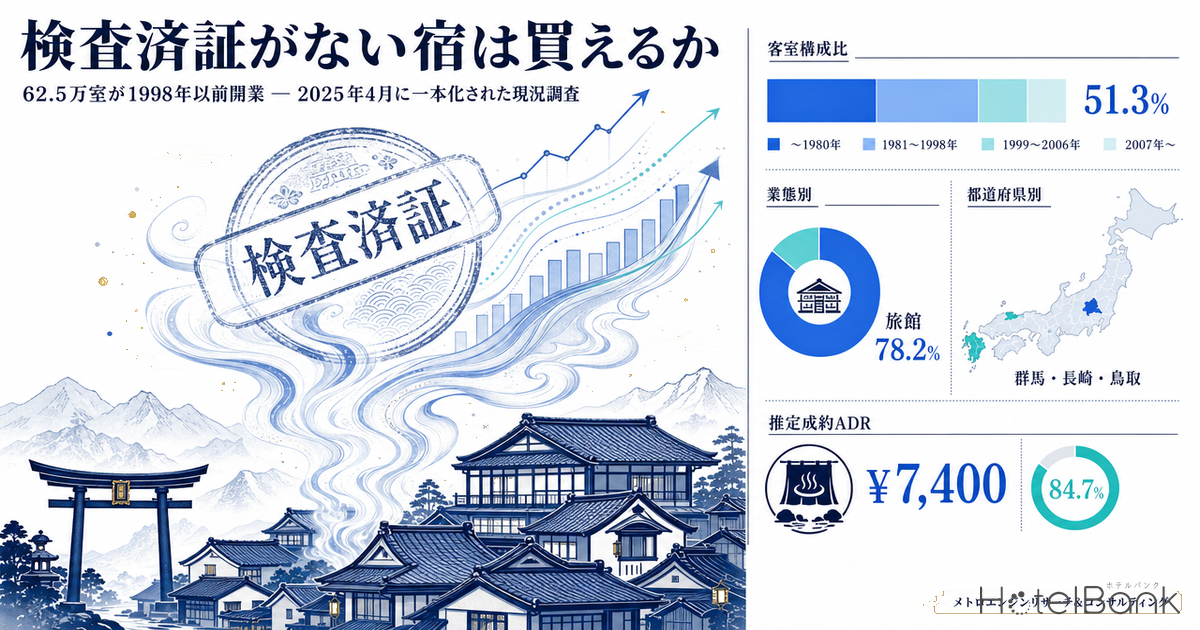
In hotel acquisition due diligence, there is one document to check right after the seismic assessment and the asbestos survey report: the certificate of inspection (検査済証, kensa-zumi-sho). A property without one can still be bought. But the buyer takes on the risk that the renovation, extension or change of use planned after closing gets stopped at the building confirmation application stage. An investment case built on a value-add plan may need to be rebuilt depending on whether this single sheet of paper exists.
On April 1, 2025, the practice around this issue changed. The Ministry of Land, Infrastructure, Transport and Tourism (MLIT) abolished its 2014 “Guidelines for Surveys of Building Standards Act Compliance Using Designated Confirmation and Inspection Bodies for Buildings Without a Certificate of Inspection” (the so-called guideline survey) and folded it into the new “Guidelines for Current-Condition Surveys of Existing Buildings.” The amended Building Standards Act, which took effect the same day, also widened the scope of what requires building confirmation and review.
This article first sizes the guestroom stock that may be exposed to this issue by opening-year cohort, based on what MetroEngines Research tracks. It then explains what changed on the regulatory side and what to check in acquisition due diligence, and when. Of the roughly 1.2 million rooms confirmed as operating, 51.3% (625,000 rooms) opened in or before 1998, which overlaps with the era when completion inspection rates were low across Japan.
Metric Definitions Used in This Article
- ADR (Average Daily Rate): An estimated settled rate (tax-exclusive equivalent), calculated by applying a property-type adjustment factor to the lowest-plan price each property publishes on OTAs (per room, 2 guests, tax-inclusive). Checked against property-level results disclosed by listed hotel REITs (91 properties, most recent 3 months), the median error is about 7%. These are estimates and differ from each property’s actual settled rates and accounting figures. Cohort-level ADR is the median across the properties in scope.
- Opening year (cohort): Grouped by the opening date registered in the property master. It does not necessarily match the year of construction or building confirmation; for properties rebranded after a rebuild or full renovation, the recorded year may be newer than the actual structure. This article treats it as “the year the property opened as lodging,” not “the age of the building.”
- Population: Of the roughly 168,000 properties in Japan tracked by MetroEngines Research, the 24,225 properties and 1,218,823 rooms that are confirmed as operating on OTAs and have both a known opening date and room count (as of September 2026). Ryokan, minshuku and simple lodgings not listed on OTAs are excluded.
- Data source: MetroEngines Research & Consulting
- — Of 1,218,823 rooms confirmed as operating, 51.3% (624,802 rooms) opened in or before 1998. This overlaps with the era when completion inspection rates were low nationwide.
- — On April 1, 2025, the old guidelines were abolished and unified into the “Guidelines for Current-Condition Surveys of Existing Buildings.” Who may conduct the survey expanded from designated confirmation and inspection bodies to include licensed architects.
- — There are three branch points: is there a certificate of inspection, can the start date of the most recent construction work be identified, and has there been a change of use since then. If the start date cannot be identified, none of the relief for existing non-conforming buildings applies.
- — The share of rooms opened in or before 1998 is 78.2% for ryokan, 74.7% for city hotels and 72.9% for resort hotels. The property types at the center of repositioning are the most likely to hit the paperwork hurdle (business hotels: 35.5%).
- — For business hotels, the estimated settled ADR of the oldest cohort is 84.7% of the newest cohort. That rate upside assumes the building confirmation application can go through, and the paperwork comes before that.
What a Missing Certificate of Inspection Stops: Not the Acquisition, but the Renovation Plan
First, let us get the order right. The absence of a certificate of inspection does not by itself prohibit a sale. A technical advisory issued by the Director of the Building Guidance Division, Housing Bureau, MLIT (Kokujushi No. 318, December 6, 2024) is explicit on this point. Where a completion inspection should have been obtained but no certificate was issued, the advisory does not deny that the building owner violated the rules. However, it states that “the fact that a certificate of inspection has not been issued does not, by itself, immediately mean that the designated administrative agency must take measures against the building as a violating building.”
The advisory further states that even if parts of a building do not comply with building standards laws, an extension or similar work can be carried out lawfully by obtaining confirmation and inspection for work that brings the entire building, including those parts, into compliance with the building standards-related provisions, and that the designated administrative agency does not need to determine whether the building is in violation before confirmation review. In other words, “no certificate of inspection = illegal building” is too simple.
What matters for investment decisions comes next. For an extension, reconstruction, relocation, major repair or major remodeling, or a change of use over 200㎡, the building confirmation application must show how the existing parts comply with the law. With a certificate of inspection, the building can be judged to have complied with the rules in force when the most recent construction work began, and the on-site survey can be narrowed to “provisions under which the building may be existing non-conforming.” Without it, the survey must re-examine compliance with all current provisions, including those that had been exempt from review. Workload, duration, and the probability that the survey will find additional work needed to meet current standards all jump.
And there is a deeper branch. The new guidelines state that if the start date of the most recent construction work itself cannot be identified, “the entire planned building shall be made to comply with the current provisions of building standards laws.” This means none of the relief for existing non-conforming buildings is available. What changes is not the range of the renovation budget, but whether the project works at all.
How This Fits With Our Earlier Coverage: The “Fourth Hurdle” After Structure, Floor Area and Exit
We have covered aging hotel stock from several angles before. Here is how the issues line up.
| Hurdle | What is tested | What stops if it is not cleared |
|---|---|---|
| Structure | Old or new seismic standard | Seismic retrofit costs, loan terms |
| Floor area ratio | Whether the building exceeds the current FAR as existing non-conforming | Less floor area after rebuilding = rebuild economics |
| Environment / hazardous materials | Asbestos and similar content | Mandatory pre-survey costs, demolition and renovation schedules |
| Paperwork (this article) | Whether legal compliance can be proven | Confirmation applications for extensions or change of use are not accepted = the renovation plan itself |
Structure, floor area and hazardous materials can be reduced to a question of “how much will it cost.” Paperwork is different. If the start date cannot be identified, the relief does not apply, and it becomes a question of whether the plan succeeds, not what it costs. We cover the structural hurdle, and the choice between retrofit and rebuild, in Japan’s Pre-1981 Hotel Stock: 236k Rooms, 19.1% of All Rooms. We have also looked separately at the floor-area hurdle and how FAR bonus floor space is used across Japan’s 138 Special Urban Renaissance Districts, where the bonus totals 10.96 million ㎡.
What Is a Certificate of Inspection? “More Than Half of Buildings Before 1999 Never Received One”
Under the Building Standards Act, the building owner must obtain a completion inspection from a building official or a designated confirmation and inspection body after construction, and receive a certificate of inspection. In practice, however, this inspection was not consistently obtained for a long time.
The old guidelines (July 2014) described their background this way: “Buildings that did not receive this certificate of inspection accounted for more than half of those built in 1999 and earlier.” A trend chart included as a reference in those guidelines shows the completion inspection rate at designated administrative agencies (building officials) at 38% as of FY1998. A separate MLIT document shows the rate rising to 89% in FY2011 (completion inspection rate = certificates of inspection issued in the fiscal year ÷ confirmations in the fiscal year).
The rise is commonly attributed to the introduction of the designated confirmation and inspection body system in 1999, government efforts to raise inspection rates, and lenders beginning to require the certificate in loan underwriting. The old guidelines themselves cited the first report of the Panel on Infrastructure Development (February 2013) and the report of the “Study Group on Promoting the Distribution and Use of Existing Homes” (June 26, 2013), starting from the recognition that “financial institutions often require a certificate of inspection when deciding whether to lend.” The collateral-valuation issue was already recognized on the regulatory side more than 10 years ago.
It is therefore fair to say that “buildings built in or before 1998” are, statistically, a group with a relatively high likelihood of lacking a certificate of inspection. This does not estimate whether any individual property received one, but it is a useful guide when estimating due diligence effort at the portfolio or area level.
Two Things That Changed on April 1, 2025: The Survey Framework and the Scope of Review
(1) Unified guidelines and a change in who conducts the survey. The technical advisory cited above (Kokujushi No. 318) states that, with the publication of the new guidelines, the old guidelines (Kokujushi No. 1137, July 2, 2014) are abolished. However, compliance surveys already started under the old guidelines on or before March 31, 2025 may continue under the previous treatment.
The bigger practical change is who does the work. The old guidelines’ very title included “using designated confirmation and inspection bodies,” and the framework assumed those bodies would be engaged. The new guidelines state that the survey “is conducted by a first-class architect, second-class architect or wooden-structure architect for buildings they are qualified to design or supervise. Designated confirmation and inspection bodies may also conduct current-condition surveys.” Designers can now take a project from current-condition survey through renovation planning in one flow, but the quality of the report and whether it is accepted still depend on the judgment of the relevant administrative agency and the confirmation and inspection body.
(2) Wider scope for building confirmation and review. Article 6(1) of the Building Standards Act, as amended by Article 4 of the Act Partially Amending the Act on the Improvement of Energy Consumption Performance of Buildings to Help Realize a Decarbonized Society (Act No. 69 of 2022), took effect on April 1, 2025. This narrowed the so-called “Category 4 exemption,” and former Category 4 buildings were reorganized into new Category 2 and new Category 3 buildings. The technical advisory describes the impact as follows: for former Category 4 buildings that now fall under new Category 2, review and inspection items increase for extensions, reconstruction and relocation, and building confirmation and inspection become newly required for major repair or major remodeling, so confirmation review work for existing buildings is expected to increase.
Many hotels and ryokan are already subject to building confirmation as special-use buildings, so the group directly hit by the narrowing of the Category 4 exemption, which mainly targets two-story wooden houses, is limited. However, for small two-story wooden ryokan, wooden buildings being converted, and properties being considered for guesthouse or simple-lodging use, renovations of a size that previously needed no confirmation application may now require one. And falling within the scope of building confirmation means the compliance of the existing parts will be questioned. It is no coincidence that the unification of the guidelines and the wider review scope took effect on the same day.
Branches in the Current-Condition Survey: Where It Stops and How Far You Can Go Back
The current-condition survey in the new guidelines has two stages: “Survey 1: Survey of the issuance status of the certificate of inspection, etc.” and “Survey 2: On-site survey.” In due diligence practice, the task is to determine early which branch a property falls into.
| Branch | Condition | Scope of on-site survey and outcome |
|---|---|---|
| Survey 2-① | Issuance of a certificate of inspection for the most recent construction work is confirmed | The building can be judged compliant with the rules at the start of work, and provisions exempt from review under the Category 4 exemption can also be deemed compliant. The on-site survey is limited to “provisions under which the building may be existing non-conforming.” Any alterations after issuance (e.g., blocking windows needed for habitable-room daylighting) are also checked by visual inspection and interviews |
| Survey 2-② | No certificate of inspection, but the start date of the most recent construction work can be identified | Compliance with all current provisions, including those exempt from review, is surveyed. For non-compliant items that may be existing non-conforming, compliance with the rules at the start of work is checked to determine whether the building is existing non-conforming |
| Survey 2-③ | No certificate of inspection, and the start date cannot be identified | Relief for existing non-conforming buildings does not apply; the entire planned building must be brought into compliance with current building standards laws |
| (Special rule) | Built before November 23, 1950 (the effective date of the Building Standards Act), with no extension or change of use since | Provisions the building does not meet may be judged “non-compliant (existing non-conforming)” |
Source: Prepared by MetroEngines Research & Consulting based on MLIT, “Guidelines for Current-Condition Surveys of Existing Buildings (4th edition)”
What matters in practice here is what evidence can be used in Survey 1-②, the “survey of the start date.” The new guidelines say that if a duplicate of the building confirmation application exists, the scheduled construction start date on its third page is checked. As alternatives when there is no duplicate, they list duplicates of the design housing performance evaluation application, the construction housing performance evaluation application, the application for certification of a long-life quality housing plan, and the loan application to the Japan Housing Finance Agency (formerly the Government Housing Loan Corporation). If none of these exist, the start date is to be established from documents such as the construction contract, the certificate of registered matters, the certificate of entries in the fixed asset tax ledger, and the fixed asset tax statement.
Even if the owner has lost the certificate of inspection, its issuance status can still be checked. The guidelines say this can be done by requesting to view the “summary of dispositions” (処分等概要書) from the designated administrative agency, or by obtaining a “certificate of ledger entries” (台帳記載事項証明書). When a seller says “we can’t find the certificate of inspection,” do not conclude anything yet; check the ledger first. This is the key first move in due diligence.
625,000 Rooms May Be Exposed to This Issue: 51.3% of Operating Rooms
So how many rooms are actually in stock that opened during the “era of low completion inspection rates”? Of the roughly 168,000 properties in Japan tracked by MetroEngines Research, we split the 24,225 properties and 1,218,823 rooms that are confirmed as operating on OTAs and have both a known opening date and room count into four opening-year cohorts.
Source: MetroEngines Research & Consulting (based on confirmed OTA listings, N=24,225 properties / 1,218,823 rooms)
Properties that opened in or before 1998 total 12,868 properties and 624,802 rooms, a 51.3% share by rooms and 53.1% by property count. 1999–2006 accounts for 182,257 rooms (15.0%) and 2007 onward for 411,764 rooms (33.8%). Note that the cohorts here are based on “the year the property opened as lodging,” not the year the building was built. Properties rebranded after a rebuild or full renovation carry a newer year than the actual structure, so this figure does not show how many of the 625,000 rooms lack a certificate of inspection. Please read it only as the scale of stock where due diligence should budget more effort for document checks.
Within this population, the share of properties with a renovation record registered in the property master was 44.6% for the cohort opened up to 1980, 23.1% for 1981–1998, 17.8% for 1999–2006, and 5.9% for 2007 onward. The older the cohort, the more likely it has been renovated. Put the other way, a considerable number of properties have already been through some construction work, so their “most recent construction work” is not the original opening. Survey 1 looks at the most recent construction work, which is why the opening year alone cannot settle the question.
Skewed by Property Type: Ryokan 78.2%, City Hotels 74.7%, Business Hotels 35.5%
The cohort mix differs greatly by property type. The share of rooms opened in or before 1998 reaches 78.2% for ryokan, 74.7% for city hotels, 72.9% for resort hotels and 68.8% for deluxe hotels, while business hotels are at 35.5% and hostels only 11.8%.
Source: MetroEngines Research & Consulting (based on confirmed OTA listings, top 6 property types, N=24,225 properties / 1,218,823 rooms)
This skew is consistent with how conversion deals work in practice. Ryokan, city hotels and resort hotels are exactly the property types where repositioning is happening now: “fewer rooms, higher rates,” “converting banquet halls into guestrooms,” “swapping the brand.” Many of these works can fall under major repair or major remodeling, or extension or change of use, and so require building confirmation. The result is that the property types with the most repositioning potential are also the most likely to hit the paperwork hurdle.
Where Old Stock Is Concentrated: Gunma 68.6%, Nagasaki 68.5%, Tottori 67.9%
Ranking prefectures by the share of rooms opened in or before 1998 puts prefectures with hot spring and tourist destinations at the top.
Source: MetroEngines Research & Consulting (based on confirmed OTA listings, top 15 and bottom 8 prefectures, N=47 prefectures)
The top of the list is Gunma at 68.6%, followed by Nagasaki 68.5%, Tottori 67.9%, Yamanashi 67.5%, Iwate 66.6%, Fukui 66.2%, Nagano 65.6% and Yamagata 65.3%. Hokkaido, at 63.7%, is also in the top 10. All are areas with deep stock of onsen ryokan and resort hotels.
At the low end are Wakayama 33.2%, Okinawa 36.7%, Ibaraki 37.1% and Gifu 38.1%, with Tokyo at 39.2%, Osaka 40.2% and Kyoto 42.2%. Major metropolitan areas saw heavy new supply during the inbound boom, which lifts the share of newer stock in the population.
The implication for investors is clear. The more a fund sources conversion deals in regional hot spring areas, the more often the presence or absence of a certificate of inspection or confirmation application duplicate will decide whether a deal works. Conversely, for funds cycling relatively new properties in major cities, this issue weighs less. The regional mix of deal sourcing changes what the due diligence team needs.
Source: MetroEngines Research & Consulting. Circle size = rooms opened in or before 1998; color intensity = share of total rooms
Older Cohorts’ ADR Is 85% of Newer Stock: The Flip Side of Value-Add Potential
To gauge value-add potential after acquisition, we held property type constant and compared estimated settled ADR by cohort. Business hotels have relatively uniform room specs and service levels within the type, which makes the effect of opening era easier to read. For properties randomly sampled from each cohort, we calculated each property’s monthly average estimated settled ADR for June–August 2026 and took the median.
Source: MetroEngines Research & Consulting (random sample of business hotels, June–August 2026, N=172 / 188 / 212 / 205 properties)
ADR is ¥7,400 for properties opened up to 1980, ¥7,900 for 1981–1998, ¥8,600 for 1999–2006 and ¥8,700 for 2007 onward. The oldest cohort is at 84.7% of the newest cohort, rising steadily with newer opening eras. By quartile, the up-to-1980 cohort ranges from ¥6,500 (Q1) to ¥9,700 (Q3), versus ¥7,100 to ¥11,300 for 2007 onward, with the gap mainly at the upper end.
This gap of about ¥1,300 cannot simply be treated as upside that renovation will capture. Location, size, chain affiliation and operating structure are all mixed in. Even so, the direction is clear: older stock still has room to grow on rate. The process for capturing that upside is renovation; the entry point to renovation is the building confirmation application; and the entry point to that application is the certificate of inspection. When building investment expectations, working through the documents first causes fewer accidents than working backward from rate upside.
We ran the same analysis for ryokan: ¥14,100 for up to 1980, ¥12,600 for 1981–1998, ¥15,200 for 1999–2006 and ¥13,800 for 2007 onward, with no consistent trend. The interquartile range was also wide, from ¥7,000 to ¥24,700, suggesting that factors such as the half-board offering, room size and whether there is a hot spring dominate over opening era. We do not use this data to infer ADR upside for ryokan stock from opening era.
Change-of-Use Cases: The Trap in Properties That Have “Changed Use in the Past”
Article 87 of the Building Standards Act covers changing a building’s use to one of the special-use buildings listed in column (i) of Appended Table 1 of the Act (including hotels and ryokan). A building confirmation application is required when the total floor area for that use exceeds 200㎡ (raised from 100㎡ by the 2018 amendment). Deals converting office or commercial buildings into hotels almost always go through this procedure. We track how often such conversions actually happen, deal by deal, in Department Store Sites: 6 of 14 Go Hotel, ADR Needs 1.4–3.1x Market.
Here the new guidelines spell out a point of great practical importance: “The Building Standards Act procedure for a change of use has no completion inspection, and no certificate of inspection is issued.” So even if there is a certificate of inspection for the most recent construction work, that certificate cannot confirm compliance with provisions that newly applied at the time of a later change of use. For those provisions, compliance with current provisions is surveyed, and if not compliant, compliance with the provisions at the time of the change of use is checked to determine whether the building is existing non-conforming.
This means that even properties “with a certificate of inspection” are not always safe. Think of a property converted once from warehouse or office to hotel, now being considered for a second conversion or major renovation; or a property that changed from ryokan to hotel, or the reverse. For properties with this kind of history, you need to check not only whether there is a certificate of inspection, but also the change-of-use history and evidence of compliance with the provisions at that time.
Moreover, a change of use involves more than the Building Standards Act. Lodging facilities are specified fire-prevention properties under item (5)(a) of Appended Table 1 of the Order for Enforcement of the Fire Service Act, and stricter standards apply to fire protection equipment than for general properties. When applying for a business license under the Inns and Hotels Act, it is customary to attach a fire code compliance notice issued by the local fire department (the notice confirms compliance with fire codes only and does not certify compliance with other laws). A change-of-use schedule needs to be planned backward from three tracks: building confirmation, fire safety and the inn/hotel business license.
Acquisition Due Diligence Checklist: What to Check, When, and With Whom
Putting all of the above into a practical order gives the following. The aim throughout is to confirm early whether the primary documents can be obtained.
| Stage | Item to check | Whom to ask | What to read from it |
|---|---|---|---|
| Initial | Originals of the certificate of inspection and certificate of confirmation | Seller / property manager | Whether they were issued, and whether they relate to the “most recent construction work” |
| Initial | Certificate of ledger entries / summary of dispositions | Designated administrative agency | Issuance status if the seller does not hold the originals; history of extensions and changes of use |
| Initial | Duplicate of the building confirmation application (scheduled construction start date on page 3) | Seller / design firm / contractor | Whether the start date can be identified without a certificate of inspection (branch between Survey 2-② and 2-③) |
| Initial | Alternative documents (housing performance evaluation application duplicate, former Government Housing Loan Corporation loan application duplicate, construction contract, certificate of registered matters, certificate of entries in the fixed asset tax ledger, etc.) | Seller / Legal Affairs Bureau / municipality | Whether evidence to identify the start date remains when there is no duplicate |
| Phase 1 DD | Whether as-built drawings and structural calculations exist | Seller / design firm | Whether any firm will take on the current-condition survey. Without structural documents, judgment on structural provisions is generally withheld |
| Phase 1 DD | Change-of-use history | Designated administrative agency / seller | A change of use has no completion inspection, so compliance with post-change provisions must be surveyed separately even with a certificate of inspection |
| Phase 2 DD | Planned renovation scope and whether a confirmation application is required | Designer / designated confirmation and inspection body | Whether it counts as major repair or major remodeling, and whether it falls within the review scope after the April 2025 amendment |
| Phase 2 DD | Quote and schedule for the current-condition survey | Architect office / designated confirmation and inspection body | Hotel use is often outside published fee schedules, so individual quotes are the norm |
| Phase 2 DD | Prerequisites for fire protection equipment and the inn/hotel business license | Local fire department / public health center | Whether a fire code compliance notice can be obtained, and the scope of equipment work needed to get there |
| Throughout | Prior consultation with the relevant administrative agency | Designated administrative agency | How the guidelines are applied is up to the relevant agency, so bring the planned renovation early to get a sense of their view |
Source: Prepared by MetroEngines Research & Consulting based on MLIT, “Guidelines for Current-Condition Surveys of Existing Buildings (4th edition),” “Smooth Operation of Confirmation Review for Existing Buildings (Technical Advisory),” and other materials
Survey Cost and Duration: No Published Standard Rate for Hotel Use
To be direct: we could not find any publicly published standard cost or duration for current-condition surveys (formerly compliance surveys) for hotel or ryokan use. Neither MLIT’s guidelines nor its technical advisory mention cost or duration. This article therefore does not give a range.
For reference, a fee schedule published by one designated confirmation and inspection body shows how costs are structured. Shonan Kenchiku Center Co., Ltd. (株式会社湘南建築センター) publishes a “Fee Schedule for Building Standards Act Compliance Surveys Based on MLIT Guidelines” (updated June 1, 2023). Its base fee table covers only detached houses, combined-use houses, row houses and apartment buildings, at ¥231,000 to ¥561,000 (tax included). All other uses, mixed-use buildings, buildings above 3 stories, and buildings over 500㎡ in total floor area are “quoted separately.” Hotels and ryokan fall on the “quoted separately” side.
The same fee schedule carries constraints that are even more telling for investors. Eligible buildings are, in principle, those that received confirmation on or after June 1, 1981, with up to 5 stories above ground or a height of 20m or less, and a total floor area of up to about 2,000㎡. It also notes that “if structural documents (including structural calculations) are not submitted or are incomplete, judgment on structural provisions will in principle be withheld.” This is just one firm’s operating conditions, but it suggests that large hotels built under the old seismic code with scattered documentation tend to fall outside standard service menus. It is better to request quotes from multiple firms earlier in due diligence than you might expect.
Building It Into the Investment Case: Three Branches and a Sensitivity Analysis
The following are simple estimates based entirely on assumptions. They are not actual results from real deals, nor figures that hold for any specific property. They are offered as a framework to show “where, and in which direction, the state of the paperwork affects investment metrics.” Actual investment decisions require an individual feasibility study, including prior consultation with the relevant administrative agency.
Assumptions: acquire a 100-room full-service hotel for ¥3.0 billion and reposition it through guestroom renovation, lifting stabilized NOI to ¥240 million per year (8.0% NOI yield). The renovation counts as major repair or major remodeling and requires a building confirmation application. Construction takes 9 months in the base case.
| Branch | Additional survey | Additional compliance work | Opening timing | Effective NOI yield |
|---|---|---|---|---|
| A. Certificate of inspection exists (Survey 2-①) | Base case | — | As planned | 8.0% |
| B. No certificate, start date identifiable (Survey 2-②) | On-site survey of all provisions | 3% of acquisition price (¥90 million) | +3 months | 7.8% |
| C. Start date not identifiable (Survey 2-③) | On-site survey of all provisions | 10% of acquisition price (¥300 million) | +12 months | 7.3% |
| C'. Same as C, with a scaled-back plan | Same as above | Limited to work not requiring a confirmation application | As planned | Smaller NOI uplift |
*All figures are simple estimates based on assumptions. Effective NOI yield = stabilized NOI ÷ (acquisition price + additional compliance work cost). Delays to opening are not reflected in the NOI yield. Source: Prepared by MetroEngines Research & Consulting
The table above moves only one axis: the state of the paperwork. In practice, stabilized NOI after acquisition also has a range. Moving both axes at once shows how much paperwork risk affects the investment metric.
| Stabilized NOI \ Additional compliance work cost (% of acquisition price) | 0% | 3% | 5% | 10% | 15% |
|---|---|---|---|---|---|
| ¥200M | 6.7% | 6.5% | 6.3% | 6.1% | 5.8% |
| ¥220M | 7.3% | 7.1% | 7.0% | 6.7% | 6.4% |
| ¥240M | 8.0% | 7.8% | 7.6% | 7.3% | 7.0% |
| ¥260M | 8.7% | 8.4% | 8.3% | 7.9% | 7.5% |
| ¥280M | 9.3% | 9.1% | 8.9% | 8.5% | 8.1% |
* Effective NOI yield = stabilized NOI ÷ (¥3.0 billion acquisition price + additional compliance work cost). The shaded cell is Case A above (certificate of inspection exists, no additional work, NOI ¥240 million = 8.0%). An additional compliance work cost rate of 3% corresponds to the Case B assumption, and 10% to Case C. 100 rooms and a ¥3.0 billion acquisition price are assumed values, not actual results from a real deal. Lost revenue from delayed opening is not reflected in this table, so the real impact of Case C is larger than the figures shown. Source: Prepared by MetroEngines Research & Consulting
Seen through this framework, branches B and C move more than the decimal places of the yield. What matters more is the delay to opening and, as in C’, being forced to shrink the renovation plan to what does not require a confirmation application. The latter means the original investment thesis for the acquisition, “raising room rates,” will not go as planned. The upside of about ¥1,300 seen in the business hotel cohort ADR above assumes the confirmation application can go through.
In practice, three ways of building this in seem realistic. First, treat the presence of a certificate of inspection or confirmation application duplicate as a condition of whether to acquire, not as a price negotiation point. Second, for properties where the start date is likely unidentifiable, separately test whether the deal still works on a conservative NOI that assumes renovation only within the scope not requiring a confirmation application. Third, since how the relevant administrative agencies apply the rules varies by region, go for a prior consultation with the planned renovation at the bidding stage. The guidelines set out survey procedures; whether a report is accepted and whether existing non-conforming status applies is ultimately up to the relevant administrative agency, building official and confirmation and inspection body.
Summary
A hotel without a certificate of inspection can be bought. But what you can do after buying it changes. On April 1, 2025, the old guidelines were abolished and unified into the “Guidelines for Current-Condition Surveys of Existing Buildings.” Licensed architects can now conduct the survey, and the amended Building Standards Act that took effect the same day made major repair and major remodeling newly subject to confirmation and inspection for some buildings. In short, the way into the survey widened, and so did the situations where a survey is needed.
There are three branch points. Is there a certificate of inspection? If not, can the start date of the most recent construction work be identified? And has there been a change of use since then? The last one matters even for properties with a certificate, because a change of use has no completion inspection and no certificate is issued.
Our own data shows that, of the 1,218,823 rooms confirmed as operating on OTAs with a known opening year, 624,802 rooms, or 51.3%, opened in or before 1998. By property type, the share is highest where repositioning is most active: ryokan 78.2%, city hotels 74.7%, resort hotels 72.9%. By prefecture, Gunma 68.6%, Nagasaki 68.5% and Tottori 67.9% lead, with the stock concentrated in regional hot spring and tourist areas. Business hotel cohort ADR also confirmed that rate upside remains, with the oldest cohort at 84.7% of the newest.
Capturing that upside depends on getting the building confirmation application through. The item at the very top of an acquisition due diligence checklist may not be the seismic assessment or the engineering report, but a request for the certificate of ledger entries.
⚠ About this article: This article organizes the issues from an investment practice perspective, based on published laws, guidelines and technical advisories and on our own aggregated data. Interpretation and application of laws are up to the relevant administrative agency, building official and designated confirmation and inspection body. For decisions on individual deals, always consult a licensed architect and the relevant administrative agency. The estimates in the investment scenario section are all simple estimates based on assumed values and do not hold for any specific deal or property.
Related Articles
- Japan’s Pre-1981 Hotel Stock: 236k Rooms, 19.1% — Retrofit or Rebuild (the structural hurdle)
- Department Store Sites: 6 of 14 Go Hotel, ADR Needs 1.4–3.1x Market (change-of-use examples)
- Banquet Floors to Guestrooms: 20 Markets Clear the ¥9,600 ADR Line
- Old Malls and Warehouses as Next Hotel Rooms: Conversion Investment Boundaries
- Corporate Retreat Conversions: 8.27% GOP Yield Across 5 Onsen Areas
References and Sources
■ Data Sources
Guestroom stock figures use as their population the 24,225 properties and 1,218,823 rooms (as of September 2026), out of the roughly 168,000 properties in Japan tracked by MetroEngines Research & Consulting, that are confirmed as operating on OTAs and have both a known opening date and room count. Cohort ADR holds property type constant; for properties randomly sampled from each cohort, each property’s monthly average estimated settled ADR for June–August 2026 was calculated and the median taken (business hotels N=172 / 188 / 212 / 205 properties). Regulatory descriptions rely on primary sources such as MLIT guideline texts and technical advisories, listed in the references below.
■ Estimate Assumptions
The investment scenarios (Tables 4 and 5) are simple estimates assuming the acquisition of a 100-room full-service hotel for ¥3.0 billion and repositioning through guestroom renovation to lift stabilized NOI to ¥240 million per year (8.0% NOI yield). The renovation is assumed to count as major repair or major remodeling requiring a building confirmation application, with a 9-month construction period in the base case. Effective NOI yield = stabilized NOI ÷ (acquisition price + additional compliance work cost), with additional compliance work cost varied from 0% to 15% of the acquisition price. Lost revenue from delayed opening, interest rates, leverage and exit assumptions are not included.
■ Limitations
(1) The cohorts in this article are based on “the year the property opened as lodging,” which does not match the year the building was built or confirmed. Properties rebranded after a rebuild or full renovation carry a newer year than the actual structure, so the figure does not show how many of the 624,802 rooms opened in or before 1998 lack a certificate of inspection. (2) Ryokan, minshuku and simple lodgings not listed on OTAs are not in the population, and coverage is biased downward for smaller and older properties. (3) ADR is an estimate derived by applying property-type adjustment factors to published prices and differs from actual settled rates and accounting figures. (4) Acceptance of current-condition surveys and whether existing non-conforming status applies depend on the relevant administrative agency, building official and designated confirmation and inspection body, so outcomes vary by region and deal. (5) The figures in Tables 4 and 5 are simple estimates based on assumptions and do not hold for any specific deal or property.
■ Laws and Guidelines (Primary Sources)
- MLIT, “Guidelines for Current-Condition Surveys of Existing Buildings (4th edition)” (Japanese)
- MLIT, “Guidelines for Current-Condition Surveys of Existing Buildings (Overview)” (Japanese)
- Director, Building Guidance Division, Housing Bureau, MLIT, “Smooth Operation of Confirmation Review for Existing Buildings (Technical Advisory)” (Kokujushi No. 318, December 6, 2024) (Japanese)
- MLIT, “Building: Promoting the Use of Existing Buildings” (Japanese)
- MLIT, “Guidelines for Surveys of Building Standards Act Compliance Using Designated Confirmation and Inspection Bodies for Buildings Without a Certificate of Inspection” (July 2014; abolished as of March 31, 2025) (Japanese)
- MLIT, “Study on an Efficient and Effective Confirmation and Inspection System” (trend in completion inspection rates) (Japanese)
- Shinjuku City, “Change of Use (Treatment Under Article 87 of the Building Standards Act)” (Japanese)
■ Commentary on the Amendments
- Bureau Veritas Japan, “Key Points of the 2025 Amendments to the Building Standards Act and the Building Energy Efficiency Act” (Japanese)
- Bureau Veritas Japan, “Overview of the Guidelines for Current-Condition Surveys of Existing Buildings” (Japanese)
- Japan Federation of Real Estate Transaction Associations (Zentaku), “[MLIT] Publication of the Guidelines for Current-Condition Surveys of Existing Buildings” (Japanese)
■ Published Survey Fee Example
■ Fire Service Act and Inns and Hotels Act
- Aomori Regional Fire Department, “For Those Planning to Open Lodging Facilities (Issuance of Fire Code Compliance Notices)” (Japanese)
- Isumi Regional Fire Department, “Fire Code Standards for Lodging Facilities” (Japanese)
■ Market Data
- MetroEngines Research & Consulting — Property master based on confirmed OTA listings (opening year, room count, renovation records; N=24,225 properties / 1,218,823 rooms, as of September 2026), estimated settled ADR (June–August 2026)