


Within a 5km radius of Hakuba Station, MetroEngines Research tracks 1,013 listed accommodation properties with 9,460 rooms — an average of just 9.3 rooms per property. Into this “dense cluster of diverse lodgings,” spread across pensions, lodges, minshuku (family-run guesthouses) and holiday rentals, three international-brand projects are arriving: Banyan Group’s “Cassia Hakuba (tentative name)” with 76 rooms (scheduled to open in 2028), and two “Novotel” hotels for which Accor has signed management agreements (82 rooms in autumn 2030 and 120 rooms in autumn 2033, both planned figures). The combined 278 rooms are only 2.9% of the listed room stock in the area, but they add 22% to the tier of properties with 51 or more rooms (15 properties, 1,245 rooms) — enough to shift the center of gravity of Hakuba’s asset mix. This article combines Hakuba Village’s seasonal spread in estimated settled ADR, nine years of room stock data, land prices, zoning and landslide warning zones around the station, and guest-review ratings of ski access to lay out the investment assumptions behind international brands’ entry, for developers, funds and regional lenders considering snow resort development or acquisition.
• ADR (average daily rate) = an estimated settled rate (tax-excluded equivalent), calculated by applying a segment-specific adjustment factor to the lowest-plan price each property publishes on OTAs (per room, double occupancy, tax-included). Checked against property-level results disclosed by listed hotel REITs (91 properties, most recent 3 months), the median error is about 7%. These are estimates and differ from each property’s actual settled prices and accounting figures.
• ADR at the area level (prefecture / municipality) is the median of the estimated settled rates of the properties covered (the level of a typical property in the area).
• Where listed prices are mentioned, they are per-room rates for double occupancy (tax-included).
• OCC (occupancy) = the share of rooms sold among total rooms in the area (an estimate based on OTA sales inventory).
• Source: MetroEngines Research (continuously tracking OTA public rates for approx. 168,000 properties in Japan, of which approx. 27,000 are confirmed active)
Room stock in this article covers accommodation properties with one or more rooms within a 5,000m radius of Hakuba Station (excluding leisure/love hotels). “Active” refers to properties with selling prices confirmed on major booking sites in the most recent three months (September–November 2026) (as of November 9, 2026; compiled by MetroEngines Research).
- — 1,013 properties, 9,460 rooms (9.3 rooms on average): listed stock within 5km of Hakuba Station (as of November 9, 2026). The three international-brand projects’ 278 rooms equal 2.9% of listed rooms, and a 22% addition to the 1,245 rooms in the 51+ room tier.
- — January ¥21,500 (+30.0% YoY): Hakuba Village’s estimated settled ADR for January 2026 (median, N=44). Its winter-to-green-season ratio of 1.60x is the highest among the neighboring snow resorts compared.
- — Only 3 properties above ¥30,000 in winter: of the 10 properties with 70+ rooms, only three — including Courtyard by Marriott Hakuba (winter ¥76,100) — settle above ¥30,000 in winter, leaving the upper tier thin.
- — Station-front commercial land +35.6%: benchmark land price ¥32,000/㎡ (as of July 1, 2026). No designated zoning district (unzoned “white” area), and zero landslide warning zones within 500m of the station.
- — Required ADR ¥41,300 / ¥26,700: a simplified estimate after factoring in construction cost inflation, at a 6% NOI yield (assumed year-round OCC: 70% for the 76-room residence type / 75% for the 120-room midscale). In two-axis sensitivity, a 10% ADR change and a 5pt OCC change have nearly the same effect.
Executive Summary — A Structural Shift as 70–120-Room Hotels Enter a Small-Property Cluster
The bottom line: Hakuba’s investment case is determined by multiplying winter rates by year-round occupancy. Hakuba Village’s estimated settled ADR (median of covered properties) rose to ¥21,500 in January 2026, +30.0% YoY, while the green season (June–October) hovered around ¥11,900. The winter (December–March) to green-season ratio of 1.60x is the largest seasonal spread among the neighboring snow resorts compared. However, this median reflects the “typical property” in a cluster averaging 9.3 rooms, not the price band international brands are targeting. The international-brand properties already operating in the area settle in the ¥70,000s in winter and at two to three times the median even on a full-year basis, and new entrants will position themselves in this upper tier.
On the supply side, looking only at properties whose opening year can be confirmed, the area’s stock went from 632 properties / 7,386 rooms in 2017 to 813 properties / 7,841 rooms in 2026 — +29% in properties but only +6.2% in rooms, meaning room counts have barely grown relative to the number of properties. The 157 properties opened in the 2020s total 521 rooms, an average of 3.3 rooms each, dominated by small-lot supply such as holiday rentals and cottages. The significance of three 76–120-room properties arriving lies not in the room count but in the fact that branded mid-to-large-scale floor space is being added in a meaningful block for the first time.
Market Trends — Hakuba Village’s Estimated Settled ADR Hits ¥21,500 in January, a 1.60x Winter-vs-Green-Season Gap
Let us start with the seasonal structure of pricing. According to MetroEngines Research data, Hakuba Village’s estimated settled ADR rose from ¥16,500 in January of the 2024-25 season to ¥21,500 in January of the 2025-26 season (+30.0% YoY). December reached ¥20,100 (+41.4% YoY), February ¥19,500 (+15.4%) and March ¥15,300 (+24.1%) — double-digit growth in all four winter months. Meanwhile August, the summer peak, came in at ¥13,000 (-8.6% YoY), and October at ¥11,900 (+8.7%). The picture is one where winter pricing is leading and the green season is broadly flat. How far rates fall from February into March, at the tail end of winter, is compared across major ski destinations including Hakuba in our analysis Spring Ski: How Far March ADR Falls vs February.
Behind this is the depth of winter demand. According to the Hakuba Village Tourism Bureau, the number of winter visitors from November 2024 to February 2025 rose 14% year on year to a record 1.3 million, and international visitors accounted for 46% of the roughly 890,000 ski-area visitors (reported by Travel Voice, April 2025). Annual international overnight guests number about 450,000, just under half of them from Australia (Honichi Lab, June 2026). Rates peak in January–February, when Australia’s summer holidays coincide with Japan’s powder season — a natural consequence of this guest mix.
That said, Hakuba’s seasonal spread stands out even among its neighbors. Over the same period, the winter-to-green-season ratio is 1.36x for Nozawa Onsen Village, 1.30x for Yamanouchi Town and 1.44x for Otari Village, while Omachi City, with year-round demand, is at 1.05x and Nagano Prefecture as a whole at 1.10x. Hakuba Village’s 1.60x means that while it is strong in winter, its green-season rates are still on par with the prefectural average (¥11,700). For an investment premised on year-round operation, product design that lifts green-season rates — mountain biking, trails, workations and long stays — is the key to recovering the investment.
| Area | Jan 2026 | Winter avg. (Dec–Mar) | Green-season avg. (Jun–Oct) | Winter / green ratio | N (Jan) |
|---|---|---|---|---|---|
| Hakuba Village | ¥21,490 | ¥19,130 | ¥11,931 | 1.60x | 44 |
| Otari Village | ¥13,744 | ¥12,766 | ¥8,895 | 1.44x | 16 |
| Nozawa Onsen Village | ¥16,582 | ¥15,799 | ¥11,590 | 1.36x | 15 |
| Yamanouchi Town | ¥15,048 | ¥14,849 | ¥11,446 | 1.30x | 113 |
| Omachi City | ¥17,437 | ¥15,980 | ¥15,256 | 1.05x | 21 |
| Nagano Prefecture (all) | ¥13,787 | ¥12,880 | ¥11,740 | 1.10x | 810 |
Looking ahead, estimates based on selling prices listed at the time of the survey come out at ¥25,300 for December 2026, ¥29,500 for January 2027 and ¥29,500 for February — above even last year’s finalized figures. These are interim readings that will move as new plans are added and prices adjusted closer to check-in, not final figures (see the note at the end). Even so, the direction — winter pricing shifting its center of gravity into the high-¥20,000s — is consistent with the rate expectations international brands have for Hakuba’s winter.
On occupancy, Hakuba Village’s occupancy rate (OTA listed-inventory basis, estimated) was high even in the green season: 89.3% in August 2026 (19 properties / 498 rooms covered, major booking site listing basis), 91.3% in October (29 properties / 537 rooms, same basis), 85.1% in July (13 properties / 434 rooms) and 85.5% in September (14 properties / 474 rooms). These are estimates based on how inventory sold on OTAs is absorbed and differ from properties’ actual overall occupancy, but they indicate that green-season Hakuba is in a supply-demand state of “rates on par with the prefectural average, inventory selling through.”
Room Stock Structure — 90%+ of 1,013 Properties Have 50 Rooms or Fewer; 2020s Supply Averaged 3 Rooms Each
Next, let us look at the market the international brands are entering. Of the 1,013 listed properties and 9,460 rooms within 5km of Hakuba Station, properties with 50 rooms or fewer account for 998 properties and 8,215 rooms — 98.5% of properties and 86.8% of rooms. There are only 12 properties (885 rooms) with 51–100 rooms and 3 properties (360 rooms) with 101 or more. By type, pensions are the largest group at 265 properties / 2,344 rooms (8.8 rooms on average), followed by resort hotels at 45 properties / 1,654 rooms (36.8 on average), ryokan at 98 / 1,579, lodges at 123 / 1,285 and holiday rentals at 250 / 451. Fittingly for Hakuba, known as the birthplace of the minshuku, family-run lodgings form the market across a broad area.
“Active” properties — those with selling prices confirmed on major booking sites in the last three months (September–November 2026) — number 362 properties / 3,458 rooms, or 36.6% of listed stock. Note that the end of the green season into early winter is a period before many winter-focused lodgings start selling, so this ratio naturally rises toward winter; it does not mean that many properties are not operating.
The time series makes the structure even clearer. For properties with a confirmed opening year, the area’s stock went from 632 properties / 7,386 rooms in 2017 to 813 properties / 7,841 rooms in 2026: over nine years, properties grew by +181 (+29%) while rooms grew by only +455 (+6.2%). By opening decade, properties opened in the 1990s account for 314 properties / 3,723 rooms, or 39% of the 9,460 listed rooms, while the 2010s added 195 properties / 1,522 rooms (7.8 rooms on average) and the 2020s 157 properties / 521 rooms (3.3 on average) — the newer the supply, the smaller each property.
This trend is consistent with official statistics. According to the Ministry of Land, Infrastructure, Transport and Tourism’s (MLIT) “Statistics on Building Construction Starts,” construction starts of accommodation buildings in Nagano Prefecture rose from 72 in 2021 to 178 in 2024, yet total floor area in 2024 was 23,390㎡, or 131㎡ per building on average. More buildings but smaller ones — in other words, holiday-rental and cottage-type supply has become the mainstream in the prefecture’s snow resorts. Hakuba’s 157 properties opened in the 2020s, averaging 3.3 rooms, are the Hakuba version of this prefecture-wide trend.
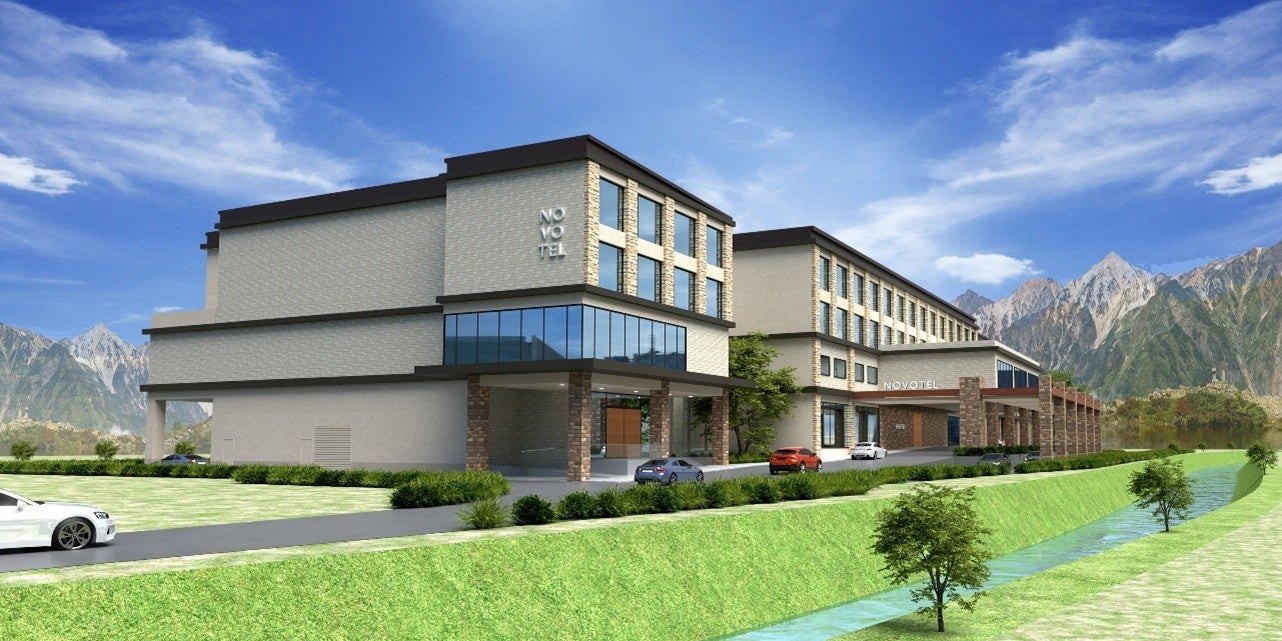
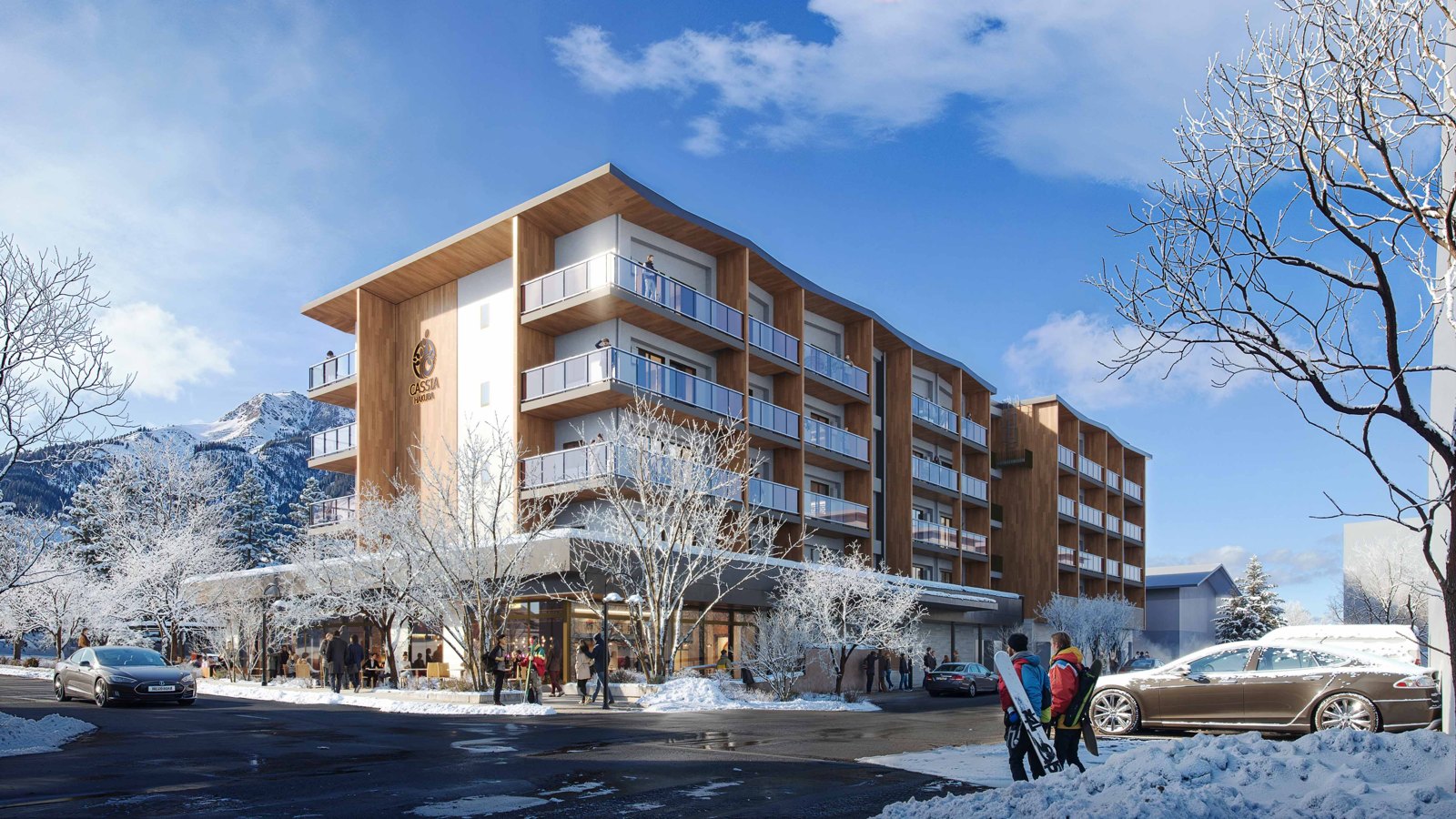
To sum up, the three international-brand projects’ 278 rooms amount to 2.9% of listed rooms in the area, 17% of the 1,654 rooms in the resort-hotel category, and a 22% addition to the 1,245 rooms in the 51+ room tier. The second Novotel, at 120 rooms, will be the largest hotel-type property in the area, and the first Novotel (82 rooms) and Cassia (76 rooms) will each rank in the area’s top ten by size. Even though their share of rooms is small, the substance of the structural shift in asset types is that, for the first time, a block of supply with the attributes “mid-to-large scale, branded, with residence functions or hot springs” is being created. Just outside the 5km radius, on the Otari Village / Hakuba Norikura side, an existing 159-room property is also set to reopen after renovation; its price-band shift is covered in THE ALPS HOTEL HAKUBA Reopens: 159 Rooms.
Site Evaluation — Station-Front Commercial Land +35.6%, No Designated Zoning, No Landslide Warning Zones within 500m of the Station
Next, we use public data to evaluate the sites: the area within walking distance of Hakuba Station, where the Novotels are planned, and the Echoland district, where Cassia is under construction. MLIT’s Real Estate Information Library contains eight land price points in Hakuba Village; their 2026 prices and year-on-year changes are shown in the table below. The commercial point 80m from Hakuba Station (Hokujo, aza Hirakawa) has a benchmark land price of ¥32,000/㎡ (+35.6% YoY); the residential point 550m from the station (Hokujo, aza Omichikami) is ¥17,600/㎡ (+31.3%); the Echoland-side residential point (Hokujo, aza Sekiwakare) is ¥27,400/㎡ (+33.0%); and the Happo commercial point (Hokujo, aza Shinden) is ¥85,000/㎡ (+25.9%). The village’s main points all posted increases in the high double digits.
| Point (Hakuba Village, Oaza) | Use | Type | Road distance from Hakuba Station | 2026 price (¥/㎡) | YoY |
|---|---|---|---|---|---|
| Oaza Hokujo, aza Shinden 3020-837 and others | Commercial | Benchmark land price (as of Jul 1) | 2,200m | ¥85,000 | +25.9% |
| Oaza Hokujo, aza Yamagoe 4093-2 | Commercial | Published land price (as of Jan 1) | 2,300m | ¥40,300 | +35.2% |
| Oaza Hokujo, aza Hirakawa 6366-2 and others | Commercial | Benchmark land price (as of Jul 1) | 80m | ¥32,000 | +35.6% |
| Oaza Hokujo, aza Sekiwakare 827-36 | Residential | Published land price (as of Jan 1) | 2,900m | ¥27,400 | +33.0% |
| Oaza Hokujo, aza Omichikami 5921 | Residential | Benchmark land price (as of Jul 1) | 550m | ¥17,600 | +31.3% |
| Oaza Hokujo 7257 | Residential | Published land price (as of Jan 1) | 1,000m | ¥8,970 | +12.5% |
| Oaza Hokujo 12319-1 | Residential | Benchmark land price (as of Jul 1) | 2,200m | ¥8,000 | +31.1% |
| Oaza Kamishiro, aza Tenjin 25256-1 | Residential | Benchmark land price (as of Jul 1) | 460m | ¥7,900 | +14.5% |
Land prices need careful interpretation. A station-front commercial price of ¥32,000/㎡ is low compared with station areas in the Tokyo metropolitan region, and even for a hotel site of around 5,000㎡ of floor area, land cost stays within the low hundreds of millions of yen. On the other hand, when prices are rising at 30%+ per year, time spent negotiating an acquisition feeds directly into acquisition cost. As noted above, Happo’s commercial land has already tripled in five years, and whether the station-side points follow the same trajectory will determine land costs for projects opening in the 2030s. For investors, whether land can be locked in two to four years before opening is the first turning point for returns.
The absence of designated zoning cuts both ways: it offers flexibility in scale but makes regulation harder to read. In unzoned “white” areas, floor-area and building-coverage ratios are set by the designated administrative agency (Nagano Prefecture) from the options in the Building Standards Act according to local conditions, so designated values can differ even within Hakuba Village — for example, between villa areas and hot-spring resort areas. When planning a mid-to-large hotel, in addition to the designated floor-area ratio, the height and color standards of Hakuba Village’s landscape plan and structural costs premised on snow loads need to be factored in at an early stage.
Competition and Positioning — 10 Properties with 70+ Rooms; an International-Brand Precedent Proves the ¥70,000s Winter Band
Within the area there are 10 hotels and ryokan with 70 or more rooms (excluding campgrounds); their line-up and estimated settled ADRs are shown in the table below. The largest is Hakuba Gondola Hotel (白馬ゴンドラホテル) with 108 rooms, followed by Hakuba Tokyu Hotel (白馬東急ホテル) with 102; the rest fall in the 70–84-room range. The property that proves the ceiling of the price range is Courtyard by Marriott Hakuba (コートヤード・バイ・マリオット白馬, 72 rooms): its estimated settled ADR is ¥76,100 in winter (December 2025–March 2026) and ¥33,700 even in the green season (June–October 2026), roughly three times the Hakuba Village median. It is a case of converting an existing building opened in 1990 to an international brand, and a precedent that anticipates this article’s theme of “inserting a large brand into a cluster of small properties.” Sierra Resort Hakuba (シェラリゾート白馬, 74 rooms, right next to Hakuba Station) follows at ¥48,300 in winter and Hakuba Mominoki Hotel (白馬樅の木ホテル, 76 rooms) at ¥30,800. Interestingly, Hakuba Tokyu Hotel (102 rooms) achieves year-round pricing with little seasonal variation: ¥29,000 in winter and ¥29,300 in the green season.
| Property | Rooms | Type | Opened | Distance from station | Winter est. settled ADR | Green-season est. settled ADR |
|---|---|---|---|---|---|---|
| Hakuba Gondola Hotel (白馬ゴンドラホテル) | 108 | Resort hotel | 2015 | 2.2km | — | — |
| Hakuba Tokyu Hotel (白馬東急ホテル) | 102 | Resort hotel | 1959 | 2.2km | ¥28,999 | ¥29,299 |
| Hakuba Hotel Pipe no Kemuri (白馬 ホテルパイプのけむり) | 84 | Resort hotel | 1989 | 2.6km | ¥17,551 | ¥8,261 |
| Hotel Nire no Ki (ホテルにれの樹) | 80 | Resort hotel | 1990 | 2.3km | ¥15,982 | — |
| Hotel Keyaki no Ki (ホテルけやきの樹) | 80 | Resort hotel | 1990 | 2.4km | ¥21,220 | ¥13,266 |
| Hakuba Mominoki Hotel (白馬樅の木ホテル) | 76 | Resort hotel | 1993 | 2.5km | ¥30,840 | ¥15,334 |
| Sierra Resort Hakuba (シェラリゾート 白馬) | 74 | Resort hotel | 1994 | 0.0km | ¥48,322 | ¥25,978 |
| Hakuba Highland Hotel (白馬ハイランドホテル) | 74 | Resort hotel | 1974 | 0.9km | ¥17,213 | ¥13,699 |
| Courtyard by Marriott Hakuba (コートヤード・バイ・マリオット 白馬) | 72 | Resort hotel | 1990 | 2.3km | ¥76,147 | ¥33,728 |
| Hakuba Sun Valley Hotel (白馬サンバレーホテル) | 70 | Business hotel | 2013 | 3.8km | — | ¥18,666 |
Cluster Filled segment
¥10,000–29,999 × 50 rooms or fewer
998 pensions, lodges, minshuku and ryokan. This diverse cluster of lodgings underpins Hakuba’s winter visitor draw, and the median estimated settled ADR (January ¥21,500) reflects this tier’s level.
WS① 70–120 rooms × ¥30,000–60,000
Currently only two properties: Sierra Resort Hakuba and Hakuba Mominoki Hotel. This is the midscale band targeted by the 82- and 120-room Novotels; year-round properties with hot-spring baths and family rooms are in short supply.
WS② Around 70 rooms × over ¥60,000 (residence type)
Courtyard Hakuba alone has proven the ¥70,000s in winter. Cassia’s 76 rooms with kitchens and balconies sit in this band, catering to inbound families on long stays.
What the positioning map shows is the “thinness of the upper tier”: most of Hakuba’s 70+ room properties sit below ¥30,000 even in winter, with only two in the ¥30,000–60,000 band and one above ¥60,000. All three planned projects have 76–120 rooms and will fill this gap on the vertical axis. For existing properties, a thicker branded upper tier could raise the overall price perception of Hakuba, widening the room to push up the winter median — a potential upside.
Ski Access as Rated in Guest Reviews — 12 Properties in Hakuba Village, Mention Rates from 7% to 43%
The HotelBank Editorial Team ran semantic analysis of guest reviews and counted positive mentions of “access to ski areas / slopes.” The properties in Hakuba Village with the most mentions are shown in the table below (most recent 24 months; properties with 20+ reviews and 5+ mentions). Hakuba Mominoki Hotel had 53 mentions (out of 555 reviews, a 9.6% mention rate), Ember Lodge 53 (39.3% of 135), Hotel Sejour Mint (ホテル セジュールミント) 48 (28.4%), Hakuba Happo Onsen Hotel Goryukan (白馬八方温泉 ホテル五龍館) 47 (21.4%) and Hakuba Hotel Pipe no Kemuri 46 (14.8%). Across Nagano Prefecture as a whole, Hotel Green Plaza Hakuba (ホテルグリーンプラザ白馬) in Otari Village had the most, at 224 mentions (20.4% of 1,098).
| Rank | Property (Hakuba Village) | Positive ski-access mentions | Total reviews | Mention rate |
|---|---|---|---|---|
| 1 | Hakuba Mominoki Hotel (白馬樅の木ホテル) | 53 | 555 | 9.6% |
| 2 | Ember Lodge | 53 | 135 | 39.3% |
| 3 | Hotel Sejour Mint (ホテル セジュールミント) | 48 | 169 | 28.4% |
| 4 | Hakuba Happo Onsen Hotel Goryukan (白馬八方温泉 ホテル五龍館) | 47 | 220 | 21.4% |
| 5 | Hakuba Hotel Pipe no Kemuri (白馬 ホテルパイプのけむり) | 46 | 310 | 14.8% |
| 6 | Hotel Abest Hakuba Resort (ホテルアベスト白馬リゾート) | 43 | 100 | 43.0% |
| 7 | Hakuba Tokyu Hotel (白馬東急ホテル) | 43 | 614 | 7.0% |
| 8 | Hakuba Ryujin Onsen RYOKAN SUI (白馬龍神温泉 RYOKAN SUI) | 42 | 300 | 14.0% |
| 9 | Hakuba Sun Valley Hotel Annex (白馬サンバレーホテルアネックス) | 37 | 129 | 28.7% |
| 10 | Hotel Grace Hakuba (ホテルグレース白馬) | 35 | 104 | 33.6% |
| 11 | Hotel Hakuba (ホテル白馬) | 34 | 571 | 6.0% |
| 12 | Hotel Mont Blanc Hakuba (ホテル モンブラン白馬) | 34 | 143 | 23.8% |
Comments such as “the slopes are right there” and “the best ski-in, ski-out location” are concentrated among properties at the foot of the Happo, Goryu and Hakuba 47 slopes. The area within walking distance of Hakuba Station, by contrast, is not slope-side but a hub for shuttle buses, and the two Novotels will market this “station-front location with access to multiple ski areas.” Echoland, where Cassia is being built, has a strip of restaurants and is close to bus stops for each ski area, giving it location value for residence-style long-stay guests that extends to how they spend their evenings. Existing properties highly rated for ski access and the new projects at the station front and Echoland appear headed less toward direct competition and more toward segmentation by guest type.
Development Scenario Estimates — Required ADR for a 76-Room Residence Type and a 120-Room Midscale, Year-Round vs Winter-Weighted
We work backward from published information and official statistics to estimate the rate levels at which 76–120-room properties of the kind international brands are bringing would be viable in Hakuba. The assumptions are as follows. Construction cost is based on the 2025 RC-structure unit cost of ¥2.026 million per tsubo from MLIT’s “Statistics on Building Construction Starts,” shown in two stages: Stage 1 (based on 2025 actual unit costs) and Stage 2 (compounding construction cost inflation of around 5% per year up to the mid-point of construction). Land uses the land price points from the Real Estate Information Library as reference values (Echoland-side residential ¥27,400/㎡, station-front commercial ¥32,000/㎡), and design and FF&E are set at 15% of construction cost. GOP margins are set within the 20–40% industry guideline for resort hotels: 30% for the residence type (light F&B) and 35% for the midscale (with hot springs and restaurant), with a target NOI yield of 6% of total investment. For the 76-room property, the gross floor area of about 5,000㎡ is the planned figure in Wealth Management’s timely disclosure (September 5, 2025); for the 120-room property, we assume 45㎡ of floor area per room. Both are simplified estimates; actual investment decisions require a detailed feasibility study.
| Item | A. 76 rooms, residence type (assumed 2028 opening) | B. 120 rooms, midscale (assumed 2033 opening) Station front |
|---|---|---|
| Gross floor area (assumed) | approx. 5,000㎡ (approx. 66㎡ per room) | approx. 5,400㎡ (45㎡ per room) |
| Land (reference, published/benchmark price basis) | 4,060㎡ × ¥27,400 = ¥110M | 3,000㎡ × ¥32,000 = ¥100M |
| Construction cost ① based on 2025 actual unit cost (RC ¥2.026M/tsubo) | ¥3.06B | ¥3.31B |
| Total investment ① (construction + land + design/FF&E 15%) | ¥3.64B | ¥3.90B |
| Required ADR ① year-round (annual OCC 70% / 75%) | ¥37,400 | ¥20,400 |
| Construction cost ② with inflation over the build period (compounded to mid-construction) | ¥3.39B (×1.11) | ¥4.36B (×1.32) |
| Total investment ② | ¥4.01B | ¥5.11B |
| Required annual revenue ② (6% NOI yield ÷ GOP margin 30% / 35%) | ¥800M | ¥880M |
| Required ADR ② year-round (annual OCC 70% / 75%) | ¥41,300 | ¥26,700 |
| Required ADR ② winter-weighted, 120 winter days (winter OCC 85% / 88%, green-season OCC 45% / 55%) | Winter ¥61,700 / green season ¥38,600 | Winter ¥38,500 / green season ¥24,100 |
| Annual OCC under winter-weighted case (calculated) | 58% | 66% |
Let us compare the required ADRs from the estimates with market performance. For Plan A (76-room residence type), the required ADR on a year-round basis at 70% annual OCC is ¥41,300; under the winter-weighted case (120 winter days at 85% OCC, green season at 45% OCC), it needs ¥61,700 in winter and ¥38,600 in the green season. Courtyard Hakuba’s actual performance (winter ¥76,100, green season ¥33,700) almost overlaps with this winter-weighted requirement. In other words, in Hakuba’s upper tier, even with inflation-adjusted construction costs, the math reaches a 6% yield if a property can settle at the precedent’s price band. Plan B (120-room midscale) needs ¥26,700 year-round, or ¥38,500 in winter and ¥24,100 in the green season under the winter-weighted case — a step above the Hakuba Village median (winter ¥19,100, green season ¥11,900), but within the winter performance range of Sierra Resort Hakuba and Hakuba Mominoki Hotel (¥30,000–48,000).
What deserves attention is that even when the “average” required ADR is similar between the year-round and winter-weighted cases, the rate required in the green season differs greatly. Plan A’s year-round case assumes ¥41,300 throughout the year, while the winter-weighted case can drop the green season to ¥38,600 and make it up in winter. Given that Hakuba Village’s green-season median is ¥11,900, the year-round case requires “a product strong enough to command more than three times the median in the green season,” while the winter-weighted case requires “the sales power to capture three times the median in winter.” Cassia’s residence-type design with kitchens appears to lean toward the former, aiming to support summer rates through multi-night and long stays.
As a sensitivity analysis, the table below shows how Plan A’s yield (Stage 2, year-round) moves with downside in ADR and occupancy.
| Plan A: 76 rooms, year-round | Base case | ADR −10% | OCC −5pt | Both |
|---|---|---|---|---|
| Annual revenue | ¥800M | ¥720M | ¥740M | ¥670M |
| GOP (30%) | ¥240M | ¥220M | ¥220M | ¥200M |
| NOI yield (on total investment ②) | 6.0% | 5.4% | 5.6% | 5.0% |
If ADR falls 10% and occupancy simultaneously drops 5pt, the yield falls to 5.0%. In Hakuba’s case, the likely drivers of such downside are external factors in winter demand, such as late snowfall or changes in airline seat capacity, and lifting the green season acts directly as a buffer against the “Both” case in the sensitivity analysis. Rising construction costs also act to restrain new supply, so projects that have already secured land and construction contracts have the upside of limited additional competitive entry.
In addition to the one-dimensional sensitivity, the tables below show two-axis sensitivity, moving ADR and annual OCC simultaneously. For Plan A to reach the 6% target, at the base ADR (¥41,300) it needs an annual year-round OCC of 70% or more, and at ADR −10% (¥37,200) it needs 80%. Plan B reaches the target at the base (¥26,700) with 75% or more, or at 70% with ADR +10% (¥29,400). In both cases, “10% of ADR” and “5pt of OCC” correspond to nearly the same 0.4–0.6pt change in yield, so sensitivity does not differ much whether a property pursues rate or occupancy.
| ADR \ Annual OCC | 60% | 65% | 70% | 75% | 80% |
|---|---|---|---|---|---|
| ¥33,000 (-20%) | 4.1% | 4.5% | 4.8% | 5.1% | 5.5% |
| ¥37,200 (-10%) | 4.6% | 5.0% | 5.4% | 5.8% | 6.2% |
| ¥41,300 (base) | 5.1% | 5.6% | 6.0% | 6.4% | 6.9% |
| ¥45,400 (+10%) | 5.7% | 6.1% | 6.6% | 7.1% | 7.5% |
| ¥49,500 (+20%) | 6.2% | 6.7% | 7.2% | 7.7% | 8.2% |
| ADR \ Annual OCC | 65% | 70% | 75% | 80% | 85% |
|---|---|---|---|---|---|
| ¥21,400 (-20%) | 4.2% | 4.5% | 4.8% | 5.1% | 5.4% |
| ¥24,000 (-10%) | 4.7% | 5.0% | 5.4% | 5.8% | 6.1% |
| ¥26,700 (base) | 5.2% | 5.6% | 6.0% | 6.4% | 6.8% |
| ¥29,400 (+10%) | 5.7% | 6.2% | 6.6% | 7.0% | 7.5% |
| ¥32,000 (+20%) | 6.2% | 6.7% | 7.2% | 7.7% | 8.2% |
Investment Summary — International Entry Fills a “Gap in the Product Mix”; Green-Season Rates Are the Key Question
Let us summarize this analysis from an investor’s perspective. First, Hakuba’s demand is concentrated in winter; estimated settled ADR rose to ¥21,500 in January 2026 (+30.0% YoY), and forward listed rates point even higher. Second, supply is a diverse cluster of lodgings averaging 9.3 rooms, with only 10 properties of 70+ rooms and only three mid-to-large properties settling above ¥30,000 in winter. Third, land prices are rising at 30%+ per year at both the station front and the Echoland side, so securing land early will shape returns. Fourth, there is no designated zoning and no landslide warning zone within 500m of the station, but confirming the floor-area ratio designation for the unzoned area and the landscape standards is a prerequisite for planning.
| Factor | Current reading | Implications for investors |
|---|---|---|
| Demand (winter) | 1.3 million winter visitors; 46% of ski-area visitors international (2024-25). January ADR +30.0% YoY | Ample room for upper-tier pricing. Residence-type products suited to long-staying Australian guests work well |
| Demand (green season) | Median estimated settled ADR ¥11,900, on par with the prefectural average. Occupancy (OTA listed-inventory basis, estimated) 85–91% | Inventory is selling; room to grow through rate design. The success of a year-round model is decided here |
| Supply | Rooms +6.2% over nine years; 2020s new supply averaged 3.3 rooms per property. Three mid-to-large branded projects totaling 278 rooms planned | First-mover advantage in the mid-to-large tier. Rising construction costs restrain follow-on supply |
| Land and regulation | Station-front commercial +35.6%, Echoland side +33.0%. No designated zoning (unzoned “white” area) | Bring acquisition timing forward and confirm floor-area ratio and landscape standards early |
| Site risk | Landslide warning zones: 0 within 500m of the station, 16 within 500–1,000m (mountainside) | Flat land in front of the station is outside the zones. Slope-side sites require case-by-case checks for zone overlap |
Finally, the timeline. Cassia broke ground in September 2025 and is scheduled to open in 2028; the Novotels are scheduled to open in autumn 2030 and autumn 2033 — all planned figures. As the 278 rooms are added in stages from 2028 to 2033, how far Hakuba’s winter rates move into the upper tier, and whether green-season rates can take off from the prefectural average, will be the points to watch for investors considering the next project. The existing diverse cluster of lodgings is the very foundation of Hakuba’s visitor draw; it is reasonable to see international brands’ entry not as replacing it but as adding mid-to-large, upper-tier products where there were none before.
Conclusion
The accommodation stock within 5km of Hakuba Station is a cluster of small properties — 1,013 properties and 9,460 rooms, averaging 9.3 rooms each — and three international-brand projects totaling 278 rooms will join it between 2028 and 2033. Hakuba Village’s estimated settled ADR was ¥21,500 in January 2026 (+30.0% YoY) versus ¥11,900 in the green season, and the 1.60x seasonal spread was the largest among neighboring snow resorts. Simplified estimates put the benchmark for a 6% yield at ¥61,700 in winter / ¥38,600 in the green season for a 76-room residence type, and ¥26,700 year-round for a 120-room midscale — overlapping with the performance range of the international-brand precedents in the area. With land prices rising 30%+ per year at both the station front and the Echoland side, the timing of land acquisition and confirmation of regulations in the unzoned area are the practical turning points for snow resort investment in Hakuba.
⚠ Note on ADR for future dates: The estimated settled ADRs shown in this article for months from November 2026 onward (December 2026 ¥25,300, January 2027 ¥29,500, February ¥29,500, March ¥23,500) are estimates based on selling prices published on OTAs at the time of the survey (November 2026), and will change as new plans are added and prices adjusted closer to check-in. Please note that prices currently set high may fall with last-minute discounting. In addition, booking curve and inventory metrics use only observations within a 45-day lead time, and occupancy (OTA listed-inventory basis, estimated) is shown together with the number of properties and rooms covered (major booking site listing basis).
On the figures for planned projects: Cassia Hakuba (tentative name)’s 76 rooms, approx. 5,000㎡ of floor area, approx. 4,060㎡ of land and 2028 scheduled opening, and the two Novotels’ 82 and 120 rooms and autumn 2030 / autumn 2033 scheduled openings, are all planned figures based on the operators’ timely disclosures and news reports and may change. The development scenario estimates are simplified estimates based on official statistics and published figures and do not represent the actual investment amounts or business plans of each project.
Related Articles
- Spring Ski: How Far March ADR Falls vs Feb — Kutchan −54%, Nozawa −3%
- Six Senses Myoko: 57 Rooms + 21 Residences vs a 2,487-Room 5km Market
- MGallery Comes to Myoko & Madarao: 5km Room Stock, Jan ADR +23% YoY
- Top 30 Ski-Slope Hotels by Reviews: Naeba Prince Leads, Kutchan ¥62k
- THE ALPS HOTEL HAKUBA Reopens: 159 Rooms, Winter ADR ¥22.5k to ¥47k
- Snow Country Hotel ADR Jan 2027: Kutchan ¥49k, Hakuba ¥29k, 5 Tiers
- Nagano Hotel Investment Map 2026: Karuizawa ¥27K, Matsumoto ¥14K
References and Sources
■ Data Sources
Estimated settled ADR is an estimated settled rate (tax-excluded equivalent) derived by applying segment-specific adjustment factors to the lowest-plan price published on OTAs (double occupancy, tax-included); municipal figures are the median of covered properties (Hakuba Village N=32–51 properties, October 2024–March 2027; November 2026 onward are estimates based on listed rates at the time of the survey). Room stock covers properties within a 5,000m radius of Hakuba Station with one or more rooms, excluding leisure/love hotels (as of November 9, 2026). Occupancy is an estimate based on OTA listed inventory (July–October 2026, 13–29 properties covered). Land prices, urban planning and landslide warning zones are from MLIT’s Real Estate Information Library; construction starts of accommodation buildings are from the Statistics on Building Construction Starts (e-Stat).
■ Estimate Assumptions
RC-structure unit cost ¥2.026 million per tsubo (2025 actual); design and FF&E = 15% of construction cost; construction-period inflation factor ×1.11 for Plan A and ×1.32 for Plan B; land: Plan A 4,060㎡ × ¥27,400, Plan B 3,000㎡ × ¥32,000 (reference values based on published/benchmark land prices); GOP margin 30% for Plan A and 35% for Plan B; target NOI yield = 6% of total investment. The winter-weighted case assumes 120 winter days and winter ADR = green-season ADR × 1.6 (Hakuba Village’s actual ratio). The two-axis sensitivity (Tables 7 and 8) varies ADR by ±20% and annual OCC by ±10pt against Stage 2 total investment.
■ Limitations and Caveats
Estimated settled ADR is not each property’s actual settled price or accounting figure (median error of about 7% when checked against property-level results of listed hotel REITs). Occupancy is an estimate based on how inventory sold on OTAs is absorbed and differs from properties’ actual overall occupancy. The estimates are simplified and do not account for actual land transaction prices, site preparation costs, pre-opening expenses, interest or taxes. Room counts and opening dates of planned projects are planned figures based on timely disclosures and news reports, and review mention rates are based on review totals that vary in size across properties.
■ Market Data
- MetroEngines Research & Consulting — Estimated settled ADR (Hakuba Village, Nozawa Onsen Village, Yamanouchi Town, Otari Village, Omachi City, Nagano Prefecture; October 2024–March 2027; Hakuba Village N=32–51 properties), room stock within 5km of Hakuba Station (1,013 listed properties / 9,460 rooms, as of November 9, 2026), property-level estimated settled ADR, occupancy (OTA listed-inventory basis, estimated)
- HotelBank Editorial Team research — NLP analysis of guest reviews (positive mentions of ski access, most recent 24 months, Hakuba Village N=12 properties)
■ Government Statistics and Public Data
- MLIT Real Estate Information Library — Land Price Publication (as of January 1, 2026), Prefectural Land Price Survey (as of July 1, 2026), city planning areas and zoning, landslide warning zones, station passenger counts (National Land Numerical Information)
- MLIT “Statistics on Building Construction Starts” (e-Stat statistics ID: 0003114490; accommodation buildings, Nagano Prefecture, 2018–2024)
- Japan Tourism Agency “Overnight Travel Statistics Survey”
- JNTO “Visitor Arrivals Statistics”
■ Corporate Disclosures and Industry Reports
- Wealth Management, Inc. “Notice Concerning Joint Investment in a Hotel Development Project” (September 5, 2025, timely disclosure; Japanese) — Echoland TMK, land approx. 4,060㎡, floor area approx. 5,000㎡, 76 rooms, construction start September 16, 2025
- 2025 unit construction cost per tsubo by structure based on the Statistics on Building Construction Starts (archi-book, 2025 edition; Japanese), Turner & Townsend construction cost escalation forecast
- Relo Hotel Solutions: GOP margin guidelines by hotel type (Japanese)
■ News and Press Releases
- Accor signs management agreements for two “Novotel” hotels in Hakuba, Nagano (Travel Voice, March 26, 2026; Japanese)
- “Cassia Hakuba (tentative name)” in Hakuba’s Echoland district, opening in 2028 (Travel Voice, November 14, 2025; Japanese)
- Hakuba Village’s 2024-25 winter visitors reach a record 1.3 million (Travel Voice, April 2025)
- “Not Chasing Niseko”: How Hakuba, Nagano, birthplace of the minshuku, is facing foreign capital (nippon.com, April 9, 2025; Japanese)
- Interview with the Secretary-General of the Hakuba Village Tourism Bureau (Honichi Lab, June 29, 2026; Japanese) — approx. 450,000 international overnight guests per year, share from Australia