

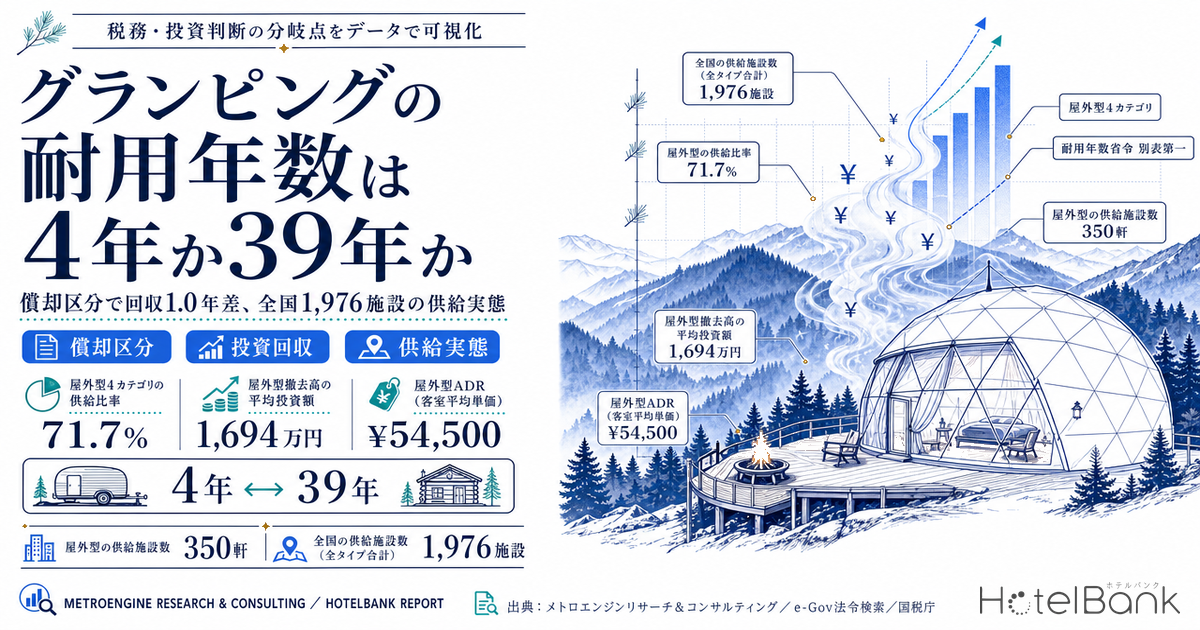
Glamping sites and cottages keep multiplying on land where a hotel could never be built — forest, moorland, urbanisation control areas. Yet the first thing that stalls an investment review is not construction cost. It is two questions: over how many years can this asset be written off for tax purposes, and is it even a “building” under the Building Standards Act? Put ¥10 million into a single unit and the after-tax cash flow profile is a completely different animal depending on whether you depreciate it over 17 years as a timber building, 7 years as a temporary simple structure, or 4 years as a towed vehicle.
This article quantifies the supply of glamping sites, campgrounds, cottages and lodges tracked by MetroEngines Research & Consulting, layers on primary sources — the Ministerial Ordinance on Useful Lives of Depreciable Assets, the Building Standards Act and the City Planning Act — and shows in a sensitivity table exactly how far the depreciation classification moves the payback period.
HotelBank has previously covered vacation rental (whole-house rental) themes such as “45% of 2026 new openings are vacation rentals” and “612 new openings in 2026 are getting extremely small.” A vacation rental is a building on a foundation, so its depreciation classification and building-confirmation issues do not differ greatly from ordinary houses and lodging facilities — it is therefore outside the scope here. This article is limited to the four categories that may include structures which arguably are not buildings — tents, trailer houses and movable units: glamping, campgrounds, cottages and lodges. Auberges (a food-service format) and leisure hotels (a separate asset class) are also out of scope.
Metric Definitions Used in This Article
- Listed price: the all-plan average of the selling prices each property publishes on OTAs and other channels (double occupancy, per-room rate, tax included, covering room-only through meal-inclusive plans). It differs from the actual transacted price. The four categories covered here are not included in the settled-ADR estimation set, so this article uses listed price throughout and does not use estimated settled ADR. Area- and category-level figures are aggregates of the covered properties and indicate the standard price level of the area.
- Property count: among the roughly 168,000 domestic properties tracked by MetroEngines Research, the number for which sales could be confirmed on OTAs for check-in dates in the stated month. Properties not listed on OTAs are excluded.
- New supply (by opening year): based on OTA listing confirmation against the establishment date in the property master. Because listings appear only a few months before opening, the most recent years are structurally under-counted.
- Assumed occupancy / assumed rate: the figures used in the investment scenarios from Section 5 onward are assumptions stated explicitly by this article, not measured values.
- Data sources: MetroEngines Research & Consulting / e-Gov Law Search / National Tax Agency / Ministry of Land, Infrastructure, Transport and Tourism (MLIT)
- — Outdoor lodging (glamping, campgrounds, cottages, lodges) totals 1,976 properties nationwide. Of those opened since 2021, 71.7% have just 1–5 rooms (July 2026, sales-confirmed basis).
- — Statutory useful lives for the same lodging use range from 39 years (reinforced concrete) to 4 years (towed vehicle) — a spread of roughly 10x. Buildings are restricted to the straight-line method, while vehicles and transport equipment can use the declining-balance method (4 years, rate 0.500).
- — Hold revenue, costs and capital outlay fixed and change only the depreciation classification, and payback swings about 1.0 year, from 3.6 to 4.6 years, with a ¥16.94 million (21.2% of the outlay) difference in cumulative five-year after-tax cash flow (45% assumed occupancy, full-year basis, this article’s assumptions).
- — Building confirmation splits sharply on whether the site is inside or outside a city planning area (Article 6(1)(iii)), while development permission turns on 1 hectare and on urbanisation control areas. Building confirmation, development permission and the hotel business licence do not move together.
- — New supply has slowed from a 2023 peak of 350 properties to 165 in 2025. Because the classification is dictated by physical reality rather than chosen, checking the zoning designation and the local building authority’s practice is a more rational first step than collecting competing construction quotes.
1,976 properties, 5.4 rooms on average — outdoor lodging supply has converged on the tiny single unit
Start with the supply picture. For July 2026 check-ins, the four outdoor categories with confirmed OTA sales comprise 1,060 cottages, 377 glamping sites, 321 lodges and 218 campgrounds — 1,976 properties in total. Vacation rentals in the same month numbered 4,972, meaning that by count they are 2.5 times the outdoor segment. That scale gap is why earlier coverage led with vacation rentals (for the detail on supply composition see Vacation Rentals Take 45% of Japan’s 2026 New Hotel Openings), but the legal and tax questions in an investment decision are far more complex on the outdoor side.
| Category | Properties July 2026 | Listed price July 2026 | Listed price Trailing 12-month avg | Avg rooms Opened since 2021 |
|---|---|---|---|---|
| Cottage | 1,060 | ¥34,300 | ¥35,400 | 4.9 |
| Glamping | 377 | ¥53,200 | ¥54,500 | 5.8 |
| Lodge | 321 | ¥27,100 | ¥25,500 | 5.9 |
| Campground | 218 | ¥28,800 | ¥28,900 | 5.8 |
| Four outdoor categories, total | 1,976 | ¥36,800 | — | 5.4 |
| (Reference) Vacation rentals — out of scope | 4,972 | ¥47,100 | ¥49,600 | — |
Listed prices differ by a factor of two across categories. Glamping stands out at a trailing 12-month average of ¥54,500, followed by cottages at ¥35,400, campgrounds at ¥28,900 and lodges at ¥25,500. Glamping’s price band even exceeds vacation rentals (¥49,600), so the assumption that “it’s a tent, therefore it’s cheap” does not hold — at least at the level of publicly listed selling prices. Room scale, on the other hand, is extremely small. The 1,315 properties confirmed as opened since 2021 average 5.4 rooms, and 943 of them (71.7%) have 1–5 rooms.
Scale and location — 71.7% have 1–5 rooms, concentrated in Nagano, Hokkaido and Okinawa
The supply wave is unmistakable. New supply across the four outdoor categories rose from 113 properties in 2020 to 206 in 2021 and 288 in 2022, peaked at 350 in 2023, then slowed to 244 in 2024 and 165 in 2025. Glamping in particular thinned rapidly, from 123 properties in 2023 to 49 in 2024 and 22 in 2025. These are listing-confirmed counts by opening year, however, so the most recent years are structurally under-counted. The 2025 and 2026 figures should be read as current floors that will rise as more listings appear.
Cottages, by contrast, have fallen less steeply — 167 properties in 2023, 147 in 2024 and 113 in 2025. Over the same period vacation rentals held a high level at 729, 837 and 745, which suggests that demand is shifting from movable glamping formats toward vacation rentals and cottages, which are buildings. That shift also moves the business into precisely the territory where the depreciation classification and the need for building confirmation feed straight through to project economics.
Location is strongly dictated by natural assets and available land. On a property-master basis Nagano stands out with 792 properties, followed by Hokkaido at 386, Okinawa at 320, Niigata at 316 and Yamanashi at 313. Near the Tokyo metropolitan area, Chiba (205), Gunma (201) and Tochigi (173) are dense. On the July 2026 sales-confirmed basis the order is Nagano 201, Okinawa 164, Hokkaido 137, Yamanashi 131 and Chiba 113 — supply clusters at two poles: mountainous and coastal areas two to three hours’ drive from major cities, and established wide-area resort destinations.
What matters here is that many of these locations sit outside city planning areas, or inside urbanisation control areas. The use-district and floor-area-ratio rules a hotel developer checks first are simply not designated on this land. That is exactly why the tests covered in the following sections — is it a building, is development permission required — determine whether the investment is feasible at all.
Price seasonality — August spikes, and the outdoor format earns in “two months of the year”
Overlaying monthly listed prices by year makes the revenue structure of outdoor lodging visible. August has been the annual peak for three straight years, at roughly the same level each time — ¥41,300 in 2024, ¥41,600 in 2025 and ¥41,800 in 2026. June, by contrast, came in at ¥34,000, ¥33,600 and ¥34,700 — about 18% below August.
This seasonality connects directly to the depreciation discussion. Because outdoor lodging concentrates its revenue in two or three peak months, applying a hotel P&L model built on year-round operation will miss the mark. That is why the investment scenarios in this article set assumed occupancy across a 35%–55% range. The design question becomes how to build resilience against occupancy shortfalls — and one lever for that is securing early cash through depreciation speed.
Legal layer 1 — Is it a building at all? The test is “can it be moved at any time and at will”
The legal analysis of outdoor lodging begins with whether the structure is a “building” under the Building Standards Act. The definition sits in Article 2(i).
“A structure fixed to land that has a roof and either columns or walls (including structures of a similar nature), gates or fences attached thereto, structures for spectating, and offices, stores, places of entertainment, warehouses and other similar facilities provided within underground or elevated structures (…), including building equipment.”
Source: e-Gov Law Search, “Building Standards Act” (Act No. 201 of 1950)
There are two tests: fixity to the land, and a roof plus columns or walls. A timber cabin or cottage anchored on a foundation obviously meets both. The difficult cases are trailer houses, containers and permanent tents. On containers, MLIT states the following explicitly on its Housing Bureau website.
“In recent years there have been cases of containers installed as warehouses and used on a continuous basis. A container that cannot be moved at any time and at will constitutes a building under Article 2(i) of the Building Standards Act, given its form and the actual manner of its use. As such, it generally cannot be installed without filing a confirmation application under the Building Standards Act and obtaining a certificate of confirmation.”
Source: MLIT Housing Bureau (related notices: Jushihatsu No. 239 of 18 July 1989 / Kokujushi No. 2174 of 6 December 2004 / Kokujuan No. 5 of 26 December 2014)
The same lineage of reasoning applies to trailer houses. The test is not “it is a trailer house, therefore it is a vehicle” but whether the actual installation permits movement at any time and at will. If there are stairs, porches, verandas or fences that impede movement, or if water, gas and electrical connections are not simple detachable hook-ups, it can be treated as a building. In other words, the belief that “making it a trailer house removes the need for a confirmation application” may not hold in practice.
Permanent tents are no different. A frame with fabric stretched over it, fixed to the ground and offered as guest accommodation year-round, can be assessed as having a roof and columns and being fixed to the land. Conversely, simply providing tent sites that guests pitch and strike themselves raises no building question. This boundary is the branch point that feeds into everything below — the depreciation classification, the hotel business licence and development permission. Individual determinations must be confirmed with the designated building authority with jurisdiction over the site; this article sets out the general framework only.
Legal layer 2 — Building confirmation: a fault line runs between inside and outside city planning areas
Once a structure qualifies as a building, the next question is whether a building confirmation application is required. The basis is Article 6(1) of the Building Standards Act. The amendment effective 1 April 2025 narrowed the so-called Category 4 exemption, restructuring the rule so that confirmation is required inside city planning areas regardless of scale.
Item (i) Special buildings used for a purpose listed in column (i) of Appended Table 1, where the total floor area used for that purpose exceeds 200 square metres (a hotel or ryokan is a special building under Article 2(ii) of the Act)
Item (ii) Other than buildings under the preceding item, buildings with two or more storeys, or with a total floor area exceeding 200 square metres
Item (iii) Other than buildings under the preceding two items, buildings within a city planning area or quasi-city planning area (excluding areas designated by the prefectural governor), within a quasi-scenic district, or within an area designated by the prefectural governor
Source: e-Gov Law Search, “Building Standards Act” (Act No. 201 of 1950), Article 6(1)
Applied to the typical unit sizes of outdoor lodging, this yields the table below. As shown earlier, 71.7% of properties opened since 2021 have 1–5 rooms, and floor area per unit centres on 20–40 square metres. Many cases fall under neither item (i) nor item (ii) — but because item (iii) captures every building inside a city planning area, the required response changes completely depending on which side of the line the site falls.
| Location | Unit type | Building confirmation | Basis |
|---|---|---|---|
| Inside city planning area Inside quasi-city planning area | Single-storey 30 m² cabin | Required | Article 6(1)(iii) (regardless of scale) |
| Outside city planning area | Single-storey 30 m² cabin | Not required | Falls under none of items (i), (ii), (iii) |
| Outside city planning area | Single-storey 250 m² management-cum-guest building | Required | Item (i) (lodging use exceeding 200 m²) |
| Outside city planning area | Two-storey lodge (80 m² total) | Required | Item (ii) (two or more storeys) |
| Any area | Trailer house movable at any time and at will | Not required | Not a building (Article 2(i)) — determined on the facts |
One thing must not be misread: “no confirmation required” does not mean “the Building Standards Act does not apply.” Only the confirmation procedure falls away; the substantive rules on structural strength, fire prevention and evacuation continue to apply as long as the structure is a building. Furthermore, accommodating people for a fee requires a separate licence under the Hotel Business Act. Article 2(3) of that Act defines simple lodging business as “a business of providing facilities whose structure and equipment are principally shared by many guests, and accommodating people for a fee,” which can cover permanent tents and cottages offered as guest rooms. On the other hand, Article 2(5) defines “lodging” as “using a facility with bedding,” so a pure site-rental tent field is treated differently. “No building confirmation,” “no development permission” and “no hotel business licence” are separate requirements under separate statutes; clearing one does not automatically clear the others.
Legal layer 3 — Development permission: the 1-hectare wall and the urbanisation control area
Where outdoor lodging is considered as a use for idle land, development permission under the City Planning Act is the third gate. Development activity is defined in Article 4(12) of that Act.
“In this Act, ‘development activity’ means a change to the division, shape or quality of land carried out primarily for the purpose of constructing a building or erecting a special structure.”
Article 4(11) and Order for Enforcement of the City Planning Act, Article 1(2) (Class 2 special structures)
“The large-scale structures specified by Cabinet Order under Article 4(11) of the Act shall be the following, where their scale is 1 hectare or more: (i) structures that are baseball fields, tennis courts, athletics grounds, amusement parks, zoos or other sports and leisure facilities (…); (ii) cemeteries.”
Source: e-Gov Law Search, “City Planning Act” (Act No. 100 of 1968) / “Order for Enforcement of the City Planning Act” (Cabinet Order No. 158 of 1969)
There are two practical implications. First, even a pure tent field with no buildings at all can fall within development permission as a Class 2 special structure if it constitutes a sports or leisure facility of 1 hectare or more. The view that “we aren’t building anything, so development permission is irrelevant” is risky. Second, and conversely, a format under 1 hectare with no buildings may fall outside the definition of development activity even if it involves changes to the division, shape or quality of land. The 1-hectare line therefore shapes the very scale at which an outdoor lodging business is designed.
The size thresholds below which permission is not required are set in Article 19 of the Enforcement Order: under 1,000 square metres in urbanisation promotion areas (under 500 square metres in the existing urban areas and suburban development zones of the Tokyo metropolitan region, the existing urban districts and suburban development areas of the Kinki region, and the urban development areas of the Chubu region), and under 3,000 square metres in city planning areas without area classification and in quasi-city planning areas. Note what is absent from that table: urbanisation control areas. In an urbanisation control area there is no size-based exemption, so a change to the division, shape or quality of land for the purpose of constructing a building requires permission in principle.
| Area | Size exempt from permission | Tightening by local ordinance |
|---|---|---|
| Urbanisation promotion area | Under 1,000 m² | May be set separately within 300 m² to under 1,000 m² |
| Urbanisation promotion area (existing urban areas / suburban development zones of the Tokyo metropolitan region, etc.) | Under 500 m² | Same as above |
| Non-classified city planning area / quasi-city planning area | Under 3,000 m² | May be set separately within 300 m² to under 3,000 m² |
| Urbanisation control area | No size-based exemption provided | — |
For owners of forest, moorland or control-area land, this structure is both a constraint and a design variable. The economics of placing small-scale lodging on idle land are also covered in our analysis of roadside hotel idle-land schemes for 2026. The three choices — build no building, stay under 1 hectare, keep the format movable — all reduce the permitting burden, but they simultaneously determine the depreciation classification for tax purposes. As the next section shows, all three push in the direction of a shorter depreciation period. Light permitting and fast depreciation are, in most cases, not a trade-off but the same direction of travel.
Tax layer — 4 years, 7 years or 39 years: the actual figures in the Useful Lives Ordinance
This is the core of the article. Statutory useful lives are set out in Appended Table 1 of the Ministerial Ordinance on Useful Lives of Depreciable Assets (Ministry of Finance Ordinance No. 15 of 1965). Setting hotel and ryokan buildings alongside the asset classes actually used in outdoor lodging gives the following.
| Asset class | Structure / use detail | Useful life | Method |
|---|---|---|---|
| Building | Steel-frame reinforced concrete / reinforced concrete — ryokan or hotel use (other) | 39 yrs | Straight-line |
| Same as above / timber interior finish exceeding 30% | 31 yrs | Straight-line | |
| Metal frame (frame member thickness over 4 mm) / ryokan, hotel or hospital use | 29 yrs | Straight-line | |
| Metal frame (over 3 mm to 4 mm) / ryokan, hotel or hospital use | 24 yrs | Straight-line | |
| Metal frame (3 mm or less) / ryokan, hotel or hospital use | 17 yrs | Straight-line | |
| Timber or synthetic resin / ryokan, hotel or hospital use | 17 yrs | Straight-line | |
| Building (simple structures) | Main timber columns 10 cm square or less, roofed with board, cedar bark, roofing felt or galvanised iron | 10 yrs | Straight-line |
| Post-in-ground construction and temporary structures | 7 yrs | Straight-line | |
| Structures | For stadiums, sports grounds, amusement parks or schools / other (mainly timber) | 15 yrs | Straight-line |
| Same as above / other | 30 yrs | Straight-line | |
| Vehicles and transport equipment | Other than the foregoing / other (without self-propulsion) | 4 yrs | Declining-balance available |
| Building fixtures | Water supply and drainage or sanitary equipment and gas equipment | 15 yrs | Straight-line |
The gap between the figures is decisive. A reinforced concrete hotel depreciates over 39 years; a timber ryokan or hotel building over 17 years; a temporary or post-in-ground simple structure over 7 years; and a trailer house classified as a towed vehicle under vehicles and transport equipment over 4 years. For the same capital outlay, the annual deductible amount can differ by roughly 10x.
The depreciation method compounds this. Under National Tax Agency Tax Answer No. 2100, buildings acquired on or after 1 April 1998 may use only the former straight-line method or the straight-line method, and building fixtures and structures acquired on or after 1 April 2016 are likewise restricted to straight-line. Equipment, fittings, vehicles and transport equipment, by contrast, may elect the declining-balance method. The declining-balance rate for a four-year useful life is 0.500 (revised rate 1.000, guarantee rate 0.12499, Appended Table 10), which writes off 50% of the acquisition cost in year one, 25% in year two and 12.5% in each of years three and four — fully depreciated in four years.
On top of that, the small-value asset provisions suit outdoor lodging well. Also under No. 2100, assets costing under ¥100,000 or with a usable period under one year are expensed in full in the year placed in service; assets from ¥100,000 to under ¥200,000 may be depreciated in a lump over three years; and blue-return filers acquiring depreciable assets from ¥100,000 to under ¥300,000 by 31 March 2026 may deduct the full acquisition cost, capped at ¥3 million per year. In a format with many low-unit-cost, frequently replaced assets — outdoor furniture, fire pits, fittings, tent fabric replacement — these provisions stack up and raise the effective depreciation speed. The same class of question, how far building ratio and depreciation move the real yield, is examined as a 70% building-ratio case in Hotel Condominium Tax Arbitrage.
Payback scenarios — the classification alone moves payback by 1.0 year and five-year cash by ¥16.9 million
Now compare the legal and tax layers on a single set of business assumptions. The design is to hold revenue, costs and capital outlay entirely fixed and see how after-tax cash flow moves when only the depreciation classification changes. Every figure below is an assumption stated by this article — neither a measured value nor a recommendation.
| Assumption | Value | Rationale |
|---|---|---|
| Number of units | 10 rooms | Against the 5.4-room average for properties opened since 2021, an upper band that works as a business |
| Depreciable capital outlay | ¥80 million (¥8 million per unit) | This article’s assumption. Excludes land acquisition, site preparation and utility connections |
| Assumed rate | ¥40,000 per room-night | Set conservatively against glamping’s ¥54,500 trailing 12-month listed price, allowing for discounts and room-only plans |
| Assumed occupancy | 45% (sensitivity at 35% / 55%) | This article’s assumption, reflecting the strong seasonality of outdoor formats |
| Annual revenue | ¥65.7 million | 10 rooms × 365 days × 45% × ¥40,000 |
| Operating margin before depreciation | 35% (= ¥23 million) | This article’s assumption, set below disclosed REIT hotel GOP results (Invincible Investment Corporation, 91 operated properties, 38.9%, FY ended December 2024) |
| Effective corporate tax rate | 30% | This article’s assumption |
| Loss carryforward | Deductible up to 100% of income | Assumes an SME (capital of ¥100 million or less). National Tax Agency Tax Answer No. 5762 |
Three classifications are compared. Case A is a timber building for ryokan or hotel use, 17 years, straight-line. Case B is a temporary or post-in-ground simple structure, 7 years, straight-line. Case C is a towed vehicle under vehicles and transport equipment, 4 years, declining-balance (rate 0.500). Annual depreciation is ¥4.71 million, ¥11.43 million and ¥40 million in year one respectively.
In Case C, first-year depreciation of ¥40 million exceeds the ¥23 million operating profit before depreciation, so no taxable income arises and the full ¥23 million remains as after-tax cash flow. Loss carryforwards keep the business effectively untaxed through year three, and cumulative cash reaches the ¥80 million outlay in year 3.6. Case B reaches it in year 4.1 and Case A in year 4.6. The classification alone swings payback by about 1.0 year.
On cumulative five-year after-tax cash flow, Case A delivers ¥87.54 million, Case B ¥97.63 million and Case C ¥104.48 million, so the gap between A and C is ¥16.94 million, equivalent to 21.2% of the ¥80 million outlay. This is not a permanent difference, however — it is purely a difference in timing. Over ten years, Cases B and C converge at ¥184.97 million while Case A reaches ¥175.08 million. A still lags by ¥9.89 million at the ten-year mark because 17-year depreciation has deducted only about 59% of the outlay by then.
| Assumed occupancy | Annual revenue | Operating profit before depreciation | A: Timber building 17 yrs, straight-line | B: Simple structure 7 yrs, straight-line | C: Movable 4 yrs, declining-balance |
|---|---|---|---|---|---|
| 35% | ¥51.1M | ¥17.89M | 5.7 yrs | 5.0 yrs | 4.6 yrs |
| 45% | ¥65.7M | ¥23.00M | 4.6 yrs | 4.1 yrs | 3.6 yrs |
| 55% | ¥80.3M | ¥28.11M | 3.8 yrs | 3.5 yrs | 3.0 yrs |
The structure that emerges is clear. The lower the occupancy, the larger the relative effect of the depreciation classification. At 55% occupancy the payback gap between A and C is 0.8 years; at 35% it widens to 1.2 years. In a format like outdoor lodging, with heavy seasonality and hard-to-read year-round occupancy, a faster depreciation class buys more early liquidity. Put the other way round, resilience to an occupancy shortfall is largely predetermined by the depreciation class.
Caveats — “faster depreciation” is not the same as “a better business”
Determined by substance, not form
Useful lives are applied on the basis of what the asset actually is. Even a trailer house may be treated as a building under the Building Standards Act — and as a building for tax purposes — if it comes with structures that impede movement, non-detachable utility connections or other evidence of fixed use. Designing backwards from an assumed four-year write-off invites a gap between the plan and the facts.
Fast depreciation means a short asset life
A four- or seven-year useful life is also a judgement that the asset needs replacing sooner. Replacement capex on fabric, canvas and movable units can fall due just as depreciation ends. Comparing payback periods only becomes practically meaningful once the replacement cycle is built in.
The three statutes do not move together
Building confirmation (Building Standards Act), development permission (City Planning Act) and the operating licence (Hotel Business Act) each have their own requirements. Clearing one does not automatically clear the others, and depending on the site, the Fire Service Act, Natural Parks Act, Agricultural Land Act, Forest Act and River Act may add further layers. Case-by-case confirmation in advance is essential.
The demand environment also deserves a look. The Japan Auto Camping Federation’s Auto Camping White Paper 2025 shows camping participation in 2024 slightly below the prior year. Meanwhile the Japan Productivity Center’s Leisure White Paper 2025 puts the 2024 leisure-related market at ¥75.203 trillion, up 5.6% year on year, and in latent demand (leisure activities people would like to try) camping ranks within the top 10 for men in every age band except those in their thirties, and appears for women in their twenties. Participation is plateauing while the latent base broadens — and on the supply side new openings have been slowing since the 2023 peak. In a market where supply growth has cooled, whether the depreciation class can secure early cash resilience feeds directly into the durability of the business.
Conclusion — whether idle land works is decided by classification, not construction cost
To recap the facts established here. First, supply across the four outdoor categories stood at 1,976 properties as of July 2026, and 71.7% of those opened since 2021 have converged on a tiny 1–5 rooms. Listed prices — ¥54,500 for glamping and ¥35,400 for cottages — are not low relative to that small scale. Second, new supply is decelerating, from a peak of 350 properties in 2023 to 244 in 2024 and 165 in 2025. Third, statutory useful lives for the same lodging use range from 39 years for reinforced concrete to 4 years for a towed vehicle, a spread of nearly 10x, and while buildings are restricted to straight-line depreciation, vehicles and transport equipment may elect declining-balance.
In this article’s estimate, holding revenue, costs and outlay entirely fixed and changing only the depreciation class moves payback at 45% assumed occupancy (full-year basis, this article’s assumption) from 3.6 years (4 years, declining-balance) to 4.6 years (17 years, straight-line) — a 1.0-year swing — and produces a ¥16.94 million difference in cumulative five-year after-tax cash flow, or 21.2% of the outlay. In other words, there are situations where designing the classification matters more to the economics than shaving 10% off the construction estimate.
The classification, however, is not chosen — it follows from the facts. Deciding to “keep it movable,” “avoid a building” and “stay under 1 hectare” simultaneously lightens permitting and accelerates depreciation, but it is also a decision that constrains asset durability, guest-room comfort and the scalability of the business. For anyone weighing the use of idle forest, moorland or urbanisation-control-area land, the rational order of decisions is to check the site’s area classification and the local building authority’s practice first, and to work through with a tax accountant which class the intended unit structure falls into — before collecting competing construction quotes.
Frequently Asked Questions
Q. What is the statutory useful life of a glamping tent or trailer house?
A. The classification depends on the substance of the asset. Under Appended Table 1 of the Ministerial Ordinance on Useful Lives of Depreciable Assets, a post-in-ground or temporary simple structure is 7 years; a simple structure with main timber columns of 10 cm square or less roofed with galvanised iron or similar is 10 years; and a timber or synthetic-resin building for ryokan or hotel use is 17 years. Where the asset is classified as a towed vehicle without self-propulsion under vehicles and transport equipment, it is 4 years. Because the determination rests on the actual installation rather than the formal name, individual cases require confirmation with a tax accountant and the competent tax office.
Q. Does using a trailer house remove the need for a building confirmation application?
A. Not as a blanket rule. Article 2(i) of the Building Standards Act defines a building as “a structure fixed to land that has a roof and either columns or walls,” and the determination rests on whether the structure remains movable at any time and at will. MLIT states explicitly with respect to containers that “a container that cannot be moved at any time and at will constitutes a building under Article 2(i) of the Building Standards Act,” and the same practice indicates that a structure may be treated as a building where it has stairs, porches or fences that impede movement, or where utility connections are not simple detachable hook-ups. Confirmation with the designated building authority with jurisdiction over the site is required.
Q. Is development permission unnecessary for a campground with no buildings?
A. It depends on the area. Article 4(11) of the City Planning Act and Article 1(2)(i) of its Enforcement Order define “structures that are baseball fields, tennis courts, athletics grounds, amusement parks, zoos or other sports and leisure facilities” of 1 hectare or more as Class 2 special structures, and a change to the division, shape or quality of land for the purpose of erecting one constitutes development activity. Even a format with no buildings can therefore fall within development permission if it qualifies as a leisure facility of 1 hectare or more.
Q. Is development permission required in an urbanisation control area even at small scale?
A. Article 19 of the Order for Enforcement of the City Planning Act sets the scale of development activity exempt from permission at 1,000 square metres in urbanisation promotion areas (500 square metres in the existing urban areas of the Tokyo metropolitan region and similar) and 3,000 square metres in city planning areas without area classification and quasi-city planning areas — but urbanisation control areas are not listed in that table. Accordingly, an urbanisation control area has no size-based exemption, and a change to the division, shape or quality of land for the purpose of constructing a building requires permission in principle. Separate exemptions for agricultural, forestry and fishery buildings are provided under Article 29(1)(ii) of the Act and elsewhere.
Q. How much does the depreciation period affect payback?
A. In this article’s estimate (10 rooms, ¥80 million depreciable outlay, ¥40,000 assumed rate, 45% assumed occupancy [full-year basis, this article’s assumption], 35% operating margin before depreciation, 30% effective corporate tax rate), payback is 4.6 years for a timber building at 17 years straight-line, 4.1 years for a simple structure at 7 years straight-line and 3.6 years for a movable asset at 4 years declining-balance — a gap of about 1.0 year. Cumulative five-year after-tax cash flow differs by ¥16.94 million (21.2% of the outlay). This is a timing difference, however: over ten years the 7-year straight-line and 4-year declining-balance cases converge to the same amount. This is a simplified calculation; an actual investment decision requires a detailed feasibility study.
Q. Is supply of outdoor lodging currently growing?
A. It is decelerating. On MetroEngines Research & Consulting’s aggregation (OTA listing-confirmed basis), combined new supply across glamping, campgrounds, cottages and lodges fell from a peak of 350 properties in 2023 to 244 in 2024 and 165 in 2025. Because listings appear only a few months before opening, however, recent-year figures are expected to rise as further listings are added and should be read as current floors.
Related Reading
- Vacation Rentals Take 45% of Japan’s 2026 New Hotel Openings (247 Villas)
- Hotel Condominium Tax Arbitrage: Real IRR via 70%+ Building Ratio × Depreciation
- Hotel Acquisition Costs 7.1%: A 6.5% Gross Yield Becomes 4.65% Net
- Niseko’s Top Tier: Just 2 Hotels, 75 Rooms — Where Fairmont’s 165 Fit
- Tokyo 23 Wards Supply Pressure 2026: Arakawa 16.0%, Minato Just 4.5%
- Japan’s ¥2.83tn Hotel Room Revenue Pool: Top 5 Prefectures 48.0%
- New Hotel Reviews Rise +0.38pt in 2 Months: 1,728 Japan 2025 Openings
References and Sources
■ Data sources
Property counts, listed prices and opening years are aggregated by MetroEngines Research & Consulting on an OTA listing-confirmed basis across roughly 168,000 domestic properties tracked (four categories: glamping, campgrounds, cottages, lodges). July 2026 check-ins N=1,976 properties; scale distribution for properties opened since 2021 N=1,315 properties / 7,037 rooms; prefectural distribution from the property master N=5,253 properties with confirmed coordinates. Listed prices are all-plan averages, double occupancy, per room, tax included. Statutes and tax rules come from primary sources on e-Gov Law Search and National Tax Agency Tax Answers; building classification follows published MLIT Housing Bureau materials.
■ Scenario assumptions
The payback scenarios hold fixed 10 units, ¥80 million depreciable outlay (¥8 million per unit, excluding land acquisition, site preparation and utility connections), ¥40,000 assumed rate per room-night, 45% assumed occupancy (full-year basis; sensitivity at 35% / 55%), 35% operating margin before depreciation, 30% effective corporate tax rate, and loss carryforwards deductible up to 100% of income (SME), while switching only the depreciation classification among A: timber building 17 years straight-line / B: simple structure 7 years straight-line / C: movable asset 4 years declining-balance (rate 0.500). The payback period is the year in which cumulative after-tax cash flow reaches ¥80 million. The assumed rate, assumed occupancy and operating margin are all assumptions stated by this article — neither measured values nor recommendations.
■ Limitations and caveats
(1) Listed prices are published selling prices and differ from actual transacted prices. The four categories covered are not included in the settled-ADR estimation set, so estimated settled ADR is not used in this article. (2) Property counts are limited to properties with confirmed OTA sales and exclude properties not listed on OTAs. (3) New supply by opening year is on a listing-confirmed basis, and because listings appear only a few months before opening, the most recent years are structurally under-counted (current floors). (4) The depreciation classification is determined by the actual installation rather than the formal name, and the need for building confirmation, development permission and a hotel business licence depends on the practice of the designated building authority and competent agencies with jurisdiction over the site. (5) This article is a simplified calculation; an actual investment decision requires a detailed feasibility study and case-by-case confirmation with a tax accountant and the competent tax office.
■ Market data
- MetroEngines Research & Consulting — property counts, listed prices and opening years on an OTA listing-confirmed basis (July 2026 check-ins N=1,976 properties / opened since 2021 N=1,315 properties / property master N=5,253 properties)
■ Statutes (primary sources)
- e-Gov Law Search, “Ministerial Ordinance on Useful Lives of Depreciable Assets” (Ministry of Finance Ordinance No. 15 of 1965), Appended Tables 1 and 10
- e-Gov Law Search, “Building Standards Act” (Act No. 201 of 1950), Articles 2 and 6
- e-Gov Law Search, “City Planning Act” (Act No. 100 of 1968), Articles 4 and 29
- e-Gov Law Search, “Order for Enforcement of the City Planning Act” (Cabinet Order No. 158 of 1969), Articles 1 and 19
- e-Gov Law Search, “Hotel Business Act” (Act No. 138 of 1948), Article 2
■ Government agencies
- National Tax Agency, Tax Answer No. 2100, “Outline of Depreciation” (laws and regulations as of 1 April 2025)
- National Tax Agency, Tax Answer No. 5762, “Carryforward of Losses for Business Years with a Blue Return” (laws and regulations as of 1 April 2025)
- MLIT Housing Bureau, “Treatment of Buildings Using Containers”
- MLIT, “Statistical Survey on Building Construction Starts”
■ Industry and market materials
- Japan Auto Camping Federation, “Market Trends in the Leisure White Paper 2025 and the State of Camping Use Shown by the Auto Camping White Paper” (18 November 2025)
- Japan Productivity Center, Leisure White Paper 2025 (published 31 October 2025)
- Invincible Investment Corporation, portfolio disclosure materials (operated hotel GOP results)