

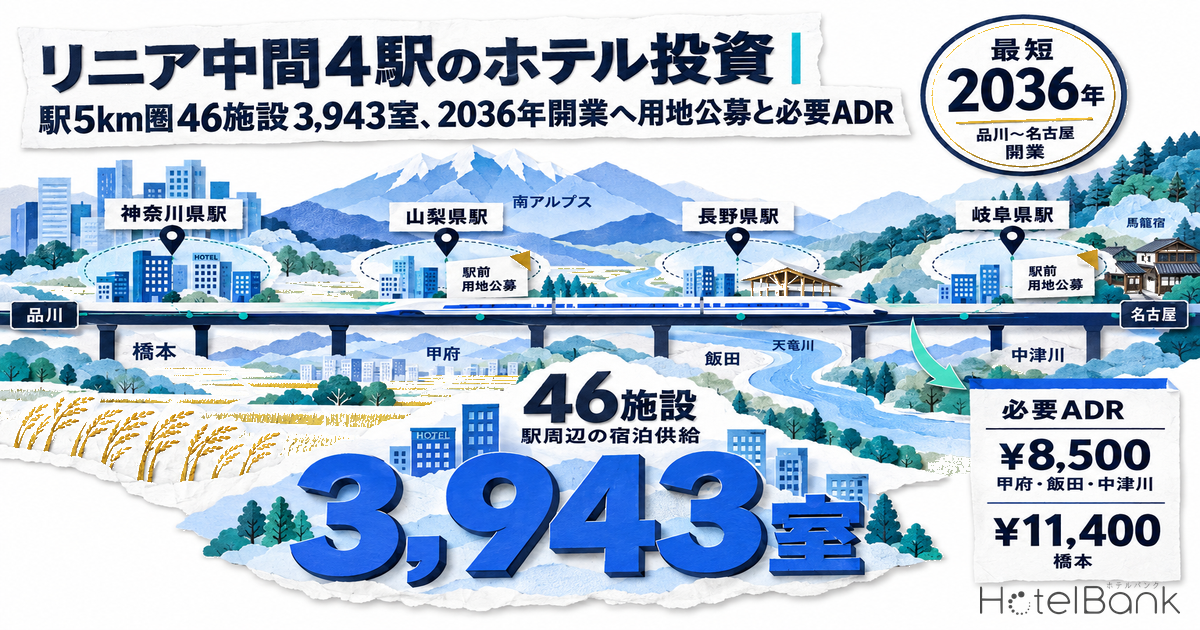
The Shinagawa-Nagoya section of the Linear Chuo Shinkansen (Japan’s maglev line) will have four intermediate stations, in Kanagawa, Yamanashi, Nagano and Gifu prefectures (all names provisional). Three of the four, Hashimoto excepted, are being built on new ground away from existing town centres, and the land around them will reach the market through processes in which a public body releases it: station-plaza construction, land readjustment projects, and solicitations for public-private partnership zones. This report sets out, for each of the four stations, the employment and resident population nearby, the existing accommodation supply and estimated settled ADR, and the timing at which land becomes available to the private sector. It then models a 100-room limited-service hotel in front of each station to estimate how a difference in opening date feeds through to the ADR the project has to achieve.
Scope of this report: Nagoya, the terminus, was covered in our earlier report Nagoya Pipeline 2026-2033, so this report takes up only the four intermediate stations: Kanagawa (Hashimoto, Midori-ku, Sagamihara), Yamanashi (Otsu-machi, Kofu), Nagano (Kamisato-Iinuma, Iida) and Gifu (Sendanbayashi, Nakatsugawa). Unlike Hokkaido Shinkansen Slips to FY2038, which centred on existing station-front room stock and a shifted opening date, the focus here is a location type — a new station away from the built-up area — and the route by which a public body releases the land.
Metric Definitions Used in This Article
- ADR (average daily rate): an estimated settled rate (tax-exclusive equivalent) derived by applying a segment-specific adjustment coefficient to the lowest plan rate each property publishes on the major booking sites (two guests per room, per-room price, tax-inclusive). Cross-checked against property-level results disclosed by listed hotel REITs (91 properties, most recent three months), the median error is about 7%. These are estimates and differ from each property’s actual transacted prices and accounting figures. City-level ADR is the monthly median across the target properties, weighted by number of days across the twelve months from September 2025 to August 2026. ADR within a 5km radius of a station is the median of each property’s average over those same twelve months.
- Hurdle ADR: in the development scenarios in this report, the room rate (tax-exclusive equivalent) required to secure the target GOP yield on the assumed total project cost. The assumptions are set out in the modelling section below.
- Resident population: the total within a 3km radius of the station, from the Ministry of Land, Infrastructure, Transport and Tourism (MLIT) National Land Numerical Information (projected population by 250m mesh). This counts residents, not the daytime or transient population.
- Number of workers: employees within a 5km radius of the station, from the Economic Census for Business Activity (2021), Ministry of Internal Affairs and Communications and Ministry of Economy, Trade and Industry.
- Data source: MetroEngines Research & Consulting (based on major booking site listings). Station positions are based on each station’s publicly announced location.
The conclusions first. One, the median estimated settled ADR within 5km of the four stations falls in a ¥6,800-7,800 band: however different the character of each location, the price level sits where a regional city dominated by business hotels sits. Two, building a 100-room limited-service hotel at the station requires an ADR 1.1-1.5 times the local level even at 2025 construction costs, and that gap is the headroom the maglev opening has to close. Three, pushing the opening back by three years raises the hurdle ADR by roughly ¥1,700-1,900, and most of that comes from construction cost inflation. In Kofu, Iida and Nakatsugawa, where land is cheap, holding the site two years longer costs under ¥10 per room in ADR terms. Deciding which fiscal year to break ground matters far more to project viability than securing the land.
- — 46 properties, 3,943 rooms: accommodation supply within 5km of the four intermediate stations (major booking site listing basis). The median estimated settled ADR is ¥6,800-7,800 (Sep 2025 – Aug 2026), on a par with business hotels in regional cities.
- — 2036 at the earliest: the press-based outlook for the Shinagawa-Nagoya opening following approval to start work on the Shizuoka section (7 July 2026). JR Central intends to announce the opening date before year-end.
- — 1.1-1.5x the local market: hurdle ADR for a 100-room limited-service hotel at the station (2025 construction costs). ¥8,500 at Kofu, Iida and Nakatsugawa and ¥11,400 at Hashimoto, and that gap is the headroom the maglev opening has to close.
- — +¥1,700〜1,900: the increase in hurdle ADR if the opening moves back three years from 2036 to 2039. Under ¥200 of it comes from the difference in land-holding period; most comes from construction cost inflation.
- — March 2029: the scheduled completion of the Gifu station land readjustment project, the earliest of the four at which land comes to market. Yamanashi moves to soliciting study partners for its public-private partnership zone in FY2026.
Where the opening date stands – the Shizuoka section cleared to start, and an outlook of “2036 at the earliest”
On 7 July 2026 Shizuoka Governor Yasutomo Suzuki announced that he would allow construction to begin on the Shizuoka section of the Linear Chuo Shinkansen, and on 18 July the prefecture and JR Central concluded the natural-environment conservation agreement required for the main works. Press reports put the work inside Shizuoka at more than ten years, so even with a start before year-end the Shinagawa-Nagoya section would open in 2036 at the earliest (nippon.com, 16 July 2026). On 24 July, meeting transport minister Yasushi Kaneko, JR Central president Shunsuke Niwa said the company wanted to “indicate the opening date within the year” (Chunichi Shimbun, 24 July 2026). Until JR Central publishes a formal opening date, this report likewise treats it as “2036 at the earliest, on the current outlook”.
Work on the intermediate stations is already well defined. Ground was broken at the Yamanashi station on 11 March 2026, with completion scheduled for 10 December 2031. It will run 1,200m, up to 46m wide and 32m high, with a roof covering the whole of its two island platforms and four tracks (Nikkan Kensetsu Kogyo Shimbun). At the Gifu station, delays in land acquisition and a design change to the viaduct pushed the scheduled completion of works back by six years and nine months, from March 2025 to December 2031 (Chunichi Shimbun, 23 December 2024). JR Central reports that, as of the end of March 2026, about 90% of the Shinagawa-Nagoya route length was under contract and about 85% of the land had been acquired (JR Central, Linear Chuo Shinkansen). The station buildings should all take shape around 2031, then wait some five years for the line to open.
What generally happens when an opening slips — whether the cost of continuing to hold land or construction cost inflation weighs more — was examined across four stations on the Hokkaido Shinkansen in an earlier report. Rather than restate that argument in general terms, this report applies it to land prices and land-release timing at the four intermediate stations and puts numbers on it in the modelling below.
Location types of the 4 stations – jobs at Hashimoto, an expressway interchange at Kofu, a terrace at Iida, land readjustment at Nakatsugawa
The four are all “intermediate stations”, yet their locations are entirely different in character. The Kanagawa station is being built underground on the south side of Hashimoto station — served by the JR Yokohama and Sagami lines and the Keio Sagamihara line — on the former site of Aihara High School, which moved out in 2019. It is the only one of the four that connects to an existing terminal. The Yamanashi station sits in Otsu-machi in southern Kofu and does not connect to any conventional rail line. Instead it will be linked by a main avenue to the planned Kofu Chuo Smart Interchange (provisional name) to its north, making it the first case in Japan of a shinkansen or maglev station connecting directly to an intercity expressway interchange. The Nagano station will be an elevated station on the terrace on the west bank of the Tenryu River in Kamisato-Iinuma, Iida, about 1km from Motozenkoji station on the JR Iida line and about 3km from the central district around Iida station. The Gifu station is west of Mino-Sakamoto station on the JR Chuo main line, in Sendanbayashi, Nakatsugawa, where the city is developing about 21.6ha around the station through a land readjustment project.
| Station (provisional name) | Location | Station structure | Relation to existing transport | Location type | Method of station-area development |
|---|---|---|---|---|---|
| Kanagawa station | Hashimoto, Midori-ku, Sagamihara | Underground | Adjacent to Hashimoto station (JR Yokohama and Sagami lines, Keio Sagamihara line) | Connects to an existing terminal; employment centre | Land readjustment by UR (about 13.7ha) |
| Yamanashi station | Otsu-machi, Kofu | At grade (2 island platforms, 4 tracks, full roof) | Linked by a main avenue to Kofu Chuo Smart IC (provisional name) | Direct expressway interchange; wide-area gateway | Infrastructure works across about 24.5ha of the station area plus a public-private partnership zone |
| Nagano station | Kamisato-Iinuma, Iida | Elevated | About 1km from Motozenkoji station, JR Iida line | New hub on the terrace; starting point for wide-area touring | City-led station plaza (about 6.5ha, large timber roof) |
| Gifu station | Sendanbayashi, Nakatsugawa | Elevated | West of Mino-Sakamoto station, JR Chuo main line | New district created by land readjustment | City-led land readjustment (about 21.6ha) |
Source: compiled by MetroEngines Research & Consulting from published materials of JR Central, Sagamihara City, the Urban Renaissance Agency, Kofu City, Iida City and Nakatsugawa City
Jobs and residents around the stations – 168,000 jobs at Hashimoto; Iida and Nakatsugawa lose 10-20% by 2040
As a gauge of how deep hotel demand might be, Table 2 sets the number of workers within 5km of each station alongside the projected resident population within 3km. Workers are compared on a 5km radius, which takes in the commuting catchment, because the new stations sit away from the existing town centres.
| Station (provisional name) | Workers within 5km | Establishments within 5km | Residents within 3km, 2020 | 2025 | 2040 | 2040 change (vs 2020) | Aged share (2025) |
|---|---|---|---|---|---|---|---|
| Kanagawa station (Hashimoto) | 167,822 | 13,220 | 191,673 | 191,942 | 186,058 | -2.9% | 23.5% |
| Yamanashi station (Otsu-machi, Kofu) | 73,632 | 6,493 | 45,166 | 45,436 | 44,289 | -1.9% | 23.2% |
| Nagano station (Kamisato-Iinuma, Iida) | 35,593 | 4,532 | 34,817 | 33,439 | 29,019 | -16.7% | 33.0% |
| Gifu station (Sendanbayashi, Nakatsugawa) | 25,296 | 2,040 | 15,132 | 14,733 | 13,213 | -12.7% | 28.4% |
Source: compiled by MetroEngines Research & Consulting from the Economic Census for Business Activity (2021), Ministry of Internal Affairs and Communications and Ministry of Economy, Trade and Industry, and MLIT National Land Numerical Information (projected population by 250m mesh)
Hashimoto, with 167,822 workers within 5km, is far ahead of the other three. Its resident population within 3km also exceeds 190,000 and falls only 2.9% by 2040. A new station is being added on top of an existing depth of Greater Tokyo business and residential activity, which makes an accommodation offer built on business demand straightforward to assemble. Kofu has 73,632 workers within 5km and its 3km resident population is stable, down just 1.9% even by 2040. The surrounding area is one where roadside retail and business cluster around the Kofu-Showa and Kofu-Minami interchanges, so the use in front of the station will be decided by how that business demand is combined with wide-area arrivals off the expressway.
Iida and Nakatsugawa are different in character. Iida’s 3km resident population falls 16.7%, from 34,817 in 2020 to 29,019 in 2040, and its aged share, 33.0% as of 2025, is the highest of the four. Nakatsugawa is projected to fall 12.7%. Demand that relies on the local population will thin out, so accommodation demand depends on how many visitors from outside the area can be captured — tourists in southern Shinshu and the Tono region, corporate facilities along the maglev route. At the same time employment has a certain scale, 35,593 at Iida and 25,296 at Nakatsugawa, so even without a large business district at the station there is demand to be had from extended business stays, construction work and training.
How the resident population declines varies from place to place even around a single station. Figure 3 shows resident population by 250m mesh within 3km of the Nagano station site, where population density clearly differs between the built-up terrace on the Iida station side and the partly agricultural residential area around the station site. For anyone looking for hotel land outside the station plaza itself, plots along the arterial roads a little away from the existing residential area are the realistic candidates.
Estimated settled ADR and existing rooms in nearby cities – around ¥7,000 at all four, ¥14,300 in the hot-spring town of Fuefuki
Looking at estimated settled ADR in the cities around the stations, Kofu is at ¥7,800 (N=35-38 properties), Iida ¥8,000 (N=19-23), Ena ¥8,100 (N=12-14) and Hachioji ¥8,200 (N=12-13): the cities around the intermediate stations cluster near ¥8,000 (Figure 4). Nakatsugawa’s ¥10,900 (N=9-12) runs high because it includes tourist lodgings such as the ryokan of Magome-juku, and it swings widely by month, from ¥7,500 to ¥15,400. Fuefuki, about 8km north-east of the Yamanashi station, is at ¥14,300 (N=47-52) on the strength of Isawa Onsen — a market at nearly double the price sitting inside the same Kofu basin.
Within a 5km radius of each station, accommodation across the four totals 46 properties and 3,943 rooms (major booking site listing basis, hotels and ryokan, excluding leisure hotels and the like), and the median estimated settled ADR falls in a ¥6,800-7,800 band (Table 3). All 11 properties and 1,530 rooms within 5km of Hashimoto are business hotels, the deepest room stock of the four. APA Hotel Sagamihara Hashimoto-Eki Higashi (117 rooms, a rebrand of an existing hotel) was added in September 2025 and KOKO STAY Sagamihara (130 rooms) in December, so supply is already moving ahead of the opening. Within 5km of Kofu, Kai no Hotel (150 rooms) opened in June 2024 and HOTEL R9 The Yard Yamanashi Chuo (42 rooms) that August. Within 5km of Nakatsugawa, AB Hotel Nakatsugawa (121 rooms) opened in November 2024 and Super Hotel Gifu Nakatsugawa Onsen (142 rooms) in December 2025, adding new rooms around the Nakatsugawa interchange on the Chuo Expressway and near the station site. Iida, at 13 properties and 603 rooms, is the smallest of the four, with its properties concentrated in the existing town centre around Iida station.
| Station (provisional name) | Properties | Rooms | of which business hotels | of which ryokan | Median estimated settled ADR | N (properties used for ADR) |
|---|---|---|---|---|---|---|
| Kanagawa station (Hashimoto) | 11 | 1,530 | 11 properties, 1,530 rooms | — | ¥7,400 | N=10 |
| Yamanashi station (Otsu-machi, Kofu) | 13 | 1,041 | 11 properties, 987 rooms | 2 properties, 54 rooms | ¥7,400 | N=13 |
| Nagano station (Kamisato-Iinuma, Iida) | 13 | 603 | 7 properties, 352 rooms | 4 properties, 93 rooms | ¥6,800 | N=13 |
| Gifu station (Sendanbayashi, Nakatsugawa) | 9 | 769 | 6 properties, 614 rooms | 3 properties, 155 rooms | ¥7,800 | N=9 |
Source: MetroEngines Research & Consulting (major booking site listing basis). Hotels and ryokan are counted; leisure hotels, campsites and whole-house rentals of the private-lodging type are excluded. The 5km radius at Nakatsugawa extends into Ena. Opening dates are based on confirmed booking site listings.
Land prices, too, differ sharply by station. In the 2026 official land price survey, commercial land at 3-chome Hashimoto, close to the Kanagawa station, was ¥715,000 per square metre (+9.8% year on year), up by roughly a tenth.By contrast, industrial land at Otsu-machi about 0.7km from the Yamanashi station was ¥22,600 (+3.7%), commercial land at Kamisato-Kuroda about 1.6km from the Nagano station ¥37,300 (flat), and residential land at Sendanbayashi about 0.5km from the Gifu station ¥30,600 (+1.0%). The gap between Hashimoto and the three regional stations reaches roughly twentyfold, and that gap shows up in the modelling below as the weight of land cost.
| Station (provisional name) | Point | Use | Distance from station | Price (JPY/sqm) | Year on year |
|---|---|---|---|---|---|
| Kanagawa station | 3-chome Hashimoto, Midori-ku, Sagamihara | Commercial | About 0.4km | 715,000 | +9.8% |
| Yamanashi station | Otsu-machi, Kofu | Industrial | About 0.7km | 22,600 | +3.7% |
| Yamanashi station | Higashi-Shimojo-machi, Kofu | Commercial | About 1.2km | 41,500 | 0.0% |
| Nagano station | Kamisato-Iinuma, Iida | Residential | About 0.8km | 29,300 | 0.0% |
| Nagano station | Kamisato-Kuroda, Iida | Commercial | About 1.6km | 37,300 | 0.0% |
| Gifu station | Sendanbayashi, Nakatsugawa | Residential | About 0.5km | 30,600 | +1.0% |
Source: compiled by MetroEngines Research & Consulting from the MLIT Real Estate Information Library (official land price survey). Distances are straight-line from each station’s published position.
On the building-plan side, the accommodation projects we record from MLIT’s Building Dynamics Statistics Survey comprise 54 rooms in Fujiyoshida (Yamanashi), 159 rooms in Otari (Nagano), 120 rooms in Minokamo (Gifu) and five projects in Yokohama and Hakone (Kanagawa); none falls near the four intermediate stations. That is a statement about the scope of our records, not evidence that no projects exist. Building confirmation applications are normally filed one to two years before opening, so a station-front accommodation project aiming to open around 2036 would appear in the filings in the early 2030s at the earliest.
How the land comes to market – reserve land, partnership zones, station plazas, and when the private sector gets access
Land in front of the four intermediate stations is organised through projects led by public bodies before any private-to-private sale. For developers and operating companies the points of entry are reserve land and replotted land from land readjustment, partner solicitations for public-private partnership zones, and the introduction of private capital around the station plazas — each announced on a different timetable (Table 5, Figure 5).
| Station (provisional name) | Project, implementing body, scale | Period and process | Treatment of accommodation use (published materials) | Private-sector entry point and timing |
|---|---|---|---|---|
| Kanagawa station | Hashimoto Station South District land readjustment project (implemented by the Urban Renaissance Agency, about 13.7ha, project cost about ¥29.0bn) | Project plan approved 25 September 2025; runs to FY2035 including the settlement period | Sagamihara City’s maglev station-area development guideline lists accommodation among the urban functions to be clustered | Development on blocks after replotting. Timing of land disposal is not stated in published materials |
| Yamanashi station | Station area of about 24.5ha (Kofu City, infrastructure works costed at about ¥4.0bn). Seven projects including the smart interchange, transport plaza, park-and-ride car park and public-private partnership zone | Infrastructure policy adopted February 2025. Concept book and study-partner solicitation in FY2026; master plan, zoning decision and project approval from FY2027; infrastructure works complete from FY2034 | The partnership zone is positioned as the core of a district where “industry, daily life and tourism converge”. Specific wording on accommodation is expected to be settled in the forthcoming concept book | Study-partner solicitation for the partnership zone (FY2026 onward), then operator selection |
| Nagano station | Maglev station plaza (Iida City, about 6.5ha, large timber roof) and an exchange facility | Detailed design of the exchange facility in FY2026, construction in FY2027, in service in FY2028. The station plaza partially opens in FY2028 | The station plaza centres on public space and the exchange facility. The arrangement of functions is being studied including the area around the plaza | Development on private land around the station plaza; the entity that manages and operates the plaza |
| Gifu station | Maglev Gifu Station Area land readjustment project (implemented by Nakatsugawa City, about 21.6ha, total project cost ¥9.15bn) | 17 October 2017 – 31 March 2029. Provisional replotting designated 22 December 2021 | The city’s development concept (July 2019) places “hotel (low-rise)” and “condominiums, hotels and the like” within the area. Municipal land acquired in advance and consolidated private plots (strip replotting) are designated as development land | Sale of reserve land (none on sale as of 2 February 2026 while works are under way; sales will be announced on the city website) |
Source: compiled by MetroEngines Research & Consulting from published materials of the Urban Renaissance Agency, Sagamihara City, Kofu City, Nikkei BP’s “New Public-Private Partnership Frontline”, Iida City, Chunichi Shimbun and Nakatsugawa City
Set out on a timeline, the order in which land reaches the private sector becomes visible. Earliest is the Gifu station, where land readjustment is due to complete in March 2029, more than two years ahead of the station’s own scheduled completion (December 2031). Once reserve land goes on sale, it may be possible to secure a site before the line opens, together with the “development land” assembled from municipal holdings and strip replotting. At the Yamanashi station, the concept book will be finalised during FY2026 and the solicitation of study partners follows. Kofu City has selected Mori Building as preferred negotiator for work supporting development using a 3D city model and VR of the station area (Kofu City), and forums for discussion among multiple operators and the local community are taking shape. For anyone intending to join the partnership zone, coming in at the study-partner stage in FY2026-2027 is the shortest route to getting accommodation use written into the plan.
At the Kanagawa station, land readjustment is a long project running to FY2035, and development on the replotted blocks is likely to be mixed-use, combining retail, offices and housing. Public comments on the guideline included calls to secure accommodation capacity and to attract a hotel above business-hotel class, and the city lists accommodation, alongside offices, retail and tourism facilities, among the urban functions to be clustered. At the Nagano station, the plaza itself is being built as public space, so accommodation use has to be assembled on private land around it. Part of the plaza and the exchange facility come into use first, in FY2028, which leaves room to test a small accommodation offer alongside the facility’s operation.
Development scenario modelling – a 3-year delay raises the hurdle ADR by about ¥1,700-1,900, most of it construction cost
Here we work backwards to the ADR required to secure a target yield, assuming a 100-room limited-service hotel in front of each station. Two scenarios are compared: A, securing the site in 2031 and opening in 2036, and B, securing the site in 2036 and opening in 2039. A holds the land for five years, B for three. B holds land for less time but shifts construction three years later.
Modelling assumptions
- 100 rooms, gross floor area 2,800sqm (28sqm per room, about 847 tsubo), site 1,000sqm.
- Construction unit cost ¥2.0m per tsubo (2025 prices), giving a construction cost of ¥1.69bn (¥16.94m per room). Set as the lower bound of the limited-service budget band with reference to planned works costs in MLIT’s Building Starts Statistics.A further 15% of construction cost is added for design, FF&E and pre-opening expenses.
- Land cost is the price at the nearest 2026 official land price survey point x 1,000sqm (Hashimoto ¥715,000/sqm, Kofu ¥41,500/sqm, Iida ¥37,300/sqm, Nakatsugawa ¥30,600/sqm). No future land price appreciation is assumed.
- Holding cost is 2.5% a year (simple interest). Land is carried from acquisition to opening; construction cost is carried for one year, as the average balance over a two-year build.
- Construction cost inflation is +5.3% in 2026, +5.0% in 2027 and +4.5% from 2028 (extending the Turner & Townsend forecast at the same rate beyond 2028), compounded to the midpoint of the build (A = 2035, B = 2038). A sensitivity case at 2.0% a year from 2028 is also shown.
- Occupancy 75% (assumed full-year average after opening), GOP margin 50%, rooms share of revenue 90% (rooms revenue as a share of total revenue), target GOP yield on total project cost 6.5%. Hurdle ADR is calculated as total project cost x 6.5% / GOP margin 50% x rooms share 90% / rooms sold a year (100 rooms x 365 days x 75%). The GOP margin is taken between the 38.9% actual for Invincible Investment Corporation’s 91 MHM-operated hotels (FY ended December 2024) and the 50-60% industry rule of thumb for limited-service hotels.
| Item | Kanagawa station (Hashimoto) | Yamanashi station (Kofu) | Nagano station (Iida) | Gifu station (Nakatsugawa) |
|---|---|---|---|---|
| Land cost (site 1,000sqm, 2026 official land price) | ¥720m | ¥40m | ¥40m | ¥30m |
| Total project cost (2025 prices) | ¥2.66bn | ¥1.99bn | ¥1.99bn | ¥1.98bn |
| Hurdle ADR (2025 prices) | ¥11,400 | ¥8,500 | ¥8,500 | ¥8,500 |
| A: site secured 2031, opens 2036 – total project cost | ¥3.94bn | ¥3.19bn | ¥3.18bn | ¥3.17bn |
| A hurdle ADR | ¥16,900 | ¥13,600 | ¥13,600 | ¥13,600 |
| B: site secured 2036, opens 2039 – total project cost | ¥4.35bn | ¥3.63bn | ¥3.62bn | ¥3.62bn |
| B hurdle ADR | ¥18,600 | ¥15,500 | ¥15,500 | ¥15,500 |
| Sensitivity: construction cost inflation 2.0% a year from 2028, A / B | ¥14,500 / ¥15,000 | ¥11,300 / ¥11,900 | ¥11,200 / ¥11,900 | ¥11,200 / ¥11,900 |
| Median estimated settled ADR within 5km (reference) | ¥7,400 | ¥7,400 | ¥6,800 | ¥7,800 |
| Hurdle ADR / local median (2025 prices / A / B) | 1.5x / 2.3x / 2.5x | 1.1x / 1.8x / 2.1x | 1.3x / 2.0x / 2.3x | 1.1x / 1.7x / 2.0x |
Source: MetroEngines Research & Consulting modelling. Construction unit cost from MLIT’s Building Starts Statistics, construction cost inflation from Turner & Townsend, land prices from the MLIT official land price survey, GOP margin from Invincible Investment Corporation disclosures. This is simplified modelling; an actual investment decision requires a detailed feasibility study.
Three things come out of the modelling. First, even at unchanged 2025 construction costs the hurdle ADR is ¥8,500 at Kofu, Iida and Nakatsugawa and ¥11,400 at Hashimoto, 1.1-1.5 times the median within 5km. A total project cost supportable at the local estimated settled ADR of ¥8,000 works out at about ¥18.7m per room, still short of the 2025-price total project cost at the three regional stations (about ¥19.8m-19.9m per room). Closing that gap, through the rate uplift the maglev opening brings and through choices of format and scale, is the starting point for accommodation development at the intermediate stations.
Second, the difference between A and B is decided almost entirely by construction cost. B’s hurdle ADR is ¥1,700-1,900 higher than A’s. The difference from the land-holding period (A is two years longer) is under ¥10 at Kofu, Iida and Nakatsugawa and only ¥150 at Hashimoto. Even in the sensitivity case holding construction cost inflation to 2.0% a year from 2028, a gap of ¥520-670 remains. At the low-land-cost regional stations, the burden of securing a site early is small, and fixing the construction start date early is what tells on project viability.
Third, Hashimoto alone carries a heavy land cost. Land for a 1,000sqm site costs ¥720m, about 27% of the ¥2.66bn total project cost at 2025 prices. At the three regional stations it is around 2%. At Hashimoto, the main levers for bringing the hurdle ADR down are designs that lighten land cost: how the land is released through replotting, building the hotel into a mixed-use block to limit the land share, and the use of fixed-term leasehold.
Note that scenario A’s 2036 opening is set to the earliest maglev outlook; if the opening slips, building A would be trading on existing business and tourism demand before the line opens. The build period is set at two years with reference to our own measurement of start-to-completion across 67 projects (an average of 1.96 years for standalone accommodation and 4.00 years for mixed-use development) (measured hotel build times). The approach of working back from interest rates to a break-even ADR is covered in policy rate 1.00% and hotel development, and the effect of construction cost inflation on supply in the 2027-2029 hotel opening map.
Conclusion – the format that works divides by station into business, tourism-gateway and wide-area touring
Kanagawa station (Hashimoto) – business
It has depth: 167,822 workers within 5km and 1,530 business hotel rooms, with the resident population falling only 2.9% by 2040. Land prices are up about a tenth in a year, and land accounts for about 30% of the hurdle ADR. Placing the accommodation function inside a mixed-use block combined with retail and offices, on a replotted block from the land readjustment, is the form most likely to work. There is room for a class above business hotels, as the comments on the guideline also suggested.
Yamanashi station (Kofu) – tourism gateway
Directly connected to the smart interchange, it will be the only station people reach from both the maglev and the expressway. The median within 5km is ¥7,400, but Fuefuki, some 8km away, is at ¥14,300, so capturing tourism demand opens up a price band one step higher. Joining the partnership zone from the FY2026 study-partner solicitation, and writing accommodation use in at the concept stage, is the entry point to the investment opportunity.
Nagano station (Iida) – wide-area touring
The resident population within 3km is projected to fall 16.7% by 2040, so demand will centre on tourists touring southern Shinshu and on business and extended stays from outside the area. Existing rooms within 5km total 603, the fewest of the four, leaving ample room for new rooms. Because part of the station plaza and the exchange facility come into use first in FY2028, a staged start from a small accommodation offer on private land nearby suits the site.
Gifu station (Nakatsugawa) – wide-area touring and tourism gateway
Land readjustment completes in March 2029, and the city’s concept envisages a low-rise hotel within the area. It is a starting point for tourism towards Magome-juku and Enakyo, and Nakatsugawa’s estimated settled ADR, including tourist areas, is ¥10,900. New rooms are already being supplied around the Chuo Expressway interchanges. Once reserve land sales are announced, a site can be secured before the station is completed (December 2031), making this the earliest of the four to move on.
What the four stations have in common is that land emerges in stages through projects led by public bodies, on timetables that range from 2029 to FY2035 depending on the station. What weighs most on project viability, though, is construction cost inflation. Rather than waiting for the line to open, responding early to solicitations and reserve land sales to fix the construction start date — then trading the first few years after opening on existing business and tourism demand as the maglev opening arrives — makes the economics easier to assemble under an outlook of 2036 or later. The opening date JR Central plans to indicate within the year, Kofu City’s concept book and Nakatsugawa City’s reserve land announcement are the next three milestones to watch.
Note:The opening date of the Linear Chuo Shinkansen has not been formally published by JR Central, so it is given here on a press-based outlook (2036 at the earliest). The development scenarios are simplified modelling combining published data with general industry rules of thumb; results vary widely with the specific site conditions, floor area ratio, subsidy schemes and borrowing terms. Building plan data is on a building confirmation application basis as of the survey date; project and room counts are expected to rise as further applications are filed, so it should be read as a lower bound on the pipeline confirmed at this point.
Related Articles
- Nagoya Pipeline 2026-2033: Conrad, Andaz & ¥32,628/¥34,115 ADR Flattening
- Hokkaido Shinkansen Slips to FY2038: 8-Year Delay Costs ¥1.37bn
- Hotel Build Times: 2.80-Year Median, 1.96 Solo vs 4.00 Mixed-Use
- Policy Rate 1.00%: Break-Even ADR Across Japan’s 8 Hotel Markets
- Construction +41% & Labor Crunch Erase Japan’s 2027-2029 Hotel Supply
- Dual-Growth Hotel Site Screening: 18 Japan Nodes With Rising Residents & Jobs
- Naniwasuji & Haneda Access Lines 2031: Hotel Investment Timelines
- Gifu’s Hotel Market in 4 Tiers 2026: ADR from ¥6,200 to ¥16,500
References and Sources
– Data sources
Estimated settled ADR, accommodation locations and room counts, and building plans are from MetroEngines Research & Consulting (major booking site listing basis; N=46 properties within 5km of the stations, N=9-52 properties at city level, Sep 2025 – Aug 2026). Worker counts are from the Economic Census for Business Activity (2021), Ministry of Internal Affairs and Communications and Ministry of Economy, Trade and Industry (within 5km of the stations); resident population from MLIT National Land Numerical Information, projected population by 250m mesh (within 3km of the stations); land prices from the 2026 official land price survey. Station-area development schedules are from published materials of JR Central, the Urban Renaissance Agency, Sagamihara City, Kofu City, Iida City and Nakatsugawa City.
– Modelling assumptions
A 100-room limited-service hotel, gross floor area 2,800sqm, site 1,000sqm. Construction unit cost ¥2.0m per tsubo (2025 prices) plus 15% for design, FF&E and pre-opening expenses. Land cost is the price at the nearest 2026 official land price survey point x 1,000sqm, with no future land price appreciation assumed. Holding cost 2.5% a year (simple interest). Construction cost inflation +5.3% in 2026, +5.0% in 2027 and +4.5% from 2028 (sensitivity case +2.0% from 2028), compounded to the midpoint of the build (A = 2035, B = 2038). Occupancy 75% (assumed full-year average), GOP margin 50%, rooms share of revenue 90%, target GOP yield 6.5%. Hurdle ADR = total project cost x 6.5% / GOP margin x rooms share / (100 rooms x 365 days x 75%).
– Limitations and caveats
Because JR Central has not formally published the maglev opening date, it is treated here on a press-based outlook (2036 at the earliest). Estimated settled ADR is an estimate derived from published plan prices and differs from each property’s actual transacted prices and accounting figures. Employment and residents at the stations are radius aggregates centred on each station’s published position, and the values change with how that position is set. The development scenarios are simplified modelling combining published data with industry rules of thumb; results vary widely with the specific site conditions, floor area ratio, subsidy schemes, borrowing terms and operating structure. Building plans are an aggregate of what we record and are not evidence that no projects exist.
– Market data
- MetroEngines Research & Consulting – estimated settled ADR (by city and within 5km of the stations, major booking site listing basis), accommodation locations and room counts, building plan data
– Government statistics and public data
- MLIT National Land Numerical Information (projected population by 250m mesh)
- Economic Census for Business Activity (2021), Ministry of Internal Affairs and Communications and Ministry of Economy, Trade and Industry
- MLIT Real Estate Information Library (official land price survey, 2025 and 2026)
- MLIT Building Starts Statistics, MLIT Building Dynamics Statistics Survey
– Published materials of operators and municipalities
- JR Central, “Linear Chuo Shinkansen” (construction progress, as of end-March 2026)
- Urban Renaissance Agency, “Hashimoto Station South District”
- Sagamihara City, “Hashimoto Station South Town Development Guideline”/Public comment results on the draft guideline
- Yamanashi Prefecture, Maglev Station Area Development Division/Kofu City, “Town development in front of and around the Yamanashi maglev station”/Kofu City, “Development support services using VR in the Yamanashi maglev station front area” – open proposal review results
- Iida City, “Maglev Station Area Development Master Plan”/Iida City, “FY2026 Maglev Promotion Roadmap”
- Nakatsugawa City, “Outline of the Maglev Gifu Station Area land readjustment project”/Nakatsugawa City, “Town development concept using the maglev” (July 2019)
- Invincible Investment Corporation, hotel portfolio (GOP results for MHM-operated hotels)
– News and press
- nippon.com (16 July 2026), approval to start the Shizuoka section and the opening outlook
- Nihon Keizai Shimbun, “Maglev moves to full-route construction as Shizuoka governor assents; Shinagawa-Nagoya to open 2036 or later”
- Chunichi Shimbun (24 July 2026), “JR Central president Niwa on the maglev opening date: ‘I want to indicate it within the year’, at a meeting with transport minister Kaneko”
- Nikkan Kensetsu Kogyo Shimbun, groundbreaking at the Yamanashi maglev station
- Chunichi Shimbun (23 December 2024), completion of the Gifu maglev station works delayed by six years and nine months
- Chunichi Shimbun (15 December 2025), an exchange facility at the Nagano maglev station plaza
- Nikkei BP, New Public-Private Partnership Frontline (24 March 2025), Kofu City’s maglev station front area development policy
- Town News, Sagamihara Midori-ku edition (16 October 2025), approval of the Hashimoto Station South land readjustment project
- MLIT, new project adoption appraisal (Kofu Chuo Smart IC access)