

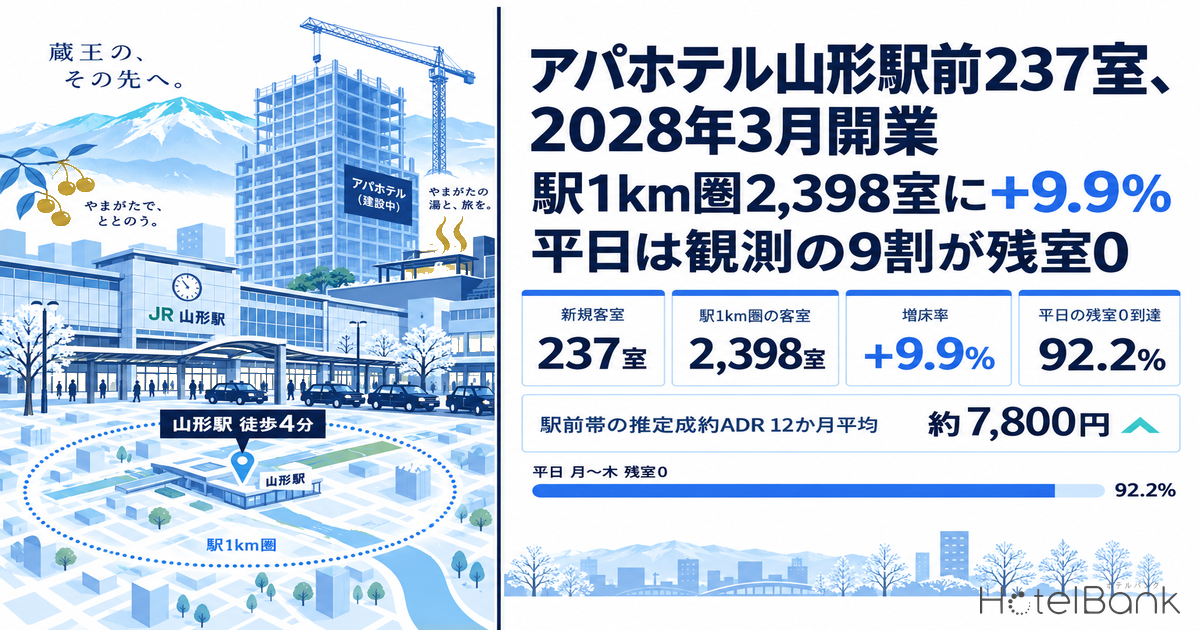
On September 17, 2026, TKP Corporation held a groundbreaking ceremony in Saiwaicho, Yamagata City, for the “APA Hotel Yamagata-Ekimae (tentative name)”. Four minutes’ walk from the East Exit of JR Yamagata Station, the steel-frame, 14-storey building will have 237 rooms; construction starts in October 2026 and opening is scheduled for March 2028. According to MetroEngines Research, the area within 1km of Yamagata Station holds 25 properties and 2,398 rooms, almost unchanged from 24 properties and 2,387 rooms in 2019. The 237 rooms add +9.9% to this area’s stock. This article overlays the estimated settled ADR of the station-front business segment, how quickly weekdays sell out, and the estimated OCC of the prefecture’s business hotels to quantify the depth of the market the new 237 rooms will enter.
Metric Definitions Used in This Article
- ADR (average daily rate): an estimated settled rate (tax-exclusive equivalent), calculated by applying a segment-specific correction factor to the lowest plan price each property publishes on OTAs (per room, 2 guests, tax-inclusive). Checked against property-level results disclosed by listed hotel REITs (91 properties, most recent 3 months), the median error is about 7%. It is an estimate and differs from each property’s actual settled prices and accounting figures. Area-level ADR is the median of the target properties (the level of a typical property in the area).
- OCC (occupancy): rooms sold as a share of total rooms in the area (an estimate based on OTA sales inventory). It covers a fixed group of properties that list at least 30% of their rooms on the major booking sites; because unlisted rooms are counted as sold, it reads higher than actual room occupancy.
- LT (lead time): days until the stay date. LT0 = the stay date itself. Early sell-out LT = the lead time at which the remaining inventory on the major booking sites first reached zero (the larger the value, the earlier it sold out). Anything beyond 45 days is shown only as “45+ days out”.
- 1km station radius: a 1km radius around Yamagata Station (38.2485°N, 140.3275°E). The room-stock time series counts properties open and not yet closed at each year-end; the price and sell-out analysis covers properties with observed selling prices in the most recent 3 months.
- Data source: MetroEngines Research
- Rooms within 1km of Yamagata Station have been almost flat, from 2,387 in 2019 to 2,398 in 2026. The 237 new rooms are the first sizeable addition since 2021.
- The median estimated settled ADR of 19 station-front hotels averages about ¥7,800 over 12 months. Its seasonal shape differs from Yamagata City as a whole (about ¥12,200, including Zao Onsen): even January–February stays around ¥9,300, making it a year-round business market.
- Over five weeks of weekdays (Mon–Thu) in May–September 2026, 188 of 204 property-nights (92.2%) at 11 station-front properties reached zero availability. 151 of those sold out within 7 days of the stay date, pointing to deep, last-minute business demand.
- For 237 rooms to hold occupancy, about 77,000 additional room-nights a year are needed. TKP’s design, with an attached training wing, strengthens absorption by generating weekday corporate-training demand in-house.
237 rooms, 14 storeys: a new urban hotel with a training wing and natural hot-spring baths
According to TKP’s press materials (September 17, 2026), the site is at 6-6 Saiwaicho, Yamagata City, with a site area of 1,149.81 m² and a total floor area of 5,380.66 m². The 237 rooms comprise 66 doubles, 168 twins and 3 deluxe twins, some usable as connecting rooms. The building will house a restaurant, a large public bath, an open-air natural hot-spring bath and a sauna, and a training facility is also planned. The building is owned by NOB Holdings (Higashine City); TKP will sign a property lease and operate the hotel under a franchise agreement with APA Hotel.
The room mix stands out. Twins account for 168 rooms, more than 70% of the 237, so the design can capture two-guest use by families, groups and inbound travellers as well as single business travellers. The first announcement on August 18 described 198 rooms on 12 floors; by the September 17 groundbreaking the plan had been raised to 237 rooms and 14 floors. The Yamagata Shimbun reports that the open-air bath will use water carried in from hot-spring areas in the prefecture, and TKP President Takateru Kawano said he wants the hotel to be a “showroom for Yamagata”. According to APA Hotel’s announcement, it will be the group’s third hotel in the prefecture, after the operating APA Hotel Yamagata Tsuruoka-Ekimae (137 rooms) and the APA Hotel Yamagata Tsuruoka-Ekimae Nishi under construction (300 rooms, opening planned August 2027).
| Item | Details |
|---|---|
| Name | APA Hotel Yamagata-Ekimae (アパホテル〈山形駅前〉, tentative name) |
| Address / access | 6-6 Saiwaicho, Yamagata City / 4 min walk from JR Yamagata Station East Exit |
| Scale | Steel frame, 14 storeys above ground / site 1,149.81 m², total floor area 5,380.66 m² |
| Rooms | 237 rooms (66 doubles, 168 twins, 3 deluxe twins) |
| Facilities | Restaurant, large public bath, open-air natural hot-spring bath, sauna, training facility (planned) |
| Schedule | Construction start Oct 2026 / completion Feb 2028 / opening Mar 2028 (planned) |
| Business structure | Building owned by NOB Holdings; operated by TKP (franchise agreement with APA Hotel) |
Location: next to Kasumicho, the prefecture’s No. 2 commercial land price, up nine years in a row
The site is in Saiwaicho, adjoining Kasumicho at the station’s East Exit, at the eastern edge of the station-front hotel cluster. In Yamagata Prefecture’s 2026 Land Price Publication, the average change for commercial land in Yamagata City was +1.3% (previous year +1.4%), the ninth consecutive rise. The East Exit benchmark site “Kasumicho 3-1-6” was ¥220,000 per m² (previous year ¥218,000, +0.9%), second among the prefecture’s commercial sites after Nanokamachi at ¥223,000. With station-front land still appreciating steadily, this structure—a local company owns the land and building and the operator leases it—lets the operator concentrate its initial investment on rooms and operations.
| Kasumicho 3-1-6 (commercial) | ¥220,000/m² |
| Same, YoY | +0.9% |
| Yamagata City, average change for commercial land | +1.3% (9th consecutive rise) |
Supply: the 1km station radius has been nearly flat for 7 years; 237 rooms add +9.9%
Room stock within 1km of the station moved by just 11 rooms in seven years, from 24 properties and 2,387 rooms in 2019 to 25 properties and 2,398 rooms in 2026. It rose to 2,575 rooms in 2021 with a 200-room-class opening, fell back to 2,304 rooms by 2024 through closures and downsizing, and recovered to around 2,400 rooms in 2025–2026 with small and mid-sized openings. In other words, this is a mature market where openings and exits roughly cancel out. Within 3km, too, stock has stayed flat, from 2,856 rooms in 2019 to 2,893 in 2026.
Adding 237 rooms takes the 1km radius to 2,635 rooms (+9.9%) and the 3km radius to 3,130 rooms (+8.2%). A single property accounting for about a tenth of the area is the largest such addition since the 200-room-class opening in 2021. Elsewhere in the prefecture, APA Hotel Yamagata Tsuruoka-Ekimae Nishi (300 rooms) is also due to open in August 2027, so 2027–2028 brings a run of large station-front supply in Yamagata Prefecture.
In the Ministry of Land, Infrastructure, Transport and Tourism’s Building Construction Statistics, compiled on a building-confirmation-application basis, no construction plans for lodging facilities with 50 or more rooms were registered in Yamagata Prefecture as of September 2026. Applications are usually filed one to two years before opening, so the count may rise as more are added. For now, the 237 rooms are the main large station-front project in the visible pipeline.
Rates: Yamagata City’s ~¥12,200 is lifted by Zao’s winter; the station front is a year-round ~¥7,800
On MetroEngines Research’s estimated settled ADR, Yamagata City averaged about ¥12,200 over the last 12 months (September 2025–August 2026), up +10.4% from about ¥11,100 a year earlier. However, the city figure includes Zao Onsen. In 2026 it jumped to about ¥17,000 in January and about ¥18,500 in February during the snow-monster (juhyo) season, then fell to about ¥9,700 in both June and July. The citywide number has to be read as a blend of the station-front business market and a mountain resort.
We therefore narrowed the view to the 19 business and city hotels within 1km of the station and took the monthly median of each property’s estimated settled ADR. The 12-month average is about ¥7,800; in 2026 even the highest month, February, was about ¥9,300 and the lowest, March, about ¥7,000—a stable market whose swings are less than half those of the city as a whole. Year on year, the average for the same 16 properties (2,089 rooms) observed in every month of both periods rose +5.7%, from about ¥8,200 to about ¥8,700. There is no seasonal peak like Zao’s, but rates are rising steadily through the year. That is the character of the station-front market.
Set against nearby cities, the station front’s position becomes clearer. Tendo City (12-month average about ¥9,000) and Yonezawa City (about ¥9,500) are mixed business-and-leisure markets, while Kaminoyama City, home to Kaminoyama Onsen, is a hot-spring market at about ¥16,100. Yamagata’s station front at about ¥7,800 represents the standard level of the prefecture’s urban markets, whereas rates at the prefecture’s hot-spring areas such as Zao, Kaminoyama and Ginzan follow a different, resort-driven structure.
| Area | Estimated settled ADR (last-12-month average) | Prior year | YoY | Properties covered |
|---|---|---|---|---|
| Yamagata City (incl. Zao Onsen) | ¥12,236 | ¥11,079 | +10.4% | 56–62 |
| 1km of Yamagata Station (same 16 properties, average) | ¥8,716 | ¥8,248 | +5.7% | 16 |
| Kaminoyama City | ¥16,118 | ¥15,543 | +3.7% | 18 |
| Yonezawa City | ¥9,481 | ¥8,432 | +12.4% | 28–32 |
| Tendo City | ¥8,960 | ¥8,789 | +1.9% | 20–21 |
Positioning: 4 properties and 665 rooms at ¥10,000+, and three 200-room-class hotels
We plotted the 19 business and city hotels (2,247 rooms) within 1km of the station with observed selling prices in the most recent 3 months by room count and estimated settled ADR (12-month average). The under-¥7,000 band has 6 properties and 481 rooms, the ¥7,000–10,000 band 9 properties and 1,101 rooms, and the ¥10,000+ band 4 properties and 665 rooms, so nearly half the rooms sit in the middle band. The ¥10,000+ band is made up of 200-room-class properties close to the station and newer properties opened since 2020.
The 237 rooms will be among the largest in the area. With a large bath, open-air bath, sauna and restaurant, and twins making up 70% of the rooms, the specification can capture a different demand layer from the middle band, which centres on single occupancy, even within the same station front. The likely picture is a new entrant joining the band around ¥10,000—where three station-front properties exceed 200 rooms—with the different strengths of hot baths and a twin-led room mix.
| Price band (estimated settled ADR) | Properties | Rooms | Room share | Weekday nights reaching zero availability (property-nights) |
|---|---|---|---|---|
| Under ¥7,000 | 6 | 481 | 21.4% | 39/40 nights (97.5%) |
| ¥7,000–10,000 | 9 | 1,101 | 49.0% | 88/100 nights (88.0%) |
| ¥10,000+ | 4 | 665 | 29.6% | 61/64 nights (95.3%) |
Sell-out speed: 92.2% of 204 weekday property-nights hit zero availability, three in four within the final 7 days
The most direct measure of demand depth is how often, and when, remaining inventory on the major booking sites reaches zero. For five weekday (Mon–Thu) weeks starting May 25, June 15, July 13, August 24 and September 7, 2026, we tracked the 11 properties (1,217 rooms) within 1km of the station whose public allotment is at least 30% of total rooms. 188 of 204 property-nights (property × stay date), or 92.2%, reached zero availability: on weekdays the station front sells out almost all of its booking-site inventory.
What stands out is when it sells out. Of the 188 property-nights that reached zero, 151 (74.0% of the total) did so within 7 days of the stay date, while only 13 (6.4%) sold out 31 or more days ahead. This shows that demand is centred on business needs whose dates firm up at the last minute—business trips, training and construction work. Even in the ¥10,000+ band, 61 of 64 weekday nights reached zero availability, all within 7 days. The upper band also keeps attracting demand until the last minute and sells out in the end.
On weekends (Fri–Sat, 3 weeks, 42 property-nights), 38 (90.5%) reached zero availability, and the share selling out 31 or more days ahead rose to 26.2%. During the Yamagata Hanagasa Festival (August 5–7), all 24 property-nights reached zero availability; 11 sold out 31 or more days ahead and 6 were already sold out 45+ days out. A two-layer structure—last-minute weekday business demand overlaid with early-booking leisure demand on weekends and event days—underpins station-front inventory. How bookings built up over the Hanagasa period is examined, with days of the week aligned, in our Yamagata Hanagasa 2026 booking-curve analysis.
The estimated OCC of business hotels across the prefecture is consistent with this picture. For Yamagata Prefecture business hotels in June–August 2026 (21–22 properties / 1,766–1,798 rooms, based on major booking-site listings), it was 88.8% in June, 87.2% in July and 91.7% in August. By day of week, Mon–Thu was 89.2% in June, 89.3% in July and 93.9% in August—roughly level with, or above, Fri–Sat (93.5%, 88.3%, 92.6%). Weekdays filling as fully as weekends signals resilient business demand, a tailwind for a training-integrated hotel that relies on weekday occupancy.
The training wing: a design that creates weekday demand rather than chasing it
From an investment perspective, the most compelling element of the plan is TKP’s attached training facility. TKP’s core business is rental meeting rooms and residential training, and it can attract corporate training and seminar demand on its own. Training dates are fixed in advance and generate participants’ stays in blocks on weekdays. Where station-front weekdays are currently filled mainly by last-minute individual business travellers, the hotel itself can layer group, pre-committed weekday demand on top—that is its strength.
According to the Yamagata Shimbun, the training wing is expected to serve corporate training and workations. Combining weekday training demand with weekend leisure and inbound demand (as a gateway to Zao’s snow monsters, Yamadera and Ginzan Onsen) in one building adds a third layer to the station front’s two-layer structure seen above—“last-minute weekdays plus early-booking weekends and events”. The open-air natural hot-spring bath and sauna raise the value of a training stay and also give weekend tourists a reason to choose the hotel.
Absorption estimate: holding occupancy requires about 77,000 additional room-nights a year
We run a simple estimate of supply and demand once the 237 rooms are added. Treating the estimated OCC of Yamagata Prefecture business hotels (June–August average 89.2%) as the level for the 1km station radius, about 2,140 rooms are sold per night out of today’s 2,398. If demand stays the same, occupancy after growth to 2,635 rooms would thin to 81.2% (an estimate based on June–August 2026 estimated OCC). Holding 89.2% requires about 211 more rooms per night, or about 77,000 room-nights a year of new demand.
How can that be filled? First, the fact that weekdays reach zero availability on 92.2% of days means overflow demand on full nights already exists. Second, the pre-committed weekday demand generated by the training wing tends to grow the market’s total rather than poach existing hotels’ guests. Third, the twin-led rooms and hot-bath facilities suit two-guest leisure and inbound demand, unlike the existing stock centred on single occupancy. The more station-front demand grows, the wider the opportunity for existing properties to raise rates as well.
| Scenario | ADR assumption | OCC assumption | Room revenue (annual) | GOP (50% GOP margin) | GOP ÷ construction cost (2025 level) | Same (inflation-adjusted) |
|---|---|---|---|---|---|---|
| Conservative | ¥9,000 | 80% | ¥623M | ¥311M | 8.0% | 7.2% |
| Base Reference | ¥10,500 | 85% | ¥772M | ¥386M | 9.9% | 8.9% |
| Upside | ¥12,000 | 89% | ¥924M | ¥462M | 11.8% | 10.7% |
The ADR assumptions range from the top of the middle band within 1km of the station (about ¥9,000) to the median of the ¥10,000+ band (about ¥12,200). Construction cost multiplies the 2025 steel-frame unit cost of ¥2.405M per tsubo, based on MLIT’s Building Construction Statistics, by the total floor area of 5,380.66 m² (about 1,628 tsubo), giving about ¥3.91bn (about ¥16.5M per room). Factoring in construction-cost inflation up to the midpoint between start and completion (+5.3% in 2026 and +5.0% in 2027, Turner & Townsend forecasts) brings it to about ¥4.33bn (about ¥18.3M per room). A 50% GOP margin is this article’s assumption, and the sensitivity table also shows a 40% case. The actual project cost has not been disclosed, and because the land and building are owned separately with the operator leasing them, this yield is a gauge of the project’s overall earning power.
| Base-scenario sensitivity | Base | ADR −10% | OCC −5pt | Both | 40% GOP margin |
|---|---|---|---|---|---|
| Room revenue (annual) | ¥772M | ¥695M | ¥727M | ¥654M | ¥772M |
| GOP | ¥386M | ¥347M | ¥363M | ¥327M | ¥309M |
| GOP ÷ construction cost (inflation-adjusted) | 8.9% | 8.0% | 8.4% | 7.6% | 7.1% |
| ADR \ OCC | 70% | 75% | 80% | 85% | 89% |
|---|---|---|---|---|---|
| ¥9,000 | 6.3% | 6.7% | 7.2% | 7.6% | 8.0% |
| ¥9,750 | 6.8% | 7.3% | 7.8% | 8.3% | 8.7% |
| ¥10,500 | 7.3% | 7.9% | 8.4% | 8.9% | 9.3% |
| ¥11,250 | 7.9% | 8.4% | 9.0% | 9.6% | 10.0% |
| ¥12,000 | 8.4% | 9.0% | 9.6% | 10.2% | 10.7% |
Source: MetroEngines Research & Consulting estimates. 50% GOP margin (this article’s assumption); construction cost about ¥4.33bn as in the text; room revenue = 237 rooms × 365 days × ADR × OCC. The shaded cell is the base scenario (¥10,500, 85%).
Even in the combined case where ADR falls 10% and occupancy drops 5pt, GOP relative to construction cost stays in the 7% range. Rising construction costs also raise the hurdle for new supply, which carries an upside: further large supply at the station front is less likely to follow after opening. The lodging tax starting in April 2027 (3% of the accommodation charge) adds about ¥315 per night at the base-scenario ADR of ¥10,500, and the hotel can open into a market that has already absorbed it. For a comparison with other municipalities’ rates and effective dates, see also Japan Lodging Tax 2026: All 62 Municipalities.
Summary: 237 rooms that add new demand entry points—training and hot baths—to a mature station front
The 1km radius around Yamagata Station is a tight business market: room stock has barely grown in seven years, more than 90% of weekday inventory sells out up to the last minute, and estimated settled ADR is up +5.7% year on year. The 237 rooms of APA Hotel Yamagata-Ekimae (tentative name) add +9.9% to the area’s stock, but the hotel has three entry points for demand: pre-committed weekday demand from the training wing, two-guest leisure and inbound demand from its twin-led rooms, and stay value from its hot-bath facilities. It is designed to be absorbed by growing the market’s total rather than redistributing existing demand.
For existing properties, the roughly year and a half until opening is a preparation period. In a market with deep last-minute weekday demand, there is room to improve the practice of raising prices step by step as the stay date approaches. With the April 2027 lodging tax and the March 2028 opening in view, now is a good time to review price bands and room mix.
Frequently Asked Questions
Q. When will APA Hotel Yamagata-Ekimae (tentative name) open?
A. Construction starts in October 2026, with completion in February 2028 and opening scheduled for March 2028 (TKP announcement, September 17, 2026).
Q. How many rooms and what facilities?
A. 237 rooms (66 doubles, 168 twins, 3 deluxe twins), with a restaurant, a large public bath, an open-air natural hot-spring bath and a sauna; a training facility is also planned.
Q. How much will hotel room supply around Yamagata Station increase?
A. According to MetroEngines Research, the area within 1km of the station has 25 properties and 2,398 rooms (2026). Adding 237 rooms makes 2,635, an increase of +9.9%.
Related Articles
- North Tohoku’s 2,079 New Rooms: Which Segments Can Absorb the Supply
- Yamagata Hanagasa 2026: Demand Settled 45 Days Out, +9.6pt vs Normal
- Japan Lodging Tax 2026: All 62 Municipalities, Rates and ADR Burden
- 226k Hotel Rooms in 32 Regional Cities: 42.7% Built Before 1996
References and Sources
■ Data sources
Data from MetroEngines Research’s daily observation of public prices and inventory on the major booking sites (estimated settled ADR: Yamagata City N=56–65 properties, 1km station radius N=18–21 properties; remaining-inventory tracking: 11 properties within 1km of the station, 204 weekday property-nights; estimated OCC: 21–22 Yamagata Prefecture business hotels), combined with TKP and APA Hotel press materials, Yamagata Prefecture’s land price publication, Yamagata City’s lodging tax materials, and MLIT’s Building Construction Statistics.
■ Estimate assumptions
GOP margin 50% (this article’s assumption; 40% also shown in the sensitivity table). Room revenue = 237 rooms × 365 days × ADR × OCC. Construction cost: the 2025 steel-frame unit cost of ¥2.405M per tsubo × about 1,628 tsubo = about ¥3.91bn, inflated for 2026–2027 (+5.3%, +5.0%) to about ¥4.33bn. The absorption estimate treats Yamagata Prefecture business-hotel estimated OCC (June–August 2026 average 89.2%) as the level for the 1km station radius and assumes no openings or closures other than the 237 rooms.
■ Limitations and caveats
Estimated settled ADR and estimated OCC are estimates based on public OTA inventory and differ from actual settled prices and room occupancy (OCC reads high because unlisted rooms are counted as sold). Zero availability means the public allotment on booking sites sold out, not that the whole property was full. The absorption estimate applies three summer months’ OCC (June–August 2026) to the full year and does not reflect winter demand swings. Project cost and lease terms are undisclosed, so GOP ÷ construction cost is a gauge of earning power, not an investment yield.
■ Market data
- MetroEngines Research & Consulting — estimated settled ADR (Yamagata City and nearby cities; 19 properties within 1km of the station), room-stock time series (1km and 3km radius), remaining-inventory tracking on the major booking sites (Yamagata City, May–September 2026), estimated OCC (Yamagata Prefecture business hotels, 21–22 properties / 1,766–1,798 rooms)
■ Project announcements
- TKP Corporation, “Groundbreaking ceremony for APA Hotel Yamagata-Ekimae (tentative name)” (PR TIMES, September 17, 2026; in Japanese)
- TKP Corporation press materials (September 17, 2026, PDF; in Japanese)
- APA Hotel, Ltd., “APA Hotel Yamagata-Ekimae (tentative name) to open in March 2028” (PR TIMES, September 17, 2026; in Japanese)
- TKP Corporation, first hotel opening in Yamagata Prefecture (PR TIMES, August 18, 2026; in Japanese)
■ Government statistics and public data
- Yamagata Prefecture, “2026 Land Price Publication Results (Yamagata Prefecture)” (in Japanese)
- Yamagata City, “About the Lodging Tax” (in Japanese)
- Ministry of Land, Infrastructure, Transport and Tourism, “Building Construction Statistics” (in Japanese)
■ REIT and industry reports
■ News
- “A ‘showroom for Yamagata’: APA Hotel breaks ground at the station, with an open-air bath using prefectural hot-spring water and a training wing” (Yamagata Shimbun, September 17, 2026; in Japanese)
- “Internal affairs minister approves Yamagata City lodging tax, to start next spring” (YTS Yamagata Television; in Japanese)