

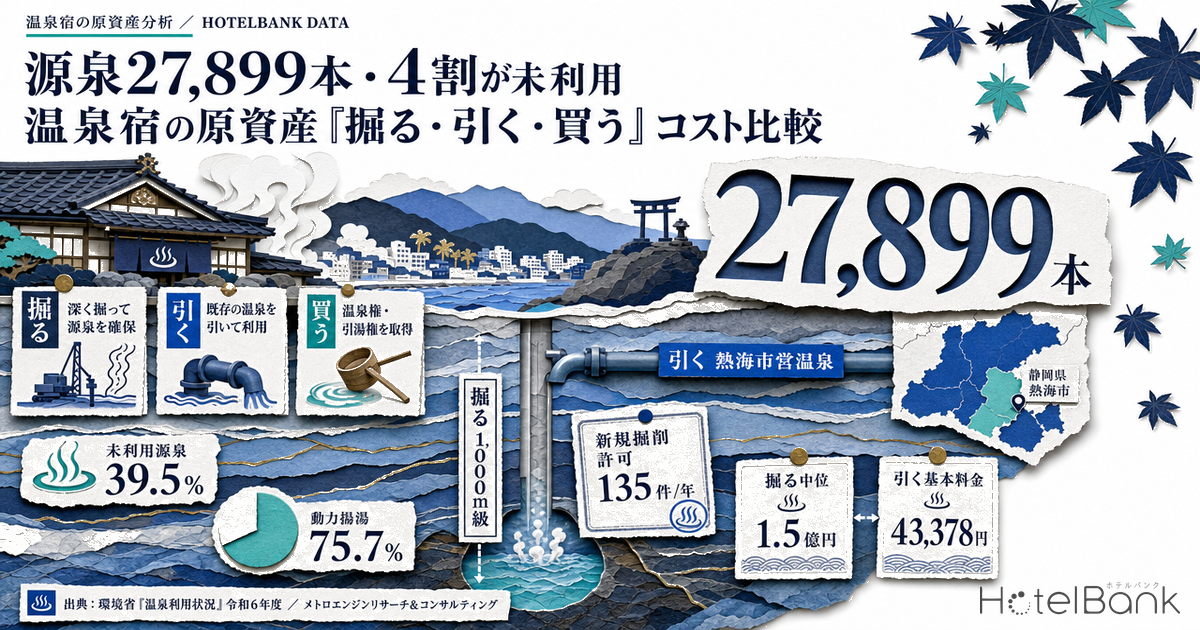
When you evaluate an onsen ryokan, everyone looks at the building, the room count and the location. Far fewer check where the property draws its hot water from, and under what right it does so. Yet hot spring water, unlike a building, is an asset that sometimes cannot be newly created. According to the latest release of the Ministry of the Environment’s Hot Spring Utilization Survey (FY2024, as of 31 March 2025), Japan has 27,899 hot spring sources and 2,839 hot spring resorts with lodging facilities. The headline count looks abundant — until you open up the breakdown.
This article breaks the Ministry’s published statistics down by prefecture, then lines up the three routes to securing hot spring water — drilling your own well, piping water from a centrally managed source, and buying a property together with its water rights — against published costs and the legal framework. It then overlays the distribution of properties whose guest reviews talk about gensen kakenagashi (free-flowing water straight from the source) with the estimated settled ADR of municipalities that host hot spring resorts, to see how far the depth of a region’s hot spring endowment actually feeds through to room rates.
Metric Definitions Used in This Article
- ADR (average daily rate): An estimated settled rate (tax-excluded equivalent) calculated by applying a segment-specific adjustment coefficient to the lowest published plan rate each property lists on OTAs (double occupancy, per-room rate, tax-included). Cross-checked against property-level results disclosed by listed hotel REITs (91 properties, most recent 3 months), the median error is roughly 7%. These are estimates and differ from each property’s actual transacted rates and accounting figures. Area-level ADR is the median of the properties covered (the level of a typical property in that area).
- Listed price: The average of all plans published on OTAs (room-only through half-board and above) on a per-room basis (double occupancy, tax-included). This is a separate metric from ADR.
- Hot spring source, resort and lodging counts: Published figures from the Ministry of the Environment’s Hot Spring Utilization Survey, FY2024 (as of 31 March 2025). The resort count covers locations that have lodging facilities.
- Data sources: Ministry of the Environment, Hot Spring Utilization Survey / National Tax Agency, Basic Property Valuation Circular / MetroEngines Research & Consulting
- — 39.5% of Japan’s 27,899 hot spring sources (11,032) sit unused. The total source count is holding up, but sources that actually well up on their own — free-flowing sources among those in use — have fallen from about 5,100 in the 1990s to 4,106 (Ministry of the Environment, Hot Spring Utilization Survey, FY2024).
- — 75.7% of sources in use are pumped, and 44.3% of temperature-classified sources are below 42°C. Pumping electricity and reheating fuel are the two variable costs that all but define an onsen property’s running cost structure.
- — New drilling runs to 141 applications and 135 permits a year nationwide. With distance restrictions in 20 prefectures and in-principle prohibition zones in 20, the regulatory wall means drilling is simply not on the menu in some locations.
- — Levelled over 20 years, drilling (mid case ¥150 million) costs ¥7.5 million a year; piping (Atami municipal supply, commercial class A base charge) costs ¥521,000. At 20 rooms that is ¥375,000 versus ¥26,000 per room per year — an order of magnitude apart.
- — A thick hot spring endowment does not explain room rates. Kagoshima, which has the most sources per lodging property (8.79), posts an estimated settled ADR of ¥6,871, while the thinnest, Kyoto (0.80), posts ¥16,808 — and the 47-prefecture distribution scatters the other way.
Source Counts Are Holding, but Free-Flowing Sources Are Shrinking
Start with the overall picture. The FY2024 national totals in the Ministry of the Environment’s Hot Spring Utilization Survey (as of 31 March 2025) show 27,899 hot spring sources, 2,839 hot spring resorts with lodging facilities, 13,425 lodging properties in those resorts, and 125.41 million guest nights for the year. Against FY2023, the source count is down 21 (99.9%) — essentially flat — and the resort count is down 18 (99.4%), while lodging properties are up 246 (101.9%) and guest nights up 4.70 million (103.9%). Demand, in other words, is recovering.
Inside that flat-looking source total, the composition is slowly turning over. Comparing FY1989 with FY2024, free-flowing sources in use fell 18.1%, from 5,012 to 4,106. Pumped sources in use, by contrast, rose 27.8%, from 9,983 to 12,762. The biggest move came in unused sources, up 63.1% from 6,763 to 11,032 — now 39.5% of all sources. On discharge volume the same story holds: of 2,477,713 L/min nationwide, only 663,493 L/min, or 26.8%, is free-flowing.
The number of sources is being maintained, then, but the sources that deliver water without help are steadily thinning out. That single fact is the starting point for thinking about an onsen property’s underlying asset.
Figure 1: Long-run trend in hot spring source composition and resort counts (as of each fiscal year-end, FY1989–FY2024) / Source: Ministry of the Environment, Hot Spring Utilization Survey; compiled by MetroEngines Research & Consulting
75.7% Pumped, 44.3% Below 42°C — the Two Ratios That Set an Onsen Property’s Running Costs
A source’s character breaks down along two axes. One is free-flowing versus pumped. The other is discharge temperature. In the FY2024 national totals, 12,762 of the 16,868 sources in use — 75.7% — are pumped. Pumping also means a permanent electricity bill for the lifting pump.
By temperature, of the 24,668 sources carrying a temperature classification in the Ministry’s published tables (88.4% of all sources; because the temperature columns do not reconcile with total source counts in some prefectures, the ratios below use temperature-classified sources as the denominator), 12,695 (51.5%) are 42°C or hotter, 6,863 (27.8%) are 25°C to under 42°C, 4,074 (16.5%) are under 25°C, and 1,036 (4.2%) are steam or gas. Sources below 42°C — short of a comfortable bathing temperature — total 10,937, or 44.3%. Properties drawing on that band carry a daily fuel bill for reheating.
These two ratios diverge sharply by prefecture. As the chart below shows, Oita has a high pumped share of 77.5% but only 14.8% of sources below 42°C, so its reheating burden is structurally light. Akita, at a 51.1% pumped share, is among the best endowed with free-flowing water nationwide, and only 33.7% of its sources fall below 42°C. At the other end, Hyogo runs 85.9% pumped and 82.6% below 42°C, and Yamanashi 63.7% and 80.1% — both pumping and reheating are a given.
Urban areas are more extreme still. Of Tokyo’s 168 sources, 96.4% of those in use are pumped, and 76.8% of the temperature-classified ones fall below 42°C. That is consistent with the fact that most of the “natural hot spring” baths in central Tokyo business hotels are drawn from great depth and reheated. Read the other way, sensitivity to fuel and electricity prices varies enormously from property to property. When you appraise a hot spring property, there is real practical value in looking past the mere presence of a source to these two ratios.
Figure 2: Pumped share and share of sources below 42°C by prefecture (FY2024, as of 31 March 2025 / prefectures where temperature classifications cover 90% or more of total sources) / Source: Ministry of the Environment, Hot Spring Utilization Survey; compiled by MetroEngines Research & Consulting
Drill — Only 141 New Drilling Applications a Year Nationwide
The first route to securing your own hot spring water is drilling. Article 3 of the Hot Spring Act provides that “any person who intends to excavate land for the purpose of causing hot spring water to well up must apply to and obtain the permission of the prefectural governor, in accordance with Ministry of the Environment ordinance.” Ministry materials explain the intent of the provision as follows: “because hot springs are an extremely valuable resource for the health and recreation of the people, this article was established to prevent the destruction of hot spring sources through indiscriminate drilling.” Excavating land is in principle a free act; for hot springs alone, a governor’s permission is required.
How many permits are actually granted can be tracked in the Ministry’s companion release, Administrative Dispositions under the Hot Spring Act. For FY2024 (as of 31 March 2025), new drilling nationwide came to 141 applications, 135 permits and 1 refusal. Deepening of existing wells drew 7 applications and 6 permits, and new pumping equipment 100 applications and 101 permits. The prior year saw 115 applications and 126 permits for new drilling. A low-triple-digit annual figure is extraordinarily small against 13,425 lodging properties in hot spring resorts nationwide. Drilling, the statistics show, is not an option everyone can choose.
| Prefecture | New drilling applications | Permits | New pumping equipment applications | Total sources in prefecture |
|---|---|---|---|---|
| Oita | 34 | 30 | 19 | 5,094 |
| Hokkaido | 20 | 20 | 9 | 2,249 |
| Kumamoto | 10 | 10 | 6 | 1,339 |
| Shizuoka | 8 | 8 | 6 | 2,185 |
| Akita | 7 | 7 | 0 | 616 |
| Nagano | 7 | 7 | 1 | 955 |
| Tokyo | 6 | 6 | 3 | 168 |
| Kanagawa | 5 | 5 | 2 | 602 |
| Hiroshima | 4 | 4 | 3 | 374 |
| Kagoshima | 4 | 3 | 6 | 2,735 |
| National total | 141 | 135 | 100 | 27,899 |
Table 1: New drilling applications and permits (FY2024, as of 31 March 2025; top 10 prefectures) / Source: Ministry of the Environment, Administrative Dispositions under the Hot Spring Act FY2024 and Hot Spring Utilization Survey FY2024; compiled by MetroEngines Research & Consulting
Applications are not flat merely for want of demand. According to the Ministry of the Environment’s Guidelines on the Protection of Hot Spring Resources (revised, April 2014), 26 prefectures have designated special zones for hot spring protection. Within those zones the principal restrictions are an in-principle prohibition on drilling in 20 prefectures, drilling-depth limits in 10, and bore-diameter limits in 6 (with overlap). A further 20 prefectures impose minimum distances from existing sources; the most common is 500 m in 7 prefectures, followed by 300 m in 3.5 and 800 m in 1.5 (the guidelines count a prefecture as 0.5 each where it sets different distances by zone). For deep drilling — 500 m or 1,000 m and beyond — 4 prefectures require 1,000 m from an existing source and 1 requires 2,000 m.
The more established the hot spring resort, the less room there is to choose where to drill. The same guidelines explicitly cite resorts that have experienced depletion in the past and subsequently moved to area-wide centralized management as an example of what may fall within an in-principle prohibition zone. At the same time, they leave room for permitting “replacement drilling” — backfilling an existing source and re-drilling nearby — and “centralized management schemes” that consolidate several existing sources, provided extraction does not exceed prior levels; on centralized management they go further, stating that it “should be actively permitted where it is undertaken for the purpose of protecting hot spring resources.” Adding a new source is hard; reorganizing existing rights is a road the framework deliberately leaves open.
On cost, no official statistics exist. Gathering figures published by developers and specialist media: geological survey firm Eonex Co., Ltd. states on its own site that drilling to around 1,000 m and installing pumping equipment costs “roughly ¥150 million or more.” An explainer from Money Forward Cloud Company Formation (updated 3 March 2026) cites up to ¥100 million for a 1,000 m well, a drilling unit cost of tens of thousands to just over ¥100,000 per metre, a minimum of ¥10 million for pumps and related equipment alone, and several million yen for preliminary geological surveys, geophysical exploration and permit applications. Both rest on different quotation assumptions and should be read as ranges; no published material sets out standard unit costs by depth or region. As an order of magnitude, though, it is worth registering that drilling is “a decision on a par with the building investment for a property of a few dozen rooms.”
Pipe — Water Bought from a Centrally Managed Source Lands as a Monthly Fixed Cost
The second route is to pipe water from a centrally managed source run by a municipality or a cooperative. The upfront drilling investment disappears, replaced by a monthly usage charge that sits in the cost base as a fixed item. The best-known case with amounts published by ordinance is the Atami municipal hot spring supply.
Under Atami’s published tariff (revised 1 April 2024, tax-included), the base charge for commercial class A is ¥43,378 per month for a base volume of up to 80 m³. Above that and up to 560 m³, ¥693 per m³ applies; above 560 m³, ¥849. Class B carries ¥66,384 for a base volume of up to 120 m³, with excess charges of ¥712 and ¥873. A meter management fee of ¥324 applies on top for standard supply. Assume a property on commercial class A using 560 m³ a month: the ¥43,378 base plus ¥332,640 for the 480 m³ of excess gives roughly ¥376,000 a month, or about ¥4.5 million a year.
The suspension charge deserves attention. Atami’s suspension tariff sets ¥34,702 per month for commercial class A and ¥53,107 for class B. Even in months when no water is drawn, a property keeps paying a substantial share of the base charge to hold its supply. In resort locations with sharp seasonality, that fixed cost defines the low-season cost structure. Atami itself explained the revision as a response to “changes in the environment surrounding the business, including declining hot spring revenue and rising maintenance and asset renewal costs associated with ageing facilities” — so it is reasonable to expect supply-infrastructure renewal costs to keep feeding into usage charges.
| Class | Base charge (monthly) | Base volume | Excess charge (per m³) | Suspension charge (monthly) |
|---|---|---|---|---|
| Commercial class A | ¥43,378 | 80 m³ | ¥693 / ¥849 | ¥34,702 |
| Commercial class B | ¥66,384 | 120 m³ | ¥712 / ¥873 | ¥53,107 |
| Group class A | ¥24,781 | 100 m³ | ¥293 / ¥342 | — |
| Temporary supply | ¥74,974 | 100 m³ | ¥867 / ¥985 | — |
Table 2: Atami municipal hot spring tariff (as of 1 April 2024, tax-included; excess charges have two tiers) / Source: Atami City, Hot Spring Tariff; compiled by MetroEngines Research & Consulting
Buy — For Tax Purposes, Spring Rights and Piping Rights Are Measured by Share of Allocated Flow
The third route is to acquire a property together with its hot spring rights. What matters here is how spring rights and piping rights are measured for tax purposes. Section 9 of the National Tax Agency’s Basic Property Valuation Circular sets out the valuation of mineral-spring land (land from which hot spring water issues) and of the rights existing over it.
Article 78 of the Circular provides that a spring right is valued “in light of the conditions under which the spring right was established, with reference to actual sale prices for spring rights, the opinions of knowledgeable parties and the like.” Article 80, covering piping rights, is more specific: a piping right is valued on the basis of “the value obtained by multiplying the value of the mineral-spring land or the value of the spring right by the ratio of the allocated flow attaching to that piping right to the discharge volume of that mineral-spring land, less an amount deemed appropriate within a range of 30/100 of that value, according to the conditions of the piping.” Article 79 defines a piping right as “the right of a party receiving an allocation of water from a holder of mineral-spring land or of a spring right to pipe that water.”
The practical implications are clear. First, the value of a piping right turns on how many litres per minute of allocated flow it commands. What to check in property due diligence is not whether a source exists, but the contractual allocated flow and its ratio to the source’s total discharge. Second, a discount of up to 30% is allowed depending on the conditions of the piping — the framework is built on the premise that better or worse terms are reflected in value. Third, mineral-spring land over which a spring right has been established is valued lower on the land side by that amount (Article 77). Land, spring right and piping right stack up as separate assets. How these differences in ownership structure feed through to ryokan acquisition prices is set out in detail in Who Owns the Hot Spring? Water Rights and Ryokan Valuation.
And the room for the “buy” route is not small in statistical terms either. FY2024 unused sources number 11,032, or 39.5% of all sources — 3,697 free-flowing and 7,335 pumped. A considerable number of these are presumably idle because of ageing equipment or the absence of a user, and in many situations taking over an existing right is more realistic than obtaining a fresh drilling permit. The guidelines cited above, which say centralized management schemes should be actively permitted, are also a tailwind for acquisitions that involve consolidating or reorganizing existing sources. On the practice of requiring consent letters from nearby existing source owners when applying for a drilling permit, case law (Tokyo High Court, 31 August 2006) has held that a failure to conclude such consent letters cannot be construed as grounds for refusal, and the Ministry of the Environment treats the practice as administrative guidance.
Comparing the Three Routes — Upfront Investment, Fixed Costs or Time
| Dimension | (a) Drill | (b) Pipe | (c) Buy |
|---|---|---|---|
| Upfront cost | Roughly ¥150 million or more for a 1,000 m-class well (Eonex) / up to ¥100 million plus a minimum ¥10 million for pumping equipment (Money Forward Cloud Company Formation). No published material on standard unit costs could be identified | Construction cost for service piping and the like. Contribution charges are set by each municipality or cooperative, and no unified published material could be identified | The value of the spring right and piping right is added to the property price. Valued with reference to actual sale prices and the opinions of knowledgeable parties (Basic Property Valuation Circular, Article 78) |
| Ongoing cost | Electricity for the lifting pump, pump replacement and pipe cleaning, and water composition analysis (roughly once every 10 years) | Monthly usage charge. On Atami’s commercial class A, a ¥43,378 base plus ¥693 per m³ of excess, and ¥34,702 even while suspended | Follows whichever arrangement is inherited (pumping costs for an own source, usage charges for piped water) |
| Permits and approvals | Governor’s permission under Article 3 of the Hot Spring Act. 141 applications a year nationwide (FY2024). Distance restrictions in 20 prefectures, in-principle prohibition zones in 20 | A contract with the supplier. Because no new drilling is involved, no Article 3 permission is required | Procedures to succeed to the rights. Joining a centralized management scheme “should be actively permitted” under the guidelines |
| Uncertainty | Discharge volume, temperature and composition are not fixed in advance. The water may fail to meet the Hot Spring Act’s requirements (25°C or above, etc.) | Exposed to the supplier’s tariff revisions and equipment renewals | Allocated flow and contract terms must be verified. A discount of up to 30% may apply depending on the conditions of the piping (Circular, Article 80) |
| Where it fits | Urban locations outside hot spring resorts where a hot spring is to serve as a differentiator. Below 42°C, reheating is a given | New builds and rebuilds within an existing hot spring district, where the aim is to hold down upfront investment and open early | Rebranding or turning around an existing property. The population of 11,032 unused sources is there to work with |
Table 3: Comparison of the three routes to securing hot spring water / Sources: Ministry of the Environment, Hot Spring Utilization Survey, Administrative Dispositions under the Hot Spring Act, and Guidelines on the Protection of Hot Spring Resources (revised); National Tax Agency, Basic Property Valuation Circular; Atami City, Hot Spring Tariff; Eonex Co., Ltd.; Money Forward Cloud Company Formation; compiled by MetroEngines Research & Consulting
Levelling the Upfront Investment per Year — Three Scenarios and Room-Count Sensitivity
The costs so far mix figures of different natures — a one-off upfront sum (drilling) and a monthly fixed charge (piping) — so they cannot be compared as they stand. The published cost levels are therefore restated as an annual burden, levelled over an assumed recovery period. Because published material gives drilling costs as a range, three points are used: optimistic, mid and pessimistic.
Four assumptions are applied. (1) For drilling, the optimistic ¥110 million comes from “up to ¥100 million plus a minimum ¥10 million for pumping equipment” (Money Forward Cloud Company Formation), and the mid case of ¥150 million takes the floor of “roughly ¥150 million or more for a 1,000 m-class well” (Eonex). The pessimistic ¥210 million is a value set by the HotelBank Editorial Team at 1.4x the mid case — a margin equivalent to overshooting the target depth or one re-drill — because published material gives no upper bound; it is not a sourced figure. (2) The levelling period is 20 years, on a simple division that ignores interest and tax effects. (3) The annual fixed cost for piping is ¥521,000, being the ¥43,378 per month base charge for Atami commercial class A multiplied by 12; excess charges (¥693 per m³) and construction contributions are excluded because they vary with usage and municipality. (4) Operating costs such as pumping electricity, reheating fuel and pump replacement are excluded from both routes, as no published standard unit costs could be identified. The table below is therefore a comparison of the cost of holding a right to hot spring water, not of the cost of using it.
| Item | Drill — optimistic | Drill — mid | Drill — pessimistic | Pipe |
|---|---|---|---|---|
| Upfront cost | ¥110mn | ¥150mn | ¥210mn | — |
| Annual burden (levelled over 20 years) | ¥5.50mn | ¥7.50mn | ¥10.50mn | ¥521,000 |
| Per room per year (20 rooms) | ¥275,000 | ¥375,000 | ¥525,000 | ¥26,000 |
| Per room night (250 room nights a year) | ¥1,100 | ¥1,500 | ¥2,100 | ¥104 |
Table 7: Sources: Eonex Co., Ltd.; Money Forward Cloud Company Formation; Atami City, Hot Spring Tariff (revised 1 April 2024); calculations by the HotelBank Editorial Team. The upfront cost in the pessimistic scenario is a value set by the editorial team
The gap is an order of magnitude. Even in the mid case, drilling costs ¥375,000 per room per year and ¥1,500 per room night — 9.6% of the median estimated settled ADR across 21 hot spring municipalities (Beppu, at roughly ¥15,700). Piping comes to ¥104 per room night, or 0.7% of ADR. A piping charge of ¥43,378 a month is not trivial in absolute terms, but set against the levelled upfront investment in drilling, it is the drilling side that weighs heavily as a fixed cost. Because that gap thins out quickly with room count, it is worth looking at by scale.
| Route / room count | 10 rooms | 20 rooms | 30 rooms | 50 rooms | 80 rooms |
|---|---|---|---|---|---|
| Drill — optimistic (¥5.50mn/yr) | 55.0 | 27.5 | 18.3 | 11.0 | 6.9 |
| Drill — mid (¥7.50mn/yr) | 75.0 | 37.5 | 25.0 | 15.0 | 9.4 |
| Drill — pessimistic (¥10.50mn/yr) | 105.0 | 52.5 | 35.0 | 21.0 | 13.1 |
| Pipe (¥521,000/yr) | 5.2 | 2.6 | 1.7 | 1.0 | 0.7 |
Table 8: Source: HotelBank Editorial Team calculations on the same assumptions as Table 7
For the mid drilling case to come down to the piping level (¥26,000 per room per year at 20 rooms) would take, on a simple calculation, a property of about 290 rooms. Put the other way, the case for drilling rests not on the economics of the water itself but on whether a hot spring can be made a differentiator in an urban location outside a hot spring resort — that is, on whether it can be recovered through an ADR premium. Recovering ¥7.5 million a year at 20 rooms in the mid scenario works out at an ADR uplift of ¥1,500 per room night. Whether adding a hot spring can command that level is the fork in the road between drilling and piping.
Properties Whose Reviews Talk About Free-Flowing Water Cluster Where Sources Run Above 42°C
So far this has been a story of regulation and statistics. How, then, do guests receive the water a property has secured? The HotelBank Editorial Team classified guest reviews from the past 24 months using natural language analysis and tallied, property by property, the share of reviews mentioning gensen kakenagashi. Properties meeting the threshold of at least 50 total reviews and at least 30 qualifying mentions numbered 123 across the 26 prefectures for which a tally was possible.
Because this screen is based on the absolute number of mentions, regions with more reviews overall are more likely to produce qualifying properties. Property counts by prefecture therefore cannot be lined up to rank regions against one another. The names at the top of the mention-rate ranking, however, do reveal a pattern. All 12 leaders are small and mid-sized properties in areas blessed with free-flowing or high-temperature water, and at some of them 30–40% of reviews touch on the water itself.
| Property | Location | Mention rate | Mentions | Total reviews |
|---|---|---|---|---|
| Yamatoya Ryokan (大和屋旅館) | Niigata | 43.0% | 37 | 86 |
| Hida Sanso (ひだ山荘) | Gifu | 40.3% | 54 | 134 |
| Miyuki Onsen (深雪温泉) | Yamanashi | 34.5% | 79 | 229 |
| Onsen Minshuku Shirahamaya (温泉民宿 しらはま屋) | Yamagata | 32.4% | 45 | 139 |
| Iwaki Yumoto Onsen Sen no Yado Kashiwa (いわき湯本温泉 鮮の宿 柏) | Fukushima | 29.2% | 38 | 130 |
| Yamagatakan (山県館) | Yamanashi | 28.9% | 131 | 454 |
| Ishizaka Ryokan (石坂旅館) | Gunma | 28.1% | 96 | 342 |
| Nanki Katsuura Onsen Umi no Hotel Ichinotaki (南紀勝浦温泉 海のホテル一の滝) | Wakayama | 24.5% | 48 | 196 |
| Yumura Hotel B&B (自家源泉かけ流し天然温泉の宿 湯村ホテルB&B) | Yamanashi | 24.2% | 190 | 785 |
| Ryu Resort and Spa (龍リゾート アンド スパ) | Gifu | 23.5% | 77 | 328 |
| Shiosai no Yado Tsukizaki (汐彩の宿 月崎) | Wakayama | 21.8% | 42 | 193 |
| Yunohama Onsen Hotel Tetra Resort Tsuruoka (湯野浜温泉 ホテルテトラリゾート鶴岡) | Yamagata | 19.9% | 32 | 161 |
Table 4: Properties with the highest mention rates for free-flowing hot spring water (past 24 months / at least 50 total reviews and 30 qualifying mentions / N=123 properties across 26 prefectures) / Source: HotelBank Editorial Team analysis
Reviews carry comments such as “the hot spring is 100% free-flowing straight from the source, and silky,” “even the room bath ran free-flowing at all times — I was amazed at the volume of water,” and “free-flowing with no added water and no reheating.” Running without either dilution or reheating is only possible where a source above 42°C is secured at sufficient discharge volume. The temperature composition seen in Figure 2 translates directly into a difference in what a property can market. Conversely, in locations with nothing but sources below 42°C, there is more room to be talked about for views, private baths, saunas and other experiences rather than the water itself. Neither is superior; the difference in upside comes down to whether the property can design its appeal around the character of its underlying asset.
A Thick Hot Spring Endowment Does Not Explain Room Rates — What the 47-Prefecture Distribution Shows
Does an abundance of hot spring sources translate into higher room rates? Taking “hot spring sources per lodging property in hot spring resorts” from the Ministry’s prefecture-level data as a proxy for the depth of the endowment, we overlaid it with estimated settled ADR for June 2025 to May 2026 (12-month average) compiled by MetroEngines Research & Consulting.
The result is the chart below: the correlation coefficient between the two is −0.24 across the 47 prefectures. Narrowing to the 25 prefectures with 300 or more sources strengthens it slightly to −0.36, but in neither case is there a relationship in which a thicker endowment means higher rates. If anything the tendency runs weakly the other way. The sample is too small to assert a direction, and the influence of high-rate urban markets in the data cannot be ignored, so this is presented as a tendency only.
Look at individual figures and the reason is easy to picture. Kagoshima, with the most sources per lodging property nationwide at 8.79, posts an estimated settled ADR of about ¥6,900; Oita, at 5.57, about ¥15,100. Kyoto, at 0.80, posts about ¥16,800, and Nagano, at 0.96, about ¥12,100. The natural reading is that rates are set not by the quantity of water but by the rooms, cuisine and experiences the water is packaged with. A hot spring source may be a necessary condition; it is not a sufficient one.
Figure 3: Hot spring sources per lodging property in hot spring resorts versus estimated settled ADR (47 prefectures / source counts as of FY2024, 31 March 2025; ADR is the 12-month average for June 2025–May 2026) / Sources: Ministry of the Environment, Hot Spring Utilization Survey; MetroEngines Research & Consulting
Drop to municipal level and the same picture sharpens. Lining up estimated settled ADR for the 21 principal municipalities that host hot spring resorts, the top is Minamioguni in Kumamoto at about ¥29,500, followed by Atami in Shizuoka at about ¥24,700 and Yufu in Oita at about ¥24,300. Beppu — in Oita, the prefecture with 5,094 sources, the most in Japan — comes in at about ¥15,700. The region that stands at the summit of Japan on absolute source volume sits mid-table on rates. Differences in room mix and product design show through here. That effective rates can move purely on a difference in policy across a prefectural boundary, even between hot spring resorts in the same Kyushu region, can be seen in Kyushu Subsidy: 10pt Border Step Cuts the Kurokawa–Yufuin Gap to ¥665.
| Municipality | Prefecture | Estimated settled ADR | Listed price (all-plan average) | Properties covered |
|---|---|---|---|---|
| Minamioguni | Kumamoto | ¥29,536 | ¥54,105 | 45 |
| Atami | Shizuoka | ¥24,700 | ¥49,621 | 101 |
| Yufu | Oita | ¥24,266 | ¥45,744 | 135 |
| Izu | Shizuoka | ¥22,449 | ¥39,918 | 63 |
| Ito | Shizuoka | ¥21,224 | ¥38,575 | 123 |
| Kaga | Ishikawa | ¥20,441 | ¥50,317 | 45 |
| Noboribetsu | Hokkaido | ¥18,856 | ¥48,126 | 15 |
| Aso | Kumamoto | ¥18,594 | ¥33,451 | 24 |
| Nikko | Tochigi | ¥18,469 | ¥33,924 | 118 |
| Gero | Gifu | ¥18,147 | ¥37,638 | 46 |
| Kusatsu | Gunma | ¥17,807 | ¥34,788 | 84 |
| Takayama | Gifu | ¥17,302 | ¥32,648 | 132 |
| Beppu | Oita | ¥15,745 | ¥31,502 | 119 |
| Shirahama | Wakayama | ¥14,810 | ¥31,074 | 57 |
| Ibusuki | Kagoshima | ¥14,338 | ¥22,388 | 20 |
| Nasushiobara | Tochigi | ¥14,062 | ¥31,436 | 67 |
| Hanamaki | Iwate | ¥13,444 | ¥33,817 | 32 |
| Yamanouchi | Nagano | ¥12,742 | ¥28,668 | 104 |
| Osaki | Miyagi | ¥10,177 | ¥24,624 | 38 |
| Tsuruoka | Yamagata | ¥9,812 | ¥26,467 | 46 |
| Hirosaki | Aomori | ¥7,421 | ¥16,172 | 24 |
Table 5: Estimated settled ADR of principal municipalities hosting hot spring resorts (12-month average, June 2025–May 2026) / Source: MetroEngines Research & Consulting
Figure 4: Distribution of estimated settled ADR across the 21 principal municipalities hosting hot spring resorts (circle size indicates ADR level / 12-month average, June 2025–May 2026) / Source: MetroEngines Research & Consulting; compiled by the HotelBank Editorial Team
How 2026’s New Entrants Secured Their Water
Finally, consider the properties that opened in 2026 flying a hot spring banner. Within the coverage of MetroEngines Research & Consulting, 39 properties confirmed as opening in 2026 across the 21 principal hot spring prefectures carry “onsen” or “yu” in their name. Ranked by room count, the leaders are as follows.
| Property | Location | Rooms | Opening | Type |
|---|---|---|---|---|
| Via Inn Prime Kumamoto <Hibari no Yu> (ヴィアインプライム熊本 <雲雀の湯>) | Kumamoto | 232 | July 2026 | Business hotel |
| Trip7 Yuzawa Tenku Onsen Hotel (Trip7湯沢天空温泉ホテル) | Niigata | 220 | February 2026 | Resort hotel |
| Super Hotel Premier Chitose Natural Hot Spring (スーパーホテルPremier千歳天然温泉) | Hokkaido | 212 | August 2026 | Business hotel |
| Natural Hot Spring Tsurumai no Yu Dormy Inn Chitose (天然温泉 鶴舞の湯 ドーミーイン千歳) | Hokkaido | 198 | June 2026 | Hotel |
| Natural Hot Spring Hekiho no Yu Dormy Inn Komatsu (天然温泉碧宝の湯 ドーミーイン小松) | Ishikawa | 171 | July 2026 | Business hotel |
| Super Hotel Kirishima Natural Hot Spring (スーパーホテル霧島天然温泉) | Kagoshima | 150 | August 2026 | Hotel |
| Livemax Resort Isawa Onsen (リブマックスリゾート石和温泉) | Yamanashi | 136 | June 2026 | Hotel |
| Livemax Resort Hakodate Shikabe Onsen (リブマックスリゾート函館 鹿部温泉) | Hokkaido | 110 | May 2026 | Hotel |
| Ooedo Onsen Monogatari Wanwan Resort Nishi-Izu (大江戸温泉物語わんわんリゾート西伊豆) | Shizuoka | 64 | March 2026 | Resort hotel |
| Anda no Mori Kaga Yamanaka Onsen (アンダの森 加賀山中温泉) | Ishikawa | 58 | July 2026 | Resort hotel |
| Ooedo Onsen Monogatari Wanwan Resort Nasushiobara (大江戸温泉物語わんわんリゾート那須塩原) | Tochigi | 44 | March 2026 | Resort hotel |
| Oshuku Onsen Yutoriro Shizukuishi (鶯宿温泉ゆとりろ雫石) | Iwate | 35 | October 2026 | Resort hotel |
Table 6: Properties confirmed as opening in 2026 with a hot spring in the name (21 principal hot spring prefectures; top 12 by room count, N=39) / Source: MetroEngines Research & Consulting (based on confirmed OTA listings). Because OTA listings appear several months ahead of opening, counts for the most recent months onward may rise as further listings appear
Viewed through the lens of the three routes, three patterns emerge. First, building within an existing hot spring resort and using the district’s water. Trip7 Yuzawa Tenku Onsen Hotel in Yuzawa, Niigata, sits in Echigo-Yuzawa Onsen; its official site states the water is a simple spring (weakly alkaline, hypotonic, high-temperature) analyzed by the Niigata Prefectural Institute of Public Health and Environmental Sciences on 20 July 2023. This is connecting into an existing resort’s supply network.
Second, bringing a hot spring to a location outside a hot spring resort. Super Hotel Premier Chitose Natural Hot Spring, which held its grand opening in Chitose, Hokkaido on 7 August 2026, has 212 rooms and markets “Tenku Kohaku Bihada no Yu,” a highly alkaline plant-derived moor spring at pH 8.86. It is a case of an airport-access business hotel making a hot spring its point of differentiation — a location choice consistent with Hokkaido ranking second nationwide with 20 new drilling permits in FY2024. Whether that property’s water comes from its own well or is piped in cannot be confirmed from published materials.
Third, acquiring and converting an existing onsen property. Ooedo Onsen Monogatari Wanwan Resort Nishi-Izu in Shizuoka opened on 1 March 2026 as a rebrand of the group’s own Ooedo Onsen Monogatari Toi Marine Hotel. It is a redesign pushed all the way toward the dog-friendly segment, inheriting the water as an underlying asset while swapping out only the building’s use and the product design. Given the population of 11,032 unused sources seen in the previous section, this pattern has substantial room to grow. On the broader question of how the stock of licensed ryokan facilities is rising and falling, 98,338 Lodging Facilities: 30 of 47 Prefectures Lost Rooms sets out both the permit and closure sides.
The move by urban business hotels to fly a natural hot spring banner continues across several operators, including Kyoritsu Maintenance’s Dormy Inn and Super Hotel, and they occupy the top of the 2026 opening list. In urban locations, where sources below 42°C predominate, reheating is a given — yet the drawing power of a large communal bath still underpins the investment case.
Conclusion — Valuing an Onsen Property Starts with the Right to the Water and Its Temperature
What the Ministry of the Environment’s FY2024 statistics show is a stable aggregate of 27,899 hot spring sources and, inside it, a shifting composition. Free-flowing sources in use are down 18.1% against FY1989, and unused sources have come to account for 39.5% of the total. Of sources in use, 75.7% are pumped, and 44.3% of temperature-classified sources fall short of 42°C. The fuel and electricity lines on an onsen property’s P&L are a projection of these geological conditions.
The three routes to securing hot spring water each have a different character. Drilling is a narrow gate — 141 applications a year nationwide — hemmed in by distance restrictions in 20 prefectures and in-principle prohibition zones in 20, while the upfront investment can reach hundreds of millions of yen. Piping holds down upfront investment, but as the Atami case shows, a monthly fixed charge that continues even during suspension has to be built into the plan. Buying comes with a framework in which the Basic Property Valuation Circular measures piping rights by share of allocated flow, and with a supply pool of 11,032 unused sources behind it.
And the depth of a hot spring endowment does not, by itself, explain rates. The correlation between sources per lodging property and estimated settled ADR is just −0.24, and Beppu in Oita — home to the largest source count in Japan — posts an estimated settled ADR of about ¥15,700, squarely mid-table. As an underlying asset, hot spring water takes its value from the product it is built into, once the route to securing it and the running cost structure are understood. When you look at a hot spring property, checking not only whether a source exists but also the allocated flow, the discharge temperature and the lifting method is practical preparation that widens the options for the revenue design that follows.
Related reading
- Who Owns the Hot Spring? Water Rights and Ryokan Valuation
- Kyushu Subsidy: 10pt Border Step Cuts the Kurokawa–Yufuin Gap to ¥665
- 98,338 Lodging Facilities: 30 of 47 Prefectures Lost Rooms in FY2024
- Kagoshima’s Capital Is Its Cheapest: ADR ¥6,819 vs Kirishima ¥14,330
References and Sources
■ Data sources
Source counts, hot spring resort counts, discharge temperature classifications and pumped shares are read directly by prefecture from the published figures in the Ministry of the Environment’s Hot Spring Utilization Survey FY2024 (as of 31 March 2025) and its time-series table of hot spring utilization (FY1957–FY2024). Drilling permit counts come from Administrative Dispositions under the Hot Spring Act FY2024, and the prefecture counts for distance restrictions and in-principle prohibition zones from the Guidelines on the Protection of Hot Spring Resources (revised, April 2014). Piping charges are from Atami City’s Hot Spring Tariff (revised 1 April 2024), and the valuation of spring and piping rights from Section 9 (Articles 69, 75 and 77–80) of the National Tax Agency’s Basic Property Valuation Circular. Estimated settled ADR covers the 47 prefectures and the 21 municipalities hosting hot spring resorts as a 12-month average for June 2025 to May 2026 (compiled by MetroEngines Research & Consulting; area-level figures are the median of the properties covered). Mention rates for free-flowing hot spring water classify guest reviews from the past 24 months using natural language analysis, limited to properties with at least 50 total reviews and at least 30 qualifying mentions (N=123 properties across 26 prefectures, HotelBank Editorial Team analysis). The 39 openings in 2026 are based on confirmed OTA listings.
■ Calculation assumptions
The annual burdens in Tables 7 and 8 are a simple division of the upfront cost over 20 years; interest, tax effects and depreciation method are not considered. For drilling, the optimistic ¥110 million takes the published “up to ¥100 million plus a minimum ¥10 million for pumping equipment,” and the mid case of ¥150 million the floor of “roughly ¥150 million or more for a 1,000 m-class well.” The pessimistic ¥210 million is a value set by the HotelBank Editorial Team at 1.4x the mid case because published material gives no upper bound; it is not a sourced figure. The annual fixed cost for piping is ¥43,378 per month for Atami commercial class A × 12 months = ¥521,000, excluding the ¥693 per m³ excess charge and construction contributions. The per-room-night conversion assumes 250 room nights sold per room per year. Operating costs such as pumping electricity, reheating fuel and pump replacement are excluded from both routes, as no published standard unit costs could be identified.
■ Limitations and caveats
(1) No published material sets out nationwide standard unit costs for drilling or service piping work, so the figures here are limited to what specific companies and specific municipalities publish. Actual amounts swing widely with geology, target depth and region. (2) Piping charges follow different tariff structures in each municipality and hot spring cooperative, and Atami’s levels cannot be generalized to other areas. (3) Estimated settled ADR is an estimate derived by applying adjustment coefficients to published plan rates, and differs from each property’s actual transacted rates and accounting figures (median error of roughly 7% against listed hotel REIT disclosures). (4) Because the review mention-rate screen is based on the absolute number of mentions, regions with more reviews overall are more likely to produce qualifying properties, so property counts cannot be compared across prefectures. (5) The relationship between source counts and estimated settled ADR is an observed correlation, not evidence of causation; confounders such as location, guest mix and product design are not controlled for.
■ Government statistics and official materials
- Ministry of the Environment, Hot Spring Utilization Survey (FY2024, as of 31 March 2025; including the time-series table of hot spring utilization)
- Ministry of the Environment, Administrative Dispositions under the Hot Spring Act, FY2024
- Ministry of the Environment, Guidelines on the Protection of Hot Spring Resources (revised), April 2014
- Ministry of the Environment, On Drilling Permits under Article 3 of the Hot Spring Act (council document 5)
- Ministry of the Environment, Overview of the Hot Spring Act / Recent Hot Spring Administration (document 3-1)
- National Tax Agency, Basic Property Valuation Circular, Section 9: Mineral-Spring Land and Rights Existing Thereon (Articles 69, 75, 77–80)
- Atami City, Hot Spring Tariff (revised 1 April 2024)
■ Private-sector materials on costs
- Eonex Co., Ltd., “How much does it cost?” (Hot Spring Development FAQ)
- Money Forward Cloud Company Formation, “Is striking hot spring water profitable? Costs, success rates and the realities of drilling at home” (updated 3 March 2026)
■ Property news and official information
- Super Hotel Co., Ltd., “Super Hotel Premier Chitose Natural Hot Spring grand opening on 7 August 2026” (PR TIMES)
- Trip7 Yuzawa Tenku Onsen Hotel official site, “Hot spring”
- GENSEN HOLDINGS Inc., “Ooedo Onsen Monogatari Wanwan Resort Nishi-Izu opens 1 March 2026” (PR TIMES)
- Travel Watch, “Ooedo Onsen Monogatari Wanwan Resort Nishi-Izu to open as a March rebrand”
■ Internal data
- MetroEngines Research & Consulting — estimated settled ADR (47 prefectures and 21 municipalities, June 2025–May 2026), new opening data (based on confirmed OTA listings)
- HotelBank Editorial Team analysis — natural language analysis of guest reviews (past 24 months, N=123 properties across 26 prefectures)