

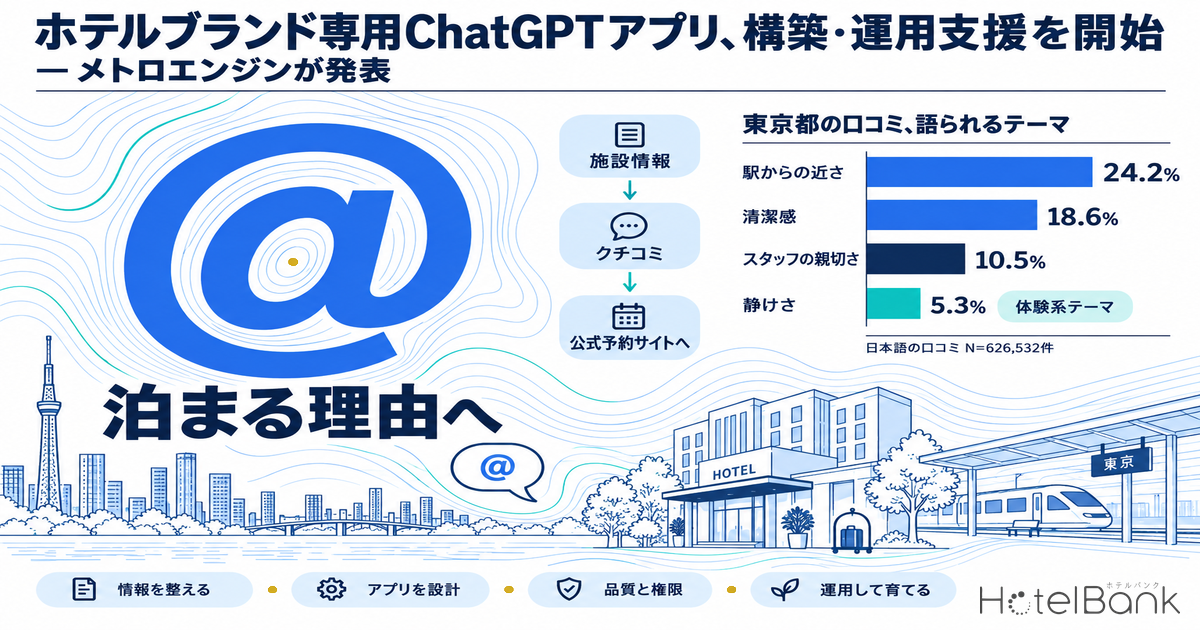
MetroEngines Inc. (Shinagawa-ku, Tokyo) has announced a new service that supports hotel brands and hotel chains in building and operating their own ChatGPT apps. The company builds a brand-dedicated app carrying the hotel or chain name, and uses hotel-approved property information together with guest review analysis organised by theme as the basis for responding to travellers’ questions and conveying what makes the hotel appealing. A distinguishing feature is that the design extends all the way to the path that guides a traveller — once they have narrowed down their candidates in conversation — to the hotel’s official booking site. This article summarises the announcement and, drawing on aggregated guest reviews for Tokyo, examines which themes guests actually talk about.
Metric Definitions Used in This Article
- Mention rate: the share of reviews posted during the target period that touch on a given theme (e.g. cleanliness, staff friendliness). It indicates how often a topic is raised, not a star rating.
- Review language: the language classification automatically detected from the review text. It does not indicate nationality or country of residence.
- Scope: reviews posted for accommodation facilities in Tokyo (past 24 months, aggregated September 14, 2026).
- Data source: HotelBank Editorial Team research (thematic analysis of guest reviews)
This article introduces the content of the service based on materials announced by MetroEngines Inc.
- — Brand-dedicated ChatGPT apps: MetroEngines has launched a service covering everything from building an app carrying the hotel or chain name through to post-launch operational improvement.
- — Three distinct evidence types: hotel-approved property information, reviews organised by theme, and the path to the official booking site are handled separately, without being conflated.
- — Station access 24.2%: in Japanese-language reviews for Tokyo (N=626,532, past 24 months), room cleanliness follows at 18.6% and staff friendliness at 10.5%.
- — Emphasis differs by language: English-language reviews mention room cleanliness at 22.7% and room size at 13.0%, higher than Japanese-language reviews (18.6% and 9.0% respectively).
- — No outcomes are guaranteed: citation or recommendation by AI, and any increase in bookings, are not guaranteed; scope, schedule and pricing are quoted individually.
Overview of the announcement — from building a brand-dedicated ChatGPT app to running it
The service announced is “ChatGPT app build and operations support for hotel brands.” In ChatGPT, adding an app lets a user call up a specific service from within a conversation. According to the announcement, a traveller can summon the brand with “@” inside a ChatGPT conversation and learn about that brand’s hotels without breaking the flow of planning their trip.
The company positions the service as “more than simply building a chat screen.” It covers organising the underlying information, verifying the answers, and improving the app after launch — designing, together with the hotel brand, a mechanism that can be operated on an ongoing basis. The company notes that “Metro Hotels,” the conversations and the property images shown in the screen mock-ups on the service site are fictitious and for demonstration purposes only.
| Main feature | Description in the announcement materials |
|---|---|
| Into the conversation, under your own brand | An app carrying the hotel or chain name is built; travellers can summon the brand with “@” inside the conversation |
| From property specs to a reason to stay | Beyond facility and location data, experiences that guests have rated are also drawn on to convey why this hotel fits the purpose of the trip |
| From one hotel of interest to the official booking site | After candidates have been narrowed down, a path is designed for checking current rates, availability and stay conditions on the official site and proceeding to book |
Source: compiled by the HotelBank Editorial Team from MetroEngines Inc. announcement materials
Background to the launch — spec information alone struggles to convey the reason to choose
According to the announcement materials, the purpose of a trip and the reason for choosing a hotel differ from traveller to traveller. For wishes such as enjoying breakfast, spending time quietly, or staying comfortably as a family, specification data such as facilities and location may not fully convey why that hotel is the right choice. The company’s view is that the moment when a traveller organises the conditions for a trip through conversation and moves on to comparison and consideration can become a new point of contact for a hotel brand to be discovered.
At the same time, introducing a hotel within a conversation calls for a mechanism that presents accurate property information alongside the experiences guests have valued, with supporting evidence and without conflating the two. An ongoing operating structure is also required, covering quality checks on the answers and control over the scope of information published. Through its revenue management system and market research tools, the company has accumulated hotel data and built expertise in reading guest reviews in fine detail. The new service draws on that data and expertise.
HotelBank has covered the growing use of generative AI in trip planning before, in Google UCP & ChatGPT: 3 Data Fixes Hotels Should Make Now in 2026, and in a survey of generative AI use in travel planning conducted by the Japan Lodging Research Institute.
The basis for answers — official information and guest reviews handled separately
The company cites three types of information as the basis for answers. First, hotel-approved property information (access, rooms, facilities, dining, terms of use and so on). Second, reviews captured by theme (ratings of breakfast, service, cleanliness, quietness and the like). Third, the connection to the official site and booking, designing the path from comparing hotels through to the official booking site. Official information and guests’ impressions are not conflated, and answers are delivered from the brand with their evidence attached.
So what themes do guests actually talk about in their reviews? When the HotelBank Editorial Team aggregated 626,532 Japanese-language reviews (past 24 months) posted for accommodation facilities in Tokyo by theme, the most frequently mentioned was “station access” (24.2%), followed by “room cleanliness” (18.6%) and “staff friendliness” (10.5%). “Room quietness,” cited as an example in the announcement materials, was touched on in 5.3% of reviews.
Source: HotelBank Editorial Team research (Tokyo, Japanese-language reviews N=626,532, past 24 months, aggregated September 14, 2026)
While some themes, such as location and cleanliness, can be inferred to a degree from property information, themes that are hard to see without having actually stayed — staff friendliness, courteous service, quietness, bed comfort — also account for a meaningful share. This characteristic of guest reviews is part of the reasoning behind the announcement materials’ framing of “from property specs to a reason to stay.”
The weight given to each theme differs by language
Even within the same Tokyo review set, the emphasis placed on each theme differs by the language the review was written in. In English-language reviews (N=357,946), the mention rate for “room cleanliness” is 22.7% and for “room size” 13.0%, higher than in Japanese-language reviews (18.6% and 9.0% respectively). In Korean-language reviews (N=39,360), “staff friendliness” stands relatively high at 13.1%, and in Traditional Chinese reviews (N=41,278), “value for money” at 11.1%. How evaluation criteria diverge by language is examined across a broader population in our tag analysis of 3.46 million reviews in eight languages.
Source: HotelBank Editorial Team research (Tokyo, past 24 months, aggregated September 14, 2026. Japanese N=626,532, English N=357,946, Traditional Chinese N=41,278, Korean N=39,360)
| Review language | Reviews | Highest-mentioned themes (top 3, excluding location and overall quality) |
|---|---|---|
| Japanese | 626,532 | Station access 24.2% / Room cleanliness 18.6% / Staff friendliness 10.5% |
| English | 357,946 | Station access 26.0% / Room cleanliness 22.7% / Staff friendliness 14.1% |
| Traditional Chinese | 41,278 | Station access 26.9% / Room cleanliness 19.6% / Room size 14.6% |
| Korean | 39,360 | Station access 27.3% / Room cleanliness 19.0% / Staff friendliness 13.1% |
| Simplified Chinese | 10,194 | Room cleanliness 20.3% / Courteous service 14.7% / Room size 11.5% |
Source: HotelBank Editorial Team research (Tokyo, past 24 months, aggregated September 14, 2026). Mention rate reflects how often a topic appears, not a rating score
In other words, even for the same hotel, the centre of gravity of “the experience I want to know about” can shift depending on which traveller is asking. The idea of conveying a hotel’s characteristics in conversation, in line with the purpose of the trip, is consistent with this diversity of themes. Note that the figures above show tendencies in guest reviews and do not demonstrate outcomes or effects attributable to this service.
What the support covers and how implementation proceeds
The support is made up of four areas.
| Support area | Content (from the announcement materials) |
|---|---|
| Organise the information to be published | Sort out the hotels covered, property information, FAQs and the reviews that may be referenced, and confirm what the brand wants to convey and how widely it should be published |
| Design the brand-dedicated app | Design the name, description, conversational tone and how hotels are presented, and support building the app and filing it for release |
| Verify answer quality and permissions | Check for misreadings of the evidence behind answers and of terms of use, separate public-facing information from non-public information, and design the publication scope and access permissions |
| Operate it and keep improving it | Define how information is updated and how answers are assessed, and design operations that can keep improving after launch |
Source: compiled by the HotelBank Editorial Team from MetroEngines Inc. announcement materials
Implementation proceeds in stages, starting with a single brand while the scope is confirmed. The three stages are: 1. consultation (confirming the properties covered, the intended users and the information to be presented); 2. prototyping (evaluating answers and the booking path in real conversations, based on approved information); and 3. launch preparation (filing for release, putting the operating structure in place, and moving on to information updates and answer improvements after launch). Scope, schedule and pricing are quoted individually according to the properties covered and the systems to be integrated.
Publishing through six traveller-facing media titles
Alongside the ChatGPT app as a point of contact, the company says it will draw on the six traveller-facing media titles it operates to help hotels publish information that conveys their appeal to travellers and is easy for AI to reference.
| Media title | Main content |
|---|---|
| hotelpicks.jp | Choosing a stay by the purpose of the trip; broad hotel-selection guidance and themed features |
| wabistay.travel | Design hotels, refined ryokan and hidden retreats — introducing high-quality stays |
| yadolist.blog | Onsen ryokan, rooms with open-air baths and food-focused inns — the appeal of Japanese lodging |
| tabilog.world | Resorts, remote islands and villas — suggesting where to stay based on how you want to spend the trip |
| kazokustay.life | Travel with children and family-oriented stays, covered from the angles families care about |
| innippon.news | Practicality for domestic business travel, newly opened hotels and related information |
Source: compiled by the HotelBank Editorial Team from MetroEngines Inc. announcement materials
Which titles run a piece, the content of that piece and the cost are discussed individually; no blanket placement across all titles is promised. The company states that each title’s editorial policy and fact-checking are respected, and that advertising and PR are labelled as such.
Notes attached to the announcement materials
- ChatGPT is a service provided by OpenAI. This service does not indicate approval by OpenAI, nor a partnership between MetroEngines and OpenAI.
- Citation or recommendation by AI, search rankings, and any increase in bookings are not guaranteed.
- Regarding the six traveller-facing media titles, which titles run a piece, the content and the cost are subject to individual discussion; no blanket placement across all titles is promised. Each title’s editorial policy and fact-checking are respected, and advertising and PR are labelled as such.
- The screens on the service site are illustrative; “Metro Hotels,” the conversations and the property images are fictitious and for demonstration purposes.
- Scope, schedule and pricing are quoted individually according to the properties covered and the systems to be integrated.
Summary
This announcement is about build and operations support that lets a hotel brand take part, under its own name, at the moment a traveller is organising the conditions of a trip in conversation with an AI. Its distinguishing features are that hotel-approved property information and thematically organised guest reviews are handled separately, that the design extends to the path to the official booking site, and that operational aspects — quality checks on answers, and the design of publication scope and permissions — are included within the scope of support.
The Tokyo review aggregation shows that the themes guests talk about range widely, from location and cleanliness to service, quietness and room size, and that the emphasis also differs by the language a review is written in. The company says it will continue to draw on its accumulated hotel data and review-analysis expertise to help hotel brands create new points of contact with travellers.
Related articles
- Google UCP & ChatGPT: 3 Data Fixes Hotels Should Make Now in 2026
- What Guests Write About in 8 Languages — 3.46M Review Tag Analysis
- Room Cleanliness: Foreign Reviews Mention It 1.5x More — 12,733 Hotels
- Tokyo Hotel Review Gap by Language: How Japanese vs Inbound Guests Differ
References and sources
- MetroEngines Inc., “ChatGPT app build and operations support for hotel brands” service site
- MetroEngines Inc. company information (Head office: Sumitomo Fudosan Takanawa Park Tower 8F, 3-20-14 Higashi-Gotanda, Shinagawa-ku, Tokyo; Representative Director and CEO: Ryosuke Tanaka; Founded: October 2016)
- OpenAI (provider of ChatGPT)
- HotelBank Editorial Team research — thematic analysis of reviews posted for accommodation facilities in Tokyo (past 24 months, aggregated September 14, 2026)