

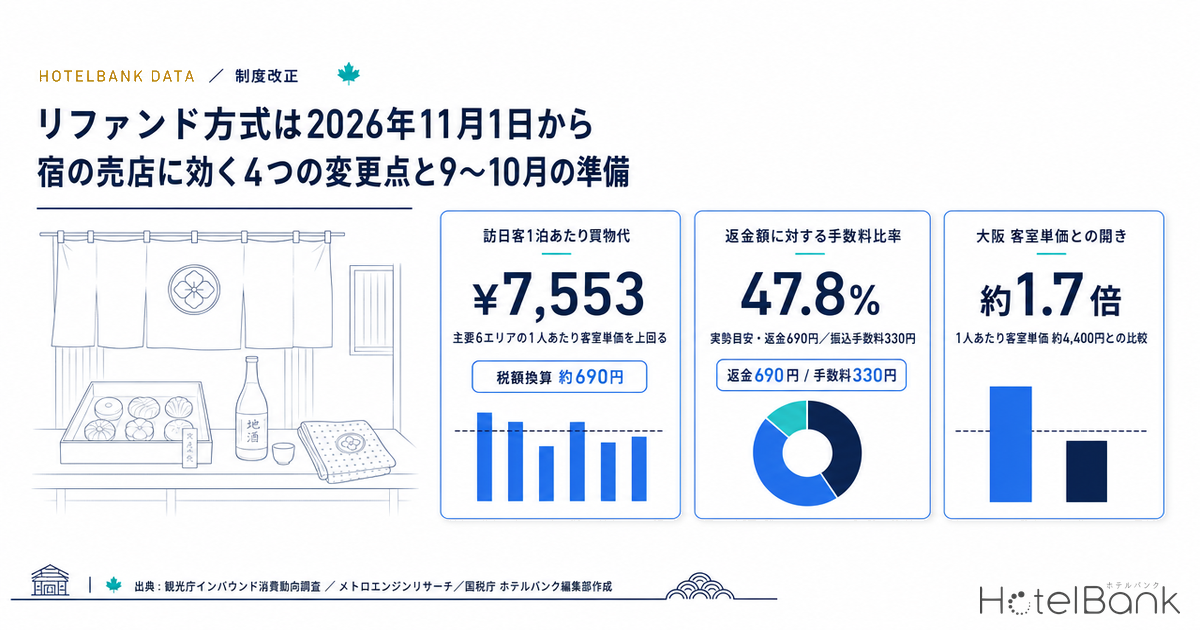
Japan’s consumption tax exemption scheme switches to a “refund method” for sales made on or after November 1, 2026. Travelers will pay the tax-inclusive price at the point of purchase, and the retailer refunds the consumption tax equivalent after customs confirms the goods were taken out of the country at departure. For a hotel or ryokan that does not operate a duty-free shop, this may look like someone else’s problem. But the same reform abolishes the distinction between general goods and consumables, unifying the ¥5,000 minimum-purchase test into a single combined threshold. That change matters most to in-house shops with small transaction sizes, and the preparation done in September and October feeds directly into revenue from November onward. This article organizes the changes from National Tax Agency and Japan Tourism Agency primary sources, then sets inbound spending data against hotel room rates to build concrete moves by property type.
Metric Definitions Used in This Article
- ADR (average daily rate): an estimated settled rate (tax-exclusive equivalent) calculated by applying a property-type correction factor to the lowest published plan level each property lists on OTAs and other booking sites (double occupancy, per-room rate, tax-inclusive). Cross-checked against property-level disclosures from listed hotel REITs (91 properties, most recent 3 months), the median error is about 7%. These are estimates and differ from each property’s actual transaction prices and accounting figures. Area-level ADR is the median of the covered properties (the level of a typical property in that area).
- Room rate per person: the estimated settled ADR above (per room) divided by two on the assumption of double occupancy. It is a reference conversion used to put the figure on the same order of magnitude as inbound spending per person per night, not an actual single-occupancy rate.
- Data sources: MetroEngines Research (room rates), Japan Tourism Agency “Consumption Trend Survey for Foreigners Visiting Japan” (inbound spending), National Tax Agency and Japan Tourism Agency (the scheme itself)
- — The refund method applies to sales made on or after November 1, 2026. There is no transition period in which the current scheme and the refund method can run side by side, so the deadline for preparation is October 31.
- — What hits hotels directly is the abolition of the goods categories. The ¥5,000 (tax-exclusive) test for an in-house shop becomes a single combined test across general goods and consumables, and the special packaging rule, the ¥500,000 cap and the intended-use requirement are all abolished.
- — Inbound travelers direct ¥7,553 per night to shopping, above the room rate per person in the six major areas (roughly ¥4,400–¥6,900).
- — Refunds run to a few hundred yen each. On a transaction at the going rate, a ¥330 transfer fee against a ¥690 refund is 47.8%, which makes the choice of refund channel a primary question of revenue design.
- — The three things to settle in September and October are the status of the required notification, the refund channel, and multilingual explanation. The details of the scheme are laid out in National Tax Agency and Japan Tourism Agency primary sources.
What Changes on November 1 — A Three-Line Summary
The National Tax Agency’s “Q&A on the Export Goods Sales Scheme (Refund Method, Overview)” describes the new method, effective November 1, 2026 (Reiwa 8), as follows. The essentials fit into three lines.
1. The duty-free store sells at the tax-inclusive price (taxable) to an eligible tax-free purchaser.
2. The traveler, departing Japan within 90 days of the purchase date, scans their passport at a tax-free procedure terminal at the airport or seaport and obtains customs confirmation.
3. After confirming the information showing that customs verified the goods were taken out of the country (customs confirmation data), the store refunds the consumption tax equivalent to the traveler.
“Within 90 days of the purchase date” means up to the 90th day counted from the day after purchase. In the National Tax Agency’s example, a purchase made on November 1, 2026 carries a confirmation deadline of January 30, 2027. At departure, scanning the passport at the terminal displays on screen whether a customs inspection is required: if not (a green result), the procedure finishes on the spot; if it is (a red result), the traveler obtains take-out confirmation at the customs inspection area. Because the traveler must have all purchased tax-free goods in hand at the moment of the terminal procedure, the guidance also states explicitly that the procedure cannot be completed after the items have been checked into hold baggage.
The other point to register is that no transition period has been provided. The National Tax Agency Q&A (Question 8) states plainly that “there is no transition period in which the current scheme and the refund method may be used in parallel upon the move to the refund method.” From sales made at or after midnight on November 1, exemption is available only through procedures compliant with the new method. The deadline for preparation is October 31.
Current Scheme vs. the Refund Method
| Item | Current scheme (through October 31, 2026) | Refund method (from November 1, 2026) |
|---|---|---|
| Price at the point of sale | Sold with consumption tax exempted on the spot | Sold at the tax-inclusive price (taxable) |
| When exemption is established | At the point of sale | When customs confirms the goods were taken out of Japan at departure |
| Procedure at departure | Generally none | Passport presented at a terminal and customs confirmation obtained on departure within 90 days of purchase |
| Refund of the consumption tax equivalent | — | Paid by the seller after confirming the customs confirmation data |
| Goods categories | Two categories: general goods and consumables | Categories abolished |
| The ¥5,000 minimum test | Applied per category (tax-exclusive value) | Applied on a combined basis without categories (still on tax-exclusive value) |
| Purchase cap on consumables | ¥500,000 per store per day | Abolished |
| Special packaging | Required for consumables | Abolished |
| Intended-use requirement | Goods must be “for ordinary personal use” | Abolished (intended use no longer relevant) |
| Goods outside the scheme | Gold and platinum bullion and the like | Gold and platinum bullion plus gold and platinum coins, and goods exempt from consumption tax |
| Types of sales premises | General, outsourced-procedure, and vending-machine types | Consolidated into two: general and vending-machine types |
| Record retention | Purchase record data | Purchase record data plus customs confirmation data, retained for seven years |
Source: National Tax Agency, “Q&A on the Export Goods Sales Scheme (Refund Method, Overview)” (April 2025), compiled by the HotelBank Editorial Team
The Real Story for Hotels Is the End of Goods Categories — the In-House Shop’s ¥5,000 Test Becomes One Combined Test
The headline of the reform is the refund method itself, but for a property with an in-house shop, what bites directly is the abolition of the goods categories. Under the current scheme, the ¥5,000 (tax-exclusive) minimum is tested separately for general goods (crafts, sundries, clothing) and consumables (confectionery, food, cosmetics). Combining them is possible, but then the general goods are treated as consumables too and require tamper-evident special packaging. In a shop where single items run from a few hundred to a few thousand yen, that packaging work has been pure operational weight.
Under the refund method the categories disappear altogether. The National Tax Agency Q&A (Question 4, Note 3) states that “in line with the abolition of the distinction between general goods and consumables, the test for the tax-free amount (the minimum purchase threshold, a combined total of ¥5,000 or more in eligible goods) is also performed without distinguishing categories.” Special packaging is abolished as well. So if a guest buys ¥2,800 of local confectionery together with a ¥2,400 hand towel, the current rules would not establish exemption without the packaging work, whereas from November the ¥5,200 combined total qualifies with no packaging at all. The way a staying guest actually shops — several low-priced items at once — finally lines up with the unit the scheme tests.
On top of that, the ¥500,000 per-store-per-day cap on consumables is removed, and judging whether goods are “for ordinary personal use” is no longer necessary. For guests who buy local sake and farm products in bulk, and for ryokan shops handling crafts, both the range of goods and the range of amounts move in the direction of being easier to handle.
Inbound Travelers Spend ¥7,553 per Night on Shopping
So how much retail demand can actually move inside a property? According to the Japan Tourism Agency’s “Consumption Trend Survey for Foreigners Visiting Japan” for April–June 2026 (first preliminary estimate), inbound travel spending was ¥2.5096 trillion (+0.2% year on year). By category, lodging was the largest at ¥927.8 billion (37.0% of the total), followed by shopping at ¥673.1 billion (26.8%) and food and beverage at ¥545.4 billion (21.7%). That ¥673.1 billion of quarterly shopping is the second-largest category after lodging, and much of it occurs at retail outside the property. For more on why lodging remains the largest category and how far it sits from real-world ADR, see Lodging Is 37% of Japan’s ¥2.51T Inbound Spend: ¥10,446 vs Real ADR.
Source: Japan Tourism Agency, “Consumption Trend Survey for Foreigners Visiting Japan,” April–June 2026 (first preliminary estimate), compiled by the HotelBank Editorial Team
Per person, travel spending in April–June 2026 was ¥244,457 over an average stay of 8.7 nights: ¥90,482 on lodging, ¥65,425 on shopping and ¥53,143 on food and beverage. For the top five markets the Agency publishes, spending per person per night was ¥28,222 overall, of which ¥10,446 went to lodging, ¥7,553 to shopping and ¥6,135 to food and beverage. That ¥7,553 of nightly shopping converts to roughly ¥690 of tax at the 10% consumption tax rate. Over an 8.7-night stay, about ¥5,900 per person could in theory be subject to refund (in practice it is an upper-bound guide, since the ¥5,000 minimum test applies and some purchases are made outside duty-free stores).
Looking at the shares over time, shopping moved from 26.2% in April–June 2025 through 25.2% in January–March 2026 and back to 26.8% most recently. Lodging holds the top spot in the 36–38% range, while shopping swings one to two points each quarter. Inbound visitor numbers themselves were 24.527 million for January–July 2026, −1.7% year on year and essentially flat (Japan National Tourism Organization estimate), so the phase we are in is one where spending is driven by how each visitor spends rather than by headcount.
Source: Japan Tourism Agency, “Consumption Trend Survey for Foreigners Visiting Japan,” each quarter (first preliminary estimates), compiled by the HotelBank Editorial Team
Nightly Shopping Spend Exceeds the Room Rate per Person
Set that ¥7,553 alongside what properties charge. MetroEngines Research estimated settled ADR for July 2026 was ¥12,600 in Tokyo, ¥8,800 in Osaka, ¥12,200 in Kyoto, ¥10,900 in Fukuoka, ¥12,200 in Hokkaido and ¥13,700 in Okinawa (all per room, tax-exclusive equivalent, N=4,320 properties). Converting to a per-person figure on the assumption of double occupancy gives roughly ¥6,300 in Tokyo, ¥4,400 in Osaka, ¥6,100 in Kyoto, ¥5,400 in Fukuoka, ¥6,100 in Hokkaido and ¥6,900 in Okinawa.
In other words, what an inbound traveler directs to shopping per night exceeds the room rate per person in every one of the six major areas — about 1.7 times in Osaka and about 1.4 times in Fukuoka. Providing accommodation is outside the scope of the export goods sales scheme, and room rates themselves never become tax-free. Yet within the same stay, an amount equal to or greater than the room rate per person is flowing into retail. Whether a property can capture part of that amount in-house is the question from November onward.
Source: MetroEngines Research (estimated settled ADR, July 2026, N=4,320 properties) and Japan Tourism Agency, “Consumption Trend Survey for Foreigners Visiting Japan,” April–June 2026, compiled by the HotelBank Editorial Team
Note that the room rate is an estimate based on all guests, not inbound travelers alone. Shopping spend is self-reported, tax-inclusive expenditure, while the room rate is a tax-exclusive-equivalent estimate. Because the two are compiled on different bases, read the comparison as a guide to orders of magnitude.
Impact by Property Type — Three Positions, Three Sets of Moves
Japan has 63,278 consumption-tax duty-free stores (as of March 31, 2025, Japan Tourism Agency), of which 39,431 are in the three major metropolitan areas and 23,847 elsewhere, putting the regional share at 37.7%. Within that population, properties fall broadly into three groups: those with a duty-free shop in house, those with a shop but no duty-free licence, and those with no retail space at all. What happens on November 1, and what to do in September and October, differ for each. How much inbound demand properties capture in house varies by property type, and that distribution is set out in City Hotels: 45.9% of Guest Nights Are Foreign — Ryokan +3.7%.
| Type | What happens on November 1 | What to do in September and October |
|---|---|---|
| A. Large hotels and resorts with an in-house duty-free shop | An existing licence is deemed to be a licence for a general-type export goods sales premises under the new scheme. However, a premises that has not filed the “notification of the method of providing purchase record data at an export goods sales premises” by October 31, 2026 loses the effect of its licence on that date. An outsourced-procedure shop can continue outsourcing to its existing approved tax-free procedure operator with no further steps, provided the outsourcing relationship is unchanged. | Confirm during October that the notification has been filed. Fix the timing of POS and tax-free system modifications, and decide where purchase record data and customs confirmation data will be held for seven years. Share with accounting the procedure for reclassifying taxable sales as tax-exempt sales. Choose the refund channel (bank transfer, card refund, app transfer, cash at the departure port) and prepare the notices that explain it. |
| B. Ryokan and hotels with a shop but no duty-free licence | With the goods categories abolished, consumables such as confectionery, local sake and cosmetics can be combined with general goods such as crafts and sundries to meet the ¥5,000 (tax-exclusive) minimum. Special packaging is no longer needed either, so shops that had passed on the scheme because of the operational weight can now clear the bar. The ¥500,000 cap and the intended-use requirement also go. | First, use recent sales data to check whether a typical inbound purchase at your shop reaches ¥5,000. If it plausibly does, consider a licence application to the tax office with jurisdiction over your place of tax payment (attaching a floor plan of the premises, a tax-free sales manual, a list of goods handled and so on). If it does not, start from designing bundled products that lift the transaction size into the ¥5,000 band. |
| C. Properties with no retail space | No procedural change applies directly. That said, the location requirement for tax-free procedure counters is relaxed: under the refund method, a counter no longer needs to be inside a “designated commercial facility.” That widens the design scope for a shared counter run with a local tourism association or shopping street. | Track what local duty-free stores and shared counters are doing, and prepare to act as the guide for your guests. Note that outsourced tax-free sales procedures must be completed on the same day as the sale, so always check the distance and opening hours. Front-desk guidance and multilingual signage are the place to start. |
Source: National Tax Agency, “Q&A on the Export Goods Sales Scheme (Refund Method, Overview)” and Japan Tourism Agency, “Consumption Tax Duty-Free Shop Site,” compiled by the HotelBank Editorial Team
The relaxed counter requirement noted under Type C is a change that can become a realistic option for small regional properties. The National Tax Agency Q&A (Question 24) states that for the location of a tax-free procedure counter, “while the current scheme requires it to be inside a ‘designated commercial facility,’ under the refund method it need not be inside a ‘designated commercial facility.'” At the same time, the tax-free sales procedure performed by an approved tax-free procedure operator at a counter must take place on the same day the goods are transferred. If the counter is remote and the procedure cannot be completed that day, exemption is not available — so locations where shops cluster within walking distance, such as hot-spring towns and temple-gate districts, are the easiest places to design a shared counter.
Where In-House Shops Get Talked About — Airport-Adjacent Hotels Dominate the Top
Source: HotelBank Editorial Team research (45 properties, 187,037 guest reviews, most recent 24 months)
The top of the list is occupied by properties around Narita and Kansai airports and resort-style hotels on Tokyo Bay. The highest mention rate for the in-house shop was at Hotel MyStays Premier Narita (ホテルマイステイズプレミア成田) at 8.85% (378 of 4,271 reviews), followed by Hotel Nikko Narita (ホテル日航成田) at 7.40% (426 of 5,753) and Narita Tobu Hotel Airport (成田東武ホテルエアポート) at 6.84% (730 of 10,676). The closer a property is to an airport, the more its retail space is discussed as part of the stay.
This distribution sits well with the refund method. Under the new rules, the traveler must obtain customs confirmation at a terminal in the airport or seaport of departure while holding all the tax-free goods they purchased. Because the procedure has to be finished before items go into hold baggage, the closer the purchase is to departure, the shorter the path through the procedure. The shop in an airport-adjacent hotel is the very last retail space on that path. Consolidating souvenir buying into the final night in Japan was already a visible pattern; from November, the fact that the goods can be carried straight to the terminal makes the logic of it explicit from the traveler’s side.
The structure is instructive for properties outside airport catchments too. The 90-day window from the purchase date is long enough that goods bought in the first half of an itinerary still qualify. Because purchases made during the stay can all be confirmed together at departure, local sake or crafts bought at a regional property’s shop are not excluded from the scheme. If anything, what became easier to handle is the food and cosmetics side, which previously required special packaging.
Three Decisions for September and October
With no transition period, it is worth narrowing down the items that must be settled by October 31. For a property with retail space in house, the open questions come down to three.
| Decision | Options and what to weigh | Primary sources to know |
|---|---|---|
| 1. Price display | From November, eligible tax-free purchasers are also sold to at the tax-inclusive price. Price display consolidates into tax-inclusive, and the practice of showing a “tax-free price” alongside a “tax-inclusive price” is up for revision. Decide how far to replace price tags, in-house signage, in-room guidance and your own website. | For sales of tax-free-eligible goods, there is generally no obligation to issue a qualified invoice, but issuing one is permissible. If you do, you may indicate with a stamp or similar that “the goods become tax-free after customs confirmation” (National Tax Agency Q&A, Question 28). |
| 2. Refund funding and fees | The law sets no rules on the refund method itself; bank transfer, credit card refund, app transfer and cash refund inside the departure port are all conceivable. Choose between refunding yourself and outsourcing to an approved transmission operator or similar. The deciding axis is whether you can design it so that transfer or remittance costs do not exceed the refund amount, which runs to a few hundred yen per transaction. | You may refund before obtaining the customs confirmation data, but if the traveler then fails to obtain customs confirmation at departure, exemption is unavailable and the sale is treated as taxable at the post-refund sales amount. An advance refund is made at the operator’s own risk (National Tax Agency Q&A, Question 29). |
| 3. Multilingual staff explanation | The new flow — “you pay tax-inclusive today, complete the terminal procedure at departure, and the refund follows later” — has to be explained at the point of purchase. Put five points on a standard explanation card: presenting the passport, departing within 90 days, the terminal procedure, finishing it before checking baggage, and how the refund arrives. | The Japan Tourism Agency’s consumption tax duty-free shop site publishes multilingual leaflets for travelers in Japanese, English, simplified Chinese, traditional Chinese and Korean on its dedicated traveler page. You can start there rather than writing your own. |
Source: National Tax Agency, “Q&A on the Export Goods Sales Scheme (Refund Method, Overview)” and Japan Tourism Agency, “Consumption Tax Duty-Free Shop Site,” compiled by the HotelBank Editorial Team
Of the three, the one with the greatest bearing on revenue design is the second: refund funding and fees. Because you collect the tax-inclusive amount at the point of sale and refund after customs confirmation, the cash sits with you in the interim. Executing the refund, however, costs money. Ten percent of ¥7,553 of nightly shopping spend is about ¥690, and even when a single transaction covers several items, refunds usually land in the band from a few hundred to a few thousand yen. Choose a channel carrying a few hundred yen in transfer fees and the fee becomes a high proportion of the refund. Card refunds, batch processing through an outsourced operator and similar options should be selected during October to match your transaction sizes.
Cost Sensitivity per Refund — Transaction Size × Refund Channel Fee
This question can be put in numbers. What gets refunded is the consumption tax equivalent on the goods, so for goods at the standard 10% rate the refund is 10% of the tax-exclusive transaction value. The table below takes the tax-exclusive transaction size and the level of fee incurred per refund as its two axes, and sets out the fee as a proportion of the refund.
| Tax-exclusive transaction size | Refund (10%) | Fee ¥0 | Fee ¥110 | Fee ¥330 | Fee ¥550 |
|---|---|---|---|---|---|
| ¥5,000 exactly at the minimum | ¥500 | — | 22.0% | 66.0% | 110.0% |
| ¥6,900 the going rate | ¥690 | — | 15.9% | 47.8% | 79.7% |
| ¥10,000 | ¥1,000 | — | 11.0% | 33.0% | 55.0% |
| ¥15,000 | ¥1,500 | — | 7.3% | 22.0% | 36.7% |
| ¥30,000 | ¥3,000 | — | 3.7% | 11.0% | 18.3% |
Illustrative case: because fee levels vary by refund channel and contract terms, four levels are assumed, from ¥0 (card refunds, app transfers and other designs with no per-transaction out-of-pocket cost) to ¥550. The mapping of transaction size to refund amount and the ratios are all HotelBank’s own arithmetic. Compiled by the HotelBank Editorial Team
On a transaction of ¥6,900 tax-exclusive — the going rate, equivalent to ¥7,553 of nightly shopping spend net of tax — the refund is ¥690. Add a ¥330 transfer fee and 47.8% of the refund disappears into the fee. With the same fee, a transaction size of ¥30,000 brings the ratio down to 11.0%. So the question is not “is the fee high” but rather how far the band of transaction sizes your shop actually achieves can dilute the fee of the channel you chose. The more a shop’s sizes stick in the ¥5,000s, the more it matters to pick a refund channel with no per-transaction out-of-pocket cost.
Note also that food and beverages carry the reduced 8% rate, so at the same transaction size the refund is 80% of the figures above and the fee ratio is correspondingly higher. A shop whose mainstays are confectionery and local sake should read this table one notch on the harsher side. Where goods at the standard 10% rate and the reduced 8% rate sit in the same transaction, the calculation must be done by rate.
The treatment when a refund cannot be made is also settled. Even where a refund is unavoidably impossible for reasons on the traveler’s side (an incorrectly written refund account number, for instance), exemption remains available as long as the customs confirmation data is retained. A consumption tax equivalent that the parties agree contractually need not be refunded is recorded as miscellaneous income (outside the scope of tax) (National Tax Agency Q&A, Question 30).
Frequently Asked Questions
Q. Are room rates tax-free?
A. No. The export goods sales scheme covers transfers of goods; providing accommodation as a service is not covered. Goods sold inside the property (souvenirs, local sake, crafts, cosmetics and so on) are covered.
Q. Can our current duty-free licence still be used after November 1?
A. A premises holding a general-type or outsourced-procedure-type licence on October 31, 2026 is deemed, on November 1, to hold a general-type export goods sales premises licence under the new scheme. However, a premises that has not filed the “notification of the method of providing purchase record data at an export goods sales premises” by that date loses the effect of its licence. Checking the filing status is the first priority.
Q. Is there a transition period in which the current and new schemes can run in parallel?
A. No. The refund method applies to sales made at or after midnight on November 1, 2026. That said, where a business follows a continuously applied revenue recognition basis under which sales between midnight and 1:00 a.m. on November 1 are recorded as October 31 sales, handling those October 31 sales under the current scheme’s procedures is acceptable.
Q. Is the ¥5,000 minimum tested on a tax-inclusive or tax-exclusive basis?
A. Under the refund method it continues to be tested on the tax-exclusive value. Because the distinction between general goods and consumables is abolished, the test is performed on a combined basis without categories.
Q. If we sell food, how much is the refund?
A. What is refunded is the consumption tax equivalent on the goods. Food and beverages carry the reduced 8% rate, so the refund follows that rate. Where goods at the standard 10% rate and goods at the reduced 8% rate sit in the same transaction, the calculation must be done by rate.
Q. What if the traveler eats the confectionery they bought before leaving Japan?
A. Where all or part of the purchased tax-free goods are consumed before departure and are no longer held, the traveler is required to declare that to a customs officer at the counter. Take-out confirmation cannot be obtained for goods no longer held.
Q. What happens if the traveler does not leave Japan within 90 days?
A. Where customs confirmation is not obtained within 90 days from the day after purchase, the tax-free sales management system provides information, per purchase record, that the goods were not confirmed as taken out of Japan. If no customs confirmation data is provided more than 90 days after the sale, that transaction is finalized as a taxable sale.
Conclusion
For duty-free stores, the refund method starting November 1, 2026 entails rebuilding procedures and accounting treatment. Seen from the property side, though, the simultaneous abolition of the goods categories, special packaging, the intended-use requirement and the purchase cap all move in a direction that benefits low-transaction-size in-house shops the most. Making ¥5,000 reachable by combining confectionery with sundries brings retail spaces that were previously out of scope into it.
Inbound travelers direct ¥7,553 per night to shopping (Japan Tourism Agency, top five markets), above the room rate per person in the six major areas (roughly ¥4,400–¥6,900). Of the ¥673.1 billion of quarterly shopping spend, the share captured inside properties is still limited. Whether to obtain a duty-free licence comes down to weighing transaction size against effort, and the inputs for that judgment sit in your own shop’s data. What to confirm across September and October is the status of the notification, the choice of refund channel, and multilingual explanation. Because the details of the scheme are laid out in National Tax Agency and Japan Tourism Agency primary sources, that is where to start.
Related Reading
References and Sources
■ The scheme (primary sources)
- National Tax Agency, “Q&A on the Export Goods Sales Scheme (Refund Method, Overview)” (April 2025, Consumption Tax Office, National Tax Agency)
- National Tax Agency, “Revision of the Export Goods Sales Scheme to the Refund Method” (refund method special site)
- Japan Tourism Agency, “Consumption Tax Duty-Free Shop Site,” new scheme (refund method) special page
- Japan Tourism Agency, “Consumption Tax Duty-Free Shop Site,” traveler page and multilingual leaflets
- Japan Tourism Agency, “How to Become a Duty-Free Shop” (licence application for an export goods sales premises)
■ Government statistics
- Japan Tourism Agency, “Results of the Consumption Trend Survey for Foreigners Visiting Japan, April–June 2026 (first preliminary estimate)”
- Japan Tourism Agency, “Results of the Consumption Trend Survey for Foreigners Visiting Japan, January–March 2026 (first preliminary estimate)”
- Japan Tourism Agency, “Results of the Consumption Trend Survey for Foreigners Visiting Japan, April–June 2025 (first preliminary estimate)”
- Japan Tourism Agency, “Number of Consumption-Tax Duty-Free Shops by Prefecture (as of March 31, 2025)”
- Japan National Tourism Organization (JNTO), “Foreign Visitors to Japan (July 2026 estimate)”
■ Market data
- MetroEngines Research — estimated settled ADR (July 2026, six prefectures, N=4,320 properties)
- HotelBank Editorial Team research — tally of in-house retail mentions in guest reviews (45 properties, 187,037 reviews, most recent 24 months)