

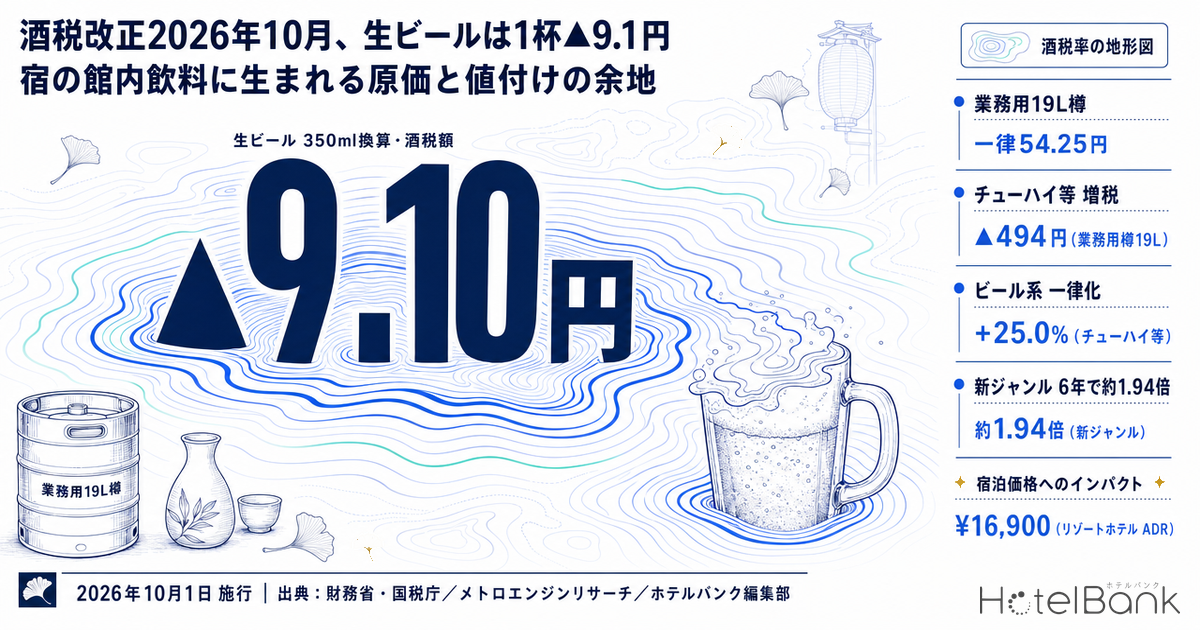
On October 1, 2026, the phased reform of Japan’s Liquor Tax Act reaches its final stage. The tax rates on beer, happoshu (low-malt beer) and “new genre” products (the so-called third-category beers) are unified at a single ¥54.25 per 350ml equivalent, and at the same time chu-hai and other “other sparkling liquors” are raised from ¥28 to ¥35. For accommodation businesses this means that the cost structure of every in-house beverage channel — draft beer in the banquet hall, all-you-can-drink plans, the in-room minibar, vending machines and the gift shop — switches over in a single night. This article confirms the content of the reform against primary sources, then uses review-tag aggregation and estimated settled ADR by property category to map out which channels in which categories gain room to re-price.
Metric Definitions Used in This Article
- ADR (average daily rate): An estimated settled rate (tax-exclusive equivalent), calculated by applying a category-specific adjustment coefficient to the lowest published plan level each property lists on OTAs and elsewhere (2 guests per room, per-room rate, tax-inclusive). Cross-checked against property-level results disclosed by listed hotel REITs, the median error is approximately 7%. It is an estimate and differs from each property’s actual contracted rates and accounting figures. Area-level ADR is the median of the properties covered (the level of a standard property in that area). The nationwide figures in this article are the estimated settled ADR of each of the 47 prefectures, weighted by the number of properties covered.
- Published price: The average price of all plans published on OTAs and elsewhere (2 guests per room, per room, tax-inclusive). Figures labelled ADR in this article are the estimated settled ADR above, which sits at a different level from published prices.
- Review tags: Guest reviews analysed semantically with natural language processing and aggregated as mention frequency per property. A mention rate is “the share of reviews that touched on that topic” — it is not a rating score.
- Data sources: Prices = MetroEngines Research / Reviews = HotelBank Editorial Team research / Tax rates = Ministry of Finance and National Tax Agency
- — Beer −¥9.10 per 350ml; −¥494 per 19L keg. All-you-can-drink and banquet offerings built around draft beer sit on the side where gross margin improves simply by holding the selling price flat.
- — Happoshu and new genre +¥7.26; chu-hai and similar +¥7.00. In percentage terms the +25.0% on chu-hai is the largest, and the increase lands on the minibar, vending machine and gift shop channels.
- — Of the 176 properties where all-you-can-drink is discussed, ryokan account for 60.8% and resort hotels 20.5% — over 80% combined, whereas among the 518 properties where the in-room minibar is discussed, business hotels are 51.4%. The tax cut and the tax increase split cleanly along category lines.
- — The net saving per guest over two hours ranges from ¥33.9 to ¥8.6 — a three- to fourfold spread. Whether the mix is three draft beers or two draft beers plus two chu-hai decides the size of the improvement.
- — From October the liquor tax on beer and on new genre products is identical. The premise of designing products around malt ratio to lower the tax burden disappears, opening room to revisit the in-house line-up.
Six years of convergence, with the final step on October 1, 2026
This reform is not a one-off tax rise or cut. It is the last of three stages of liquor tax revision implemented in October 2020, October 2023 and October 2026. The Ministry of Finance explains the aim as “correcting a situation in which rate gaps between similar categories of liquor influence product development and sales volumes, and restoring fairness in the tax burden across liquor categories,” and the design is premised on revenue neutrality.
From October 1, 2026, beer-type beverages are unified at ¥155,000 per kilolitre (¥54.25 per 350ml equivalent). Compared with the rates in force since October 2023, beer falls from ¥63.35 to ¥54.25, a cut of ¥9.10, while happoshu and new genre products rise from ¥46.99 to ¥54.25, an increase of ¥7.26. Chu-hai, sours and other “other sparkling liquors” go from ¥80,000 to ¥100,000 per kilolitre — ¥28 to ¥35 per 350ml equivalent, an increase of ¥7.
| Category | To Sep 2020 | From Oct 2020 | From Oct 2023 | From Oct 2026 | Change this time |
|---|---|---|---|---|---|
| Beer | ¥77.00 | ¥70.00 | ¥63.35 | ¥54.25 | −¥9.10 (−14.4%) |
| Happoshu (malt ratio under 25%) | ¥46.99 | ¥46.99 | ¥46.99 | ¥54.25 | +¥7.26 (+15.5%) |
| New genre (third-category beer) | ¥28.00 | ¥37.80 | ¥46.99 | ¥54.25 | +¥7.26 (+15.5%) |
| Chu-hai etc. (other sparkling liquors) | ¥28.00 | ¥28.00 | ¥28.00 | ¥35.00 | +¥7.00 (+25.0%) |
Liquor tax per 350ml equivalent (excluding consumption tax). Source: Ministry of Finance, “Materials on Liquor Tax”; National Tax Agency
Source: Compiled by the HotelBank Editorial Team from Ministry of Finance, “Materials on Liquor Tax”
What deserves attention is the relative size of the change. In absolute terms beer’s ¥9.10 reduction is the largest, but measured against the original tax amount, the 25.0% rise on chu-hai is the biggest of the three categories. New genre products stood at ¥28 per 350ml equivalent as of September 2020; six years on they reach ¥54.25, roughly 1.94 times that level. In other words, the categories whose structure changes most under this reform are precisely those that could be sold cheaply because the tax rate was low.
There is a second consequence that matters greatly in practice. From October 1, 2026, the liquor tax on beer and on happoshu and new genre products becomes exactly the same. Because the very premise of lowering tax through malt ratio disappears, the reason to carry new genre products in-house will no longer be “the tax rate is cheaper” but purely the difference in purchase price and guest preference. That is where room opens up to revisit the line-up.
How much moves when converted to one glass and one keg
A table of tax rates alone is not something the front line can act on, so the figures are converted into the volumes actually handled in banquet halls and guest rooms. The following shows the change in liquor tax itself, with a tax-inclusive basis at 10% consumption tax shown alongside for reference (because liquor tax is included in the consumption tax base, any change in liquor tax passes through to the final price at 1.1 times).
Source: Compiled by the HotelBank Editorial Team from Ministry of Finance, “Materials on Liquor Tax”
| Serving unit | Beer | Happoshu / new genre | Chu-hai etc. |
|---|---|---|---|
| 350ml can (1 can) | −¥9.10 | +¥7.26 | +¥7.00 |
| Medium mug equivalent, 435ml (1 glass) | −¥11.31 | +¥9.02 | +¥8.70 |
| 500ml can (1 can) | −¥13.00 | +¥10.37 | +¥10.00 |
| Commercial 19L keg (1 keg) | −¥494 | +¥394 | — |
| 350ml can (incl. 10% consumption tax) | −¥10.01 | +¥7.99 | +¥7.70 |
Only the change in liquor tax is calculated. Revisions to purchase prices themselves follow each manufacturer’s own announcements. Source: Calculated by the HotelBank Editorial Team from Ministry of Finance materials
A commercial 19L keg of draft beer becomes ¥494 lighter per keg on liquor tax alone. Converted to medium mugs (435ml of liquid), about 43 glasses come from one keg, so that is ¥11.3 less tax per glass. Assuming an average of three medium mugs of draft beer over a two-hour all-you-can-drink session, the tax burden falls by ¥33.9 per guest (¥37.3 including consumption tax) — roughly ¥3,400 (about ¥3,700 tax-inclusive) for a banquet of 100 people.
That, however, is the upper bound, assuming the entire volume is draft beer. Replace it with a mix of two draft beers and two chu-hai over the same two hours and the ¥22.6 saving on the beer side is offset by a ¥14.0 increase on the chu-hai side, shrinking the net saving to ¥8.6 per guest (¥9.5 including consumption tax). Because the gross-margin improvement on all-you-can-drink varies three- to fourfold depending on “what is poured and how many times,” properties that hold actual consumption data are best placed to size the upside of this reform accurately.
The impact concentrates on “ryokan with all-you-can-drink” and “business hotels with minibars”
So in which categories does this reform actually bite? Guest reviews were analysed with natural language processing to aggregate the properties where beverage topics are genuinely discussed. From guest reviews nationwide, properties with mentions were extracted across five viewpoints: all-you-can-drink and free drinks, drinks at dinner, the in-room minibar, the in-house bar, and local sake.
Source: HotelBank Editorial Team research (NLP analysis of guest reviews, trailing 24 months)
| Review viewpoint | Properties | Mentions | Thickest category | Prefectures aggregated |
|---|---|---|---|---|
| All-you-can-drink / free drinks | 176 | 3,824 | Ryokan 60.8% (107 properties) | 38/47 |
| Drinks / pairings at dinner | 413 | 9,902 | Ryokan 42.9% (177 properties) | 36/47 |
| In-room minibar / in-room drinks | 518 | 11,634 | Business hotels 51.4% (266 properties) | 44/47 |
| In-house bar / night bar | 5 | 80 | Resort hotels 80.0% (4 properties) | 47/47 |
| Local sake / sake tasting | 8 | 114 | Business hotels 50.0% (4 properties) | 47/47 |
Covers properties with 10 or more mentions and 20 or more total reviews over the trailing 24 months. “Prefectures aggregated” is the number of the 47 prefectures for which aggregation completed (the remainder are not counted due to aggregation errors, so actual figures are higher). Source: HotelBank Editorial Team research
The result is clearly polarised. Of the 176 properties where all-you-can-drink and free drinks are discussed, ryokan account for 60.8% and resort hotels 20.5% — more than 80% between them. On a mention-count basis the split is similar, at 59.6% ryokan and 26.2% resort, so the world of one-night-two-meals plus banquets, where the beer tax cut works most directly, is concentrated here. By contrast, among the 518 properties where the in-room minibar is discussed, business hotels are the largest group at 51.4%, well ahead of ryokan at 30.3%. It is this minibar, vending machine and gift shop channel where the tax increase on canned chu-hai and new genre products feeds straight into the cost structure.
Only five properties nationwide had their in-house bar discussed in reviews. That does not mean in-house bars do not exist; it means few properties turn it into an experience guests actively mention. Read the other way, in a period when draft beer is getting cheaper, there is still wide untouched room to polish an in-house bar or lounge to the point where guests talk about it. Local sake is similarly thin at eight properties, and although the tax rate on seishu (refined sake) is unchanged this time, a moment when the gap against beer-type rates narrows is a good opportunity to rework the position of the whole drinks menu.
Categories with all-you-can-drink also have more room to absorb it on rate
How much beverage cost movement a property can absorb also depends on its per-night rate level. Estimated settled ADR for the 47 prefectures was weighted by the number of properties covered and compared by category over the trailing 12 months (August 2025 to July 2026).
Weighted average of estimated settled ADR over the trailing 12 months (August 2025 to July 2026). Source: MetroEngines Research; compiled by the HotelBank Editorial Team
Resort hotels (¥16,900; 1,453–1,613 properties covered) and ryokan (¥15,200; 6,146–6,893), where all-you-can-drink is thick, sit at roughly 1.7 to 1.9 times the rate level of business hotels (¥8,900; 7,141–7,483). City hotels are in between at ¥13,800 (1,048–1,117). The higher the nightly rate, the lighter a movement of tens of yen in beverage cost is relative to the whole package — and conversely, the more of the gross-margin improvement stays with the property when the plan price is held flat.
This structure shows that all-you-can-drink can be used not as “an excuse to raise prices” but as “an opportunity to lift the margin while holding prices flat.” Ryokan and resort hotels offering draft-beer-centred all-you-can-drink stand on the side where gross margin improves at the same selling price and the same content from October 1. For properties already moving toward the rate lift from going all-inclusive, a cost-side tailwind now stacks on top of that effect.
Practice 1: Pricing all-you-can-drink plans that straddle October 1
The reform reaches the purchasing side from check-ins on October 1. Because accommodation plans go on sale several months ahead of that, it is worth sorting out which cost basis — old or new — the autumn and winter plans currently on sale were built on.
There are three practical points. First, there is basically no need to split the selling price of all-you-can-drink between check-ins on or before September 30 and those from October 1. The difference in tax burden per guest is around ¥34 even for a draft-beer-centred mix, and the cost of complicating the booking path by splitting prices is greater. Second, if the decision is to hold the price flat, make the resulting gross-margin improvement explicit. The higher the share of draft beer in a plan, the larger the improvement; plans weighted toward canned chu-hai and new genre products are close to neutral or slightly negative. Third, if the all-you-can-drink offer includes drinks on the tax-increase side, cost can be recovered simply by shifting the item mix toward draft beer. From October the liquor tax on beer and on new genre products is identical, so the tax rationale for stocking new genre products disappears.
For properties: plan-name cues that work for this theme
Appeal elements common in published plan names for ryokan × all-you-can-drink (N=392) ——
All-you-can-drink 49% 2 meals included 30% Buffet 25% All-inclusive 21% Wagyu / branded beef 18% Kaiseki course 17% Open-air onsen bath 17%
Wording that explicitly states all-you-can-drink appears in 49% of published plan names in this segment, mixing examples written without a time limit, such as “free drinks throughout your stay,” with examples that state a timed all-you-can-drink offer.
* A tendency observed in aggregated published plan names; it does not demonstrate that naming causes sales.
Practice 2: Build November–December banquet quotes on post-reform costs
Right after the reform comes the peak of banquet demand. Tracking ryokan estimated settled ADR monthly, November and December form a clear rate peak.
Estimated settled ADR for the ryokan category across the 47 prefectures, weighted by the number of properties covered. August–October 2026 are estimates based on published levels at the time of research (dashed line). Properties covered: 5,923–7,109. Source: MetroEngines Research; compiled by the HotelBank Editorial Team
Ryokan estimated settled ADR in December 2025 was ¥18,300, 29.2% above the ¥14,200 of October that year. Year on year, December 2025 was +20.5% and November 2025 +11.6%, so the rate increase through the banquet season has accelerated for two consecutive years. The estimate for October 2026 is ¥16,100, but this is based on prices published on OTAs and elsewhere at the time of research and will move with subsequent sales.
Quotes for this period are drawn up at many properties between summer and early autumn. That means quoting a November or December banquet plan with all-you-can-drink on a pre-reform cost sheet loads a more conservative cost than reality onto draft-beer-centred plans. Thirty to forty yen per guest is small on its own, but multiplied by the cumulative headcount of the banquet season it becomes a meaningful sum. Conversely, cost moves higher on after-party and party plans that pour a lot of canned chu-hai, so it is worth re-checking unit costs item by item at the point the quote is prepared.
Practice 3: Timing the inventory switchover and the minibar line-up
Liquor tax is levied at the point goods are shipped from the manufacturing site. Stock purchased during September therefore carries the old rate, while purchases from October are priced at the new rate. For in-house beverage inventory, that means managing two movements running in opposite directions at the same time.
| Item | Inventory policy through end-September | Room created |
|---|---|---|
| Draft beer (kegs) | Little need to build stock — it gets cheaper from October | ¥494 less tax per keg. Gross margin improves on banquets and all-you-can-drink |
| Canned beer | Same as above; shift purchasing to October onward | Per-can cost for minibars and vending machines improves by around ¥10 |
| Happoshu / new genre | Consider buying ahead within the range of turnover days | Liquor tax equals beer from October. Switching to beer allows a stronger quality pitch |
| Canned chu-hai / sours | Same as above; the largest increase in percentage terms (+25.0%) | A natural moment to revise minibar prices. Also an entry point for expanding local sake and non-alcoholic options |
| Seishu / shochu / wine | Outside the scope of this reform | The gap against beer-type rates narrows, making it easier to feature the local sake menu relatively more prominently |
Source: Compiled by the HotelBank Editorial Team from Ministry of Finance and National Tax Agency materials
For the in-room minibar, this October is easy to use as a reason to revise prices. Liquor tax on a 350ml canned chu-hai rises by ¥7.7 on a tax-inclusive basis, but given prevailing retail price bands, a revision in ¥10 increments absorbs that comfortably. Of the 518 properties where the minibar is discussed in reviews, 51.4% are business hotels, a category whose estimated settled ADR is ¥8,900 and where non-room revenue therefore carries relatively more weight in total in-house revenue. Reviewing per-can margin design is worth real money.
Non-alcoholic drinks fall outside liquor tax, so their tax burden does not move under this reform. As the price gap against the chu-hai category narrows, this becomes a tailwind for thickening options such as non-alcoholic cocktails, craft sodas and locally produced juices. Designing the beverage itself as the centrepiece of the stay — as properties known for local sake and sake tasting do — has the power to lift rates independently of any change in the tax system.
Where properties whose all-you-can-drink earns praise are distributed
Finally, here are the properties where all-you-can-drink and free drinks are actually well received in guest reviews, ranked by mention volume. All of them have the channel where the beer tax cut works most directly.
| Property | Location | Category | Rooms | Mentions | Mention rate |
|---|---|---|---|---|---|
| Beppu Onsen Suginoi Hotel (別府温泉 杉乃井ホテル) | Oita | Resort hotel | 791 | 81 | 2.6% |
| Aishinkan (愛真館) | Iwate | Ryokan | 113 | 72 | 13.0% |
| Awara Onsen Mimatsu (あわら温泉美松) | Fukui | Ryokan | 84 | 68 | 9.1% |
| Kurokawa Onsen Yukyo no Hibiki Yusai (黒川温泉 湯峡の響き 優彩) | Kumamoto | Ryokan | 55 | 62 | 4.8% |
| Oarai Hotel (大洗ホテル) | Ibaraki | Resort hotel | 93 | 60 | 7.8% |
| Nikko Kinugawa Hotel Mikazuki (日光きぬ川ホテル三日月) | Tochigi | Ryokan | 259 | 60 | 7.1% |
| Hakone Ashinoko Hanaori (箱根・芦ノ湖 はなをり) | Kanagawa | Resort hotel | 154 | 60 | 3.0% |
| Harazuru Grand Sky Hotel (原鶴グランドスカイホテル) | Fukuoka | City hotel | 106 | 59 | 6.8% |
| Yufuin Sansuikan (ゆふいん山水館) | Oita | Ryokan | 85 | 58 | 8.0% |
| Hotel Kusakabe Armeria (ホテルくさかべアルメリア) | Gifu | Resort hotel | 125 | 54 | 3.5% |
| Kagari Kisshotei (かがり吉祥亭) | Ishikawa | Ryokan | 48 | 53 | 8.0% |
| Kitakobushi Shiretoko Hotel & Resort (北こぶし知床ホテル&リゾート) | Hokkaido | Resort hotel | 181 | 51 | 5.1% |
Covers properties with 10 or more mentions and 20 or more total reviews over the trailing 24 months (N=176 properties across 38 prefectures). The mention rate is the share of mentions in total reviews, not a rating score. Source: HotelBank Editorial Team research
From a 48-room small ryokan to a 791-room large resort, all-you-can-drink functions as an element that stays in the memory of the stay regardless of scale. By mention rate, mid-sized ryokan of around 100 rooms post high values of 8–13%, which shows designs built around all-you-can-drink supporting both rate and satisfaction. For properties reconsidering the one-night-two-meals model and the staffing it requires in the kitchen and dining room, October onward — when beverage costs get lighter — is a window in which the value offered can be restructured without cutting back on the food itself.
Conclusion
The October 1, 2026 liquor tax reform is neither a uniform price increase nor a uniform decrease for accommodation businesses. In the all-you-can-drink and banquet channel built around draft beer, the tax burden falls by ¥9.10 per 350ml equivalent and ¥494 per 19L keg, so gross margin improves simply by holding prices flat. In the in-room minibar, vending machine and gift shop channel, which is weighted toward canned chu-hai and new genre products, a tax increase of 15–25% in percentage terms lands on cost.
What the review aggregation shows is that these two channels split cleanly by property category. The 176 properties where all-you-can-drink is discussed are more than 80% ryokan and resort hotels, while business hotels make up half of the 518 properties where the minibar is discussed. Once a property knows which side it is thick on, settling three decisions in advance — plan prices straddling October 1, November–December banquet quotes, and inventory policy through end-September — turns this reform from a cost event into an opportunity to rebuild pricing.
One further structural change should not be overlooked: the liquor tax on beer and on new genre products becomes identical. In-house line-ups built on the premise of a rate gap lose their rationale from October. Switching to beers with a stronger quality pitch, thickening local sake and non-alcoholic options, growing the in-house bar into an experience guests mention in reviews — all are moves that are easier to start precisely because the tax system is moving.
⚠ Note on ADR for future dates: Estimated settled ADR for August 2026 onward in this article is an estimate based on selling prices published on OTAs and elsewhere at the time of research, and it moves as the check-in date approaches. Please note that current levels will not necessarily become actual results. In addition, the change in liquor tax is only one part of total purchase cost; each manufacturer’s own price revisions follow their separate announcements.
Related reading
- All-Inclusive Japan 2026: Free Drinks, Lounges & the +40.7% Meal Lift
- Autumn Food Travel: Japan’s Top 20 Inns Praised for Regional Cuisine
References and sources
■ Data sources
Tax rates = Ministry of Finance, “Materials on Liquor Tax,” and National Tax Agency, “On the Revision of the Liquor Tax Act and Related Legislation” (primary sources). Estimated settled ADR by category = MetroEngines Research (estimated settled ADR for each of the 47 prefectures, weighted by the number of properties covered; trailing 12 months = August 2025 to July 2026). Beverage-related review aggregation = HotelBank Editorial Team research (natural language processing of guest reviews, trailing 24 months).
■ Calculation assumptions
Per-glass calculations convert a medium mug as 435ml of liquid and a commercial keg as 19L (about 43 glasses). The per-guest all-you-can-drink calculation uses two hours with three medium mugs of draft beer as the upper-bound case, and two draft beers plus two canned chu-hai as the mixed case. Tax-inclusive figures apply 10% consumption tax (because liquor tax is included in the consumption tax base, changes in liquor tax pass through to the final price at 1.1 times). Only the change in liquor tax is calculated; revisions to each manufacturer’s purchase prices are not included.
■ Limitations and caveats
ADR is an estimated settled rate derived by applying category-specific adjustments to published selling prices (median error of approximately 7% when cross-checked against REIT property-level disclosures), and differs from each property’s actual contracted rates and accounting figures. Figures from August 2026 onward are estimates based on published levels at the time of research and move as the check-in date approaches. Review aggregation reports mention rates, not rating scores, and aggregation completed for 36–47 prefectures depending on the viewpoint (prefectures not completed are excluded, so actual figures are higher). The in-house bar (5 properties) and local sake (8 properties) samples are thin and should be read only as a tendency in the distribution.
■ Tax system (primary sources)
- Ministry of Finance, “Materials on Liquor Tax” — unification of rates on beer-type beverages (¥155,000 per kilolitre) and the rate on chu-hai and similar (¥100,000 per kilolitre)
- National Tax Agency, “On the Revision of the Liquor Tax Act and Related Legislation”
- Ministry of Finance, “Outline of the Liquor Tax Reform” (PDF) — schedule and rationale of the phased reform
■ Explanatory articles
- Koyano & Partners, “[2026 Liquor Tax Act Reform] What Is the Impact of the Rate Changes on Business Owners?”
- @DIME, “Will Chu-hai Also Go Up in 2026? The Liquor Tax Change Schedule You Should Know”
■ Market data
- MetroEngines Research — estimated settled ADR by category (47 prefectures, November 2023 to October 2026; properties covered: ryokan 5,923–7,109, resort hotels 1,403–1,613, business hotels 6,722–7,483, city hotels 1,048–1,117)
- HotelBank Editorial Team research — beverage-related tag aggregation from natural language processing of guest reviews (trailing 24 months; all-you-can-drink N=176 properties / 3,824 mentions, drinks at dinner N=413 properties / 9,902 mentions, in-room minibar N=518 properties / 11,634 mentions, in-house bar N=5 properties / 80 mentions, local sake N=8 properties / 114 mentions)
- MetroEngines Research — aggregation of published plan names for ryokan × all-you-can-drink (N=392)