

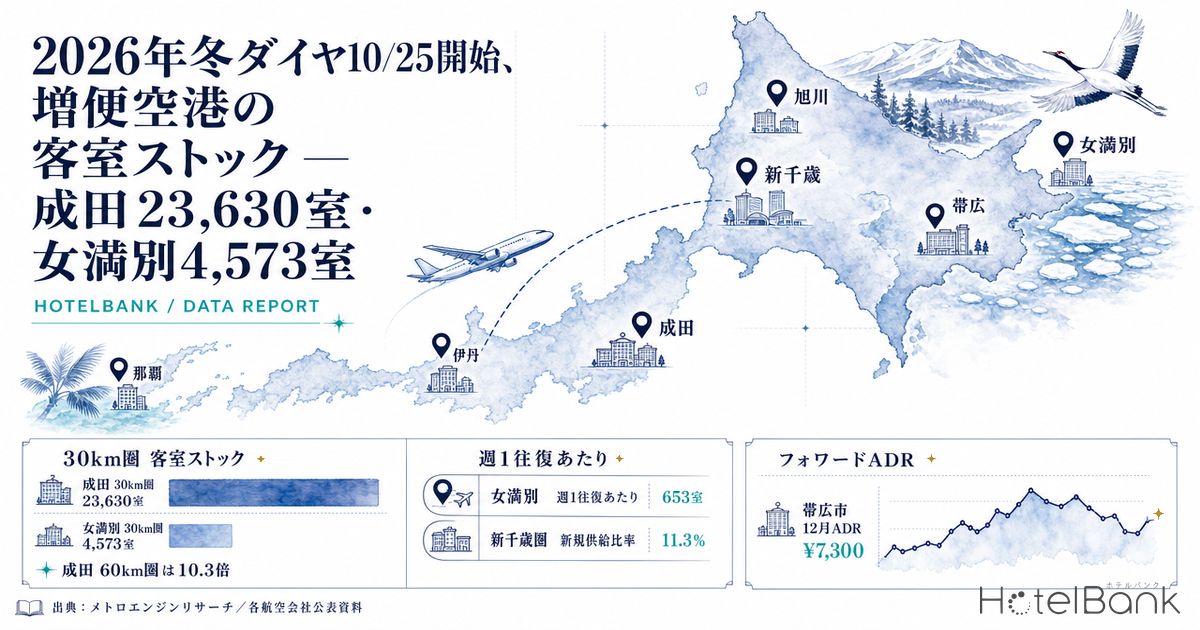
Japan’s FY2026 winter flight schedule begins on Sunday, October 25, 2026 and runs through Saturday, March 27, 2027. Across that window, a run of new routes and added frequencies — international and domestic — has been set at Tokyo (Narita), Sapporo (New Chitose), Naha and Osaka (Itami), together with the Hokkaido points they connect to: Asahikawa, Obihiro and Memanbetsu. More seats can mean more people landing in those airport zones. The question is where the rooms that would receive them actually sit, and how many there are.
This article does not claim that “more seats equals more accommodation demand.” It first organizes the announced schedule changes airport by airport from carriers’ published materials, then tabulates the accommodation properties tracked by MetroEngines Research within 30km and 60km radii of each airport to compare the depth of room stock as a supply-side inventory check. Forward prices for October 2026 through January 2027 are set alongside them, separating the zones with room left to absorb arrivals from those where rates already sit at a high level.
- — 653 rooms per weekly round trip — Among the airport zones gaining frequencies this winter, Memanbetsu has the thinnest 30km room stock. Obihiro follows at 792 rooms and Asahikawa at 1,174.
- — Narita is 10.3x larger at 60km — 23,630 rooms within 30km against 243,122 rooms within 60km. The receiving base sits in central Tokyo rather than around the airport, and the per-round-trip figure shifts from 1,182 rooms to 12,156.
- — Itami 8,799 rooms, Naha 5,921 — Against additions of 21 and 7 weekly round trips respectively, in-zone stock is an order of magnitude thicker. The question is not whether arrivals can be housed but how rates should be set.
- — Eastern Hokkaido supply is not moving — 36 new rooms at Asahikawa, 31 at Obihiro and 30 at Memanbetsu, equal to 0.4–0.7% of existing stock. Each zone will absorb its added 7 weekly round trips with the rooms it already has.
- — Forward ADR is splitting in two — Matsumoto at ¥15,900 and Ota Ward at ¥15,100 sit at the top, while Narita City at ¥9,400 and Asahikawa at ¥9,400 fall below ¥10,000 (all estimated transacted ADR as of October 2026).
Metric Definitions Used in This Article
- ADR (average daily rate): An estimated transacted rate (tax-exclusive equivalent) calculated by applying segment-specific adjustment coefficients to the lowest publicly listed plan level each property posts on OTAs and similar channels (double occupancy, per-room rate, tax included). Cross-checked against property-level actuals disclosed by listed hotel REITs (91 properties, most recent three months), the median error is approximately 7%. These are estimates and differ from each property’s actual transacted prices and accounting figures. Area-level ADR is the median across the covered properties (the level of a typical property in that area).
- Listed price: The average per-room price across all plans posted on OTAs and similar channels (two guests per room, tax included). Because its basis differs from ADR, it is labeled explicitly as “listed price” throughout this article.
- Room stock: The total number of rooms at accommodation properties with a registered room count, within the coverage tracked by MetroEngines Research. Zones are cut by straight-line distance from the center point of each airport’s runway.
- Data sources: MetroEngines Research; materials published by the individual airlines
What Grows Under the Winter Schedule — New Routes and Added Frequencies by Airport
First, the new routes and added frequencies that could be confirmed from carriers’ published materials, organized by airport. Frequencies are stated as weekly round trips as a rule. For routes where aircraft seat counts have not been published, only frequency is shown and no seat conversion is made.
| Airport | Route / carrier | Weekly round trips | Start date |
|---|---|---|---|
| Narita | Narita–Chicago (United Airlines, new) | 7 | Oct 24 |
| Narita–Tel Aviv (Arkia Israeli Airlines, new) | 2 | Oct 25 | |
| Narita–Shanghai (Pudong) (JAL Group, resumed) | 7 | Oct 25 | |
| Narita–Melbourne (JAL Group, moving to daily) | +4 | Oct 25 | |
| New Chitose | New Chitose–San Francisco (United Airlines, new seasonal) | 3 | Dec 11 |
| Naha | Naha–Taipei (Taoyuan) (Japan Transocean Air, to two round trips daily) | +7 | Oct 25 |
| Itami (to Hokkaido) | Itami–Asahikawa (JAL, converted to year-round / one round trip daily) | 7 | Oct 25 |
| Itami–Obihiro (JAL, new / one round trip daily) | 7 | Dec 1 | |
| Itami–Memanbetsu (JAL, converted to year-round / one round trip daily) | 7 | Feb 1 |
Source: Compiled by the HotelBank Editorial Team from materials published by the carriers (JAL corporate site, United Airlines press releases, TRAICY, sky-budget, Tabiris)
Narita differs from the other airports in that three route launches overlap. United Airlines adds a Chicago service on a daily basis from October 24, and Arkia Israeli Airlines opens a Tel Aviv route on October 25 with two weekly round trips. The Tel Aviv service was initially announced for A330-200 operation and is a rare scheduled link between Japan and Israel. The JAL Group resumes Narita–Shanghai (Pudong), completing a structure that serves Shanghai from Haneda, Narita and Kansai. Narita–Melbourne also moves to daily service during the winter schedule.
On China routes, Spring Japan has opened winter-schedule sales for four services out of Narita — Shanghai (Pudong), Beijing (Capital), Harbin and Tianjin — so seat supply on the Narita side thickens across several carriers at once. Adding up only the services whose frequencies can be pinned down from published materials, 20 weekly round trips are layered onto Narita.
At regional airports, by contrast, the restructuring of domestic services takes the lead. In its second-half FY2026 plan, JAL reshuffles its Hokkaido routes out of Itami: Itami–Obihiro launches on December 1, while the previously summer-only Itami–Asahikawa converts to year-round operation from October 25 and Itami–Memanbetsu does the same from February 1, 2027. All three run one round trip daily, or seven weekly. Frequency ranges on Itami’s New Chitose and Naha routes have also been raised, making Itami an airport that takes on a substantial reshuffle this winter as the “sending” side.
Separately, Fuji Dream Airlines has set a seasonal Sendai–Izumo service for the 2026 winter schedule and will run Shizuoka–Izumo, Shizuoka–Kumamoto and Kobe–Aomori over the year-end and New Year period. At Shizuoka and Matsumoto, rather than year-round scheduled services being added, the change is mainly a reshuffle toward seasonal and limited-period operations. In the sections that follow, these two airport zones serve as a control group of “zones where seats do not increase on a year-round basis.”
Room Stock in the Airport Zones — The Tiers Visible at 30km and 60km
Next, the receiving side. Radii of 30km and 60km were cut from each airport’s coordinates, and properties with a registered room count were tabulated. The 30km zone corresponds roughly to “accommodation reachable within an hour of the airport,” the 60km zone to “the wider area that could be chosen as a base for a multi-night stay.” The same approach applied across 20 regional airports and their international-service zones is covered in Winter Schedule Oct 25: Do 20 Regional Airports Have Enough Rooms?.
Source: Compiled by the HotelBank Editorial Team from MetroEngines Research
| Airport | 30km properties | 30km rooms | 60km properties | 60km rooms | 30km segment mix (room basis) |
|---|---|---|---|---|---|
| Narita | 516 | 23,630 | 3,872 | 243,122 | Business 40% / City 32% / Vacation rental 8% |
| New Chitose | 175 | 7,525 | 895 | 59,738 | Business 56% / City 14% / Resort 7% |
| Naha | 1,430 | 41,444 | 2,510 | 55,852 | Business 38% / Resort 28% / City 7% |
| Itami | 2,661 | 184,772 | 8,172 | 298,974 | Business 56% / City 18% / Vacation rental 5% |
| Asahikawa | 363 | 8,215 | 715 | 14,019 | Business 51% / Resort 10% / Ryokan 9% |
| Obihiro | 128 | 5,543 | 210 | 6,644 | Business 56% / Ryokan 18% / City 7% |
| Memanbetsu | 127 | 4,573 | 304 | 8,880 | Business 66% / Ryokan 11% / Resort 6% |
| Shizuoka (reference) | 354 | 14,090 | 1,173 | 34,413 | Business 68% / City 10% / Ryokan 6% |
| Matsumoto (reference) | 984 | 19,304 | 3,798 | 62,724 | Business 35% / Ryokan 28% / Resort 6% |
Source: Compiled by the HotelBank Editorial Team from MetroEngines Research (only properties with a registered room count are tabulated)
The tiers are clear. The Itami zone alone exceeds 180,000 rooms within 30km, because that circle takes in the entire urban stock of Osaka, Kobe and Amagasaki. Setting Haneda aside, it is one of the largest concentrations in Japan, and passengers landing at Itami can in practice choose from the rooms of the whole Kansai region. The Naha zone, at 41,444 rooms within 30km, is strikingly thick relative to the local population. What characterizes Okinawa’s main island is that widening to 60km only lifts the count to 55,852 — Naha’s stock is concentrated almost entirely in and immediately around Naha City.
Narita is the counterpoint. Its 30km zone holds only 23,630 rooms, but the 60km zone jumps 10.3x to 243,122 as central Tokyo’s stock enters the circle. The long-recognized structure — that the base receiving Narita arrivals sits downtown rather than near the airport — is confirmed in the numbers.
Obihiro (5,543 rooms within 30km) and Memanbetsu (4,573) are the thinnest among the airports gaining frequencies this winter. Widening to 60km lifts them only to 6,644 and 8,880 rooms respectively (+19.9% for Obihiro, +94.2% for Memanbetsu), and no wide-area concentration of the Narita kind appears. Eastern Hokkaido has long distances between cities, so extending the radius brings no new core accommodation cluster into the circle. On segment mix, the Memanbetsu zone is 66% business on a room basis and Obihiro 56% — limited-service, lodging-focused properties dominate in both.
Source: Compiled by the HotelBank Editorial Team from MetroEngines Research
Room Stock per Weekly Round Trip — Thinnest at Memanbetsu, Obihiro and Asahikawa
Now the added seat supply is set against room stock. Here we calculate how many rooms sit within 30km per weekly round trip added at each airport. The denominator covers only the new and added services whose frequencies could be identified in the table above (Itami counts the three new or year-round-converted routes, or 21 weekly round trips); aircraft type and load factor are not considered. It is a coarse measure of depth — how many rooms stand behind a single flight.
Source: Compiled by the HotelBank Editorial Team from MetroEngines Research
The thinnest is Memanbetsu at 653 rooms per weekly round trip, followed by Obihiro at 792, Asahikawa at 1,174 and Narita at 1,182. At the other end, Itami stands at 8,799 rooms and Naha at 5,921 — in-zone stock an order of magnitude thicker than the frequencies being added.
Narita’s figure of 1,182 rooms needs care in interpretation. Computed on the 60km zone, Narita comes to 12,156 rooms per weekly round trip, and the ranking reverses entirely. Narita’s “thinness” is therefore confined to the airport’s immediate surroundings: so long as rail access to central Tokyo functions, the effective receiving base is deep. Memanbetsu and Obihiro, by contrast, reach only 1,268 and 949 rooms per round trip even at 60km. These are the only two airport zones that fail to reach 1,300 rooms per round trip even when the radius is widened to 60km.
That gap feeds directly into operating plans during the winter schedule. Itami–Memanbetsu launches on February 1, 2027, overlapping the drift-ice season, eastern Hokkaido’s peak demand period. With existing stock limited to 4,573 rooms, a direct service from Kansai arriving into that base gives existing properties room to pull booking lead times forward and to revisit their rate design. Obihiro’s December 1 launch likewise starts alongside year-end and New Year travel and homecoming demand.
Forward Prices, October to January — Zones Where Rates Lead, and Where Headroom Remains
Turning to the price side, the estimated transacted ADR and listed price for a representative city in each airport zone are set out for October, November and December 2026 and January 2027, the months covered by the winter schedule. All are estimates based on selling prices posted on OTAs as of the survey date and will move as the check-in date approaches.
Source: Compiled by the HotelBank Editorial Team from MetroEngines Research
| Representative city (airport) | Oct 2026 ADR | Dec 2026 ADR | Jan 2027 ADR | Oct 2026 listed price | N (Oct / Jan) |
|---|---|---|---|---|---|
| Matsumoto (Matsumoto) | ¥15,900 | ¥12,000 | ¥12,200 | ¥30,600 | 99 / 62 |
| Ota Ward (Haneda) | ¥15,100 | ¥14,900 | ¥12,000 | ¥23,800 | 54 / 51 |
| Chitose (New Chitose) | ¥14,100 | ¥13,700 | ¥14,700 | ¥23,700 | 26 / 21 |
| Chuo Ward, Sapporo (New Chitose, wider zone) | ¥13,900 | ¥16,300 | ¥15,200 | ¥25,300 | 136 / 120 |
| Kita Ward, Osaka (Itami) | ¥12,000 | ¥11,100 | ¥10,500 | ¥22,400 | 71 / 63 |
| Obihiro (Obihiro) | ¥11,100 | ¥7,300 | ¥7,600 | ¥17,000 | 31 / 21 |
| Naha (Naha) | ¥10,200 | ¥10,700 | ¥10,000 | ¥16,600 | 141 / 130 |
| Kitami (Memanbetsu) | ¥9,900 | ¥8,700 | ¥9,900 | ¥16,200 | 26 / 20 |
| Shimada (Shizuoka) | ¥9,800 | ¥9,500 | ¥10,600 | ¥19,400 | 11 / 6 |
| Asahikawa (Asahikawa) | ¥9,400 | ¥8,700 | ¥11,600 | ¥22,600 | 32 / 30 |
| Narita City (Narita) | ¥9,400 | ¥9,600 | ¥9,200 | ¥17,200 | 28 / 24 |
Source: Compiled by the HotelBank Editorial Team from MetroEngines Research. ADR is the estimated transacted ADR; listed price is the all-plan average (two guests per room, tax included). N is the number of properties covered in the estimated transacted ADR calculation
Ranked on October levels, Matsumoto (¥15,900) and Ota Ward (¥15,100) sit at the top, followed by Chitose (¥14,100) and Chuo Ward, Sapporo (¥13,900). The zones already at high rate levels are those with thick year-round accommodation demand and a wide range of travel options on both international and domestic services. Chuo Ward, Sapporo shows the classic winter-uplift pattern at ¥16,300 in December and ¥15,200 in January, and United Airlines’ New Chitose–San Francisco launch on December 11 lands squarely inside that rising-rate window.
At the other end, Narita City (¥9,400 in October), Asahikawa (¥9,400), Shimada (¥9,800) and Kitami (¥9,900) sit below ¥10,000. The gap to listed price is also wide: Narita City shows an ADR of ¥9,400 against a listed price of ¥17,200, and Asahikawa an ADR of ¥9,400 against ¥22,600. That gap reflects both the persistence of high-rate plans on OTAs and the fact that what actually sells is the cheapest band. These read as zones with rate headroom still to be captured.
Asahikawa in particular steps up toward the back half of winter: ¥9,400 in October and ¥8,700 in December against ¥11,600 in January 2027 (N=30 properties). The year-round conversion of Itami–Asahikawa begins October 25, so the direct service from Kansai is added over November and December, when rates are falling. Obihiro likewise softens in winter at ¥7,300 in December and ¥7,600 in January, meaning the Itami route launching December 1 opens a new inbound channel right at the trough in prices. Where the rate levels of both cities stand nationally is examined on an annual ADR basis in Why Hotels Feel Expensive in Obihiro, Fukui & Okayama: 393-City Check.
⚠ Note on ADR for future dates: The ADR figures for October 2026 onward in this article are estimates based on selling prices posted on OTAs as of the survey date, and they move as the check-in date approaches. Current levels will not necessarily become transacted levels. Please also note that month-to-month swings are larger in zones with a small number of covered properties (N).
New Supply in 2026–2027 — Building Up at Naha and Chitose, Static in Eastern Hokkaido
Finally, new properties confirmed as operating from 2026 onward were tabulated for each airport’s 30km zone. Because OTA listings appear several months ahead of opening, the most recent months and beyond may rise as further listings are posted.
| Airport (30km zone) | New properties | New rooms | Ratio to existing rooms |
|---|---|---|---|
| Naha | 23 | 1,791 | 4.3% |
| New Chitose | 12 | 851 | 11.3% |
| Itami | 42 | 3,307 | 1.8% |
| Narita | 14 | 308 | 1.3% |
| Matsumoto | 19 | 214 | 1.1% |
| Asahikawa | 23 | 36 | 0.4% |
| Obihiro | 2 | 31 | 0.6% |
| Memanbetsu | 1 | 30 | 0.7% |
Source: Compiled by the HotelBank Editorial Team from MetroEngines Research & Consulting (based on confirmed OTA listings). Note: because listings appear several months before opening, the most recent months and beyond may rise as further listings are posted
The largest ratio is the New Chitose zone at 11.3%. In central Chitose, limited-service properties with hot-spring facilities have been added in succession, and 200-room-class openings such as Super Hotel Premier Chitose Natural Hot Spring (スーパーホテルPremier千歳天然温泉, 212 rooms) and Comfort Hotel Chitose (コンフォートホテル千歳, 201 rooms) are confirmed as operating in 2026. An addition of 851 rooms against existing stock of 7,525 is meaningful depth for a base immediately adjacent to the airport. It also aligns in timing with the December San Francisco launch, so supply and seats point in the same direction.
The Naha zone is the largest in absolute terms at 1,791 rooms, centered on resort properties around Shurijo Castle and city hotels in central Naha, several of them in the 300-room class. The Grand Castle Naha Shurijo by Hewitt Resort (ザ グランドキャッスル 那覇 首里城 by ヒューイットリゾート, 333 rooms) is listed as scheduled to open at the end of 2026. That coincides with the move to two daily round trips on Naha–Taipei, making this a zone where the room side is being refreshed to receive travelers from Taiwan.
Asahikawa (36 rooms), Obihiro (31) and Memanbetsu (30), by contrast, show almost no movement in new supply. The Asahikawa zone does count 23 properties, but most are small operations of one to six rooms, and on a room basis they amount to just 0.4% of existing stock. The three airport zones each gaining seven weekly round trips this winter will all absorb that increase with their existing rooms. Read the other way, existing properties in these zones have considerable room to capture the demand as it starts to build.
Conclusion — The Playbook Splits Between “Thick” and “Thin” Zones
Organizing the FY2026 winter schedule’s new routes and added frequencies by airport and matching them against room stock, three types emerge.
First, zones thick in both seats and rooms. Itami (184,772 rooms within 30km) and Naha (41,444) fall here. Stock per weekly round trip is 8,799 and 5,921 rooms respectively, leaving ample capacity to absorb the added frequencies. The question in these zones is not whether arrivals can be housed but where to set rates. Forward ADR in Kita Ward, Osaka eases gradually from ¥12,000 in October to ¥10,500 in January 2027, while Naha City moves in a narrow ¥10,200–¥10,700 band — the direction of rate design differs by zone.
Second, zones thin around the airport but thick across the wider area. Narita is the representative case, widening 10.3x from 23,630 rooms within 30km to 243,122 within 60km. Against 20 added weekly round trips, the 30km zone offers 1,182 rooms per round trip, but the 60km figure is 12,156. Given that Narita City’s ADR sits around ¥9,400, below ¥10,000, properties close to the airport that can create a reason to stay without heading into central Tokyo have headroom to lift rates.
Third, zones where seats grow but room stock does not. These are the Asahikawa, Obihiro and Memanbetsu zones. Against seven added weekly round trips each on the Itami routes, rooms within 30km number 8,215, 5,543 and 4,573 respectively, and new supply from 2026 onward stays at 0.4–0.7%. What characterizes these three is that even widening to 60km leaves them at roughly 950 to 2,000 rooms per round trip. Forward ADR stands at ¥9,400 in Asahikawa (October) and ¥11,100 in Obihiro, both below the levels of Hokkaido’s larger cities. For existing properties, pulling booking lead times forward from the launch date and preparing stay proposals aimed at travelers who could not previously reach them without a direct service translates directly into rate headroom.
More seats and more accommodation demand are not the same thing. But knowing in advance how many rooms sit in each airport zone, and what they are selling for now, will make decisions during the winter schedule measurably faster.
Frequently Asked Questions
When does the FY2026 winter schedule run?
From Sunday, October 25, 2026 through Saturday, March 27, 2027. The new routes and added frequencies covered in this article are those set within that period.
What does “room stock per weekly round trip” measure?
It is a coarse depth measure: the number of rooms within 30km divided by the weekly round trips added at that airport under the winter schedule. Aircraft seat counts and load factors are not considered. It is used as a rough basis for comparing across airports how many rooms stand behind a single flight.
How should the 30km and 60km zones be used?
The 30km zone corresponds roughly to “accommodation reachable within an hour of the airport,” the 60km zone to “the wider area that could be chosen as a base for a multi-night stay.” Where the two diverge by 10.3x, as at Narita, the effective receiving base needs to be read at 60km. Naha is the opposite: 41,444 rooms within 30km against 55,852 within 60km, a small gap, with stock concentrated around Naha City.
Does more seat supply mean more accommodation demand?
This article does not equate added seats with added demand. Added frequencies are a supply-side setting; actual accommodation demand depends on load factors, travelers’ purposes, length of stay and other factors. This article is an inventory check of the depth of room stock available to receive arrivals in each airport zone.
Are the ADR figures confirmed actuals?
No. ADR figures for October 2026 onward are estimated transacted rates (two guests per room, per-room, tax-exclusive equivalent) based on selling prices posted on OTAs as of the survey date, and they move as the check-in date approaches. Please also note that month-to-month swings are larger in zones with a small number of covered properties (N).
What are the options in airport zones with thin room stock?
In zones such as Asahikawa, Obihiro and Memanbetsu, where new supply amounts to only 0.4–0.7% of existing stock, the added frequencies will be absorbed by existing properties. Pulling booking lead times forward from the launch date and preparing stay proposals aimed at travelers who could not previously reach the area without a direct service translates directly into rate headroom.
Related Reading
- Winter Schedule Oct 25: Do 20 Regional Airports Have Enough Rooms?
- Why Hotels Feel Expensive in Obihiro, Fukui & Okayama: 393-City Check
- Rental-Car Inbound: Parking Mentioned 2.9x More in Traditional Chinese
- Regional Japan: 61.7% of Rooms, 33.7% of Inbound Nights, 16.5% Growth
- Japan Inbound July 2026: 3.44M Arrivals, 41.7–42.8M Full-Year Range
- Matsumoto ADR ¥13,400 vs ¥18,300 Ceiling: Absorbing 222 New Rooms
- Hakodate Station Land +10.3%, Goryokaku Flat: 226 Hotels, 11,449 Rooms
References and Sources
■ Data sources
Property counts, room counts and segment mix for the airport zones were extracted from the accommodation property master within radii of 30km and 60km centered on the center point of each airport’s runway, tabulating only properties with a registered room count. Forward estimated transacted ADR and listed price come from the same source’s monthly area-level tabulations (October 2026 – January 2027, 18 representative cities and wards). Frequencies and launch dates are from materials published by the individual airlines and from news reporting.
■ Calculation assumptions
Frequencies are stated as weekly round trips as a rule, and no seat conversion is made for routes whose aircraft seat counts have not been published. “Room stock per weekly round trip” is the number of rooms within 30km divided by the weekly round trips added at that airport (Narita 20, Itami 21, Naha 7, New Chitose 3, Asahikawa 7, Obihiro 7, Memanbetsu 7). Estimated transacted ADR is stated on a two-guests-per-room, per-room, tax-exclusive-equivalent basis; listed price is the all-plan average (two guests per room, tax included). Area-level ADR is the median across the covered properties.
■ Limitations and caveats
ADR figures for October 2026 onward are estimates based on selling prices as of the survey date and move as the check-in date approaches. Zones with a small number of covered properties (N) — Shimada at N=11 / 6, for example — show larger month-to-month swings. New supply is based on confirmed OTA listings, so the most recent months and beyond may rise as further listings are posted. Load factors, travelers’ length of stay and connections between airports are not considered, and an increase in seat supply does not mean an increase in accommodation demand.
■ Airlines and news reporting
- JAL, “Partial revision to the JAL Group’s second-half FY2026 route and frequency plan” (Japan Airlines, August 18, 2026)
- JAL, “JAL/JTA decide the FY2026 international route and frequency plan” (Japan Airlines)
- JAL, “Partial revision to FY2026 international routes, frequencies and in-flight services” (Japan Airlines, June 11, 2026)
- “JAL sharply increases Itami Airport’s Hokkaido and Okinawa services: Obihiro launch, Asahikawa and Memanbetsu go year-round” (Tabiris, August 18, 2026)
- “JAL domestic: Itami routes strengthened, Obihiro added, JTA returns after 19 years — second-half FY2026 plan” (Aviation Wire)
- “United Airlines launches Sapporo–San Francisco nonstop and Tokyo/Narita–Chicago service” (United Airlines, Inc. press release via PR TIMES)
- “United Airlines: Sapporo launch in December, Narita–Chicago from October” (Aviation Wire)
- “Arkia Israeli Airlines opens Tokyo/Narita–Tel Aviv route, two weekly round trips from October 25” (TRAICY)
- “Arkia Israeli Airlines to launch Tokyo/Narita–Tel Aviv service on October 25, 2026” (sky-budget)
- “Spring Japan opens sales for the FY2026 winter schedule” (NEWSCAST)
- “[FDA] Routes, frequencies and fares from Sunday, October 25, 2026” (Fuji Dream Airlines Co., Ltd. via PR TIMES, August 18, 2026)
- “Operations and fares for the FY2026 winter schedule (Sunday, October 25, 2026 – Saturday, March 27, 2027)” (Skymark)
- “JAL targets inbound capture in its second-half FY2026 plan, including added Haneda–Hong Kong frequencies” (Honichi Lab)
■ Market data
- MetroEngines Research — accommodation property master (property counts, room counts and segment mix within 30km / 60km airport radii)
- MetroEngines Research — area-level estimated transacted ADR and listed price (forward, October 2026 – January 2027)
- MetroEngines Research & Consulting — new-opening data (based on confirmed OTA listings)