


Imperial Hotel (帝国ホテル) has charged a 15% service charge at its Tokyo, Osaka and Kamikochi hotels since April 2022, and The Okura Tokyo was reported to have raised its rate from 10% to 15% on July 1 of the same year. Because this percentage is added on top of the room rate, it also feeds into the calculation of consumption tax and accommodation tax, so the gap between 10% and 15% shows up in the guest’s total bill as more than the five points on the rate card. In Tokyo, the accommodation tax switches to a flat 3% of the accommodation charge from April 1, 2027, and the Tokyo Metropolitan Government’s guidebook states explicitly that service charges are included in the tax base. This article confirms the definition and tax treatment of service charges from primary sources, builds up the total bill for two cases (room rates of ¥50,000 and ¥100,000), and, together with rate data for Tokyo’s upper-tier hotel categories, sets out the issues for operators.
• ADR (average daily rate) = estimated settled rate (tax-excluded equivalent), calculated by applying a category-specific adjustment factor to the lowest-plan level each property publishes on OTAs (per-room price for 2 guests, tax-included). Cross-checked against property-level results disclosed by listed hotel REITs (91 properties, most recent 3 months), the median error is about 7%. These are estimates and differ from each property’s actual settled prices and accounting figures.
• Area-level ADR (prefecture / municipality) is the median of the estimated settled rates of the properties covered (the level of a typical property in the area).
• Where listed prices are mentioned, they are per-room prices for 2 guests (tax-included).
• OCC (occupancy) = share of rooms sold relative to total rooms in the area (estimate based on OTA sales inventory).
• Source: MetroEngines Research (continuously tracks OTA published prices for about 168,000 properties in Japan, of which about 27,000 are confirmed active)
- — Imperial Hotel set its service charge at 15% in Tokyo, Osaka and Kamikochi from April 2022, and The Okura Tokyo moved from 10% to 15% on July 1 of the same year (press reports).
- — In 2023, Hotel Okura Kyoto (15% for stays from September 1) and Tokyu Hotels (12%, 13% and 15% by brand) followed.
- — Under Tokyo’s flat 3% accommodation tax starting April 1, 2027, the tax base is the per-person, per-night accommodation charge including service charge and excluding consumption tax.
- — For one room, two guests and a ¥100,000 room rate, the total bill is ¥124,300 at a 10% service charge and ¥129,950 at 15% — a difference of ¥5,650 per night.
- — The estimated ADR of Tokyo city hotels was about ¥31,700 in October 2026 (N=109 properties). When comparing rates, the display basis — service charge included, or tax and service charge excluded — must be aligned.
What a Service Charge Is — Billed Regardless of the Guest’s Wishes, and Treated Separately from Tips
Let us start with the definition. A hotel service charge is a fee billed by applying a fixed percentage to the room rate or food and beverage charges, and it differs in nature from tips or gratuities that guests give voluntarily. The clearest statement of this line comes from the Tokyo Metropolitan Government Bureau of Taxation’s “Accommodation Tax Guidebook (revised ordinance edition).” For the “accommodation charge” that forms the tax base, the guidebook includes, in addition to the room charge, “bedding fees, cleaning fees, bathing fees, nightwear fees, heating and cooling fees, etc. that are billed regardless of the guest’s wishes,” and goes on to state that “service charges, etc. related to these are also included.” On the other hand, “gratuities, tips, congratulatory gifts, etc. paid voluntarily by guests” are listed as items not included in the accommodation charge. In other words, whether a charge depends on the guest’s own choice is the criterion that separates a service charge from a tip.
The tax treatment is also worth setting out. Article 28 of the Consumption Tax Act defines the tax base as “the amount of consideration for taxable transfers of assets, etc.,” so a service charge that is always billed as consideration for the stay is subject to consumption tax together with the room rate. On price display, the Ministry of Finance’s “Main Questions on Tax-Inclusive Price Display” addresses businesses that receive a fixed percentage of a transaction amount as a fee or service charge, explaining that the rate need not be changed if the underlying transaction amount is a tax-inclusive price. As the National Tax Agency’s Tax Answer No. 6902 explains, the tax-inclusive display obligation covers prices that businesses show to consumers in advance, regardless of medium, including websites. The starting point of this issue is that a single percentage — the service charge — spans three systems: consumption tax, accommodation tax and price display.
Revision Cases — Imperial Hotel and The Okura Tokyo Moved to 15% in 2022; Kyoto and Tokyu Hotels Followed in 2023
Next, we line up the revision cases whose year and month could be confirmed through official announcements and press reports. The travel outlet TRAICY reported on June 17, 2022 that The Okura Tokyo would raise its service charge from 10% to 15% from July 1, and in the same article noted that Imperial Hotel had raised its rate to 15% at its Tokyo, Osaka and Kamikochi hotels from April, and that 15% had become the norm among foreign-brand luxury hotels in Tokyo. Nikkei (日本経済新聞) also reported on October 24, 2022 that major hotels such as Imperial Hotel, Hotel New Otani (ホテルニューオータニ) and The Okura Tokyo had raised their service charges from 10% to 15% that year. 2022 can thus be described as the year Japan’s flagship hotels aligned their rate with that of top foreign brands.
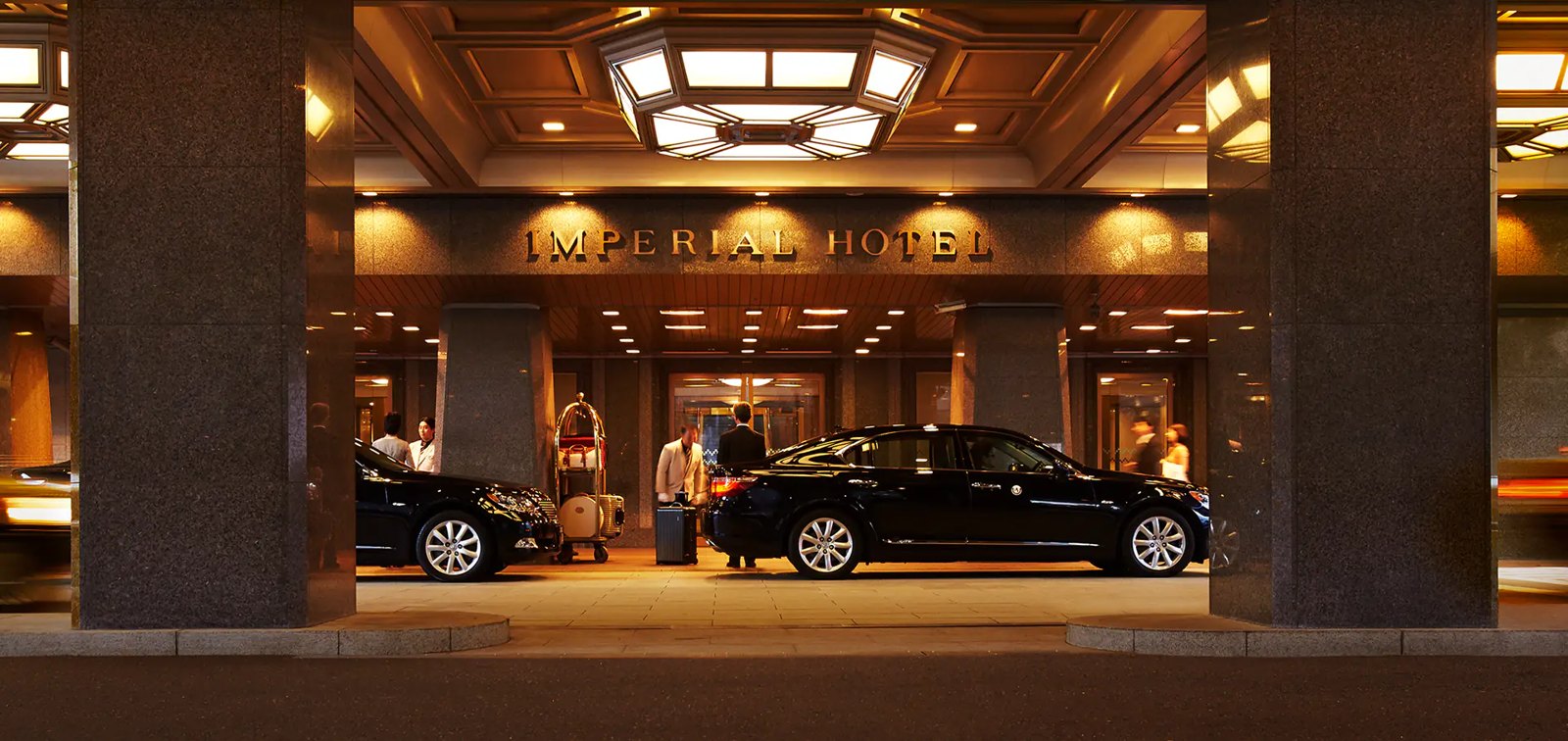
In 2023 the movement spread. Hotel Okura Kyoto (ホテルオークラ京都) announced in an official notice that it would change its service charge from 10% to 15% for stays from September 1, 2023, citing “creating an environment where guests can use the hotel safely and securely, and maintaining and improving service and quality.” Nikkei reported that from April 2023 Tokyu Hotels (東急ホテルズ) would raise Cerulean Tower Tokyu Hotel and Yokohama Bay Hotel Tokyu from 13% to 15%, and Excel Hotel Tokyu from 10% to 12%, designing its rates in tiers according to each brand’s positioning. The rate is not uniform; it is being used as a design variable that expresses each brand’s service level.
| Hotel / operator | Effective | Service charge rate | Sources checked |
|---|---|---|---|
| Imperial Hotel (Tokyo, Osaka, Kamikochi) | April 2022 | 10%→15% | TRAICY (June 17, 2022), Nikkei (October 24, 2022) |
| The Okura Tokyo | July 1, 2022 | 10%→15% | TRAICY (June 17, 2022) |
| Hotel New Otani | 2022 (month not stated in report) | 10%→15% | Nikkei (October 24, 2022) |
| Tokyu Hotels (Cerulean Tower Tokyu Hotel, Yokohama Bay Hotel Tokyu) | April 2023 | 13%→15% | Nikkei (October 24, 2022) |
| Tokyu Hotels (Excel Hotel Tokyu) | April 2023 | 10%→12% | Nikkei (October 24, 2022) |
| Hotel Okura Kyoto | Stays from September 1, 2023 | 10%→15% | The hotel’s “Notice of Service Charge Revision” (September 1, 2023) |
Source: Compiled by HotelBank Editorial Team from company announcements and press reports (as of each revision; check each hotel’s official website for current rates)
Building Up the Total — About 1.30× the Room Rate at 15%, About 1.24× at 10%
So how does the difference in rates show up in the total bill? The usual calculation order is to add the service charge to the room rate, apply 10% consumption tax to that sum, and finally add the accommodation tax. Tokyo’s accommodation tax becomes 3% of the accommodation charge for stays from April 1, 2027; the tax base is the per-person, per-night accommodation charge (rounded down to the nearest ¥100), including service charge and excluding consumption tax. As a formula: total = room rate × (1 + service charge rate) × 1.10 + room rate × (1 + service charge rate) × 3%. Ignoring rounding, the guest pays about 1.243× the room rate at a 10% service charge and about 1.300× at 15%. Effective dates and rates for Tokyo and other municipalities are compiled in our list of accommodation tax revisions for 2026-27.
The table and chart below apply this to two cases for one room and two guests: room rates of ¥50,000 and ¥100,000. At ¥50,000, the total is ¥62,150 with a 10% service charge versus ¥64,972 with 15%, a difference of ¥2,822. That breaks down into ¥2,500 of service charge itself, ¥250 of consumption tax and ¥72 of accommodation tax, so the five-point service charge gap translates into a total difference of about 5.6% of the room rate. At ¥100,000, the totals are ¥124,300 and ¥129,950, and the gap widens to ¥5,650.
Source: HotelBank Editorial Team estimates based on the calculation method in the Tokyo Metropolitan Government Bureau of Taxation’s “Accommodation Tax Guidebook (revised ordinance edition)” (1 room, 2 guests, 1 night; assumes Tokyo on or after April 1, 2027)
| Item | ¥50k · 10% | ¥50k · 15% | ¥100k · 10% | ¥100k · 15% |
|---|---|---|---|---|
| Room rate (per room, excl. tax and service charge) | ¥50,000 | ¥50,000 | ¥100,000 | ¥100,000 |
| Service charge | ¥5,000 | ¥7,500 | ¥10,000 | ¥15,000 |
| Consumption tax (10%) | ¥5,500 | ¥5,750 | ¥11,000 | ¥11,500 |
| Per-person tax base (rounded down to ¥100) | ¥27,500 | ¥28,700 | ¥55,000 | ¥57,500 |
| Accommodation tax (3%, 2 guests) | ¥1,650 | ¥1,722 | ¥3,300 | ¥3,450 |
| Total bill (from April 2027) | ¥62,150 | ¥64,972 | ¥124,300 | ¥129,950 |
| Reference: total under current accommodation tax (¥200 per person) | ¥60,900 | ¥63,650 | ¥121,400 | ¥126,900 |
Source: HotelBank Editorial Team estimates based on materials published by the Tokyo Metropolitan Government Bureau of Taxation (room only, excluding meals; no subsidies, etc.)
In addition, under the flat-rate system the service charge rate also enters the accommodation tax calculation. Under the current fixed-amount system, the tax is a flat ¥200 for stays of ¥15,000 or more per person per night, so the accommodation tax did not move when the service charge rate changed. From April 2027, the same ¥100,000 room rate produces accommodation tax of either ¥3,300 or ¥3,450. The exemption threshold also looks different: the ¥13,000 per person per night threshold is judged including service charge, so converted to a room rate for two guests per room, the taxable line falls at about ¥23,600 for a 10% property and about ¥22,600 for a 15% property. The move to a flat rate makes clearer that the service charge is both “part of the price” and “the basis of the tax calculation.” For a comparison of the accommodation tax system itself, see our analysis of Tokyo’s switch to a flat 3% accommodation tax.
Rates in Tokyo’s Upper-Tier Categories — City Hotel Estimated ADR About ¥31,700 in October
Next, we look at rate levels in the upper-tier categories, where many properties set a service charge. According to MetroEngines Research data, the estimated ADR of city hotels in Tokyo was about ¥31,700 in October 2026 (N=109 properties), essentially flat at −0.7% YoY against about ¥32,000 in the same month of the previous year (N=106 properties). April, the spring peak, was also about ¥31,200 in 2026 versus about ¥31,100 in 2025, +0.5% YoY, so peak-month rates have settled in the low ¥30,000s. Applying the earlier formula, room rates at this level exceed the ¥13,000 per-person exemption threshold even with two guests, so from April 2027 most stays are likely to fall under the flat 3% tax.
Source: Compiled by HotelBank Editorial Team from MetroEngines Research (Tokyo city hotels, estimated settled ADR, tax-excluded equivalent, N=104–110 properties per month; November–December 2026 are estimates based on listed levels at the time of research)
Moving up a price tier, the listed price (all-plan average, tax-included) of deluxe hotels in Tokyo was about ¥129,600 in October 2026 (N=55 properties), +14.0% YoY from about ¥113,700 in the same month of the previous year (N=52 properties). Note that this category is outside the scope of the estimated ADR calculation, so it can only be tracked by listed price. In price bands above ¥100,000 per room, as the previous section’s estimate shows, a five-point service charge difference becomes a total difference in the ¥5,000s per night. In this band, designing the service charge rate carries as much weight as designing the room rate itself.
Source: Compiled by HotelBank Editorial Team from MetroEngines Research (Tokyo deluxe hotels, listed price, all-plan average, tax-included, N=49–58 properties per month; November–December 2026 are listed levels at the time of research)
However, when comparing rate data from a service charge perspective, the display basis must be aligned. Whether a listed price includes service charge varies by booking site and plan, and it cannot be determined uniformly from the data in this article. Definitions in disclosure documents should also be checked. For example, Japan Hotel REIT Investment Corporation (ジャパン・ホテル・リート投資法人, 8985) notes in its asset management report for the period ended December 2025 that ADR is “room revenue including service charges divided by the number of rooms sold.” Depending on whether you are comparing ADRs that include service charge or comparing against room rates excluding tax and service charge, an apparent gap of more than 10% can arise for a 15% property. Note that the ADR in this article is an estimate (median error of about 7% against REIT-disclosed results); settled ADR disclosed by REITs is shown excluding consumption tax, and the estimated settled ADR in this article is also at a tax-excluded equivalent level.
Implications for Operators — An Opportunity to Communicate the Total and Give the Rate Meaning
Putting this together, the issues for operators come down to three. The first is how to communicate the total. Because the service charge, consumption tax and accommodation tax are each applied to a different base, it takes effort for guests to calculate the total themselves. Showing the “total per room per night” alongside its breakdown early in the booking flow widens the room for guests to choose based on whether the total feels justified rather than on whether the rate is high or low. The move to the flat 3% tax will be a natural moment to review price display. How much the property actually keeps after taxes and fees are deducted from what the guest pays is analyzed in detail in our per-night stack of taxes and fees with a channel-by-channel comparison.
The second is giving the rate meaning. Just as Hotel Okura Kyoto cited creating a safe environment and maintaining and improving service and quality as reasons for its revision, the service charge is a fee that can be explained in connection with the level of personal service provided. Clarifying internally its role as a funding source for recruiting and training staff, and putting that into words externally as well, lays the groundwork for guests to accept a rate revision positively. Tokyu Hotels’ example of tiering rates at 12%, 13% and 15% by brand is a useful reference for designing the rate as part of a brand architecture.
The third is communication with international guests. For guests from cultures where tipping is decided case by case, a system in which a fixed-rate service charge is built into the price in advance and no extra gratuity is expected can be a strength in terms of clarity. As Tokyo’s guidebook clearly separates service charges from tips, the two are also distinct under the rules. English-language rate displays should show the “service charge” rate together with the fact that tipping is not necessary. Precisely because the total difference grows in higher price bands, careful explanation becomes an opportunity to sustain rates while also delivering satisfaction.
Frequently Asked Questions
Q. What is Imperial Hotel’s service charge?
A. According to press reports, Imperial Hotel has set its service charge at 15% at its Tokyo, Osaka and Kamikochi hotels since April 2022. Before that it was 10%. For current rates and plan-by-plan treatment, the company’s official website is the most reliable source.
Q. Is consumption tax charged on the service charge?
A. Yes. Because the service charge is billed as part of the consideration for the stay, the combined amount with the room rate is subject to consumption tax.
Q. Does Tokyo’s accommodation tax apply to the service charge?
A. The Tokyo Metropolitan Government Bureau of Taxation’s guidebook states explicitly that the accommodation charge includes the service charge. From April 1, 2027, the tax is 3% of the per-person, per-night accommodation charge including service charge and excluding consumption tax (rounded down to the nearest ¥100), and stays below ¥13,000 are not taxed.
Q. What is the difference between a service charge and a tip?
A. A service charge is billed at a fixed rate regardless of the guest’s wishes, while tips and gratuities are paid voluntarily by the guest. In the accommodation tax calculation as well, the former is included in the accommodation charge and the latter is not.
Q. Can an ADR that includes service charge be compared directly with a room rate excluding tax and service charge?
A. Not as-is. For example, Japan Hotel REIT Investment Corporation (8985) notes in its asset management report that its ADR is calculated from room revenue including service charges; set side by side with room rates excluding tax and service charge, an apparent gap of more than 10% can arise for a property with a 15% service charge. Before comparing, the treatment of service charge and consumption tax must be aligned.
Summary
A 15% service charge is the rate adopted by Imperial Hotel and The Okura Tokyo in 2022 that spread to Japan’s top hotels through 2023. In total-bill terms, a guest pays about 1.24× the room rate at a 10% property and about 1.30× at a 15% property — a difference of ¥5,650 per night at a ¥100,000 room rate. Because Tokyo’s flat 3% accommodation tax, starting in April 2027, applies to the accommodation charge including service charge, the rate also takes on meaning as the basis of the tax calculation. Readers of rate data should align display bases, and operators should put the total and the meaning of the rate into words. Both are the next step toward correctly conveying the value of the high-price segment.
⚠ Note on ADR for future dates: The ADR in this article is the average of selling prices published on OTAs at the time of research, and it changes as the check-in date approaches. Prices currently set high may fall due to last-minute discounting.
Related Articles
Further Reading
- A ¥13,600 Hotel Night Nets ¥10,000 — The Stack of Taxes and Fees and a Channel-by-Channel Comparison 2026
- Accommodation Tax Revisions 2026-27 | Effective Dates for Tokyo 3%, Niseko Flat Rate, New Oita Tax and Nagasaki Revision, and the Rate Bands Where Flat Rates Raise the Burden
- Tokyo’s Accommodation Tax Is ¥100 or ¥200 per Night, Exempt Under ¥10,000 | 3% from April 2027, with Guidelines by Hotel Type
- Japan’s Most Expensive Hotel Is Aman Tokyo | ¥423,000 Median per Night, the National Top 30 and High-Price Areas [2026]
- Kyoto City’s Accommodation Tax Has 5 Tiers from ¥200 to ¥10,000 | Higashiyama, Shimogyo and Nakagyo Wards in the ¥1,000 Listed / ¥400 Settled Bands, Effective Rate 2.7–3.7%
References and Sources
■ Data sources
The definition of service charges and the accommodation tax base are based on the Tokyo Metropolitan Government Bureau of Taxation’s “Accommodation Tax Guidebook (revised ordinance edition, for April 2027 onward)”; the consumption tax base on Article 28 of the Consumption Tax Act; and tax-inclusive price display on materials published by the Ministry of Finance and the National Tax Agency. Revision cases are limited to those whose year and month could be confirmed in company announcements and press reports (TRAICY, Nikkei). Rates use MetroEngines Research’s estimated settled ADR for Tokyo city hotels (tax-excluded equivalent, N=104–110 properties per month) and listed prices for deluxe hotels (all-plan average, tax-included, N=49–58 properties per month).
■ Calculation assumptions
The total was calculated as “room rate × (1 + service charge rate) × 1.10 + accommodation tax.” The accommodation tax applies Tokyo’s flat 3% rate from April 1, 2027 to the per-person, per-night accommodation charge (including service charge, excluding consumption tax, rounded down to the nearest ¥100), apportioned across 1 room and 2 guests. Two room rate cases (¥50,000 and ¥100,000) and two service charge levels (10% and 15%) were used; meals, subsidies and discounts are not included.
■ Limitations and caveats
The estimates are illustrations of the calculation method; actual charges vary with each property’s rounding and plan structure. Revision cases reflect the content at the time of revision, and current rates should be checked on each hotel’s official website. Estimated ADR is an estimate and differs from each property’s actual settled prices; whether listed prices include service charge varies by booking site and plan, so this article does not determine it from the data. Values for November–December 2026 are based on listed levels at the time of research.
■ Regulations and public materials
- Tokyo Metropolitan Government Bureau of Taxation, “Review of the Accommodation Tax” (Japanese)
- Tokyo Metropolitan Government Bureau of Taxation, “Accommodation Tax Guidebook (revised ordinance edition, for April 2027 onward)” (Japanese)
- Tokyo Metropolitan Government Bureau of Taxation, “For Accommodation Operators” (Japanese)
- Ministry of Finance, “Main Questions on Tax-Inclusive Price Display” (Japanese)
- National Tax Agency, Tax Answer No. 6902 “Mandatory Tax-Inclusive Price Display” (Japanese)
- Consumption Tax Act (Article 28, Tax Base) (Japanese)
■ Company announcements and press reports
- TRAICY, “The Okura Tokyo raises service charge to 15% from July” (June 17, 2022, Japanese)
- Nikkei, “Tokyu Hotels to raise service charge rates in spring 2023” (October 24, 2022, Japanese)
- Hotel Okura Kyoto, “Notice of Service Charge Revision” (September 1, 2023, Japanese)
- Japan Hotel REIT Investment Corporation, Asset Management Report (period ended December 2025, English)
■ Market data
- MetroEngines Research — estimated settled ADR for Tokyo city hotels (N=104–110 properties per month) and listed prices for Tokyo deluxe hotels (N=49–58 properties per month), January 2024–December 2026