

When a guest checks out of a Japanese onsen inn, the bill includes two taxes the property collects on top of the room rate and passes on to local government: the bathing tax (nyutozei) and the lodging tax (shukuhakuzei). In 2026, Hokkaido and Nagano launched prefecture-level lodging taxes, and on October 1 Nasu Town introduces a tiered lodging tax. Percentage-based schemes have started in Kutchan Town (3% from April 2026) and Nozawa Onsen Village (3.5% from June 2026), and Tokyo will switch to a flat 3% rate on April 1, 2027. The mix of taxes collected per night now differs widely from one onsen town to the next.
In this article we checked the bathing tax and lodging tax amounts, schemes and start dates for 19 municipalities with major onsen resorts on each municipality’s official website. Using MetroEngines Research’s estimated settled ADR (the 12 finalized months from September 2025 to August 2026) as the denominator, we built up how much bathing tax + lodging tax + consumption tax comes to per room-night in yen and as a share of the room rate. We then split the 1,152 properties in scope into price bands to show why flat per-person taxes take a larger share at lower-priced inns. We do not argue for or against the taxes; the aim is to turn them into practical inputs for price display and cost accounting.
Metric Definitions Used in This Article
- ADR (Average Daily Rate): An estimated settled rate (tax-exclusive equivalent) calculated by applying a property-type adjustment factor to the lowest-plan rate each property publishes on OTAs (per room, two guests per room, tax-inclusive). Checked against property-level results disclosed by listed hotel REITs (91 properties, most recent three months), the median error is about 7%. These are estimates and differ from each property’s actual transaction prices and accounting figures. Area-level ADR is the median of properties in scope (the level of a typical property in the area). Where listed prices are mentioned, they are per-room rates for two guests (tax-inclusive).
- Effective burden rate: Tax per room-night for two guests (bathing tax and lodging tax = per-person amount × 2 guests) ÷ estimated settled ADR. Consumption tax is added as 10% of the estimated settled ADR (tax-exclusive equivalent).
- Price band: Classification by each property’s estimated settled ADR (per room, 12-month average): under ¥10,000 / ¥10,000–20,000 / ¥20,000–30,000 / over ¥30,000.
- Data source: MetroEngines Research (period: the 12 finalized months from September 2025 to August 2026). Tax amounts and start dates are from materials published by each municipality and the Ministry of Internal Affairs and Communications (as of September 28, 2026).
- — The bathing tax is a statutory earmarked municipal tax (standard rate ¥150), while the lodging tax is a non-statutory tax created by prefectures and municipalities through local ordinance. Properties collect both as special collection agents, but the rules on how the revenue is used and how rates are set differ
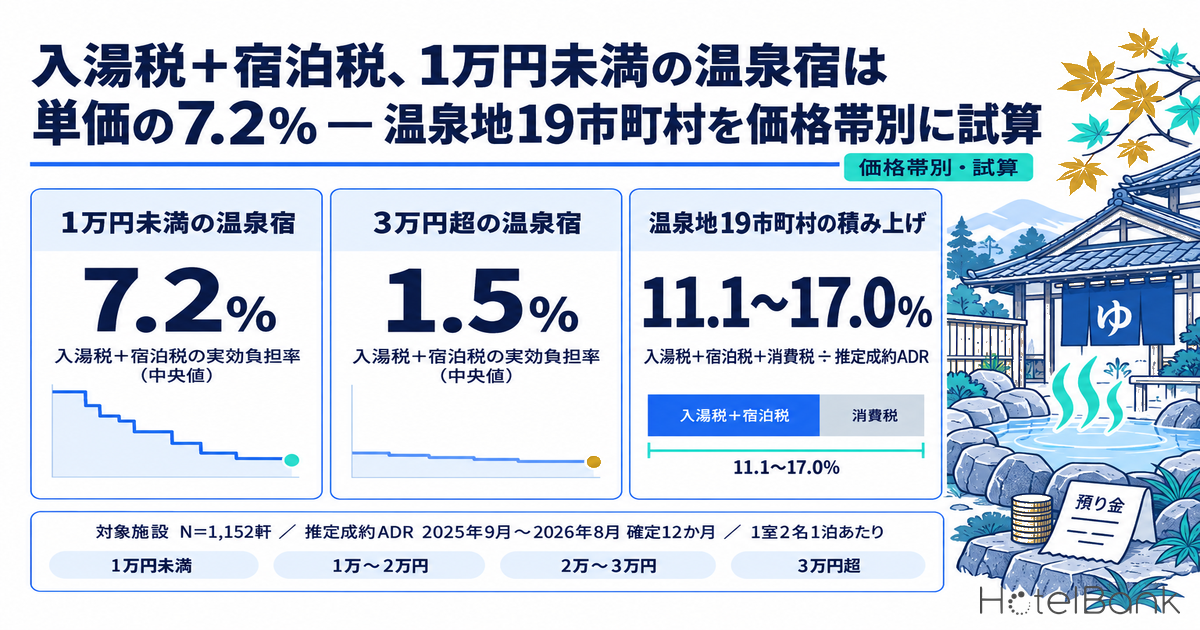
- — Across the 19 municipalities, the combined burden (bathing tax + lodging tax + consumption tax) is 11.1–17.0% of estimated settled ADR. Excluding the 10% consumption tax, the range runs from 1.1% (Hakone, current rules) to 7.0% (Hakodate)
- — By price band, the median effective burden of bathing tax + lodging tax is 7.2% for properties under ¥10,000 and 1.5% for those over ¥30,000. Flat per-person taxes take a larger share the lower the room rate (N=1,152 properties)
- — Only Kutchan (3%) and Nozawa Onsen (3.5%) use a percentage rate. Niseko Town and Akaigawa Village use tiered flat amounts, so schemes differ even within the same Shiribeshi region of Hokkaido
- — Tax amounts should sit outside revenue and cost as funds held in trust, and be displayed as “tax-inclusive rate + bathing/lodging tax charged separately”. As percentage rates spread, separating the room-only portion from the meal portion becomes a prerequisite for calculating the tax
Bathing Tax vs. Lodging Tax — Both Are Collected by the Property, but Who Levies Them, How They Are Used and How Rates Are Set Differ
The bathing tax is a statutory earmarked tax levied by municipalities under the Local Tax Act. According to the Ministry of Internal Affairs and Communications (MIC), the levying body is the municipality where the mineral-spring bath is located, the rate is “¥150 per person per day as the standard,” and inns and similar facilities collect it from bathers as special collection agents and pay it to the municipality. Its use is restricted to environmental sanitation facilities, protection and management of hot spring sources, firefighting facilities and tourism promotion (MIC “Local Tax System: Bathing Tax”). Municipalities may set rates above the ¥150 standard by ordinance — examples include ¥350 in Aizuwakamatsu and ¥300 in Ito, Higashi-Izu and Noboribetsu. Conversely, Toyako Town (¥300→¥100) and Hakodate (¥150→¥100) cut their bathing taxes in April 2026 when lodging taxes were introduced.
The lodging tax, by contrast, is a non-statutory tax with no dedicated item in the Local Tax Act; prefectures and municipalities create it by ordinance and levy it with the consent of the Minister for Internal Affairs and Communications. Most are non-statutory earmarked taxes restricted to tourism promotion, but the ordinance Hakone Town submitted to its September 2026 regular council session would be Japan’s first lodging tax structured as a non-statutory general tax with no restriction on use (a proposed ¥350 per person per night). Rates are set in three ways: a flat amount (e.g. ¥200 per person per night), tiered flat amounts by room rate, or a percentage of the room rate.
The bathing tax targets the act of bathing in a hot spring; the lodging tax targets the act of staying overnight. So a property without a hot spring does not charge bathing tax, and day-trip bathing is not subject to lodging tax. Children are treated separately too: in Nozawa Onsen Village, for example, the bathing tax exempts children under 12 (Nozawa Onsen Village “Bathing Tax”), while the lodging tax exempts stays for educational activities and sets a tax-free threshold of under ¥6,000 per person per night on a room-only basis (Nozawa Onsen Village “About the Lodging Tax”). For one family’s single night, the two taxes run separate taxable/exempt tests.
| Item | Bathing tax | Lodging tax |
|---|---|---|
| Legal basis | Local Tax Act (statutory tax) | Each body’s ordinance (non-statutory tax, Minister’s consent) |
| Levying body | Municipalities only | Prefectures and municipalities (some levy at both levels) |
| Taxable activity | Bathing at a mineral-spring bath (both overnight and day-trip) | Overnight stays at ryokan, hotels, etc. (many bodies also include private lodging/minpaku) |
| Rate | Standard ¥150 per person per day; may be raised or lowered by ordinance | Set by ordinance: flat / tiered flat / percentage |
| Use of revenue | Environmental sanitation, hot spring source protection, firefighting, tourism promotion (by statute) | Mostly tourism promotion (earmarked by ordinance); Hakone’s proposal is a general tax |
| Collection | Property collects as special collection agent and files/pays to the municipality | Property collects as special collection agent and files/pays to the levying body; in Hokkaido some towns also collect the prefectural portion |
| Consumption tax treatment | Not included in the consumption tax base if received separately | Generally treated the same way, as funds held in trust |
Source: Compiled by HotelBank Editorial Team from MIC “Local Tax System: Bathing Tax”, municipal publications, and National Tax Agency “Basic Circular on the Consumption Tax Act 10-1-11”
Tax Rates in 19 Onsen Municipalities — Only Kutchan and Nozawa Onsen Use a Percentage Rate
The table below lists bathing tax and lodging tax amounts, schemes and start dates for 19 municipalities with major onsen resorts, plus two reference bodies: Tokyo, which has decided to move to a percentage rate, and Akaigawa Village, home to Kiroro. All amounts are per person per night, and the source column shows the official pages we checked.
Hokkaido’s Mount Yotei area is often described collectively as a “percentage-rate region.” However, Hokkaido’s rate list (as of March 1, 2026) shows that only Kutchan Town uses a percentage rate: from April 1, 2026 the town collects “3% of the accommodation charge (including the prefectural portion)” in a single levy (Kutchan Town). Niseko Town uses five tiers of flat amounts from ¥5,000 or less up to ¥100,000 or more, and Akaigawa Village uses four tiers (Hokkaido “Lodging Tax Rate List”). Among percentage-rate onsen towns, Nozawa Onsen Village in Nagano has charged 3.5% of the accommodation charge since June 1, 2026 (5% from June 2029), and MIC’s consent notice also gives the rate as “5% of the accommodation charge (3.5% for the first three years)” (MIC “New Lodging Tax in Nozawa Onsen Village, Nagano”). This 3.5% is reported to include the Nagano prefectural lodging tax portion (Shinano Mainichi Shimbun, November 29, 2025).
| Municipality (main onsen area) | Bathing tax (overnight, per person per night) | Lodging tax (per person per night, by room-rate band) | Scheme | Start date | Source |
|---|---|---|---|---|---|
| Sapporo (Jozankei Onsen) Hokkaido | ¥150 (day trip ¥100) | Prefecture + city combined: under ¥20,000 ¥300 / ¥20,000–under ¥50,000 ¥400 / ¥50,000+ ¥1,000 | Tiered flat (prefecture + city) | April 1, 2026 | Sapporo “Bathing Tax” Hokkaido “Lodging Tax Rate List” |
| Hakodate (Yunokawa Onsen) Hokkaido | ¥100 (changed from ¥150 on April 1, 2026) | Prefecture + city combined: under ¥20,000 ¥200 / ¥20,000–under ¥50,000 ¥400 / ¥50,000–under ¥100,000 ¥1,000 / ¥100,000+ ¥2,500 | Tiered flat (prefecture + city) | April 1, 2026 | Hakodate “Bathing Tax Overview” Hokkaido “Lodging Tax Rate List” |
| Noboribetsu (Noboribetsu Onsen) Hokkaido | Standard overnight ¥300 (since April 1, 2020); day trip ¥50 | Hokkaido lodging tax only: under ¥20,000 ¥100 / ¥20,000–under ¥50,000 ¥200 / ¥50,000+ ¥500 | Tiered flat (prefecture) | April 1, 2026 | Noboribetsu “Bathing Tax Increase” Hokkaido “Lodging Tax Rate List” |
| Toyako Town (Toyako Onsen) Hokkaido | ¥100 (changed from ¥300 on April 1, 2026) | Town + prefecture combined: under ¥20,000 ¥300 / ¥20,000–under ¥50,000 ¥700 / ¥50,000+ ¥1,500 | Tiered flat (town + prefecture) | April 1, 2026 | Toyako Town “Bathing Tax” Toyako Town “Introduction of the Lodging Tax” |
| Niseko Town Hokkaido | ¥150 (day trip ¥100) | Town + prefecture combined: ¥5,000 or less ¥200 / ¥5,001–under ¥20,000 ¥300 / ¥20,000–under ¥50,000 ¥700 / ¥50,000–under ¥100,000 ¥1,500 / ¥100,000+ ¥2,500 | Tiered flat (town + prefecture) | Town tax November 1, 2024 / prefectural tax April 1, 2026 | Niseko Town “Bathing Tax” Hokkaido “Lodging Tax Rate List” |
| Kutchan Town (Niseko Hirafu) Hokkaido | ¥150 (day trip ¥70) | 3% of the accommodation charge (including the prefectural portion) | Percentage | Town tax November 1, 2019 (raised from 2% to 3% on April 1, 2026) | Kutchan Town “Bathing Tax” Kutchan Town “Kutchan Lodging Tax” |
| Akaigawa Village (Kiroro) Hokkaido | — (not verified for this article) | Village + prefecture combined: under ¥8,000 ¥100 / ¥8,000–under ¥20,000 ¥300 / ¥20,000–under ¥50,000 ¥700 / ¥50,000+ ¥1,000 | Tiered flat (village + prefecture) | Prefectural tax April 1, 2026 | Hokkaido “Lodging Tax Rate List” |
| Sendai (Akiu and Sakunami Onsen) Miyagi | ¥150 (day trip ¥70) | Prefecture + city combined ¥300 (no tax on room-only rates under ¥6,000 excl. tax) | Flat (prefecture + city) | January 13, 2026 | Sendai “Bathing Tax” Miyagi Prefecture “Lodging Tax” |
| Aizuwakamatsu (Higashiyama and Ashinomaki Onsen) Fukushima | ¥350 (special rate, October 1, 2025–September 30, 2035) | None | — | — | Aizuwakamatsu “Bathing Tax” |
| Nasu Town (Nasu Onsen) Tochigi | ¥150 (day trip ¥50) | Under ¥10,000 ¥100 / ¥10,000–under ¥20,000 ¥300 / ¥20,000–under ¥30,000 ¥500 / ¥30,000–under ¥50,000 ¥800 / ¥50,000–under ¥100,000 ¥1,500 / ¥100,000+ ¥3,000 | Tiered flat | October 1, 2026 | Nasu Town “Bathing Tax” Nasu Town “Lodging Tax” |
| Kusatsu Town Gunma | ¥150 if base room charge over ¥6,000, ¥100 if ¥6,000 or less (day trip ¥50) | None | — | — | Kusatsu Town “About the Bathing Tax” |
| Hakone Town Kanagawa | ¥150 (day trip ¥50) | ¥350 per person per night (proposed ordinance, submitted to the September 2026 council session) | Flat (non-statutory general tax) | To be set by regulation after the Minister’s consent | Hakone Town “Bathing Tax” Hakone Town Council “September 2026 Regular Session” |
| Yugawara Town Kanagawa | ¥150 (day trip ¥100) | Under ¥50,000 ¥300 / ¥50,000+ ¥500 | Tiered flat | April 1, 2026 | Yugawara Town “Other Town Taxes” Yugawara Town “About the Lodging Tax” |
| Atami Shizuoka | ¥150 | Flat ¥200 | Flat | April 1, 2025 | Atami “Bathing Tax” Atami “Lodging Tax Overview” |
| Ito Shizuoka | Overnight ¥300, day trip ¥150 (since October 1, 2025) | None | — | — | Ito “Bathing Tax” |
| Higashi-Izu Town (Atagawa and Inatori Onsen) Shizuoka | ¥300 (March 1, 2025–February 28, 2035) | None | — | — | Higashi-Izu Town “Bathing Tax” |
| Nozawa Onsen Village Nagano | ¥150 (day trip ¥50) | 3.5% of the accommodation charge (5% from June 1, 2029; no tax on room-only rates under ¥6,000 excl. tax) | Percentage | June 1, 2026 | Nozawa Onsen Village “Bathing Tax” Nozawa Onsen Village “About the Lodging Tax” |
| Hakuba Village Nagano | ¥150 (day trip ¥50) | Prefecture + village combined: ¥6,000–under ¥20,000 ¥200 / ¥20,000–under ¥50,000 ¥400 / ¥50,000–under ¥100,000 ¥900 / ¥100,000+ ¥1,900 (until May 31, 2029) | Tiered flat (prefecture + village) | June 1, 2026 | Hakuba Village “Bathing Tax” Hakuba Village “Lodging Tax Guide” |
| Gero (Gero Onsen) Gifu | ¥150 (day trip ¥100) | Room-only under ¥5,000 ¥100 / ¥5,000+ ¥200 | Tiered flat | October 1, 2025 | Gero “Bathing Tax Overview” Gero “About the Lodging Tax” |
| Beppu Oita | Tiered by accommodation and dining charge (per person per day, excl. tax): ¥6,001–¥50,000 ¥250 / ¥50,001+ ¥500, etc. | Oita prefectural lodging tax enacted; start date not yet set | Tiered flat (prefecture) | Not yet set | Beppu “Bathing Tax” Oita Prefecture “Lodging Tax System” |
| Tokyo (reference) Tokyo | Varies by ward/city/town (outside the scope of this article) | Current: ¥10,000–under ¥15,000 ¥100 / ¥15,000+ ¥200 → from April 1, 2027, 3% of the accommodation charge (no tax under ¥13,000) | Moving to percentage | April 1, 2027 (percentage rate) | Tokyo Bureau of Taxation “Lodging Tax Review” |
Source: Compiled by HotelBank Editorial Team from materials published by each municipality and MIC (linked in the source column). As of September 28, 2026. Room-rate bands follow each ordinance’s definition (in most cases the room-only, tax-exclusive charge per person per night)
The list shows that onsen-town tax combinations fall into four broad types. Type 1 has a bathing tax but no lodging tax (Aizuwakamatsu, Kusatsu, Ito, Higashi-Izu, Beppu); three of these have raised the bathing tax to ¥300–350 (our analysis of bathing tax increases). Type 2 stacks a flat lodging tax on top of the bathing tax (Atami, Sendai). Type 3 adds a tiered flat lodging tax (various Hokkaido municipalities, Nasu, Yugawara, Hakuba, Gero). Type 4 adds a percentage-based lodging tax (Kutchan, Nozawa Onsen). Beppu has a tiered bathing tax, and Oita Prefecture has enacted a lodging tax ordinance whose start date is not yet set (Oita Prefecture “Lodging Tax System”).
Source: Compiled by HotelBank Editorial Team from municipal publications and MetroEngines Research. Circle size = effective burden of bathing tax + lodging tax (share of estimated settled ADR)
Per-Night Build-Up — Bathing Tax + Lodging Tax + Consumption Tax Equals 11–17% of the Room Rate
Next, we assumed two guests staying one night at a typical property in each onsen town (the median estimated settled ADR) and stacked up bathing tax, lodging tax and consumption tax. For tiered and percentage lodging taxes, we treated the per-person rate (estimated settled ADR ÷ 2) as the accommodation charge. Because Hakone’s lodging tax is still only a proposed ordinance, we calculated Hakone under current rules (bathing tax only).
Source: Compiled by HotelBank Editorial Team from MetroEngines Research (estimated settled ADR is the 12-month average of finalized months, September 2025–August 2026; tax amounts from municipal publications)
| Onsen area | Estimated settled ADR (per room, 12-month avg.) | N (properties) | Bathing tax (2 guests) | Lodging tax (2 guests) | Consumption tax 10% | Total per room | Share of ADR (bathing + lodging tax) |
|---|---|---|---|---|---|---|---|
| Hakodate | ¥8,556 | 80–88 | ¥200 | ¥400 | ¥856 | ¥1,456 | 17.0% (7.01%) |
| Aizuwakamatsu | ¥10,039 | 38–40 | ¥700 | ¥0 | ¥1,004 | ¥1,704 | 17.0% (6.97%) |
| Toyako Town | ¥13,794 | 13–15 | ¥200 | ¥600 | ¥1,379 | ¥2,179 | 15.8% (5.80%) |
| Nozawa Onsen Village | ¥13,195 | 15–26 | ¥300 | ¥462 | ¥1,320 | ¥2,082 | 15.8% (5.77%) |
| Sendai, Taihaku Ward (Akiu) | ¥18,080 | 20–22 | ¥300 | ¥600 | ¥1,808 | ¥2,708 | 15.0% (4.98%) |
| Hakuba Village | ¥14,285 | 32–50 | ¥300 | ¥400 | ¥1,428 | ¥2,128 | 14.9% (4.90%) |
| Yugawara Town | ¥20,608 | 50–59 | ¥300 | ¥600 | ¥2,061 | ¥2,961 | 14.4% (4.37%) |
| Noboribetsu | ¥18,794 | 14–15 | ¥600 | ¥200 | ¥1,879 | ¥2,679 | 14.3% (4.26%) |
| Niseko Town | ¥21,748 | 7–10 | ¥300 | ¥600 | ¥2,175 | ¥3,075 | 14.1% (4.14%) |
| Kutchan Town | ¥27,542 | 20–24 | ¥300 | ¥826 | ¥2,754 | ¥3,880 | 14.1% (4.09%) |
| Gero | ¥17,497 | 42–49 | ¥300 | ¥400 | ¥1,750 | ¥2,450 | 14.0% (4.00%) |
| Sapporo, Minami Ward (Jozankei) | ¥22,932 | 22–25 | ¥300 | ¥600 | ¥2,293 | ¥3,193 | 13.9% (3.92%) |
| Beppu | ¥15,660 | 113–126 | ¥500 | ¥0 | ¥1,566 | ¥2,066 | 13.2% (3.19%) |
| Ito | ¥20,573 | 120–128 | ¥600 | ¥0 | ¥2,057 | ¥2,657 | 12.9% (2.92%) |
| Higashi-Izu Town | ¥20,756 | 46–49 | ¥600 | ¥0 | ¥2,076 | ¥2,676 | 12.9% (2.89%) |
| Atami | ¥24,594 | 99–108 | ¥300 | ¥400 | ¥2,459 | ¥3,159 | 12.8% (2.85%) |
| Nasu Town | ¥19,863 | 49–54 | ¥300 | ¥200 | ¥1,986 | ¥2,486 | 12.5% (2.52%) |
| Kusatsu Town | ¥17,644 | 77–92 | ¥300 | ¥0 | ¥1,764 | ¥2,064 | 11.7% (1.70%) |
| Hakone Town | ¥26,385 | 170–187 | ¥300 | ¥0 | ¥2,638 | ¥2,938 | 11.1% (1.14%) |
Source: Compiled by HotelBank Editorial Team from MetroEngines Research. N is the number of properties used to calculate estimated settled ADR (monthly minimum–maximum). Estimates assume two adults staying one night at a property with a hot spring (mineral-spring bath); not every property in a municipality charges bathing tax
Because the 10% consumption tax is proportional to the room rate, it adds the same share in every onsen town. The differences come from the bathing and lodging taxes, and the highest share is Hakodate at 7.0%. Its estimated settled ADR of ¥8,600 is the lowest of the 19 municipalities, so the ¥100 bathing tax plus ¥200 lodging tax (under-¥20,000 band) — ¥300 × 2 guests = ¥600 — is large relative to the rate. Aizuwakamatsu (ADR ¥10,000) also reaches 7.0% with a ¥350 bathing tax × 2 guests = ¥700; even without a lodging tax, the above-standard bathing tax alone brings it to the same level.
At the other end, the lowest shares are Hakone (1.1% under current rules) and Kusatsu (1.7%). Hakone has a high estimated settled ADR of ¥26,400 and no lodging tax yet, so only the ¥300 bathing tax (for two guests) applies. If the proposed ¥350 per person per night is added, that is ¥700 for two guests, or 2.65 percentage points more of ADR, bringing bathing + lodging tax to 3.8%. Kusatsu has no lodging tax, and its bathing tax is just ¥150 per person per night (¥100 where the base room charge is ¥6,000 or less).
In percentage-rate Kutchan, the lodging tax for two guests is about ¥830 on an estimated settled ADR of ¥27,500, and together with the bathing tax the share is 4.1%. Compared with flat-rate Atami (ADR ¥24,600, 2.9%), the share is 1.2 points higher despite a similar price level. Because a 3% rate does not fall as a share when prices rise, the gap with flat-rate towns widens the higher the onsen town’s prices.
Effective Burden by Price Band — 7.2% Under ¥10,000, 1.5% Over ¥30,000
Comparing area medians hides the differences within each onsen town. So we split the 1,152 properties in the 19 municipalities for which we could calculate estimated settled ADR into four price bands by each property’s 12-month average ADR, calculated the bathing + lodging tax effective burden for each property, and took the median.
Source: Compiled by HotelBank Editorial Team from MetroEngines Research (properties in the 19 municipalities with a calculable estimated settled ADR; price band based on each property’s 12-month average ADR)
In the under-¥10,000 band (N=240 properties, median ADR about ¥7,400), bathing + lodging tax takes 7.2% of the room rate, or 17.2% including consumption tax. In the over-¥30,000 band (N=272, median ADR about ¥40,000) the figure is 1.5%, and only 11.5% even including consumption tax. Each step up in price band brings the share down to roughly 50–60% of the level below, and the gap between the two ends is about 4.9x. Flat per-person taxes weigh more heavily the lower the room rate — a structure the price-band breakdown makes clear.
That said, the share does not always fall steadily as prices rise. In Nasu, the ¥20,000–30,000 band (3.9%) is higher than the ¥10,000–20,000 band (3.2%). Nasu’s lodging tax jumps from ¥100 to ¥300 per person at ¥10,000 per night, so the tax triples for properties charging more than ¥20,000 per room for two. In percentage-rate Nozawa Onsen, the tax-free threshold for room-only rates under ¥6,000 per person actually makes the lowest price band’s share lower. For taxes with tiers or tax-free thresholds, the share moves discontinuously near band boundaries.
| Onsen area | Under ¥10,000 | ¥10,000–20,000 | ¥20,000–30,000 | Over ¥30,000 |
|---|---|---|---|---|
| Hakone Town | 3.5% N=22 | 2.0% N=35 | 1.2% N=57 | 0.7% N=76 |
| Ito | 7.8% N=26 | 3.8% N=38 | 2.3% N=27 | 1.5% N=38 |
| Beppu | 3.1% N=35 | 2.9% N=49 | 2.2% N=26 | 1.4% N=16 |
| Atami | 8.4% N=13 | 4.5% N=31 | 2.7% N=26 | 1.8% N=36 |
| Kusatsu Town | 2.5% N=11 | 1.9% N=43 | 1.3% N=25 | 0.8% N=12 |
| Hakodate | 8.7% N=54 | 4.4% N=25 | 2.4% N=4 | 1.9% N=5 |
| Yugawara Town | 13.3% N=8 | 5.6% N=23 | 3.5% N=15 | 1.8% N=14 |
| Nasu Town | 6.4% N=6 | 3.2% N=21 | 3.9% N=12 | 2.7% N=14 |
| Gero | 5.2% N=10 | 4.8% N=20 | 2.8% N=10 | 1.7% N=10 |
| Higashi-Izu Town | 7.5% N=7 | 4.2% N=14 | 2.4% N=17 | 1.6% N=11 |
| Hakuba Village | 3.7% N=10 | 4.3% N=17 | 3.0% N=5 | 2.1% N=10 |
| Aizuwakamatsu | 10.8% N=19 | 4.8% N=11 | 3.1% N=5 | 1.9% N=3 |
| Sapporo, Minami Ward (Jozankei) | — N=2 | 6.8% N=8 | 3.6% N=8 | 2.6% N=6 |
| Nozawa Onsen Village | 3.8% N=6 | 5.4% N=12 | 4.6% N=5 | — N=1 |
| Kutchan Town | 7.0% N=3 | 5.6% N=3 | 4.1% N=9 | 3.6% N=8 |
| Sendai, Taihaku Ward (Akiu) | 4.4% N=4 | 6.7% N=7 | 3.9% N=4 | 2.5% N=5 |
| Noboribetsu | — N=1 | 4.8% N=7 | 3.6% N=6 | — N=1 |
| Toyako Town | 10.6% N=3 | 6.4% N=7 | — N=2 | 2.2% N=3 |
| Niseko Town | — N=0 | 5.5% N=4 | — N=2 | 2.3% N=3 |
| All 19 municipalities | 7.2% N=240 | 3.8% N=375 | 2.4% N=265 | 1.5% N=272 |
Source: Compiled by HotelBank Editorial Team from MetroEngines Research. Figures are the median property-level effective burden (bathing + lodging tax, two guests, one night) within each band. Bands with N<3 are shown as “—”
Flat, Tiered and Percentage Rates Produce Different Curves — ¥13,300 Is the Crossover Point
The chart below compares tax schemes by holding the bathing tax at ¥150 and changing only the lodging tax scheme. A flat rate (Atami model: ¥200 lodging tax) declines gently as a share as prices rise. A percentage rate (Kutchan model: 3%) is lower than the flat rate at low price points, overtakes it once the estimated settled ADR for two guests exceeds about ¥13,300, and then levels off toward a 3% floor. A tiered flat rate (Nasu model) jumps at each band boundary, producing a sawtooth shape.
From April 1, 2027, Tokyo will switch to 3% of the accommodation charge and exempt stays under ¥13,000 per person per night (Tokyo Bureau of Taxation “Lodging Tax Review”). If that scheme were applied to an onsen town, the lodging tax portion would jump from zero to 3% at ¥26,000 per room for two guests. Even within the shift to percentage rates, whether there is a tax-free threshold — and where it is set — changes the impact on each price band entirely.
Source: Compiled by HotelBank Editorial Team from municipal publications. Bathing tax of ¥150 per person per night in all cases; two guests per room. The Tokyo model is a hypothetical calculation applied to an onsen town
Collection in Practice — Treating Taxes as Funds Held in Trust, Display, OTA Bookings and Peak-Season Cash
For both the bathing tax and the lodging tax, the property acts as a “special collection agent,” collecting the tax from guests and filing and paying it by the deadline. The money passes outside the property’s P&L, so the basic accounting treatment is to record it as funds held in trust rather than revenue. On consumption tax, the National Tax Agency’s Basic Circular 10-1-11 states that the user is the taxpayer for the bathing tax, and that where the amount equivalent to the tax is clearly separated, it is not included in the consideration for taxable transfers of assets (National Tax Agency “Basic Circular on the Consumption Tax Act, Chapter 10, Section 1”). Showing the tax separately from the room charge on invoices and receipts is the basis both for the property’s consumption tax calculation and for guests’ own expense accounting.
| Practical item | Details (examples from official publications) | Municipalities checked |
|---|---|---|
| Registration | Register and file as a special collection agent for each property before opening. Toyako Town requires the filing at least five days before opening | Toyako Town |
| Combined prefectural tax | In Hokkaido, Kutchan and Toyako collect the prefectural lodging tax together with the town tax and file/pay it to the town in one lump. Invoicing and receipting the combined town + prefecture amount is sufficient | Kutchan, Toyako |
| Filing and payment deadlines | Bathing tax is due by the end of the following month in Kusatsu and Hakuba; lodging tax by the end of the following month in Atami. Nasu’s council approved an amendment to the town tax ordinance in September 2026, revising the bathing tax filing and payment deadline from October 1. Deadlines can differ by tax even at the same property | Kusatsu, Hakuba, Atami, Nasu |
| Special rules for small facilities | Hakuba’s bathing tax has a special filing and payment rule for mineral-spring baths whose payments from December two years prior to November of the prior year total ¥1.8 million or less. Tokyo is relaxing the requirements for quarterly special filing of the lodging tax | Hakuba, Tokyo |
| Collection incentives | Nagano Prefecture grants special collection agents 2.5% of amounts filed and paid on time (plus 0.5% for the first five years, and a further 0.5% for electronic filing). Kutchan raised its rate from 2.5% to 3.5% for filings from April 2026 through March 2031 | Nagano Prefecture, Kutchan |
| Electronic filing | A growing number of municipalities accept electronic filing and payment of bathing and lodging taxes via eLTAX (the local tax portal). Beppu has supported it since October 16, 2023 | Beppu, Kutchan |
Source: Compiled by HotelBank Editorial Team from materials published by Toyako, Kutchan, Kusatsu, Hakuba, Atami, Nasu, the Tokyo Bureau of Taxation, Nagano Prefecture (“Nagano Prefecture Lodging Tax System Overview”) and Beppu
Display. Separately from the all-inclusive room rate (including consumption tax), it is common to show the bathing tax and lodging tax as charged “separately.” The Tokyo Bureau of Taxation’s guest information likewise says the lodging tax “may be paid at the hotel or ryokan front desk separately from the travel price” (Tokyo Bureau of Taxation “Lodging Tax” page for businesses). With a flat tax, you can state the amount, e.g. “Bathing tax ¥150 and lodging tax ¥200 (per person per night) charged separately.” With a percentage tax, the amount varies with the room rate, so stating the formula — “Lodging tax: 3% of the accommodation charge (room-only, excl. tax) charged separately” — and adding sample amounts for representative plans makes explanations at checkout more consistent.
Bookings via OTAs and travel agencies. For bookings made through booking sites or travel agencies, prepayment typically covers the room rate (tax-inclusive) while bathing and lodging taxes are settled on site. In that case, the property should record the tax received on site separately from room revenue and be able to reconcile it with the number of guests and nights by booking channel. Under a percentage tax, the tax base must be calculated as the room-only equivalent — the prepaid amount minus meals and consumption tax — so keeping the room-only/meal breakdown of each plan consistent in the management system as well is what makes the tax amount reproducible.
Cash handling in peak season. During New Year and holiday periods, when checkouts are concentrated, the number of small cash payments of bathing and lodging tax rises. Totaling the tax held in trust daily, separately from the room-revenue till close, and reconciling the theoretical amount (guests × tax rate) with the amount actually received shortens the variance check at monthly filing. Because exempt guests such as children under 12, and guests on plans below the tax-free threshold, are judged by different criteria for the bathing tax and the lodging tax, holding exemption categories per tax in the front-desk system helps keep totals accurate.
Where Taxes Belong in Price Display and Cost Accounting — Pricing Design That Assumes Percentage Rates
Keep taxes out of cost accounting. Guests are the taxpayers for the bathing and lodging taxes; for the property they are funds held in trust. They should not be included in room-rate or room-cost calculations. What affects the P&L is the cost of collection (system changes, front-desk workload) and, on the other side, the incentives and grants paid by local governments. Keeping incentive rates — such as Kutchan’s 3.5% or Nagano’s up to 3.5% — alongside estimated collection costs in monthly management accounts provides a basis for staffing decisions as new taxes are added.
Know how each price band looks to guests. The guest’s total payment includes bathing and lodging taxes on top of consumption tax. In our estimates, bathing + lodging tax is 7.2% of the room rate at properties under ¥10,000 and 1.5% at properties over ¥30,000. When reviewing prices or new plans, comparing against competitors not only on the tax-inclusive rate but also on the total payment (tax-inclusive rate + bathing and lodging tax) captures the fact that the same tax-inclusive rate can mean a different total depending on the municipality’s scheme.
Know where the tier boundaries fall. In tiered schemes such as Nasu’s (¥10,000, ¥20,000, ¥30,000, ¥50,000, ¥100,000) or Hakodate’s (¥20,000, ¥50,000, ¥100,000), the per-person tax steps up when the room rate crosses a boundary. Properties with many plans near a boundary should list which plan falls in which band, which makes the work of updating tax displays at each price change clear. The tax base is the accommodation charge as defined by the ordinance (in most cases room-only, excluding tax), so separating the meal charge according to the ordinance’s definition is a prerequisite.
Design for percentage rates. Following Kutchan and Nozawa Onsen, Tokyo moves to a percentage rate in April 2027. Under a percentage tax, the tax tracks the room rate, so properties that change prices daily through dynamic pricing will also see the tax change daily. Generating the rate table and the tax calculation from the same master data, and using the same formula in booking confirmation emails, in-house signage and receipts, makes display and settlement easier to keep consistent. Lodging tax schemes are being revised municipality by municipality, so checking start dates and bands every year is also essential (our nationwide lodging tax list).
Methodology and Notes
Estimated settled ADR uses MetroEngines Research municipality-level data (average of the 12 finalized months from September 2025 to August 2026). Sapporo figures are for Minami Ward, which includes Jozankei Onsen, and Sendai figures for Taihaku Ward, which includes Akiu Onsen. The price-band analysis covers the 1,152 properties located in the 19 municipalities with at least six months of calculable estimated settled ADR. For tiered and percentage lodging taxes we treated half the estimated settled ADR as the per-person accommodation charge, but the tax base under the ordinances is the room-only, tax-exclusive charge, so at ryokan selling mainly meal-inclusive plans the actual band may be lower. Tiered and percentage lodging tax amounts should therefore be read as upper-end estimates. Bathing and lodging taxes were calculated for two adults with no exemptions.
Tax amounts, schemes and start dates are based on materials published by each municipality as of the survey date (September 28, 2026). Hakone’s lodging tax (still a proposed ordinance) and Oita’s lodging tax (start date not yet set) are not included in the build-up. Akaigawa Village was excluded from the build-up because only one or two properties were available for estimated settled ADR.
Frequently Asked Questions
Q. What is the difference between the bathing tax and the lodging tax?
A. The bathing tax is a statutory earmarked municipal tax under the Local Tax Act, levied on bathing at mineral-spring baths at a standard ¥150 per person per day. The lodging tax is a non-statutory tax created by prefectures and municipalities by ordinance and levied with the consent of the Minister for Internal Affairs and Communications on stays at ryokan, hotels and similar facilities. Properties collect both from guests as special collection agents and file and pay them to the local government (Table 1).
Q. Which onsen towns use a percentage-based lodging tax?
A. Of the 19 municipalities in this article, two: Kutchan Town (3% of the accommodation charge, including the prefectural portion, from April 1, 2026) and Nozawa Onsen Village (3.5% of the accommodation charge, rising to 5% from June 1, 2029; from June 1, 2026). Niseko Town and Akaigawa Village use tiered flat amounts, and Tokyo moves to a 3% rate on April 1, 2027 (no tax on stays under ¥13,000 per person per night).
Q. How much does the effective burden differ by price band?
A. Using the median of properties in the 19 municipalities with calculable estimated settled ADR, the bathing + lodging tax effective burden is 7.2% under ¥10,000 (N=240 properties), 3.8% at ¥10,000–20,000 (N=375), 2.4% at ¥20,000–30,000 (N=265) and 1.5% over ¥30,000 (N=272). Flat per-person taxes take a larger share the lower the room rate (Table 4).
Q. Is consumption tax charged on the bathing tax and lodging tax?
A. The National Tax Agency’s Basic Circular 10-1-11 states that the user is the taxpayer for the bathing tax, and that where the amount equivalent to the tax is clearly separated it is not included in the consideration for taxable transfers of assets. The lodging tax is generally treated the same way, as funds held in trust; showing the room charge and the tax separately on invoices and receipts is the prerequisite.
Q. For bookings via booking sites, where is the tax collected?
A. For bookings via booking sites or travel agencies, prepayment typically covers the room rate (tax-inclusive), while bathing and lodging taxes are often settled on site. Under a percentage tax, the tax base must be calculated as the room-only equivalent — the prepaid amount minus meals and consumption tax — so properties should manage the room-only and meal breakdown for each plan.
Summary
The bathing tax is an earmarked tax levied by municipalities under national law; the lodging tax is a non-statutory tax created by prefectures and municipalities by ordinance. Properties collect and pay both. Built up across 19 municipalities, bathing tax + lodging tax + consumption tax equals 11.1–17.0% of estimated settled ADR, and most of the difference comes from the combination of bathing and lodging taxes. By price band, the share is 7.2% at properties under ¥10,000 and 1.5% at those over ¥30,000 — a gap of about 5x — and the flatter the tax, the larger its share at lower-priced properties.
In practical terms, the core design principles are: keep tax amounts outside cost accounting as funds held in trust; display “tax-inclusive rate + bathing/lodging tax charged separately”; and, under percentage or tiered schemes, manage the room-only and meal breakdown in line with each ordinance’s definitions. With Tokyo following Kutchan and Nozawa Onsen into percentage rates, a system that holds the rate master and tax calculation together will be the foundation for handling future rule changes.
Related Articles
- Onsen Bathing Tax Rises: ¥350 in Aizuwakamatsu, ¥300 in Izu — New Funding for Onsen Town Renewal
- Japan Lodging Tax 2026: All 62 Municipalities, Rates, Start Dates and Burden on ADR
References and Sources
■ Data sources
MetroEngines Research estimated settled ADR (by municipality and property; the 12 finalized months from September 2025 to August 2026). Bathing and lodging tax amounts, schemes and start dates from materials published by each municipality, Hokkaido, Miyagi, Nagano and Oita Prefectures, the Tokyo Bureau of Taxation and MIC (as of September 28, 2026). Consumption tax treatment per National Tax Agency “Basic Circular on the Consumption Tax Act 10-1-11”.
■ Calculation assumptions
Two adults, one room, one night, no exemptions. For tiered and percentage lodging taxes, half the estimated settled ADR was treated as the per-person accommodation charge when assigning bands. Consumption tax added as 10% of estimated settled ADR (tax-exclusive equivalent). Price bands are four categories based on each property’s 12-month average estimated settled ADR; figures are the median property-level effective burden within each band (bands with N<3 not shown). Hakone’s lodging tax (proposed ordinance) and Oita’s lodging tax (start date not set) are not included in the build-up.
■ Limitations
Estimated settled ADR is an estimate and differs from each property’s actual transaction prices and accounting figures. The tax base under the ordinances is the room-only, tax-exclusive charge; at ryokan selling mainly meal-inclusive plans the actual band may be lower, so tiered and percentage lodging tax amounts are upper-end estimates. Properties without a hot spring (mineral-spring bath) do not charge bathing tax. Tax amounts, schemes and start dates continue to be revised and may have changed by the time you read this. Akaigawa Village was excluded from the build-up because only one or two properties were available.
■ Market data
■ Government and municipal publications
- MIC “Local Tax System: Bathing Tax”
- MIC “New Lodging Tax in Nozawa Onsen Village, Nagano” (February 13, 2026)
- e-Gov Law Search “Local Tax Act”
- National Tax Agency “Basic Circular on the Consumption Tax Act, Chapter 10, Section 1 (10-1-11 Treatment of Individual Excise Taxes)”
- Hokkaido “Hokkaido Lodging Tax”
- Hokkaido “Lodging Tax Rate List” (as of March 1, 2026)
- Sapporo “Bathing Tax”
- Hakodate “Bathing Tax Overview”
- Noboribetsu “Bathing Tax Increase”
- Toyako Town “Bathing Tax”
- Toyako Town “Introduction of the Lodging Tax”
- Niseko Town “Bathing Tax”
- Kutchan Town “Bathing Tax”
- Kutchan Town “Kutchan Lodging Tax”
- Sendai “Bathing Tax”
- Miyagi Prefecture “Lodging Tax”
- Aizuwakamatsu “Bathing Tax”
- Nasu Town “Bathing Tax”
- Nasu Town “Lodging Tax”
- Kusatsu Town “About the Bathing Tax”
- Hakone Town “Bathing Tax”
- Hakone Town Council “September 2026 Regular Session”
- Yugawara Town “Other Town Taxes”
- Yugawara Town “About the Lodging Tax”
- Atami “Bathing Tax”
- Atami “Lodging Tax Overview”
- Ito “Bathing Tax”
- Higashi-Izu Town “Bathing Tax”
- Nozawa Onsen Village “Bathing Tax”
- Nozawa Onsen Village “About the Lodging Tax”
- Hakuba Village “Bathing Tax”
- Hakuba Village “Lodging Tax Guide”
- Nagano Prefecture “Nagano Prefecture Lodging Tax Overview”
- Nagano Prefecture “Nagano Prefecture Lodging Tax System Overview”
- Gero “Bathing Tax Overview”
- Gero “About the Lodging Tax”
- Beppu “Bathing Tax”
- Oita Prefecture “Oita Prefecture Lodging Tax System”
- Tokyo Bureau of Taxation “Lodging Tax Review”
- Tokyo Bureau of Taxation “Lodging Tax” page for businesses
■ News