

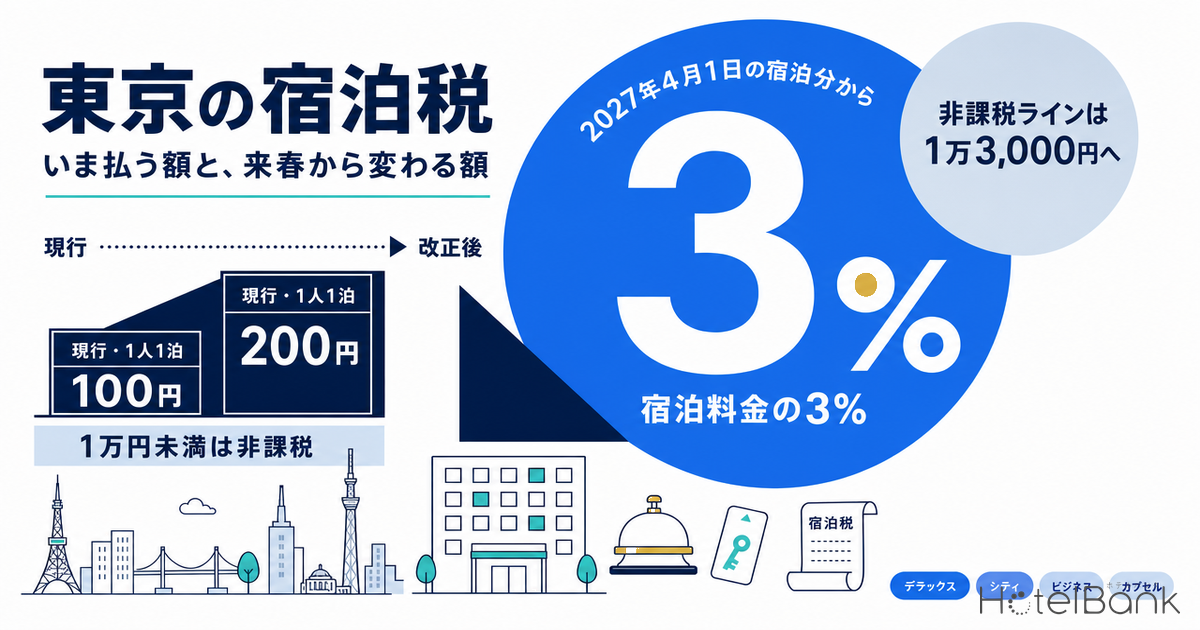
Tokyo’s accommodation tax is ¥100 when the accommodation charge per person per night is ¥10,000 to under ¥15,000, and ¥200 at ¥15,000 or more. Stays under ¥10,000 are not taxed. The “accommodation charge” used for this test is the room-only rate excluding consumption tax and meals, so it differs slightly from the tax-inclusive price you see on booking sites. Converted to a tax-inclusive price for two guests sharing one room, the rough guide is no tax below ¥22,000 per room, and ¥200 per person at ¥33,000 or more.
The other thing to know is the upcoming change: for stays on or after April 1, 2027, the tax becomes “3% of the accommodation charge” (stays under ¥13,000 are exempt). The Tokyo Metropolitan Government obtained the consent of the Minister for Internal Affairs and Communications on June 30, 2026, so the effective date is fixed (Tokyo Metropolitan Government press release). This article applies both the amount guests pay now and the amount guests will pay from next spring onward to actual hotel prices.
- — Tokyo’s current accommodation tax is ¥100 when the accommodation charge per person per night is ¥10,000 to under ¥15,000, and ¥200 at ¥15,000 or more. Stays under ¥10,000 are not taxed (Tokyo Metropolitan Government Bureau of Taxation).
- — For stays from April 1, 2027, the tax changes to “3% of the accommodation charge”, with stays under ¥13,000 exempt. The effective date was fixed when the Minister for Internal Affairs and Communications gave consent on June 30, 2026, and the switchover is determined by the stay date, not the booking date.
- — The test uses the room-only rate excluding consumption tax and meals. For a tax-inclusive price with two guests in one room, the guide is no tax under ¥22,000 and ¥200 per person at ¥33,000 or more.
- — Based on listed prices for October 2026 stays, business hotels (N=959) average about ¥9,600 per person before tax, right on the line between tax-free and ¥100. City hotels (N=117) and deluxe hotels (N=55) fall in the ¥200 bracket.
- — Under the revised system, our estimate is about ¥790 per person per night at city hotels and about ¥1,500 at deluxe hotels. Because the tax is sometimes settled separately at the front desk, check whether your booking confirmation lists an “accommodation tax” line.
How much is Tokyo’s accommodation tax? — ¥100 or ¥200 now, 3% from April 2027
The tax is set by the “accommodation charge per person per night.” Placing the current and revised systems listed on the Bureau of Taxation’s accommodation tax page side by side gives the following.
| Current (stays through March 31, 2027) | Revised (stays from April 1, 2027) | |
|---|---|---|
| Tax amount | ¥10,000 to under ¥15,000: ¥100 ¥15,000 or more: ¥200 |
3% of the accommodation charge |
| Not taxed | Under ¥10,000 per person per night | Under ¥13,000 per person per night |
| Covered properties | Hotels and ryokan in Tokyo | Hotels, ryokan, simple lodgings (kan’i shukusho) and private lodging (minpaku) in Tokyo |
| Basis of the amount | Accommodation charge per person per night (excluding consumption tax and meals) | Same |
Source: Tokyo Metropolitan Government Bureau of Taxation, “Accommodation Tax”, same, “Revision of the Accommodation Tax” (accessed October 3, 2026). All amounts are per person per night, before tax.
The switchover is based on the date you stay, not the date you book. The Bureau of Taxation’s Q&A explains that, regardless of when the booking was made, a stay dated April 1, 2027 or later is calculated at the revised 3%. For consecutive nights spanning the fiscal year, nights up to March 31 fall under the current system and nights from April 1 under the revised one.
The revised calculation method has also been published: amounts under ¥100 in the per-person, per-night accommodation charge are rounded down before multiplying by 3%. In the Bureau’s example, ¥13,550 per person per night (before tax) becomes ¥13,500 × 3% = ¥405 (Bureau of Taxation FAQ).
What counts as the “accommodation charge” — consumption tax and meals are excluded
The ¥10,000 and ¥15,000 lines are drawn on the “accommodation charge,” not the total you pay. The Bureau of Taxation’s page for guests defines the accommodation charge as the room-only rate plus any service charge applied to it.
| Included in the accommodation charge | Not included in the accommodation charge |
|---|---|
| Room-only rate (room charge) | Taxes such as consumption tax, local consumption tax and bathing tax |
| Service charge on the room-only rate | Meals such as breakfast and dinner, food and drink |
| Charges billed uniformly with the stay, such as bedding, bathing and cleaning fees | Parking, minibar drinks, laundry, telephone, etc. |
Source: Tokyo Metropolitan Government Bureau of Taxation, “To Our Guests”, same, FAQ (accessed October 3, 2026).
This gives three practical ways to read prices when booking.
- Divide tax-inclusive prices by 1.1. Booking screens show tax-inclusive prices, so at properties without a separate service charge, ¥11,000 tax-inclusive equals an “accommodation charge of ¥10,000,” and ¥16,500 tax-inclusive equals ¥15,000.
- Breakfast plans are assessed on the rate minus meals. For the same room, adding breakfast does not change the tax bracket compared with room-only.
- When two or more people share a room, divide by the number of guests. The Bureau’s Q&A says that when two or more people stay in a twin room or similar, the test uses the per-person accommodation charge. If you stay alone, the room rate is your per-person rate.
Discounts are also covered: when the property itself reduces the price, such as a member discount, the test uses the discounted rate. At hot-spring properties, a separate bathing tax (nyuto-zei) is charged in addition to the accommodation tax; its standard rate is ¥150 per person per night.
Tax brackets by hotel type (listed prices for October 2026)
Let us apply this to actual prices. For properties in Tokyo, we averaged OTA listed prices for October 2026 stays (one room, two guests, tax-inclusive) by hotel type, divided by two to get a per-person figure, and then divided by 1.1 to remove consumption tax.
| Type (Tokyo) | Properties | Listed price, 1 room / 2 guests (tax incl.) | Per person (tax incl.) | Before tax | Current tax (per person per night) | Estimate from April 2027 |
|---|---|---|---|---|---|---|
| Deluxe hotels | N=55 | ¥110,134 | approx. ¥55,100 | approx. ¥50,100 | ¥200 | approx. ¥1,500 |
| City hotels | N=117 | ¥57,870 | approx. ¥28,900 | approx. ¥26,300 | ¥200 | approx. ¥790 |
| Business hotels | N=959 | ¥21,058 | approx. ¥10,500 | approx. ¥9,600 | On the line between tax-free and ¥100 | Tax-free range (under ¥13,000) |
| Capsule hotels | N=33 | ¥15,433 | approx. ¥7,700 | approx. ¥7,000 | Tax-free range (under ¥10,000) | Tax-free range (under ¥13,000) |
Compiled by the HotelBank Editorial Team. OTA listed prices (October 2026 stays, aggregated as of October 3, 2026), averaged per room for two guests, tax-inclusive. Per-person figures are approximations obtained by halving the listed price; pre-tax figures divide by 1.1 on the assumption that no separate service charge applies. Estimates from April 2027 round the pre-tax figure down to the nearest ¥100 and multiply by 3%. Actual tax is determined by property, date and plan.
Three points stand out.
Business hotels sit right on the line. The average is about ¥10,500 per person tax-inclusive, or about ¥9,600 excluding consumption tax. That is just below the ¥10,000 line, so even at the same hotel the tax tends to vary by date: ¥100 on days when rates rise, nothing on quieter days. Checking whether the booking screen shows more than ¥22,000 tax-inclusive for two guests in one room gives a good indication. For solo business trips, the guide is ¥100 when the tax-inclusive room rate is ¥11,000 or more and ¥200 at ¥16,500 or more. For ways to cope when business-trip lodging costs no longer fit company allowances, see Business Trip Budgets Fall Short: ¥15,959 Hotels and 5 Fixes.
City hotels and deluxe hotels fall in the ¥200 bracket. Before tax, they come to around ¥26,000 and ¥50,000 per person respectively, well above the ¥15,000 line. Under the current system the tax is capped at ¥200 per person per night no matter how high the rate, so two guests staying two nights pay no more than ¥800 in total.
From April 2027, the effect depends on the price band. Because the tax-free line rises from ¥10,000 to ¥13,000, stays of ¥10,000 to under ¥13,000 that are now charged ¥100 become tax-free. On the other hand, our estimates put city hotels at about ¥790 per person and deluxe hotels at about ¥1,500, an amount proportional to the rate. Anyone booking a trip for next spring or later should budget separately depending on whether the stay falls on or after April 1. Since the business-hotel average sits below ¥13,000 per person while city and deluxe hotels sit well above it, the new line mainly lightens the load at the budget end and adds to it at the upper end of the market.
Capsule hotels fall in the tax-free range on price alone, and in any case the current system only covers stays at facilities licensed for hotel or ryokan operation. Simple lodgings and private lodging (minpaku) will be added from April 1, 2027, and even then no tax applies below ¥13,000 per person per night.
If you want to see the business-hotel price range at specific properties, an article comparing five business hotels near Kinshicho and Ryogoku stations with indicative prices for two guests per night (in Japanese) is a useful reference. It includes properties from around ¥18,000 per night for two guests, making it easy to compare against the “¥22,000 for one room, two guests” line above.
Quick reference by tax-inclusive price — one room, two guests
So that you can estimate the tax from the amount on your booking screen, the table below lists the current and revised accommodation tax for each tax-inclusive room rate for two guests sharing one room. The per-person pre-tax rate is the room rate divided by two and then by 1.1.
| Room rate, 2 guests (tax incl.) | Per person (before tax) | Current, per person per night | From April 2027, per person per night | Current, 2 guests 1 night total | From April 2027, 2 guests 1 night total |
|---|---|---|---|---|---|
| ¥20,000 | ¥9,091 | Tax-free | Tax-free | Tax-free | Tax-free |
| ¥22,000 | ¥10,000 | ¥100 | Tax-free | ¥200 | Tax-free |
| ¥28,600 | ¥13,000 | ¥100 | ¥390 | ¥200 | ¥780 |
| ¥33,000 | ¥15,000 | ¥200 | ¥450 | ¥400 | ¥900 |
| ¥44,000 | ¥20,000 | ¥200 | ¥600 | ¥400 | ¥1,200 |
| ¥66,000 | ¥30,000 | ¥200 | ¥900 | ¥400 | ¥1,800 |
| ¥110,000 | ¥50,000 | ¥200 | ¥1,500 | ¥400 | ¥3,000 |
Estimate by the HotelBank Editorial Team. Tax rates, tax-free lines and the rule of rounding down amounts under ¥100 follow the Tokyo Metropolitan Government Bureau of Taxation’s published information. Breakfast plans are assessed on the rate excluding meals, and properties that charge a separate service fee are assessed on the rate including it, so please confirm the actual tax with the property.
The band that stands out is ¥22,000 to under ¥28,600 tax-inclusive. In this range guests currently pay ¥100 per person, but the stay becomes tax-free after the revision. Conversely, at ¥28,600 (¥13,000 per person before tax) or more, the revised system costs more: a ¥44,000 tax-inclusive room goes from ¥400 to ¥1,200 for two guests per night.
How to pay — settled at the front desk, sometimes separately from the booking price
The accommodation tax is collected through “special collection,” in which the property collects it from guests and pays it to the Tokyo Metropolitan Government. Guests do not need to file anything themselves; they pay it at the hotel or ryokan front desk, using the method each property specifies (Bureau of Taxation, To Our Guests).
- It is not necessarily included in the booking price. The Bureau notes that the tax “may be payable separately from the travel fee.” Even if you have prepaid, some properties collect only the accommodation tax on site at check-in or check-out. Checking whether your booking confirmation email lists an “accommodation tax” line saves surprises on the day.
- The receipt shows “accommodation tax” and the amount. The Tokyo Metropolitan Government asks properties to display the name and amount of the tax on receipts and similar documents. The English label is “Accommodation Tax.” For business-trip expense claims, it can be processed as a line separate from the room charge.
- Groups are also assessed per person per night. Whether one representative pays for everyone or payments are split, whether tax applies and how much is determined by dividing one night’s room charge by the number of guests.
The tax revenue goes to tourism promotion. According to the Bureau of Taxation, the fiscal 2026 initial budget allocates it to projects totaling ¥8.1 billion, including improving the visitor-receiving environment and developing tourism resources.
Three things to check before booking
- Is your stay on or before March 31, 2027, or on or after April 1? The former is ¥100 or ¥200; the latter is 3% of the accommodation charge.
- What is the pre-tax, room-only rate per person? Divide the tax-inclusive room rate by the number of guests and by 1.1, and exclude breakfast. The lines are ¥10,000 and ¥15,000 now, and ¥13,000 after the revision.
- Is the accommodation tax included in your booking breakdown? If not, expect to settle it on site and allow a few hundred yen per person per night.
For more detail
For how the tax applies to children and for comparisons of specific properties, these articles (in Japanese) go into more detail.
Explains, using Hakone Town, Beppu City and Kyoto City, the difference that bathing tax exempts children under 12 while accommodation tax has no age cutoff. Using Hakone Yumoto Onsen Yoshiike Ryokan with its two-room Japanese-style suites for 5–10 guests, Beppu Onsen Hotel Shiragiku, and RIHGA Royal Hotel Kyoto with family rooms for up to six, it shows how to read the bill when a family of four shares one room.
Compares five properties — Tobu Hotel Levant Tokyo (383 rooms, 3 minutes from Kinshicho Station north exit), THE GATE HOTEL Ryogoku by HULIC on the Sumida River, Sotetsu Fresa Inn Tokyo-Kinshicho and Keisei Richmond Hotel Tokyo Kinshicho with coin laundries, and Dai-ichi Hotel Ryogoku directly connected to an Oedo Line exit — by room count, walking time from the station, facilities and indicative price for two guests per night.
Frequently Asked Questions
Q. Do children have to pay the accommodation tax?
It depends on the room rate, not on age. The Bureau of Taxation states that “even children are subject to the accommodation tax if the accommodation charge per person per night is at or above the threshold,” so if the rate falls below the threshold, neither children nor adults pay. When a family shares one room, the room rate is divided by the number of guests, so the larger the party, the more likely each person falls into a lower bracket.
Q. Are school trips taxed?
Tokyo’s accommodation tax does not apply when the accommodation charge per person per night is below the threshold (currently ¥10,000; ¥13,000 from April 2027), and the Bureau of Taxation’s guest page and Q&A both say the test is based on price. A school trip therefore incurs no tax as long as the room-only equivalent per person per night is below the threshold. For specific cases, it is safest to confirm with the property or a metropolitan tax office.
Q. Does the tax change with a breakfast plan or a multi-night stay?
Meals are not part of the accommodation charge, so even with breakfast included the test uses the room-only portion of the rate. For multi-night stays, each night is assessed separately and the tax is charged for every night. Under the current system, two guests staying three nights at a property that charges ¥200 per person per night pay ¥200 × 2 guests × 3 nights = ¥1,200.
Q. How does it differ from the Osaka and Kyoto accommodation taxes?
The brackets and the tax-free threshold differ by municipality. Since September 1, 2025, Osaka Prefecture exempts stays under ¥5,000 per person per night and charges ¥200 for ¥5,000 to under ¥15,000, ¥400 for ¥15,000 to under ¥20,000, and ¥500 for ¥20,000 and above (Osaka Prefecture). Since March 1, 2026, Kyoto City charges ¥200 under ¥6,000, ¥400 for ¥6,000 to under ¥20,000, ¥1,000 for ¥20,000 to under ¥50,000, ¥4,000 for ¥50,000 to under ¥100,000, and ¥10,000 for ¥100,000 and above, and exempts participants and chaperones on school-organized trips (Kyoto City). If you are touring Tokyo, Osaka and Kyoto, you need to recalculate for each city you stay in. Rates for municipalities nationwide are compiled in Japan Lodging Tax 2026: All 62 Municipalities.
Q. What if I have already booked a stay for April 2027 or later?
Regardless of when you booked or paid, if the stay date is April 1, 2027 or later, the tax is calculated at the revised 3%. Stays below ¥13,000 per person per night are exempt; above that, the tax is 3% of the accommodation charge after amounts under ¥100 are rounded down.
Q. When traveling alone, at what price does the accommodation tax start?
At properties that do not charge a separate service fee, the rough guide is ¥100 when the tax-inclusive room rate is ¥11,000 or more, and ¥200 at ¥16,500 or more. For stays from April 1, 2027, 3% of the accommodation charge applies at ¥14,300 tax-inclusive (¥13,000 before tax) or more. With a breakfast plan, the test uses the rate excluding meals.
Q. Is the accommodation tax included in what I paid on the booking site?
Not always. The Bureau of Taxation notes that the tax “may be payable separately from the travel fee,” and some properties collect only the accommodation tax on site at check-in or check-out even if the stay was prepaid. It is worth checking whether your booking confirmation email lists an “accommodation tax” line. The tax you pay is shown by name and amount on the receipt.
Methodology and Sources
■ Data sources
Details of the system are based on materials published by the Tokyo Metropolitan Government Bureau of Taxation and the Tokyo Metropolitan Government; other municipalities are based on materials published by Osaka Prefecture and Kyoto City (all accessed October 3, 2026). Prices are type-level averages of OTA listed prices for properties in Tokyo compiled by the HotelBank Editorial Team (October 2026 stays, as of October 3, 2026, one room for two guests, per room, tax-inclusive): deluxe hotels N=55, city hotels N=117, business hotels N=959, capsule hotels N=33.
■ Estimation assumptions
Per-person figures divide the listed price for one room and two guests by two; pre-tax figures divide by 1.1. We assume no separate service charge and room-only stays (no meals). Tax from April 2027 rounds the per-person, per-night pre-tax rate down to the nearest ¥100 and multiplies by 3% (following the calculation example in the Bureau’s Q&A). Room rates in the quick-reference table were chosen at the points where the per-person pre-tax rate hits ¥10,000, ¥13,000 and ¥15,000, plus price bands around them.
■ Limitations
Listed prices are not amounts actually paid and vary with the time of collection and the stay date. Type averages are pulled toward the price bands with the most properties, and tax brackets differ within a type by property, date and plan. Plans with meals and properties that charge separate service fees will differ from the actual accommodation charge, so the brackets are only a guide; please confirm the actual tax with the property where you stay.
■ References
- System details: Tokyo Metropolitan Government Bureau of Taxation, “Accommodation Tax”, same, “To Our Guests”, same, “Revision of the Accommodation Tax”, same, FAQ, Tokyo Metropolitan Government press release, “Consent of the Minister for Internal Affairs and Communications and Effective Date for the Accommodation Tax” (all accessed October 3, 2026).
- Other municipalities: published figures from Osaka Prefecture, “The Accommodation Tax System Is Changing” and Kyoto City, “About the Accommodation Tax”.
- Prices: compiled by the HotelBank Editorial Team. OTA listed prices for properties in Tokyo (October 2026 stays, aggregated as of October 3, 2026). Averages per room for two guests, tax-inclusive: deluxe hotels N=55, city hotels N=117, business hotels N=959, capsule hotels N=33.
- Per-person amounts are approximations obtained by halving the listed price, and pre-tax amounts are approximations obtained by dividing by 1.1; they will differ from the actual accommodation charge at properties with separate service fees or for plans with meals. Tax brackets are only a guide; please confirm the actual tax with the property where you stay.
Related Articles